Surgical site infections (SSIs) cause prolonged hospital stays, increased mortality, and excessive healthcare costs. Reference GlobalSurg1 Adherence to guideline-recommended complex SSI prevention bundles in the clinical setting remains challenging. Reference Tanner, Kiernan and Hilliam2 Identifying surgeons’ motivational factors for adherence can help design effective implementation strategies for SSI prevention.
The Theoretical Domains Framework (TDF), synthesizing multiple behavior change theories, was developed for research on the clinical implementation of evidence-based guidelines. Reference Atkins, Francis and Islam3 TDF constructs can be organized under 3 main domains that influence behavior as previously described by Michie et al Reference Michie, Johnston and Abraham4 in the COM-B TDF: capability, opportunity, and motivation (Supplementary Fig. 1 online). In this study, we pilot-tested the application of the COM-B TDF to the study of SSI prevention.
Mental models, that is, people’s world views, shaped by individual experiences, intuitions, and perceptions, influence how people reflexively respond to changes in clinical practice and workflows in a healthcare organization. Reference Sax and Clack5 Surgeons’ adherence to recommended SSI prevention bundles is likely affected by their mental models of SSI, particularly in their view of infection preventable versus inevitable, as previously described by Suresh and Edwards. Reference Suresh and Edwards6
In our study, we aimed (1) to define surgeons’ mental models of SSI and (2) to identify determinants of adherence to complex SSI prevention bundles, using the COM-B TDF.
Methods
Study design
We conducted this qualitative descriptive study based on semistructured interviews with surgeons, combining directed content analysis (deductive) based on COM-B TDF domains and constructs with conventional content analysis (inductive) to allow for the emergence of new themes. Reference Eimear7 The study qualified for minimal risk category 2 exemption from ongoing institutional review board.
Setting, timing, and recruitment
The study took place at a 592-bed US tertiary-care hospital during February–June 2019. At the time of the study, a 13-element SSI prevention bundle had been implemented for 3 years. Participants were recruited via mass e-mail to all surgeons employed by the hospital.
Interview guide and procedures
We conducted in-person or phone interviews for 30–60 minutes using a semistructured interview guide (Supplementary Material 1 online) created through the multidisciplinary expert consensus of our research team and a review of the relevant literature.
Data collection and analysis
We recorded, transcribed, deidentified, and uploaded all interviews into a Web-based qualitative data analysis software (Dedoose version 4.2; http://www.dedoose.com/) to facilitate data organization, coding and retrieval. We coded responses and categorized main themes based on a priori constructs and domains from the COM-B TDF applied to SSI prevention (Supplementery Material 2 online), which allowed the creation of additional codes based on new themes that could emerge during analysis. Discrepancies in coding were resolved via researcher triangulation Reference Tanner, Kiernan and Hilliam2,Reference Atkins, Francis and Islam3 with senior author Safdar. Lastly, we synthesized the main themes by their relevance to an inevitable versus preventable mental SSI model, as defined a priori.
Results
Of 80 eligible surgeons, we interviewed 10 attending surgeons (2 women, 8 men) with an average of 14.2 years (range, 5–33 years) in practice after finishing highest level of training, from 8 different surgical departments, who agreed to participate in the study.
SSI mental models
SSI mental models with representative quotes are shown in Table 1. The view that SSIs are inevitable included the following perceptions: (1) Some patients’ preoperative SSI risk is extremely high and/or unmodifiable. (2) SSIs occur despite perfect compliance with the SSI prevention bundle. And (3) some SSI have unidentified causes, and are, therefore, impossible to prevent. The view that SSIs are preventable included the following perceptions: (1) The SSI prevention bundle is an effective evidence-based intervention. (2) It is generally desireable to continuously improve practice and to aim for SSI elimination in elective surgery. And (3) a zero-infection rate is theoretically possible.
Mental Models Related to Surgical Site Infection Prevention Among Surgeons Interviewed

Factors influencing adherence to SSI prevention recommendations
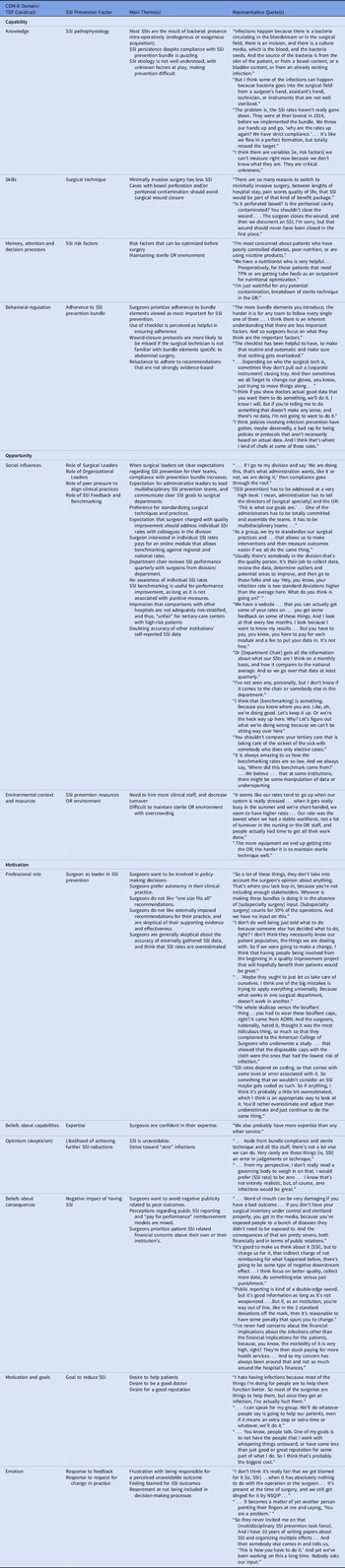
Analyzed using COM-B TDF, factors influencing adherence to SSI prevention recommendations are presented in Table 2. Selected themes are highlighted below (N = number of surgeons expressing the cited views).
Common Themes of Surgical Site Infection (SSI) Prevention According to Qualitative Analysis of Interviews With Attending Surgeons

Perception of SSI causes and risk factors
Several causes and risk factors emerged among the responses. (1) Intraoperative endogenous or exogenous bacteria, present within the surgical cavity with devitalized tissue or bleeding, favor bacterial multiplication (N = 1 surgeon’s response). (2) Patient-related factors such as smoking, diabetes, obesity, malnourishment, are risk factors for SSI (N = 3). (3) Poor wound care after hospital discharge contributes to SSI risk (N = 2). (4) Organization-related risk factors include multiple tasks added to an already high-stress operating-room (OR) environment (N = 2). (5) Frequent clinician turnover and inadequate OR staffing impair SSI prevention workflows (N = 1). (6) Maintaining sterility is difficult in an overcrowded OR (N = 1). And (7) unknown factors are present but are poorly understood because SSIs persist despite perceived compliance with the prevention bundle (N = 2).
Perception of complex SSI prevention bundles
The following bundle elements were perceived to have high adherence: hand hygiene, appropriate scrub technique, correct choice and dose of preoperative antibiotics, and chlorhexidine-alcohol skin prep (N = 5). Several bundle elements were perceived to have lower adherence: glove changes and separate instrument trays before surgical wound closure, missed due to time constraints or lack of reminders (N = 3); maintaining intraoperative normothermia in orthopedic surgery, due to the physical discomfort of operating in a hot OR environment, and lack of conviction regarding effectiveness. (N = 1).
Factors promoting adherence with SSI prevention bundles
Several factors were perceived to promote SSI bundle adherence: (1) provision of strong evidence-based data before adopting a new SSI prevention measure into clinical practice (N = 6); (2) surgical leaders (department or division chairs) and organizational high-rank administrators setting clear expectations for SSI prevention (N = 5); and (3) standardizing clinical practices with use of OR checklists (N = 5). Concern for patient well-being and intrinsic desire to be a good doctor were universally cited as more important motivators than financial enticements (N = 10).
Perceptions of audit and feedback
Benchmarking against regional or national SSI rates was considered helpful only if it was not associated with punitive measures (N = 10). Five surgeons felt that current benchmarking does not adequately risk stratify between hospitals, and they suspected that hospitals performing more emergency or technically complex surgeries are “unfairly penalized.” One surgeon doubted the accuracy of institutions’ self-reported SSI rates. Three surgeons expressed frustration at being held responsible or “blamed” for unavoidable outcomes (ie, infections already present at the time of surgery). All surgeons preferred to receive SSI performance feedback from their department chairs or designated surgical colleagues, rather than directly from the infection control department.
Surgeons’ role in SSI prevention
Surgeons expressed deep preference for autonomy in clinical practice and a strong desire to be directly involved in policy design (N = 3). They expressed occasional resentment at not being included in high-level decision making despite having specific expertise with SSI prevention (N =1). Some also expressed some skepticism toward externally imposed recommendations, which they perceived as lacking sufficient scientific evidence of effectiveness (N =3).
Discussion
SSI persistence remains a stark reality in clinical practice. 8 Our findings support the development of implementation strategies within the “Four Es” (ie, engage, educate, execute, and evaluate) implementation framework Reference Pronovost, Berenholtz and Needham9 recommended to translate evidence-based guidelines into clinical practice. Reference Ariyo, Zayed and Riese10 Specifically, strategies that engage surgeons to champion the multidisciplinary SSI prevention efforts, appeal to their intrinsic motivating factors, promote interventions perceived to be strongly evidence based, and deliver performance feedback through surgical administrative leaders are favored by surgeons and may be more likely to increase their adherence in the clinical setting.
This study has several limitations. The pilot nature of our single-institution study with small sample size limits the generalizability of our findings, and this study should be followed by qualitative studies with greater participation from surgeons and other surgical clinicians, both senior and in training.
Future research should evaluate (1) how prevention strategies tailored to surgeons’ mental models influence adherence, (2) whether increased adherence translates into significant SSI reductions, and (3) whether this success promotes a “SSI as preventable rather than inevitable” viewpoint.
Supplementary material
To view supplementary material for this article, please visit https://doi.org/10.1017/ice.2021.161
Acknowledgments
This study was supported by the Department of Medicine, University of Wisconsin School of Medicine and Public Health, Madison, Wisconsin.
Conflicts of Interest
All authors declare they have no conflicts of interest relevant to this study.