INTRODUCTION
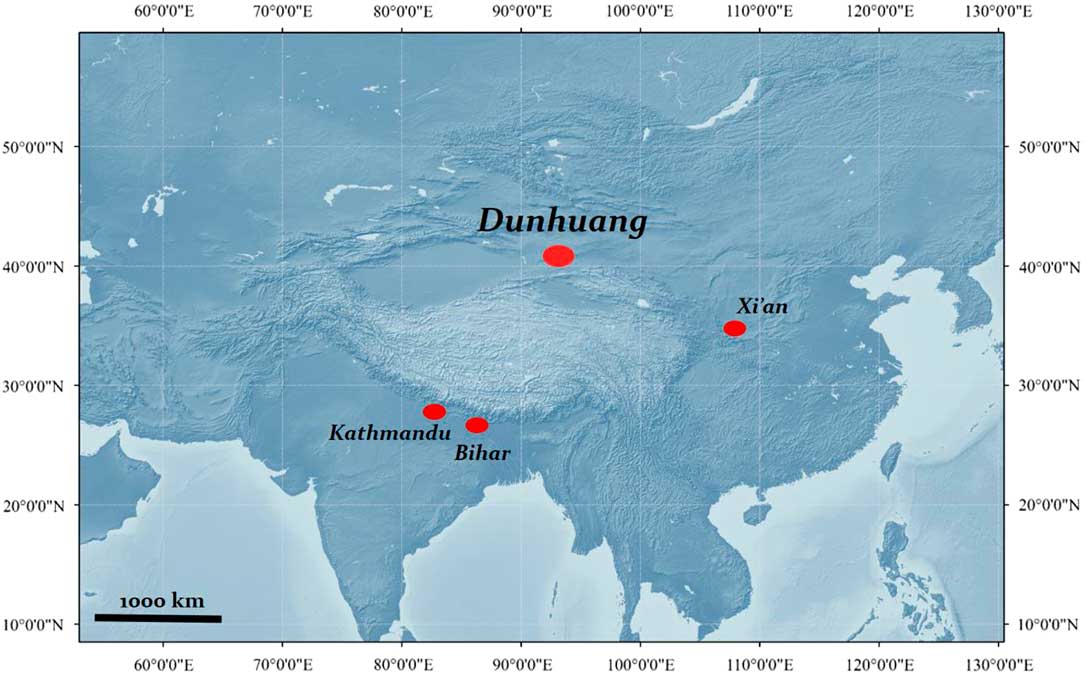
The complex of the Dunhuang Mogao Grottoes is widely known as one of the largest and best-preserved ancient Buddhist sites in the world. These caves, dating from various dynasties, were built in the Mingsha mountains, approximately 25 km northeast of the modern Dunhuang city in Gansu province, northwestern China. Today, the Dunhuang complex comprises a total of 715 caves, 2145 statues, and approximately 45,000 m2 of wall paintings, and is therefore sometimes referred to as the “Thousand Buddha Grottoes.” Owing to the importance of the site for the history of art, the study of East–West connections, as well as the transition and transformation of Buddhism into China, Dunhuang was designated a UNESCO World Heritage Site in 1987 (Figure 1).
Locations of the Dunhuang Mogao Grottoes, Gansu Province, China.

Chronological Studies of the Dunhuang Caves
Around the time that the Han empire defeated Xiongnu, extending its reach into the Gansu corridor (133 BC–AD 89), Buddhism started to move into western China, having originated in India in the 6th century BC. Later periods, such as Northern Wei (AD 386–534), Sui (AD 581–618), and Tang (AD 618–907), witnessed an increasing effort and dedication channeled into Buddhism, which is perhaps best evidenced by the rapid development of the Dunhuang Mogao Grottoes (Nagahiro Reference Nagahiro2011).
A stele erected during the Tang dynasty (AD 618–907) by Li Huairang has been recovered from Cave 323 of the Dunhuang Mogao grottoes. It describes the beginning of the construction of the Dunhuang Mogao Grottoes in AD 366 (Dunhuang Academy 2000). The stele records a narrative that a monk named Yuezun had a vision of a thousand Buddhas bathed in golden light while he stopped at the Mingsha Mountains. Therefore, he made the decision to build a cave there for meditation and worship. Unfortunately, no more detailed information is provided about, for instance, whether or not the cave was a pre-existing natural feature prior to Yuezun’s arrival, or who were the craftsmen to dig or extend the cave and to draw the wall paintings.
While this stele, which was erected roughly 300 years later than the event it has recorded, may contain important indications of the beginnings of the Dunhuang Mogao Grottoes, the complete temporal framework of the various Buhhda caves, together with many associated details, has been subject to a long history of interdisciplinary debate, spanning archaeology, art history, Buddhism studies, transmitted texts, and radiocarbon (14C) dating (e.g., Yan Reference Yan1951, Reference Yan1980; Xie Reference Xie1955; Mizuno Reference Mizuno1958; Soper Reference Soper1958; Bussagli Reference Bussagli1963; Dunhuang Academy 1982; Fan et al. Reference Fan, Ma and Guan1982; Wang Reference Wang1983, Reference Wang1985; Jin Reference Jin1988; Su Reference Su1989; Zhao Reference Zhao1991; Guo et al. Reference Guo, Hiromi, Toshio, Chen, Ken, Bomin, Fan and Hiroshi2010). Inherent to many branches of archaeology, dating needs to take into account a range of considerations and types of information. In the case of the Dunhuang Caves, these include inscriptions (e.g., specific dates, names of specific person(s)/sponsors), typological comparisons (e.g., statues, wall paintings, structure of the grottoes), technological progress, and stratigraphic sequence (relative positions between different caves). Among them, probably the most straightforward and convincing evidence for chronology is inscriptions with specific dates. The earliest inscribed date in Dunhuang Mogao is attributed to Cave 285. On the north wall of the cave, two inscribed dates have been uncovered, namely “Datong [the dynasty of Western Wei] fourth year” (i.e. AD 538) and “Datong fifth year” (AD 539), implying at least that the wall paintings were completed around these two years and that the cave itself must originate even earlier.
In parallel, by being intrinsically associated with the development of Buddhism, it is also possible, for instance, to link the symbols, stories and styles of the Buddhas illustrated in the wall paintings to accounts in specific manuscripts and postulate the potential range of dates for the initial construction. This topic is so fundamental that its results or interpretations may exert vital influence on the scholarly interpretations on the direction and dynamics of the process of Buddhist development along the Silk Road into China. Investigation into the chronology of each cave at Dunhuang Mogao has never ceased and more focused studies have been published over the past 70 years (see references above).
Caves 268, 272, and 275
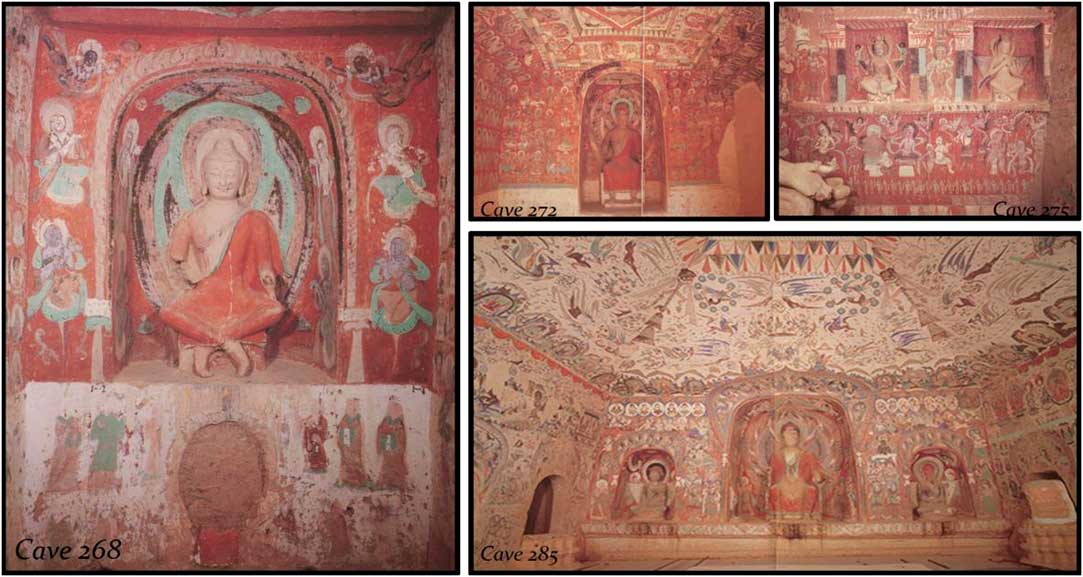
A particularly significant issue is the chronology of Caves 268, 272, and 275 of the Dunhuang Mogao complex. Details of these three caves are very well illustrated by Fan et al. (Reference Fan, Chang and Juliano2013, Figure 2). It has been commonly agreed that these are probably the earliest surviving caves of Dunhuang (Yan Reference Yan1980; Fan et al. Reference Fan, Ma and Guan1982; Su Reference Su1989; Zhao Reference Zhao1991; Dunhuang Academy 2000; Guo et al. Reference Guo, Hiromi, Toshio, Chen, Ken, Bomin, Fan and Hiroshi2010). Attempts to date them have been made since around the 1940s, initially by a renowned Chinese painter, Zhang Daqian, who once spent nearly three years at Dunhuang hand-copying 276 sections of mural paintings. He proposed that the styles of the wall paintings in Cave 275 appear broadly less mature than those in the other two caves, and therefore considered this to be the earliest, dated to early Northern Wei (AD 386–534). To him, Cave 268 appears to be dated to the later Sui dynasty (AD 581–618; National Palace Museum 1985).
Illustrations of the four caves of Dunhuang in this paper (wall paintings and statues of Buddha from the four caves of Dunhuang discussed herein).

Numerous different opinions have been expressed since those of Zhang Daqian, and it was not until the 1980s that some agreement, yet in a very broad sense, began to be reached. Scholars at Dunhuang Academy published a much more systematic and comprehensive chronological study of the caves, which they dated to the Northern dynasties (AD 386–581; Fan et al. Reference Fan, Ma and Guan1982). Like many typo-chronological studies, these scholars undertook a two-stage process. In the first stage, by comparing a considerable number of aspects (structure of the caves, the features of Buddha, the styles, elements and content of the wall paintings), all of the associated caves, which can be roughly dated to the Northern dynasties, are divided into four groups, with Caves 268, 272, and 275 assigned to the first group. The aim of the second stage is to find out the relative and absolute chronology for each of these four groups. A range of features present in the first group appears to be absent from the other groups. For instance, the statues of flying apsaras in these three caves are designed in U shapes and their performance seems rather stark and clumsy. Meanwhile, the first and second group of caves share a certain number of characteristics, such as the strong style of the Western regions presented through the clothes in the wall paintings and the drawing skills (Ao-tu hua, or receding-and-protruding painting; Fong Reference Fong1981). This connection between the first and second groups reveals a potential inheritance and indicates a relatively earlier date for the first group compared to the remaining three.
To assign absolute dates to these groups, a thorough comparison is required to sites elsewhere that have more secure chronologies (i.e. based upon inscriptions at these sites). Fan and her colleagues suggested that their first group at Dunhuang Mogao can be associated with those dated to the first phase of the Yungang Grottoes in modern Shanxi province (AD 460–465). Similar affinities can also be drawn with the stone inscription on the tower of Ma Dehui at Jiuquan (Northern Liang), Cave 169 at Bingling temple (AD 420) and pottery figures excavated at Asita in Turpan, Xinjiang (AD 455). The major caves of the first phase of Yungang were constructed by the distinguished monk named Tanyao, who initially traveled from the Gansu area. It is therefore likely that the construction of the caves of the first phase of Yungang had been influenced by those made earlier in Gansu. Moreover, Fan et al. emphasize that the governor of the Northern Liang controlling Gansu (AD 421–439) was a follower of Buddhism and sponsored several constructions of Buddhist-related caves and temples. It would therefore, they suggest, not be surprising for the earliest three caves at Dunhuang to have been augmented under his support (Fan et al. Reference Fan, Ma and Guan1982).
While the work of Fan et al. (Reference Fan, Ma and Guan1982) has exerted a considerable influence in this sphere, a different view has been articulated by Su (Reference Su1989). Su was rather doubtful about the evidence proposed by Fan and her colleagues that Caves 268, 272, and 275 are the earliest surviving at Dunhuang. Very few stylistic affinities, argued Su, can be observed between these three caves and those which are already confidently dated to as early as the Northern Liang elsewhere (e.g., Caves 1 and 2 of the Tianti Mountains; the stone towers distributed around Jiuquan, Dunhuang or Turpan; and the statues of Bingling Temple in Eastern Gansu). Instead, he chose to focus on the layout and upper structure of the cave, the design of the statues of Buddha and the arrangement of the wall paintings. After carefully listing all sorts of information and comparing them to the counterparts in the first as well as the second phase of Yungang (AD 471–494; see also Su Reference Su1987), Su concluded that the three caves of Dunhuang appear to be more consistent with the second phase of Yungang rather than the first (ca. AD 460; Su Reference Su1989). He further points out that it is more likely to have been Yungang that impacted upon Dunhuang, rather than vice versa, since Yungang is situated in the suburban areas of Pingcheng, the capital of the Northern Wei, which was undoubtedly the main political and cultural center during that time (i.e. assuming central to peripheral diffusion). Therefore, the construction of the three caves at Dunhuang can be no later than AD 484–494 (Su Reference Su1989).
A different approach to this question is exemplified by Zhao (Reference Zhao1991). This author proposed that the Buddhist stories in the wall paintings of Cave 272 were actually derived from the manuscripts named Xianyu Jing (贤愚经, Damamūka), which, according to the text Youlu (祐录), were created in AD 445 (see also Chen Reference Chen1964). Considering this, Zhao believes that Cave 272, along with Caves 268 and 275 which exhibit the same styles, was presumably made no earlier than AD 445.
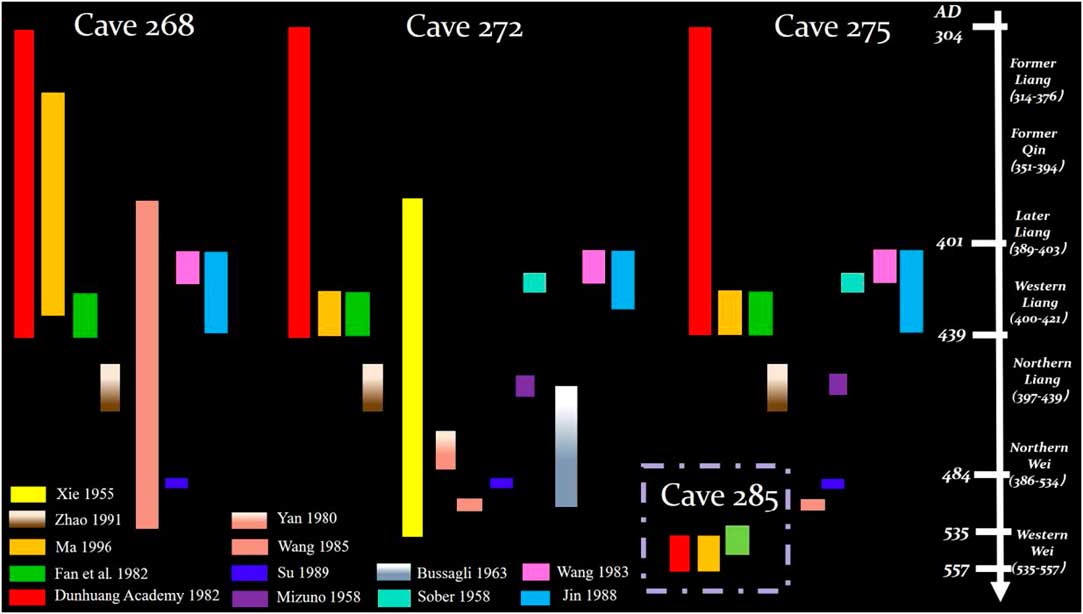
While the issue of chronology relating to these caves of Dunhuang Mogao has been debated for decades, it is not yet possible to reach a firm consensus. Figure 3 summarizes the chronological ranges of construction of Caves 268, 272, 275, and 285 ascribed by different groups of scholars based upon different pieces of evidence, involving typological analysis of wall paintings and statues, the illustrated Buddhist stories, manuscripts or stratigraphy. While the discrepancy proposed between these various scholars is readily apparent, a general consensus apparent from this figure might be that Cave 285 was highly likely to be the latest of them all. As mentioned above, in accordance with the two inscribed dates, Cave 285 should have been completed by around—or at least no later than—AD 538–539. Nevertheless, the disparities between the results of different investigations, particularly of the three early caves, raise serious obstacles to other related subjects and become inextricably entangled with models of the dispersal of Buddhism in China. As exemplified by the cases of Dunhuang and Yungang mentioned above, dating plays a defining role in our understanding of the past, and can dramatically alter our interpretation of various archaeological remains, transmitted texts and Buddhist manuscripts.
Summary of the existing date estimates for Caves 268, 272, 275, and 285. The length of the bar represents the possible period during which the targeted cave was constructed, and the colors illustrate different sources of information.

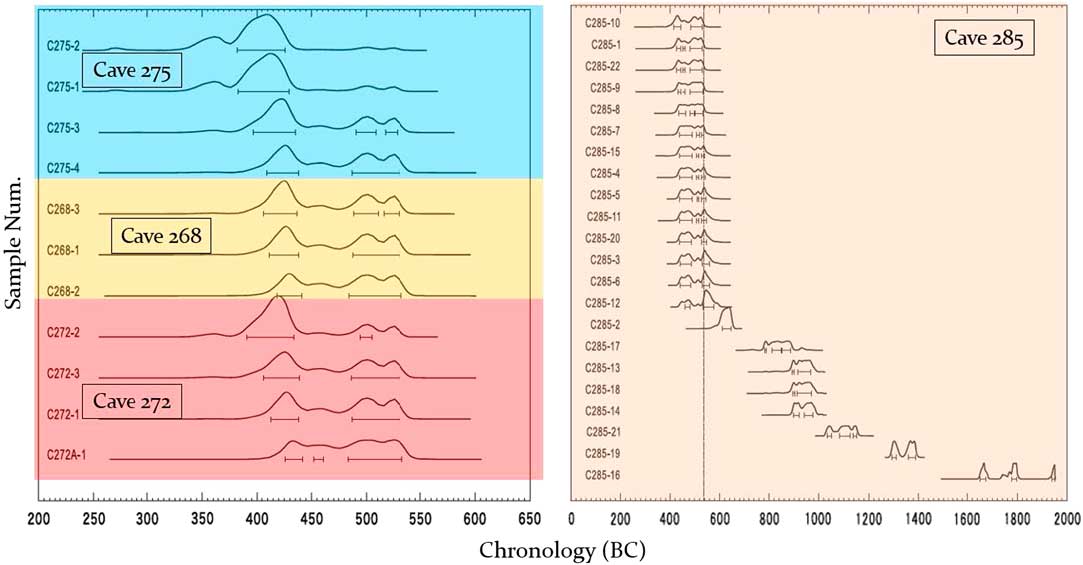
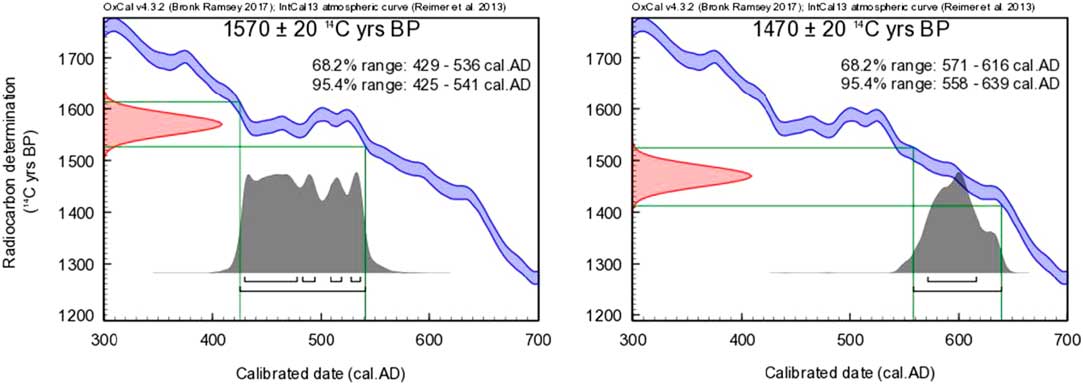
The application of 14C dating sheds some new light on this discussion. The short-lived plants used to make the basal layer for wall paintings and statues offer excellent materials to date their initial construction. To this end, Guo et al. (Reference Guo, Hiromi, Toshio, Chen, Ken, Bomin, Fan and Hiroshi2010) published 35 accelerator mass spectrometry (AMS) dates of straw, chaff, and fibers from the basal layer of wall paintings from Caves 268, 272, 275, and 285. These are all short-lived (perhaps even from a single growth year) materials and cannot be stored for years before making the wall paintings or statues, which allows us to circumvent the potentially problematic issue caused by the in-built age of some plant material, such as wood. However, despite the high-quality raw AMS data, a rather broad age range is produced through the process of calibration. This is the result of the plateau in the calibration curve during the period AD 400–550 (Figure 5). Through calibrating the dates and plotting them individually, Guo and his colleagues suggested that Caves 268, 272, and 275 were constructed between ca. AD 380 and AD 530 (Cave 268: AD 406–532; Cave 272: AD 391–533; and Cave 275: AD 382–531; Figure 4). In contrast, the results for Cave 285 can be grouped into several distinct stages. These groupings reveal the long and complicated construction history of Cave 285, such as repair or redecoration in later times. Similar observation can be seen in the case of Cave 275
Calibrated 14C ages (68.2%) presented by Guo et al. (Reference Guo, Hiromi, Toshio, Chen, Ken, Bomin, Fan and Hiroshi2010).

Equivalent-precision raw radiocarbon ages (±20 14C yr) (red) producing either: (1) an imprecise age (grey); or (2) a more tightly constrained age (grey) when coinciding with either: (1) a plateau; or (2) steeper (non-plateau) structure in the calibration curve (blue).

.
The paper by Guo and colleagues marked a new and critical attempt to resolve the chronology of the Dunhuang Grottoes. This study demonstrated how scientific dating techniques can contribute to the ongoing chronological debate. While the conclusion of Guo et al. (Reference Guo, Hiromi, Toshio, Chen, Ken, Bomin, Fan and Hiroshi2010) agrees with several important interpretations by art historians and archaeologists based on different information and methods, the fact that each of the calibrated dates extends over one hundred years (68.2% probability range) cannot be said to be entirely satisfactory. In addition, using a probability range of 68.2% (approximating 1σ uncertainty for normally distributed data) instead of 95.4% (~2σ) is not adequately rigorous. Furthermore, since the construction of the three caves occurred during a period during which the government of Dunhuang was rapidly changing (Former Liang, AD 320–376; Former Qin, AD 376–386; Later Liang, AD 386–403; Western Liang, AD 403–421; Northern Liang, AD 421–439), aligning an individual cave to a specific dynasty is therefore problematic. Increasing chronological precision is hugely important because the establishment of Buddhist caves is strongly indicative of important changes in social contexts and regional interactions, which is almost certainly linked to the inclinations of the ruling elites.
As noted above, one factor that causes the large age ranges is the shape of the calibration curve and the coincidence of this time period with a 14C plateau (Reimer et al. 2013). So merely increasing the density of 14C dates and taking a simple average will not be particularly fruitful. Instead, a Bayesian statistical approach provides a means to increase chronological precision, making use of additional prior information that can be incorporated into the modeling process (Buck et al. Reference Buck, Litton and Smith1992; Bronk Ramsey Reference Bronk Ramsey2009). Therefore, in this paper we not only present more 14C dates, but also, for the first time, apply a Bayesian statistical approach for the chronological study of the Dunhuang Grottoes.
RESEARCH OBJECTIVES
The objective of this paper is to apply a new perspective on the chronology of the Dunhuang Grottoes based on modeling of the published—as well as some new—14C dates combined with archaeological information within a Bayesian statistical framework, with emphasis on what are believed to be the earliest of the Grottoes, Caves 268, 272, and 275. We argue that a much higher chronological resolution can be achieved if we carefully combine all types of information (stylistic studies and inscribed dates) together into this Bayesian modeling framework.
METHODS AND RESULTS
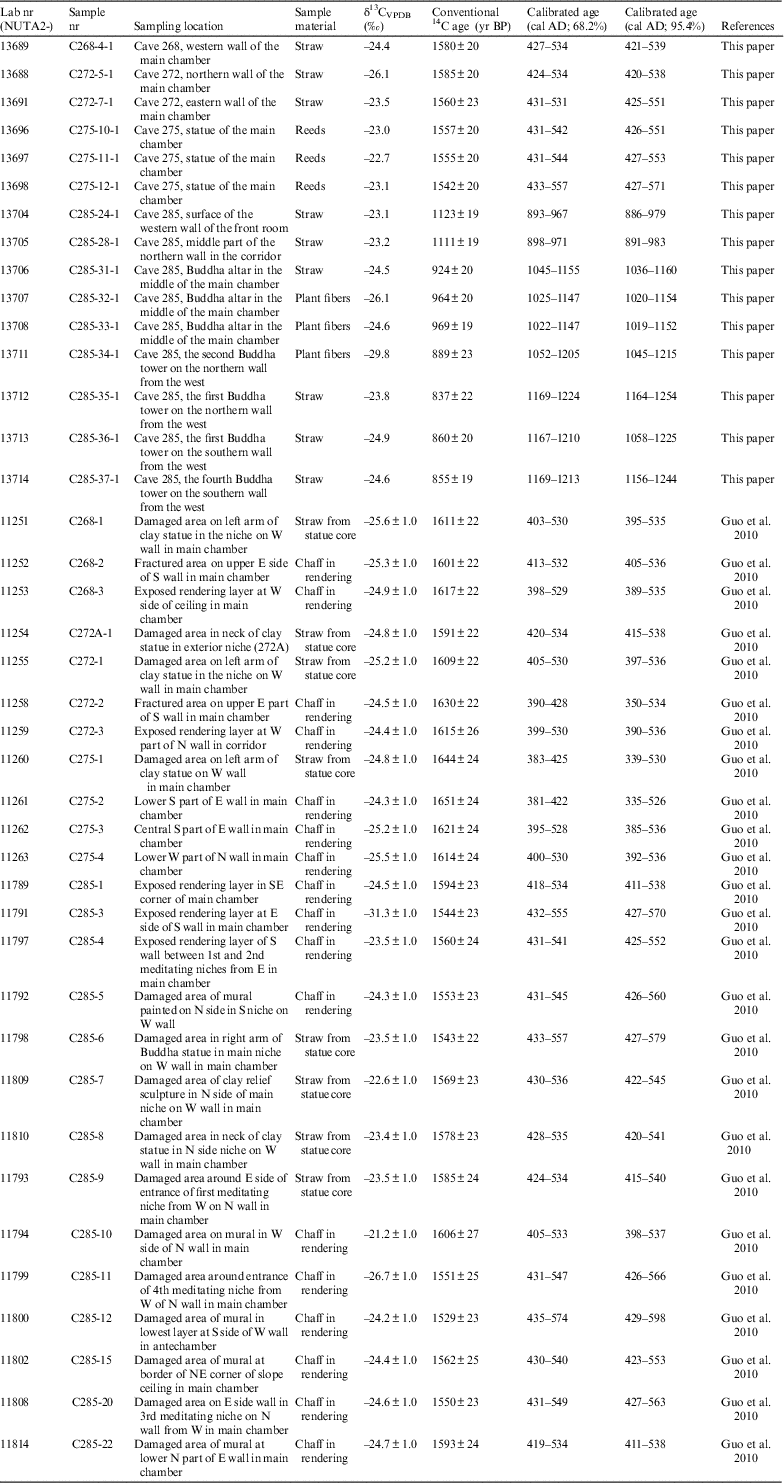
In addition to the 14C dates published by Guo et al. (Reference Guo, Hiromi, Toshio, Chen, Ken, Bomin, Fan and Hiroshi2010), this paper presents 15 new results based on the analyses of plant materials extracted from the early three caves, as well as Cave 285. These results were obtained through cooperation between Dunhuang Academy, Nagoya University and the National Research Institute for Cultural Properties in Japan. The details of these samples are listed in Table 1.
New radiocarbon results for the three putative early caves and Cave 285.

Sample pretreatment and AMS measurement were performed at Nagoya University. The analytical protocol was exactly the same as that used by Guo et al. (Reference Guo, Hiromi, Toshio, Chen, Ken, Bomin, Fan and Hiroshi2010). In summary: samples of plant materials (~100 mg) were first mechanically cleaned with distilled water in an ultrasonic bath. Next, samples were chemically pretreated as follows: (1) 1.2M HCl at 90ºC for 3 hr (repeated four times); (2) 0.12–1.2M NaOH solution, depending on the deterioration of the sample, three or four times for 2 hr at room temperature; (3) 1.2M HCl, repeated three or four times; (4) distilled water after each stage and for final rinsing (repeated until pH=7). After freezing and drying, around 6–7 mg of each prepared sample was combusted in the presence of granular CuO in evacuated, flame sealed glass for 8–10 hr at 850°C. The resultant CO2, having been purified through successive liquid nitrogen, ethanol, and liquid nitrogen and n-pentane traps, was reduced to graphite with Fe power as the catalyst at 650°C in a Vycor tube. Finally, the graphite samples were pressed into aluminium holders and for AMS analysis.
BAYESIAN CHRONOLOGICAL MODELING
The Bayesian chronological modeling presented herein was performed using the statistical software OxCal (v4.3.2; Bronk Ramsey Reference Bronk Ramsey1994, Reference Bronk Ramsey1995, Reference Bronk Ramsey1998, Reference Bronk Ramsey2001, Reference Bronk Ramsey2017) with the objective of narrowing the age range for likely construction of the three caves. The first assumption explicitly incorporated within the OxCal model is that the starting date of the construction of Cave 285 (modeled as a starting “Boundary” in OxCal) should post-date the completion of the three earliest caves (268, 272, and 275). This is consistent with all of the proposals published by art historians and archaeologists (Figure 3). The second assumption incorporates the prior information from the inscribed dates in Cave 285 (i.e. AD 538 and AD 539). These two specific dates suggest that the wall paintings were highly likely to have been finished around that time and, therefore, the construction is prescribed in the model to be no later than AD 538–539.
In order to operationalize these two prior assumptions, we represented the three earliest caves as individual sub-Phases within a broader collective “Phase,” which was constrained to lie earlier than the Phase for Cave 285. Meanwhile, a terminus ante quem (TAQ, AD 538–539) was applied after the Phase for Cave 285, in order to signify its completion date. Within the collective Phase, no assumption was made about the chronological relationship between the individual sub-Phases (for Caves 268, 272, and 275). The OxCal code for the model can be found in the online supplementary document.
Both before and after each model Phase and sub-Phase, we apply “Boundary” functions in OxCal to determine the start and end of each Phase. In this context, these Boundaries therefore provide the probability density functions (PDFs) reflecting the start and end of the complete construction process of each of the caves included within the model. Within each of the Phases, the 14C data were included using “R_Date” functions. Additionally, “Date” functions were included to provide summary statistics for the time ranges represented by each of the respective Phases (i.e. periods of cave construction).
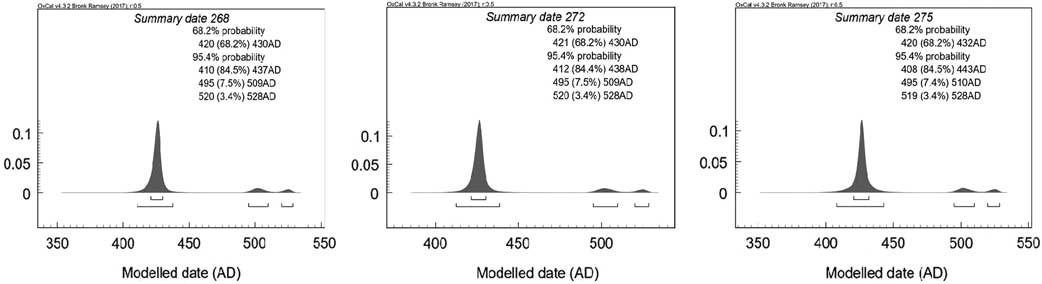
Figure 6 shows that, compared to the results of Guo et al. (Reference Guo, Hiromi, Toshio, Chen, Ken, Bomin, Fan and Hiroshi2010; Figure 4), the probability distributions for the construction of the earliest three caves have been significantly narrowed and shifted. With a very good level of confidence (ca. 84.5%), it is possible to date all of the caves to a period within around thirty to forty years. This resolution enables scholars to solve two specific issues. Firstly, it appears very likely (ca. 87% probability) that Caves 268, 272, and 275 of Dunhuang were built before the Yungang I and II stage (AD 460–465 and AD 471–494, respectively). Secondly, assigning these caves to one or two specific dynasties (namely Western Liang: AD 403–421; Northern Liang: AD 421–439) becomes feasible.
Summary Date functions representing the time range over which construction of each of the caves (268, 272, and 275) took place. Horizontal bars under each probability density function represent the 68.2% and 95.4% highest probability density ranges, respectively.

Using the “Order” function in OxCal (Table 2), we show that these three early caves were most likely constructed during the Northern Liang dynasty, rather than that of the Western Liang. As mentioned above, a few historical reasons can be highlighted in favor of this result. The royal family of the Northern Liang themselves were Buddhists, or followers of Buddhism, sponsored a variety of Buddhist temples and grottoes in different places (Fan et al. Reference Fan, Ma and Guan1982).
The probabilities that the three early caves (268, 272, and 275) were constructed during the Western Liang or Northern Liang dynasties.

In addition, it is possible to present the relative chronological sequence between the three caves in a quantitative manner. This issue has been highly debated among the previous studies of Dunhuang Mogao. For instance, Cave 268 has been suggested by some scholars as been constructed earlier than the others (Figure 3; Wang Reference Wang1985) considering that it is the smallest in size and thus the relatively easiest to dig. Different opinions can be found from Zhao (Reference Zhao1991), however, arguing that Cave 272 appears more likely to be earlier than Cave 268 or 275. Again applying the Order function in OxCal, we calculate the likelihood that one cave was constructed earlier or later than the others and, we find that the probability that any of the three caves was constructed earlier than either of the other two is close to 50%. This provides further support for the assertion above that each of the caves was constructed within a very short time of each other, if not contemporaneously, rather than sequentially.
CONCLUSIONS AND FUTURE WORKS
The chronology for the three early caves at Dunhuang has been sufficiently improved by incorporating 14C dates with archaeological information within a Bayesian statistical framework. There appears little doubt that none of these caves can be the earliest at Dunhuang Mogao, as indicated by the Tang dynasty inscription (AD 366). Rather, it is more likely that these three caves were constructed between AD 410 and AD 440, a period in which Dunhuang was controlled by the Western Liang and the later Northern Liang dynasties. This finding creates a more focused window through which scholars can correlate the construction of these early Buddhist caves to other forms of historical evidence, such as the spread of Buddhism. Given the fact that the rulers of the Northern Liang dynasty were devout followers of Buddhism, and that our chronological modeling suggests that the construction of the caves most likely falls into this reign time, we can now be more confident to suggest that the construction of these three caves was sponsored by the Northern Liang rulers. Moreover, from the perspective of 14C dating, the probability that these three caves were constructed at different times/sequentially during different periods appears very small. This is consistent with a number of results from previous scholarship, but here we are able to show this probability in a quantitative way.
The chronology of the dispersal of Buddhism into China via the Silk Road is an enormously interesting but highly debated subject. As with the introduction of bronze technology in the first and second millennia BC, China must have experienced a series of crucial transitions and transformations after Buddhism was introduced. One of the fundamental limitations in these studies is that sometimes the chronology of various Buddhist remains, such as the wall paintings, statues, temples, caves and manuscripts, is not sufficiently resolved. As demonstrated by this paper, combining 14C dates and archaeological observations through Bayesian statistical modeling may help to improve this situation, or at least test the existing chronological frameworks in a quantifiable way. This can certainly make vital contributions to our understanding of the process through which Buddhism moved into China and was subsequently transferred and transformed into different regions.
ACKNOWLEDGMENTS
Richard A. Staff is supported by an Early Career Fellowship from the Leverhulme Trust (grant: ECF-2015-396). Michael Dee is principal investigator on the European Research Council ECHOES (ERC Action No. 714679). Prof. A. Mark Pollard is also principal investigator on the European Research Council Project FLAME (1300505). Both Prof. Dame Jessica Rawson and Ruiliang Liu are part of FLAME. We are also very grateful to Prof. A. J. Timothy Jull and two anonymous reviewers for their helpful suggestions in revising an earlier version of the manuscript. It is with great sadness that we announce the passing of Prof Su Bai on 1st February 2018 at the age of 96. Prof Su Bai was one of the founders of Chinese archaeology and has made significant contribution to various areas, particularly the archaeology of Buddhism in China. With our deepest respect we remember this truly outstanding scholar. We send our sincere condolences to his family and friends.
Supplementary material
To view supplementary material for this article, please visit https://doi.org/10.1017/RDC.2018.4