

Introduction
Distinction between gaits performed by different gaited horse breeds is typically left to the gaited horse breed association and the guidelines for gait performance outlined in the breed association handbooks, but these guidelines are often subjective and unclear to the novice gaited horse owner so that gait analysis becomes necessary to more objectively and clearly define the gaits. Discrimination between the gaits performed by various gaited horse breeds using gait analysis was first attempted by HildebrandReference Hildebrand1 using measurements of lateral advanced placement and hind limb stance duration to graphically depict the stepping gaits performed by the Tennessee Walking Horse (TWH), Missouri Fox Trotter (MFT) and Paso horse breeds. These stepping gaits were found to produce a gait continuum requiring additional temporal measurements to clearly and more completely distinguish between these gaits. Further gaited horse research was performed on 16 stepping gaits performed by various gaited horse breeds by measuring stride, stance and swing durations; advanced placements and lift-offs; and limb support phases, and from this research, conclusions were drawn that timing of lateral and diagonal limb placements and the type and duration of limb support were useful for differentaiting between the measured gaitsReference Nicodemus and Clayton2. The same temporal variable measurements were further applied to differentiate between the stepping gaits performed by a singular gaited horse breed on finding that the collected walk, classic fino, paso corto and paso largo performed by the Paso Fino horse breed were influenced by the collection of the gait creating variations in both the timing of limb placements and limb support between the Paso gaits, and thus, individualising each of these gaitsReference Nicodemus and Clayton3. These findings of the Paso Fino horse breed were similar to those reported for the non-gaited dressage horse performing the collected, medium, working and extended walksReference Clayton4. Similar to the dressage horse, the Paso Fino was found to perform gaits that did not follow breed guidelines, suggesting that gait analysis gave a more objective description of what the horse actually performs in the show arena.
While all gaited horse breeds perform variations of the walk as determined by HildebrandReference Hildebrand1, it is the characteristic style of limb movements quantified using temporal, linear and angular kinematics that assists in characterising each of these unique gaits. The MFT, a popular American gaited horse breed, is identified for its performance of the flat walk and the fox trot. The fox trot was first described by HildebrandReference Hildebrand1 as a fast, lateral sequence (left hind limb ground contact followed by left forelimb, right hind limb and right forelimb), diagonal couplets walk in that the gait is performed with a slight disassociation of the diagonal limbs at ground contact, like that of a broken trot. Later research found that, along with the diagonal rhythm, the fox trot was performed with alternating periods of tripedal (three limbs on the ground supporting the body) and bipedal (two limbs, either the lateral or diagonal, on the ground supporting the body) limb support, in which the majority of the stride was spent in diagonal bipedal limb supportReference Clayton and Bradbury5. Movement of the fox trotting limbs was portrayed as if the forelimbs were walking while the hind limbs were trotting. Nevertheless, velocity, limb displacements and joint angular motion of both the forelimbs and hind limbs were not measured in these earlier studiesReference Hildebrand1, Reference Nicodemus and Clayton2, Reference Clayton and Bradbury5. As for the flat walk, gait analysis has assisted in defining the gait, but this research was done using the TWH, another American gaited horse breed, performing the gait. Nicodemus and HoltReference Nicodemus and Holt6 defined the TWH flat walk as a faster variation of the walk, in that the flat walk had footfall and limb support sequences similar to the non-gaited walk, along with demonstrating similar two-dimensional joint motion patterns for the elbow, carpus, hip and stifle. However, unlike the walk, the flat walk had an irregular rhythm with lateral couplets, as ground contact of the lateral limbs occurred more closely together in the stride cycle than that of the diagonal limbs. Furthermore, the flat walk demonstrated more gradual and less distinctive shoulder, tarsal and forelimb fetlock extension peaks. While both the TWH and MFT perform a flat walk, kinematic studies on non-gaited horses have found breed type as being an influence on gait kinematicsReference Cano, Vivo, Miro, Morales and Galisteo7–Reference Galisteo, Morales, Cano, Miro, Arguera and Vivo9, and thus, limiting the application of the research findings for the TWH flat walk for the flat walk performed by other gaited horse breeds.
Although previous gaited horse research has assisted in defining and distinguishing between the stepping gaits of the gaited horse using temporal variable measurements, additional research using linear and angular kinematics of the gaited horse like that of the TWH flat walk is lacking. Identification of the normal locomotion of the gaited horse is of particular importance to those gaited horse owners showing their horses at breed-sanctioned competitions. In 1970, the Horse Protection Act initiated a horse inspection programme in the United States that is regulated by the United States Department of Agriculture (USDA)10. Horses competing at a breed-sanctioned show can be inspected by a government representative called a designated qualified personnel (DQP) for any type of ‘soring’ inflicted upon any aspect of the horse's limbs. Soring is a practice mainly found in the gaited horse industry as a way to cause more animation in the show gaits, using painful devices and chemicals applied to the distal aspects of the horses' limbs. The DQP is required to detect any sign of lameness in which training manuals for the DQP provided by USDA do not give a complete definition of normal gait locomotion of the gaited horse or give lameness indicators specific to the gaited horse breed. This lack of objective information provided by both the breed associations and USDA concerning gaited horse locomotion has created difficulties not only in the judging of horses in the show arena, but also, more importantly, during the inspections performed by the DQP. Therefore, the objective of this study was to measure forelimb joint motions of the flat walk and fox trot of the MFT to provide an objective description of the gaits and to assist in distinguishing between them.
Materials and methods
Subjects
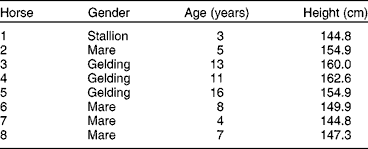
The subjects were eight horses (Table 1). The criteria for inclusion in the study were that the horse was sound, a registered MFT and naturally able to perform the flat walk and the fox trot gaits according to breed standards11. Soundness of gait was determined by a veterinarian specialising in gaited horse breeds. Upon veterinary inspection, none of the horses were determined to be ‘sored’ according to USDA (United States Department of Agriculture) regulations10. All horses had been shown and placed at breed-recognised shows in which none of the horses had been cited for any soring violation by a DQP or a veterinary medical officer during their show careers. Horses were ridden by an experienced gaited horse trainer during data collection. Trials were excluded from the study if the horses were determined not to be performing the gait properly according to the gait standards, as determined by a gaited horse judge recognised by the breed association11.
Description of horses

The flat walk, also termed the ‘flat foot walk’, is described by judging standards as a regular, four-beat gait with a lateral sequence of footfalls (left hind–left fore–right hind–right fore). The flat walk is faster than a walk, with springy, elastic strides and an elevated head and tail. The strides of the flat-walking horse should have scope and reach from both the forelimbs and hind limbs while ‘overstriding the front track’. The fox trot is described as a four-beat stepping gait with a lateral sequence of limb placements (left hind–left fore–right hind–right fore) and an irregular rhythm with diagonal couplets. A horse performing this gait according to judging standards gives the appearance of walking with the forelimbs and trotting with the hind limbs, in that the forelimbs have long, sweeping strides with minimal flexion of the carpal joint, as the hind limbs demonstrate more lifting of the limbs with accentuated hock flexion with each stride. The head of the fox trotting horse should nod in rhythm with the gait.
Marker placement
Circular, lateral reflective markers, 3.5 cm in diameter, were attached to the skin overlying well-defined bony landmarks on the proximal and distal ends along the long axis of the spina scapulae, humerus, antebrachium, metacarpus and proximal phalanx as described by Back et al. Reference Back, van den Bogert, van Weeren, Bruin and Barneveld12. Two reflective markers were placed on the distal aspect of lateral hoof at both the toe and heel so that ground contact and lift-off could be tracked. A reflective marker was placed on the right side of the zygomatic process of the temporal bone, and another marker was placed along the sixth thoracic spinal process, approximately along the withersReference Nicodemus and Booker13 in which this marker was used to determine height for the horse while the horse was filmed standing at the start of data collection. Vertical head excursions were determined from the marker on the zygomatic process of the temporal bone as described by Nicodemus and BookerReference Nicodemus and Booker13.
Forelimb protraction/retraction in the sagittal plane was determined using methodology described by Back et al. Reference Back, Schamhardt and Barneveld14. Protraction/retraction angles were determined from a vertical line drawn perpendicular to the ground and a line drawn from the marker on the proximal aspect of the spina scapulae to the marker on the heel of the lateral side of the hoof. Protraction (cranial rotation of the distal end of the limb segment) was assigned a positive value, and retraction (caudal rotation of the distal end of the limb segment) was assigned a negative value.
Data collection
The calibration volume (measurements: longitudinal direction 342 cm; transverse direction 190 cm; vertical direction 210 cm) was defined using 30 points. Kinematic data of the flat walk and fox trot were recorded using two 60 Hz camcorders (Panasonic AG-450; Matsushita Electric Corporation, Secausus, NJ, USA) placed on the lateral aspect of the right side of the horse and oriented at 60° to each other. A 500 W lamp was placed behind each camcorder to illuminate the retroreflective markers during recording.
The horses were ridden along the long side of an arena at a flat walk and fox trot. The arena footing was a compact surface of both sand and clay to promote proper gait production for the gaited horse and clear visualisation of hoof contact and lift-off. A successful pass in front of the cameras was one where the horse travelled along a straight line that was aligned with the calibrated longitudinal axis with all the tracking markers being clearly visible in the two lateral camcorder views. In addition, gaits needed to follow breed standards as determined by a gaited horse judge11. Ten strides were selected to be analysed for each horse at each gait.
Data reduction
The frames of hoof contact, heel off and toe off were recorded for each limb and were used to calculate temporal variables. Temporal variables that were measured include stride duration (period of time occupied by a complete stride), stance phase (period of time the hoof is on the ground), stride frequency (rate of recurrence of the strides), lateral advanced placement (period of time elapsed between successive footfalls of the two lateral limbs) and diagonal advanced placement (period of time elapsed between successive footfalls of the two diagonal limbs).
The reflective markers on each horse were automatically tracked and digitised using a video analysis system (Ariel Performance Analysis System; Ariel Dynamics, Inc., Trabuco Canyon, CA, USA). Coordinates of markers were obtained using direct linear transformation adapted for two-dimensional dataReference Abdel-Azis and Karara15. Joint angles were measured on the anatomical flexor side of each joint. Flexion was assigned a negative value, and extension a positive value. The angular measurements were time normalised to stride duration.
Data analysis
Mean values ± SD were determined for the temporal variables; vertical head excursions; protraction/retraction angles; and peak flexion/extension joint angles and timing of peak angles for the shoulder, elbow, carpus and forelimb fetlock for both gaits. Student's paired t-tests were used to determine differences for temporal variables, vertical head excursions, protraction/retraction angles, peak joint angular measurements and timing of peak joint angles between the flat walk and fox trot (P < 0.05). Microsoft Excel was used for all statistical analysis.
Results
Flat walk
The flat walking velocity of 1.75 ± 0.06 m s− 1 was achieved using a stride length of 1.95 ± 0.05 m, stride frequency of 0.09 ± 0.04 strides s− 1 and stride duration of 1.17 ± 0.06 s. The gait was performed with an even rhythm of limb placements (lateral advanced placement: 0.30 ± 0.01 s, diagonal advanced placement: 0.32 ± 0.03 s). The forelimb stance phase occupied the period from 0 to 57% of the stride, with breakover starting at 50% of the stride. The forelimbs demonstrated a maximum protraction angle of 22 ± 4° and a maximum retraction angle of − 35 ± 4°. The vertical head excursion was 0.15 ± 0.05 m, with the highest displacement occurring with forelimb impact.
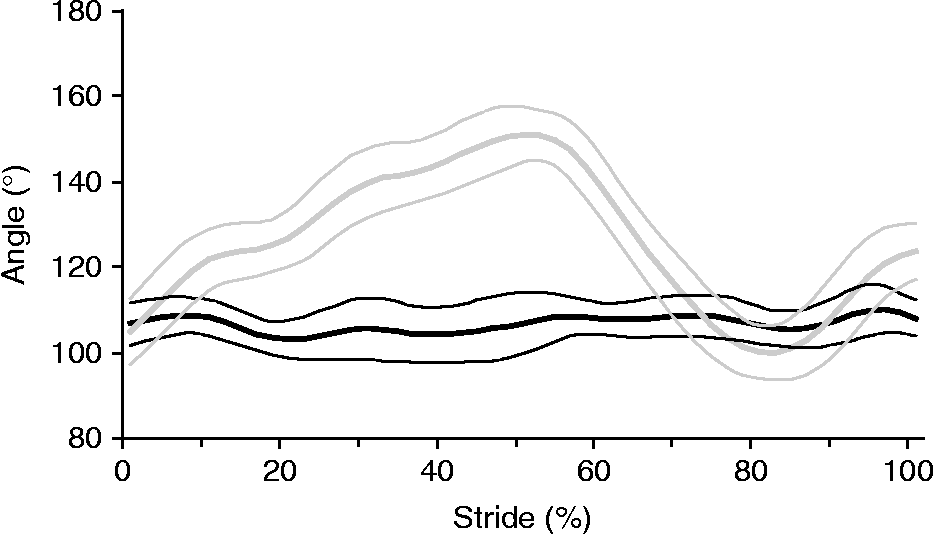
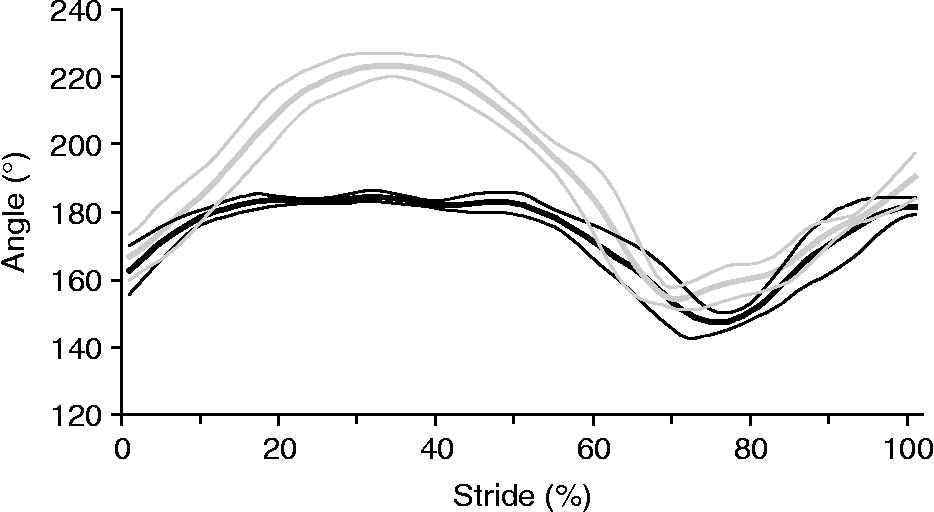
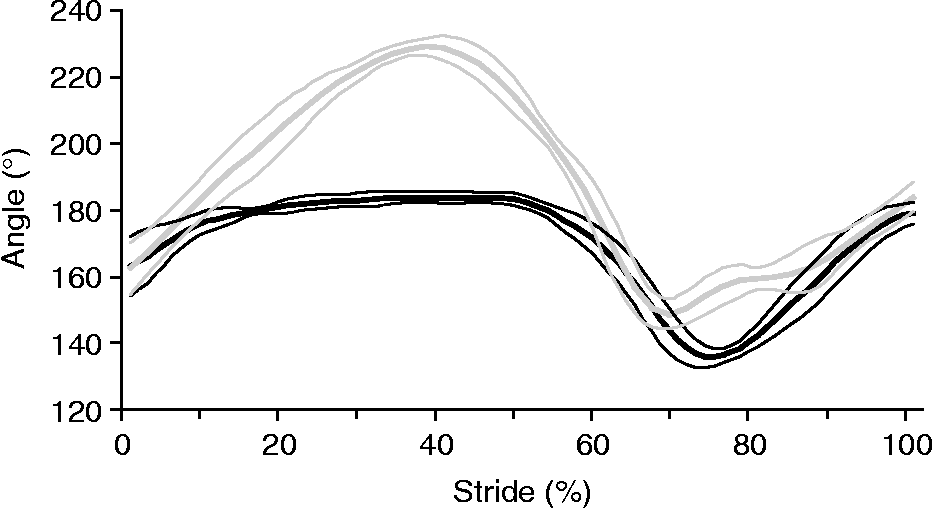
Early in the stance phase (20 ± 3% of stride), the shoulder reached peak flexion (103 ± 4°; Fig. 1), followed by peak extension of the carpus (185 ± 2°) occurring at 32 ± 1% of stride and peak extension of the fetlock (224 ± 4°) at 34 ± 1% of stride (Fig. 2). Towards the end of the stance phase (50 ± 6% of stride), the elbow reached peak extension (151 ± 6°; Fig. 1). During the swing phase at 70 ± 4% of stride, peak flexion of the fetlock (155 ± 4°) occurred followed by peak flexion of the carpus (147 ± 4°) at 73 ± 7% of stride (Fig. 2). Towards the end of the swing phase (82 ± 5% of stride), the elbow joint demonstrated peak flexion (99 ± 7°) with the shoulder joint producing a small extension peak (110 ± 5°) at the end of the stride (96 ± 5% of stride; Fig. 1).
Mean (thick lines) ± SD (thin lines) joint motion for the shoulder (black lines) and elbow (grey lines) joints during the flat walk of the MFT

Mean (thick lines) ± SD (thin lines) joint motion for the carpal (black lines) and forelimb fetlock (grey lines) joints during the flat walk of the MFT

Fox trot
The fox trot was performed at a faster velocity (3.17 ± 0.03 m s− 1) than the flat walk and was achieved using a shorter stride duration (0.63 ± 0.03 s) and greater stride frequency (1.59 ± 0.09 strides s− 1; P < 0.05). Stride length (fox trot: 2.0 ± 0.03 m) was similar between the MFT gaits. The fox-trotting forelimb stance phase occupied the period from 0 to 51% of the stride, with breakover starting at 46% of the stride. An irregularity of rhythm with diagonal couplets was achieved in the fox trot using a shorter diagonal advanced placement (0.10 ± 0.01 s) compared with the flat walk (P < 0.05), while the lateral advanced placement (0.23 ± 0.02 s) remained comparable to the flat walk. The forelimbs demonstrated a maximum protraction angle (28 ± 3°) and a maximum retraction angle ( − 36 ± 2°) that was similar to the flat walk. Although vertical head excursions were not significantly different between the MFT gaits (fox trot: 0.12 ± 0.05 m) and head displacement patterns were similar, the slight decrease in vertical head excursion at the fox trot from the flat walk may indicate a trend towards decreasing vertical displacements.
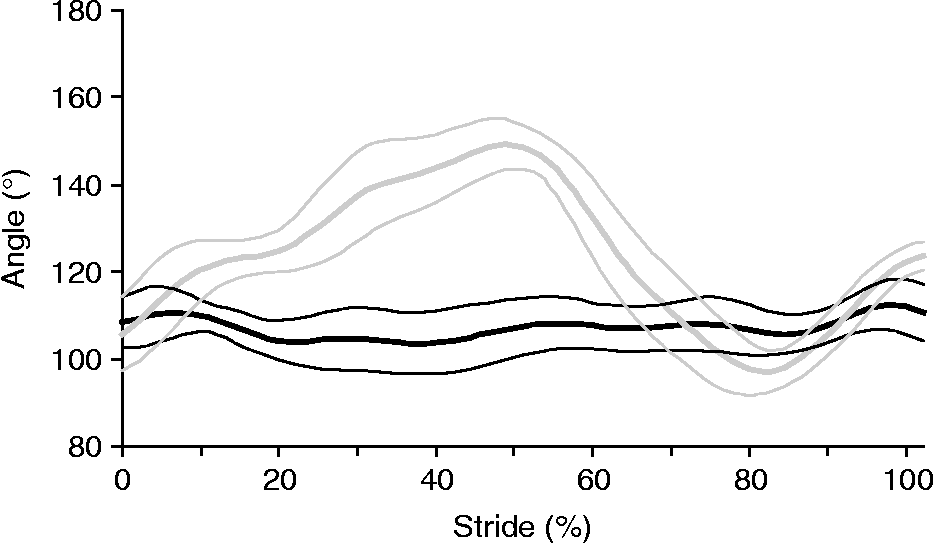
Although peak flexion of the shoulder (104 ± 7°) occurred later in the stance phase (38 ± 5% of stride, P < 0.05) compared with the flat walk, flexion angles were similar between the two MFT gaits (Fig. 3). Peak extension of the fox-trotting fetlock (229 ± 3°, 38 ± 3% of stride) and the carpus (184 ± 2°, 38 ± 1% of stride) occurred in conjunction with shoulder peak flexion and demonstrated extension angles comparable to the flat walk (Fig. 4). Peak extension angles for the elbow (fox trot: 149 ± 6°) were similar between the two MFT gaits and occurred around the same point in the stride (49 ± 4% of stride; Fig. 3). Similar to the flat walk, the fox-trotting fetlock demonstrated peak flexion (149 ± 5°) at 69 ± 4% of stride, and while peak flexion of the carpus occurred at similar points in the stride for both MFT gaits (fox trot: 76 ± 5% of stride), the fox-trotting carpus produced more flexion (136 ± 3°) than the flat walk (P < 0.05; Fig. 4). Similar to the flat walk, the fox-trotting swing phase ended (82 ± 6% of stride) with peak flexion of the elbow (97 ± 5°) followed by peak extension of the shoulder (113 ± 6°) at 96 ± 6% of stride (Fig. 3).
Mean (thick lines) ± SD (thin lines) joint motion for the shoulder (black lines) and elbow (grey lines) joints during the fox trot of the MFT

Mean (thick lines) ± SD (thin lines) joint motion for the carpal (black lines) and forelimb fetlock (grey lines) joints during the fox trot of the MFT

Discussion
Gait analysis has assisted in defining gaits unique to the gaited horseReference Hildebrand1–Reference Nicodemus and Clayton3, Reference Clayton and Bradbury5, Reference Nicodemus and Holt6. These studies were able to identify the ‘normal’ parameters for the temporal variables of the measured gaits of the gaited horse and determine variables that were unique to each gait. The measurement of temporal variables in this study further assisted in differentiating between the four-beat stepping gaits of the MFT, in that velocity, stride duration and frequency, and diagonal advanced placement were different between gaits. The stride length was similar for both gaits, which indicates that the MFT does not use stride length as a primary mechanism for increasing speed as the horse transitions from the flat walk to fox trot. This is in contrast to non-gaited dressage horses moving from a collected to extended walk in which stride length makes an important contribution to changes in speedReference Clayton4, but is similar to non-gaited pleasure horses that increase walking speed without significant contribution from stride lengthReference Nicodemus, Lanovaz, Clayton and Lidner16.
As for the influence of velocity on gaited horse breeds, previous research of the four-beat stepping toelt performed by the Icelandic horse associated increasing velocity (2.62–4.62 m s− 1) of the toelt with increases in both stride frequency and lengthReference Nicodemus17. While stride length did not increase as the MFT transitioned from the flat walk to the fox trot, comparable to the Icelandic horse, stride frequency was found to increase with increasing velocity in the MFT. Unlike the rhythm of the MFT which became irregular at the faster fox trot, the rhythm of the stepping toelt remained regular. Irregularity of the rhythm in the toelt was not introduced to the gait until a suspension phase was added to the stride cycle creating a fast (4.7 ± 0.53 m s− 1) four-beat leaping gaitReference Zips, Peham, Scheidl, Licka and Girtler18. The rhythm irregularity of this leaping toelt was associated with lateral couplets instead of the diagonal couplets that were found in the fox trot. Similar to the Icelandic horse, the TWH performing the running walk became irregular in the rhythm with lateral couplets as velocity of the gait increased, but in contrast to the Icelandic horse, the running walk, like that of the MFT, remained a stepping gait at faster velocities (3.8 ± 0.18 m s− 1)Reference Nicodemus, Holt and Swartz19. Differences described above in the stride parameters associated with gait production of faster velocities in the four-beat stepping gaits performed by these gaited horse breeds may be linked to the mechanical approaches the horses use in producing the gait, in which, depending on the approach, the gait would be classified as either a walk or runReference Biknevicius, Mullineaux and Clayton20. Although the toelt was found to be a four-beat stepping gait similar to the walk, Biknevicius et al. Reference Biknevicius, Mullineaux and Clayton20 concluded, that although the toelt was found to be a four-beat stepping gait similar to the walk, the toelt functions more as a running gait using spring-mass or bouncing mechanics, and thus depends on elastic energy storage for gait production unlike the pendulum-like mechanisms utilised in the non-gaited walk. While research is unavailable at this time to make conclusions concerning the mechanical approaches of gait production for other gaited horse breeds, further studies in gait mechanics may find differences in these mechanical approaches that will assist in distinguishing between these gaits and in explaining further how these gaits are performed.
Irregularity of the fox-trotting rhythm is associated with diagonal couplets in which diagonal couplets have been reported for the Paso Fino gaitsReference Nicodemus and Clayton3. As the Paso Fino transitioned from the slower, more collected classic fino to the faster, more extended paso corto, the rhythm became irregular as evident by the coupling of the diagonal limbs. Other stepping gaits reported to have an irregular rhythm with diagonal couplets, as was found in the fox trot, include the marcha batidaReference Nicodemus and Clayton2, Marsh Tacky trotReference Nicodemus and Beranger21 and jogReference Nicodemus and Booker13. All of these gaits were performed with a period of quadrupedal support, and although limb support phases were not measured in this study, previous research of the fox trot did not find any period of quadrupedal supportReference Nicodemus and Clayton2, Reference Clayton and Bradbury5.
While temporal variable measurements are available for many of the gaited horse gaits, kinematic analysis measuring joint motion of the gaited horse is limited, and the application of previous kinematic research of other stepping gaits on breeds that have not been studied may be hindered by the influence of breed type on kinematic variablesReference Cano, Vivo, Miro, Morales and Galisteo7–Reference Galisteo, Morales, Cano, Miro, Arguera and Vivo9. This conclusion is further supported when comparing research findings for the TWH flat walk and those for of the MFT flat walk, as Nicodemus and HoltReference Nicodemus and Holt6 reported that the flat walk of the TWH had an irregular rhythm with lateral couplets unlike the MFT. In addition, the flat walk of the MFT was performed with a slightly faster velocity (TWH: 1.66 ± 0.21 m s− 1) and longer stride duration (TWH: 1.06 ± 0.33 s) and stride length (TWH: 1.76 ± 0.49 m).
Although the TWH and MFT are known for their distinctive head nod while performing their stepping gaits, vertical head excursions were not comparable between the flat walksReference Nicodemus and Holt6, 11. Nevertheless, vertical head excursions were similar between the flat walk of the TWH (0.11 ± 0.02 m) and the fox trot of the MFT. At the walk, Khumsap et al. Reference Khumsap, Clayton, Lanovaz and Bouchey22 found that an increase in vertical head excursions was associated with increasing velocity at the walk, in which a trend towards the opposite was noted for the MFT as vertical head excursions demonstrated a slight decrease as the MFT transitioned from the flat walk to the fox trot. Similar to the MFT, the non-gaited horse at the trot was found to decrease vertical head excursions with increasing velocity at the trot (3.5–6.0 m s− 1)Reference Robert, Valette, Pourcelot, Audigie and Denoix23. Vertical head excursions for the TWH at faster stepping gaits are unavailable, so that conclusions cannot be made at this time as to whether the TWH or any other gaited breeds demonstrate decreased vertical head excursions at faster velocities similar to the fox trot and the trotReference Nicodemus and Holt6, Reference Robert, Valette, Pourcelot, Audigie and Denoix23.
Joint motion patterns, joint range of motion and peak angles for the shoulder and elbow were similar between the flat walks of the MFT and the TWHReference Nicodemus and Holt6; and although timing of the carpal flexion peaks was similar between breeds, the carpus of the TWH flat walk (132 ± 6°) flexed more than that of the MFT flat walk, with flexion peaks of the TWH resembling angles of that of the fox-trotting carpal angle. A double peak of fetlock extension during stance was present in the TWH flat walk (222 ± 9°, 221 ± 9°), but this double peak was not found in either the flat walk or fox trot of the MFT. The MFT at both gaits flexed more at the fetlocks than the TWH (175 ± 7°), although timing of peak flexion was similar between the breeds. Differences between the flat walks of the MFT and TWH indicate that breed differences may influence the manner and style on how the gait is performed, and thus influence the joint motion as was found for non-gaited horses at the walkReference Galisteo, Morales, Cano, Miro, Arguera and Vivo9 and trotReference Cano, Vivo, Miro, Morales and Galisteo7, Reference Galisteo, Vivo, Cano, Morales, Miro and Arguera8.
Gaits of the gaited horse are often generalised as ‘faster variations of the walk’ because these gaits, like the walk, are symmetrical, four-beat stepping gaits with a lateral footfall sequence, and yet are performed as was found for the flat walk and fox trot at faster velocities than the walk of non-gaited horses (1.39 ± 0.07 m s− 1)Reference Khumsap, Clayton, Lanovaz and Bouchey22. While differences are seen in velocity of gait, both the flat walk and walk (1.27 ± 0.08 s) are performed using similar stride durations. In addition, although the fox trot is described as if the horse is ‘trotting on the hind limbs’Reference Back, Schamhardt and Barneveld14, the gait is performed at a slower velocity than what has been reported previously for the trot (4.0 m s− 1)Reference Back, Schamhardt and Barneveld14. Nevertheless, similar to the comparisons made between the flat walk and walk stride, durations for the trot (0.67 ± 0.03 s) and fox trot were comparable; and while retraction angles for the MFT gaits were greater than what has been reported for the walk ( − 22.5 ± 1.7°) and trot ( − 22.8 ± 1.5°), patterns for retraction angles were similar between the MFT and the non-gaited horse breeds as both demonstrated no significant changes in retraction angles as the horse transitioned from the slower gait to the faster gaitReference Back, Schamhardt and Barneveld14.
Along with temporal variables, and more specifically velocity, assisting with the distinction between the gaits of the gaited horse and that of the non-gaited walk, comparisons made by Nicodemus and HoltReference Nicodemus and Holt6 of the joint motion of the TWH flat walk with the joint motion of the non-gaited horse found flexion/extension characteristics unique to the flat walk. Similar to the findings for the TWH flat walk, the MFT gaits exhibited two-dimensional joint motion that not only individualised the two MFT gaits from each other, but also distinguished these gaits from the non-gaited walk. For the walking shoulder, Galisteo et al. Reference Galisteo, Morales, Cano, Miro, Arguera and Vivo9 reported more extension of the shoulder (120.7 ± 6.5°) for the walking than for both MFT gaits, with peak extension occurring earlier in the stride (50.5 ± 40.4% of stride), and while shoulder peak flexion angles were similar between the stepping gaits (103.1 ± 6.1°), peak flexion occurred later for the walk (45.7 ± 27.5% of stride). Breed type may explain the differences in shoulder extension angles and in timing of peak shoulder extension, as breed type has been reported to influence these variablesReference Galisteo, Morales, Cano, Miro, Arguera and Vivo9, but the difference in timing of shoulder flexion between the walk measured in previous research and that of the MFT gaits was not found to be influenced by breed type. Furthermore, although differences in the height of the horse contribute to variations associated with breed type, the walking variables reported by Galisteo et al. Reference Galisteo, Morales, Cano, Miro, Arguera and Vivo9 included that of the Arabian horse breed in which the Arabian height (147.2 ± 2.1 cm) was comparable to that of the MFT, suggesting that additional conformational characteristics besides height may attribute more to the differences in gait performance between the stepping gaits. In addition, differences in shoulder joint motion between this study and that of previous research of other stepping gaitsReference Galisteo, Morales, Cano, Miro, Arguera and Vivo9, Reference Back, Schamhardt and Barneveld14, Reference Hodson, Clayton and Lanovaz24 may be attributed to the fact that corrections for skin displacement were not applied in this study due to the lack of algorithms available for gaited horse breeds and gaited horse gaitsReference Van Weeren, van den Bogert and Barneveld25. While skin displacement is of particular concern for tracking proximal skin markers, research is unavailable as to how the application of walking algorithms would influence measurements of other stepping gaits.
Although differences in shoulder joint motion are evident when comparing the finding from this study and that of previous research of the walk, similarities between kinematic variables for the walk, flat walk and fox trot can be found for the timing of peak flexion and extension of the elbow, carpus and fetlock joint anglesReference Galisteo, Morales, Cano, Miro, Arguera and Vivo9. In addition, peak flexion and extension for the elbow (walk flexion: 96.3 ± 3.2°, walk extension: 156.0 ± 4.5°) and fetlock (walk flexion: 151.9 ± 9.1°, walk extension: 231.8 ± 5.1°) demonstrated comparable joint angles between the three stepping gaits. As for the carpus, the fox trot demonstrated more flexion than the flat walk, and while increases in velocity have been reported to produce more flexion in the carpusReference Robert, Valette, Pourcelot, Audigie and Denoix23, Galisteo et al. Reference Galisteo, Morales, Cano, Miro, Arguera and Vivo9 found that the slower walk created more flexion in the carpus than the MFT gaits in which breed type was indicated as an influence for carpal flexion, as the Andalusian horse breed was reported to perform the walk with greater flexion (96.6 ± 7.3°) than that of the Arabian horse breed (109.7 ± 7.0°).
While joint motion curves for the elbow and carpus as reported by Back et al. Reference Back, Schamhardt and Barneveld14 closely resembled that of the MFT gaits, the fetlock at the walk demonstrated two distinct extension peaks during stance that were not present in the MFT gaits. Hodson et al. Reference Hodson, Clayton and Lanovaz24, as in this study, did not find two distinct peaks of fetlock extension during the walk, attributing the lack of these extension peaks to the slower velocity performed by the horses in that study (1.4 m s− 1) compared with the walking velocity (1.7 m s− 1) measured by Back et al. Reference Back, Schamhardt and Barneveld14. Nevertheless, the MFT gaits were performed at a faster velocity than both walking studies, producing one distinct peak of extension instead of two distinct peaks of fetlock extension similar to that of the trotReference Back, Schamhardt and Barneveld14. Differences in the extension patterns of the fetlock during stance may be due to the differences in loading patterns represented in the measurement of ground reaction forces, both vertical and longitudinal; and while ground reaction forces were not measured in this study, fetlock extension patterns of the MFT gaits suggest a loading pattern, and more specifically ground reaction forces, that resembles more of a trotting gait. Nevertheless, the fetlock of the MFT gaits during the swing phase does not mimic that of the trot or of the faster walk, as Back et al. Reference Back, Schamhardt and Barneveld14 reported during swing two distinct peaks of flexion for both gaits during swing, which was not reported by Hodson et al. Reference Hodson, Clayton and Lanovaz24 during the slower walk, suggesting that velocity may not be associated with the presence of two distinctive flexion peaks during swing. These differences in fetlock joint motion during swing may be due to the fact that the gaits measured by Back et al. Reference Back, Schamhardt and Barneveld14, unlike this study and that of Hodson et al. Reference Hodson, Clayton and Lanovaz24, were performed on a treadmill in which earlier kinematic analysis of equine gaits on a treadmill found differences in gait performance compared with those gaits that were performed overgroundReference Barrey, Galloux, Valette, Auvinet and Wolter26–Reference Sloet van Oldruitenborgh-Oosterbaan, Barneveld and Schamhardt28.
Conclusion
Similarities in both the temporal variables and the forelimb joint motion between the flat walk and fox trot and between the MFT gaits and the walk, as measured in previous studies, explain why the fox trot is described according to judging standards as the forelimbs appearing as though they are walking during the fox-trotting stride11. The application of kinematic analysis in measuring forelimb joint motion of the MFT assisted in clearly defining the MFT gaits and identifying the subtle differences between the MFT gaits and between these gaits and other equine gaits. Definitions of the gaited horse gaits, with a clear understanding of the unique characteristics of these gaits, will assist with the DQP inspection of gaited horses at breed-recognised shows, as objective and concise definitions of the normal locomotion of the gaited horse are not available for training of DQP officials, and thus making the detection of unsoundness due to soring difficult. Further kinematic research for gaited horse breeds, as was done in this study, will assist in more completely defining the gaits of the gaited horse.
Acknowledgements
The authors would like to thank the gaited horse trainers, judges and horse owners who took part in the study.