





Introduction
Affective disorders are common and represent a major risk factor for suicide. Globally, 17.6% of adults experienced a common mood disorder within a 12-month period, and 29.2% do so across their lifetime (Steel et al., Reference Steel, Marnane, Iranpour, Chey, Jackson, Patel and Silove2014). The lifetime suicidal risk of an individual with an affective disorder is 6–15% (Lewitzka et al., Reference Lewitzka, Severus, Bauer, Ritter, Müller-Oerlinghausen and Bauer2015). Within this spectrum, patients diagnosed with bipolar disorder face a particularly severe burden, with 25–50% having at least one suicidal attempt in their lifetime (Riblet, Shiner, Young-Xu, & Watts, Reference Riblet, Shiner, Young-Xu and Watts2022).
Lithium and valproate are mood stabilizers commonly prescribed for treating affective disorders. Despite their anti-suicidal mechanisms remaining unclear (Taylor, Barnes, & Young, Reference Taylor, Barnes and Young2025), lithium has been a primary focus in existing literature. Studies suggest that its use correlates with 70% lower odds of suicide (Riblet et al., Reference Riblet, Shiner, Young-Xu and Watts2022), or a 5.2-fold reduction in the occurrence of suicide events compared to the patients not receiving lithium (Lewitzka et al., Reference Lewitzka, Severus, Bauer, Ritter, Müller-Oerlinghausen and Bauer2015). For valproate, literature on its anti-suicidal effect is sparser, though a descriptive review concluded that its use was associated with 28–86% fewer suicide attempts and 91% fewer suicide deaths compared to no treatment (Caley, Perriello, & Golden, Reference Caley, Perriello and Golden2018).
Previous studies (Ng et al., Reference Ng, Leung, Chan, Lee, Hayes, Osborn, Wing, Lau, Man and Wong2023; Tondo & Baldessarini, Reference Tondo and Baldessarini2024) have shown the superiority of lithium’s anti-suicidal effect compared to the broader class of anticonvulsants. However, there is little research directly comparing the reduction in suicide risk during monotherapy with lithium versus valproate. To bridge this literature gap, our primary objective was to conduct a systematic review and meta-analysis of both randomized controlled trials (RCTs) and observational studies across the wider spectrum of affective disorders. To further strengthen our pooled analysis and supplement the existing literature, we integrated this systematic review with a newly conducted retrospective cohort study based on a comprehensive territory-wide public healthcare database in Hong Kong, China.
Methods
Cohort study
Data source
We utilized electronic health records managed by the Hong Kong Hospital Authority (HA). The HA is the sole provider of public inpatient services and a major provider of public outpatient services in Hong Kong. This centralized electronic medical database captures comprehensive clinical information and has been frequently used for high-quality pharmacovigilance analysis of medicines and vaccines at the territorial level (Lai et al., Reference Lai, Li, Peng, Huang, Ip, Tong, Chui, Wan, Wong, Siu, Wong and Chan2022; Lau et al., Reference Lau, Chan, Cheung, Sing, Man, Lip, Siu, Lam, Lee and Wong2017) as all residents of Hong Kong are eligible for receiving public medical services.
Cohort selection
To supplement our systematic review, we adopted a retrospective active-comparator new user design to provide a head-to-head comparison of suicide risk between lithium and valproate monotherapies among patients with bipolar disorder. The primary inclusion criterion for this cohort was a formal diagnosis record of bipolar disorder between 2003 and 2023, which was identified using the International Classification of Diseases, Ninth Revision, Clinical Modification (ICD-9-CM) codes detailed in Supplementary eTable S1. To ensure an incident-user cohort, available prescription records from 2001 to 2002 were utilized strictly as a 2-year wash-out period. Only patients who started on lithium or valproate from 1 January 2003 onward and had no prior exposure to these drugs during the wash-out period were included.
The first description date of lithium or valproate was designated as the index date. We excluded patients who: (1) were aged under 18 years at the index date; (2) initiated lithium and valproate concurrently; (3) lacked valid birth dates; (4) used other mood stabilizers (i.e. haloperidol, chlorpromazine, olanzapine, quetiapine, and risperidone) before index date; (5) attempted suicide before index date; and (6) had an observational period of <365 days.
Ethics approval for this study was obtained from the Institutional Review Board of the University of Hong Kong/Hospital Authority Hong Kong West Cluster (UW 19-409). Informed consent was waived as a requirement for ethics approval because the data were all anonymized.
Exposure, outcome, and follow-up
The exposures in this study were lithium and valproate monotherapies, identified by British National Formulary (BNF) codes starting with 0402030 and 0408010, respectively. The primary outcome was the occurrence of a suicide attempt/death identified by codes listed in Supplementary eTable S1. To provide an as-treated estimate, eligible participants were followed up from the index date until their first suicide attempt, death, the end of data availability (31 December 2023), treatment discontinuation (defined as a gap of more than 90 days without a prescription refill), or treatment switch (including augmentation with the other study drug, with observation right-censored on the date of addition), whichever occurred earliest.
Covariates
Baseline covariates identified on or before the index date included demographics (age at index date and sex), severity of general medical comorbidities (quantified by the Charlson Comorbidity Index [CCI] score), baseline psychiatric conditions (presence of depression, alcohol misuse, and substance abuse), and medication history (prior use of antidepressants and antipsychotics).
Statistical analysis
We used Cox proportional hazards regression models to estimate hazard ratios (HRs) and 95% confidence intervals (CIs) for the risk of suicide attempt. Crude estimates were derived from an unweighted model. To mitigate potential confounding, we subsequently constructed a weighted model utilizing an inverse probability of treatment weighting (IPTW) approach. The propensity scores for the IPTW were calculated using a logistic regression model that incorporated the above baseline covariates. Covariate balance was assessed using the standardized mean difference (SMD), with an absolute SMD < 0.1 indicating acceptable balance between groups. Subgroup analyses were also stratified by each of these baseline characteristics to investigate the association across different patient profiles.
Systematic review
Search strategy
This systematic review and meta-analysis were conducted in accordance with the Preferred Reporting Items for Systematic Reviews and Meta-Analyses (PRISMA) guidelines (the full checklist is provided in Supplementary Material 1). Before conducting all searches, this systematic review and meta-analysis was preregistered with PROSPERO (identifier: CRD42024564712). We formulated our search strategy based on the Population, Exposure, Comparator, and Outcome (PECO) framework: the population comprised patients diagnosed with bipolar disorder or relevant mood disorders; the exposures and comparators included the use of lithium, valproate, and nontreatment or placebo controls to facilitate both pairwise and network meta-analyses; and the outcomes of interest were strictly restricted to objective clinical endpoints of suicide attempts and death by suicide, explicitly excluding broader definitions such as nonsuicidal self-harm or suicidal ideation to minimize clinical heterogeneity. A comprehensive and systematic literature search of English-language papers was conducted across electronic databases, including PubMed, Embase, APA PsycINFO, the Cochrane Library, and ClinicalTrials.gov, with the search updated to July 2026. The search strings across all databases combined terminology for the target medications (lithium and valproate) and suicidal outcomes, employing specific methodological filters to systematically capture both RCTs and observational study designs. Unpublished and non-peer-reviewed data were omitted. Detailed search strategies for each database are provided in Supplementary eTable S2.
Screening
To minimize selection bias, two investigators independently evaluated the eligibility of all retrieved articles. An initial screening of titles and abstracts was conducted, followed by a comprehensive full-text review of all potentially relevant studies. Any discrepancies between the reviewers were resolved through consensus discussion. We included published English-language RCTs and observational studies that investigated the comparative effectiveness of lithium, valproate, and/or nontreatment/placebo controls. Studies were excluded if they featured inadequate study designs, evaluated unrelated active pharmacological interventions, or lacked data on the explicitly defined clinical endpoints of suicide attempts and death by suicide (e.g. reporting exclusively on nonsuicidal self-harm or suicidal ideation).
Quality assessment
The methodological quality and risk of bias of each included article were evaluated independently by two investigators, with any disagreements resolved through discussion. For RCTs, quality was assessed using both the Jadad scale and the Cochrane Risk of Bias 2 (RoB 2) tool. The Jadad scale evaluates studies on a maximum of five points, with scores of three or above indicating high quality. To provide a more comprehensive domain-level evaluation, the RoB 2 tool was employed to assess bias across five distinct domains: the randomization process, deviations from intended interventions, missing outcome data, measurement of the outcome, and selection of the reported result. For observational studies, the Newcastle-Ottawa Scale (NOS) was utilized to assess study quality based on patient selection, comparability of cohorts, and adequacy of outcome ascertainment, with a maximum score of nine points indicating the highest methodological quality. The detailed quality assessments are provided in Supplementary eTables S4a–S4c.
Data synthesis and analysis
Quantitative synthesis for both RCTs and observational studies was planned provided that sufficient and combinable effect estimates were available; otherwise, the evidence was synthesized narratively. For pairwise comparisons comparing lithium versus valproate, extracted hazard ratios (HRs) were pooled using an inverse-variance weighted random-effects model. A network meta-analysis was also conducted to synthesize direct and indirect evidence comparing lithium, valproate, and nontreatment controls. For studies reporting odds ratios (ORs), these were approximated as HRs because suicidal outcomes are rare events (VanderWeele, Reference VanderWeele2020). Statistical heterogeneity was evaluated using Cochran’s Q test and the I 2 statistic. Publication bias was assessed through visual inspection of funnel plots and evaluated quantitatively using Egger’s regression test. Sensitivity analyses were performed using a leave-one-out approach and by excluding studies with a high risk of bias or lower methodological scores.
All statistical analyses were conducted using R, version 4.4.1 (R Foundation for Statistical Computing). Statistical significance was set at a two-tailed p-value of <0.05, and associations were correspondingly considered significant if the 95% CI for the HR did not include 1.00.
Results
Cohort study
Cohort characteristics
We identified 1,379 lithium new users and 5,556 valproate new users from 2003 to 2023 (Figure 1a). Table 1 summarized the baseline characteristics of the cohort before and after applying IPTW. The mean age of the lithium group was 37.7 with a standard deviation (SD) of 13.3, ~3 years younger than that of the valproate group (41.00 ± 15.4 years). The proportion of female patients taking lithium was 58.7%, while that of the valproate group was 56.9%. In terms of the baseline severity of comorbidities, 1,277 (92.6%) lithium users and 4,945 (89.0%) valproate users had a CCI of 0, while 102 (7.4%) lithium users and 611 (11.0%) valproate users had a CCI of ≥1. Regarding baseline mental disorders, 222 (16.1%) lithium users and 980 (17.6%) valproate users were diagnosed with depression. Seventeen (1.2%) lithium users and 65 (1.2%) valproate users were reported with alcohol misuse, and substance abuse was present in 12 (0.9%) lithium users and 54 (1.0%) valproate users. Three hundred and seventy (26.8%) lithium users and 1,694 (30.5%) valproate users were recorded as having a medication history of antidepressants (BNF 4.3). Antipsychotic use was also recorded in 668 (48.4%) lithium users and 2,509 (45.2%) valproate users. After weighting, the SMD of characteristics was all below 0.1, suggesting a well-balanced weighted cohort for subsequent analyses.
(a) Cohort selection flowchart of the cohort study. (b) PRISMA flow diagram of randomized controlled trials. (c) PRISMA flow diagram of observational studies.

Figure 1. Long description
Panel a is a cohort selection flowchart. It begins with 17,428 participants diagnosed with bipolar disorder from 2003 to 2023. An arrow points down to 10,461 lithium or valproate new users since 2003 with a wash-out period from 2001 to 2002. The next step shows 9,039 participants diagnosed with bipolar disorder before one year after initiation. A side box lists exclusion criteria including 71 simultaneous users, 6 without birth dates, 597 aged 18 or below, 662 using other mood stabilizers, 486 with suicide-related records, and 282 with observational periods under 365 days. The final cohort splits into 1,379 Lithium new users and 5,556 Valproate new users.
Panel b is a P R I S M A flow diagram for randomized controlled trials. Under Identification, records are found in PubMed (8), Embase (100), A P A PsycInfo (47), Cochrane Library (50), and ClinicalTrials dot gov (17). These 222 total records lead to the removal of 140 duplicates. Under Screening, 82 records undergo title and abstract screening, where 79 are excluded as irrelevant. 3 records undergo full-text screening with 0 excluded. The process concludes with 3 studies included in the review.
Panel c, though not fully visible in the crop, follows the P R I S M A format for observational studies as indicated by the caption.
The flowchart is organized into three vertical phases labeled on the left: Identification, Screening, and Included.
1. Identification Phase:
* At the top, four boxes represent database searches: 49 records from PubMed, 146 from Embase, 94 from A P A PsycInfo, and 17 from Cochrane Library.
* These merge into a central box: 306 records identified in total.
* An arrow points right to: 173 duplicate records removed.
2. Screening Phase:
* The central path leads to: 133 records for title and abstract screening.
* An arrow points right to: 113 irrelevant records excluded.
* The central path continues to: 20 records for full-text screening.
* An arrow points right to a box listing 8 records excluded: 3 wrong study design, 2 incompatible estimate, 2 wrong comparators, and 1 wrong outcome.
3. Included Phase:
* The central path leads to: 13 studies included in network meta-analysis.
* A side box labeled ‘1 our cohort study’ points into this central box.
* The final central box at the bottom indicates: 8 studies included in pairwise meta-analysis.
Panel a is a cohort selection flowchart. It begins with 17,428 participants diagnosed with bipolar disorder from 2003 to 2023. After filtering for lithium or valproate new users since 2003, the count is 10,461. Further filtering for diagnosis before one year after initiation leaves 9,039. A side box lists exclusion criteria including simultaneous initiation (71), no valid birth date (6), age 18 or below (597), other mood stabilizers (662), suicide-related records (486), and short observation periods (282). The final cohort splits into 1,379 Lithium new users and 5,556 Valproate new users.
Panel b is a P R I S M A flow diagram for randomized controlled trials. Identification phase: 8 records from PubMed, 100 from Embase, 47 from A P A PsycInfo, 50 from Cochrane Library, and 17 from ClinicalTrials dot gov, totaling 222 records. 140 duplicates are removed. Screening phase: 82 records screened by title and abstract, 79 irrelevant records excluded. 3 records undergo full-text screening with 0 excluded. Included phase: 3 studies included in review.
Panel c is a P R I S M A flow diagram for observational studies. Identification phase: 49 records from PubMed, 146 from Embase, 94 from A P A PsycInfo, and 17 from Cochrane Library, totaling 306 records. 173 duplicates are removed. Screening phase: 133 records screened by title and abstract, 113 irrelevant records excluded. 20 records undergo full-text screening. 8 records are excluded due to wrong study design (3), incompatible estimate (2), wrong comparators (2), and wrong outcome (1). Included phase: 13 studies included in network meta-analysis, which includes 1 cohort study from the current paper. Finally, 8 studies are included in pairwise meta-analysis.
Baseline cohort characteristics of cohort study

Table 1. Long description
The table presents data for Crude and Weighted cohorts across seven columns: Characteristic, Crude Lithium, Crude Valproate, Weighted Lithium, Weighted Valproate, Pre-I P T W-S M D, and Post-I P T W-S M D.
* Number of participants: Crude Lithium 1,379; Crude Valproate 5,556; Weighted Lithium 6,913; Weighted Valproate 6,936.
* Demographics: Mean age is 37.7 for Crude Lithium and 41.9 for Crude Valproate. After weighting, ages are 40.6 and 41.1 respectively. Female percentage is approximately 57 to 59 percent across all groups.
* Baseline Charlson Comorbidity Index score (C C I): Most participants have a C C I of 0 (89 to 92.6 percent). C C I greater than or equal to 1 ranges from 7.4 to 11 percent.
* Baseline mental disorder: Depression affects 16.1 to 17.6 percent. Alcohol misuse and substance abuse are low, each around 1 percent.
* Medication history: Antidepressant use ranges from 26.8 to 30.5 percent. Antipsychotic use ranges from 45.2 to 48.4 percent.
* Standard Mean Difference (S M D): Post-I P T W-S M D values are significantly lower than Pre-I P T W-S M D values, with most post-weighting differences being less than 0.01 or less than 0.001, indicating successful balancing of the cohorts.
a Weighted estimates were derived using inverse probability of treatment weighting (IPTW). Propensity scores were estimated from a logistic regression model that included age, sex, baseline Charlson Comorbidity Index score, baseline diagnoses of depression, alcohol misuse, substance abuse, and prior use of antidepressants and antipsychotics. The weighted columns represent a pseudo-population and do not reflect actual patient counts.
b Standard mean difference (SMD): For categorical covariates, the SMD was the absolute difference in proportions between the lithium and valproate groups. The SMD for continuous variables such as age was calculated as the mean difference divided by the pooled standard deviation.
Main analysis
In the unweighted cohort, we had identified 44 lithium and 165 valproate users with suicidal attempts (Table 2). There was no statistically significant difference in the risk of suicide attempts between valproate and lithium users (crude HR = 0.75, 95% CI: 0.54–1.04; weighted HR = 0.76, 95% CI: 0.54–1.08). The associations in different patient subgroups, including sex, comorbidity index, mental disorder, and medication history, aligned with the main findings, suggesting no significant differences in suicidal risk between the two groups. However, among patients aged 65 years or older, valproate use was significantly associated with a 94% lower risk of suicide attempts compared to lithium (weighted HR = 0.06, 95% CI: 0.02–0.20).
Effect sizes for risk of suicide in the cohort study

Table 2. Long description
The table presents data for Lithium as the reference group and Valproate. Columns include N percentage for both groups, Crude H R with 95 percent C I, and Weighted H R with 95 percent C I.
* Overall: Lithium 44 (3.19 percent); Valproate 165 (2.97 percent); Crude H R 0.75; Weighted H R 0.76.
* Sex:
- Female: Lithium 25 (1.81 percent); Valproate 90 (1.62 percent); Crude H R 0.68; Weighted H R 0.67.
- Male: Lithium 19 (1.38 percent); Valproate 75 (1.35 percent); Crude H R 0.85; Weighted H R 0.89.
* Age in years:
- Greater than or equal to 65: Lithium 2 (0.15 percent); Valproate 4 (0.07 percent); Crude H R 0.08; Weighted H R 0.06.
- Less than 65: Lithium 42 (3.05 percent); Valproate 161 (2.90 percent); Crude H R 0.82; Weighted H R 0.84.
* Severity of comorbidity at baseline:
- C C I equals 0: Lithium 40 (2.90 percent); Valproate 144 (2.59 percent); Crude H R 0.75; Weighted H R 0.77.
- C C I equals 1: Lithium 4 (0.29 percent); Valproate 21 (0.38 percent); Crude H R 0.69; Weighted H R 0.68.
* Mental disorder at baseline:
- Depression: Lithium 10 (0.73 percent); Valproate 50 (0.90 percent); Crude H R 0.85; Weighted H R 0.67.
- No depression: Lithium 34 (2.47 percent); Valproate 115 (2.07 percent); Crude H R 0.70; Weighted H R 0.72.
* Medicine history:
- Antidepressants: Lithium 18 (1.31 percent); Valproate 67 (1.21 percent); Crude H R 0.63; Weighted H R 0.64.
- No antidepressants: Lithium 26 (1.89 percent); Valproate 98 (1.76 percent); Crude H R 0.80; Weighted H R 0.91.
- Antipsychotics: Lithium 21 (1.52 percent); Valproate 75 (1.35 percent); Crude H R 0.77; Weighted H R 0.74.
- No antipsychotics: Lithium 23 (1.67 percent); Valproate 90 (1.62 percent); Crude H R 0.73; Weighted H R 0.81.
Note: HR, hazard ratio; CI, confidence interval; CCI, Charlson Comorbidity Index.
The number of events (N) and corresponding percentages (%) are based on the original, unweighted cohort to reflect actual observed clinical events.
Weighted estimates were derived using inverse probability of treatment weighting (IPTW). Propensity scores were estimated from a logistic regression model that included age, sex, baseline Charlson Comorbidity Index score, baseline diagnoses of depression, alcohol misuse, substance abuse, and prior use of antidepressants and antipsychotics.
Systematic review and meta-analysis
Study characteristics
As detailed in the PRISMA flow diagrams (Figure 1b and 1c), 3 RCTs and 13 observational studies were identified. Observational studies excluded at the full-text review stage are listed in Supplementary eTable S3. All three included RCTs (Table 3) were conducted in the United States and compared lithium directly with valproate. The study populations comprised high-suicide-risk adults with bipolar I or II disorder in two reports (Dervic et al., Reference Dervic, Sher, Galfalvy, Grunebaum, Burke, Sullivan, Sublette, Mann and Oquendo2023; Oquendo et al., Reference Oquendo, Galfalvy, Currier, Grunebaum, Sher, Sullivan, Burke, Harkavy-Friedman, Sublette, Mann and Parsey2011) and pediatric patients aged 6–15 years with bipolar I disorder in the remaining trial (Salpekar et al., Reference Salpekar, Joshi, Axelson, Reinblatt, Yenokyan, Sanyal, Walkup, Vitiello, Luby, Nusrat, Riddle and Wagner2015). The 3 RCT records evaluated relatively small cohorts ranging from 94 to 279 patients, with follow-up durations spanning from 8 weeks to 2.5 years (Table 4). The 12 included observational studies (Table 5) spanned 7 countries: the United States (n = 5) (Ahearn et al., Reference Ahearn, Chen, Hertzberg, Cornette, Suvalsky, Cooley-Olson, Swanlund, Eickhoff, Becker and Krahn2013; Changchien et al., Reference Changchien, Zul, Cheng, Mathurin, Dagbue, Fang, Liang, Yeh and Hsu2026; Goodwin et al., Reference Goodwin, Fireman, Simon, Hunkeler, Lee and Revicki2003; Smith et al., Reference Smith, Austin, Kim, Miller, Eisen, Christiansen, Kilbourne, Sauer, McCarthy and Valenstein2014; Smith et al., Reference Smith, Austin, Kim, Miller, Sauer and Valenstein2022), South Korea (n = 2) (Lee et al., Reference Lee, Lim, Kim, Kim, Mun and Kang2025; Park et al., Reference Park, Son, Tae, Choi, Jeong, Yoon, Shin, Kwon and Ko2025), the United Kingdom (Hayes et al., Reference Hayes, Pitman, Marston, Walters, Geddes, King and Osborn2016), Taiwan (Tsai et al., Reference Tsai, Cheng, Chou, Lin, McInnis, Chang and Lan2016), Sweden (Song et al., Reference Song, Sjölander, Joas, Bergen, Runeson, Larsson, Landén and Lichtenstein2017), Finland (Antolín-Concha et al., Reference Antolín-Concha, Lähteenvuo, Vattulainen, Tanskanen, Taipale, Vieta and Tiihonen2020), and Denmark (Fitzgerald et al., Reference Fitzgerald, Christensen, Simons, Andersen, Benros, Nordentoft, Erlangsen and Hawton2022). These cohorts encompassed highly diverse populations of individuals with bipolar disorder sourced from large-scale national registries, insurance claims, and electronic health records, with sample sizes ranging from 1,306 to 96,336 patients (Table 6).
Study characteristics of included randomized controlled trials (n = 3)

Table 3. Long description
The table consists of nine columns: Study (authors, publication year), Study design, Sites, Population, Exposure: lithium, Exposure: valproate, Outcome, Jadad scores, and R o B 2 overall.
* Oquendo et al. (2011): A double-blind, parallel-group study at a single site in the U S A. The population included adults with D S M-I V bipolar I or I I and a past suicide attempt. Lithium carbonate (target 0.6 to 1.0 mEq/L) and Valproate (target 50 to 125 micrograms/mL) were monitored by unblinded nontreating psychiatrists. Outcomes included time to suicide attempt, time to suicide event, and suicidal ideation severity via Beck S S I. Jadad score is 5; R o B 2 is low risk of bias.
* Salpekar et al. (2015): A multicenter, randomized, masked 3-arm parallel trial across five U S A sites. The population included children/adolescents (6 to 15 years) with D S M-I V bipolar I. Lithium carbonate (target 1.1 to 1.3 mEq/L) and Divalproex sodium (target 111 to 125 micrograms/mL) were used. Outcomes included C G I-B P-I-D improvement and suicidality via C D R S-R item 13. Jadad score is 3; R o B 2 is high risk of bias due to single-item suicidality assessment and differential attrition.
* Dervic et al. (2023): A secondary analysis of Oquendo et al. (2011) using the same sites and exposures. It focused on age times treatment interaction on time to suicide attempt/event and baseline comparisons between older (greater than or equal to 42 years) and younger (less than 42 years) subgroups. Jadad score is N A; R o B 2 has some concerns due to post hoc data-driven age cutoff.
Study results of included randomized controlled trials (n = 3)

Table 4. Long description
The table consists of six columns: Study (authors, publication year), N analyzed, Comparison, Follow-up, Suicide events (lithium versus valproate), and Effect estimate.
* Row 1: Oquendo et al. (2011). N analyzed: 98 randomized (lithium 49, valproate 49); 94 analyzed (lithium 46, valproate 48). Comparison: Lithium versus valproate (double-blind) with adjunctive medications. Follow-up: 2.5 years. Suicide events: 45 events in 35 patients (lithium 16, valproate 19); 18 attempts (lithium 6, valproate 8); 0 deaths. Effect estimate: No significant difference in time to suicide event or attempt (log-rank test).
* Row 2: Dervic et al. (2023). N analyzed: 94 (same cohort as Oquendo et al.). Comparison: Lithium versus valproate; post hoc age-stratified (greater than or equal to 42 versus less than 42 years). Follow-up: 2.5 years. Suicide events: Same as Oquendo et al. Effect estimate: Age times treatment interaction z equals minus 1.98, p equals 0.049. For age greater than or equal to 42 years, the hazard ratio is 0.09 (95 percent C I: 0.01 to 0.89, p equals 0.039). No significant difference for those under 42.
* Row 3: Salpekar et al. (2015) (T E A M). N analyzed: 279 (lithium 90, valproate approximately 89, risperidone approximately 89). Comparison: Lithium versus valproate versus risperidone (8-week parallel trial). Follow-up: 8 weeks. Suicide events: Suicidality (C D R S R item 13) was infrequent; no overall treatment effect. Effect estimate: No estimable between-group effect due to low event frequency.
Study characteristics of included observational studies from databases and registers (n = 12)

Table 5. Long description
The table includes the following studies and key data points:
* Goodwin et al. 2003: Retrospective cohort in the USA with 20,638 adults. Compares lithium alone versus valproate, carbamazepine, or combinations. Outcome: Suicide death and attempts. N O S score: 7.
* Ahearn et al. 2013: Retrospective chart review in the USA with 1,306 Veterans. Compares lithium, divalproex, and atypical antipsychotics. Outcome: Suicide attempts. N O S score: 5.
* Smith et al. 2014: Propensity score-matched cohort in the USA with 42,388 Veterans. Head-to-head comparison of lithium versus valproate. Outcome: Suicide death. N O S score: 8.
* Hayes et al. 2016: Propensity score-matched cohort in the UK with 6,671 adults. Compares lithium to valproate, olanzapine, and quetiapine. Outcome: Self-harm. N O S score: 8.
* Tsai et al. 2016: Nationwide cohort in Taiwan with 5,091 patients. Compares lithium, divalproex, and carbamazepine versus no treatment. Outcome: Suicide-related events and completed suicide. N O S score: 8.
* Song et al. 2017: Within-individual cohort in Sweden with 51,535 individuals. Compares lithium and valproate periods to own nonuse periods. Outcome: Suicide-related events. N O S score: 9.
* Antolín-Concha et al. 2020: Nationwide cohort in Finland with 18,018 adults. Time-varying use of lithium and valproate versus nonuse. Outcome: Suicide mortality. N O S score: 8.
* Fitzgerald et al. 2022: Between and within-individual cohort in Denmark with 33,337 individuals. Compares lithium, valproate, and antipsychotics to no treatment. Outcome: Suicide and self-harm. N O S score: 9.
* Smith et al. 2022: High-dimensional propensity score-matched cohort in the USA with 23,298 Veterans. Head-to-head lithium versus valproate. Outcome: Suicide death. N O S score: 8.
* Lee et al. 2025: Nationwide cohort in South Korea with 96,336 individuals. Compares lithium, valproate, and clozapine versus nonuse. Outcome: Suicide mortality. N O S score: 8.
* Changchien et al. 2026: Propensity score-matched cohort in the USA with 6,112 adults. Head-to-head lithium versus valproate. Outcome: Suicide attempt. N O S score: 8.
* Park et al. 2025: Nationwide cohort in South Korea with 44,694 individuals. Compares lithium, valproate, and antipsychotic monotherapy or combinations versus none. Outcome: Suicide incident composite. N O S score: 9.
Study results of included observational studies from databases and registers (n = 12)

Table 6. Long description
The table consists of six columns: Study (authors, publication year), N (total/lithium/valproate), Person-years/follow-up, Comparison, Number of events (by exposure group), and Effect estimate.
* Goodwin et al. 2003: 20,638 total participants. Comparison of lithium versus valproate. Suicide death hazard ratio for valproate versus lithium is 2.7.
* Ahearn et al. 2013: 1,306 total participants. Comparison of lithium, valproate, and atypical antipsychotics. Crude attempt rates per 10,000 months were 7.7 for lithium alone and 7.0 for valproate alone.
* Smith et al. 2014: 42,388 participants. Head-to-head comparison. Intent-to-treat odds ratio is 1.22.
* Hayes et al. 2016: 6,671 total participants. Valproate hazard ratio versus lithium is 1.31.
* Tsai et al. 2016: 5,091 total participants. Lithium only hazard ratio is 0.10 and valproate only is 0.14 compared to no treatment.
* Song et al. 2017: 51,535 total participants. Within-individual lithium hazard ratio is 0.86 and valproate is 1.02.
* Antolín-Concha et al. 2020: 18,018 total participants. Lithium versus valproate head-to-head hazard ratio is 0.58.
* Fitzgerald et al. 2022: 33,337 total participants. Between-individual suicide hazard ratio is 0.40 for lithium and 0.78 for valproate compared to no treatment.
* Smith et al. 2022: 23,298 with bipolar disorder. Intent-to-treat hazard ratio is 1.50 for lithium versus valproate.
* Lee et al. 2025: 96,336 with bipolar disorder. Lithium hazard ratio is 0.54 and valproate is 0.66.
* Changchien et al. 2026: 6,112 participants. Lithium versus valproate hazard ratio is 0.594.
* Park et al. 2025: 44,694 total participants. Between-individual hazard ratio is 0.608 for lithium alone and 0.740 for valproate alone.
Quality of included studies
As shown in Supplementary eTables S4a and S4b, Oquendo et al.’s trial achieved a Jadad score of 5/5 and was rated at low risk of bias across all RoB 2 domains. Dervic et al.’s trial, a secondary analysis of the same trial, retained the parent study’s Jadad score but was judged to raise some concerns due to a data-driven age cutoff not prespecified in the analysis plan. Salpekar et al.’s trial received a Jadad score of 3/5 and an overall high risk of bias, driven by the open-label design, differential attrition, and reliance on a single measurement for suicidality ascertainment. Across the 12 observational studies assessed with the NOS (Supplementary eTable S4c), scores ranged from five to nine out of nine, with nine studies scoring eight or above.
Pairwise meta-analysis of lithium versus valproate
A meta-analysis of the three included randomized controlled trials was infeasible because two studies analyzed the exact same patient cohort (Dervic et al., Reference Dervic, Sher, Galfalvy, Grunebaum, Burke, Sullivan, Sublette, Mann and Oquendo2023; Oquendo et al., Reference Oquendo, Galfalvy, Currier, Grunebaum, Sher, Sullivan, Burke, Harkavy-Friedman, Sublette, Mann and Parsey2011), and the third (Salpekar et al., Reference Salpekar, Joshi, Axelson, Reinblatt, Yenokyan, Sanyal, Walkup, Vitiello, Luby, Nusrat, Riddle and Wagner2015) could not produce an estimable effect size due to an extremely low event frequency and short follow-up period. Consequently, meta-analysis was performed only for the observational studies.
A total of eight observational studies, comprising seven previously published databases and our newly conducted retrospective cohort, were pooled to evaluate the association. The overall pooled HR was 0.87 (95% CI: 0.69–1.09) for lithium users compared with valproate users, indicating no statistically significant difference in suicide risk between the two treatment groups (Figure 2). Substantial heterogeneity was observed across studies (Cochran’s Q = 32.19, p < 0.001; I 2 = 78.30%; τ 2 = 0.143). Subgroup analyses (Supplementary eFigure S1) stratified by outcome definition revealed that lithium use was not statistically significantly associated with a reduction in suicide mortality across five studies (pooled HR = 0.77, 95% CI: 0.35–1.71) compared to valproate, marked by substantial heterogeneity (Cochran’s Q = 20.33, p < 0.001; I 2 = 80.3%; τ 2 = 0.302). In contrast, the subgroup analysis of four studies focusing on suicide attempts demonstrated a statistically significant protective effect for lithium over valproate (pooled HR = 0.60, 95% CI: 0.45–0.81; Cochran’s Q = 2.65, p = 0.449; I 2 = 0%; τ 2 = 0.003). Furthermore, a sensitivity analysis restricted to the bipolar disorder population (n = 7 studies) yielded results consistent with the primary findings (pooled HR = 0.68, 95% CI: 0.45–1.02; Cochran’s Q = 24.93, p < 0.001; I 2 = 75.9%; τ 2 = 0.129; Supplementary eFigure S2). In addition, the leave-one-out analysis (Supplementary eTable S5) showed robust findings, except when excluding Smith et al. (Reference Smith, Austin, Kim, Miller, Sauer and Valenstein2022), which yielded a statistically significantly lower risk for lithium (HR = 0.66, 95% CI: 0.48–0.91). Egger’s regression test revealed no evidence of funnel plot asymmetry (intercept = −0.32, t = 0.02, p = 0.983; Supplementary eFigure S3), suggesting that publication bias is unlikely to have influenced the pooled estimate.
Forest plot of primary pairwise meta-analysis.

Figure 2. Long description
A forest plot with columns for Study (authors, year, outcome), Weight (%), and Hazard ratio [95% confidence interval]. The x-axis at the bottom represents the Hazard ratio on a logarithmic scale from 0.1 to 4, with a vertical line of no effect at 1. Values less than 1 indicate lower suicide risk with lithium, while values greater than 1 indicate lower suicide risk with valproate.
Individual study data from top to bottom:
* Hayes et al., 2016, Suicide death: Weight 4.5%, Hazard ratio 0.37 [0.10, 1.33].
* Song et al., 2017, Suicide attempt + Suicide death: Weight 7.7%, Hazard ratio 0.46 [0.20, 1.10].
* Goodwin et al., 2003, Suicide attempt: Weight 16.5%, Hazard ratio 0.56 [0.46, 0.71].
* Antolin-Concha et al., 2020, Suicide death: Weight 14%, Hazard ratio 0.58 [0.39, 0.86].
* Changchien et al., 2026, Suicide attempt: Weight 13.9%, Hazard ratio 0.59 [0.40, 0.88].
* Wei et al., 2025, Suicide attempt + Suicide death: Weight 14.8%, Hazard ratio 0.76 [0.54, 1.07].
* Smith et al., 2014, Suicide death: Weight 14%, Hazard ratio 1.22 [0.82, 1.81].
* Smith et al., 2022, Suicide death: Weight 14.6%, Hazard ratio 1.50 [1.05, 2.15].
At the bottom, the Random-effects model is represented by a diamond centered at 0.74 [0.51, 1.08]. Heterogeneity statistics are listed as Q = 32.19, d f = 7, p < 0.001, I super 2 = 78.3%, tau super 2 = 0.143.
Network meta-analysis
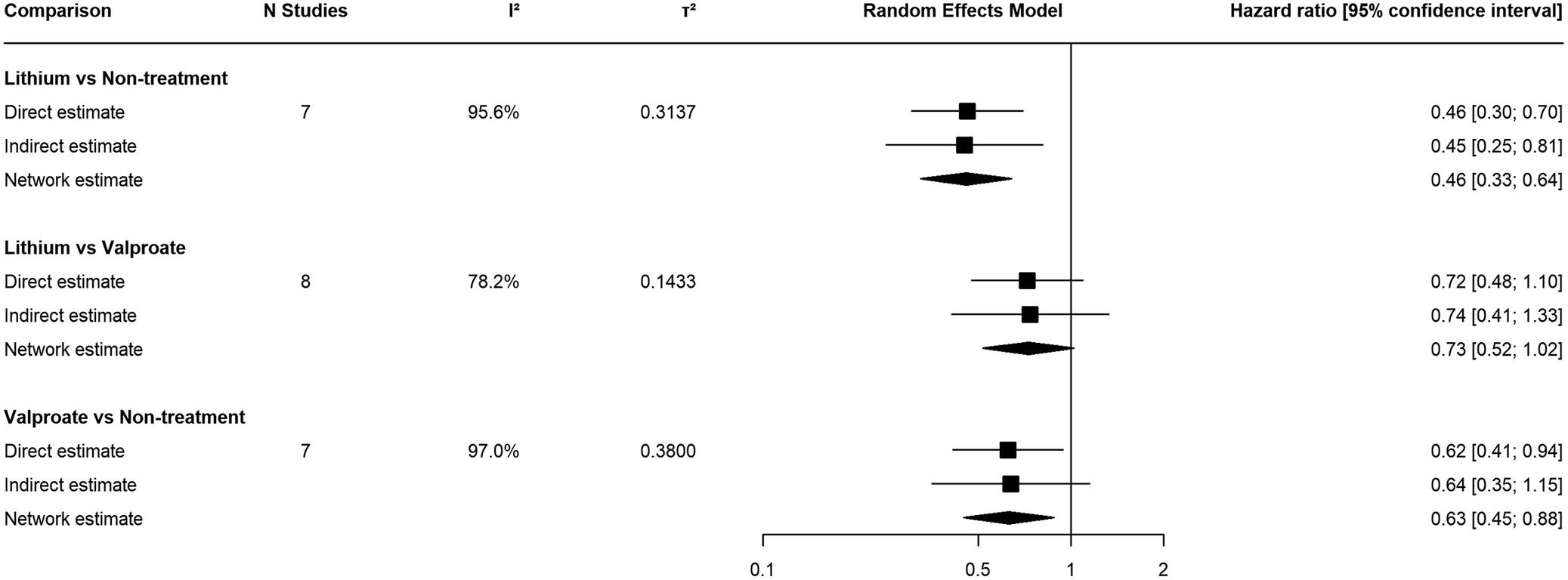
The network meta-analysis incorporated data from 13 observational studies to comprehensively compare the suicidal risks across the lithium, valproate, and nontreatment groups. As detailed in Figure 3, the pooled estimates demonstrated that lithium use was associated with a significantly lower risk of suicidal events compared with nontreatment (n = 7 studies; network HR = 0.46, 95% CI: 0.33–0.64). Similarly, valproate use also showed a statistically significant protective effect when compared to the nontreatment reference group (n = 7 studies; network HR = 0.63, 95% CI: 0.45–0.88). However, the head-to-head network comparison between the two active medications showed no significant difference in suicidal risk (n = 8 studies; network HR = 0.73, 95% CI: 0.52–1.02). This overarching network estimate aligns with the findings from our primary pairwise meta-analysis.
Forest plot of network meta-analysis.

Figure 3. Long description
The plot is organized into six columns. The X axis for the Random Effects Model ranges from 0.1 to 2 on a logarithmic scale, with a vertical line of no effect at 1.
1. Lithium vs Non-treatment: Based on 7 studies with I super 2 of 95.6% and T super 2 of 0.3137.
- Direct estimate: Hazard ratio 0.46 [0.30; 0.70].
- Indirect estimate: Hazard ratio 0.45 [0.25; 0.81].
- Network estimate: Hazard ratio 0.46 [0.33; 0.64]. All points and diamonds are positioned to the left of the line of no effect.
2. Lithium vs Valproate: Based on 8 studies with I super 2 of 78.2% and T super 2 of 0.1433.
- Direct estimate: Hazard ratio 0.72 [0.48; 1.10].
- Indirect estimate: Hazard ratio 0.74 [0.41; 1.33].
- Network estimate: Hazard ratio 0.73 [0.52; 1.02]. The confidence intervals for all three estimates cross the line of no effect.
3. Valproate vs Non-treatment: Based on 7 studies with I super 2 of 97.0% and T super 2 of 0.3800.
- Direct estimate: Hazard ratio 0.62 [0.41; 0.94].
- Indirect estimate: Hazard ratio 0.64 [0.35; 1.15].
- Network estimate: Hazard ratio 0.63 [0.45; 0.88]. The direct and network estimates are significantly to the left of the line, while the indirect estimate crosses it.
Discussion
In this study, our territory-wide cohort study of 6,935 individuals with bipolar disorder in Hong Kong found no significant superiority of lithium over valproate in reducing suicide risk. The pairwise meta-analysis of eight observational studies similarly indicated no statistically significant difference between the two groups. Notably, subgroup analyses revealed that lithium was associated with a significantly lower risk of suicide attempts compared with valproate, although this association did not extend to suicide mortality. The network meta-analysis, which incorporated indirect evidence from nontreatment controls, confirmed that both lithium and valproate showed a significant reduction in suicide risk relative to no treatment, while the network estimate showed no significant difference between the two agents.
The current international guidelines recommend lithium as the first-line pharmacological intervention for suicidal behaviors (Sarkhel, Vijayakumar, & Vijayakumar, Reference Sarkhel, Vijayakumar and Vijayakumar2023). The proposed mechanisms underlying lithium’s anti-suicidal properties include its neuroprotective effects through the activation of gamma-aminobutyric acid (GABA) neurotransmission, inhibition of excitatory pathways, and upregulation of neurotrophic factors such as brain-derived neurotrophic factor (BDNF) and B-cell lymphoma 2 (Sarai, Mekala, & Lippmann, Reference Sarai, Mekala and Lippmann2018). Valproate, by contrast, is an anticonvulsant with serotonergic actions that overlap with those of antidepressants and is thought to improve mood and cognitive function (Kalinin, Reference Kalinin2007). Earlier meta-analyses demonstrated that lithium use was associated with a significantly lower suicidal risk compared with no treatment (Baldessarini et al., Reference Baldessarini, Tondo, Davis, Pompili, Goodwin and Hennen2006; Tondo, Hennen, & Baldessarini, Reference Tondo, Hennen and Baldessarini2001), whereas a systematic review on valproate reported no significant effect on the incidence of suicide-related events (Chen et al., Reference Chen, Kamali, Chu, Yeh, Huang, Mao, Lin, Chen, Tseng and Hsu2019). The results of our network meta-analysis align with previous evidence regarding lithium’s anti-suicidal effect, and extend the literature by demonstrating that valproate similarly shows a significant reduction in suicidal risk compared with no treatment. However, when directly compared, neither the pairwise meta-analysis nor the network meta-analysis revealed a significant difference between lithium and valproate in reducing suicidal risk. Taken together, these findings may challenge the long-held perception that lithium was superior to other mood stabilizers in preventing suicide-related events (Ute Lewitzka, Reference Lewitzka and Pompili2022). While the overall analyses revealed no significant difference between lithium and valproate in reducing suicidal risk, our subgroup analysis showed that lithium demonstrated a statistically significant protective effect over valproate for suicide attempts, whereas the pooled estimate for suicide mortality remained nonsignificant. These findings suggest that the evidence for a protective effect of lithium may be more apparent for nonfatal suicidal behaviors. However, the lack of statistical significance for suicide mortality should be interpreted cautiously, as it may reflect greater variability in effect estimates, limited statistical power due to the rarity of suicide deaths, or differences in outcome ascertainment. Future studies with standardized outcome definitions and larger samples are needed to determine whether lithium has differential effects on fatal and nonfatal suicidal outcomes.
From a clinical perspective, the choice between lithium and valproate must also account for safety considerations specific to the patient population being treated. Of particular importance, valproate carries well-established teratogenic risks and has been associated with transgenerational adverse effects, prompting calls for stricter prescribing guidelines for both women of childbearing potential and men considering fatherhood (Gonzalez-Campos et al., Reference Gonzalez-Campos, Andreu, De Juan, Olivier and Anmella2024). Moreover, lithium use requires vigilance regarding renal and thyroid safety, particularly among patients with preexisting risk factors for chronic kidney disease (Chan et al., Reference Chan, Solmi, Correll, Man Wong, Lo, Lai and Chang2025a, Reference Chan, Solmi, Correll, Wong, Lo, Lai and Chang2025b). These findings highlight the need for individualized risk – benefit assessment: in younger patients or those planning pregnancy, lithium’s anti-suicidal efficacy must be weighed against valproate’s teratogenic potential, whereas in older adults or those with preexisting renal impairment, valproate may offer a more favorable safety profile. Beyond lithium and valproate, emerging interventions for suicide prevention in bipolar disorder merit consideration. Notably, esketamine has recently been investigated for bipolar depression, with a large retrospective cohort study of 2,126 patients reporting on the risks of manic switch and suicidal outcomes over a 1-year follow-up period (Liu et al., Reference Liu, Wu, Huang, Cheng and Lai2025). Although esketamine remains an experimental option in this population, these preliminary data highlight the importance of expanding the treatment options beyond traditional mood stabilizers, particularly for patients who do not tolerate or respond adequately to lithium or valproate.
To the best of our knowledge, this work represents the first systematic review and meta-analysis to directly compare the anti-suicidal effects of lithium and valproate. A key methodological strength lies in the combined use of pairwise and network meta-analytic approaches, which, while revealing no significant difference between the two agents, consistently demonstrated that both lithium and valproate possess significant anti-suicidal properties relative to no treatment. However, several limitations warrant cautious interpretation. Regarding our territory-wide cohort study, the dual healthcare system in Hong Kong, comprising both public and private sectors, may lead to delays or incomplete capture of clinical information in the Clinical Management System (CMS) of the HA. However, given that the HA is the sole provider of public inpatient services and the predominant provider of specialist outpatient care in Hong Kong, the majority of patients with bipolar disorder requiring long-term pharmacotherapy are captured within this system. The inability to account for medication adherence and unmeasured stressors may introduce residual bias, although our as-treated design with a 90-day permissible gap partially mitigates the impact of nonadherence by censoring patients upon treatment discontinuation. Residual confounding cannot be entirely excluded, yet we employed an active-comparator new-user design with IPTW to minimize confounding by indication, and the well-balanced covariates after weighting support the robustness of the weighted estimates. The finding of a significantly lower suicidal risk with valproate among patients aged 65 years or older should be interpreted with caution given the small sample size in this subgroup, and this observation warrants replication in larger cohorts before informing clinical practice. Regarding our meta-analysis, this review was restricted to English-language publications, which may limit the comprehensiveness of the evidence base. Nonetheless, the included studies spanned seven countries across three continents, supporting reasonable geographic generalizability. The substantial heterogeneity observed in the pairwise meta-analysis reflects differences in study design, population characteristics, and outcome definitions across the included observational studies, yet this heterogeneity was explored and partially resolved through subgroup and sensitivity analyses to provide a more nuanced interpretation of the comparative effects.
In conclusion, our cohort study and meta-analysis found no significant difference between lithium and valproate in preventing suicide, while demonstrating that both agents are associated with a significantly lower risk of suicide relative to no treatment. These findings suggest that the choice between lithium and valproate for suicide prevention in the management of bipolar disorder should be guided by individual patient characteristics and safety considerations.
Supplementary material
The supplementary material for this article can be found at http://doi.org/10.1017/S0033291726105881.
Author contribution
F.T.T.L., C.W., and J.S.C.Y. conceived the idea and design of the study. C.W., J.S.C.Y., and P.C.Y.W. performed literature search, screening, data collection, and extraction. C.W. performed the data analysis and drafted the paper. All authors reviewed the final manuscript. All authors have read and approved the final submitted manuscript, and agree to be accountable for the work.
Funding statement
This research did not receive any specific grant from funding agencies in the public, commercial, or not-for-profit sectors.
Competing interests
The authors declare no competing interests.
Ethical standard
Ethics approval for the cohort study was obtained from the Institutional Review Board of the University of Hong Kong/Hospital Authority Hong Kong West Cluster (UW 19-409).




 Open access

