

Health economic evaluations are conducted to inform resource allocation decisions. Economic evaluation has been defined as “the comparative analysis of alternative courses of action in terms of both their costs and their consequences.”Reference Drummond, Sculpher, Torrance, O'Brien and Stoddart(1) All economic evaluations assess costs, but approaches to measuring and valuing the consequences of health interventions may differ (see box).
FORMS OF ECONOMIC EVALUATIONReference Drummond, Sculpher, Torrance, O'Brien and Stoddart(1)
Specific forms of analysis reflect different approaches to evaluating the consequences of health interventions. Health consequences may be estimated from a single analytical (experimental or non-experimental) study, a synthesis of studies, mathematical modelling, or a combination of modelling and study information.
Cost consequences analysis examines costs and consequences without attempting to isolate a single consequence or aggregate consequences into a single measure
Cost minimisation analysis (CMA)—The consequences of compared interventions are required to be equivalent, and only relative costs are compared
Cost effectiveness analysis (CEA) measures consequences in natural units, such as life years gained, disability days avoided, or cases detected. In a variant of CEA, often called cost utility analysis, consequences are measured in terms of preference-based measures of health, such as quality adjusted life years or disability adjusted life years.
Cost benefit analysis—Consequences are valued in monetary units.
Readers should be aware that an economic evaluation might be referred to as a “cost effectiveness analysis” or “cost benefit analysis” even if it does not strictly adhere to the definitions above. Multiple forms may also exist within a single evaluation. Different forms of analysis provide unique advantages or disadvantages for decision making. The Consolidated Health Economic Evaluation Reporting Standards (CHEERS) statement can be used with any form of economic evaluation.
Economic evaluations have been widely applied in health policy, including the assessment of prevention programmes (such as vaccination, screening, and health promotion), diagnostics, treatment interventions (such as drugs and surgical procedures), organisation of care, and rehabilitation. Economic evaluations are increasingly being used for decision making and are an important component of programmes for health technology assessment internationally.Reference Drummond, Schwartz, Jönsson, Luce, Neumann and Siebert(2)
REPORTING CHALLENGES AND SHORTCOMINGS IN HEALTH ECONOMIC EVALUATIONS
Compared with clinical studies, which report the consequences of an intervention only, economic evaluations require more reporting space for additional items, such as resource use, costs, preference related information, and cost effectiveness results. This creates challenges for editors, reviewers, and those who wish to scrutinise a study's findings.Reference Rennie and Luft(3) There is evidence that the quality of reporting of economic evaluations varies widely and could potentially benefit from improved quality assurance mechanisms.Reference Neumann, Stone, Chapman, Sandberg and Bell(4)Reference Rosen, Greenberg, Stone, Olchanski and Neumann(5)
With the increasing number of publications available, and opportunity costs from decisions based on misleading study findings, transparency and clarity in reporting are important. In addition, outside of economic evaluations conducted alongside clinical trials, there are no widespread mechanisms for warehousing economic evaluation data to allow for independent interrogation, such as ethics review proceedings, regulator dossiers, or study registries. Instead, independent analysis may rely on the record keeping of individual investigators.
Even if measures to promote transparency exist, such as registries, biomedical journal editors have increasingly promoted and endorsed the use of reporting guidelines. Endorsement of guidelines by journals for randomised controlled trials has been shown to improve reporting.Reference Turner, Shamseer, Altman, Schulz and Moher(6) The combination of the risk of making costly decisions due to poor reporting with the lack of mechanisms that promote accountability makes transparency in reporting economic evaluations especially important and a primary concern among journal editors and decision makers.Reference Rennie and Luft(3)Reference Drummond(7)
AIM AND SCOPE
The aim of the Consolidated Health Economic Evaluation Reporting Standards (CHEERS) statement is to provide recommendations, in the form of a checklist, to optimise reporting of health economic evaluations. The need for a contemporary reporting guidance for economic evaluations was recently identified by researchers and biomedical journal editors.Reference McGhan, Al, Doshi, Kamae, Marx and Rindress(8) The CHEERS statement attempts to consolidate and update previous efforts (9)Reference Drummond and Jefferson(10)Reference Gold(11)Reference Siegel, Weinstein, Russell and Gold(12)Reference Nuijten, Pronk, Brorens, Hekster, Lockefeer and de Smet(13)Reference Vintzileos and Beazoglou(14)Reference Drummond, Manca and Sculpher(15)Reference Ramsey, Willke, Briggs, Brown, Buxton and Chawla(16)Reference Goetghebeur, Wagner, Khoury, Levitt, Erickson and Rindress(17)Reference Davis, Robertson, Comans and Scuffham(18)Reference Petrou and Gray(19)Reference Petrou and Gray(20) into a single useful reporting guidance.
The primary audiences for the CHEERS statement are researchers reporting economic evaluations and the editors and peer reviewers evaluating their publication potential. We hope the statement (which consists of a 24 item checklist and accompanying recommendations on the minimum amount of information to be included when reporting economic evaluations) is a useful and practical tool for these audiences and will improve reporting and, in turn, health and healthcare decisions. To best understand and apply the recommendations contained within the statement, we encourage readers to access the Explanation and Elaboration Report.Reference Husereau, Drummond, Petrou, Carswell, Moher and Greenberg(21)
DEVELOPMENT OF THE CHEERS STATEMENT
The statement was developed by a task force supported by the International Society for Pharmacoeconomics and Outcomes Research (ISPOR), as part of a broader initiative to facilitate and encourage the interchange of expert knowledge and develop best practices. The CHEERS Task Force members were chosen by the chair of the task force primarily based on their longstanding academic expertise and contribution to the multidisciplinary field of health economic evaluation. In addition to four members of the task force with doctorates in economics and its sub-discipline of health economics (AHB, MD, JM, SP), members included experts in health technology assessment and decision making (FA, AHB, DH, MD, JM) and in clinical epidemiology and biostatistics (AHB, EL, DM), those in active clinical practice (EL, FA), and those with previous experience in reporting guideline development (MD, DM). All members are researchers in applied health and health policy, with five members currently serving as editors for journals in the field (AHB, CC, MD, DG, EL).
The CHEERS Task Force followed current recommendations for developing reporting guidelines.Reference Moher, Schulz, Simera and Altman(22) Briefly, the need for new guidance was first identified through a survey of members of the World Association of Medical Editors. Of the 6% (55/965) who responded, 91% (n = 50) indicated they would use a standard if one were widely available.Reference McGhan, Al, Doshi, Kamae, Marx and Rindress(8) Next, published checklists or guidance documents related to reporting economic evaluations were identified from a systematic review and survey of task force members.Reference Moher, Weeks and Ocampo(23) Both of these activities were used to create a preliminary list of items to include when reporting economic evaluations. Recommendations of the minimum set of reporting items were then developed through a modified Delphi panel process. Forty eight individuals identified by the task force with broad geographical representation and representing academia, biomedical journal editors, the pharmaceutical industry, government decision makers, and those in clinical practice were invited to participate. Thirty seven agreed to participate. Participants were asked to score importance on a Likert scale and the average scores, weighted by each individual's confidence in ability to score, were then used to rank items. A cut-off point was applied to the ranked list to determine the minimum number of items important for reporting.
The CHEERS statement recommendations have been independently reviewed and subsequently revised by task force members. The recommendations are entirely those of the task force—the sponsors of the study had no role in study design, data analysis, data interpretation, or writing of the final recommendations. A more complete description of the methods and findings of the Delphi panel are found in the larger explanation and elaboration document.Reference Husereau, Drummond, Petrou, Carswell, Moher and Greenberg(21)
CHECKLIST ITEMS
The final recommendations are subdivided into six main categories: (1) title and abstract; (2) introduction; (3) methods; (4) results; (5) discussion; and (6) other. The recommendations are contained in a user friendly, 24 item checklist (table(T1)) to aid users who wish to follow them. A copy of the checklist can also be found on the CHEERS Task Force website. (www.ispor.org/TaskForces/EconomicPubGuidelines.asp). In order to encourage dissemination and use of a single international standard for reporting, the task force approached 14 journals identified as either the largest publishers of economic evaluations or widely read by the medical and research community. Thirteen journals responded, and 10 expressed their ability and interest in endorsing this guidance. The CHEERS statement is being simultaneously published in BMC Medicine, BMJ, BJOG: An International Journal of Obstetrics and Gynaecology, Clinical Therapeutics, Cost Effectiveness and Resource Allocation, The European Journal of Health Economics, International Journal of Technology Assessment in Health Care, Journal of Medical Economics, Pharmacoeconomics, and Value in Health. To facilitate wider dissemination and uptake of this reporting guidance, we encourage other journals and groups to consider endorsing CHEERS.
CONCLUDING REMARKS
As the number of published health economic evaluations continues to grow, we believe more transparent and complete reporting of methods and findings will be increasingly important to facilitate interpretation and comparison of studies. We hope the CHEERS statement, consisting of recommendations in a 24 item checklist, will be viewed as an effective consolidation and update of previous efforts and serve as a starting point for standard reporting going forward.
We believe the CHEERS statement represents a considerable expansion over previous efforts. The strength of our approach is that it was developed in accordance with current recommendations for the development of reporting guidelines, using an international and multidisciplinary team of editors and content experts in economic evaluation and reporting.Reference Moher, Schulz, Simera and Altman(22) Similar to the approach taken with other widely accepted guidelines, we have defined a minimum set of criteria though a modified Delphi technique and have translated these into recommendations, an explanatory document with explanations, and a checklist. Unlike some previous reporting guidance for economic evaluation, we have also made every effort to be neutral about the conduct of economic evaluation, allowing analysts the freedom to choose different methods.
There may be several limitations to our approach. A larger Delphi panel with a different composition could have led to a different final set of recommendations.Reference Campbell, Hann, Roland, Quayle and Shekelle(24) Some less common approaches and contexts (such as public health, developing countries, and system dynamic models) for conducting health economic evaluation may not be well represented by our sample of experts. Additionally, like many Delphi panel processes, we based decisions to reject or accept criteria on arbitrary levels of importance. However, we feel the group recruited to create the statement is sufficiently knowledgeable of the more common applications of economic evaluation, and the rules used to select criteria were created a priori and are consistent with previous efforts.
We believe it will be important to evaluate the effects of implementation of this statement and checklist on reporting in future economic evaluations. As methods for the conduct of economic evaluation continue to evolve, it will also be important to revisit or extend the guidance. The CHEERS Task Force feels that this statement should be reviewed for updating five years from its release.
Contributors
All authors provided a substantial contribution to the design and interpretation of the protocol and guidance, aswell as writing sections of drafts, revising based on comments received, and approving the final version. DH conducted the analysis of Delphi panel responses, drafted and revised the protocol and the drafts of this paper, and is the guarantor for the study.
CHEERS checklist—Items to include when reporting economic evaluations of health interventions
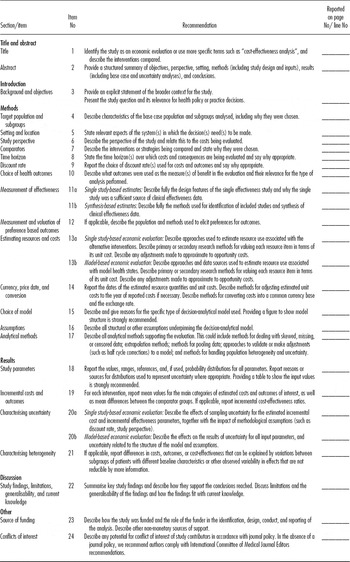
For consistency, the CHEERS statement checklist format is based on the format of the CONSORT statement checklist
The International Society for Pharmacoeconomics and Outcomes Research (ISPOR) Health Economic Evaluation Publication Guidelines—CHEERS Task Force acknowledge the support of Elizabeth Molsen; Donna Rindress, who provided the initial leadership for this effort; and the reviewers and Delphi panel participants, who are named in the larger explanation and elaboration document and on the CHEERS Task Force website.
Competing interests All authors have completed the ICMJE uniform disclosure form at www.icmje.org/coi_disclosure.pdf and declare: FA served as board member for the study funder; FA, AHB, CC, MD, DG, DH, EL, JM, and SP were provided support for travel to a face-to-face meeting to discuss the contents of the report; FA and MD have received payment from the study sponsor for serving as co-editors for Value in Health; no other relationships or activities that could appear to have influenced the submitted work. Elizabeth Loder—BMJ clinical epidemiology editor—played no part in the peer review or decision making of this paper at the editorial level, and contributed solely as an author.
Funding All CHEERS Task Force members are volunteers. Support for this initiative was provided by the International Society for Pharmacoeconomics and Outcomes Research.


