Significant outcomes
-
∙ Psychiatrists had a significantly higher rate of utilising second-generation antidepressants with higher dosages than non-psychiatrists.
-
∙ Selective serotonin re-uptake inhibitors were the drugs of choice for both psychiatrists and non-psychiatrists, with no significant difference in prescription dosage.
-
∙ Trazodone was the most frequently prescribed antidepressant, but was generally prescribed in low dosages.
Limitations
-
∙ The reimbursement data was not the most recent and had small sample size.
-
∙ The diagnoses of depression were not validated by a structural interview.
-
∙ The information about physical comorbidity or depression severity was not analysed.
-
∙ The results might not reflect all the elderly at the present time.
Introduction
Depression is a highly prevalent mental disorder among the elderly. Previous epidemiological studies revealed that depressive symptoms affect 8–16% of community-dwelling elderly (Reference Ellison, Kyomen and Harper1), and the Taiwanese community has a high prevalence of elderly with depression as well (Reference Chong, Tsang and Chen2). Elderly patients hospitalised for medical/surgical reasons were quite often afflicted with depression; however, the detection and treatment of depression were often overlooked by primary care physicians (Reference Gerson, Mistry and Bastani3). Depressive symptoms were associated with a poor prognosis and increased mortality in elderly patients who were hospitalised (Reference Blazer, Hybels and Pieper4). If the depressive illness is ignored or has been inadequately treated, this could lead to a longer period of hospitalisation coupled with higher medical costs. Thus, identifying elderly with depression and providing an optimal treatment regimen are crucial.
Pharmacological approaches, especially antidepressants, have been demonstrated to be effective in the treatment of depression in old age (Reference Diniz, Nunes, Machado-Vieira and Forlenza5). In recent decades, there has been a trend towards an increased utilisation of antidepressants in Taiwan (Reference Wu, Shau, Chan, Lee, Lai and Lai6). This trend is also common in non-ethnic Chinese communities (Reference Raymond, Morgan and Caetano7,Reference Sonnenberg, Deeg, Comijs, van Tilburg and Beekman8), where there is an increased use of antidepressants among the elderly (Reference Soudry, Dufouil, Ritchie, Dartigues, Tzourio and Alperovitch9–Reference Harman, Crystal, Walkup and Olfson11). Selective serotonin re-uptake inhibitors (SSRI) and other newer antidepressants were prescribed in most cases (Reference Uchida, Chong and Tan12). In addition, antipsychotics, which may serve as an augmentative regimen, provide benefits for agitated, psychotic, or treatment resistant depression in the elderly (Reference Alexopoulos13). Moreover, elderly patients with depression have frequently comorbid with anxiety symptoms (Reference Gum and Cheavens14), and anxiolytic-hypnotics are commonly used to relieve symptoms of anxiety or insomnia. Nevertheless, studies investigating the use of psychotropic drugs specifically among elderly inpatients with depression are still scarce.
Prescribing behaviour may be influenced by many factors: health delivery system and health insurance regulations, treatment guidelines, pharmaceutical company promotions, and the physician’s specialty (Reference Semark, Engstrom and Brudin15). The patterns of prescription for elderly with depression of psychiatrists might differ from those of non-psychiatrists, particularly in the primary care setting (Reference Harman, Crystal, Walkup and Olfson11). Elderly depressive patients who are admitted for treatment of physical illness and injury are likely to report somatic symptoms instead of psychological ones, so the possibility of the patient being depressive is frequently overlooked by the physician (Reference Gerson, Mistry and Bastani3). Furthermore, a previous study reported that treatment for elderly with depression provided by general medical providers is less effective than that provided by psychiatrists (Reference Young, Klap, Sherbourne and Wells16). Efficient treatment of elderly with depression, aside from an appropriate diagnosis and the selection of an effective drug, depends on the optimal dosage and also an adequate time of treatment with consideration of the effect of ageing and physical morbidity (Reference Kok, Nolen and Heeren17). Inadequate treatment is likely to occur if there is a lack of understanding about the patients being treated or the implication of the drug therapy.
Aims of the study
Population ageing is an important issue in Taiwan. In 1993, Taiwan achieved the definition of an ageing country by exceeding 7% elderly population aged 65 and over, and the elderly population was growing up to 9% since 2001 (Reference Lin, Chou, Liang, Peng and Chen18). The escalating tendency remarks the important issue of mental health among ageing population. Therefore, this study attempted to investigate the differences in prescription patterns, including the types of drugs and dosages used, of psychiatrists and non-psychiatrists when prescribing medications for elderly inpatients with depressive disorders.
Material and methods
The study population and sample
The study, which received approval from the Institutional Review Board of Chang Gung Memorial Hospital and was endorsed by the Taiwan Department of Health, was carried out under ethical guidelines with stringent requirements for data manipulation and protection. The database, provided by the Bureau of National Health Insurance (BNHI) of Taiwan, consisted of reimbursement information, including prescriptions that had been modified for research use only. Taiwan’s National Health Insurance programme was introduced in 1995, and all residents are entitled to the health and medical services offered under this system. Reimbursement of any medical expenses for a medical visit or admission is handled by the BNHI, which has access to data in the patient’s relevant medical records. These medical claims data will eventually be scrutinised for health science research use and for the promotion of medical services (Reference Chien, Bih, Chou, Lin, Lee and Chou19).
The study population consisted of inpatients who were admitted to BNHI-contracted hospitals from 2001 to 2003. The types of contracted hospitals included medical centers, regional hospitals and district hospitals. A random sampling of 1 out of 20 patients (5%) was selected for the study, and there were no statistical differences in sex and age within the population. The selected sample included 424 695 subjects, with the 121 830 (28.7%) elderly persons being defined as those aged 65 and older. The elderly patients with a diagnosis of any depressive disorder were then included as the study sample. The depressive disorders noted were divided into two major groups for analysis, based on the diagnostic criteria of the International Classification of Diseases (ICD-9-CM): major depressive disorders (MDD) (296.2, 296.3, 296.5, 296.6), and non-MDD (296.80, 296.82, 296.90, 298.0, 300.4, 309, 311).
The diagnoses and ICD-9-CM codes of physical comorbidities were sorted into infectious and parasitic diseases (001–139), cancer (140–239), endocrine, nutritional and metabolic diseases and immunity disorders (240–279), diseases of the blood and blood-forming organs (280–289), diseases of the nervous system and sense organs (320–389), diseases of the circulatory system (390–459), diseases of the respiratory system (460–519), diseases of the digestive system (520–579), diseases of the genitourinary system (580–629), complications of pregnancy, childbirth, and the puerperium (630–676), diseases of the skin and subcutaneous tissue (680–709), diseases of the musculoskeletal system and connective tissue (710–739), congenital anomalies (740–759), certain conditions originating in the perinatal period (760–779), symptoms, signs, and ill-defined conditions (780–799), injury and poisoning (800–999) and all supplementary classifications (V01–V82).
Definition of drug class and dosage
The patterns of prescription for elderly inpatients were addressed by focussing on the use of psychotropic drugs, especially antidepressants, with regard to the types of drug used, dosages, and differences in prescription between psychiatrists and non-psychiatrists. The antipsychotics and antidepressants were classified according to their chemical structures and pharmacological properties.
Antidepressants were generally divided into first-generation antidepressants and second-generation antidepressants (Reference Gartlehner, Hansen and Morgan20). The first-generation antidepressants included tricyclic antidepressants (TCA, including amitriptyline, clomipramine, doxepin, imipramine, maprotiline) and reversible inhibitors of monoamide oxidase (moclobemide). The second-generation antidepressants included SSRIs (including citalopram, fluoxetine, fluvoxamine, paroxetine, and sertraline), newer antidepressants (mirtazapine, venlafaxine), and trazodone.
Antipsychotics were categorised into first-generation antipsychotics (FGA) and second-generation antipsychotics (SGA). FGA included chlorpromazine, flupentixol, haloperidol, loxapine, sulpiride, thioridazine, and trifluoperazine. Amisulpiride, clozapine, olanzapine, quetiapine, risperidone, and zotepine were grouped as SGA.
Alprazolam, bromazepam, buspirone, chlordiazepoxide, clobazam, clorazepate dipotassium, cloxazolam, diazepam, fludiazepam, hydroxyzine, lorazepam, mephenoxalone, nordazepam, oxazolam, and oxazepam were classified as anxiolytics; while brotizolam, estazolam, flunitrazepam, flurazepam, lormetazepam, midazolam, nitrazepam, nimetazepam, triazolam, zolpidem, and zopiclone were classified as hypnotics. Mood stabilisers contained clonazepam, carbamazepine, gabapentin, lithium, topiramate, and valproic acid. Methylphenidate was classified as a psychostimulant.
Two indicators were used to compare dosages: the defined daily dosage (DDD) and prescribed daily dosage (PDD). The DDD assignment was based on dose information obtained from the World Health Organization, Collaborating Centre for Drug Statistics Methodology (21), and the PDD was calculated from the prescription data of each hospitalisation. The PDD/DDD ratio of a drug thus indicates the relative dosage of any given drug as compared to what has been recommended (or standardised): a ratio below 1 was defined as low dose, equal to 1.0 but less than 1.5 as standard (or median) dose and equal to or above 1.5 as high dose.
Statistical analysis
Sample mean and standard deviation (SD) were calculated to describe demographic and medication information. Comparisons of the use of drugs between psychiatrists and non-psychiatrists were made using the χ2 test, while the dosages were stratified according to the above definitions and compared between psychiatrists and non-psychiatrists. Statistical significance was defined as a level of p<0.05, and Fisher’s exact test was employed when the sample size was <5. All data processing and statistical analyses were performed with the Statistical Package for the Social Sciences (SPSS) version 12.0 (SPSS Inc., Chicago, IL, USA).
Results
Characteristics of the sample
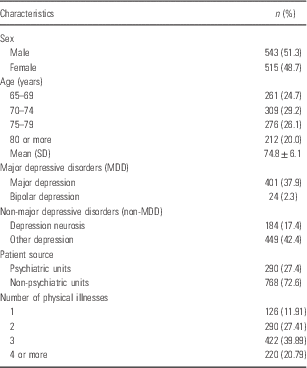
Of the 121 830 inpatients aged 65 and older, 1058 (0.9%) (mean age: 74.8±6.1 years) with diagnoses of depressive disorders constituted the study sample (Table 1). Of these, 543 (51.3%) were males and 515 (48.7%) were females; 425 (40.2%) and 633 (59.8%) patients were diagnosed as having MDD and non-MDD, respectively. High morbidity of physical illnesses was seen among the elderly depressive inpatients, with 88.1% having two or more physical illnesses. Most of these patients were admitted to non-psychiatric wards (n=768, 72.6%) providing medicine (n=505, 47.7%), neurology (n=146, 13.8%), surgery (n=98, 9.3%), and rehabilitative medicine (n=19, 1.8%). A total of 290 (27.4%) elderly depressive inpatients were admitted to psychiatric units, and approximately three-quarters (74.8%) of them were patients with MDD.
Clinical characteristics of the sample of elderly patients with depression (n=1058)

( ) proportion of the total population.
Prescription pattern
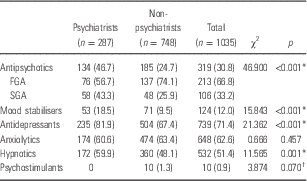
Twenty-three (2.2%) of the 1058 patients had no prescription of any psychotropic drug. Of the psychotropic prescriptions noted, antidepressants (71.4%) were the most commonly prescribed, followed by anxiolytics (62.6%), hypnotics (51.4%) and antipsychotics (30.8%). Psychiatrists had significantly higher rates of prescribing all psychotropic drugs than non-psychiatrists, except for anxiolytics, while psychostimulants, although small in number, were all prescribed by non-psychiatrists (Table 2). In using antipsychotics, the non-psychiatrists preferred FGA (74%) to SGA and prescribed antidepressants for 67.4% of their patients only.
Comparison of prescriptions between psychiatrists and non-psychiatrists

FGA, first-generation antipsychotics; SGA, second-generation antipsychotics.
Data were expressed as n (%).
*p<0.05
† p value was calculated by using Fisher’s exact test.
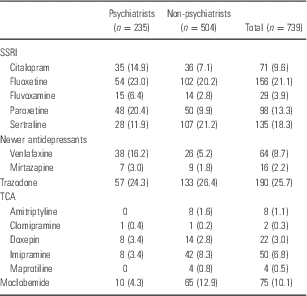
More than 90% of the antidepressants prescribed were second-generation drugs, including trazodone (25.7%), fluoxetine (21.1%), sertraline (18.3%), paroxetine (13.3%), moclobemide (10.1%), citalopram (9.6%), venlafaxine (8.7%), fluvoxamine (3.9%), and mirtazapine (2.2%). About one-tenth (9.7%) of the antidepressants prescribed were first-generation antidepressants, and 80% of these were prescribed by non-psychiatrists (Table 3). Among them, amitriptyline and maprotiline were all prescribed by non-psychiatrists. Psychiatrists had significantly higher prescription rates for antidepressants (81.9% vs. 67.4%), especially second-generation antidepressants, than non-psychiatrists, with a threefold higher prescription rate for venlafaxine (16.2% vs. 5.2%), twofold higher for citalopram (14.9% vs. 7.1%), paroxetine (20.4% vs. 9.9%), and fluvoxamine (6.4% vs. 2.8%), and 1.5 times higher for mirtazapine (3.0% vs. 1.8%). Non-psychiatrists, on the other hand, had threefold higher prescription rates for moclobemide (12.9% vs. 4.3%) and twofold higher use of imipramine (8.3% vs. 3.4%) and sertraline (21.2% vs. 11.9%) than psychiatrists.
The distribution of each antidepressant prescribed by psychiatrists and non-psychiatrists

SSRI, selective serotonin reuptake inhibitors; Newer, newer antidepressants, including Mirtazapine, Venlafaxine; TCA, tricyclic antidepressants.
Data were expressed as n (%).
With regard to polypharmacy, 55 (7%) elderly inpatients were prescribed more than one type of antidepressant. Trazodone was the most frequently used drug in polypharmacy regimens: 22% of trazodone users were prescribed trazodone together with another antidepressant, and 75% of patients with a polypharmacy regimen received combination treatment with trazodone and another antidepressant.
Dosing
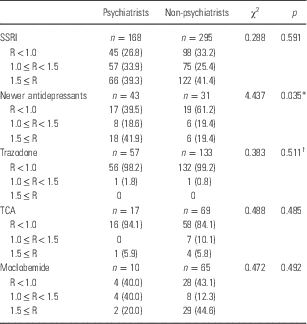
The prescribed dosages of different antidepressants varied (Table 4). Trazodone (98.9%) and TCAs (86%) had the highest rates of prescriptions with low dosages (PDD/DDD<1.0).
The ratio distribution of prescribed daily dosage to defined daily dosage of antidepressants by psychiatrists and non-psychiatrists

Data were expressed as n (%).
Patient may receive more than one prescription of antidepressants. The summations of the users of the 5 antidepressants were not equal to total number of elderly with depression.
R, ratio of prescribed daily dosage to defined daily dosage of antidepressants; SSRI, selective serotonin reuptake inhibitors; Newer antidepressants, including Mirtazapine, Venlafaxine; TCA, tricyclic antidepressants.
*p<0.05.
† p value was calculated by Fisher’s exact test.
When different dosages were compared, the prescription dosage of SSRIs was not significantly different between psychiatrists and non-psychiatrists. Non-psychiatrists tended to prescribe lower dosages (PDD/DDD<1.0) of newer antidepressants than psychiatrists (61.2% vs. 39.5%); in contrast, high dosages (PDD/DDD≥1.5) of newer antidepressants were prescribed to a significant extent by psychiatrists (41.9% vs. 19.4%, χ2=4.437, p<0.05). There were no significant differences in the prescription dosage of TCAs and moclobemide between the psychiatrists and non-psychiatrists.
Discussion
Only 0.9% of the total inpatients aged 65 and older in the study database were diagnosed as having depressive disorders. The prevalence of depression was much lower than shown in previous international studies, which reported a rate as high as 16% among elderly persons (Reference Chong, Tsang and Chen2,Reference Almeida22). Depression among the elderly is commonly undetected or not well-managed because, despite manifesting all the core symptoms of depression, the elderly may show fewer symptoms of dysphoric mood but have more somatic concerns, which differs from depression in younger adults (Reference Lim, Chang, Yu, Chiu, Chong and Kua23,Reference Chiu, Ames, Draper and Snowdon24). Even among ethnic Chinese who are used to expressing their emotions in terms of somatic symptoms, there was a great variation in the reported rates of elderly with depression among different geo-political ethnic Chinese communities (Reference Chong25). Thus, many elderly patients with depression may not have been identified during admission, particularly in non-psychiatric wards. In this study, about three-quarters of the elderly depressive inpatients were managed by non-psychiatrists. The appropriateness of primary care physicians selecting and dosing an effective drug to treat psychiatric problems is of great concern.
In comparing the patterns of prescribing antidepressants between psychiatrists and non-psychiatrists, psychiatrists had a significantly higher rate of utilising antidepressants than non-psychiatrists, especially newer drugs, but non-psychiatrists were more likely to prescribe TCAs or moclobemide, which are reported to carry a risk of cardiac problems or high blood pressure (Reference Chiu, Ames, Draper and Snowdon24,Reference Montgomery26). Despite the differences, more than 90% of the prescribed antidepressants were second-generation drugs, and SSRIs remained the drug of choice for both psychiatrists and non-psychiatrists. The results of this study were consistent with the findings of other East Asian studies, in which there was a trend towards an increasing use of SSRIs and newer antidepressants, and a corresponding decrease in the use of older antidepressants (Reference Chien, Bih, Chou, Lin, Lee and Chou19,Reference Sim, Lee and Chua27). These new-generation drugs might have a better adherence rate than TCAs, with a less severe side-effect profile (Reference Wilson and Mottram28), and were more recommended for treating depressive elderly persons with multiple medical illnesses (Reference Ellison, Kyomen and Harper1). Among the antidepressants, trazodone remained the single most frequently prescribed drug. In a further examination of its pattern of use, it was found that both psychiatrists and non-psychiatrists tended to prescribe trazodone mostly in lower dosages and also co-prescribed trazodone with another antidepressant, which was most probably employed as a hypnotic rather than an antidepressant because of its strong sedative property.
Antidepressant polypharmacy was not commonly found and comprised about 7% of the prescriptions, with the majority being the prescription of trazodone together with another antidepressant, as described above. This phenomenon differs from the prescription pattern in Japan, where polypharmacotherapy is a tradition (Reference Uchida, Chong and Tan12). One of the reasons for the low rate of polypharmacy in this study is auditing by the BNHI, which does not allow this practice to be routinely acknowledged unless supplemented with solid evidence and needs, or else a forfeit will apply with an indication of losses from reimbursement. These measures, which are used to minimise unnecessary medical spending, have also indirectly served as an internal audit for good prescription habits.
Furthermore, psychiatrists had significantly higher utilisation rates of antipsychotics, mood stabilisers and hypnotics than non-psychiatrists. Patients admitted to psychiatric units might have higher rates of MDD or bipolar depression than their non-psychiatric counterparts with depression, and therefore would have a greater need of concomitant treatment with other psychotropic drugs. A high proportion of anxiolytics was prescribed in this sample – more than 60% by both psychiatrists and non-psychiatrists. In addition, hypnotics were also widely prescribed. This was similar to the prescription rates in outpatient services, where elderly subjects with medical or psychiatric illnesses were given higher dosages of anxiolytic-hypnotics (Reference Cheng, Huang, Lin and Shih29). Comorbidity of anxiety with depression is common, and anxiolytic treatment for these patients is often needed (Reference Gum and Cheavens14). However, elderly patients are usually prone to excessive physical diseases and disability. Decreasing the use of inefficient anxiolytic-hypnotics and increasing the use of newer antidepressants may be more beneficial to the treatment response for older depressed adults (Reference Bartels, Horn, Sharkey and Levine30). In terms of risks and benefits, drug treatment of the elderly should always be carefully assessed, especially with the falls that result from over-sedation with benzodiazepine (Reference Chang, Wu, Chang and Lin31).
Although the prescription pattern for different dosages of psychotropic drugs was rather similar between psychiatrists and non-psychiatrists, it appears that psychiatrists generally utilised higher dosages of antidepressants than non-psychiatrists, especially with the newer antidepressants. Compared to patients in non-psychiatric wards, those who were admitted to psychiatric units might have a greater severity of depression, and a higher proportion may be treatment-resistant (Reference Flint32,Reference Sable, Dunn and Zisook33). On the contrary, elderly patients who admitted to medical wards usually with primary physical illness and higher physical comorbidity (Reference Rapp, Parisi and Wallace34). Therefore, the distribution of depressive diagnosis, demographic characteristics and physical condition may influence physicians’ decision on the prescription dosage of psychotropics. Another possible explanation is that non-psychiatrists might be less familiar with the usage of newer antidepressants; therefore, the dosage prescribed by non-psychiatrists was relatively conservative. TCAs and trazodone were commonly prescribed in low dosages – the former because of the tendency of adverse effects increasing with the dosage, while the latter was commonly prescribed as an adjunctive drug for sleep. Both were commonly prescribed by non-psychiatrists, which may explain the inadequate dosages of the prescribed medications. However, it is noteworthy that the practical dose of an antidepressant for an elderly patient is often lower than that recommended for a younger adult, because of the influence of ageing on drug distribution, metabolism, and elimination rate (Reference Ellison, Kyomen and Harper1). In this study, primary care physicians, especially non-psychiatrists, prescribed many antidepressants in low dosages. Whether the regimen is adequate for depressive elderly patients warrants further investigation.
There are several limitations in this study. First, the study used reimbursement data from 2001 to 2003, which was not the most recent and might differ from the actual clinical condition. For instance, the diagnoses of depression were not validated using a structural interview. In addition, data regarding the physicians’ characteristics and the types of contracted hospitals were not analyzed. Moreover, whether the prescriptions written by non-psychiatrists were derived from their own judgement or from the suggestion of a psychiatrist via consultation liaison could not be determined. These issues might have an effect on the findings in this study. Further investigations for current prescription pattern of psychotropic drugs among different specialists are warranted. Second, the sample size was relatively small and does not represent all elderly inpatients with depression. Third, there was some missing clinical information. For example, the differences in distribution of depressive diagnosis, demographic characteristics and physical conditions between patients who admitted to psychiatric ward and those admitted to non-psychiatric ward were not analysed. Moreover, clinical assessments of depression and profiles of adverse effects were unavailable in the claims data. It is difficult to determine whether the regimens identified in this study were actually appropriate for patients in clinical settings. Taken together, caution should be taken when applying the results to clinical practice.
In conclusion, the results of this study show that psychotropic drugs were commonly used to treat elderly with depression. Psychiatrists had a higher rate of prescribing antidepressants and other psychotropic drugs, except anxiolytics, than non-psychiatrists. SSRIs remained the drugs of choice for both psychiatrists and non-psychiatrists, with no significant difference in prescription dosage. Trazodone was the most frequently prescribed antidepressant, but was generally prescribed in low dosages. Differences in the prescribing pattern of antidepressants among physician specialties were observed in the higher utilisation and higher dosage of newer drugs by psychiatrists; non-psychiatrists preferred to use older drugs. Further clinical investigations are warranted to determine how the selection and dosing of drugs influence treatment effectiveness and outcome among elderly inpatients with depression.
Acknowledgements
The study was supported by a grant from the Taiwan Ministry of Health and Welfare (DOH94-TD-D-113-005). We are grateful to Mr Hsin-Nan Lee for statistical analyses, and Dr Kuang Ching He for reading and correction of the draft.
Authors’ contributions: Y.C.H. participated in interpreting data, reviewing references and drafting manuscript. L.J.W. participated in interpreting data and drafting manuscript. M.Y.C. participated in the design of study, statistical analysis, drafted and supervised the manuscript. All authors read and approved the final manuscript.
Financial Support
None.
Conflicts of Interest
The authors declare that there is no conflict of interests regarding the publication of this paper.