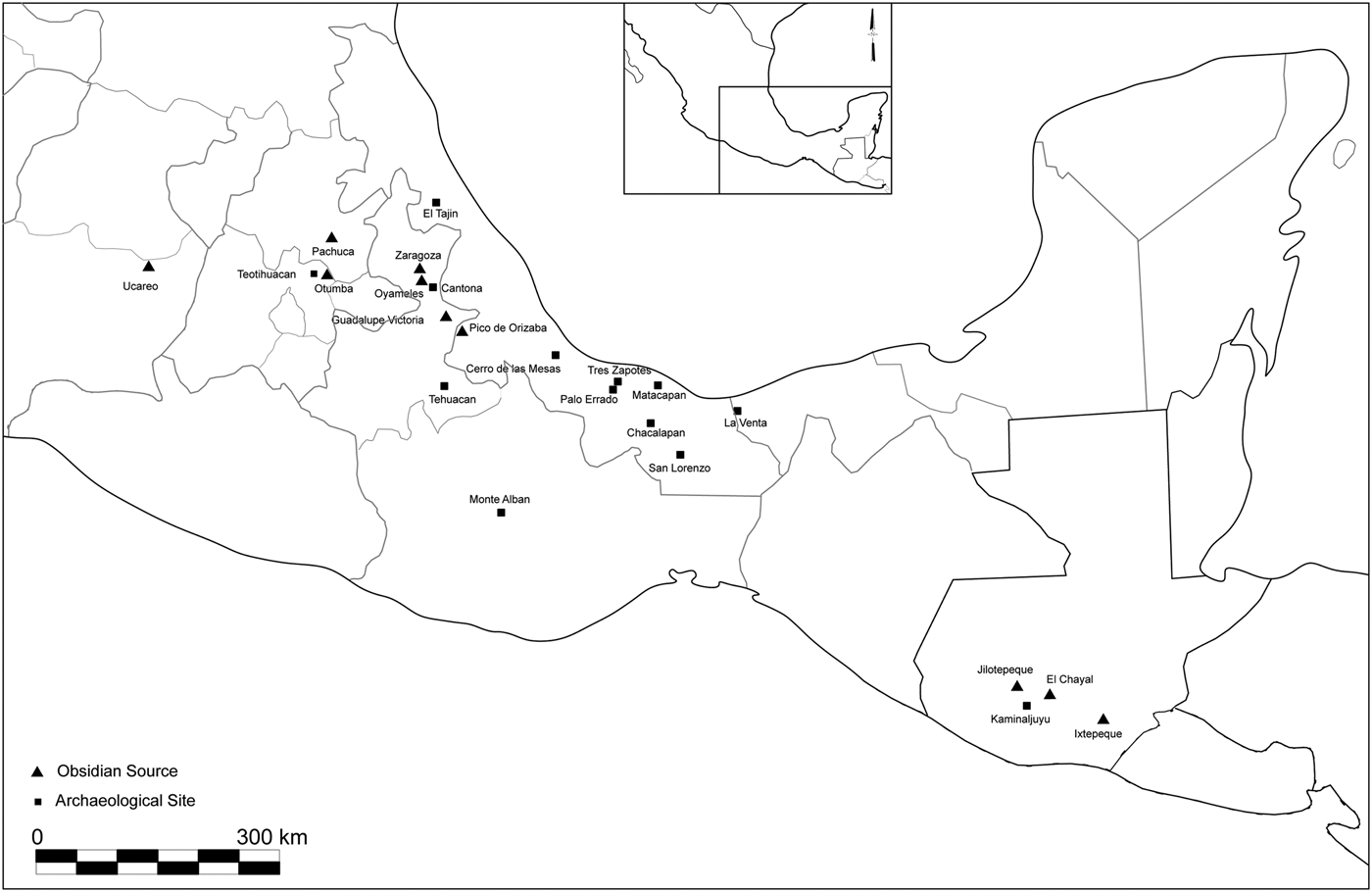
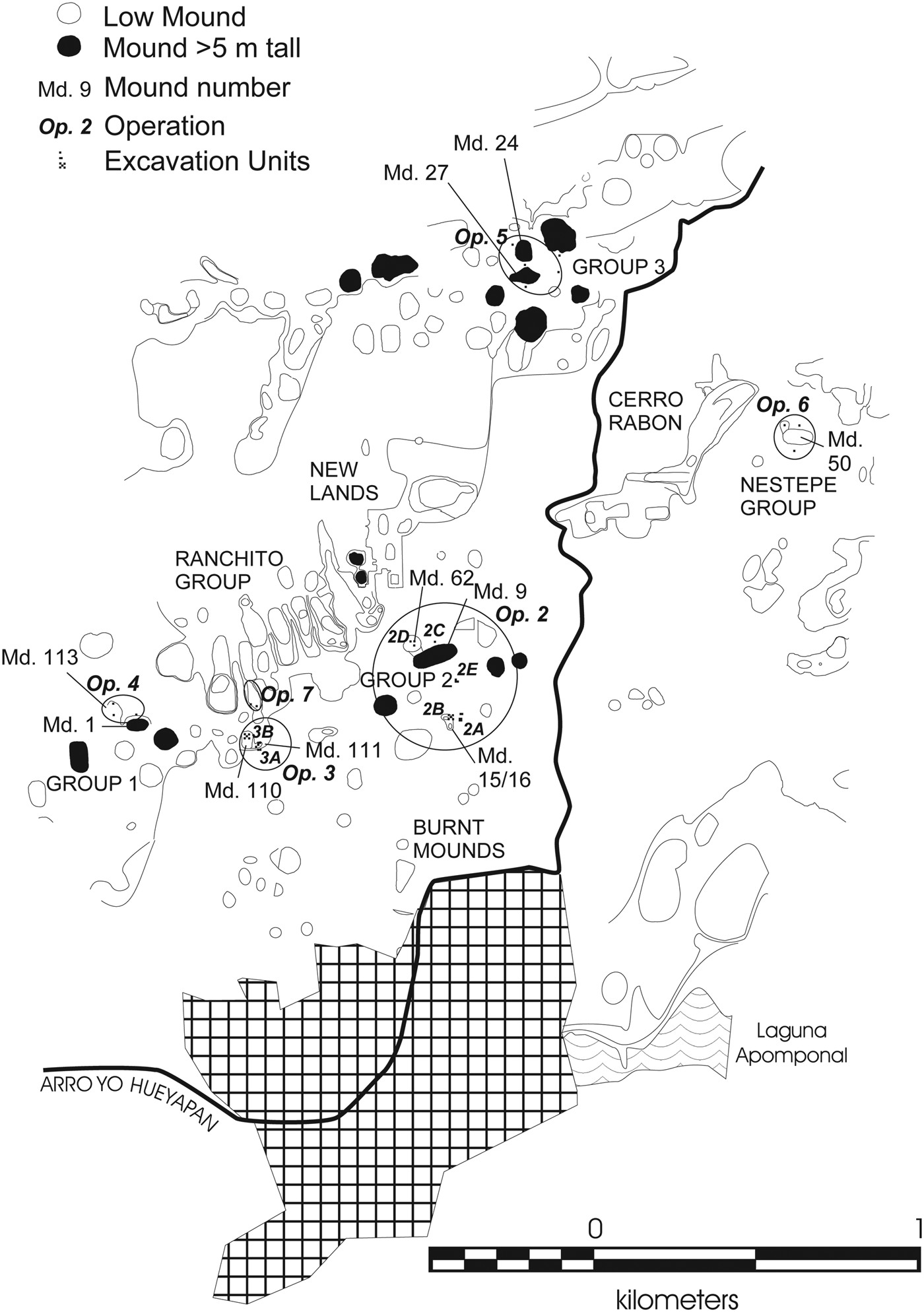
Over a decade ago, Richard Diehl (Reference Diehl, Clark and Pye2000:24) noted, “the transformation of Olmec into Epi-Olmec has never been investigated systematically.” The Proyecto Arqueológico de Tres Zapotes was designed precisely to explore this “most poorly documented phase of Olmec culture” (Diehl Reference Diehl, Clark and Pye2000:24) at the center where it is best represented in the archaeological record. The excavations at Tres Zapotes (Figures 1 and 2), which encompass Olmec and Epi-Olmec ceremonial, residential, and craft production loci in elite and nonelite contexts, provide the most comprehensive information to date on the political and economic factors that contributed to this important transition. Several lines of evidence suggest that the transition involved changes from a centralized political economy in which rulers employed exclusionary strategies to monopolize material and ideological sources of power to one characterized by power-sharing among the leaders of multiple factions in a confederation that emphasized collective themes in polity governance (Pool Reference Pool, Ceballos and González Lauck2008). More broadly, the evolution of Epi-Olmec society from Olmec appears to have responded to and to have helped create a new political and economic landscape in Mesoamerica characterized by greater regionalization in material culture, more intensive competition among polities, realignment of interregional exchange systems, and the emergence of writing systems tied closely to political expression.
Selected archaeological sites and obsidian sources in Mesoamerica.

Map of Tres Zapotes with excavation units and operations indicated.
Research at Tres Zapotes also has highlighted synchronic variation among Olmec and Epi-Olmec societies of the southern Gulf lowlands in art, architectural forms, artifact styles, and chemical compositions of ceramic figurines and pottery (Pool Reference Pool, Arnold and Pool2008; Pool Reference Pool, Clark, Guernsey and Arroyo2010; Pool and Ortiz Ceballos Reference Pool, Arnold and Pool2008; Sears Reference Sears2009). In this regard, one of us (Pool Reference Pool2007:148–149; Pool et al. Reference Pool, Ceballos, Rodríguez and Loughlin2010) has argued that a critical component of Gulf Olmec social and political variation was the establishment of overlapping networks of interregional interaction by communities acting autonomously of one another within the Gulf lowlands. Variation in the presence and apparent prevalence of obsidian sources in different Gulf Olmec sites constitutes an important component of this argument (Cobean et al. Reference Cobean, Coe, Perry, Turekian and Kharkar1971, Reference Cobean, Vogt, Glascock and Stocker1991; Coe and Diehl Reference Coe and Diehl1980a:258–259; Doering Reference Doering2002; Hester et al. Reference Hester, Jack and Heizer1971b; Knight Reference Knight and Pool2003; Knight and Glascock Reference Knight and Glascock2009; Nelson and Clark Reference Nelson, Clark and Rattray1998; Santley et al. Reference Santley, Barrett, Glascock and Neff2001; Stark et al. Reference Stark, Heller, Glascock, Elam and Neff1992; Stokes Reference Stokes1999). Until very recently (see Hirth et al. Reference Hirth, Cyphers, Cobean, de León and Glascock2013), however, sourcing studies of Gulf Olmec and Epi-Olmec obsidian have employed a strategy of judgmentally sampling visually determined obsidian categories for chemical analysis (Cobean et al. Reference Cobean, Coe, Perry, Turekian and Kharkar1971, Doering Reference Doering2002; Knight and Glascock Reference Knight and Glascock2009; Santley et al. Reference Santley, Barrett, Glascock and Neff2001), have conducted chemical analysis on obsidian from a combination of surface-collected and excavated collections (Stark et al. Reference Stark, Heller, Glascock, Elam and Neff1992), or have analyzed unprovenienced specimens (Hester et al. Reference Hester, Jack and Heizer1971b; Hester et al. Reference Hester, Heizer and Jack1971a), all of which reduce the precision with which we can categorize contemporaneous and diachronic variation in reliance on specific sources.
With particular reference to Tres Zapotes, the specimens from Stirling's (Reference Stirling1943; Drucker Reference Drucker1943; Weiant Reference Weiant1943) excavations analyzed with X-ray fluorescence (XRF) spectrometry by Hester and colleagues (Reference Hester, Jack and Heizer1971b) could not be associated with specific excavation units, which in general sampled Late Formative through Classic period deposits but not Early or Middle Formative deposits. Knight's (Reference Knight1999, Reference Knight and Pool2003) subsequent study visually classified obsidian specimens from surface collections and assigned probable sources to them based on instrumental neutron activation analysis (INAA) conducted on Late Formative through Classic period obsidian artifacts classified in the same system as the nearby site of Palo Errado (Knight and Glascock Reference Knight and Glascock2009) and in the central Tuxtlas (Santley et al. Reference Santley, Barrett, Glascock and Neff2001). Knight's study found that certain visual categories in this system did not distinguish between obsidian from Zaragoza-Oyameles and obsidian from Ucareo or from Otumba.
The chemical analysis reported in this study represents a systematically recovered sample of obsidian artifacts from controlled excavation contexts dating from 1200 b.c. to a.d. 300. Knight's (Reference Knight and Pool2003, 2012) visual source classifications have indicated that major changes occurred throughout this time in the number of sources available to elite and nonelite consumers and producers at Tres Zapotes, which correlate to several reduction technologies in meaningful ways. The central question addressed by this project is, how did the transition from Olmec to Epi-Olmec political economies affect obsidian provisioning systems? In particular, we seek answers to the following questions: (1) What sources were utilized, and how did source utilization change over the course of the Formative period? (2) How are sources correlated to reduction technologies? (3) Does temporal and social variation in sources and technology correspond to patterns of corporate and exclusionary strategies of governance as seen in other archaeological indices like architecture and monuments?
For the current study, we submitted 204 obsidian samples from Tres Zapotes for XRF analysis to identify geological sources. This study differs from previous sourcing studies of obsidian in the Gulf lowlands generally and at Tres Zapotes specifically in the following respects: (1) samples were drawn from secure archaeological proveniences specifically assigned to Early, Middle, and Late Formative and Protoclassic periods, and (2) we employed a stratified random sampling strategy that allowed us to statistically assess changes in the prevalence of specific sources in the transition from an Olmec to an Epi-Olmec economy. With 90 specimens drawn randomly from each era, we can say with 99% confidence that sources not represented in the sample did not exceed 5% of the total excavated assemblage for that era and 95% confidence that they did not exceed 3.3%. We supplemented the random sample with specimens judgmentally drawn from visual categories not represented in the random sample so that we may also extend observations to our much larger sample of visually classified obsidian artifacts.
OBSIDIAN AND FORMATIVE POLITICAL ECONOMIES
From the Formative period on, obsidian was the most widely used material for making cutting and piercing implements in Mesoamerica, in addition to being used for finely crafted jewelry, insignia, ritual paraphernalia, and other lapidary items. In most parts of Mesoamerica, obsidian tools and debitage also constitute the largest class of lithic artifacts, the exceptions occurring in places such as parts of Oaxaca and the Maya lowlands where high-quality chert was available. Natural occurrences of obsidian, however, are restricted to those cases where rapid cooling of magma or lava flows resulted in an amorphous, glassy structure with little to no crystal development. As is well known, conditions for the production of voluminous obsidian deposits are unusual, even in volcanic terrains. For example, the volcanic Tuxtla Mountains that rise from the southern Gulf lowlands of Mexico produced extensive basalt flows but no obsidian deposits. As a result, exploitable obsidian deposits are restricted to a limited (though not small) number of discrete sources. Currently, about 40 obsidian sources are distinguished within Mesoamerica. These sources lie in two large regions of volcanism, one containing some 28 sources stretching from Jalisco and Nayarit through central Mexico to Veracruz and the other in the Guatemala highlands (eight sources) and nearby Honduras (one source, at Lake Yojoa) (Cobean Reference Cobean2002:Figure 1.1). Other sources are known beyond the geographic limits of Mesoamerica in north and west Mexico, and it is possible that as-yet unexplored sources exist in Oaxaca, Guerrero, and/or Chiapas (Cobean Reference Cobean2002:31).
Outside of these source zones, obsidian had to be acquired as an exotic good, often over hundreds of kilometers, along routes that ran through the territories of multiple polities, either by direct procurement, through some form of exchange, or as tribute. The use of obsidian for a variety of utilitarian, military, and symbolic functions; the technological skill required to produce prismatic blades and lapidary items; the wide distribution of obsidian beyond source zones; and the limited geographic occurrence of sources offer multiple possibilities for elite involvement in and control over obsidian production and distribution systems. Consequently, obsidian has figured in explanations for the Formative period emergence of administrative hierarchies and political elites for decades, whether framed within an adaptationist model (in the sense of Brumfiel and Earle Reference Brumfiel, Earle, Brumfiel and Earle1987; but see also Cobean et al. Reference Cobean, Coe, Perry, Turekian and Kharkar1971; Pires Ferreira Reference Pires-Ferreira and Flannery1976; Rathje Reference Rathje1971, Reference Rathje and Leone1972) or in more strictly political terms (for example, Clark Reference Clark, Johnson and Marrow1987).
For the Formative period Gulf lowlands, Rathje (Reference Rathje and Leone1972) argued that sociopolitical hierarchies developed among the Olmecs in response to the need to organize long-distance trade for utilitarian goods not available locally, including obsidian, basalt, and salt. Coe and Diehl (Reference Coe and Diehl1980b:148) likewise argued that control over the exchange of obsidian and basalt played an important (but not exclusive) role in supporting elites, stating, “Once these imports arrived at San Lorenzo, the elite redistributed them to their kin, festival guests, and allies. The effects of withholding these essentials would have been realized by both the givers and the recipients, and this inevitably led to the formation and consolidation of economic power by the San Lorenzo elite.” Clark (Reference Clark, Johnson and Marrow1987) later observed that, while obsidian exchange and expedient reduction technologies involving direct percussion and/or bipolar reduction were widespread, blade technology was adopted on a region-by-region basis and appeared to be associated with chiefly centers. Clark noted that there was little evidence for Early Formative exchange of blade cores, including at San Lorenzo, where it appeared finished prismatic blades were imported as luxury goods used to reinforce chiefly status. In contrast, Middle Formative chiefs at La Libertad and in the Central Depression of Chiapas adopted blade core technology and patronized the craft, distributing blades to supporters. Clark (Reference Clark, Johnson and Marrow1987:283) concluded that the spread of prismatic blade technology required the achievement of a threshold of organizational complexity comparable to that of a complex chiefdom, as well as sufficient political motivation by elites to sponsor the production of blades and the acquisition of suitable material.
Describing Formative period obsidian procurement in the Mixtequilla, Stark and associates (Reference Stark, Heller, Glascock, Elam and Neff1992:231) suggested that relatively open community relations and down-the-line exchange accounted for the greater diversity of Formative period obsidian sources but hinted that the general adoption of prismatic blades in the Classic period and the shift to one dominant source zone (Zaragoza-Oyameles) was consistent with achievement of Clark's organizational threshold, albeit in a later time frame. Santley and associates (Reference Santley, Barrett, Glascock and Neff2001:59) indicate that prismatic blades occur in low frequencies in Formative assemblages in the Tuxtlas. They do not specify whether those blades were assigned to the Early, Middle, or Late Formative period, but Santley (Reference Santley2007:Figure 3.3) reports the presence of prismatic blades, macrocore reduction debitage, and pressure cores from Early Formative contexts at Matacapan, which at the time consisted of a small village and several hamlets. There is some question as to whether the Olmec ceramic assemblage at Matacapan is more indicative of the Early or Middle Formative period, but in either case, the assemblage offers a contrast to the pattern described by Clark and would suggest that prismatic blade production in some cases escaped elite control. Santley and associates (Reference Santley, Barrett, Glascock and Neff2001:59) nevertheless posit individual exchange partnerships between the source region's producers and clients, with an (apparently) minor role for local “elites” in managing the network of exchange partners.
Evidence from beyond the southern Gulf lowlands supports some degree of elite involvement in the procurement of strategic resources. Discussions of Formative interregional interaction underscore the extensive exchange of obsidian and frequently posit obsidian procurement in combination with other materials (especially greenstone and iron ore), as an incentive for Gulf Olmec involvement in other regions (Hirth Reference Hirth1978; Pool Reference Pool2007:216; Tolstoy Reference Tolstoy, Sharer and Grove1989). The Early Formative site of Cantón Corralito offers a case in which Olmecs may have established an enclave at an important trade node (Cheetham Reference Cheetham2010), although the degree to which heartland elites may have controlled the enclave's activities is uncertain (Pool Reference Pool2007:192–194). The themes and distribution of Middle Formative Olmec-style monuments and rock carvings, especially, suggest the formation of alliances between Olmec elites and those of polities along routes to the sources of these materials (Castro and Cobean Reference Castro Lainez and Cobean1996; Doering Reference Doering2002; Grove Reference Grove and Grove1987, Reference Grove and Rice1993; Pool Reference Pool2007:240). Such efforts evoke Hirth's (Reference Hirth1996:224) “matrix control” principle in which elites seek to control networks by placing themselves at key positions to control the production, accumulation, and flow of resources—they may also have sought to create social contexts (marriages, feasts, alliance renewals, etc.) that promoted the accumulation and exchange of goods like obsidian.
INFERRING CONTROL
How do we infer elite control? As this brief review of research on Formative obsidian production and exchange suggests, we must first ask, control over what? Not just control over which materials or products, but control over which aspects of the procurement-production-distribution sequence. We may ask that question broadly, with respect to control over source regions, production technology, transport, or the formulation of social and religious sanctions, but each of these encompasses particular sets of knowledge, skills, tools, and social relations that may offer opportunities for control or its subversion. Another approach is to analyze political economies in terms of how they applied general principles or strategies, such as those described by Hirth (Reference Hirth1996) as the accumulation, context, matrix-control, and ideological principles; the sets of “corporate” and exclusionary strategies discussed by Blanton et al. (Reference Blanton, Feinman, Kowalewski and Peregrine1996); or the staple and wealth finance systems proposed by D'Altroy and Earle (Reference D'Altroy and Earle1985). Such frameworks provide useful insights into how political actors may have employed economic relations toward political ends, but they still hinge on empirical demonstration of control over particular components of the economic system.
Demarest (Reference Demarest2014) makes the important point that the conceptual distinctions among “control,” “supervision,” and “participation” must be maintained, with control implying power over actors, supervision involving oversight and direction of participants, and participation involving the physical execution of some aspect of the activity. We would add that these are distinctive but not mutually exclusive categories. Thus supervision is one way by which control may be exercised, although supervisors themselves may respond to the orders of superiors. Most arguments for elite control over production come down to a demonstration of the proximity of craft production facilities to elite residential or administrative structures, and by inference elite or state supervision of those activities, as in discussions of attached, as opposed to independent, specialization (Brumfiel and Earle Reference Brumfiel, Earle, Brumfiel and Earle1987; Costin Reference Costin and Schiffer1991; Pool Reference Pool and Pool2003; but compare with Hirth Reference Hirth2008:443–444).
Some words of caution regarding propinquity arguments are necessary, however. First, physical proximity may argue strongly for supervision over the activities conducted in a facility, as well as control over access to the facility, but unless producers resided at such attached production locations, it's hard to say what they did while they were away; whether they worked similar materials or created similar products elsewhere, or whether their labor was mobilized seasonally or intermittently for production at those locations. Second, identifying one or a few cases of physically attached production does not necessarily imply that elites controlled all such production, as John Clark (Reference Clark and Hirth2003:53) has observed. At Tres Zapotes, for example, we have found evidence for contemporaneous crafting of ceramics, basalt, and obsidian in elite and nonelite contexts (Pool Reference Pool and Hirth2009). Third, a lack of proximity does not necessarily imply an absence of control. Indeed, elite power is all about increasing the ability to exercise control over more people at ever-greater distances, and it is not always necessary that clients make their crafts under a patron's watchful eye for such control to be effective.
Some have therefore argued that the production of highly crafted, labor intensive luxury or wealth items in nonelite residential contexts also constitutes attached specialization (Lewis Reference Lewis1996). On the other hand, we have identified cases at Tres Zapotes in which quotidian items were produced in facilities physically attached to elite structures (Pool Reference Pool and Pool2003). Here the problem is one of disentangling the product and the location of production from control over production. Doing so is important if we are to recognize novel arrangements with respect to production and patronage; distinguishing supervision as one means of control moves us in that direction. All of this is to say that, though propinquity may provide a strong argument for elite supervision of that production unit when we find it, it is certainly incomplete. To argue that elites controlled production of a class of goods by locating producers under their gaze (or producing items themselves as, for example, has been argued for Aguateca, Guatemala [Aoyama Reference Aoyama2007; Emery and Aoyama Reference Emery and Aoyama2007]), we must also look for (and fail to find) evidence for production of those goods in nonelite (residential or nonresidential) contexts.
The exercise of control also involves determining rights of allocation—that is, who has access to a good and how much. For valuable items, it is reasonable to posit that those in control of valuables will have greater access to them, and greater access will be reflected by proportionately greater representation of the good in contexts associated with that segment of society. In essence, this is the basis for distributional arguments for elite control over a resource: elites will have more and better examples of a valued good than will nonelites, with value being determined by overall scarcity, exoticness, labor expenditure, and such subjective characteristics as quality of material and skill of execution.
Keeping these considerations in mind in our evaluation of the role of obsidian in the political economy of Tres Zapotes and the southern Gulf lowlands, we expect elite control over obsidian procurement to result in one or more of the following patterns:
(1) If elites exclusively controlled obsidian procurement, the number of sources represented at centers should equal or exceed the number at hinterland sites (compare with Hirth Reference Hirth2008:443–444).Footnote 1 Demonstration of greater source diversity in centers is not, however, conclusive demonstration of elite control because inhabitants of centers could also have access to more sources through periodic fairs or incipient markets. If procurement was household-based, we might also expect a greater diversity of sources due to the aggregate effect of individualized procurement arrangements among a larger populace.
(2) Where particular technologies require specific material characteristics, elite control may be expressed in monopolization of these “higher quality” (most suitable) resources for elite use. For example, for prismatic blade production on obsidian, an amorphous texture lacking crystalline inclusions or internal fracture planes is frequently cited among “high quality” characteristics.
(3) Under classic models of chiefly redistribution, obsidian pooled by elites at centers and redistributed to lower-order centers and hinterland sites should exhibit similar proportions of different sources within sites or intrasite contexts of similar rank (Hirth Reference Hirth2008:444; Pires-Ferreira Reference Pires-Ferreira and Flannery1976).
(4) It follows from (1), (2), and (3) that the obsidian sources present in villages, lower-order centers, and nonelite residences should be a subset of those present in elite contexts at higher-order centers, again, if classic redistribution models apply.
(5) Supervision of a specific obsidian technology would be supported by the presence of production debitage characteristic of that technology in elite contexts and its absence in nonelite contexts (although we acknowledge that elite control may also be exercised at a distance). To the degree that specific sources are favored for a particular reduction technology, we would expect this pattern to appear for some sources and not others.
A reduced degree or absence of elite control should be reflected in divergences from these patterns. In particular, if elites are unable to effectively control procurement-distribution networks at a particular scale (supraregionally, regionally, or within their hinterlands), we would expect greater variation in the number of sources and relative frequencies of specific sources, the number of sources would not be a simple function of site rank or intrasite social rank, hinterland sites and domestic contexts might gain access to alternative obsidian sources not represented in centers or elite contexts, and production residues associated with specific obsidian technologies will not be exclusive to elite contexts.
ARCHAEOLOGICAL BACKGROUND FOR TRES ZAPOTES
Tres Zapotes is famous as the site of the first discovery of a colossal Olmec head (Melgar Reference Melgar1869, Reference Melgar1871) and the second earliest Long Count inscription in Mesoamerica (Stirling Reference Stirling1939, Reference Stirling1940). The modern study of Formative period Gulf Coast archaeology was launched there in 1939 by Stirling's (Reference Stirling1943) joint National Geographic–Smithsonian Institution expedition (see also Drucker Reference Drucker1943; Weiant Reference Weiant1943). Archaeological survey, surface collection, and excavation we have conducted at Tres Zapotes since 1995 have documented the following site history, spanning two millenia.
Tres Zapotes was founded in the Early Formative period, growing to a village of 17 ha by 1000 cal b.c. (Pool et al. Reference Pool, Ceballos, Rodríguez and Loughlin2010). Over the course of the Middle Formative period (1000–400 cal b.c.), the site center grew to 80 ha, surrounded by another 70 ha of adjoining settlement concentrations. At least 11 Olmec monuments were set at Tres Zapotes during the Middle Formative period, including two colossal heads, two stelae, five figures in the round, two tenoned busts, and a carved serpentine column (Pool Reference Pool, Clark, Guernsey and Arroyo2010). The number of monuments, their thematic content, and the areal extent of Tres Zapotes, second only to La Venta among Middle Formative Gulf Olmec sites, marks it as a regional Olmec center (Pool and Ortiz Ceballos Reference Pool, Arnold and Pool2008). The sculptural focus on the ruler as an individual, the arrangement of monuments in a way that emphasizes the centralization of political power, and greater use of exotic greenstone in ritual displays and mortuary programs suggest that polity governance and the political economy emphasized exclusionary principles (Pool Reference Pool, Clark, Guernsey and Arroyo2010; see also Blanton et al. Reference Blanton, Feinman, Kowalewski and Peregrine1996).
Alone among Gulf Olmec centers, Tres Zapotes continued to flourish in the Late Formative period, expanding to cover 500 ha. Major programs of formal mound construction were initiated at the Epi-Olmec center, focused on four widely dispersed complexes, each of which replicated a basic layout consisting of a plaza oriented east-west, bounded on the north by a long, loaf-shaped, administrative/elite residential mound and on the west by a pyramidal temple mound, with a low mound on the centerline of the long axis of the plaza; other mounds were added as the complexes grew (Pool Reference Pool, Arnold and Pool2008). The functional and formal redundancy of the architectural layouts, the lack of a single, clearly dominant center, and the chronological overlap in their construction and use suggest that political power was shared among faction leaders (Pool Reference Pool, Arnold and Pool2008). Additionally, a thematic shift in stone monuments away from an individualizing emphasis on the ruler suggests that governing strategies at the polity level emphasized collective (or “corporate” [Blanton et al. Reference Blanton, Feinman, Kowalewski and Peregrine1996]) as opposed to exclusionary themes (Pool Reference Pool, Clark, Guernsey and Arroyo2010). In concert with these changes (whether as cause or consequence) we would expect the Late Formative political economy of Tres Zapotes to deemphasize the monopolization of prestige goods and to broaden access to strategic resources. These expectations are met in a reduction in the prevalence of exotic materials other than obsidian in our excavations and the redundant production of utilitarian craft items in elite and nonelite contexts (Knight Reference Knight and Pool2003, 2012; Pool Reference Pool and Pool2003).
During the Protoclassic period (a.d. 1–300), architectural layouts at Tres Zapotes diversified through a combination of new construction, shifts in mound function, and resetting of associated monuments—trends which continued in the Classic period (Pool Reference Pool, Arnold and Pool2008, Reference Pool, Clark, Guernsey and Arroyo2010). As factional leaders began to distinguish themselves through novel architectural programs at Tres Zapotes, leaders at settlements like El Mesón, Alvarado, and La Mojarra reemphasized exclusionary themes of dominance and individualizing claims to rulership (Loughlin Reference Loughlin2012; Pool and Loughlin Reference Pool and Loughlin2006). Although Tres Zapotes retained its regional prominence and most of its areal extent in the Protoclassic period, it began a slow decline, falling to about 200 ha by the beginning of the Classic period around a.d. 300. By a.d. 900 Tres Zapotes lay abandoned, to be reoccupied only briefly in the Early Postclassic period (Drucker Reference Drucker1943; Pool Reference Pool1995).
The location of Tres Zapotes, on the ecotone between the Papaloapan drainage system to the west and the Sierra de los Tuxtlas to the east, was ideally suited to take advantage of both riverine and montane resources. One montane resource, basalt, is plentiful in the Tuxtlas and occurs in fine-grained varieties that can produce a sharp edge when flaked. Kruszczynski's (Reference Kruszczynski2001) survey of basalt exploitation in the area, however, indicates that this common local source was used for different tasks from obsidian. At the same time, cryptocrystalline alternatives, such as chert, are scarce in the southern Gulf lowlands. As a result, the inhabitants of Tres Zapotes relied almost exclusively on imported obsidian throughout the Formative and Classic periods for all cutting and scraping activities. Since the valleys and streams of the Ríos Papaloapan, Salado, and Grande to the west of Tres Zapotes provide the most direct and gradual route between the southern Gulf lowlands, the Basin of Mexico, and the Valley of Oaxaca (Drennan et al. Reference Drennan, Fitzgibbons, Dehn and Isaac1990:197), Tres Zapotes was better positioned than most other sites in the southern Gulf lowlands to acquire obsidian from sources in the central and western highlands of Mexico.
The three closest and most commonly utilized obsidian sources for the southern Gulf lowlands are those at Pico de Orizaba, Guadalupe Victoria, and Zaragoza-Oyameles, all located 150–200 km to the northwest along the eastern edge of the Trans-Mexican Volcanic Belt, straddling the Veracruz/Puebla border (Ferriz Reference Ferriz1985, Siebert and Carrasco-Núñez Reference Siebert and Carrasco-Núñez2002). Surface and excavation data from the Mixtequilla (Stark et al Reference Stark, Heller, Glascock, Elam and Neff1992) indicate that obsidian from Guadalupe Victoria and Pico de Orizaba were the most common sources used there during the Early and Middle Formative periods, while Zaragoza-Oyameles was most common in the Protoclassic and Classic periods, coinciding with the establishment of Cantona as a regional center near the Zaragoza-Oyameles source area in eastern Puebla (García Cook Reference García Cook, Sanders, Mastasche and Cobean2003, García Cook and Merino Carrión Reference García Cook and Carrión1998). A similar diachronic pattern was observed in a nonrandom sample of excavated obsidian from the Sierra de los Tuxtlas (Santley et al. Reference Santley, Barrett, Glascock and Neff2001). In both samples, however, materials also were identified from sources in the central and western Mexican highlands at Paredón, Otumba, Zacualtipan, and Pachuca and from the highland Guatemalan source of San Martín Jilotepeque. Prior to the study reported here, the degree to which Tres Zapotes participated in these and similar provisioning networks through time was uncertain.
Whether Tres Zapotes was provisioned with obsidian from the three closest sources or from farther afield, it had to be transported over hundreds of kilometers from sources in the Mexican and Guatemalan highlands. As such, the energy involved in the transportation of obsidian to the southern Gulf lowlands—and the reduction technologies embedded in the commodity—may have imbued it with a value whose control could have been beneficial to local elites. It is within this framework of political economy that we investigate the role of obsidian in the models of centralization and confederacy at Tres Zapotes.
LITHIC TECHNOLOGY AND OBSIDIAN SOURCING AT TRES ZAPOTES
The Tres Zapotes Archaeological Project (PATZ) investigated a sequence of site occupation spanning some 2,000 years, from the Early Formative to the Early Classic period (1400 b.c.–a.d. 600) (Pool Reference Pool2005). As noted above, Late Classic and Postclassic occupations also have been identified at Tres Zapotes but were not a focus of this study. The project excavated 41 stratigraphic units grouped into 12 Operations and Suboperations, sampling all formal plaza groups and three domestic areas with evidence of craft production. This resulted in a chipped-stone assemblage of 5,728 artifacts, with all but 15 made from obsidian. Industries represented in the assemblage consisted almost entirely of bipolar and core-blade reduction technologies. Less than 1% of the assemblage was the product of bifacial reduction technology. Of the 5,728 artifacts recovered, 29% (n = 1,636) came from civic-ceremonial and elite contexts and 27% (n = 1,562) came from nonelite, domestic contexts. The remaining 44% of artifacts came from the plowzone, from mixed contexts, or from contexts with questionable temporal affiliation. All obsidian artifacts collected so far have been analyzed by Charles Knight, ensuring consistency in visual characterization and technological classification.
Following established procedures for the Tuxtla region, Knight's visual characterization of artifacts distinguished black, gray, clear, and green obsidian, as well as finer variations in color, texture, and fabric referred to as “subcolors” (Barrett Reference Barrett2003; Santley et al. Reference Santley, Barrett, Glascock and Neff2001).Footnote 2 The Olmec epoch (Early and Middle Formative periods) was dominated by clear obsidian. Olmec reduction technology at Tres Zapotes was principally bipolar, but core-blade reduction became increasingly prevalent in both elite and nonelite contexts with time (Knight Reference Knight2009; Knight and Pool Reference Knight and Pool2008). In the Early Formative period, prismatic blades were made from black obsidian and were limited to elite contexts. By the end of the Middle Formative period, prismatic blades and their production indicators occurred in both elite and nonelite contexts, in clear and, to a much lesser degree, black obsidians. Without chemical analysis it was difficult to say if the Early and Middle Formative clear and black obsidians represented an “international” variety of sources, such as those identified at San Lorenzo (Cobean et al. Reference Cobean, Coe, Perry, Turekian and Kharkar1971, Reference Cobean, Vogt, Glascock and Stocker1991; Hirth et al. Reference Hirth, Cyphers, Cobean, de León and Glascock2013), or if they represent more local or “provincial” obsidian exchange networks centered on the Guadalupe Victoria, Pico de Orizaba, or Zaragoza-Oyameles sources of eastern Puebla and western Veracruz.
Core-blade technology became a relatively common Epi-Olmec technology in the Late Formative period before the major exchange network in black obsidian was established, which source analyses elsewhere in the southern Gulf lowlands suggest was from the Zaragoza-Oyameles source (Esquivias Reference Esquivias2003; Knight and Glascock Reference Knight and Glascock2009; Santley et al. Reference Santley, Barrett, Glascock and Neff2001; Stark et al. Reference Stark, Heller, Glascock, Elam and Neff1992). By the Protoclassic period, black obsidian predominated in commoner contexts where core-blade technology all but replaced bipolar technology. Visual determinations suggest the existence of significantly different obsidian procurement strategies in the Protoclassic period from previous occupation periods and between elite and nonelite contexts. One such system may be that which provisioned a single nonelite locus of the site with polyhedral cores exhibiting ground and scratched platforms, a technology heretofore unseen at the site (Knight Reference Knight2009). All examples with this platform treatment are black and may have come from one source, possibly as a single core. If, however, they came from multiple sources, the platform grinding would have had to occur at some common distribution point away from the sources, perhaps by itinerant craftsmen. Evidence for the removal of these blades from cores with ground platforms exists at Tres Zapotes, but no direct evidence for platform grinding has been recovered, such as platform preparation flakes, pecking tools, or stone slabs with characteristic abrasion marks (see Hirth and Flenniken [Reference Hirth, Flenniken, Hirth and Andrews2006] for examples).
PREVIOUS OBSIDIAN STUDIES AT TRES ZAPOTES AND IN ADJACENT AREAS OF THE SOUTHERN GULF COAST
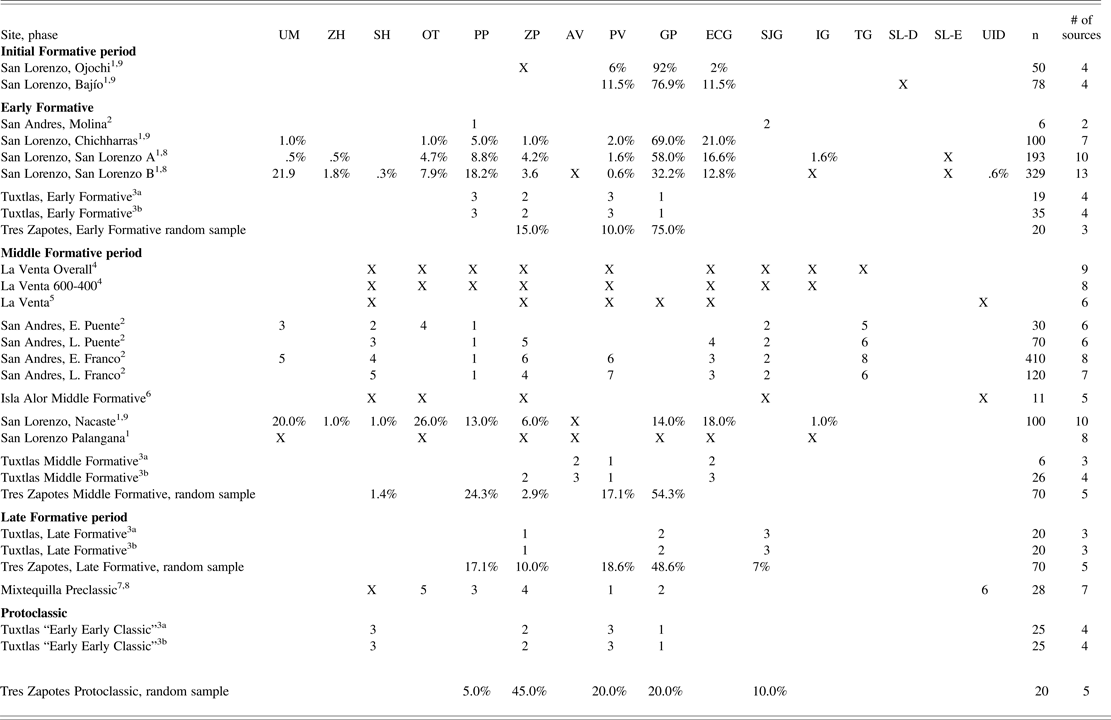
Over the course of the Formative period, the southern Gulf lowlands were provisioned by at least 13, and possibly as many as 16, obsidian sources (Table 1). The number of sources utilized varied greatly over time and space, however. At San Lorenzo, for example, 11 sources have been identified in the Early Formative assemblage (not including two still “unidentified sources” and “unknown” sources [Cobean et al. Reference Cobean, Coe, Perry, Turekian and Kharkar1971, Reference Cobean, Vogt, Glascock and Stocker1991; Hirth et al. Reference Hirth, Cyphers, Cobean, de León and Glascock2013]). At San Andrés, Tabasco, Formative deposits yielded obsidian from a total of nine sources, with only two sources assigned to the Early Formative period (Doering Reference Doering2002). For Formative settlements in the Tuxtla Mountains, Santley and associates (Reference Santley, Barrett, Glascock and Neff2001) identified six sources, with three to four being utilized in any one period. In the south-central Gulf lowlands, Stark and associates (Reference Stark, Heller, Glascock, Elam and Neff1992) identified six known sources in the Formative obsidian assemblage of two low mounds (Mounds 693 and 985) in the Mixtequilla area, as well as a possible additional source.
Formative period obsidian source utilization in the southern Gulf lowlands
X = present, integer = rank in sample (1 = highest rank), percentage values for Tres Zapotes and San Lorenzo indicate prevalence in random samples.
Source Abbreviations: UM, Ucareo-Zinapecuaro, Michoacan; SH, Sierra de Pachuca, Hidalgo; OM, Otumba, Mexico; PP, Paredón, Puebla; ZP, Zaragoza, Puebla; AV, Altotonga, Veracruz; PV, Pico de Orizaba, Veracruz; GP, Guadalupe Victoria, Puebla; ECG, El Chayal, Guatemala; SMG, San Martín Jilotepeque, Guatemala; IG, Ixtepeque, Guatemala; TG, Tajumulco, Guatemala; SL-A', San Lorenzo source A'; SL-D, San Lorenzo source D; SL-E, San Lorenzo source E; UID, Unidentified sources.
References:
1Cobean et al. Reference Cobean, Coe, Perry, Turekian and Kharkar1971:Table 2 (presence/absence). Subsequent analysis reassigned Group A/A' to Paredón, B/B' to Ucareo-Zinapecuaro, and C/C' to Zaragoza-Oyameles (Cobean Reference Cobean2002:53, personal communication 2013; Hirth et al. Reference Hirth, Cyphers, Cobean, de León and Glascock2013:2785, footnote 5).
2Doering Reference Doering2002:Tables 5 and 10 (rank based on weight in visually sourced sample).
3aSantley et al. Reference Santley, Barrett, Glascock and Neff2001:Table 3a (phase-specific samples only).
3bSantley et al. Reference Santley, Barrett, Glascock and Neff2001:Table 3b (includes samples assigned to more than one phase).
4González 2005, personal communication.
5Stross et al. Reference Stross, Hester, Heizer, Jack and Taylor1976.
6Stokes Reference Stokes1999.
7Stark et al. Reference Stark, Heller, Glascock, Elam and Neff1992:229. Includes Late Preclassic (600–300 b.c.) and Terminal Preclassic (300 b.c.–a.d. 300). Pachuca (SH) was visually identified.
8Heller Reference Heller and Stark2001:161–163, Table 9.2. See notes for Reference 7 (Stark et al. Reference Stark, Heller, Glascock, Elam and Neff1992).
9Hirth et al. Reference Hirth, Cyphers, Cobean, de León and Glascock2013:Tables 4–8 (percentages calculated from reported frequencies).
In one of the early obsidian sourcing studies, Hester et al. (Reference Hester, Jack and Heizer1971b) conducted XRF source analysis from a sample of 865 unprovenienced obsidian artifacts excavated in 1939 and 1940 by Matthew Stirling at Tres Zapotes. Their analysis determined that 93.4% of the sample was Zaragoza-Oyameles obsidian. In addition, obsidian from Guadalupe Victoria, Pachuca, Pico de Orizaba, and three unknown sources were identified, one of which has since been identified as Zinapecuaro (Healan Reference Healan1997). Unfortunately, the results cannot be used to understand diachronic and spatial variation in the Tres Zapotes obsidian economy.
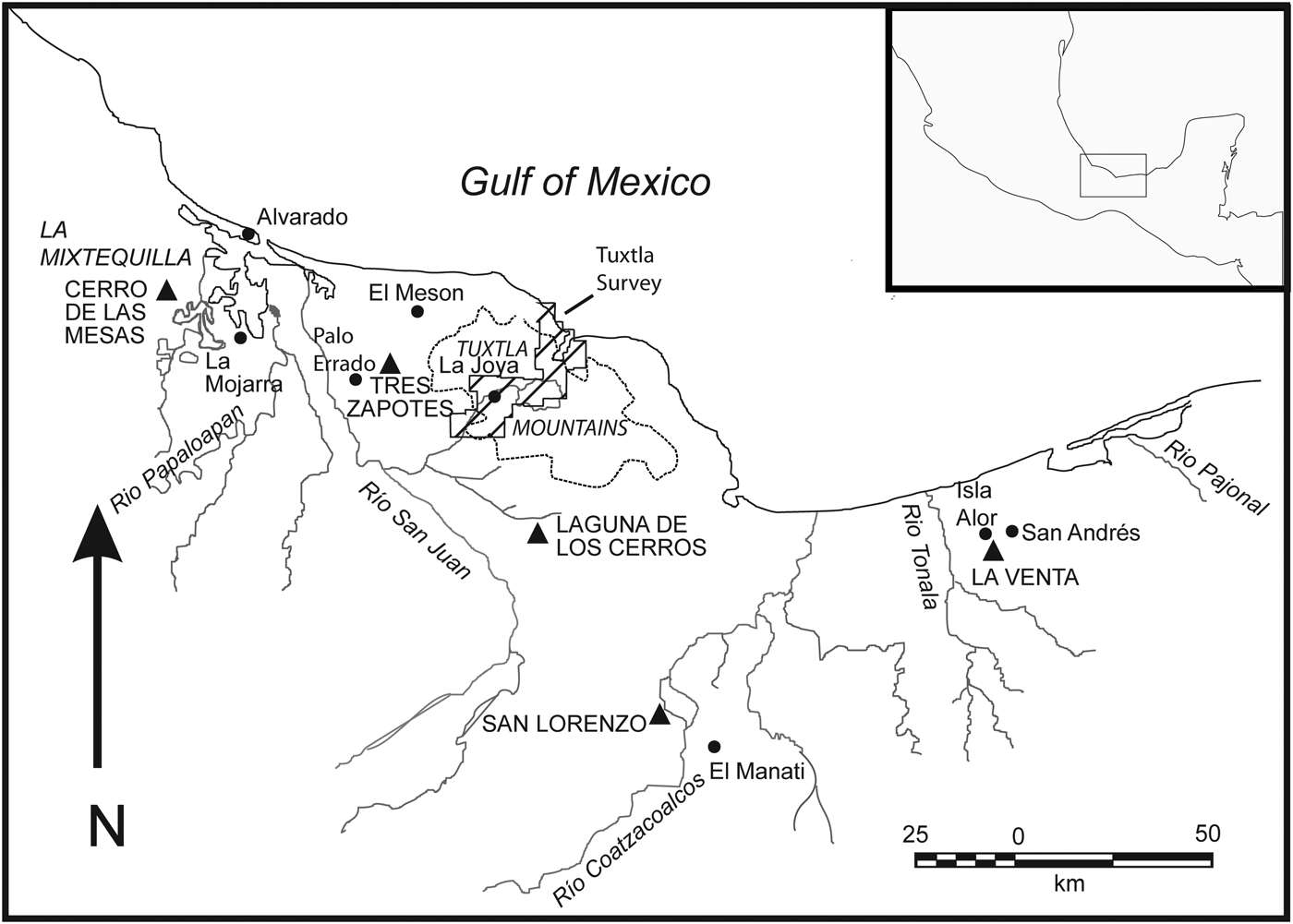
Knight had a sample of 100 provenienced artifacts from excavated contexts at the Protoclassic to Classic period site of Palo Errado, located 10 km southwest of Tres Zapotes (Figure 3), sourced using INAA (Knight and Glascock Reference Knight and Glascock2009). The results identified clear obsidians from Zaragoza-Oyameles, Pico de Orizaba, and Guadalupe Victoria; black obsidians from Zaragoza-Oyameles, Ucareo-Zinapecuaro, and Otumba; and green obsidian from Pachuca (Figure 1). Obsidian from Guatemala has not been identified at Palo Errado but has been recovered from Middle and Late Formative contexts in the Sierra de los Tuxtlas (Santley et al. Reference Santley, Barrett, Glascock and Neff2001), Classic period contexts in the Hueyapan region (Esquivias Reference Esquivias2003), and Early and Middle Formative occupations at the Olmec centers of La Venta and San Lorenzo (Cobean et al. Reference Cobean, Coe, Perry, Turekian and Kharkar1971, Reference Cobean, Vogt, Glascock and Stocker1991; Hirth et al. Reference Hirth, Cyphers, Cobean, de León and Glascock2013; Jack and Heizer Reference Jack and Heizer1968).
Map of the southern Gulf Coast of Mexico, with sites discussed in the text.
SAMPLING AND ANALYTICAL PROCEDURES
Obsidian artifacts from the PATZ excavations were visually classified based on color, including characteristics of transparency and translucency. Four base colors were distinguished (black, clear, green, and gray). Color categories also were divided into fourteen “subcolors” that refer to secondary visual characteristics and account for the full range encountered in the analysis. The presence and size of inclusions, surface texture, and other characteristics also were noted. The visual categories assigned to the PATZ obsidian match those assigned to the sample submitted to the University of Missouri Research Reactor (MURR) for INAA testing from Palo Errado (Knight and Glascock Reference Knight and Glascock2009).
After the initial visual classification, a stratified random sample of 180 excavated obsidian artifacts was selected for XRF at MURR. These were supplemented by a judgmental sample of 24 artifacts, raising the total to 204 artifacts (a .04% sample overall). The random sample was stratified between Olmec (Early and Middle Formative) and Epi-Olmec (Late Formative and Protoclassic) occupations to obtain a statistically valid representation of obsidian source use through time. The figure of 90 specimens from each sampling stratum was chosen to provide a confidence level of .99 that a missing source constituted less than 5% of the obsidian recovered (Drennan Reference Drennan1996:Table 18.1). The nonrandom sample was chosen to ensure that all visually distinct categories were sampled and to determine the source of several anomalous prismatic blades and flakes with ground platforms. The blades and flakes with platform grinding all come from a single Protoclassic occupation and represent one of the earliest examples of platform grinding technology in Mesoamerica (Coe and Diehl [1980a:248] report a possibly earlier example from the Nacaste phase).
All artifact samples were analyzed by an energy-dispersive XRF spectrometer. The spectrometer was a Bruker Tracer III-V handheld portable. It is equipped with an air-cooled rhodium target anode X-ray tube with a 140 µm Be window and a thermoelectrically cooled Si-PIN diode detector. The detector has a resolution of 180 eV for the 6.4 keV peak from iron. The beam dimensions are approximately 2 × 3 mm. In order to measure the elements in this study (K, Ti, Mn, Fe, Zn, Ga, Rb, Sr, Y, Zr, and Nb), the X-ray tube was operated at 40 kV and a count rate of about 1,250 counts per second, which varied according to sample size. Measurement times on all samples were 180 seconds. Peak deconvolution and element concentrations were accomplished using the Bruker spectral analysis package. The instrument was calibrated using data from a series of well-characterized source samples in the MURR reference collection, including eleven Mesoamerican sources (El Chayal, Ixtepeque, San Martín Jilotepeque, Guadalupe Victoria, Pico de Orizaba, Otumba, Paredón, Sierra de Pachuca, Ucareo, Zaragoza, and Zacualtipan) and three Peruvian sources (Alca, Chivay, and Quispisisa). These sources were previously analyzed by INAA and XRF in several different analytical laboratories to establish consensus values.
RESULTS
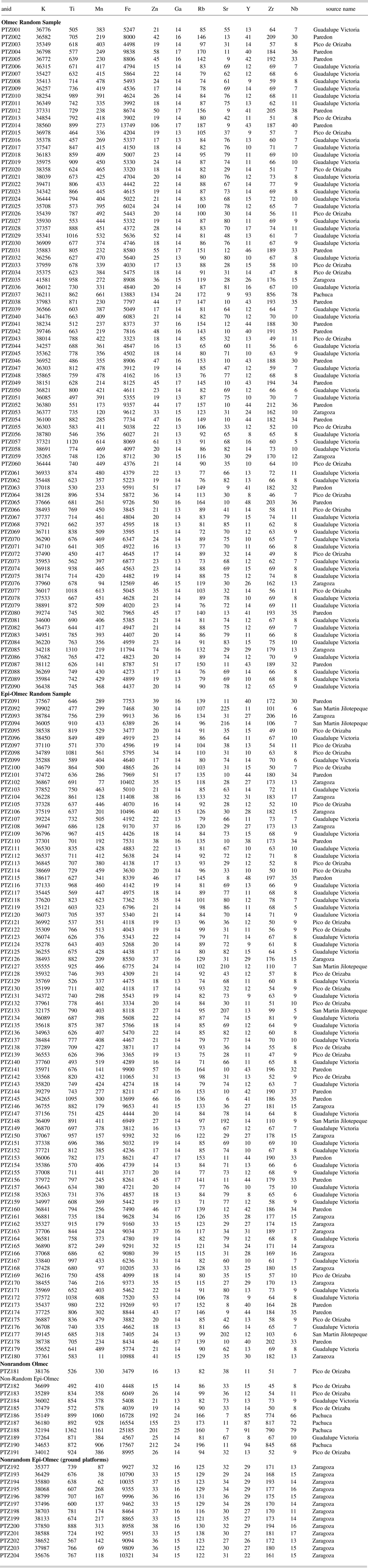
The results from this XRF investigation are listed in Table 2 with the elements reported in parts per million for each sample. By using bivariate plots to compare the artifact compositional data to data for sources in Guatemala and Mexico, it was possible to determine sources for all of the artifacts. The last column of Table 2 lists the sources.
Concentrations of elements determined by XRF (ppm) for obsidian artifacts from Tres Zapotes
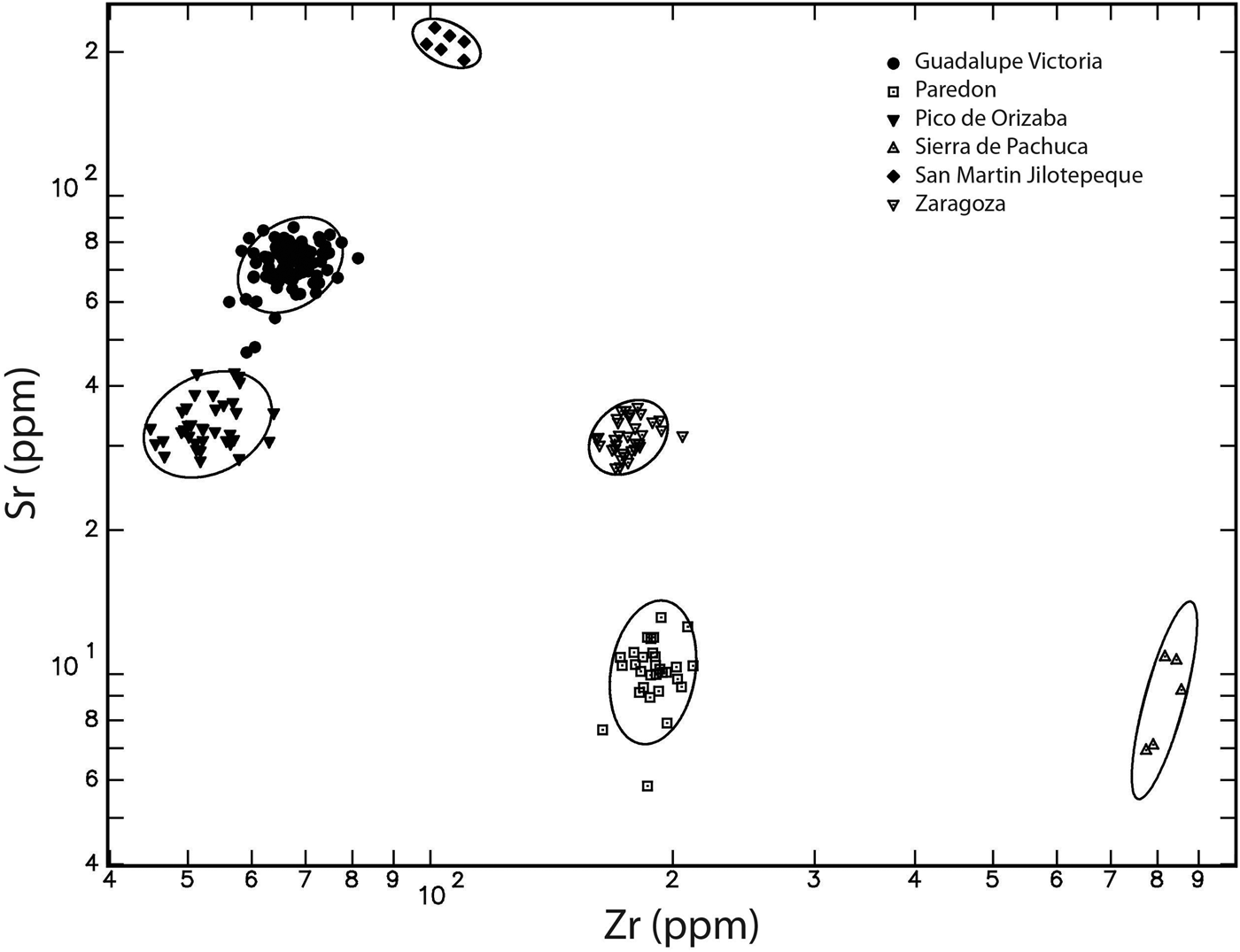
In general, the best elements for obsidian sourcing are found among the incompatible elements (Rb, Sr, Y, Zr, and Nb) and sometimes Fe and Zn. Experience has shown that these elements most often exhibit the greatest differences between obsidian sources as needed to differentiate between sources. Figure 4 shows a plot of Zr versus Sr for the artifacts, indicating the presence of six compositional groups which correspond to five sources from central Mexico: Guadalupe Victoria (n = 93), Pico de Orizaba (n = 36), Zaragoza-Oyameles (n = 34), Paredón (n = 30), Pachuca (n = 5), and one source from the highlands of Guatemala: San Martín Jilotepeque (n = 6).
Bivariate plot of Zr versus Sr showing source groups for the artifacts in this study on a loglog plot. Groups are surrounded by ellipses at the 90% confidence level.
Correspondence of Visual Categories to Chemically Determined Sources
As noted above, previous studies of obsidian exchange in the south-central and southern Gulf lowlands have relied heavily on visual sourcing, usually supplemented by chemical analysis of judgmentally selected specimens (Barrett Reference Barrett2003; Cobean et al. Reference Cobean, Coe, Perry, Turekian and Kharkar1971, Doering Reference Doering2002; Knight Reference Knight1999; Knight and Glascock Reference Knight and Glascock2009; Santley et al. Reference Santley, Barrett, Glascock and Neff2001; and compare with Hirth et al. Reference Hirth, Cyphers, Cobean, de León and Glascock2013; Stark et al. Reference Stark, Heller, Glascock, Elam and Neff1992:226). In this section we are particularly concerned with evaluating how well visual categories correspond to chemically determined sources in a random sample.
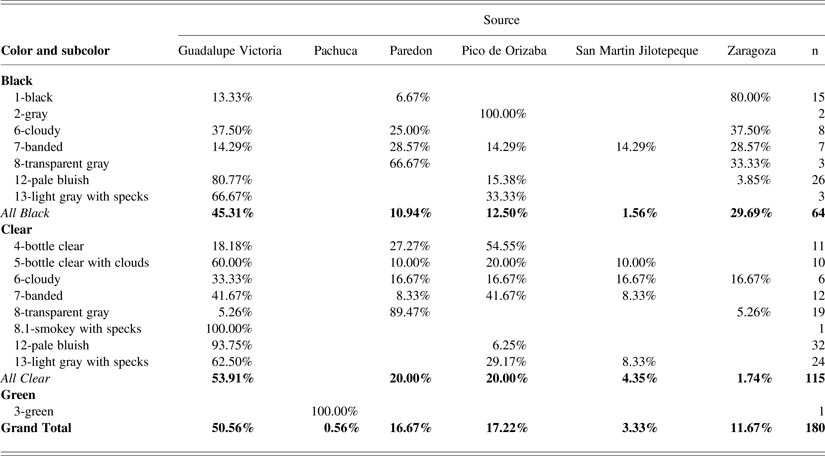
Correspondences between chemically identified sources and visual categories in our sample support the visual characterization of specific color-subcolor combinations while arguing for caution in the assignment of general colors, such as black, gray, or clear, to a specific source (see also Heller and Stark Reference Heller and Stark1998; Santley et al. Reference Santley, Barrett, Glascock and Neff2001; Stark et al.Reference Stark, Heller, Glascock, Elam and Neff1992) (Table 3).Footnote 3 For example, “black” or “dark gray” obsidian is usually assigned to the Zaragoza-Oyameles source in southern Veracruz (Knight and Glascock Reference Knight and Glascock2009; Santley et al. Reference Santley, Barrett, Glascock and Neff2001; Stark et al. Reference Stark, Heller, Glascock, Elam and Neff1992); in our random Formative sample, however, only 29.69% of black obsidian came from Zaragoza-Oyameles whereas 45.3% of the obsidian identified as black came from the Guadalupe Victoria source. In part, this discrepancy may reflect different criteria for assigning obsidian to “black” or “clear” categories. Temporal and spatial variation in source utilization, however, may also affect the perception of consistency in visual characterization. We note that most of the previous obsidian sourcing studies in southern Veracruz have been dominated by obsidian from Classic period contexts in which chemically analyzed black obsidian is overwhelmingly from the Zaragoza-Oyameles source. By contrast, in the Tres Zapotes Formative assemblage, heavy reliance on Guadalupe Victoria obsidian, which also contains some black components, increases the proportion of non-Zaragoza black obsidian in the sample.
Percentage of each color and subcolor category assigned to a specific obsidian source in the random XRF sample from Tres Zapotes
Fortunately, comparison with visual characteristics in the random sample indicates strong associations between more specific color-subcolor classes and particular sources (Table 3). For example, 80% of the 15 black-black pieces were of Zaragoza-Oyameles obsidian. Overall, 87.9% of artifacts with a pale-bluish subcolor were sourced to Guadalupe Victoria, including 80.8% of the 26 black-pale-bluish pieces and 93.75% of 32 clear-pale-bluish pieces. Of clear samples with a highly lustrous, “ice-like transparent gray appearance” (Cobean Reference Cobean2002:55), 89.47% were sourced to Paredón.Footnote 4 In addition, two of three specimens with a black base color and transparent gray subcolor were also from this source, thus Paredón accounted for 86.4% of all transparent gray specimens in the random sample. In the judgmentally selected sample, five of seven (71.43%) obsidian pieces classified as having a “gray” base color were from the Pico de Orizaba, and the other two were from Guadalupe Victoria. As is to be expected, all five of the green specimens chemically analyzed were from the Pachuca source.
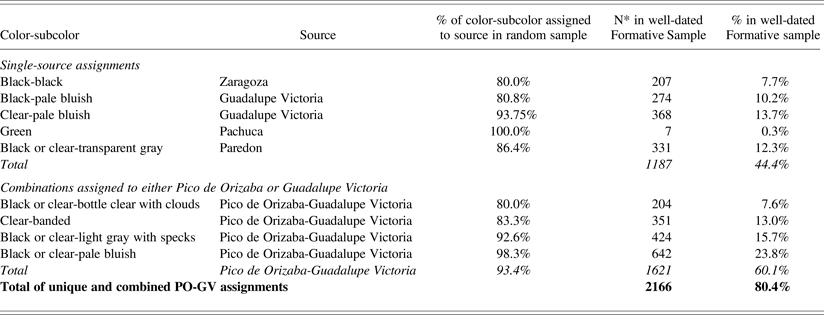
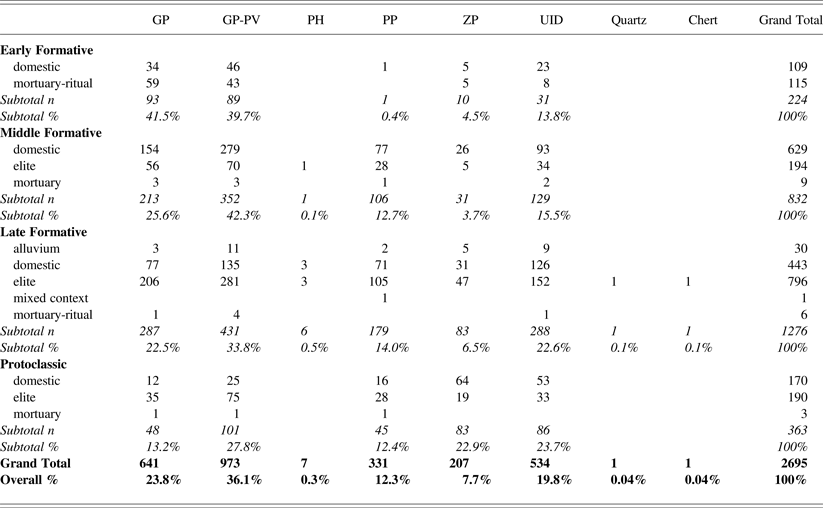
Despite these strong associations, color categories that are assigned to a single source with 80% or more probability in the random sample only account for 44.4% of the 2695 specimens in our well-dated Formative obsidian sample (Table 4). In large part, the low percentage of unique source assignments is due to the well-known visual similarities between “clear” Guadalupe Victoria and Pico de Orizaba obsidian (Stark et al. Reference Stark, Heller, Glascock, Elam and Neff1992). If these two geographically close sources are combined, then the percentage of the well-dated sample that can be sourced visually with “reasonable confidence” (≥ 80%) rises to 80.4%. While this number is lower than we would like, it justifies the cautious extension of our observations to select color categories in the larger sample.
Color-subcolor combinations for which more than 80% of specimens were assigned to a single source or the combined Pico de Orizaba-Guadalupe Victoria sources and their frequencies in the well-dated Formative sample
*of 2,695 specimens
In the following sections we describe source utilization for the Olmec and Epi-Olmec assemblages as indicated by our random sample (Table 5) and as extended to our larger sample (Table 6). We also discuss trends within these eras, subdivided into the Early and Middle Formative Olmec periods and the Late Formative and Protoclassic Epi-Olmec periods. Because the Early Formative and Protoclassic periods are each represented by 20 specimens in our random sample, our conclusions are less secure than for the Middle and Late Formative periods, each represented by 70 specimens. In these cases, extension of the inferences to the larger excavated sample helps confirm the patterns identified in the random sample.
XRF Source assignments by period in the stratified random sample from Tres Zapotes
Visual source assignments for well-dated contexts at Tres Zapotes
See Table 1 for source abbreviations.
The Olmec Obsidian Assemblage
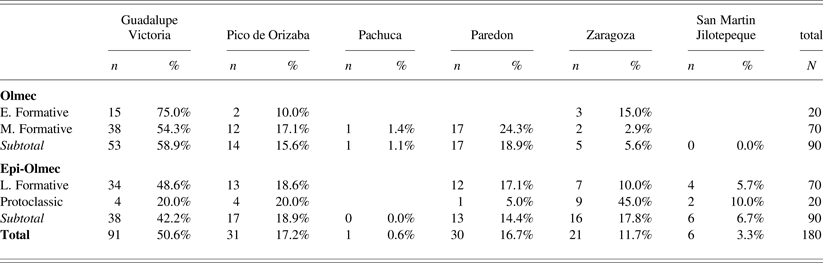
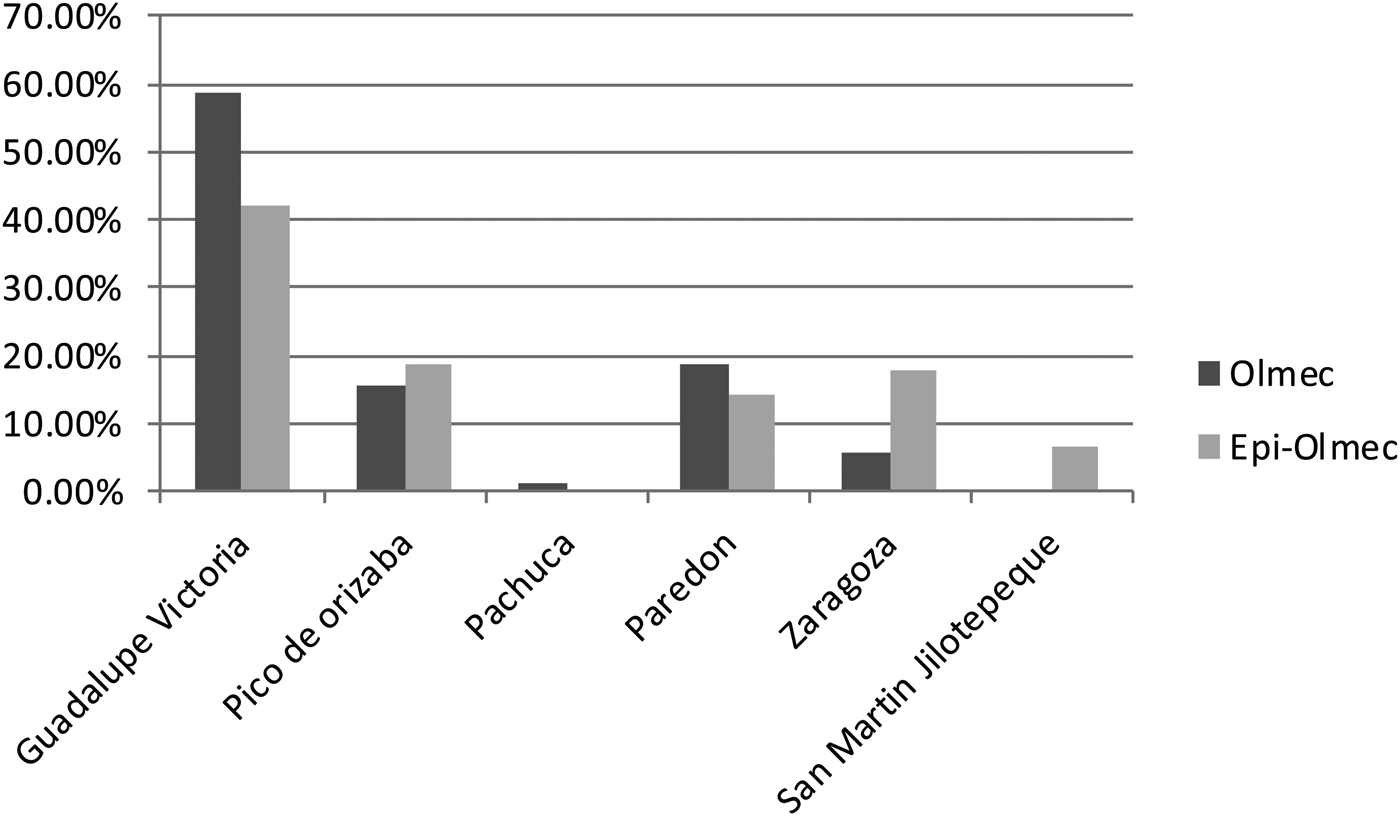
Five obsidian sources are represented in our random sample of Olmec obsidian: Guadalupe Victoria (53.9%), Pico de Orizaba (17.2%), Paredón (16.7%), Zaragoza-Oyameles (11.67%), and Pachuca (.6%, n = 1) (Table 5 and Figure 5). Therefore, 99.4% of the Olmec obsidian at Tres Zapotes came from four sources in eastern Puebla and adjacent Veracruz, all within 150 km of one another. These four also are the nearest known sources to Tres Zapotes, with the exception of obsidian cobbles in ash-flow deposits near Altotonga, Veracruz (Cobean Reference Cobean2002:175 and Figure 1). Relative frequencies do not correlate precisely with proximity to Tres Zapotes, however (Pico de Orizaba is the nearest source, and Zaragoza is nearer than Paredón), suggesting that other considerations besides transport costs affected procurement of obsidian. Notably absent from the Olmec assemblage at Tres Zapotes are any of the Guatemalan obsidians, which have been reported from Early and Middle Formative Olmec sites in eastern Olman (San Lorenzo [Cobean et al. Reference Cobean, Coe, Perry, Turekian and Kharkar1971, Reference Cobean, Vogt, Glascock and Stocker1991; Hirth et al. Reference Hirth, Cyphers, Cobean, de León and Glascock2013]; La Venta [Hester et al. Reference Hester, Jack and Heizer1971b; Jack and Heizer Reference Jack and Heizer1968; Rebecca González, personal communication 2005]; San Andrés [Doering Reference Doering2002]), and much closer in the Tuxtla Mountains (Santley et al. Reference Santley, Barrett, Glascock and Neff2001).
Percentages of obsidian sources by era (Olmec and Epi-Olmec) at Tres Zapotes as determined by XRF for the stratified random sample.
The Early Formative Period
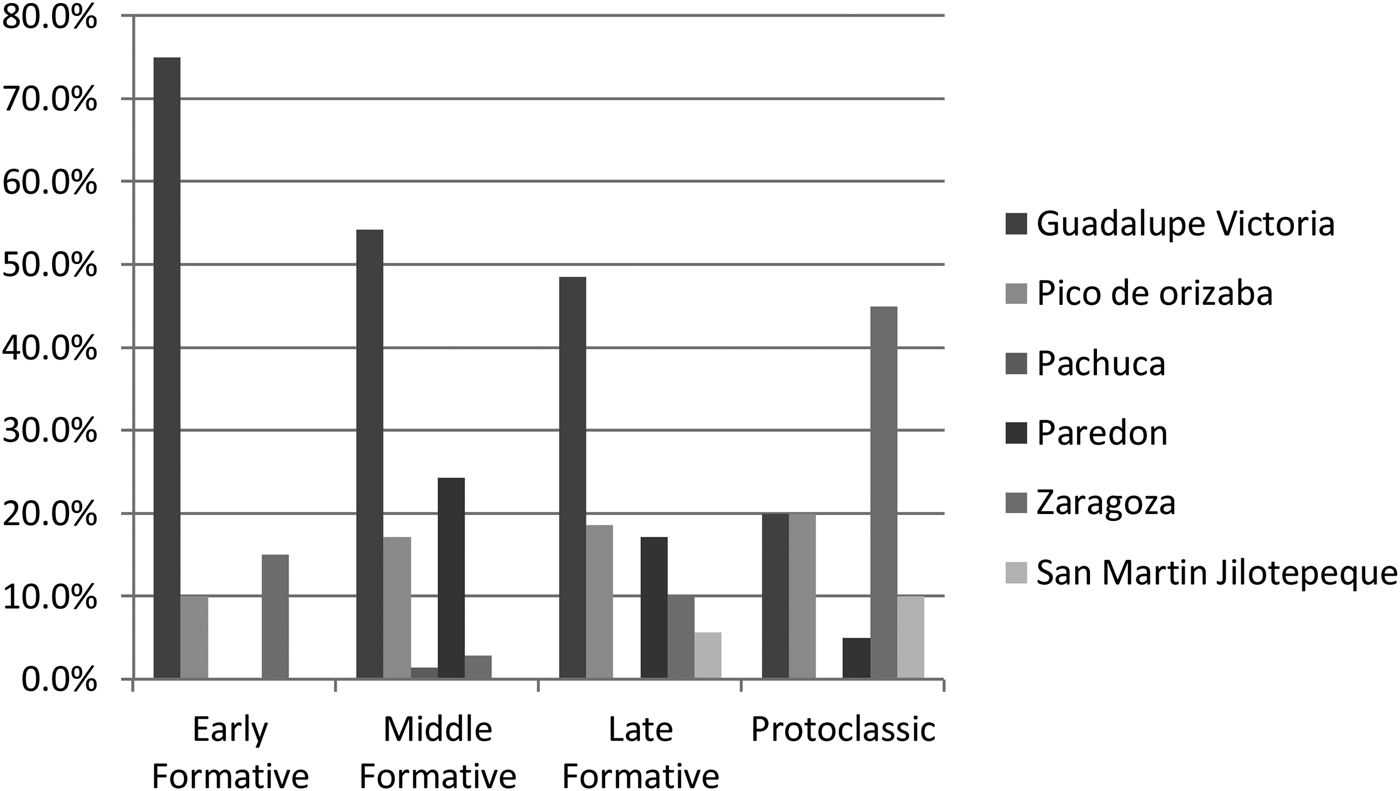
Only three sources are represented in the random XRF sample for the Early Formative period: Guadalupe Victoria, Pico de Orizaba, and Zaragoza-Oyameles (Table 5 and Figure 6). In the well-dated excavation sample all color-subcolor combinations are consistent with these three samples: no green or transparent gray specimens occur (Table 6). As discussed in Knight (Reference Knight2009), the Early Formative assemblage overall is marked by bipolar reduction technology with the exception of two prismatic blade fragments that were recovered from a ceremonial/mortuary context in Unit 12. Visually, these blade fragments are clear-light gray with specks and likely correspond to the Guadalupe Victoria or Pico de Orizaba sources. Of the entire Early Formative assemblage, obsidian assigned visually to Guadalupe Victoria or Pico de Orizaba by the criteria discussed above makes up 81.25% (n = 182), and Zaragoza-Oyameles constitutes 4.46% (n = 10). Elite contexts are not yet apparent at Tres Zapotes in the Early Formative period, and access to different obsidian sources appears to have been similar across the site, although Guadalupe Victoria obsidian comprises a higher proportion of visually sourced artifacts in the ceremonial/mortuary context.
Percentages of obsidian sources by period at Tres Zapotes as determined by XRF for the stratified random sample.
The Middle Formative Period
The Middle Formative period saw significant changes in obsidian sources and technology at Tres Zapotes. The number of chemically identified sources increases from three to five with the addition of obsidian from Paredón and Pachuca (Table 5 and Figure 6). Obsidian from the Paredón source becomes the second most common obsidian in the random XRF sample (Guadalupe Victoria = 54.3%, Paredón = 24.3%, Pico de Orizaba = 17.1%).
Flakes continue to dominate the Middle Formative assemblage, and bipolar reduction remains the most common identifiable technology. Prismatic blade technology remains uncommon, but it is identified for the first time in domestic contexts, as well as in newly established elite contexts where it was more prominent (8.3% compared to 1.5% in domestic contexts). Paredón obsidian appears to have been preferred for prismatic blades. The one Middle Formative prismatic blade in our random sample was of Paredón obsidian. In the full Middle Formative sample, all prismatic blade technology artifacts (initial series blades, irregular pressure blades, and prismatic pressure blades) in domestic contexts are of clear obsidian and more than half of this is clear-transparent gray, thus likely from Paredón. In elite contexts, 56% (n = 10) of all blade technology indicators (mostly prismatic blade segments), are clear or black-transparent gray, thus also likely Paredón, while two are black-black. Unlike the Early Formative period sample, the two black-black artifacts in the Middle Formative random sample sourced to Guadalupe Victoria rather than Zaragoza-Oyameles. Therefore, in the Middle Formative period the newly arrived Paredón source was principally utilized for prismatic blade reduction and secondarily for bipolar reduction. Prismatic blades were also produced from Guadalupe Victoria and Pico de Orizaba obsidian, but these sources were used more frequently for bipolar reduction. The two Middle Formative examples of Zaragoza-Oyameles obsidian in the random sample represented bipolar and direct percussion technologies. The one Pachuca artifact dating to the Middle Formative was a bipolar core recovered from an elite civic-ceremonial context.
The Epi-Olmec Obsidian Assemblage
While continuing to rely on the same suite of sources in the Mexican highlands as their predecessors, the Epi-Olmec inhabitants at Tres Zapotes instituted significant changes in obsidian provisioning and technology. The Guatemalan source, San Martín Jilotepeque, appears for the first time in the Late Formative period, constituting 6.67% of the random Epi-Olmec sample (Table 5 and Figure 5). Guadalupe Victoria continued to be the most common source in the random sample (42.2%) with Zaragoza-Oyameles (17.78%), Pico de Orizaba (18.9%), and Paredón (14.4%) making up the remainder. The random sample did not include any Pachuca obsidian, but it was present in excavated Epi-Olmec contexts, and four samples in our nonrandom sample were analyzed by XRF. In the excavated sample, Pachuca green obsidian occurs in Late Formative domestic (n = 3) and elite (n = 1) contexts and in a Protoclassic elite context (n = 1) but is not common (Table 6).
In addition to the incorporation of a Guatemalan source, frequencies of obsidian from central Mexican sources are significantly different from the Olmec period in our random sample (X2 = 8.92, df = 3, p = .03, Pachuca [n = 0] excluded). Notably, the relative representation of these sources is also more even than in the Olmec sample, with no single source representing more than 43% of the sample (for Guadalupe Victoria), and three other Central Mexican sources representing between 14% and 19% of the sample each (Table 5 and Figure 5). Changes in the proportional representation of sources and in technology are even more marked within the Epi-Olmec era in the transition from the Late Formative to the Protoclassic period.
The Late Formative Period
Source proportions in the random sample change slightly beginning in the Late Formative period, continuing a gradual decline from Early Formative levels in the representation of Guadalupe Victoria obsidian, which continues to be the most common obsidian type in our random sample (48.6%, n = 34) (Table 5 and Figure 6). The relative frequency of Pico de Orizaba increases slightly over the Middle Formative becoming the next most common source (18.6%, n = 13), while the proportion of Paredón falls to 17.1% (n = 12), and that of Zaragoza rebounds to 10% (n = 7). As noted above, the Late Formative period marks the first appearance of obsidian from the San Martín Jilotepeque source in highland Guatemala and represents 5.7% (n = 4) of the random sample for this period.
Technologically, the Late Formative period marks the beginning of an increased reliance on prismatic blades, preceding the dominance of Zaragoza-Oyameles obsidian. Blade production debitage was recovered from both elite and commoner contexts and was likely reduced from macrocores, as all sources except Pachuca include macrodebitage and/or macrocore reduction debitage. Types other than Guadalupe Victoria were favored for blade production. Although the combined sources of Guadalupe Victoria and Pico de Orizaba comprise 29.1% of Late Formative blades, only 5% of Late Formative blades could be visually sourced to Guadalupe Victoria specifically. Other sources used for prismatic blades (including initial series blades) were Paredón (27.7%), Zaragoza-Oyameles (14.2%), and Pachuca (.7%). While a larger number of blades were produced from Paredón obsidian, a larger proportion of the Zaragoza obsidian was used as blades (24% vs. 21.8%). By comparison, relatively few blades were produced as a proportion of the Guadalupe Victoria obsidian (2.4%) or the combined Guadalupe Victoria-Pico de Orizaba assemblage (5.7%). Visually assigned Paredón obsidian comprises very similar proportions of blades and blade production in both contexts. Interestingly, elite contexts contained a higher proportion of visually assigned Guadalupe Victoria blade and blade production artifacts than did commoner contexts. Bipolar artifacts in elite contexts are visually assigned primarily to the Guadalupe Victoria source; in domestic contexts, both Paredón and Guadalupe Victoria are well represented among the bipolar artifacts.
The Protoclassic Period
Although it is still culturally Epi-Olmec, pronounced changes in obsidian procurement systems characterized the Protoclassic period at Tres Zapotes, establishing patterns that would persist through the Classic period in the southern and south-central Gulf lowlands (Tables 5 and Figure 6). Zaragoza-Oyameles becomes the most common obsidian source in the random sample, representing 45% (n = 9) of it, coincident with growth in the population and regional influence of Cantona (Garcia Cook Reference García Cook, Sanders, Mastasche and Cobean2003:313, 337–339, 341; García Cook and Merino Carrión Reference García Cook and Carrión1998). The proportional utilization of Guadalupe Victoria continues to decline, while that of the Pico de Orizaba source remains steady, each now representing 20.0% (n = 4) of the random sample. The representation of San Martín Jilotepeque increases to 10.0% of the random sample, while that of Paredón obsidian declines to only 5% (n = 1). These proportions correspond reasonably well to the visually sourced obsidian in Protoclassic contexts (Table 6). For example, the combined count for Guadalupe Victoria and Guadalupe Victoria-Pico de Orizaba obsidian is 41%. The major exception is that Zaragoza-Oyameles only makes up 22.9% of the excavated Protoclassic sample, suggesting that much of the 23.7% of the visually unsourced obsidian also is from Zaragoza-Oyameles.
Despite the pronounced change in reliance on Zaragoza-Oyameles and Guadalupe Victoria sources, both the number of sources and the more even distribution of material among sources (as compared to the Olmec assemblage) persists from the Late Formative to the Protoclassic period. Differences in elite and nonelite source utilization are evident, however. Excluding mortuary contexts, domestic contexts contain proportionately more black-black, probable Zaragoza-Oyameles obsidian (37.6%, n = 64) as compared to elite contexts (10%, n = 19), while obsidian visually sourced to Guadalupe Victoria or Pico de Orizaba makes up a total of 57.9% (n = 110) of the elite obsidian assemblage, as compared to 21.8% (n = 37) in domestic assemblages in our well-dated sample.
With the Protoclassic period, prismatic core-blade reduction becomes the dominant technology at Tres Zapotes, with blades and production indicators representing 45% of the total assemblage. Bipolar reduction is still employed at about the same rate with bipolar products representing 5.4% of the assemblage, slightly up from 4.1% in the Late Formative but considerably less than the 12% to 13% seen in our Olmec assemblages. Knight (Reference Knight2009) has documented a surprising pattern in that prismatic blades are more prevalent in the domestic assemblage (47.7%, n = 158) than in the elite assemblage, where flakes and flake debitage predominate (71.7%, n = 147), corresponding to the noted differences in source utilization. This probably reflects the presence of a residential obsidian production unit in the Terminal Formative domestic context, where polyhedral cores and polyhedral core reduction debitage was found as well as macrodebitage. Excavations in this context yielded 13 whole or proximal blades, three initial series blades, a hinge recovery blade, and several flakes, all with ground platforms. Of these, 13 blades were analyzed by XRF, and all proved to be from the Zaragoza-Oyameles source. With the possible exception of a Nacaste phase example at San Lorenzo (Coe and Diehl Reference Coe and Diehl1980a:248), this is the earliest occasion of ground platforms we know of in the southern Gulf lowlands.
To summarize, three sources were consistent suppliers of obsidian to Tres Zapotes throughout the Formative period: Zaragoza-Oyameles, Guadalupe Victoria, and Pico de Orizaba. The Paredón source was added in the Middle Formative period and continued to be used thereafter. Pachuca green obsidian appeared in the Middle Formative period, but was scarce and did not reappear until the Classic period. The San Martín Jilotepeque source was the only Guatemalan source utilized at Tres Zapotes, and it made its debut in the Late Formative period. The most profound change in source utilization occurred in the Terminal Formative period with the great increase in Zaragoza-Oyameles obsidian (both proportionately and, with the 525% growth of the site, absolutely), replacing Guadalupe Victoria as the dominant source. At no time did elites monopolize a particular obsidian source or technology, and where differences were observed, they were often contrary to what might be expected. For example, inhabitants of Late Formative domestic contexts used the finer-grained Paredón obsidian more frequently than elites for bipolar artifacts, and residents of a Terminal Formative domestic context accumulated proportionately more of the higher-quality Zaragoza-Oyameles obsidian than was found in elite contexts (albeit in a context of more specialized prismatic blade production).
DISCUSSION
Clark (Reference Clark, Johnson and Marrow1987) and Stark and colleagues (Reference Stark, Heller, Glascock, Elam and Neff1992:231) called attention to the greater diversity of Formative obsidian distribution networks as compared to the Classic period in the Gulf lowlands and parts of highland Mexico, attributing them to relatively open community relations and reliance on down-the-line exchange. For the southern Gulf lowlands, an impression of declining source diversity has been enhanced by the great variety of sources used at San Lorenzo during the Early Formative period (at least 13 [Cobean et al. Reference Cobean, Coe, Perry, Turekian and Kharkar1971]) and the fewer sources (eight) and heavy representation of Zaragoza Oyameles described by Hester et al. (Reference Hester, Jack and Heizer1971b:Table 8) for artifacts from Tres Zapotes, which are often attributed to the Late Formative period (Nelson and Clark Reference Nelson, Clark and Rattray1998:Figure 4, 292). Recent investigations in the area around La Venta and the Tuxtla Mountains, as well as the current study, paint a more complex picture of obsidian procurement (Table 1). Overall, the number of sources for obsidian entering the southern Gulf lowlands as a whole appears not to have changed from the Early to the Middle Formative period, with both represented by 13 to 14 sources, although the specific sources varied across the region. Particularly striking is the near absence and late appearance of Guatemalan sources in the Tuxtlas and the Papaloapan River basin as well as a persistent pattern of less diverse resource utilization in those areas.
At San Lorenzo, the greatest variety of sources (13, including two “unidentified sources”) is associated with the San Lorenzo phase, specifically the San Lorenzo B phase (Cobean et al. Reference Cobean, Coe, Perry, Turekian and Kharkar1971; Hirth et al. Reference Hirth, Cyphers, Cobean, de León and Glascock2013:2785). It is also during the San Lorenzo B phase that the recycling of stone monuments intensified at San Lorenzo, and status items were distributed to a wider sector of society (Borstein Reference Borstein2001:186–187, citing Cyphers). Cyphers has suggested that these changes reflect the efforts of elites to maintain power in the face of increasing difficulty in procuring the material resources, such as basalt, that legitimized that power. In this context, the diversification of obsidian sources may reflect efforts to ensure greater access to this good during a time of greater uncertainty in extralocal supply chains. The degree to which elites were exclusively involved in negotiating access to obsidian sources remains uncertain; therefore, the increased diversity of sources may also reflect a broadening of procurement and exchange activities late in San Lorenzo's apogee.
At Tres Zapotes, following an initial increase from three sources in the Early Formative period to five in the Middle Formative, changes in obsidian procurement were characterized more by shifting proportions of sources than by variation in the number of sources. Throughout the Formative period, Tres Zapotes relied on a persistent set of procurement networks focused on eastern Puebla and Veracruz. Those networks, however, never included exploitation of obsidian from Altotonga, which has been documented at San Lorenzo (Cobean et al. Reference Cobean, Coe, Perry, Turekian and Kharkar1971; see also discussion of the Altotonga source in Cobean et al. Reference Cobean, Vogt, Glascock and Stocker1991, Cobean Reference Cobean2002) and which Hester et al. (Reference Hester, Heizer and Jack1971) identified as a major source at La Venta. Additionally, our investigations confirm that Zaragoza-Oyameles was a minor obsidian source at Tres Zapotes until the Protoclassic period; the sample tested by Hester et al. (Reference Hester, Jack and Heizer1971) evidently overrepresented the Classic period component, which was extensively tested by Stirling's project (Drucker Reference Drucker1943; Weiant Reference Weiant1943).
Variation in Formative period resource exploitation is not only evident broadly across the southern Gulf lowlands, but it is sometimes striking between adjacent subregions and between centers and sites in their hinterlands. For example, the great variety of sources represented at San Lorenzo seems to have been greatly reduced, to perhaps as few as two, in the few pieces of obsidian recovered from the Early Formative component of the hinterland site of Las Galeras (O'Rourke Reference O'Rourke2002:185). San Lorenzo cannot be said to have generally monopolized obsidian sources throughout the southern Gulf lowlands, however; the Tuxtla Mountains and Tres Zapotes may have lacked the more far-flung Guatemalan and Mexican sources present at San Lorenzo, but they compensated with much greater reliance on the Zaragoza-Oyameles and Pico de Orizaba (Ixtetal Valley) sources. Meanwhile Paredón obsidian entered the Tuxtlas, but was very nearly absent at Tres Zapotes (1 possible piece of 224 visually identified in our Early Formative sample and none in our random sample).
La Venta has a legitimate claim as the most powerful Middle Formative Olmec capital, and it was clearly a major importer of exotic goods, including greenstone and iron ore. Its control over obsidian networks appears to have been weak, though. As noted, Altotonga obsidian identified at La Venta (Hester et al. Reference Hester, Jack and Heizer1971b:Table 8)4 seems absent at the hinterland sites of San Andrés (Doering Reference Doering2002) and Isla Alor (Stokes Reference Stokes1999). San Andrés appears to have relied much more on Paredón, but that source is absent from Middle Formative contexts at Isla Alor. Pico de Orizaba has not been identified in the Puente phase at San Andres or at Isla Alor but is a minor component at La Venta (Hester et al. Reference Hester, Jack and Heizer1971b:Table 8; González, personal communication 2005). Ranging farther afield, the much-reduced population at San Lorenzo continued to exploit a remarkable variety of sources (nine in the Nacaste phase and eight in the Palangana phase), indicating that rural sites did not have to rely on the intercession of regionally dominant centers (Cobean et al. Reference Cobean, Coe, Perry, Turekian and Kharkar1971). Notably, however, the sources exploited by San Lorenzo at that time appear not to have included Pico de Orizaba obsidian identified at La Venta and points west. Guadalupe Victoria continued to be a major source in the Tuxtlas (Santley et al. Reference Santley, Barrett, Glascock and Neff2001) and at Tres Zapotes but was only a minor component at Middle Formative San Lorenzo (Cobean et al. Reference Cobean, Coe, Perry, Turekian and Kharkar1971) and in the La Venta area (Doering Reference Doering2002; Stokes Reference Stokes1999).
For the Late Formative period, comparisons across the southern Gulf lowlands are difficult, owing to the near abandonment of the Tonala and Coatzacoalcos basins. Pronounced variation in the prevalence of different obsidian sources is suggested, however, in the Tuxtlas and Lower Papaloapan River basin. In the Tuxtlas, Zaragoza-Oyameles is the predominant Late Formative source (Santley et al. Reference Santley, Barrett, Glascock and Neff2001), but it is still secondary to Guadalupe Victoria at Tres Zapotes. Conversely, Paradón and Pico de Orizaba are significant secondary sources at Tres Zapotes, but neither was present in the Late Formative Tuxtlas sample analyzed by Santley and his colleagues. Across the Papaloapan River basin in the Mixtequilla, the nearby Pico de Orizaba source, predictably, is the most prevalent, followed by Guadalupe Victoria, Paredón, Otumba, and Zaragoza, but the San Martín Jilotepeque source of Guatemala is absent (Stark et al. Reference Stark, Heller, Glascock, Elam and Neff1992:229), whereas Otumba obsidian has not yet been identified in Formative deposits at Tres Zapotes.
Who Controlled What When?
With the possible exception of Early Formative San Lorenzo, the local and regional variation in Early and Middle Formative obsidian procurement patterns argue against strong control of obsidian procurement-distribution systems by elites in Gulf Olmec centers. Impoverished obsidian inventories in hinterland sites relative to San Lorenzo (O'Rourke Reference O'Rourke2002:185; Wendt Reference Wendt2003:557) may suggest the center restricted access to this extralocal good during its height. A lack of prismatic blade production debris in San Lorenzo as well as in the hinterland sites suggests that blades, for the most part, entered the southern Gulf lowlands in finished form (Wendt Reference Wendt2003:566) and tends not to support the idea that Gulf Olmec elites controlled this technology (compare with Clark Reference Clark, Johnson and Marrow1987). Other than obsidian, residents of the hinterland site at El Bajío appear to have had similar access to resources as at San Lorenzo, and Wendt (Reference Wendt2003:566; see also De León Reference de León2008) suggests differences in obsidian utilization may have been due to differences in subsistence practices between the hinterland levee site and the center.
Substantial elite control of obsidian procurement and distribution is likewise equivocal for Middle Formative Olmec sites. As discussed above, nothing in the obsidian inventory at Tres Zapotes exists to support such a thesis, and per capita access to obsidian in rural sites in the Tuxtlas appears to have been comparable to Tres Zapotes; specific source networks overlapped in these areas but were not coterminous. Rust (Reference Rust2008:1306) suggests that La Venta served as a distribution center for obsidian to sites in its hinterland, and while such may have occurred, that role seems to have been neither exclusive nor a source of great economic power. Although obsidian artifacts certainly were more numerous in Rust's excavations at La Venta than in hinterland sites, variations in frequency may result more from differences in intensity of occupation and overall sample size than lack of access. Obsidian made up comparable proportions of the lithic inventory within specific contexts: 69.6% to 85.5% in domestic contexts at La Venta versus 52.5–86.4% at hinterland sites (data from Rust Reference Rust2008:Table 5.3.33a). Blades and blade fragments are fairly common at La Venta and hinterland sites with obsidian that was tested by Rust, but production debris other than flakes is nearly absent in both the center and the hinterland (Rust Reference Rust2008:Tables 5.3.1–5.3.33).
As we have noted, the Late Formative period saw a retraction overall of obsidian sources in the southern Gulf lowlands but not within the regional sequence of western Olman or at the site of Tres Zapotes. For the first time, the sources present in the Tuxtlas represent a subset of those at Tres Zapotes, but relative frequencies differ greatly with Zaragoza being most prevalent in the Tuxtlas. The lack of a clear pattern of preferential utilization of higher quality obsidians by elites or greater elite access to the technology to work them is also evident at Tres Zapotes. At this point we simply do not have the data to assess patterns of Late Formative obsidian procurement in the Tres Zapotes hinterland (or for other periods), so it remains a possibility that the confederation of factions hypothesized for Tres Zapotes may have united to control obsidian access at the polity scale, but currently it seems unlikely.
For Tres Zapotes, the Terminal Formative saw the most profound changes in obsidian procurement with rise to dominance of the Zaragoza-Oyameles source. Though this source, together with Paredón, became associated primarily with blade reduction, blade production was not more strongly associated with elite contexts (quite the opposite, in fact), and Zaragoza-Oyameles was most prevalent overall in the domestic contexts we excavated. Interestingly, it was the more traditional sources—Guadalupe Victoria, Pico de Orizaba, and Paredón—that remained more common in elite contexts. Recall too, that ground platforms made a precocious appearance on Zaragoza-Oyameles prismatic blades and production residues in domestic contexts. Thus, innovation in technology and resource procurement seems to have been situated among nonelite producers. This is not to say that elites could not have commissioned blades from such producers, but it seems evident that their access to the products overall was nonexclusive.
CONCLUSION
Not only is this study the first to analyze provenienced obsidian artifacts from the major center of Tres Zapotes, but it goes beyond most previous studies of obsidian exchange in the southern Gulf lowlands by employing a dual strategy of stratified random sampling augmented by judgmental sampling of scarce color categories for obsidian, all from well-provenienced excavated contexts. As a result, we have been able to characterize changes in the relative importance of different obsidian sources in the political economy of Tres Zapotes across the critical transition from Olmec to Epi-Olmec society with greater confidence than has been possible with previous sampling strategies and to extend our observations to a much larger sample of visually characterized obsidian in a manner comparable to previous studies.
We are not surprised to find evidence that Epi-Olmec elites at Tres Zapotes exercised relatively little control over access to obsidian, specific sources of obsidian, or obsidian technology (see Knight Reference Knight and Pool2003). What is surprising is that the same general statement appears to hold for their Olmec predecessors at Tres Zapotes and to a lesser degree to Olmec elites more broadly (Hirth et al. Reference Hirth, Cyphers, Cobean, de León and Glascock2013), given that the Olmec have been held up as a paragon of an exclusionary political economy (Blanton et al. Reference Blanton, Feinman, Kowalewski and Peregrine1996; but see also Pool Reference Pool2007:31; Stark Reference Stark, Clark and Pye2000:36–37). Our findings do not refute exclusionary control of Olmec elites over some aspects of the political economy or its ideological underpinnings, but they do underscore the variable participation of different goods within the political economy based on what was advantageous to control (or could be controlled) and to what degree.
Obsidian source identification has played a vital role in reconstructing Formative period exchange networks and political economies since the late 1960s. The accumulating results of sourcing studies suggest that obsidian procurement networks in the southern Gulf lowlands varied across space and through time with respect to the relative importance of different obsidian sources as well as the variety of sources exploited. Consequently, we have argued that Gulf Olmec sites exercised substantial autonomy in negotiating exchange relations with populations in source regions. The data we have presented here support that argument and imply significant limits existed on the power and authority of Olmec rulers in the largest centers as well as the territorial reach of their economic and political control. Finally, we suggest that changes in resource procurement, such as the Protoclassic dominance of Zaragoza-Oyameles, may have had more to do with developments in the economic and political landscapes outside of the southern Gulf lowlands than the intentions of Gulf elites.
RESUMEN
Reportamos los resultados de la caracterización química de artefactos de obsidiana provenientes de Tres Zapotes por medio del análisis de florescencia de rayos-X (XRF). Este estudio de la identificación de yacimientos de obsidiana es el primero para este centro olmeca y epi-olmeca en que la muestra proviene de contextos seguros asignados a los periodos formativo temprano, formativo medio, formativo tardío, y protoclásico. Empleamos una estrategia de muestreo al azar estratificado para seleccionar 180 artefactos de obsidiana del conjunto excavado, supliéndolos con otro 24 especímenes de categorías visuales escasos. Entonces logramos caracterizar con mayor confianza los cambios en la importancia relativa de distintos yacimientos de obsidiana dentro de la economía política de Tres Zapotes a través de la transición clave desde la sociedad olmeca a la epi-olmeca. También pudimos extender nuestras observaciones a la muestra completa de 5,713 artefactos que caracterizamos visualmente, incluyendo los 2,695 piezas provenientes de contextos de fechas seguros que examinamos en este artículo. Nuestro estudio confirma la ausencia de obsidiana de Otumba y de los yacimientos guatemaltecos dentro del conjunto excavado olmeca. Este resultado apoya un modelo de obtención de obsidiana por redes traslapados pero autónomos por los sitios olmecas de la costa del Golfo. La presencia de obsidiana del yacimiento guatemalteco de San Martín Jilotepeque en contextos epi-olmecas puede relacionarse con el re-establecimiento de contactos trans-istmeños, mientras que el aumento en la obsidiana del yacimiento de Zaragoza-Oyameles, ubicado en el este del estado de Puebla, marca la empieza de una tendencia de largo tiempo. Aunque la representación más uniforme de yacimientos de obsidiana en contextos epi-olmecas es consistente con la transición hipotética desde una economía política olmeca exclusiva hacía un sistema más cooperativa epi-olmeca asociada con el repartimiento de poder entre facciones elites en Tres Zapotes, ni los elites olmecas ni epi-olmecas monopolizaron un yacimiento particular de obsidiana o una tecnología especial para trabajarla.
ACKNOWLEDGEMENT
Field work at Tres Zapotes was supported by a National Science Foundation grant (BCS-0242555) and conducted with the kind permission of Mexico's Instituto Nacional de Antropología e Historia. The chemical analysis of obsidian from Tres Zapotes reported in this article was supported by a Sabbatical Research Fund grant from the College of Arts and Sciences at the University of Kentucky and a grant from the National Science Foundation (BCS-1110793) to the Archaeometry Laboratory at MURR. We thank Jennifer Rideout for her assistance in measuring the artifacts by XRF. Barbara Stark and Robert Cobean graciously responded to our requests for information in the eleventh hour, for which we are most grateful. Finally, we thank our reviewers, Geoffrey Braswell and Carl Wendt for their helpful comments. We alone bear responsibility for any errors of fact or interpretation.