1. Introduction
Previous efforts to compare the dynamics of income poverty across European countries have used the European Community Household Panel (ECHP) survey, which provided longitudinal micro-data from 1994 to 2001 on the ‘old’ EU-15 member states. In this paper, we extend the analysis of poverty dynamics and include the ‘new’ EU member states, using the longitudinal European Union Survey on Income and Living Conditions (EU-SILC), which covers nearly all EU countries since 2005. We cluster EU countries according to the six groups identified by the literature on welfare regimes (Anglo-Saxon, Nordic, Continental, Southern, Eastern and Baltic), with the goal of assessing whether major differences between these groups exist when poverty is examined from a dynamic perspective.Footnote 1 We focus on the determinants of entry into poverty and exit from it in the two-year period 2005–2006, but we do not study the length or recurrence of poverty spells, which cannot be properly analysed using the EU-SILC panel due to its brief observation window.
Therefore, we extend the literature on poverty dynamics in EU welfare regimes in three directions by: (i) presenting results concerning the years prior to the financial and economic crisis starting in 2007, (ii) including the new accession countries and (iii) conducting descriptive and econometric analyses to assess the differences in poverty transition rates among groups of countries and the role played by the main events associated with the transitions. To the best of our knowledge, no study has analysed poverty transitions in the enlarged EU with a focus on trigger events related to individual mobility above and below the relative poverty threshold.
The paper is organised as follows. First, we discuss the main methodological issues and evidence concerning poverty dynamics (Section 2) and the findings and theoretical claims in the literature concerning the differences in poverty dynamics across European welfare regimes (Section 3). Then, we describe the advantages and disadvantages of EU-SILC for comparing poverty dynamics across countries (Section 4) and specify the characteristics of our dataset (Section 5). We then present the empirical results, providing a descriptive analysis of poverty entry and exit rates and the associated trigger events (Section 6) and estimating logit regressions to determine whether poverty entry and exit rates, and the association between the events and poverty mobility, differ across the six groups of countries (Section 7). Section 8 concludes the paper.
2. Poverty dynamics: methodological issues and principal evidence
Poverty indexes measured at a certain time do not disclose information on the past histories of individuals suffering from economic hardship. Poverty is not a fixed condition, but a complex phenomenon that develops over time. As many scholars argue (e.g., Jenkins, Reference Jenkins2011; Addison et al., Reference Addison, Hulme, Kanbur, Addison, Hulme and Kanbur2009), accounting for the effects of time is crucial in developing a complete picture of poverty and in designing effective policies. Three issues can be analysed from a longitudinal perspective (Jenkins, Reference Jenkins2000; Riegg et al., Reference Riegg, McKernan and Ratcliffe2008): (i) the duration of poverty spells, (ii) the recurrence of poverty spells and (iii) the determinants of poverty transitions.
On the one hand, analysing the duration of poverty (over a given period) allows one to establish whether poverty is a transitory status that individuals are exposed to in certain phases of life (temporary poverty) or it has characteristics that persist for several years (long-lasting poverty). With respect to long-lasting poverty, poverty recurrence (when individuals frequently move in and out of poverty) must be distinguished from persistent poverty (when they spend consecutive spells in poverty).
On the other hand, an analysis of poverty mobility is intended to identify the main determinants of transitions in and out of poverty. These transitions could be linked to individual or household characteristics or specific trigger events that influence individual or household needs or resources. Following Bane and Ellwood (Reference Bane and Ellwood1986), the literature distinguishes between demographic and economic events: the former pertain to changes in family composition (e.g., births, deaths, divorce) and the latter concern factors leading to changes in family income (e.g., changes in occupational status, workloads, welfare benefits).
Analysing poverty dynamics requires panel data, i.e., the same individuals and/or households must be followed over many periods. The increased availability of longitudinal data allowed empirical studies on poverty dynamics to be conducted over the last decade. Typically, they refer to a single country (e.g., Jenkins and Rigg, Reference Jenkins and Rigg2001; Jenkins, Reference Jenkins2011 for the UK; Riegg et al., Reference Riegg, McKernan and Ratcliffe2008 for the US; Addabbo and Baldini, Reference Addabbo and Baldini2000 for Italy) or a limited number of developed countries (e.g., Oxley et al., Reference Oxley, Dang and Antolìn2000; Valletta, Reference Valletta2006). After the completion of the ECHP, in which individuals are followed for up to eight years, some studies compared poverty dynamics between the EU15 countries (e.g., Mendola et al., Reference Mendola, Buseta and Aassve2009; Damioli, Reference Damioli2010).
Few studies have used the longitudinal EU-SILC data to analyse poverty dynamics. Jenkins and Van Kerm (Reference Jenkins and Van Kerm2011, Reference Jenkins and Van Kerm2012) analysed poverty dynamics across EU countries with the aim of examining the correlation between the static and longitudinal poverty measures proposed by the European Commission, while Van Kerm and Pi Alperin (Reference Van Kerm and Pi Alperin2010) computed entry and exit rates in twenty-four EU countries (without studying the events associated with poverty transitions).
Longitudinal studies of the pre-enlargement EU reveal high levels of mobility into and out of poverty and indicate that the share of the population experiencing poverty at least once over a given period is much larger than what is suggested by cross-sectional figures. The majority of poverty experiences belong to the one-year-spell type (but often they are characterised by recurrence), whereas a minority of the poor are below the threshold for the entire observation period. Furthermore, empirical evidence highlights a positive association between poverty incidence, recurrence and persistency: EU countries with the highest poverty headcount ratios are characterised by the highest shares of individuals who are permanently or recurrently poor. Jenkins and Van Kerm (Reference Jenkins and Van Kerm2011, Reference Jenkins and Van Kerm2012) confirm these results for the enlarged EU and note the existence of an almost perfectly linear relationship between persistent and static poverty rates. However, Van Kerm and Pi Alperin (Reference Van Kerm and Pi Alperin2010) note that static poverty rates are closely related to entry rates, whereas there is hardly any correlation with exit rates.
Regarding the association between trigger events and poverty transitions, studies analysing individual or various EU15 countries (e.g., Addabbo and Baldini, Reference Addabbo and Baldini2000; Jenkins and Rigg, Reference Jenkins and Rigg2001; Layte and Whelan, Reference Layte and Whelan2003) demonstrate that the largest share of entries into and exits out of poverty is related to economic events and a major role is played by labour market outcomes and social transfers, but demographic events also account for a non-negligible fraction of poverty transitions.
3. Poverty dynamics and welfare state regimes: empirical evidence and theoretical claims
Since the influential work by Esping-Andersen (Reference Esping Andersen1990), who distinguished Social-Democratic, Corporatist and Liberal welfare state typologies, many social scientists have used welfare regimes as a framework to interpret the performance of the EU15 countries. Ferrera (Reference Ferrera1996) extended Esping-Andersen's typology by identifying a specific Southern regime and several authors have proposed different classifications, often naming groups of countries according to their geographical location rather than their political attitudes (for a survey, see Arts and Gelissen, Reference Arts and Gelissen2002).
As summarised by Whelan and Maitre (Reference Whelan and Maitre2010), the Social-Democratic regime – prevailing in Northern European countries – assigns the welfare state a large redistributive role and is characterised by generous benefits to guarantee adequate economic resources independent of the market or family support. The Corporatist regime – typical of Continental Central-European countries – places less emphasis on redistribution and makes benefit eligibility more dependent on having entered the labour market. The Liberal regime – which characterises the Anglo-Saxon countries – acknowledges the primacy of the market, assigns a residual role to the state and makes limited use of benefits, which are not particularly generous and typically subject to means tests. The Southern European regime is characterised by the crucial role of family support, an (often) uneven benefit system and the lack of a generous guaranteed minimum income provision (no form of the latter is provided in Italy or Greece). Furthermore, active labour market policies play a much greater role in Nordic than in Southern and Anglo-Saxon countries.
The literature on the welfare regimes of the new EU post-socialist member states is limited; Alber et al. (Reference Alber, Fahey, Saraceno, Alber, Fahey and Saraceno2007) note that it is difficult to categorise these welfare regimes, although they are all characterised by a low level of social expenditure and high labour market flexibility. Bukodi and Robert (Reference Bukodi and Robert2007) and Whelan and Maitre (Reference Whelan and Maitre2010) suggest dividing post-socialist EU countries into two clusters: the Eastern (the so-called Corporatist post-socialist regime) and the Baltic (the so-called Liberal post-socialist cluster). They argue that, compared to Eastern countries, Baltic countries are characterised by a more flexible labour market and the absence of policies designed to promote employment.
Welfare regime theory has been relatively successful in explaining the variation in static poverty rates across different regime types, showing that the lowest rates are observed in the Social-Democratic regime and the highest in the Liberal and Southern clusters (Layte and Whelan, Reference Layte and Whelan2003). By also including the post-socialist countries, Whelan and Maitre (Reference Whelan and Maitre2010) demonstrate that the Baltic group has the highest static poverty rate in the enlarged EU, while the Eastern group performs better than the Liberal and Southern groups.
Less attention has been devoted to studying the relationship between welfare regimes and poverty dynamics. From an empirical perspective, there have been few attempts to evaluate how different types of welfare regimes influence the dynamics of poverty, concerning both the duration of poverty spells and exit and entry rates.
By using the ECHP and considering the typical four-cluster grouping of the EU15 countries, but focussing on different issues (i.e., poverty duration or poverty mobility) and using different methodologies, Layte and Whelan (Reference Layte and Whelan2003), Fouarge and Layte (Reference Fouarge and Layte2005) and Callens and Croux (Reference Callens and Croux2009) note that the differences among the EU15 countries are consistent with their welfare regime typologies with respect to poverty entry. In other words, more-encompassing regimes exhibit lower rates. It is much more difficult to interpret the patterns concerning poverty exit according to the welfare regime typologies.
Layte and Whelan (Reference Layte and Whelan2003) – by computing longitudinal poverty measures and transition rates in eleven countries belonging to different welfare regimes and assessing the links between transitions and the occurrence of demographic and economic events – demonstrate that individuals in the Social-Democratic regime are less likely to experience poverty and have lower levels of persistent poverty than their counterparts in the Liberal and Southern regimes. Moreover, they find that labour income changes are more often associated with poverty transitions in Anglo-Saxon and Southern countries. Nevertheless, they highlight that clear differences consistent with the welfare regime typologies emerge more clearly for poverty entry than poverty exit.
Fouarge and Layte (Reference Fouarge and Layte2005), using ordered probit and hazard rate models, analyse poverty duration and recurrence across the same countries considered by Layte and Whelan (Reference Layte and Whelan2003) and argue that EU welfare states cluster around welfare regime typologies with respect to poverty dynamics, especially for poverty entry. Their analysis reveals that Anglo-Saxon and Southern European countries are less able to prevent both short- and long-term poverty than Nordic and Continental countries. However, the authors demonstrate that Social-Democratic and Corporatist countries have higher initial exit rates from poverty that decrease rapidly as poverty duration increases, whereas Liberal and Southern countries have low initial exit rates that remain more constant over time. The existence of processes underlying poverty exits that cannot be easily summarised using welfare regime typologies is confirmed by Callens and Croux (Reference Callens and Croux2009) who, applying hazard rate models and clustering countries in the usual four groups, demonstrate that welfare regimes have a high impact on poverty entry, but no clear differences emerge concerning poverty exit.
From a theoretical perspective, the central claims regarding the relationship between welfare regimes and poverty dynamics concern the four groups of EU15 countries and argue that countries that supply more generous social benefits with universal coverage – decommodifying individuals and smoothing their income flows through generous and universal unemployment and social assistance benefits (Esping-Andersen Reference Gallie and Paugam1990) – should be characterised by a smaller number of individuals falling into poverty and shorter poverty duration (Gallie and Paugam, Reference Gallie and Paugam2000). Moreover, if the welfare regime also emphasises active labour market policies, lower entries into and higher exits out of poverty should be expected (Fouarge and Layte, Reference Fouarge and Layte2005).
Therefore, according to these claims, Nordic countries (followed by Continental ones) should exhibit the lowest poverty duration and the lowest entry and highest exit rate, while Anglo-Saxon and Southern countries should experience the greatest poverty persistence and high entry rates and low exit rates. Extending these lines of reasoning to the two new groups of accession countries, we should expect relatively high poverty entry rates and low poverty exit rates in both groups, due to their limited social expenditures, and a lower exit rate in Baltic countries than in Eastern countries due to their limited spending on active labour market policies.Footnote 2
However, deriving hypotheses concerning income and poverty dynamics from welfare regime theory is more difficult than one may imagine, especially when focusing on transitions out of poverty (as confirmed by the aforementioned empirical studies). A more generous welfare regime – providing individuals with greater guarantees against sudden falls in income, through social insurance and assistance schemes – could well imply fewer falls into poverty, but it does not necessarily mean that individuals who are experiencing poverty escape it faster.
Exit rates should primarily depend on increases in social transfers (also as a consequence of demographic events), the efficacy of active labour market policies and the capacity of the labour market to employ inactive individuals and the short- and long-term unemployed. On the one hand, we should then expect lower exit rates in countries with lower spending on active labour market policy and less-encompassing welfare systems (e.g., the Anglo-Saxon, Southern and Baltic countries). However, on the other hand, flexible labour markets in conjunction with weak unemployment benefits (as in the Liberal and the new accession countries) could affect the share of individuals who are temporarily unemployed, thereby increasing the number of temporary poor and, consequently, poverty entry and exit rates. Moreover, the longer duration of unemployment and social security benefits in Nordic and Continental countries could limit exits from relative poverty, especially when the features of social insurance and assistance schemes could engender lower incentives, so that it is not worthwhile for individuals to accept a low-paid job (e.g., when ‘excessively’ generous minimum incomes or high marginal tax rates could place the individual in a ‘poverty trap’).
Therefore, we expect that our empirical analyses will reveal clear differences among groups of countries and, consistent with the welfare regime typologies, with respect to poverty entry. Conversely, we do not have clear expectations regarding the differences in poverty exit rates among the groups of countries because, as previously mentioned, the theoretical relationship between labour market and welfare scheme characteristics and poverty persistence is undetermined.
Concerning the role played by trigger events, the effect of economic events on poverty entry should be much stronger in countries with less generous insurance and assistance benefits, such as the new accession countries and the Southern and Anglo-Saxon countries, while the relationship with poverty exit is theoretically undetermined (as exits are fostered by active policies and generous transfers where the welfare state is encompassing, and by labour market dynamics in welfare states that are less-encompassing).
Moreover, demographic events should more frequently trigger poverty entries in countries, such as Southern and new accession countries, where the provision of cash and in-kind benefits supplementing family support (and facilitating female labour market participation) is relatively more limited and means tested social assistance benefits (which could also be helpful following adverse events, such as divorce) are absent or limited. Again, the links among poverty exits, demographic events and welfare regimes are theoretically undetermined, as it is unclear how welfare regimes could influence favourable demographic events (e.g., marriages) when individuals are poor.
4. Advantages and disadvantages of EU-SILC for comparing poverty dynamics across countries
We study poverty mobility in the enlarged EU using the longitudinal component of the EU-SILC. This dataset has numerous advantages: it comprises annual waves for nearly all EU countries; it is based on a homogeneous conceptualisation of income, for both household disposable income (i.e., the sum of all incomes from any source earned by all family members, net of personal taxes and gross of welfare cash benefits) and various sources (e.g., employment, self-employment, pensions, welfare benefits); it provides information on several individual and household features. However, EU-SILC characteristics can limit, on the one hand, cross-country comparability and, on the other hand, the study of poverty dynamics.
The EU-SILC is based on a common framework with a common set of target variable definitions and rules, but it is not a fully harmonised, European-wide survey.Footnote 3 In contrast to the ECHP, where all countries had to follow a common and harmonised questionnaire, the EU-SILC is an output-harmonised survey. Member states are required to deliver data to Eurostat on an annual basis concerning a harmonised list of target variables produced according to common concepts and classifications, but they have substantial discretion concerning the data collection instruments employed to derive the data.
The data collection methods differ across countries that can be classified into two broad groups: (i) the ‘register countries’ (Finland, Denmark, Sweden, the Netherlands and Slovenia) that rely on administrative sources for collecting several variables (e.g., income variables) and obtain the other information via interviews with a single ‘representative person’ in the household, who provides information on all household members; (ii) the other countries (so-called ‘survey countries’), where all information is collected through personal interviews with all adults in each household over sixteen years of age.
Some authors argue that cross-country comparisons of income data are hampered by the different data collection methods employed in register and survey countries (Van Kerm and Pi Alperin, Reference Van Kerm and Pi Alperin2010) and the different methods these countries follow for managing extreme income values (Verma et al., Reference Verma, Betti and Gagliardi2010). However, apart from the impact of households with very high incomes on the median income, poverty rates are not affected by the treatment of zero or negative incomes. Furthermore, Lohmann (Reference Lohmann2011) notes that the general structure of poverty risk across EU countries is not affected by the differences in the data collection approaches of register and survey countries.
With respect to conducting in-depth studies of poverty dynamics, the main shortcomings of the EU-SILC result from its brief longitudinal observation window. Whereas the ECHP was a panel survey, in which the same individuals were re-interviewed year after year, the EU-SILC is a rotating panel, in which individuals are interviewed for a maximum of four years. Therefore, this brief observation period does not allow the use of modelling frameworks, such as hazard rate models, appropriate for studying the duration and recurrence of poverty spells.
A further limitation concerns the following rule for individuals who change households during the observation period. EU-SILC protocols state that sample individuals aged sixteen or over should be re-interviewed if they leave their original household (e.g., after a divorce or when young adults move out of their parents’ home). However, in the EU-SILC, household splits are conceptualised differently in register and in survey countries (Verma et al., Reference Verma, Betti and Gagliardi2010, Iacovou and Lynn, Reference Iacovou and Lynn2013). In the register countries, sample households only contain a single sample person, while the other members are defined as co-residents. If a household in a register country splits, any members of the original household who no longer live with the sample person are no longer part of the sample and are not followed. Thus, in register countries, no one is followed upon departure from the original household. Furthermore, the capacity to follow individuals after a household split is limited and highly variable in survey countries, ranging from zero in Ireland to approximately 40 per cent in Italy (Iacovou and Lynn, Reference Iacovou and Lynn2013). The characteristics of the EU-SILC thus substantially limit longitudinal, cross-country comparisons of the groups of individuals moving out of their original households (primarily the youngest and divorced individuals).
In addition, apart from Ireland and the UK, there is a discrepancy between the time at which socio-economic and demographic characteristics are recorded (which refers to the year of the interview) and the income reference period, which is the calendar year preceding the year in which data were collected.Footnote 4
Despite these drawbacks, as confirmed by the European Commission (2012), the EU-SILC is well suited for studying short-term poverty transitions (i.e., in a two-year period) and thus, to the purposes of our research: updating the picture of poverty mobility in the enlarged EU and studying events associated with movements into and out of poverty.
5. Data and groups of countries
Our analysis is based on the 2005–07 waves of the longitudinal EU-SILC that covers twenty-three countries, as data are not available for Germany and three new member states (Malta, Bulgaria, Romania) plus Croatia, which was not an EU member in those years. We do not use the 2004 wave because data on new accession countries are only available since 2005, and we do not consider the 2008 wave for two reasons: (i) the results could be biased by the first phase of the current economic crisis; (ii) three waves are sufficient to observe transitions into and out of poverty and the events associated with these transitions. We employ a balanced panel of individuals who remained in the sample from 2005 to 2007 (198,138 observations). Consistent with the literature on poverty, we consider the entire population, i.e., adults and children. To avoid potential biases, due to the afore-mentioned different countries’ capacities to follow individuals changing households, we exclude from the poverty mobility analysis the very few individuals leaving their original families during the observation period (fewer than 1,000 observations)Footnote 5.
In accordance with European Commission methodology, we set the relative income poverty threshold at 60 per cent of annual disposable equivalent median income for each country in each year.Footnote 6 Thus, an individual is considered poor in a given year if his/her equivalent income (computed from his/her household disposable income) is below the threshold. Therefore, in line with the literature, the unit of observation is the individual, but the unit for calculating income is the household. All monetary values are expressed in 2006 prices derived from the country's Harmonised Index of Consumer Prices to allow comparisons across time; values are also adjusted through the Purchasing Power Parities provided by Eurostat such that they can be compared across countries. In line with suggestions by Jenkins and Rigg (Reference Jenkins and Rigg2001) and Jenkins (Reference Jenkins2011), we classify each movement across the threshold as a poverty transition, irrespective of the size of the gap from the threshold before and after the transition.Footnote 7
Due to the aforementioned time mismatch in the reference period between individual/household characteristics and the income variables, except for Ireland and the UK, variables collected in different waves must be matched to ensure that both characteristics and incomes refer to the same period. Therefore, incomes recorded in wave t were matched with characteristics reported in wave t – 1, i.e., incomes recorded in 2007 (referring to 2006) were matched to characteristics collected in 2006, and those recorded in 2006 to the characteristics collected in 2005.Footnote 8 This procedure implies the loss of the last observation of each individual in the panel, as the individual's characteristics cannot be associated with any income value. Consequently, we have contemporaneous data on income and characteristics for 2005 and 2006. The following empirical analyses are then based on this two-year period.
On the basis of the welfare regime literature reviewed in Section 3, we cluster the enlarged EU countries into six groups (named according to their geographical locations): (1) Nordic: Sweden, Denmark and Finland; (2) Continental: Austria, Belgium, France, Luxembourg and the Netherlands;Footnote 9 (3) Anglo-Saxon: the United Kingdom and Ireland; (4) Southern: Italy, Spain, Greece, Portugal and Cyprus; (5) Eastern: Poland, Hungary, the Czech Republic, Slovakia and Slovenia; (6) Baltic: Latvia, Lithuania and Estonia.
Therefore, as a detailed comparison of twenty-three countries is nearly impossible, following Fouarge and Layte (Reference Fouarge and Layte2005) and Callens and Croux (Reference Callens and Croux2009), our hypothesis is that the use of six regime types does not lead to a significant loss of information compared to the use of separate countries. Nevertheless, it must be noted that the relative poverty thresholds for each regime are computed at the national level rather than at the cluster level; groups of countries’ values (e.g., poverty rates or flows into and out of poverty) are then a weighted (by sample population) average of national results.
6. Poverty mobility and trigger events in the enlarged EU
In this section, we provide an overview of poverty mobility in the two-year period 2005–2006 in the six groups of EU countries identified in the previous section, reporting the frequencies of transitions into and out of poverty and then focussing on the main events related to these transitions.Footnote 10
6.1 Poverty transition rates in the EU groups of countries
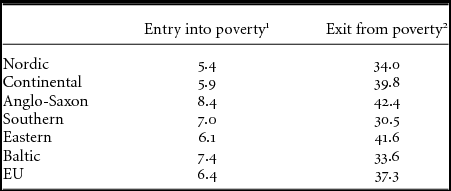
Regarding poverty entry and exit rates (Table 1), the flow into poverty is much smaller than that out of poverty because of the different sizes of the populations (non-poor and poor individuals) potentially affected by the two events (poverty entry and exit, respectively).Footnote 11 Anglo-Saxon countries have the highest poverty entry rates (8.4 per cent), followed by Baltic (7.4 per cent) and Southern countries (7.0 per cent), while the lowest values are observed in the Eastern (6.1 per cent), Continental (5.9 per cent) and Nordic countries (5.4 per cent). Regarding exit rates, the highest values are observed in Anglo-Saxon and Eastern countries (42.4 per cent and 41.6 per cent, respectively), and the Continental countries are not far behind (39.8 per cent), whereas Southern countries exhibit the lowest probability of exiting poverty (30.5 per cent), followed by the Baltic and Nordic countries (33.6 per cent and 34.0 per cent, respectively).
Flows into and out of poverty in the EU groups of countries in 2005–06 (% values)

Notes: 1Share of people classified as non-poor in 2005 becoming poor the following year. 2Share of people classified as poor in 2005 becoming non-poor the following year.
Source: Authors’ estimates from EU-SILC 2005–07 longitudinal data.
In line with the remarks in Section 3, the pattern of poverty entry rates in the EU15 country groups over a two-year period is consistent with the differences stressed by welfare regime theory. Among the new accession countries, those belonging to the Eastern cluster outperform the Baltic countries.
The EU-SILC data confirm that the differences in exit rates are not consistent with the usual rankings of welfare regimes. The two groups of countries characterised by the highest frequencies of exits (Anglo-Saxon and Baltic) have weak active labour market policies and targeted welfare schemes, while Nordic countries, characterised by an encompassing welfare state, have limited exit rates, and Southern countries, which also lack generous universal guarantees and substantial active labour market policies, perform the worst.
This puzzle could be explained by the substantial flexibility of labour markets in Anglo-Saxon and Baltic countries. This flexibility could engender frequent movements into and out of poverty for individuals characterised by intermittent job relationships – thereby affecting poverty recurrence in the long term – while, on the contrary, exit rates could increase in Nordic countries over a longer time span due to active labour market policies. However, as noted above, the brief observation period available in EU-SILC data does not provide information on individual poverty experiences in previous years and, therefore, does not allow us to perform a detailed analysis of the recurrence of poverty spells or compare exit rates in the short- and long-term.
6.2 The definition of demographic and economic events
As mentioned above, an individual is considered poor when his/her equivalent income is below the poverty threshold. Equivalent income is computed by dividing household disposable income (i.e., household resources, given by the sum of all incomes from any source earned by all family members, net of personal taxes and gross of welfare cash benefits) by the equivalence scale (i.e., the household's needs, expressed by the number and characteristics of the components). Therefore, changes in equivalent income and, as a result, in poverty transitions may be due to changes in the numerator – linked to economic events, in particular to changes in income components – or in the denominator – linked to demographic events, which may modify the number and certain characteristics of household's members – or to changes in both the numerator and the denominator (Jenkins, Reference Jenkins2000).
Demographic and economic events are considered the primary sources of poverty entries and exits (Bane and Ellwood, Reference Bane and Ellwood1986; Jenkins and Rigg, Reference Jenkins and Rigg2001). Drawing on the notion that poverty transitions are associated with trigger events, the relationship between some main events and changes in poverty status is analysed in what follows.
Obviously, a number of events may occur simultaneously. As clarified by Jenkins and Rigg (Reference Jenkins and Rigg2001) and Jenkins (Reference Jenkins2011), two methods can be applied to analyse the events associated with poverty transitions: (1) a mutually exclusive system (followed by Bane and Ellwood, Reference Bane and Ellwood1986), in which the researcher establishes a hierarchy of events and associates each transition into or out of poverty with a single ‘major’ event (hence the sum of the shares of poverty transitions related to each event amounts to 100 per cent); (2) a non-mutually exclusive system, in which no hierarchy of events is established in the case of contemporaneous events and the shares of transitions associated with each event are computed (as some transitions are related to more than one event, the sum of the shares of poverty transitions linked to each event exceeds 100 per cent; see Tables 2–3).
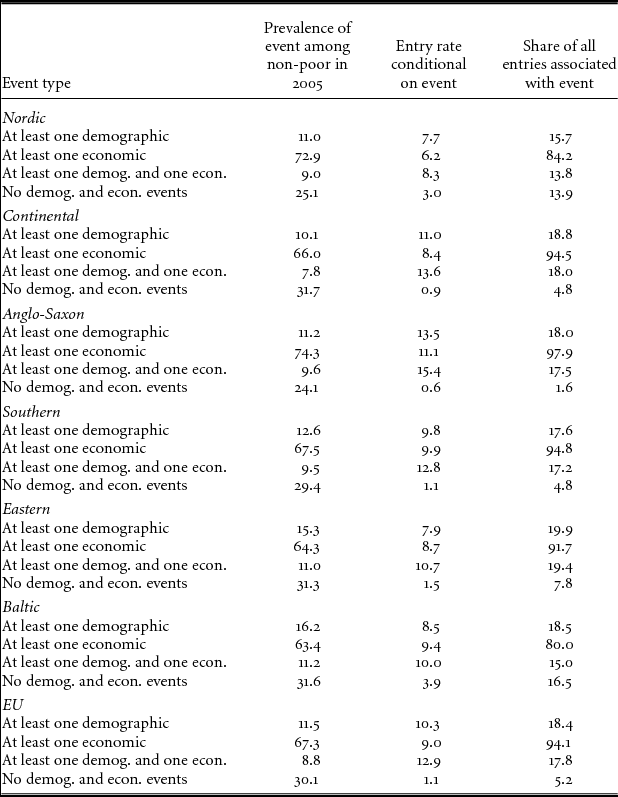
Trigger events1 and entry into poverty in EU groups of countries in 2006 for individuals non-poor in 2005 (% values)2

Notes: 1 Events are not mutually exclusive. 2 For each group of countries, in column 4 the sum of rows 1, 2 and 4 minus row 3 amounts to 100.
Source: Authors’ estimates from EU-SILC 2005–07 longitudinal data.
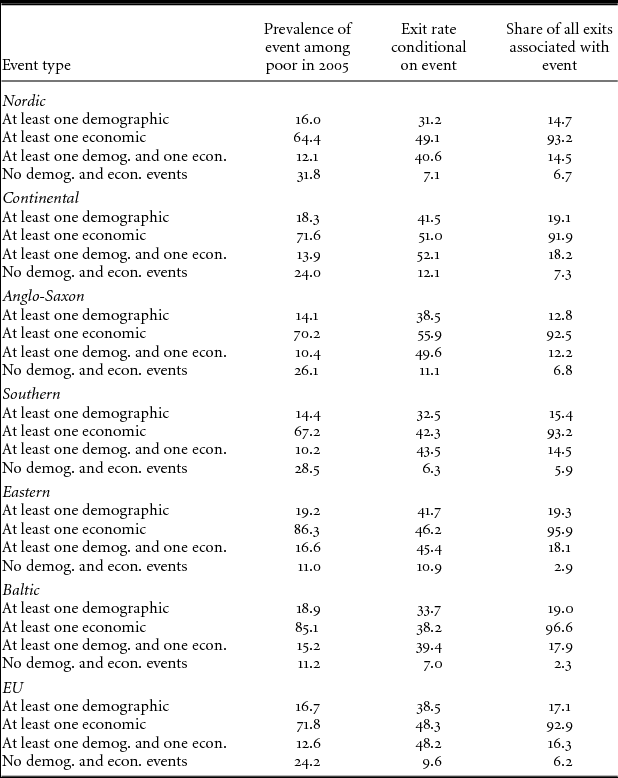
Trigger events1 and exits from poverty in EU groups of countries in 2006 for individuals poor in 2005 (% values)2
Notes: 1 Events are not mutually exclusive. 2 For each group of countries, in column 4 the sum of rows 1, 2 and 4 minus row 3 amounts to 100.
Source: Authors’ estimates from EU-SILC 2005–07 longitudinal data.
Furthermore, Jenkins and Rigg (Reference Jenkins and Rigg2001) and Jenkins (Reference Jenkins2011) underline that the ‘non-mutually exclusive system’ allows the researcher to study both ‘individual’ and ‘aggregate’ approaches to poverty transitions, thereby providing complementary information on the relative importance of various trigger events. The individual approach refers to the probabilities of experiencing a poverty transition after having experienced a specific event. From the individual perspective, an event is important if the conditional probability of experiencing a poverty transition is relatively high. The aggregate approach refers to the share of all poverty transitions accounted for by each of a variety of events (considering those occurring simultaneously as separate events). From the aggregate perspective, an event is important if several transitions are associated with it. In practice, the individual and aggregate approaches are related because the share of all transitions associated with the event (i.e., the aggregate measure) can be expressed by the ratio between the product of the frequency of the event (i.e., its prevalence) and the conditional probability of transitioning after the event occurs (i.e., the individual measure) and the total transition rate (Jenkins, Reference Jenkins2011).
In line with Jenkins and Rigg (Reference Jenkins and Rigg2001) and Jenkins (Reference Jenkins2011), who argue that the second method should be preferred due to its greater flexibility in the number and type of events that can be analysed and because it is less arbitrary than the first method, we perform a parallel analysis of events, i.e., we consider all of the events occurring simultaneously, and for each event we report its prevalence, conditional transition rates and the share of all transitions associated with the event.Footnote 12
Drawing on the variables available in the longitudinal EU-SILC dataset for the two-year period 2005–06 – i.e., an event occurs when the associated variable changes in 2006 relative to 2005 – we consider the following events:
1. Demographic events: changes in the number of household members, marital status, the number of household members affected by poor healthFootnote 13 and disappearance of the 2005 household head in the 2006 wave (e.g., due to death or divorce or moving into another household), where the household head is identified as the member receiving the highest individual income in 2005.Footnote 14
2. Economic events: changes in the total number of labour income earners in the household, the total months worked by the household in a given year, the total weekly hours usually worked and the household main equivalent income sources (i.e., total incomes earned by all family members from employment, self-employment, public and occupational private mandatory pension schemes and other public welfare transfers, converted into equivalent values using the modified OECD scale). We identify an ‘economic event’ when the percentage change (decrease or increase) exceeds 5 per cent.
In the following analysis, entry into poverty is associated with increases in needs (e.g., in the number of components) and/or decreases in resources (e.g., in incomes), whereas exit is linked to the opposite.
6.3 Events related to poverty transitions across EU groups of countries
In line with results concerning the EU15 regimes (Layte and Whelan, Reference Layte and Whelan2003) and according to the aggregate perspective, the economic events are much more frequently associated with poverty transitions than the demographic events in all six welfare regimes (see the last columns of Tables 2 and 3). In Table 2, the share of all entries associated with an economic event is at least 80 per cent (in the Baltic countries), while the maximum share of entries associated with a demographic event is 19.9 per cent (in the Eastern countries). Similarly, in Table 3, the minimum exit rate related to economic events is 91.9 per cent (in the Continental countries), while the maximum share of exits related to demographic event is equal to 19.3 per cent (in the Eastern countries). However, concerning both types of transitions, the differences in these shares are primarily due to differences in the prevalence of demographic and economic events in the population, rather than to a substantial difference in conditional transition rates (i.e., according to the individual measure).
Entry rates conditional on the occurrence of demographic events are higher than those associated with economic events in the Nordic, Continental and Anglo-Saxon countries, while the opposite is observed in the new accession countries (Table 2). Conditional exit rates associated with economic events are, instead, consistently higher than those associated with demographic events and the largest gaps emerge in the Nordic and Anglo-Saxon countries and the lowest in the Eastern and Baltic countries (Table 3).
Therefore, the findings regarding the relationship between trigger events and entry and exit rates are consistent with the expectations established in Section 3, as conditional transition rates related to economic events are relatively lower (apart from in Anglo-Saxon countries) when social insurance is more generous and active labour market policies are more broadly applied, while no clear patterns emerge regarding the conditional transition rates associated with demographic events.
However, a caveat is in order concerning the aggregate measure of demographic events. As discussed in Section 4, due to the limitations concerning the following rule applied in the event of household splits in EU-SILC, individuals affected by a demographic event are not always followed. As a consequence, the occurrence of these events could be under-counted, leading us to underestimate the share of transitions associated with certain demographic events; for instance, if both partners become poor after a divorce, only one individual falls into poverty according to the EU-SILC dataset, as the other is not interviewed (or seldom in survey countries) in the subsequent waves.
Finally, we must note that the share of poverty transitions that are not associated with economic or demographic changes (e.g., due to income movements of less than 5 per cent or movements due to changes in the threshold) is quite important in Nordic and Baltic countries with respect to the poverty entry.
Interesting results emerge when we consider the association between the aforementioned types of demographic and economic events and the poverty transition (these are not presented for the sake of space but are available upon request). Following the aggregate approach, the demographic event most frequently related to the poverty entry in all groups of countries is the increase in the number of household members affected by poor health, which is often associated with reduced labour income. Conversely, according to the individual approach, the most important demographic event is the disappearance of the household head in the Nordic, Southern and Eastern countries and divorce (which is often associated with a change in the household head) in the other three groups of countries. Regarding poverty exit, no demographic event clearly emerges as the primary cause in either the individual or the aggregate approach.
Regarding individual economic events, decreased total household employment income is everywhere the most important event in terms of both entry and exit according to the aggregate approach. Following the individual approach (i.e., considering the entry rates conditional on the event), a decrease in the number of income recipients is associated with the highest conditional entry rate in all groups of countries, while no clear rankings among the economic events emerge with respect to conditional exit rates.
7. Multivariate regression analysis of poverty transition rates in the enlarged EU
7.1 Methodology and control variables
Cross-country econometric comparisons in the poverty dynamics literature have followed two different approaches. The first is to run a regression in which all countries are pooled together and cross-country heterogeneity is captured by a change in the country-specific intercept, thus assuming equal effects of characteristics on poverty across countries (e.g., Fouarge and Layte, Reference Fouarge and Layte2005; Callens and Croux, Reference Callens and Croux2009, which include welfare regime dummies).Footnote 15 A second approach is to estimate separate equations for each country and base the cross-country analysis on the comparison of the coefficients of these models (e.g., Valletta, Reference Valletta2006).
In line with Fouarge and Layte (Reference Fouarge and Layte2005) and Callens and Croux (Reference Callens and Croux2009), we follow the first approach, i.e., regressions are run pooling all countries and including dummies for the groups of countries to verify whether differences in poverty entry and exit rates emerge when controlling for several covariates. We also extend this approach by including interaction terms between the cluster dummies and the occurrence of specific events in the regressions to assess whether events have different effects on poverty transitions in the EU welfare regimes (i.e., we measure the conditional probability of poverty transitions after the occurrence of the events according to an individual approach in a multivariate context).Footnote 16
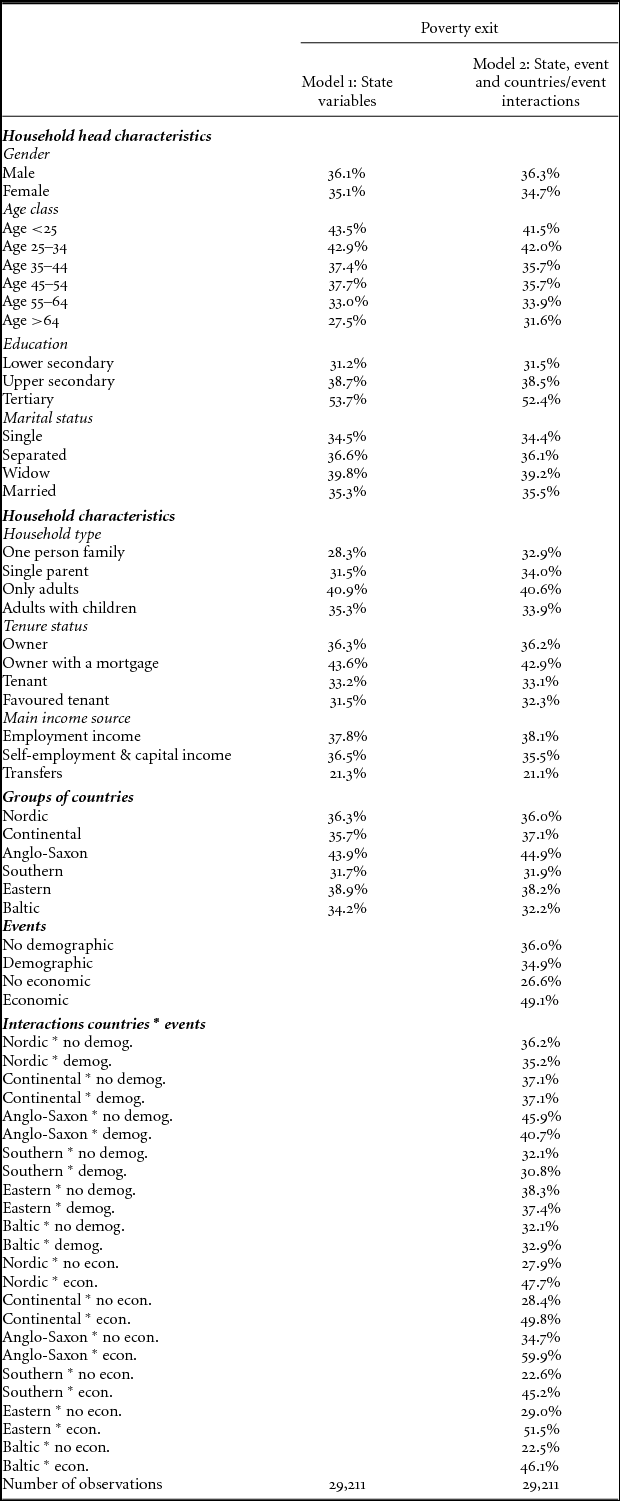
We estimate poverty exit and entry probabilities in a two-year period (2005–06), controlling for the characteristics of the household and the household head in the base year (2005) and changes in certain characteristics (i.e., the occurrence of trigger events between the two years). We run two logit models referring, respectively, to the determinants of entry into and exit from relative income poverty. The first model estimates the probability of being poor in 2006 for the sub-sample of non-poor individuals in 2005 (Tables 4 and 5), whereas the second assesses the probability of not being poor in 2006 for the sub-sample of individuals below the poverty threshold in 2005 (Tables 6 and 7).
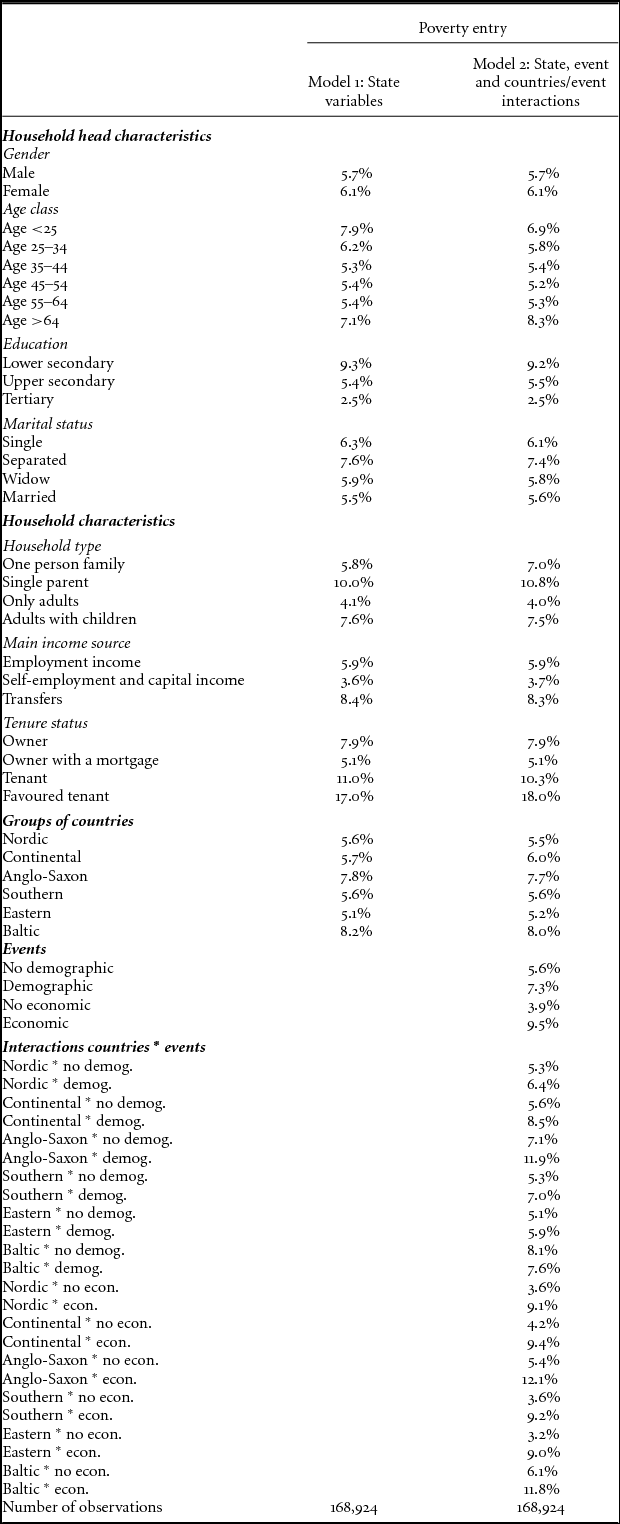
Multivariate regressions of the association between groups of countries and poverty entry in the EU in 2006 for individuals non-poor in 2005 (logit model: estimated average partial effects)
Source: Authors’ estimates from EU-SILC 2005–07 longitudinal data.
P values of Wald test of pairwise comparisons on the equality of estimated coefficients of groups of countries (poverty entry)
Source: Authors’ estimates from EU-SILC 2005–07 longitudinal data.
Multivariate regressions of the association between groups of countries and poverty exit in the EU in 2006 for individuals poor in 2005 (logit model: estimated average partial effects)
Source: Authors’ estimates from EU-SILC 2005–2007 longitudinal data.
P values of Wald test of pairwise comparisons on the equality of estimated coefficients of groups of countries (poverty exit)
Source: Authors’ estimates from EU-SILC 2005–07 longitudinal data.
The following groups of covariates are considered in the estimations:
(a) Characteristics of the household head in 2005: gender, age group, education and marital status.
(b) Household characteristics in 2005: household type, its main income source and tenure status.
(c) Dummies for the six groups of countries.
(d) The occurrence of demographic and economic events from 2005 to 2006: these events are identified by grouping the economic events and demographic events discussed in Section 6.2 into two dummy variables (equal to 1 if the event occurs, 0 otherwise).Footnote 17
(e) Interactions between clusters and the occurrence of demographic or economic events.
For both types of transitions, we run two different models: in ‘Model 1’, dummies related to the occurrence of events and their interactions with country clusters are not included among the covariates, while ‘Model 2’ includes all groups of variables as covariates.
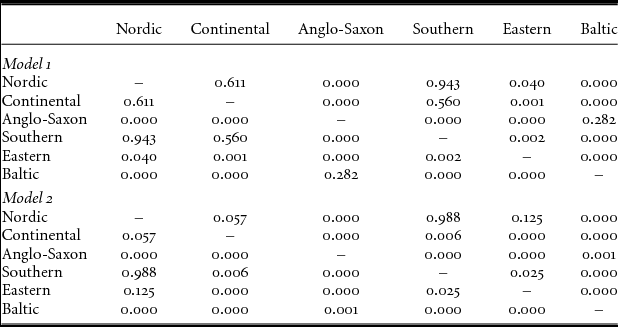
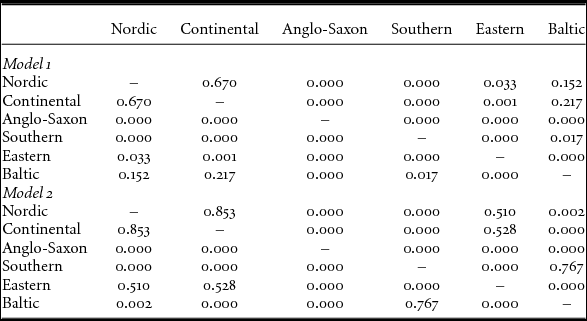
The regression results are expressed as average partial effects, indicating the estimated transition probability according to the covariate value, and Tables 5 and 7 present the p values of Wald tests of pairwise comparisons of the equality of the estimated coefficients of groups of countries.
7.2 Multivariate regressions of poverty entry rates
Controlling for characteristics that can affect poverty transitions (Model 1, Tables 4 and 5), the highest individual risks of entering poverty are observed in the Anglo-Saxon and Baltic groups (7.8 per cent and 8.2 per cent, respectively), while the estimated entry risks in the other groups are approximately 5.5 per cent (and are not significantly different from each other according to the usual confidence level; Table 5), apart from Eastern countries where the probability is significantly lower (5.1 per cent; Tables 4 and 5).
When also controlling for the occurrence of trigger events (Model 2), the country differences change only slightly, as demonstrated by the pairwise comparisons made using the Wald test: individuals living in Continental countries now have a significantly higher probability of falling into poverty than those living in Nordic and Southern countries (other than those living in Eastern countries, as in Model 1), and the difference between the estimated coefficients of the Nordic and Eastern dummies are not significant at the 90 per cent confidence level.
These results partially contrast our expectations (and the descriptive results presented in Table 1), as, controlling for several covariates, a higher entry rate for those living in Southern and Eastern Europe is not observed, while higher risks continue to characterise individuals living in Anglo-Saxon and Baltic countries.
Apart from the cluster dummies, the estimated coefficients present the expected signs: the risks of becoming poor are higher for individuals living in households headed by elderly or very young individuals, unmarried and less-educated persons and among single parent households. By contrast, the risk of becoming poor is lower for individuals belonging to families that primarily rely on self-employment income, those without minors and homeowners.
As expected, the occurrence of demographic and economic events increases the risk of becoming poor and the gap in the conditional probability of an economic event occurring (compared to it not occurring) is much higher than that concerning a demographic event. In the Baltic countries, the probability of falling into poverty is reduced by the occurrence of a demographic event, while the occurrence of such an event results in a relatively larger increase in poverty entry risks in Continental and Anglo-Saxon countries. The occurrence of an economic event substantially increases poverty risks in all countries but, in contrast to our expectations, the size of the increase in the probability is similar in all welfare regimes.
7.3 Multivariate regressions of poverty exit rates
When controlling for household characteristics and the occurrence of events, the Anglo-Saxon countries have the highest probabilities of exiting poverty (see Models 1 and 2 in Tables 6 and 7). Southern countries are characterised by the lowest exit rate (together with the Baltic countries when controlling for the occurrence of events). Nordic, Continental and Eastern countries lie in the middle and the differences among them are not statistically significant (except for those concerning the Eastern cluster in Model 1; Table 7). Therefore, multivariate regressions also seem to indicate that a clear link between welfare regime typologies and exit rates does not exist.
The probability of escaping poverty is higher for those living in households exclusively comprising adults, homeowners, those earning most of their income from employment or self-employment and households headed by males and young individuals (who can more easily find a job when unemployed). Controlling for household characteristics, the occurrence of demographic events does not affect the probability of escaping poverty (on the contrary, these events are associated with reduced likelihoods in most groups of countries, especially the Anglo-Saxon group), while poor individuals experiencing favourable economic events experience a substantially greater likelihood of escaping poverty everywhere and no clear differences between groups of countries emerge, although the relative probability doubles in the Baltic and Southern countries (Model 2, Table 6).
8. Conclusions
This paper depicts poverty dynamics in the enlarged EU using EU-SILC data. Due to the limited time span covered by the longitudinal EU-SILC, the analysis focused on poverty mobility in a two-year period (2005–06), assessing what types of events are associated with poverty transitions in the six groups of countries identified by the literature on welfare regimes.
In line with our expectations, the descriptive analysis reveals that the highest entry rates emerge in Anglo-Saxon, Southern and Baltic countries and the lowest in the encompassing Nordic regime. However, these findings are partially contradicted by multivariate regressions, where a higher entry rate for those living in Southern Europe does not emerge. Regarding poverty exit, a clear ranking of groups of EU countries consistent with the welfare regime typologies does not emerge from either the descriptive analysis or multivariate regressions. These findings clearly support our claims regarding the theoretical indeterminacy of the relationship between well-known welfare regime typologies and poverty exit.
Concerning the assessment of the importance of demographic and economic trigger events, we followed both an aggregate approach (how many transitions are associated with the event?) and an individual one (what is the transition rate when the event occurs?). The aggregate approach tends to overemphasise the role of economic events in poverty transitions, while the individual approach provides a different picture because demographic events also substantially affect poverty mobility. However, after controlling for household characteristics (which can clearly influence the occurrence of the events) in the multivariate regressions, the change in the transition probability after the occurrence of a demographic event declines for poverty entry and disappears for poverty exit, while the occurrence of economic events is always associated with individual poverty transitions.
Therefore, in contrast to our expectations, the multivariate regressions do not support the notion that the economic events have a noticeably stronger effect on poverty mobility in less generous welfare regimes, in which individuals are less decommodified, and no differences related to welfare regimes typologies emerge with respect to the conditional transition rates associated with demographic events.
In summary, our analysis suggests that the relationship between poverty mobility and welfare regimes is not very clear, especially when we control for several individual characteristics that can influence the occurrence of economic and demographic events and can, at least partially, explain the gaps between countries. As noted by Jenkins (Reference Jenkins2011), it is difficult to infer clear links between welfare state characteristics and poverty dynamics, as this relationship depends on various interdependent factors – i.e., population composition, event occurrence, conditional transition rates after the events, total transition rates – that can differ across groups of countries and can be differently affected by the various welfare schemes and the design of each policy.
These issues thus deserve further research, which could develop along at least two non-mutually exclusive lines that were not considered in this paper: (i) studying whether substantial differences within the groups of countries emerge concerning the patterns of poverty dynamics; (ii) assessing whether the relationship between poverty dynamics and welfare regimes changes when the monetary value of in-kind benefits (which are highly difficult to impute correctly) is added to monetary disposable income when computing poverty thresholds and rates. As argued by Esping Andersen and Myles (Reference Esping Andersen, Myles, Salverda, Nolan and Smeeding2009), an exclusive focus on cash benefits does not allow the researcher to capture the differences between welfare regimes and the complete effects of various welfare states on poverty mobility.