Intimate partner violence (IPV) in romantic relationships negatively impacts the physical, mental, and relational health of young men and women (Breiding, Black, & Ryan, Reference Breiding, Black and Ryan2008; Coker et al., Reference Coker, Davis, Arias, Desai, Sanderson, Brandt and Smith2002; White, Reference White2009). Based on data from the National Longitudinal Study of Adolescent Health, 47% (43% men, 50% women) of young adults ages 18 to 27 years reported some form of psychological, physical, or sexual violence in their romantic relationships (Renner & Whitney, Reference Renner and Whitney2012), the majority of which was bidirectional. Most victims of IPV report having experienced their first IPV victimization before the age of 25 years (71% for young women and 58.2% for young men; Breiding et al., Reference Breiding, Smith, Basile, Walters, Chen and Merrick2014). Once initiated, violent patterns of interacting and resolving conflict with romantic partners may become established (Ehrensaft et al., Reference Ehrensaft, Cohen, Brown, Smailes, Chen and Johnson2003), and these patterns can spill over to other familial relationships, as evidenced by the substantial overlap between child maltreatment and witnessing parent IPV (an estimated 34% overlap in past-year victimization and 57% lifetime overlap; Hamby, Finkelhor, Turner, & Ormrod, Reference Hamby, Finkelhorb, Turner and Ormrod2010). Given the high prevalence and problematic outcomes related to IPV, identifying developmental precursors and exacerbating factors for IPV during young adulthood remains a significant health priority.
This study adopts a dynamic dyadic systems (DDS) model framework (Capaldi & Clark, Reference Capaldi and Clark1998; Capaldi, Shortt, & Kim, Reference Capaldi, Shortt, Kim, Pinsof and Lebow2005) to examine risks for IPV perpetration in young adulthood. In this model, the developmental history and characteristics of both partners, as well as current contextual factors (e.g., socioeconomic and relationship status), are viewed as potential contributors to relationship processes (e.g., conflict) and outcomes (e.g., IPV, relationship satisfaction, and break up). The DDS model is unusual in emphasizing a couple-level perspective and the conjoint role of both selection and socialization processes (Capaldi, Shortt, & Crosby, Reference Capaldi, Shortt and Crosby2003). A recent systematic review, predicated on a DDS framework, suggests that one of the most compelling and robust developmental risk factors for IPV involvement is exposure to IPV in the family of origin (Capaldi, Knoble, Shortt, & Kim, Reference Capaldi, Knoble, Shortt and Kim2012). This pathway reflects both social learning and intergenerational transmission theory, emphasizing social and cognitive impairments that serve to maintain or exacerbate aggressive behaviors (Capaldi & Clark, Reference Capaldi and Clark1998; Wolfe, Crooks, Lee, McIntre-Smith, & Jaffe, Reference Wolfe, Crooks, Lee, McIntyre-Smith and Jaffe2003).
Because of design constraints in most studies of couples, family-of-origin risk factors are rarely assessed prospectively. One of the first studies to employ a prospective model was that of the Oregon Youth Study (Capaldi & Clark, Reference Capaldi and Clark1998), in which parent antisocial behavior predicted interparent IPV and unskilled parenting, and both were related to male-to-female psychological and physical IPV perpetration in young adulthood via adolescent antisocial behavior (note that Capaldi & Clark, Reference Capaldi and Clark1998, examined only indirect effects not direct effects). Ehrensaft et al. (Reference Ehrensaft, Cohen, Brown, Smailes, Chen and Johnson2003) conducted a 20-year prospective developmental study and found that exposure to parent IPV was the greatest risk factor for experiencing IPV victimization and made a significant contribution to perpetration of IPV, even controlling for the contribution of punishment during childhood and conduct disorder during adolescence. Subsequently, other studies have indicated that exposure to parent physical IPV in early childhood and adolescence prospectively predicted physical IPV in young adulthood (e.g., Cui, Durtschi, Donnellan, Lorenz, & Conger, Reference Cui, Durtschi, Donnellan, Lorenz and Conger2010; Ireland & Smith, Reference Ireland and Smith2009; Linder & Collins, Reference Linder and Collins2005; Narayan, Englund, Carlson, & Egeland, Reference Narayan, Englund, Carlson and Egeland2014; Narayan, Englund, & Egeland, Reference Narayan, Englund and Egeland2013).
Despite evidence of intergenerational continuity, reviews of the body of literature have consistently characterized the direct relation between childhood exposure and young adult IPV as only weak to moderate (Capaldi et al., Reference Capaldi, Knoble, Shortt and Kim2012; Stith et al., Reference Stith, Rosen, Middleton, Busch, Lundeberg and Carlton2000), possibly suggesting an indirect effects model. One of the most widely hypothesized mechanisms is psychopathology symptoms, owing to the large body of work documenting elevated levels of externalizing and internalizing problems in children and adolescents exposed to parent IPV (Evans, Davies, & DiLillo, Reference Evans, Davies and DiLillo2008; Kitzmann, Gaylord, Holt, & Kenny, Reference Kitzmann, Gaylord, Holt and Kenny2003; Lang & Stover, Reference Lang and Stover2008; Wolfe et al., Reference Wolfe, Crooks, Lee, McIntyre-Smith and Jaffe2003). In a meta-analysis of exposure to IPV and childhood and adolescent outcomes, associations were found for both externalizing and internalizing behaviors, and gender was found to moderate the effect such that it was significantly stronger for boys than for girls (Evans et al., Reference Evans, Davies and DiLillo2008). A second meta-analysis on the same topic indicated that associations of exposure with externalizing and internalizing symptoms increased over time, with effects persisting 10 years after exposure (Vu, Jouriles, McDonald, & Rosenfeld, Reference Vu, Jouriles, McDonald and Rosenfield2016).
An indirect effects model is supported by a large body of research indicating externalizing and internalizing behaviors elevate risk for later involvement in IPV. Numerous studies have found conduct problems elevate risk for young men's and women's physical and psychological IPV perpetration (see Capaldi et al., Reference Capaldi, Knoble, Shortt and Kim2012), whereas the association between depressive symptoms and IPV is more mixed and has been more extensively examined with young adult samples. One cross-sectional study (Lehrer, Shrier, Gortmaker, & Buka, Reference Lehrer, Shrier, Gortmaker and Buka2006) found that women with higher levels of depressive symptoms endorsed more IPV victimization or injury, although the direction of the effect, that is, whether women's depressive symptoms preceded or followed victimization, is uncertain. Other cross-sectional work has found depressive symptoms are no longer a significant predictor of IPV for men and women in multivariate analyses after accounting for sociodemographics, individual characteristics, and experiences (Halpern, Spriggs, Martin, & Kupper, Reference Halpern, Spriggs, Martin and Kupper2009). Prospective data from the Oregon Youth Study found that women's but not men's depressive symptoms predicted female-to-male violence (Capaldi & Crosby, Reference Capaldi and Crosby1997), whereas a later study found both men's and women's depressive symptoms were related to later physical and psychological aggression toward their partner (Kim & Capaldi, Reference Kim and Capaldi2004). Finally, a third study from that sample (Kim, Laurent, Capaldi, & Feingold, Reference Kim, Laurent, Capaldi and Feingold2008) found that, while controlling for antisocial behavior, neither men's nor women's depressive symptoms were related to his/her own perpetration. In sum, depressive symptoms may be a relatively weak predictor of IPV perpetration and appear to be far less robust than conduct problems. Conduct problems and depressive symptoms consistently show a low to moderate association (Capaldi & Kim, Reference Capaldi, Kim, Richards and O'Hara2014) and thus some of the effects of depressive symptoms may be explained by conduct problems. Regarding gender moderation, there is some evidence that women may be more vulnerable to internalizing symptoms than are men, such that internalizing symptoms are a stronger predictor of IPV perpetration for women than for men (Capaldi et al., Reference Capaldi, Knoble, Shortt and Kim2012).
Longitudinal Evidence of Intergenerational Transmission of Violence
Despite ample research on psychopathology symptoms as an outcome of exposure to parent IPV, and as a risk factor for later IPV, there is a surprising dearth of prospective longitudinal evidence on the indirect effects of exposure on IPV perpetration through psychopathology symptoms. Because both symptom classes are related to risk and dysfunction in the family of origin (Wolff & Ollendick, Reference Wolff and Ollendick2006), we predicted they would mediate the association of childhood exposure to violence and young adult perpetration of IPV. A handful of prospective studies provide preliminary support for the candidate mediator. In the Oregon Youth Study, conduct problems were a robust meditational mechanism between exposure to IPV and later partner aggression (Capaldi & Clark, Reference Capaldi and Clark1998). Ehrensaft et al. (Reference Ehrensaft, Cohen, Brown, Smailes, Chen and Johnson2003) examined conduct disorder as a prospective mediator between exposure to parent IPV and involvement in partner violence and found that conduct disorder during adolescence mediated the effect of child abuse. However, exposure to violence between parents remained a significant predictor even after taking conduct disorder into account in the model. These two studies, albeit prospective, reveal limitations. First, Capaldi and Clark (Reference Capaldi and Clark1998) examined only men, whereas Ehrensaft et al. (Reference Ehrensaft, Cohen, Brown, Smailes, Chen and Johnson2003) did not examine gender differences. Second, both examined symptoms that fall within the broader class of conduct disorder or adult antisocial behavior. We are not aware of any study that has simultaneously considered internalizing and externalizing symptoms, which is an important consideration given their comorbidity (Costello, Mustillo, Erkanli, Keeler, & Angold, Reference Costello, Mustillo, Erkanli, Keeler and Angold2003; Oland & Shaw, Reference Oland and Shaw2005; Reitz, Deković, & Meijer, Reference Reitz, Dekovic and Meijer2005). The current study addresses this gap by examining a prospective longitudinal model of the mediational role of adolescent psychopathology symptoms in explaining the developmental risks conveyed by childhood exposure to parent IPV on young adult perpetration of IPV. Both internalizing and externalizing, and a combined psychopathology symptoms construct were examined as mediators, and gender was examined as a moderator.
Proximal Relationship Context
A predicate of the DDS framework is that risk for involvement in IPV in young adulthood is the product of both developmental risk factors from childhood and adolescence, and proximal risk factors reflecting both partners’ individual and couple-level dynamics. As such, one hypothesis is that the impact of early adversity and distal risk factors (apparent in childhood and adolescence) may be overshadowed by characteristics of the proximal relationship context, a theory that has not yet been formally tested. Thus, a major aim of the current study was to evaluate a more comprehensive DDS model of violence transmission by simultaneously accounting for developmental history and proximal relationship context at both the individual and the couple level. In terms of developmental history, antisocial behavior is arguably one of the most robust antecedents of IPV involvement in young adulthood (Capaldi et al., Reference Capaldi, Knoble, Shortt and Kim2012), for men and women. Inclusion of partner antisocial behavior in young adulthood makes for a rigorous test of the intergenerational effects of family-of-origin risk given antisocial behaviors tend to be associated across partners via assortative partnering and social influence effects (Capaldi & Crosby, Reference Capaldi and Crosby1997; Moffitt, Robins, & Caspi, Reference Moffitt, Robins and Caspi2001).
In comparison to familial or intraindividual characteristics, relationship risk factors, such as discord, are understudied, despite the conceptual overlap with psychological aggression (see Capaldi et al., Reference Capaldi, Knoble, Shortt and Kim2012). Qualitative (Stephenson, Martsolf, & Draucker, Reference Stephenson, Martsolf and Draucker2011), cross-sectional (Bookwala, Sobin, & Zdaniuk, Reference Bookwala, Sobin and Zdaniuk2005), and longitudinal studies (Aldorando & Sugarman, Reference Aldarondo and Sugarman1996; DeMaris et al., Reference DeMaris, Benson, Fox, Hill and Van Wyk2003; Giordano, Soto, Manning, & Longmore, Reference Giordano, Soto, Manning and Longmore2010) suggest relationship conflict/discord is a proximal risk factor for IPV. In order to reduce possible overlap with the dependent variable of IPV, relationship conflict was assessed by observed negative behaviors during a couples’ discussion task, but excluding psychological or physically aggressive behaviors. This is the first study, to our knowledge, that uses a prospective model to examine the conjoint influences of childhood IPV exposure, adolescent psychopathology symptoms, and the proximal relationship context in explaining young adult IPV perpetration for both men and women.
Current Study
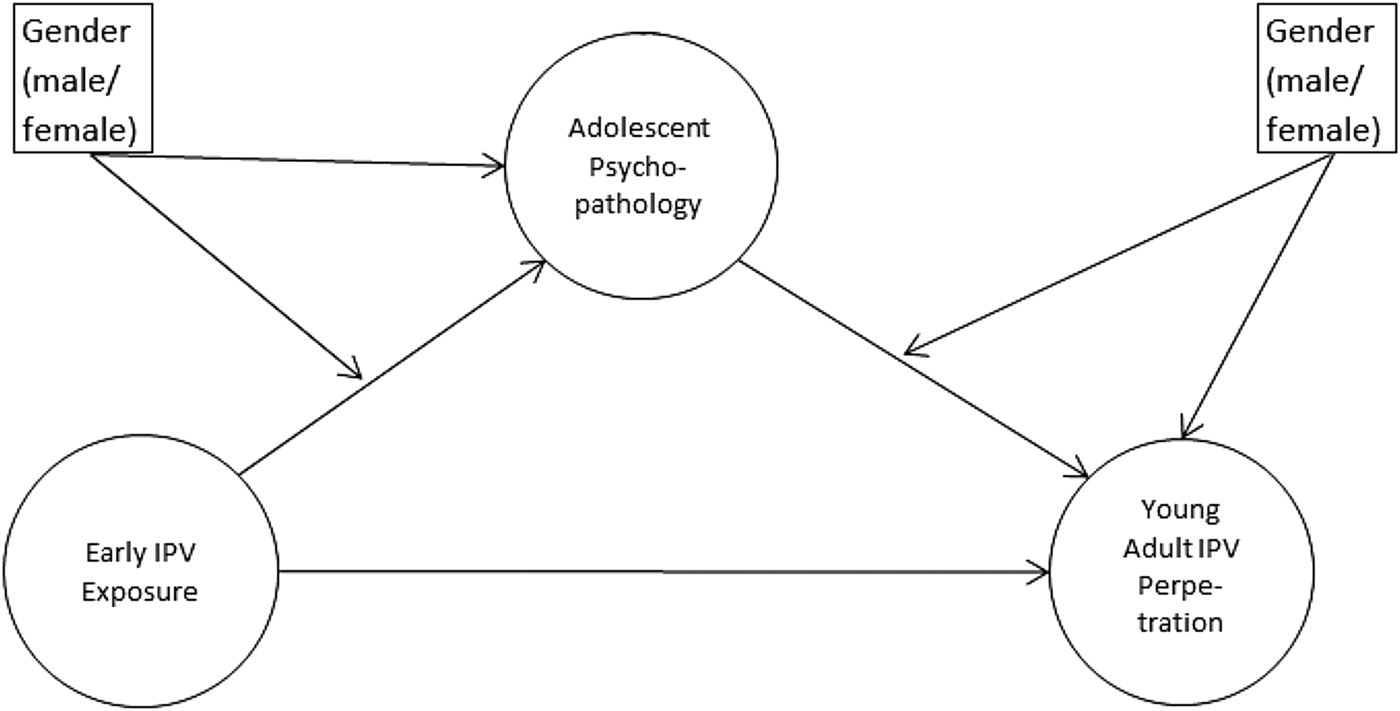
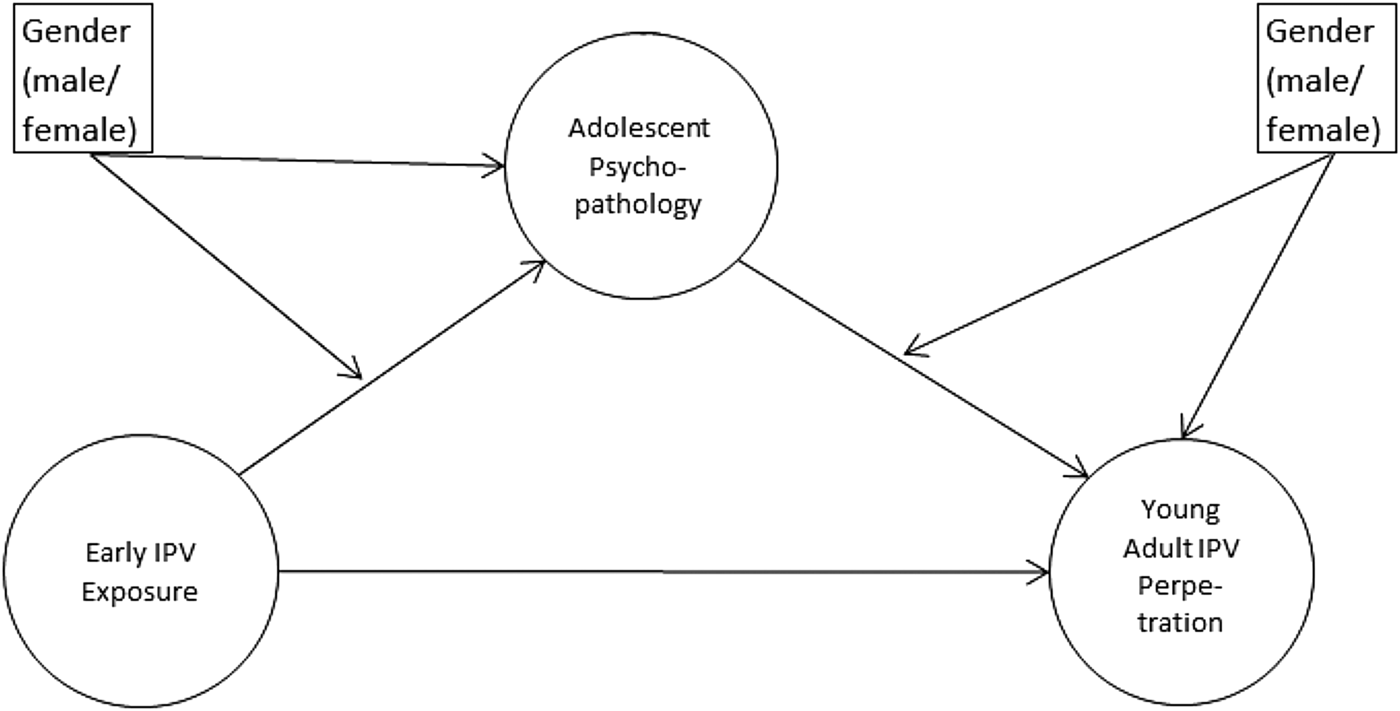
The current study utilized a DDS model to examine whether and to what extent adolescent externalizing and internalizing symptoms explain the intergenerational transmission of IPV, and whether meditational processes operate differently for men and women. A prospective moderated-mediational model (Muthén & Asparouhov, 2014; Preacher, Rucker, & Hayes, Reference Preacher, Rucker and Hayes2007) was examined in which adolescent psychopathology symptoms (i.e., internalizing, externalizing, and combined) mediated the association between exposure to IPV in middle childhood and young adult IPV perpetration (see Figure 1). Specifically, we examined gender moderation from (a) childhood to adolescence, assessing whether the impact of childhood IPV exposure on psychopathology symptoms (and subsequent young adult IPV perpetration) differed for men or women; and (b) adolescence to young adulthood, examining whether men or women perpetrated more IPV in young adulthood attributable to greater adolescent psychopathology symptoms as a result of childhood IPV exposure. In a more novel contribution, we examined how features of the proximal relationship context (partner antisocial traits and couple-level conflictual problem solving) may attenuate direct and indirect pathways involving parent IPV exposure, adolescent psychopathology symptoms, and young adult IPV perpetration. We hypothesized that, in general, externalizing would play a stronger explanatory role for men and women than would internalizing. We expected greater IPV exposure to predict higher adolescent externalizing behavior for men than for women. Given the higher levels of depressive symptoms in girls versus boys at adolescence and in young adulthood (Angold, Costello, & Worthman, Reference Angold, Costello and Worthman1998; Costello et al., Reference Costello, Mustillo, Erkanli, Keeler and Angold2003), and the suggestion from a review of etiological studies that depressive symptoms may play a stronger etiological role in IPV for women than for men (Capaldi et al., Reference Capaldi, Knoble, Shortt and Kim2012), we expected that internalizing would play a stronger mediational role for women than for men. Finally, because of correspondence between partners in antisocial behavior (Capaldi, Kim, & Shortt, Reference Capaldi, Kim, Shortt, Putallaz and Bierman2004), we expected partner antisocial behavior would significantly attenuate developmental mediational mechanisms. In contrast, given that the sample was drawn from a normative population, couples’ negative engagement was anticipated to be a less salient predictor of IPV and thus not attenuate developmental mediational mechanisms.
Conceptual model depicting mediating role of adolescent psychopathology symptoms in explaining the intergenerational transmission of intimate partner violence with moderation by gender. Indicators of latent constructs not shown for clarity.
Method
Data were drawn from a larger longitudinal study of participants (n = 671) who were part of a randomized controlled trial of a multimodal school-based preventive intervention, Linking the Interest of Families and Teachers (LIFT; Eddy, Reid, & Fetrow, Reference Eddy, Reid and Fetrow2000). LIFT comprised a child social and problem-solving skills program, a playground-based behavior management program, and a parent-management training component with the overarching aim of promoting healthy social dynamics in family and peer relationships and preventing the development of serious antisocial behavior problems. The intervention was intended to be delivered to an entire population, rather than a selected group, and thus was “universal” in nature (Mrazek & Haggerty, Reference Mrazek and Haggerty1994). Randomization in the study was at the school level, with either the first- or the fifth-grade class in each of 12 schools participating. Following the intervention phase of the study, which occurred over a 3-month period during the school year, participants in both the intervention and the control groups were followed annually for up to 15 years. In the later years of the LIFT Study, n = 542 remained as young adults (81%), with dropout attributed to those who had (a) participated in the school-related portion of the study only, (b) dropped out of participation, (c) left the United States, or (d) died (i.e., 3 youth). Baseline levels of antisocial behavior and demographic characteristics did not significantly differ for those participants who remained in versus dropped out of the study. Remaining participants were invited to participate with an intimate partner in a “LIFT Couples” portion of the project, which resulted in 323 young adults.
LIFT Couples sample
A total of 323 couples participated in the LIFT Couples Study, out of the remaining 542 young adult (60%) study participants (184 women, 139 men; average age = 21 years, SD = 2, range = 18–28 years) and their romantic partners (146 women, 177 men; average age = 22 years, SD = 4, range = 15–40 years). No minimum length of relationship was set, and the couples defined their relationship status (i.e., dating, living together, engaged, or married). Of the couples, 98% were heterosexual and 2% were same-sex women. Due to the lack of power to detect effects, the seven same-sex couples were dropped from analyses. The young men and women who received the LIFT intervention were not found to be significantly more or less likely to perpetrate or be victims of IPV in young adulthood compared to those in the control condition (Eddy, Feldman, & Martinez, Reference Eddy, Feldman, Martinez, Dishion and Snyder2016).
In order to test the mediational hypotheses adequately (Maxwell & Cole, Reference Maxwell and Cole2007), the current study included only LIFT participants who were measured on parent IPV prior to having been measured on the mediator of adolescent psychopathology symptoms; this yielded a subsample of n = 205 original LIFT participants. No significant differences were found between those n = 205 participants who were included in the current analyses and those who were excluded for all study variables: parent IPV exposure, t (502) = –0.338, –0.106, 0.511, and 0.236, p = .736, .916, .610, and .813, for mothers’ and fathers’ perpetration of psychological IPV, and mothers’ and fathers’ perpetration of physical IPV, respectively; adolescent internalizing symptoms, t (539) = 0.387, p = .699, and adolescent aggression, t (539) = 1.121, p = .263, as measured by the Child Behavior Checklist and averaged over mother, father, and/or teacher reports; young adult perpetration of IPV, t (321) = –0.427, p = .670, for psychological, t (321) = –0.408, p = .683, for physical, and t (317) = –1.600, p = .111, for sexual IPV; partner young adult aggression and delinquency, t (319) = 0.223, p = .823, and couples’ negative engagement in young adulthood, t (310) = 0.219, p = .827.
Demographics
These participants were, on average, assessed for exposure to parent IPV at ages 12.30 years (SD = 1.45) and adolescent psychopathology symptoms at ages 15.77 years (SD = 0.52). Young adult IPV perpetration was assessed on average at age 21.30 years (SD = 1.76). Of the couples, 42.5% were dating (including 4.8% engaged), 42.0% were cohabitating (including 14.0% engaged), and 15.5% were married. Regarding children, 14.5% of LIFT participants and 16.0% of their partners had one or more children. In terms of education, 8.2% of LIFT participants and 16.9% of partners had less than a high school education, 45.5% of LIFT participants and 35.7% of partners had obtained a high school diploma or a GED, and 41.5% of LIFT participants and 42.5% of partners had attended at least some college. The couples were predominantly European American (87.4% for LIFT participants; 78.8% for partners) and lower income (71.7% earned under $25,000 and 37.7% received financial aid for LIFT participants; and 68.2% earned under $25,000 and 27.5% received financial aid for partners).
Procedure
In the LIFT Study, participants were interviewed yearly and participated in a variety of data collection tasks, including direct observations, over approximately a 15-year period from 1991 to 2009 during childhood, adolescence, and young adulthood. Data for the couples study were gathered during a visit when couples came into the research laboratory or were visited in their homes, and they completed surveys (about 1.5 hr in length) and a videotaped couple discussion task. Both the LIFT participant and partner were compensated for their participation time. All procedures were approved by the Oregon Social Learning Center Institutional Review Board.
Measures
Young adult IPV perpetration
Participants’ perpetration of psychological, physical, and sexual IPV were measured using the self-reported perpetration and partner-reported victimization subscales of the Revised Conflict Tactics Scales (Straus, Hamby, Boney-McCoy, & Sugarman, Reference Straus, Hamby, Boney-McCoy and Sugarman1996). A total of 8 psychological, 12 physical, and 7 sexual IPV items were answered by both partners, once in relation to the participants’ perpetration (e.g., I pushed my partner) and once in relation to the partners’ victimization (e.g., my partner pushed me). Participant-reported perpetration and partner-reported victimization scores were significantly associated for psychological (r = .38, .24, p < .001), physical (r = .24, p < .001), and sexual (r = .19, p = .005) IPV; thus, scores were averaged to form one IPV perpetration score for each participant for each type of IPV. Item response scales included seven categories that were coded to reflect the midpoints of the categories as follows: never and not in last year but before = 0, once = 1, twice = 2, 3–5 times = 4, 6–10 times = 8, 11–20 times = 15.5, and 20+ times = 20. The ceiling of IPV perpetration scores was taken to yield integer values to be modeled as count outcomes in the analyses. On average, no significant differences were found for women's versus men's perpetration of IPV, t (203) = –0.12, p = .906, for psychological IPV; t (203) = 0.98, p = .327, for physical IPV; and t (200) = 0.96, p = .132, for sexual IPV.
Psychological IPV
Examples of psychological IPV include shouted/yelled, insulted/swore, and did something to spite partner. Reliability of participant self-reported perpetration and partner-reported victimization for the unstandardized count items equaled α = 0.71 and α = 0.70, respectively. Significant congruence was observed between self- and partner-reported behaviors (r = .38, p < .001), and thus they were combined. Prevalence of psychological IPV perpetration equaled 90.2% (n = 185 of the 205 participants). Of the 185 participants who endorsed psychological IPV, n = 85 (45.9%), 35 (18.9%), 27 (14.6%), and 16 (8.6%) reported 1, 2, 3, and 4 psychologically aggressive acts, respectively, with the remaining n = 22 (11.9%) having reported 5 or more acts in the last year.
Physical IPV
Example items include pushed/shoved, slapped, and punched/hit. The reliability coefficient for self-reported perpetration was slightly higher (α = 0.82) than for partner-reported victimization (α = 0.72). Moderate, but significant, congruence was observed between self- and partner-reported behaviors (r = .24, p < .001); thus, they were combined. Prevalence of physical IPV perpetration equaled 32.7% (n = 67 of the 205 participants). Of the 67 participants who endorsed physical IPV, n = 57 reported a single incident, and n = 4, 3, 2, and 1 reported 2, 3, 4, and 5 acts, respectively, in the last year.
Sexual IPV
Example items include insisted on sex and used force or threats to make partner have sex. Reliability coefficients for self-reported perpetration and partner-reported victimization were α = 0.65 and α = 0.26, respectively. As discussed by O'Leary and Williams (Reference O'Leary and Williams2006), we examined why reliability was in the unacceptable range, particularity for partner-reported victimization. At least three contributing factors were identified. First, the majority of participants and partners did not endorse any of the items (n = 150, 73.2% and n = 134, 65.4%, respectively), thus item variances were estimated to be quite small. Second, of the n = 55 participants and n = 71 partners who reported sexual aggression, the majority endorsed only one (n = 29, 52.7% and n = 43, 60.6%, respectively) or two behaviors (n = 19, 34.5% and n = 21, 29.6%, respectively); thus, interitem covariances were also estimated to be quite small. Third, reliability coefficients presented above were estimated from the unstandardized items, which were recoded to reflect count variables that ranged from 0 to 20 (rather than the Likert scaling of 0–6). This resulted in substantial differences among the item variances, such that the most commonly endorsed items pertaining to insisting on sex when one's partner was not interested and insisting on having sex without a condom (prevalence ranging from 7.4% to 26.5%) yielded the largest variances whereas the rarely endorsed items pertaining to using force or threats to make one's partner have sex (prevalence ranging from 0.5% to 2%) resulted in the smallest variances. Note that reliability coefficients based on the standardized sexual aggression items equaled α = 0.74 and 0.67 for self-reported perpetration and partner-reported victimization, respectively.
Significant congruence was observed between self- and partner-reported behaviors (r = .16, p = .024; again, note that this correlation is based on the recoded count variables); thus, reports were combined. Prevalence of sexual IPV perpetration as reported by one or both partners equaled 48.3% (n = 99 of the 205 participants). Averaged over all sexual IPV behaviors, of the 99 participants who endorsed sexual IPV, n = 60 (60.6%), 27 (27.3%), and 8 (8.1%) reported 1, 2, and 3 sexually aggressive acts, respectively, with the remaining n = 4 (4.0%) having reported 4 or more acts in the last year.
Childhood IPV exposure
Interparent dyadic IPV was formed from mother and father reports on the physical and psychological aggression subscales from the Conflict Tactics Scales (Straus, Reference Straus1979; age at assessment was already reported). Items were answered twice by each partner, once in relation to their own perpetration and once in relation to their own victimization. Psychological and physical aggression subscales were measured using five and six items, respectively. Item response scales included seven categories that were coded from 1 to 7, respectively, as follows: never or less than once a year, once or twice a year, several times per year but less than monthly, once or twice a month, several times a month to weekly, more than once a week, and daily. For psychological aggression, reliability of self-reported perpetration and partner-reported victimization equaled α = 0.69 and 0.78, respectively, for mother behaviors, and α = 0.77 and 0.83, respectively, for father behaviors; for physical IPV, reliability equaled α = 0.73 and 0.79, respectively, for mother behaviors and α = 0.77 and 0.79, respectively, for father behaviors. Partner reports of each other's behaviors were significantly associated for psychological aggression, r (107) = .57, p < .001 for mothers and r (107) = .51, p < .001 for fathers, and physical aggression, r (107) = .38, p < .001 for mothers and r (107) = .35, p < .001 for fathers, and thus averaged for each person and IPV type. Mother and father psychological aggression, r (187) = .66, p < .001, and physical aggression scores were significantly associated, r (187) = .46, p < .001, and averaged. The final calculated interparent dyadic physical and psychological aggression score was the mean of the physical and psychological aggression indicators, which were significantly associated (r = .53, p < .001).
Adolescent psychopathology symptoms
Adolescent psychopathology symptoms was calculated as the mean of the internalizing and externalizing subscales, which were significantly associated, r (190) = .60, p < .001 (age at assessment was already reported). Details regarding the calculation of the internalizing and externalizing subscales are given below.
Adolescent internalizing behaviors
Adolescent internalizing was composed of three subscales denoting internalizing, anxiety, and depressive symptoms. Adolescent internalizing was measured using mother, father, and teacher reports from the Child Behavior Checklist internalizing subscale (CBC; Achenbach, Reference Achenbach1997), which included 7 items. Reliability coefficients equaled .73, .68, and .57 for mothers, fathers, and teachers, respectively. Significant congruence was observed among all reporters’ scores (rs = .31 to .36, p < .001), and scores were thus averaged to form a single adolescent internalizing score. Adolescent internalizing scores ranged from 0 to 32 with a mean of 5.89 (SD = 5.36), and 6% of sample were in the clinical range. Adolescent anxiety was measured via self-reported anxiety symptoms using 8 items from the Traumatic Stress Schedule (TSS; Norris, Reference Norris1990; α = 0.83; e.g., “in last month how often was your child jumpy, unusually forgetful, have trouble sleeping”). Adolescent anxiety scores ranged from 1 to 3.5 with a mean of 1.78 (SD = 0.55). Adolescent depression was measured via self-reported depressive symptoms using 27 items from the Child Depression Inventory (CDI; Kovacs, Reference Kovacs1985; α = 0.69); scores ranged from 0 to 25, with a mean of 7.60 (SD = 6.05), with 23% of the sample in the clinical range (Kovacs, Reference Kovacs1992). The final internalizing score was then calculated as the mean of the three standardized subscales denoting internalizing (CBC), anxiety (TSS), and depressive symptoms (CDI), which were all significantly associated, r (186) = .40 to .59, all p < .001.
Adolescent externalizing behaviors
Externalizing was composed of three subscales denoting aggression, oppositional defiant disorder, and conduct disorder. Adolescent aggression was measured using mother, father, and teacher reports from the CBC aggression subscale (Achenbach, Reference Achenbach1997), which includes 20 items. Response scales ranged (0 = not true, 1 = somewhat true, and 2 = very true). Reliability coefficients equaled .89, .90, and .94 for mothers, fathers, and teachers, respectively. Significant congruence was observed among all reporters’ scores (rs = .37 to .50, all p < .001), and scores were thus averaged to form a single adolescent aggression score. Adolescent aggression scores ranged from 0 to 38.5 with a mean of 4.46 (SD = 4.94), with 1% of the sample falling in the clinical range. Oppositional defiant and conduct disorders were measured using mother and father reports from the overt–covert aggression scale (Oregon Social Learning Center). The oppositional defiant subscale was measured with 12 items (e.g., argues with adults; actively defies), and the conduct scale has 15 items (e.g., gets in physical fights, hits brothers or sisters). Alphas for mother and father report were both α = 0.85 for oppositional defiance, and 0.61 and 0.65, respectively, for conduct disorder. Mothers’ and fathers’ reports of each disorder were significantly associated, r (101) = .61, p < .001 for oppositional defiant and r (103) = .55, p < .001 for conduct disorder, and thus averaged for each indicator. Adolescent oppositional defiance and conduct disorder scores ranged from 2.04 to 5.50 (M = 3.30, SD = 0.67), and 2.14 to 3.64 (M = 2.40, SD = 0.26), respectively. The final externalizing score was then calculated as the mean of the three standardized subscales denoting aggression, oppositional defiant disorder, and conduct disorder, which were all significantly associated, r (158) = .61 to .71, all p < .001.
Young adult proximal relationship factors
Partner antisocial behavior
Partner antisocial behavior was measured via self-report of aggressive (17 items total; α = 0.86) and delinquent behaviors (11 items total; α = 0.80) using the Young Adult Self-Report Checklist (Achenbach, Reference Achenbach1997). The aggressive and delinquent behaviors composite scores were significantly associated (r = .55, p < .001) and thus averaged to form a single score for partner antisocial behavior.
Couple negative engagement
This construct was designed to capture couple conflict and unskilled interaction without reaching the threshold of IPV, thus avoiding overlap with the dependent construct of IPV perpetration. The Family and Peer Process Code (Stubbs, Forgatch, & Capaldi, Reference Stubbs, Forgatch and Capaldi1998) was used to code the couple interactions. The code was based on the Family Process Code, which has been described in prior publications (e.g., Patterson, Reid, & Dishion, Reference Patterson, Reid and Dishion1992). The Family and Peer Process Code was developed to provide more finely grained coding categories for some behaviors, and has been used in numerous studies with the Oregon Youth Study–Couples Study (e.g., Capaldi, Kim, & Shortt, Reference Capaldi, Kim and Shortt2007). Twenty-five interpersonal content codes and six affect codes described each interaction. Content and affect were independent so that any affect could modify any content code. The content codes were sampled from verbal, vocal, nonverbal, physical, and compliance behaviors and were judged a priori as having a positive, neutral, or negative impact. Coders were professional research assistants. Initial coder training lasted approximately 3 months. To assess coder reliability at each wave, a minimum of 14% of the tasks were randomly selected to be coded independently by two coders. The overall content κ score (Cohen, Reference Cohen1960) was 0.80.
Negative engagement included the following codes: (a) commands (e.g., directives) and negative nonverbal behavior (e.g., negative facial expressions) in combination with all affective ratings; (b) positive verbal statements, talk, negative verbal statements (e.g., disapproval), positive interpersonal, tease, endearment, self-disclosure (e.g., evaluation), advise, vocal, positive and neutral nonverbal behavior (e.g., head nods), touch/hold, physical interaction (e.g., holding hands) in combination with negative affect; and (c) negative interpersonal, verbal attacks (e.g., name calling), coercion (e.g., threatening directives that express a demand), physical aggression/attack (e.g., shoving) in combination with positive affect (note, these behaviors in neutral and negative affects, i.e., not with a playful element as indicated by positive affect, were considered indicators of IPV, and therefore not included in negative engagement).
Data analytic plan
First, we examined the extent to which adolescent psychopathology symptoms (measured via internalizing and externalizing behaviors) mediated the effect of early parent IPV exposure on young adult IPV perpetration. Second, we explored how this mediated effect may be moderated by gender, examining whether the mediating role of adolescent psychopathology symptoms in explaining the intergenerational transmission of IPV differentially operated for men and women. Specifically, as depicted in Figure 1, we tested (a) whether greater parent IPV exposure in childhood differentially increased men's versus women's adolescent psychopathology symptoms, which in turn increased risk for IPV perpetration in young adulthood, and (b) whether adolescent psychopathology symptoms were a greater risk factor for IPV perpetration in young adulthood for men versus women who were exposed to parent IPV in childhood. Third, we incorporated the effects of proximal relationship factors on young adult IPV perpetration to test whether mediated effect were attenuated. Fourth, to gain a more nuanced understanding of how the broader construct of adolescent psychopathology symptoms as well as each of its individual components of internalizing and externalizing behaviors may mediate the association between parent IPV exposure in childhood and IPV perpetration in young adulthood, separate models were tested using the broader construct of psychopathology symptoms as well as for internalizing and externalizing behaviors individually.
Regarding the measurement model, when three or more indicators of a construct were available, latent constructs were used. Thus latent constructs were used for childhood IPV exposure (measured via mother and father physical and psychological aggression; four indicators total), adolescent internalizing (measured via the CBC internalizing subscale, the TSS anxiety subscale, and the CDI depression subscale), adolescent externalizing (measured by indicators of aggressive behavior and oppositional and conduct disorder), and young adult IPV perpetration (measured via psychological, physical, and sexual IPV perpetration; three indicators total). The moderator was gender (male or female). Couple negative engagement and partner antisocial behavior served as observed proximal control variables. All analyses were conducted in Mplus version 7.3 (Muthén & Muthén, Reference Muthén and Muthén1998–2012) and moderated mediation was tested as outlined in Preacher et al. (Reference Preacher, Rucker and Hayes2007) using the model constraint command to define the parameters.
Results
Bivariate correlations
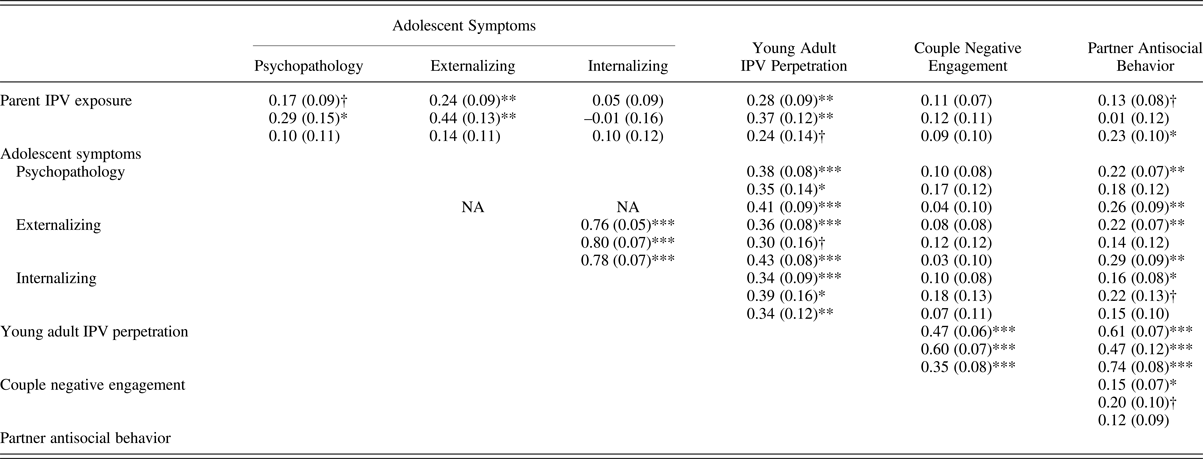
Correlations among the latent constructs and control variables are shown in Table 1. The first, second, and third rows within each variable are for all participants, men, and women, respectively. Young adult IPV perpetration was significantly associated with all predictor and control variables, at least when all participants were considered.
Bivariate correlations among the latent constructs and control variables for all participants, men, and women

Note: IPV, intimate partner violence; NA, not applicable.
†p < .10. *p < .05. **p < .01. ***p < .001.
Simple mediation
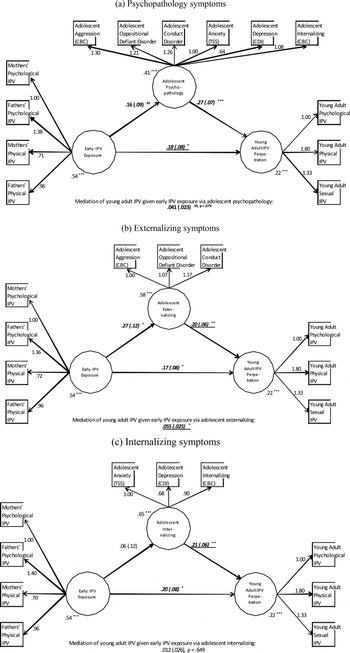
First, three simple mediation models were fitted, examining whether adolescent psychopathology symptoms, or its two separate components of internalizing and externalizing behaviors, mediated the effect of parent IPV exposure in childhood on IPV perpetration in young adulthood. The results are shown in Figure 2. First, a significant direct effect was found in all models; children exposed to IPV were more likely to perpetrate IPV in their own romantic relationships in young adulthood. In addition, the broader construct of adolescent psychopathology symptoms, as well as both of its individual components of internalizing and externalizing behaviors, were significant predictors of greater young adult IPV perpetration. However, parent IPV was only marginally predictive of adolescent psychopathology symptoms, and further examination of the individual components revealed that to the extent that children were exposed to IPV, they had greater externalizing, but not internalizing, behaviors in adolescence. Finally, of the three mediating factors, only adolescent externalizing was found to be a significant mediator. Thus, these results support that greater adolescent externalizing behaviors are a mechanism through which the effect of early IPV exposure on young adult IPV perpetration operates. Next, we further explored these mediation models by considering gender moderation of the indirect effect. Mediation models with gender moderation of the pathway from childhood IPV exposure to adolescent psychopathology symptoms were examined, followed by separate examination of mediation models with gender moderation of the pathway from adolescent psychopathology symptoms to young adult IPV perpetration.
Simple mediation results for adolescent (a) psychopathology, (b) externalizing symptoms, and (c) internalizing symptoms. Figured numbers denote parameter estimate or parameter estimate (standard error). Mp < .10, *p < .05, **p < .01, ***p < .001.

Moderated mediation involving gender
Gender moderation from childhood to adolescence
First, we examined whether the detrimental effects of childhood IPV exposure on adolescent psychopathology symptoms (or externalizing and internalizing individually) were more salient for men or women, and whether this in turn increased risk for IPV perpetration later in young adulthood. The results indicated a significant gender difference in the magnitude of the indirect pathway from early IPV exposure to young adult IPV perpetration via adolescent externalizing, such that the indirect effect was significant for men but not for women, moderated mediated effect, b (SE) = 0.09 (–0.04), p = .032 for men and b (SE) = 0.03 (0.02), p = .19 for women. Men, but not women, who were exposed to greater IPV in childhood had greater adolescent externalizing behaviors and thus showed greater vulnerability to externalizing due to IPV exposure.
The DDS model was tested with externalizing behaviors as the mediator, and proximal controls for couple negative engagement and partner antisocial behavior were added in two separate models. Both of the control variables were predictive of young adult IPV perpetration, b (SE) = 0.23 (0.04), p < .001 and b (SE) = 0.28 (0.04), p < .001, for negative engagement and partner antisocial behavior, respectively. The mediated effect for men persisted with negative engagement in the model, but did not remain significant in the model including partner antisocial behavior.
Finally, akin to the simple mediation results, neither adolescent internalizing nor the broader psychopathology construct were significant mediators of the intergenerational transmission of IPV for men, moderated mediated effects, b (SE) = 0.004 (0.03), p = .91 and b (SE) = 0.07 (0.04), p = .08, respectively, or women, moderated mediated effects, b (SE) = 0.02 (0.04), p = .60 and b (SE) = 0.02 (0.02), p = .33, respectively.
Gender moderation from adolescence to young adulthood
Second, we examined whether adolescent psychopathology symptoms were a greater risk factor for IPV perpetration in young adulthood for men versus women who were exposed to parent IPV in childhood. Results indicated significant moderation by gender, such that there was higher risk for later young adult IPV perpetration for women with higher externalizing behaviors in adolescence, moderated mediated effects: for women, b (SE) = 0.07 (0.03), p = .03; for men, b (SE) = 0.03 (0.04), p = .52. Thus, adolescent externalizing mediated the intergenerational transmission of IPV, in that women appear to be more vulnerable to effects of adolescent externalizing on young adult IPV perpetration than are men.
Testing the DDS model with externalizing behaviors as the mediator and proximal controls (in two separate models) indicated that, similar to findings for men, the mediated effect for women persisted beyond couple's negative engagement in the first model, but not beyond partner antisocial behavior in the second model. Finally, neither adolescent internalizing nor the broader psychopathology symptoms construct were significant mediators of the intergenerational transmission of IPV for men, moderated mediated effects, b (SE) = 0.01 (0.03), p = .68 and b (SE) = 0.03 (0.03), p = .20, respectively, or women, moderated mediated effects, b (SE) = 0.01 (0.02), p = .67 and b (SE) = 0.05 (0.03), p = .09, respectively.
Discussion
The current study used fully prospective data to examine whether the association of exposure to IPV in the family of origin with subsequent perpetration of IPV in young adulthood is explained by adolescent psychopathology symptoms. This study was unique in spanning approximately a 9-year period from late childhood (age 12 years) to young adulthood (age 21 years); including men and women; and in assessing physical, psychological, and sexual IPV (combined) as the outcome. Further novel aspects are that, to date, we know of no studies that have investigated both internalizing and externalizing symptoms concomitantly, nor studies that have modeled the couple's proximal relationship context.
Drawing upon DDS theory, the aims of the current study were to examine whether psychopathology, that is youth with externalizing and/or internalizing symptoms, explains the intergenerational transmission of IPV. Second, we examined whether, and how, mediated developmental risk pathways differed for men and women, and to what extent such effects were attenuated by the proximal relationship features. Regarding direct paths, the results confirmed a small, albeit significant, direct link between childhood exposure to parent IPV and perpetration of IPV during young adulthood for men and women. This is notable given the 9-year period between measuring exposure to IPV in the family of origin and perpetration of IPV in young adulthood. The findings also confirmed that a construct of co-occurring symptoms of adolescent psychopathology, as well as both of its individual components of internalizing and externalizing behaviors, were significant predictors of young adult IPV perpetration. However, exposure to parent IPV was only predictive of elevated externalizing in adolescence, and marginally predictive of adolescent psychopathology symptoms more generally. Finally, of the three indices of psychopathology symptoms, only adolescent externalizing was found to be a significant mediator for the entire sample (including men and women). These findings confirm prior evidence of both the association of exposure to IPV with externalizing symptoms in childhood and adolescence found in a meta-analysis of studies (Evans et al., Reference Evans, Davies and DiLillo2008) and prior findings of a robust association between externalizing behaviors in adolescence and IPV perpetration (Capaldi et al., Reference Capaldi, Knoble, Shortt and Kim2012).
Moderated mediational analyses (by sex) suggest externalizing behavior is a key mechanism through which exposure operates, for both women and men, but risk for transmission occurs at different developmental periods. Specifically, the mediating role of adolescent externalizing behavior in explaining the intergenerational transmission of IPV was intensified for men to the extent that greater IPV exposure in childhood increased adolescent externalizing. For women, transmission was intensified to the extent that when they displayed higher adolescent externalizing behavior, they were more likely to perpetrate IPV in young adulthood. In theory, all exposure to IPV is bad, and should be a public health priority. However, these data are novel in suggesting more or less sensitive periods to intervene for men and women, given limited resources and the importance of strategic, efficient intervention. Given that risk is intensified earlier in development for men, intervening in childhood to reduce immediate (or short-term) impacts could be most beneficial in curtailing risk trajectories for men. In contrast, interventions targeted at adolescent girls who exhibit higher levels of externalizing behaviors could be most impactful in mitigating progress toward IPV involvement in young adulthood. Contrary to hypothesis, there was no evidence of internalizing being a significant mediational factor for women. It is possible that depressive symptoms that extend into or emerge in adulthood might have a stronger mediational association, as well as clinical levels of depression.
Regarding the proximal relationship indices, the current study suggests adolescent externalizing behavior, as an earlier developmental risk factor, is no longer a significant mediator of intergenerational transmission of IPV (for men or women) once partner antisocial behavior is added to the model. Although not tested in the current study, this may be partially due to assortative partnering, leading to an association of antisocial behaviors across partners that may account for similar variation in IPV perpetration; at the same time, it might have been expected that both partner's antisocial behaviors would have an additive effect (Kim & Capaldi, Reference Kim and Capaldi2004). Considering that IPV is a subtype of antisocial behavior, further work is needed to understand continuity and discontinuity in antisocial tendencies from adolescence into young adulthood, and furthermore, how proximal risk from both partners’ antisocial behaviors in young adulthood may attenuate earlier developmental risk pathways for IPV perpetration.
Unlike partner antisocial behavior, when modeling couple negative engagement for men and women, adolescent externalizing behaviors remained a significant mediator of intergenerational transmission of IPV. One interpretation for the differential findings of proximal risks is that having a partner who engages in more antisocial behavior in young adulthood is a more discriminating characteristic for IPV perpetration than, say, couple negative engagement, at least when assessed among normative populations (vs. clinical or indicated populations). Negative engagement, even though involving conflicts and disagreements that do not cross the threshold to psychological aggression (e.g., threats) or physical aggression may be less sensitive in discriminating couples at higher risk for IPV.
The findings from the current study utilized a prospective, protracted longitudinal design, increasing confidence in the observed developmental risk factors and providing empirical validation of intergenerational transmission and developmental dyadic systems theories. Further, the current paper utilized rich measurement methods from multiple reporters and observational data, increasing confidence in the validity of findings. Nonetheless, there are important limitations or considerations that warrant mention. First, the sample was drawn from a predominantly European American, nonurban population, limiting generalization. Second, self- and partner reports of IPV were not always highly correspondent, which reduces confidence in the validity of the IPV measures. However, self-reports are also problematic with regard to bias, especially with sensitive questions. Thus, in this case, it is arguable that combining partner reports (even when there is some discrepancy) improves the underlying validity of the measured construct (i.e., IPV). An alternative approach would have been to use the maximum score reported by each partner for the IPV measures, as both victims and perpetrators of aggression may have reasons for underreporting but not necessarily overreporting (O'Learly & Williams, Reference O'Leary and Williams2006; Straus et al., Reference Straus, Hamby, Boney-McCoy and Sugarman1996). Third, it is important to note that we assessed psychopathology symptoms rather than using diagnostic criteria or cutoffs. While symptom counts have a number of advantages over dichotomous clinical measures, they could underestimate the role of more severe forms of psychopathology (particularly depression diagnoses) on IPV. Future studies are certainly encouraged to explore this further. Fourth, while the findings were consistent with a mediational model particularly for externalizing, baseline levels of externalizing were not included in the model, and thus it is possible that externalizing behaviors had emerged at younger ages, possibly prior to exposure to parental IPV. Fifth, although the DDS model posits influence of both partners’ prior behaviors on IPV perpetration, as the models were fully prospective, it was not possible to include prior behaviors of the partner who was not a LIFT participant. Sixth, exposure to interparent IPV was measured at one point in time, whereas multiple measurements would enhance the reliability of estimates.
These limitations aside, this study provides a rigorous and long-overdue empirical test of the role of psychopathology in intergenerational transmission of violent behavior within intimate relationships. It also provides more nuanced information on the role of gender, developmental timing, and proximal relationship characteristics, which has important translational value. Although additional prospective passive longitudinal studies are needed on the DDS model in other populations of young adults, enough evidence has accumulated on some of the key constructs examined here to launch experimental longitudinal work that targets identified precursors of IPV for change. As has been abundantly clear during the past several years in the public arena in the United States, IPV is an issue that impacts many young adults. It is long past time to focus scientific resources and efforts toward promoting relational health in the intimate partner relationships of young men and women.