INTRODUCTION
Providing support for people receiving radiotherapy for head and neck cancers (HNC) presents unique challenges for radiotherapists and mould room staff. Aside from the impact of the diagnosis, a lengthy period of daily treatments, the possibility of chemotherapy and even surgery, individuals may have a history of smoking, excessive alcohol use and poor diet.Reference Sanderson and Ironside1 These behaviours may be indicative of complex lives and difficult personal histories commonly reported amongst patients with HNC.Reference Tromp, Brouha, De Leeuw, Hordijk and Winnubst2,Reference Conway, McMahon, Smith, Black, Robertson, Devine and McKinney3 To reduce side effects of radiotherapy in the margins of treatment areas requires precise fixation of masks/moulds; this helps to reduce variation and ensure all treatments are accurate and consistent. In a recent study by Sharp and colleagues, severe anxiety and claustrophobia sensations were reported in 58% of patients (n = 120) being fitted for head and shoulder moulds; the authors of this study argued that this area of practice is under researched.Reference Sharp, Lewin, Johansson, Payne, Gerhardsson and Rutqvist4 In this paper, we report on a pilot project, which combined hypnotherapy with massage, aromatherapy, and relaxation training to manage severe anxiety and panic states associated with radiotherapy procedures.
Anxiety and panic
Mask/mould making, in addition to ongoing stress linked to a cancer diagnosis, can be a trigger to an acute anxiety or panic state.Reference Sharp, Lewin, Johansson, Payne, Gerhardsson and Rutqvist4 If the patient is not able to adapt or be supported, they risk becoming overwhelmed. This impacts on his or her ability to continue with radiotherapy treatment.Reference Penner5 It is important for health professionals to have an understanding of the nature of anxiety and panic. In terms of the body responding physically to stress, the most direct brain pathway is the sympathetic-adrenal-medullary (SAM) axis. This pathway functions by activating the autonomic nervous system, (ANS). The second and less direct brain pathway is the hypothalamic-pituitary-adrenal (HPA) axis. This pathway triggers the endocrine system to release hormones that in turn modulate both physiology and immunity.Reference Deacon and Abramowitz6,Reference Wolitzky-Taylor, Horowitz, Powers and Telch7 Importantly, increased levels of adrenaline are associated with fear and flight. The release of noradrenaline and testosterone is linked to anger and fighting for survival. In the longer term, feelings of helplessness, being overwhelmed and depression are associated with raised cortisol and lowered testosterone levels,Reference Henry8 with potential deleterious effects on recovery and well-being.Reference Fritzsche, Liptai and Henke9
Claustrophobia
Acute anxiety can lead to an overwhelming panic state with distressing signs and symptoms (Box 1). If triggered repeatedly by certain stimuli or situations it can lead to the development of an uncontrollable phobic reaction. Phobias have been defined as ‘. . . an excessive, irrational fear of a specific object or situation, which is avoided at all cost or endured with great distress’ (p. 267).Reference Choy, Fyer and Lipsitz10 In terms of medical procedures, such as cannulation or feeling trapped by the mask/mould, it would be expected that patients experiencing claustrophobia would progress from panic state to hyperventilation. Ultimately, this could then lead to vasovagal reaction, risk of injury and disruption to the procedure.Reference Deacon and Abramowitz11,Reference Wolitzky-Taylor, Horowitz, Powers and Telch12

Procedures: the CALM service
The service has been developed from our previous work with patients experiencing needle anxiety and phobia, the term ‘CALM’ being used to denote the broad aim of calming patients during medical procedures.Reference Mackereth, Maycock, Cawthorn and Mackereth13 Any patients disclosing suicidal thoughts and/or pre-existing mental health concerns were referred directly to psycho-oncology health professionals for urgent assessment. Unique to this service was the availability of complementary therapists skilled in hypnotherapy, relaxation training and touch techniques. Oversight of the project was undertaken by therapists who were also trained nurses. When working with distressed patients, the complementary therapists aimed to
1. assist patients to effectively utilize anxiety by noticing how it fluctuates and how it affects them physically and emotionally during procedures;
2. introduce and teach relaxation and self- hypnosis techniques that can help in both the short and long term to manage anxiety and panic and to support self-efficacy;
3. provide support and a presence before, during and after procedures so that the patient experiences and maintains a sense of ‘being calm’ and ‘being in control’;
4. ensure the patient is fully informed and is giving ongoing consent to continue a procedure/treatment, for example, to teach the patient to give agreed ‘consent or stop signals’, take a short break or to continue;
5. assist radiotherapy staff in ensuring that the patients are comfortable, feel safe and can be observed for the agreed ‘consent or stop signals’.
The primary intervention offered was rapid induction hypnotherapy combined with relaxation techniques. Self-hypnosis training was given to provide patients with the ability to self-manage their anxiety and, ultimately, take them to the point where the presence of a therapist was no longer required during treatments. Hypnosis is an altered state of consciousness where the patient’s mental faculties are focused. In this state, positive change, strategies and solutions can be suggested, explored and anchored for future use. One of the most renowned of practitioners and teachers, Dr. Milton H. Erickson, has argued that it is not a mystical procedure, but ‘. . . a state of awareness in which there is a marked receptiveness to ideas and understanding’ (p.224).Reference Erickson and Rossi14
The use of language that is empowering and permissive is included in hypnotherapy practice. Critics of complementary therapies often dismiss positive outcomes as placebo effects. Researchers who have evaluated both placebo (pleasing) and nocebo (harmful) effects from ‘sugar pills’ report that anxiety is a significant factor to suggestibility of both benefits and side effects, with the language of health care professionals (HCPs) playing a key role.Reference Ernst and Peters15,Reference Loftus and Fries16 The implication arising is that anxiety raises the expectations that the side effects (nocebo) or the benefits (placebo) described will be experienced from treatment.Reference Kienle and Kiene17,Reference Crow, Gage, Hampson, Hart, Kimber and Thomas18 It is therefore imperative for HCPs to pay attention to language and how it might be perceived. For example, contrast the potential impact on the following two statements upon a patient who is acutely anxious;
1. . . . the mask needs to be tight fitting to immobilize you during the treatment . . . you must stay absolutely still.
2. . . . the mask is a snug copy of your face . . . you can ease into it . . . its OK to swallow . . . you can always move your fingers.
Aside from the second statement using gentler words, choices are offered. First, permission was given for the patient to swallow. Second, a suggestion was made that the patient could move another body part; this allows them to focus on what they can do rather than what is prohibited.
Progressive muscle relaxation training
Progressive muscle relaxation (PMR) is a useful means of facilitating a hypnotherapy trance induction and as a component of self-hypnosis training.Reference Mackereth, Maycock, Cawthorn and Mackereth13,Reference Mackereth, Tomlinson, Cawthorn and Mackereth19 PMR can help to dissipate the urge to take flight by actively tightening and releasing a sequence of muscle groups, repeating each area four times, for example, making a fist and releasing the tension.Reference Mackereth, Tomlinson, Cawthorn and Mackereth19 This offers the patients’ conscious mind an activity to focus upon, distracting it from the panic state. Patients in the project were offered a squeezable stress ball to anchor the physical act of tightening and releasing tension. PMR instructions were directed towards the feet, knees and hands so as to not disturb the head and neck areas. Gentle-paced prompting of the technique began as a patient got into position on the radiotherapy table, being reminded periodically during treatment via the intercom. Patients were asked to attend to the complementary therapist’s voice and instructions. Cameras in the radiotherapy suites enabled PMR movements to be observed and acknowledged and to ensure ‘stop signals’ could be seen.
The use of aromatherapy
In addition to a stress ball, aromatherapy was offered in the form of an ‘aromastick’—a single patient use inhalator, resembling the Vicks® Vapoinhaler®, containing specially selected essential oils. A service evaluation following the rollout of the aroma sticks in the hospital demonstrated their potential in managing anxiety and supporting patients through distressing procedures.Reference Stringer and Donald20 A perforation at the end of the tube allows the aroma to be inhaled when required, empowering patients with a tool to use themselves. Provided in acute stress situations, an aroma stick can be used as an immediate resource, interrupting the panic pattern; which is then available to the patient for use during future procedures.Reference Mackereth, Maycock, Cawthorn and Mackereth13 The authors have also developed blends to assist in smoking cessation work.Reference Maycock and Mackereth21
Smoking Cessation
The CALM team also provided smoking cessation support; this includes smoking cessation assessment, motivational interviewing, nicotine replacement therapy and hypnotherapy, acupuncture and/or other complementary therapies, if requested. The service has been established for over 5 years with managerial support from the Trust’s Clinical Lead for Tobacco Control.
Data Extraction
The pilot project data was extracted from treatment records reviewed by research assistants not involved in the project. Tables were generated from the information gathered using an Excel database. The data represented a time period of 15 months from September 2008. The project was registered with the Trust’s audit department as part of a larger service evaluation, which is ongoing. The data was not subjected to inferential statistical analysis as the evaluation is descriptive with a number of uncontrolled contextual and treatment variables.
Findings
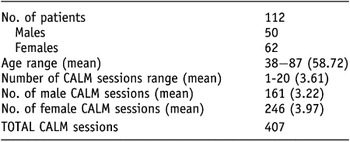
The CALM team supported 112 patients during mould making, verification, simulation and radiotherapy treatments, with a total of 407 sessions provided to patients with HNC Table 1. Males accessed a mean 3.22 number of sessions while females accessed a mean of 3.97 sessions. Without closer analysis of individual confounders, it is unclear how relevant this may be. Potentially, the data suggests that females require more support during HNC radiotherapy than their male counterparts. Furthermore, more female patients were referred to the service.
Demographics

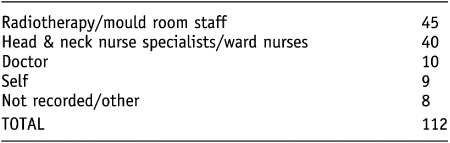
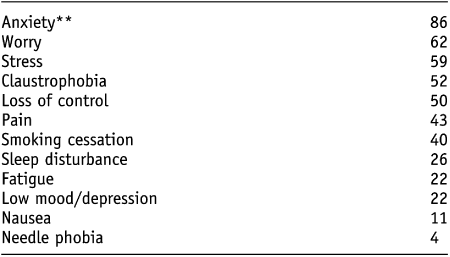
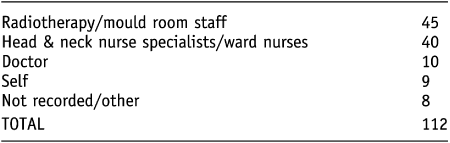
Radiotherapy/Mould Room staff, nurses and doctors referred the bulk of patients to the service, likely reflecting their close contact with their patients Table 2. There were a number of reasons for referral, with often a cluster of concerns for each patient. These included anxiety, worry, stress, claustrophobia, pain and loss of control Table 3.
Referrers to the CALM service
Reasons for referral/concern*
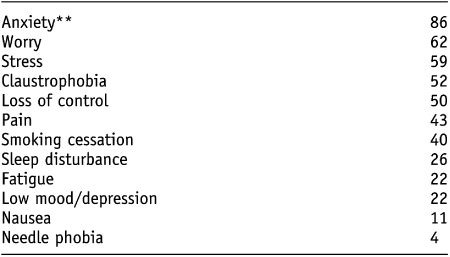
*Referrals were often for more than one concern
**Panic states were not specifically captured and so were recorded under anxiety
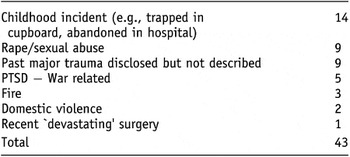
It was reported that 43 patients became psychologically disturbed during treatment. This necessitated temporarily stopping the procedure and it transpired they were experiencing a flashback to a prior traumatic event. The disclosures were voluntary with comments made about a childhood event, past rape/sexual abuse, war-related incident or other traumatic event; nine patients did not disclose the content of the trauma, for example, too painful to talk about Table 4. Appropriate psychological care was offered to these patients as a priority.
Reported trauma linked to claustrophobia

Complementary therapists recorded a range of patient comments and whether they were able to complete the procedure or radiotherapy treatment. Patients typically reported ‘feeling calmer’, ‘being more relaxed’ and ‘less fearful’. All 112 patients were able to ‘successfully’ complete the treatment or procedure. The most common intervention provided was hypnotherapy incorporating PMR training (n = 217); additionally, many patients received massage, reflexology and/or aromatherapy (n = 73). Patients were also taught self-help techniques sessions (n = 55); this was reinforced on subsequent sessions Table 5. An aroma stick was provided to 24 patients.
Interventions provided in the CALM session*

*Some patients received more than one intervention
Smoking cessation
Out of the 112 patients, 40 were referred for smoking cessation (see Table 4). An additional three patients requested assistance having experienced nicotine cravings during radiotherapy. One patient disclosed that she had told her consultant and “even my best friend that I have stopped [smoking] . . .” when in reality she was still smoking more and wanted discreet help.
DISCUSSION
This area of practice is under-researched in relation to reports of failure to complete and disruption to procedures due to claustrophobia.Reference Thorpe, Salkovskis and Dittner22,Reference Clover, Oulram, Adams, Cross, Findlay and Ponman23 Many articles in the literature acknowledge this to be a significant problem, yet there is a paucity of research exploring methods to manage it.Reference Luckett, Britton, Clover and Rankin24 In a recent study by Sharpe and colleaguesReference Sharp, Lewin, Johansson, Payne, Gerhardsson and Rutqvist4 in Stockholm, patients (n = 241) being fitted for head and shoulder masks experienced significantly (p = .023) more claustrophobia than just a head mask. An important observation was that the more patient can relax and ‘feel at ease’ (p.255), the less likely they are to attempt to move their heads and hyperventilate compromising the outcome. The project presented here sought to find ways of supporting adults to master their fears when faced with radiotherapy procedures.
In a major radiation oncology centre in Australia, Clover and colleaguesReference Clover, Oulram, Adams, Cross, Findlay and Ponman23 asked HNC patients (n = 147) over a 3 month period to take part in a study using self-reported measures of anxiety, history of panic and fears related to mask/mould usage. Of the 90 participants recruited, 11% (n = 10) reported anxiety that disrupted their first mould room session and a further 24% (n = 19) in the first radiotherapy session. Significant factors associated with session disruption were known claustrophobia triggers (being unable to move, having the face covered, and being in enclosed places), previous panic attacks and current use of psychoactive drugs. The study did not report on interventions provided but suggested that anxiolytic medication and/or psychological intervention may have been valuable to these patients prior to procedures. In addition, data on patients’ lifestyle risk factors, such as smoking and alcohol use, was not reported in this study.
Traumatic flashback
In our study, radiotherapy procedures were reported as being a trigger for a traumatic memory for some patients (n = 43). These flashbacks included assault, rape or childhood incidents linked to feelings of being trapped. Adverse childhood events and abuse are acknowledged predictors for an increase risk for cancers and heart disease.Reference Kendall-Tackett25 It is important to acknowledge that all of the 43 patients reported this voluntarily; 9 of the 43 did not divulge the flashback content. Patients can access psycho-oncology services at the centre and urgent referrals were made for assessment and support although many patients chose not to seek this help at the time of their treatment. It is known that other medical procedures can trigger severe anxiety. For example, refusal and premature termination of MRI scans is not uncommon. In a recent study (n = 130), 25% of patients reported moderate to severe anxiety during a first MRI scan.Reference Thorpe, Salkovskis and Dittner22 Patients in this study also reported fear being publicly observed having anxiety reactions – ‘1 will lose control’ (p.1082). It therefore needs to be acknowledged that this service may only have seen patients who felt able to share their distress. Developing expertise of HCPs in identifying anxiety and panic signals is crucial to prompting the use of an intervention and/or referral for support.
Interventions
Radiotherapy procedures, such as mask making and simulation, require continuous cooperation; sedation is not always the easy or acceptable option - it can make it harder for clinical staff to discern ongoing consent. In terms of cost-effectiveness, the work helped avoid the use of sedation - requiring greater supervision by staff and family, inability to drive and even hospital admission for observation. Early recognition of anxiety states can prompt an intervention and so help prevent further distress, interrupted procedures, delays and increase in staff time.
Without an appropriate intervention, the cycle can repeats itself with every stressful procedure reinforcing the inability of the patient to gain a measure of control. These concerns have been reported for radiotherapy patients with short-term memory problems and early stage dementia requiring radiotherapists to be vigilant during procedures, observing cues and repeating information and checking for understanding and consent.Reference Mowbray and Mowbray26 At the other end of the age spectrum, effective play preparation using behavioural rehearsal techniques, has been used with children to minimize sedation/anaesthesia need for radiotherapy procedures.Reference Scott, Langton and O’Donoghue27
Luckett and colleaguesReference Luckett, Britton, Clover and Rankin24 recently reviewed 9 studies evaluating interventions to help improve psychological outcome for people with head and neck cancers. Evidence for the interventions was deemed limited by small numbers and methodological problems. The recommendation for future work is to target HNC patients exhibiting clinical distress with therapies integrated into standard care. This project, although not a controlled trial, did attempt to report retrospectively on interventions provided in practice with distressed patients.
In our pilot, we largely provided a package of interventions centring on the use of hypnotherapy and relaxation techniques. The key components of this package were the skilful use of calming language, observing for cues and teaching patients self-help techniques. The use of helpful language and the avoidance of negatively loaded wording has been investigated in a 3-arm randomized trial (n = 159) during radiological procedures by Lang and colleagues.Reference Lang, Hatsiopoulou, Koch, Berbaum, Lutgendorf, Kettenmann, Logan and Kaptchuk28 Warning about negative outcomes and undesirable experiences (e.g., little sting here – sharp scratch) resulted in significantly greater pain and anxiety and sympathizing language (e.g., sorry pronounced ‘sooory’ – it’s a bit tender . . . ah) created greater anxiety compared to a self-hypnotic relaxation technique. Clearly this has implications for how HCP select words/phrases for use before, during and after medical procedures; this study can be a useful starting point for a discussion on the therapeutic use of language.
Hypnotherapy incorporating relaxation techniques, similar to the approach taken with our project was the focus of another randomized controlled trial (n = 69) with radiotherapy patients (prostate and breast) by Stalpers and colleagues.Reference Stalpers, da Costa, Merbis, Fortuin, Muller and van Dam29 While no statistical difference was found for anxiety or quality of life, patients in the hypnotherapy group reported significant improvements in mental (p = <.05) and overall (p = <.05) well-being using a quality of life measure (SF-36). In our project, many patients also received short treatments of massage, reflexology and aromatherapy with the aim of providing relaxation and comfort. These were delivered within the department often in a quiet corner or interview room and usually prior to a radiotherapy treatment.
Smoking cessation
A behavioural model has been proposed by Kendall-Tackett that links higher rates of smoking and other non-helpful coping strategies amongst adult survivors of childhood trauma and sexual abuse/rape.Reference Kendall-Tackett25 This correlation has been confirmed by a telephone survey (n = 12,256) in FranceReference King, Guilbert, Ward, Arwidson and Noubary30; this reported higher levels of current smoking amongst abuse survivors (p < .001) and higher rates (1.8 times) of successful quitting amongst non-sexually abused participants. It is well documented that HNC patients are often heavy smokers, often live alone and are especially vulnerable with reported lower levels of health competence (e.g., seeking health interventions early) and higher levels of health-risk behaviours.Reference Tromp, Brouha, De Leeuw, Hordijk and Winnubst2,Reference Duffy, Ronis, Valenstein, Lambert, Fowler, Gregory, Bishop, Myers, Blow and Terrell31 Providing support during treatment for HNC can increase chances of quitting, particularly as the smoker is meeting frequently with health professionals who can use the opportunity to promote smoking cessation services and stress the importance of quitting, assisting longer term survival and lessening side effects from treatment.Reference Duffy, Ronis, Valenstein, Lambert, Fowler, Gregory, Bishop, Myers, Blow and Terrell31,Reference Sharp, Johansson, Fagerström and Rutqvist32
The project did provide an opportunity to review and develop hypnotherapy-based interventions for patients experiencing procedure-related anxiety and panic; this has implications for future research and dissemination to other radiotherapy centres. Currently, there is a paucity of research in this area of clinical practice and limited guidance for training staff. It is important to acknowledge that repeatedly witnessing patients made anxious and frightened by procedures and treatment can contribute to staff ‘burnout’.Reference Isikhan, Comez and Danis33 Lacovides et al suggest that staff working in stressful clinical areas can acquire higher anxiety levels, performance disorders, and even physical symptoms of stress.Reference Iacovides, Fountoulakis, Kaprinis and Kaprinis34 Observations from this pilot service would suggest there is a clinical need for further staff training. Locally, the authors have provided in-service training events focussed on the following areas of practice:
• Wider awareness of radiotherapy procedures and treatments as potential triggers to anxiety and panic responses, which maybe linked to a past traumatic event.
• Sensitive and skilful use of language in providing information about procedures to patients and their carers
• Assisting radiotherapy staff to develop skills with safe calming techniques, which include reminding and reinforcing techniques taught by the CALM team to patients
• Improving complementary therapists’ working knowledge of cancers, radiotherapy treatments, safety issues and how they might assist patients with smoking cessation.
The service described in this paper required funding and the availability of complementary therapists skilled in hypnotherapy and other relaxation/massage interventions. The feedback recorded indicates that the service made a difference and enabled greater compliance to treatment.
Limitations
As a retrospective evaluation, there was no attempt to compare interventions for outcomes so these reported comments and observations are subjective and anecdotal to the locality and service. What is not known is how these patients may have fared if the interventions had not been available. On reviewing the draft paper with the project team, it was acknowledged that reinforcing and supporting techniques and reminding/supporting patients with smoking cessation, while done routinely, was not always recorded. It also needs be acknowledged that data was not collected from radiotherapy/mould room staff. It is important to acknowledge that radiotherapy staff may have helped to reinforce and remind patients to utilize techniques taught by the complementary therapists. Future research is needed to formally evaluate complementary therapy interventions in managing panic and anxiety related to radiotherapy procedures, this includes the use of validated outcome measures and with attempts made to control confounders.
CONCLUSION
Mask/mould making, simulation, verification and daily radiotherapy treatments can trigger acute anxiety and provoke panic for a significant number of patients with HNC. The service was developed to assist patients to be ‘in control’ and ‘more at ease’ during procedures, to be successful in completing treatment, and to neutralize and/or prevent further trauma. From a service delivery perspective it was essential not only to ensure safety and comfort but also to avoid interrupting treatment, provoking non-compliance and compromising service capacity. The project has since grown from strength to strength. This is the result of patient demand for assistance and the radiotherapy, mould room staff, HNC nurse specialists and ward staff making referrals, sharing their expertise with the complementary therapy team and so safely growing this innovative service.
Acknowledgements
The project team was most grateful to Christie Friends who helped fund the pilot service. Thanks to other CALM therapists – Julie Sexton and Joanne Barber. In addition, thanks go to Linda Orrett for assistance with the data extraction.