Exposure to childhood adversity threatens physical well-being across the life span (Matthews & Gallo, Reference Matthews and Gallo2011; Nusslock & Miller, Reference Nusslock and Miller2016; Repetti, Taylor, & Seeman, Reference Repetti, Taylor and Seeman2002). The accumulation of adverse childhood experiences (ACE), such as being the victim of physical abuse, growing up with a parent who suffers from psychopathology, and witnessing domestic violence, leads to poor physical health outcomes (Monnat & Chandler, Reference Monnat and Chandler2015; Repetti et al., Reference Repetti, Taylor and Seeman2002; Shonkoff, Boyce, & McEwen, Reference Shonkoff, Boyce and McEwen2009; Taylor, Reference Taylor2010). More specifically, Felitti et al. (Reference Felitti, Anda, Nordenberg, Williamson, Spitz, Edwards and Marks1998) found that the risk for several age-related diseases, such as stroke, liver diseases, and diabetes, increases with the number of ACE experienced in the first 18 years of life.
Miller, Chen, and Parker (Reference Miller, Chen and Parker2011) proposed a model of biological embedding of childhood adversity, in which they theorized several pathways by which experiences of stress during sensitive periods in childhood exacerbate risk for poor health in adulthood. Building on other models and extensive evidence, their biological embedding model suggests that childhood adversity gets programmed or embedded in the cells of the immune system, leading to overactivation of the body's inflammatory response to challenge and insensitivity to inhibitory signals. They proposed that the resulting state of chronic inflammation may be further exacerbated by neuroendocrine and autonomic system dysregulation (Gunnar & Quevedo, Reference Gunnar and Quevedo2007) and behavioral tendencies (e.g., vigilance for threat, mistrust of others, and poor self-regulation) that directly follow from exposure to childhood adversity (Nusslock & Miller, Reference Nusslock and Miller2016; Pollak, Reference Pollak2008; Repetti et al., Reference Repetti, Taylor and Seeman2002; Taylor, Eisenberger, Saxbe, Lehman, & Lieberman, Reference Taylor, Eisenberger, Saxbe, Lehman and Lieberman2006). From an evolutionary perspective, these pro-inflammatory tendencies may have served to enhance survival in the short term; however, with time and increased life spans, such tendencies likely lead to persistent pathogenic mechanisms that are linked to chronic diseases of aging (Miller et al., Reference Miller, Chen and Parker2011).
One biological marker that may offer further insight into pathways by which childhood adversity leads to poor health outcomes is accelerated cellular aging, measured via telomere length (Price, Kao, Burgers, Carpenter, & Tyrka, Reference Price, Kao, Burgers, Carpenter and Tyrka2013; Shalev, Reference Shalev2013). Telomeres are repetitive sequences of DNA that protect chromosomes from damage. Telomere shortening is an important indicator of physical health risk independent of chronological health, as it is associated with an array of age-related diseases, including cardiovascular diseases and metabolic disorders (Yang et al., Reference Yang, Huang, Jiang, Zhang, Liu, Qin and Ju2009), cancer (Ma et al., Reference Ma, Zhou, Wei, Liu, Pooley, Dunning and Wei2011; Willeit et al., Reference Willeit, Willeit, Mayr, Weger, Oberhollenzer, Brandstätter and Kiechl2010; Zhang et al., Reference Zhang, Chen, Li, Zhou, Wang and Hou2015), dementia (Honig, Kang, Schupf, Lee, & Mayeux, Reference Honig, Kang, Schupf, Lee and Mayeux2012; von Zglinicki et al., Reference von Zglinicki, Serra, Lorenz, Saretzki, Lenzen-Grossimlighaus, Gessner and Steinhagen-Thiessen2000), Type 2 diabetes (Salpea et al., Reference Salpea, Talmud, Cooper, Maubaret, Stephens, Abelak and Humphries2010; Zee, Castonguay, Barton, Germer, & Martin, Reference Zee, Castonguay, Barton, Germer and Martin2010; Zhao et al., 2014), as well as earlier mortality (Bakaysa et al., Reference Bakaysa, Mucci, Slagboom, Boomsma, Mcclearn, Johansson and Pedersen2007; Cawthon, Smith, O'Brien, Sivatchenko, & Kerber, Reference Cawthon, Smith, O'Brien, Sivatchenko and Kerber2003; Kimura et al., Reference Kimura, Hjelmborg, Gardner, Bathum, Brimacombe, Lu and Christensen2008).
A number of studies have found that adults with histories of child maltreatment have shorter telomeres than those without such histories (Donovan et al., Reference Donovan, Epel, Lin, Wolkowitz, Cohen, Metzler and Thomas2012; Kananen et al., Reference Kananen, Surakka, Pirkola, Suvisaari, Lönnqvist, Peltonen and Hovatta2010; Kiecolt-Glaser et al., Reference Kiecolt-Glaser, Gouin, Weng, Malarkey, Beversdorf and Glaser2011; Tyrka et al., Reference Tyrka, Price, Kao, Porton, Marsella and Carpenter2010; for a meta-analysis, see Ridout et al., Reference Ridout, Levandowski, Ridout, Gantz, Goonan, Palermo and Tyrka2017). Studies collectively suggest that the association between early life stress and reduced telomere length follows a dose–response relationship, with greater severity, number, or chronicity of exposures associated with greater telomere attrition (Kiecolt-Glaser et al., Reference Kiecolt-Glaser, Gouin, Weng, Malarkey, Beversdorf and Glaser2011; Price et al., Reference Price, Kao, Burgers, Carpenter and Tyrka2013; Puterman et al., Reference Puterman, Gemmill, Karasek, Weir, Adler, Prather and Epel2016).
Despite exposure to trauma and adversity, some individuals show remarkable resilience. A number of studies suggest that parent sensitivity may buffer children from the accumulated physiological wear and tear resulting from chronic stress exposure, commonly referred to as allostatic load (McEwen, Gray, & Nasca, Reference McEwen, Gray and Nasca2015). For example, Evans, Kim, Ting, Tesher, and Shannis (Reference Evans, Kim, Ting, Tesher and Shannis2007) found that maternal responsiveness moderated the association between early life cumulative exposure to psychosocial (e.g., family turmoil) and physical (e.g., substandard housing) stressors, and levels of allostatic load. More specifically, the link between early life adversities and allostatic load, indicated in heightened secretion of stress hormones, resting blood pressure, and an index of fat deposition (i.e., body mass index [BMI]), was only apparent among adolescents who experienced low maternal responsiveness. A similar buffering effect of maternal responsiveness was reported by Asok, Bernard, Roth, Rosen, and Dozier (Reference Asok, Bernard, Roth, Rosen and Dozier2013); high-risk children involved with Child Protective Services showed reduced telomere length relative to low-risk peers, but not if they had sensitive parenting. Overall, these studies and others (e.g., Afifi & MacMillan, Reference Afifi and MacMillan2016) suggest that responsive parenting may have protective benefits on cellular aging for children exposed to early life stress.
Few studies have investigated the potential buffering effect of supportive parental care on the link between childhood adversity and adulthood physical health at the molecular level. In one study of African American young adults, elevated levels of lifelong nonsupportive parenting predicted reduced telomere length at age 22 (Brody, Yu, Beach, & Philibert, Reference Brody, Yu, Beach and Philibert2015). However, participating in a 6-week program designed to increase parental emotional support during late adolescence mitigated the negative impact of nonsupportive parenting on accelerated telomere shortening at age 22. In another study, Chen, Miller, Kobor, and Cole (Reference Chen, Miller, Kobor and Cole2011) examined healthy adults who were raised in low socioeconomic households in early life. Compared to adults who retrospectively reported experiencing high maternal warmth in childhood, those who reported low maternal warmth showed indications of excess immune and pro-inflammatory activity, which may contribute to accelerated telomere shortening (Shalev, Moffitt, et al., Reference Shalev, Moffitt, Sugden, Williams, Houts, Danese and Caspi2013).
Taken together, these studies suggest that attachment theory may offer an important framework for examining moderators of the association between childhood adversity and cellular markers of physical well-being. According to attachment theory (Bowlby, Reference Bowlby1982), individuals develop secure attachments when parents are available and responsive in times of distress; in turn, individuals with secure attachments derive a sense of safety from physical or perceived proximity to caregivers when facing distress. Thus, a secure attachment may provide one with an internal psychological resource that helps regulate anxiety and promote resilience in the face of trauma (Charuvastra & Cloitre, Reference Charuvastra and Cloitre2009; Pierrehumbert, Torrisi, Ansermet, Borghini, & Halfon, Reference Pierrehumbert, Torrisi, Ansermet, Borghini and Halfon2012). In the absence of a secure attachment, then, individuals may be especially vulnerable to stressors. When parents respond insensitively to children's distress, by being hostile or punitive, intrusive, inconsistent, or unresponsive, children are likely to develop insecure attachment patterns (Ainsworth, Blehar, Waters, & Wall, Reference Ainsworth, Blehar, Waters and Wall1978). Children may develop an insecure–avoidant attachment, characterized by turning away from one's caregiver in times of need, or an insecure–resistant attachment, characterized by expressing anger or resistance toward one's caregiver while seeking proximity (Ainsworth et al., Reference Ainsworth, Blehar, Waters and Wall1978; Main, Reference Main2000). In addition to the organized attachment patterns (i.e., secure, insecure–avoidant, and insecure–resistant), some children develop disorganized attachments, such that they lack a solution for dealing with distress in their parents’ presence (Main & Solomon, Reference Main, Solomon, Greenberg, Cicchetti and Cummings1990). When distressed, children with disorganized attachments may show odd or anomalous behaviors, freeze or stay still for a period of time, show contradictory attachment behaviors (e.g., simultaneously displays of avoidance and proximity seeking), or show fear of the parent (Main & Solomon, Reference Main, Solomon, Greenberg, Cicchetti and Cummings1990). Antecedents of disorganized attachment include frightening or frightened parental behavior, maltreatment, and high sociodemographic risk (Cyr, Euser, Bakermans-Kranenburg, & van IJzendoorn, Reference Cyr, Euser, Bakermans-Kranenburg and van IJzendoorn2010; Madigan et al., Reference Madigan, Bakermans-Kranenburg, van IJzendoorn, Moran, Pederson and Benoit2006; Schuengel, Bakermans-Kranenburg, & van IJzendoorn, Reference Schuengel, Bakermans-Kranenburg and van IJzendoorn1999).
In adulthood, these behavioral attachment patterns are theorized to be become internalized as representations guiding interpersonal behavior (Main, Kaplan, & Cassidy, Reference Main, Kaplan and Cassidy1985), and are evident in individuals’ attachment state of mind as manifested in their discourse during the Adult Attachment Interview (AAI; George, Kaplan, & Main, Reference George, Kaplan and Main1984). The AAI is a semistructured interview that asks one to reflect on attachment-related experiences with primary caregivers. Similar to the insecure–avoidant behavioral pattern observed in children, adults classified as insecure–dismissing on the AAI tend to fix their attention away from past attachment relationships and the influences of those relationships on the self, minimizing the importance of or idealizing attachment figures (Hesse, Reference Hesse, Cassidy and Shaver2016). Likewise, similar to the insecure–resistant behavioral pattern observed in children, adults classified as insecure–preoccupied tend to fix their attention strongly toward past and present attachment relationships, exhibiting overinvolvement and anger when describing attachment figures and attachment-related experiences (Hesse, Reference Hesse, Cassidy and Shaver2016). Given that adult insecure–dismissing and insecure–preoccupied attachment states of mind are linked to ineffective and to inflexible strategies for regulating distress (Shaver & Mikulincer, Reference Shaver, Mikulincer and Gross2007), individuals with these insecure attachment patterns may experience chronic, dysregulated physiological stress responses (Cassidy, Jones, & Shaver, Reference Cassidy, Jones and Shaver2013), which may ultimately lead to shorter telomeres (Lin, Epel, & Blackburn, Reference Lin, Epel and Blackburn2012).
Unresolved attachment state of mind is characterized by failures in reasoning or lapses in monitoring of discourse during discussion about past trauma of loss or abuse (Hesse & Main, Reference Hesse and Main2006). Hesse and Main (Reference Hesse and Main2006) suggested that adults who show such evidence of disorientation in response to questions about trauma may still be overwhelmed by their experiences of abuse or loss. Similar to behavioral disorganization in infancy, unresolved adults’ disorganized discourse may reflect disoriented or fear responses to activation of their attachment system. In addition, similar to infant disorganized attachment, which has been linked with dissociation (Carlson, Reference Carlson1998) and physiological dysregulation (Bernard & Dozier, Reference Bernard and Dozier2010), unresolved attachment state of mind in adulthood has been linked with dissociative symptoms (Joubert, Webster, & Hackett, Reference Joubert, Webster and Hackett2012; West, Adam, Spreng, & Rose, Reference West, Adam, Spreng and Rose2001) and physiological responses suggestive of heightened vigilance (Bahm, Simon-Thomas, Main, & Hesse, Reference Bahm, Simon-Thomas, Main and Hesse2017). Thus, unresolved attachment state of mind may play an important role in influencing health outcomes among individuals exposed to childhood trauma.
In the current study, we examined whether adult attachment state of mind moderated the association between early adversity and telomere length among young adults. As the gold standard measure of adult attachment, the AAI offers a number of strengths not afforded by measures of parent sensitivity (observed or parent report) used in previous studies. First, although AAI classifications are correlated with parental sensitivity (Haydon, Roisman, Owen, Booth-Laforce, & Cox, Reference Haydon, Roisman, Owen, Booth-Laforce and Cox2014), they reflect consolidated attachment patterns based on relational experiences across development (Treboux, Crowell, & Waters, Reference Treboux, Crowell and Waters2004). Thus, the AAI offers a relatively stable and generalized measure of attachment (Ammaniti, van IJzendoorn, Speranza, & Tambelli, Reference Ammaniti, van IJzendoorn, Speranza and Tambelli2000; Haydon et al., Reference Haydon, Roisman, Owen, Booth-Laforce and Cox2014; Hesse, Reference Hesse, Cassidy and Shaver2016; Steele et al., Reference Steele, Waters, Bost, Vaughn, Truitt, Waters and Roisman2014). Second, the different insecure classifications, dismissing and preoccupied, allow for more nuanced examination of the attentional strategies that may guide individuals’ responses to distress in the context of activation of the attachment system (Main, Reference Main2000; Ravitz, Maunder, Hunter, Sthankiya, & Lancee, Reference Ravitz, Maunder, Hunter, Sthankiya and Lancee2010); whereas dismissing individuals may engage in deactivating strategies by detaching from or avoiding processing potential threat or pain, preoccupied individuals may engage in hyperactivating strategies by becoming overinvolved in the availability of others (Shaver & Mikulincer, Reference Shaver, Mikulincer and Gross2007). Third, given that the attachment classifications assessed during the AAI are more heavily based on individuals’ manner of speech (e.g., coherence of discourse) than its content, biases associated with retrospective reporting or self-report are reduced (Jacobvitz, Curran, & Moller, Reference Jacobvitz, Curran and Moller2002).
In line with previous research, we examined the following hypotheses. First, we predicted that the number of ACE would be negatively associated with telomere length, with increased exposure to ACE associated with reduced telomere length. Second, we predicted that attachment classification would moderate the association between the number of ACE and telomere length. Specifically, we predicted that, among individuals with insecure attachment (dismissing or preoccupied), the association between number of ACE and telomere length would be stronger than among individuals with secure–autonomous attachment. Third, we examined whether unresolved attachment state of mind moderated the association between number of ACE and telomere length, predicting that the association between number of ACE and telomere length would be stronger for unresolved individuals than individuals who are resolved with respect to trauma or loss (referred to here as organized).
Method
Participants
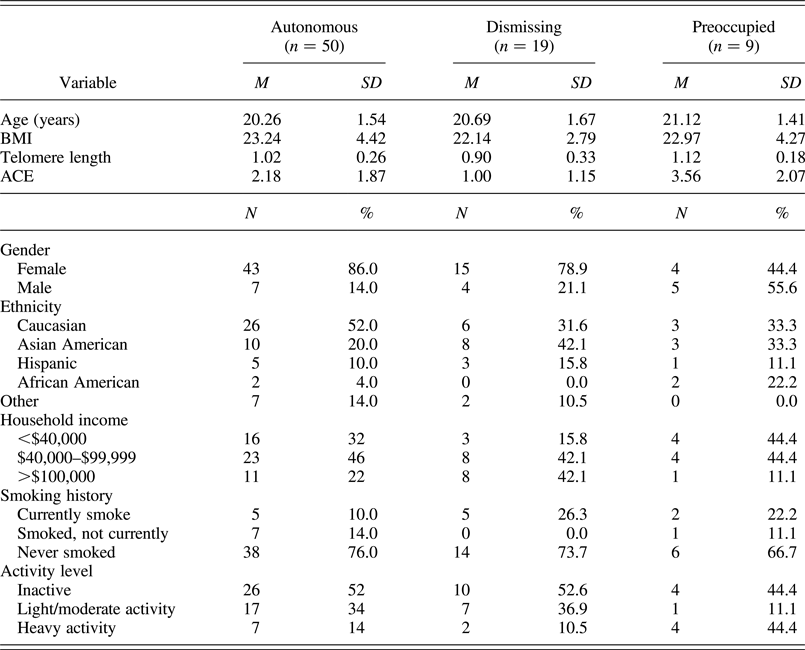
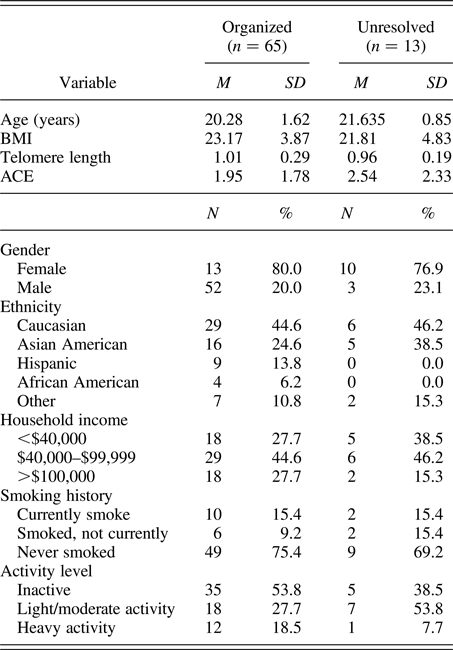
Participants included 85 young adults recruited through undergraduate subject pools at two universities. Of the original sample, 78 participants were included in analyses, with 3 excluded due to outlying telomere values (as described below) and 4 excluded because samples were lost due to storage problems. Participants (80% female) ranged in age from 18 to 23.75 years (M = 20.46, SD = 1.57). The majority of the sample was Caucasian (47%), with 26% Asian Americans, 12% Hispanics, and 4.5% African Americans. Participants were distributed across income levels with 45% reporting an annual household income of between $40,000 and $99,999, 29.5% reporting an annual household income of less than $40,000, and 25.5% reporting an annual household income of more than $100,000. See Table 1 (comparing the three organized attachment classifications) and Table 2 (comparing organized vs. unresolved attachment classifications) for additional sample demographic information per adult attachment classification group.
Characteristics of participants per organized adult attachment classification group

Note: BMI, body mass index; ACE, adverse childhood experiences.
Characteristics of participants per organized and unresolved adult attachment classification group

Note: BMI, body mass index; ACE, adverse childhood experiences.
Procedure
After obtaining informed consent, participants completed questionnaires electronically that assessed for demographic information, health-related covariates, and exposure to ACE. Then, research assistants administered the AAI, which was audio recorded for later verbatim transcription and coding. Research assistants were trained to administer the interview by reliable coders of the AAI; training involved detailed review of the procedure, listening to sample interviews, and having audio-recorded practice interviews reviewed by a reliable AAI coder (last author of study). Following the interview, participants brushed the inside of both of their cheeks (about 30 s on each side) using SK-1 buccal swabs (Boca Scientific, Boca Raton, FL). Samples were stored short term at –20 °C, and long term at –80 °C until assay.
Measures
Attachment state of mind
The AAI (George et al., Reference George, Kaplan and Main1984) is a 20-question semistructured interview, which asks participants to describe their relationships with primary caregivers in childhood, recall specific memories about their relationships in childhood and memories of distress, describe experiences of trauma and loss, and evaluate how their childhood relationships and experiences might have influenced who they are today. When multiple primary caregivers were involved (e.g., mother and father, or mother and grandmother), the interviewer probed about each relationship. Taking into account responses across relationships, with an emphasis on the narrative coherence produced by the speaker (Hesse, Reference Hesse, Cassidy and Shaver2016), transcribed interviews were classified as secure–autonomous, insecure–dismissing, or insecure–preoccupied. A fourth category, unresolved/disorganized with respect to trauma or loss, was assigned in conjunction with one of the three other classifications. In our sample, 50 participants (64%) were classified as secure–autonomous, characterized by a collaborative, balanced, and coherent description of attachment-related experiences with primary caregivers; 19 (24%) as insecure–dismissing, characterized by a tendency to minimize the importance of or idealize attachment figures; and 9 (12%) as insecure–preoccupied, marked by overinvolvement with past or current attachment experiences. Thirteen (17%) of the participants were primarily classified with an unresolved status (of whom 7 had a secondary classification of secure–autonomous, 4 insecure–dismissing, and 2 insecure–preoccupied), characterized by lapses in monitoring of reasoning or discourse during discussions of potentially traumatic experiences of loss and/or abuse (Hesse, Reference Hesse, Cassidy and Shaver2016). The distribution of AAI classifications in our low-risk sample resembles normative rates reported in a recent meta-analysis (Bakermans-Kranenburg & van IJzendoorn, Reference Bakermans-Kranenburg and van IJzendoorn2009). All transcripts were coded by the first author, with approximately 25% (n = 20) double-coded by the last author. Both coders are certified reliable coders who were trained by Drs. Mary Main and Eric Hesse. The agreement between the two raters was high: 90%; k = 0.81 for the three-way classification system (secure, insecure–dismissing, and insecure-preoccupied), and 77%; k = 0.92 for the four-way classification system (adding the unresolved category to the previous three). Disagreements between the raters were resolved by discussion and conferenced classifications were used in analyses.
ACE
ACE in the first 18 years of life were assessed using the ACE Study questionnaire (Dube et al., Reference Dube, Felitti, Dong, Chapman, Giles and Anda2003; Felitti et al., Reference Felitti, Anda, Nordenberg, Williamson, Spitz, Edwards and Marks1998). The ACE instrument assesses for 10 ACE, including 5 that reflect experiences of maltreatment (i.e., physical abuse, physical neglect, emotional abuse, emotional neglect, and sexual abuse) and 5 that reflect experiences of household dysfunction (i.e., parent with psychopathology, incarcerated parent, parent with substance abuse problems, parental divorce/separation, and domestic violence). Each item was scored dichotomously (as present or absent), and items were totaled to yield an ACE score ranging from 0 (no exposure) to 10 (exposure in all categories). Number of ACE in our sample ranged from 0 to 7 (M = 2.05, SD = 1.88), with frequencies similar to other low-risk samples (e.g., Murphy et al., Reference Murphy, Steele, Dube, Bate, Bonuck, Meissner and Steele2014).
Telomere length
Following procedures used previously (cf. Asok et al., Reference Asok, Bernard, Roth, Rosen and Dozier2013), participants’ DNA was purified from buccal swabs using the Gentra Puregene Buccal Cell Kit (Qiagen, Valencia, CA). Following DNA extraction, DNA was quantified, assessed for purity, and diluted to 10-ng/μL. A 20-ng sample of DNA was measured in triplicate via quantitative polymerase chain reaction (PCR) on a Bio-Rad CFX96 real-time PCR system (Bio-rad, Hercules, CA). Relative telomere length was calculated by comparing amplification of telomeres (T) to the single copy gene (S) acidic ribosomal phosphoprotein P0 (36B4) using the formula T/S = (2ΔCt tel)/(2ΔCt 36B4) and the following primer sets: TelF 5′-CGGTTTGTTTGGGTTTGGGTTTGGGTTTGGGTTTGGGTT-3′, TelR 5′-GGCTTGCCTTACCCTTACCCTTACCCTTACCCTTACCCT-3′) and 36B4 (36B4F 5′-CAGCAAGTGGGAAGGTGTAATCC-3′, 36B4R 5′-CCCATTCTATCATCAACGGG-TACAA-3′). For each participant, the T and S quantitative PCR assays were carried out in triplicate on different 96-well plates. A participant's DNA was pipetted into the same well positions on separate plates (T and S) to reduce well-to-well variability (cf. Asok et al., Reference Asok, Bernard, Roth, Rosen and Dozier2013). All plates used five dilutions of the same DNA reference sample spanning 2.5 to 80 ng to construct a standard curve. Any triplicate (~1.44% of all triplicates) that deviated by more than 1 cycle threshold (Ct) was excluded from the calculation of the sample average, and the remaining replicates were used. The inter- and intraassay coefficients of variation were 0.67% and 0.99%, respectively, for telomeres and 0.59% and 0.73%, respectively, for 36B4. Three samples were excluded from analyses: one because it amplified beyond the range of standards, and two because values were beyond 3 SD of the sample mean.
Covariates
We also collected information on demographic and health-related factors in order to control for potential confounds. Demographic variables included age at the time of buccal swab collection, gender, ethnicity, and current income. Health-related factors, also assessed via self-report, included smoking history (currently smoking, smoked but not currently, or never smoked), current physical activity level (heavy activity, moderate activity, low activity, or inactive), and BMI (computed from participant report of current height and weight).
Analytic approach
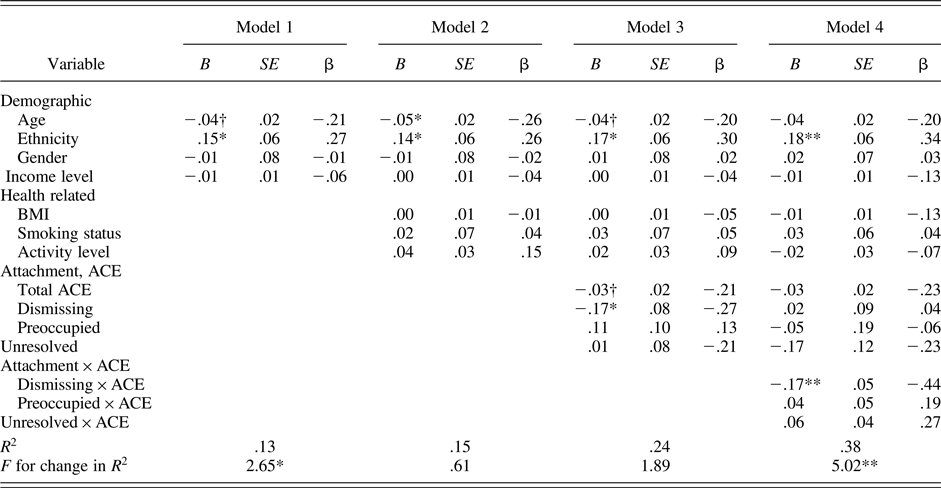
We conducted preliminary analyses to examine bivariate associations between primary variables of interest (i.e., AAI classification, ACE, and telomere length), demographic characteristics, and health-related factors. Then, we conducted a hierarchical multiple regression, with telomere length as the dependent variable. In Model 1, we entered demographic covariates of age, gender (entered as 0 for male, 1 for female), ethnicity (entered as 0 for nonminority, 1 for minority), and income level. In Model 2, we added health-related covariates, including smoking status (entered as a categorical variable, with never smoked [0] vs. past/current smoking [1]), current physical activity level (entered as a continuous variable from inactivity [0] to heavy activity [3]), and BMI. In Model 3, we added number of ACE and dummy-coded indicators of adult attachment state of mind (for secure–autonomous vs. insecure–dismissing and secure–autonomous vs. insecure–preoccupied), with secure–autonomous as the reference group, and a dichotomous variable for unresolved attachment (entered as 0 for organized and 1 for unresolved). Finally, in Model 4, we added in ACE × Attachment State of Mind interaction terms (for insecure–dismissing, insecure–preoccupied, and unresolved variables) to examine whether attachment state of mind moderated the link between ACE and telomere length. We probed significant interaction terms by conducting bivariate correlations between ACE and telomere length separate by AAI classification.
Results
Preliminary analyses
We first conducted preliminary analyses for the organized AAI classifications (i.e., secure–autonomous, insecure–dismissing, and insecure–preoccupied). Gender was significantly associated with AAI classification, χ2 (N = 78, df = 2) = 6.5, p = .039, with a higher percentage of males in the insecure–preoccupied group than in the secure–autonomous group. The organized AAI classification was also significantly associated with ACE, F (2,75) = 6.89, p = .002, with participants classified as insecure–dismissing reporting fewer ACE than participants classified as either insecure–preoccupied or secure–autonomous. To examine whether the type of ACE experienced were associated with attachment classification, we separated exposures related to household dysfunction (i.e., parent separation, parent psychopathology, parent substance abuse, parent incarceration, and domestic violence) and exposures related to maltreatment (i.e., physical abuse, physical neglect, emotional abuse, emotional neglect, and sexual abuse). We conducted a 2 × 2 mixed-model analysis of variance, with ACE type as the within-subjects factor (i.e., maltreatment-related, household dysfunction-related), organized AAI classifications as the between-subjects factor (i.e., secure–autonomous, insecure–dismissing, insecure–preoccupied), and number of ACE as the dependent variable. The ACE Type × Attachment classification interaction was not significant in predicting number of ACE, F (2, 75) = 1.42, p = .25, suggesting that the number of ACE reported in each category did not vary as a function of attachment state of mind. Associations between the organized AAI classifications and telomere length, age, ethnicity, income level, smoking history, level of current physical activity, and BMI were nonsignificant (all ps >.05).
Preliminary analyses comparing the organized and unresolved AAI classifications showed that, on average, unresolved individuals in our sample were older (M = 21.35 years, SD = 0.85) than those with organized primary classifications (M = 20.28, SD = 1.62), t (32, 67) = –3.45, p < .01. No significant differences were detected between the organized and unresolved attachment classification groups with respect to gender, ethnicity, income level, smoking history, telomere length, level of current physical activity, or BMI (all ps >.05).
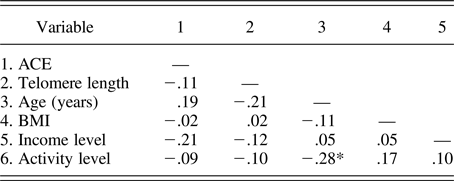
Preliminary analyses for ACE revealed no significant associations with demographic or health-related variables; further, in contrast to our prediction, number of ACE was not correlated with telomere length. Finally, telomere length was not associated with demographic or health-related variables (all ps > .05). Despite these nonsignificant associations, we included demographic and health-related covariates in primary analyses, given associations reported in previous studies (Puterman & Epel, Reference Puterman and Epel2012). Bivariate correlations are presented in Table 3.
Bivariate correlations between demographic, behavioral–health, and cellular aging variables

Note: ACE, adverse childhood experiences; BMI, body mass index.
*p < .05.
Primary analyses
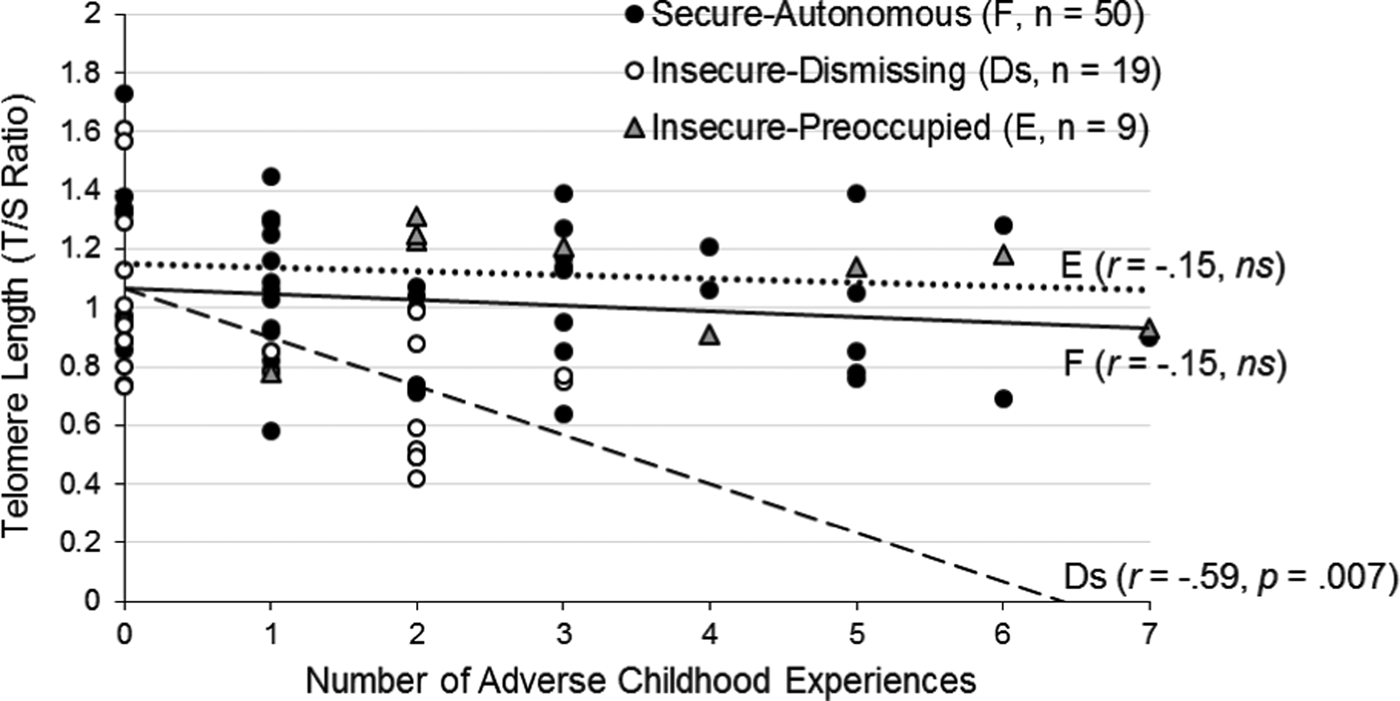
The hierarchical multiple regression (see Table 4 for results) revealed that Model 1 (demographic variables) accounted for significant variation in telomere length (R 2 = .13). Model 2 (adding health-related variables) did not significantly increase the amount of variance explained. Introducing the attachment state of mind and ACE variables without their interactions (Model 3) did not contribute significantly to the explained variance in telomere length. However, there was a main effect of insecure–dismissing (vs. secure–autonomous) on telomere length (b = –0.27, p = .029). Adding the ACE × Attachment State of Mind interaction terms (Model 4) resulted in a significant increase in the total variance explained in telomere length (38%). The interaction between insecure–dismissing (vs. secure–autonomous) attachment and number of ACE significantly predicted telomere length (b = –0.44, p = .002), suggesting that attachment state of mind moderated the association between childhood adversity and telomere length. To probe this interaction effect, we examined the correlation between ACE and telomere length separately for each AAI classification group. There was a significant negative correlation between ACE and telomere length in the insecure–dismissing group, r (19) = –.59, p = .007, but not for either the secure–autonomous group, r (50) = –.15, p = .31, or the insecure–preoccupied group, r (9) = –.15, p = .71 (see Figure 1). There was no main effect of unresolved attachment or interaction between unresolved attachment and ACE in predicting telomere length.
Summary of hierarchical regression analysis for covariates, ACE, and adult attachment state of mind as predictors of telomere length (N = 78)

Note: ACE, adverse childhood experiences; BMI, body mass index. Insecure–dismissing and insecure–preoccupied are dummy-coded variables with secure–autonomous (coded as 0 for both variables) as the reference group. Insecure–Dismissing/Preoccupied × ACE are interaction terms between dummy-coded attachment variables and total ACE score.
†p < .10. *p < .05. **p < .01.
Moderating effect of attachment state of mind on the association between number of adverse childhood experiences (ACE) and telomere length, graphed using the continuous measure of ACE, as used in multiple regression analyses.

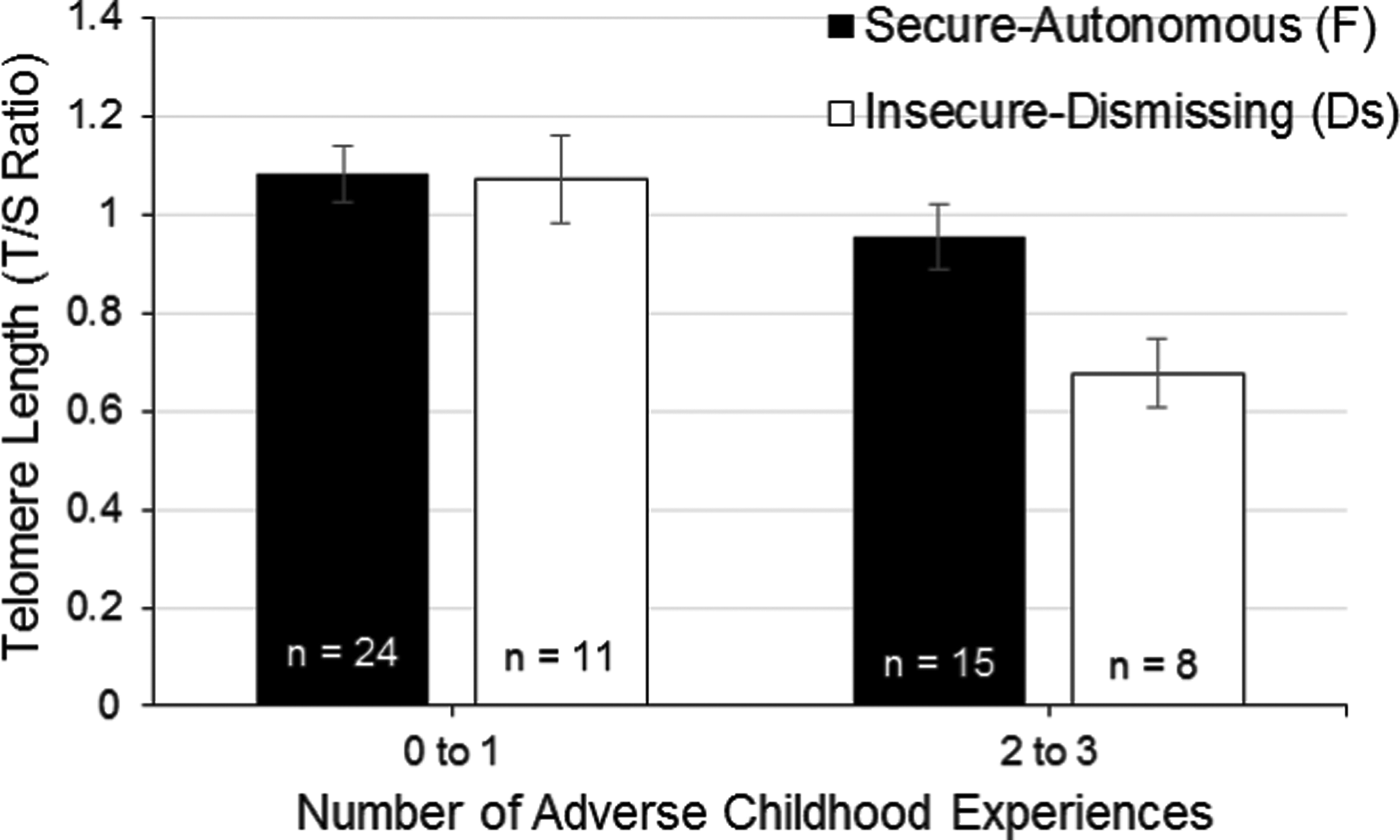
Given that the insecure–dismissing group reported a more limited range of ACE scores than the secure–autonomous group (0–3 and 0–7, respectively), we confirmed that the moderation effect held when reducing analyses to autonomous–secure and insecure–dismissing adults who reported between 0 and 3 ACE (see Figure 2). The Insecure–Dismissing × ACE interaction effect remained significant (b = –0.16, p = .01), and Model 4 still explained a similar amount of variance in telomere length, R 2 = .48, F (10, 47) = 4.32, p < .001.
Moderating effect of attachment state of mind on the association between number of adverse childhood experiences (ACE) and telomere length, graphed categorizing ACE data as 0 to 1 versus 2 to 3, for reduced sample (ACE < 4). Error bars represent ±1 SE of the mean.

Discussion
Our findings showed that attachment representation moderated the association between exposure to childhood adversity and telomere length in young adulthood. Specifically, controlling for demographic and health-related variables, increased exposure to ACE was associated with reduced telomere length among young adults classified as insecure–dismissing. In contrast, there was no association between childhood adversity and telomere length among young adults classified as secure–autonomous and insecure–preoccupied. These findings highlight the potential role of attachment in exacerbating or mitigating the effects of early life stress and trauma on cellular aging, adding to the growing body of evidence suggesting that parenting can shape pathways toward physical well-being in the face of adversity (Cicchetti & Blender, Reference Cicchetti and Blender2006; Gunnar & Quevedo, Reference Gunnar and Quevedo2007).
Given that secure–autonomous individuals did not exhibit the negative effects of childhood adversity on telomere erosion, it is critical to consider mechanisms that may be involved. Attachment patterns influence individuals’ expectations, interpretations, and memories of relationship experiences (Dykas & Cassidy, Reference Dykas and Cassidy2011); thus, stressors encountered across the life span, including ACE, may be perceived as less overwhelming for secure–autonomous adults (Coan, Schaefer, & Davidson, Reference Coan, Schaefer and Davidson2006; Eisenberger et al., Reference Eisenberger, Master, Inagaki, Taylor, Shirinyan, Lieberman and Naliboff2011). Furthermore, secure–autonomous attachment state of mind, entailing an ongoing perception of a secure base that one can reliably count on as a haven of safety for comfort and support when stressed (Waters & Cummings, Reference Waters and Cummings2000), may allow for greater flexibility of problem solving and openness to social support. In the long run, these cognitions and stress regulation capacities may reduce systematic inflammation (Ehrlich, Miller, Jones, & Cassidy, Reference Ehrlich, Miller, Jones, Cassidy, Cassidy and Shaver2016), and consequently lead to lower levels of cumulative physiological wear and tear.
Of note, developing a secure–autonomous attachment state of mind despite high levels of adversity may reflect a phenomenon termed “earned security” (as opposed to “continuous security”; Roisman, Padrón, Sroufe, & Egeland, Reference Roisman, Padrón, Sroufe and Egeland2002). Earned secure individuals shift from patterns of insecure attachment during early childhood to secure–autonomous representations some time later in development. Earned secure individuals represent an interesting group for future research. Of particular interest would be to assess whether earned secure individuals show similar telomere length to continuous secure individuals. This comparison could provide insight into issues related to developmental timing, such as when having a secure attachment is most protective during development.
Although we interpret the Significant Attachment × ACE interactive effect as evidence of buffering, it is important that the main effect of ACE on telomere length was nonsignificant (β = –0.21, p = .091). Thus, another interpretation of our findings is that the combination of ACE and insecure–dismissing attachment (i.e., the combined effects of these two different risk factors) predicts reduced telomere length.
Regardless of whether findings are interpreted in a buffering framework or a dual-risk framework, our finding that increased exposure to ACE was associated with reduced telomere length among insecure–dismissing individuals complements findings from the broader literature. For example, studies show that insecure–dismissing individuals exhibit elevated physiological reactivity, assessed via electrodermal activity, when responding to AAI questions about separation, rejection, and other potentially threatening childhood experiences (Dozier & Kobak, Reference Dozier and Kobak1992; Roisman, Tsai, & Chiang, Reference Roisman, Tsai and Chiang2004), and when directly interacting with their mothers in the context of a conflict issue (Beijersbergen, Bakermans-Kranenburg, van IJzendoorn, & Juffer, Reference Beijersbergen, Bakermans-Kranenburg, van IJzendoorn and Juffer2008). Elevated physiological responses among insecure–dismissing individuals may reflect ineffective strategies for regulating distress. During stressful times, insecure–dismissing adults tend to engage in greater avoidance behavior and less support seeking from close partners than insecure–preoccupied adults and secure–autonomous adults (Collins & Feeney, Reference Collins and Feeney2000; Simpson, Rholes, & Nelligan, Reference Simpson, Rholes and Nelligan1992). Insecure–dismissing adults tend to turn away from feelings of distress, appear distant, and prefer not to rely on others (Miga, Hare, Allen, & Manning, Reference Miga, Hare, Allen and Manning2010). These avoidance strategies may prevent the restoration of felt security and overall social support via suppression of social communicative channels of emotion (Gross & John, Reference Gross and John2003; Srivastava, Tamir, McGonigal, John, & Gross, Reference Srivastava, Tamir, McGonigal, John and Gross2009) leading to the maintenance of their distress. Over time, insecure–dismissing stress regulation strategies may harm one's ability to develop and sustain close relationships (Miga et al., Reference Miga, Hare, Allen and Manning2010), which may perpetuate the lack of perceived or actual warmth and support (Barger & Cribbet, Reference Barger and Cribbet2016). This lack of support in turn may contribute to chronic activation of physiological stress response systems (Cassidy et al., Reference Cassidy, Jones and Shaver2013), specifically more pronounced and prolonged neuroendocrine (i.e., cortisol) stress responses (Scheidt et al., Reference Scheidt, Waller, Malchow, Ehlert, Becker-Stoll, Schulte-Mönting and Lücking2000). Altered cortisol reactivity to stress is linked to shorter telomeres, thereby providing support for how disrupted patterns of attachment may mechanistically influence cellular aging across the life span (Gotlib et al., Reference Gotlib, LeMoult, Colich, Foland-Ross, Hallmayer, Joormann and Wolkowitz2014; Tomiyama et al., Reference Tomiyama, O'Donovan, Lin, Puterman, Lazaro, Chan and Epel2012).
Whereas ACE were associated with reduced telomere length among insecure–dismissing young adults, there was no significant association between ACE and telomere length among insecure–preoccupied individuals. It is possible that the null finding among insecure–preoccupied individuals was due to a small sample size; thus, we should not interpret this null effect as true evidence of no association. That said, if the lack of ACE–telomere association in preoccupied individuals is replicated in larger samples, these findings may highlight distinctions between the two types of insecure attachment state of mind. In contrast to insecure–dismissing adults, for example, insecure–preoccupied adults may overemphasize the need for support and heighten affective expression, sometimes manifesting in elevated anger and hostility during conflicts with partners (Simpson, Collins, Tran, & Haydon, Reference Simpson, Collins, Tran and Haydon2007). Thus, similar to secure-autonomous adults, insecure-preoccupied adults are prompted to engage in social interaction, though aggressive or excessive in nature, in order to attenuate or eliminate their distress. Regardless of the end result, engaging in social interaction may reflect an inherent belief that an attenuation of stress is possible, which itself may function as a protective factor (O'Donovan et al., Reference O'Donovan, Lin, Dhabhar, Wolkowitz, Tillie, Blackburn and Epel2009).
We also found no evidence of a direct effect or moderating role of unresolved attachment state of mind in predicting telomere length. This may seem surprising, given that unresolved attachment state of mind is quite relevant in the context of adverse experiences (i.e., abuse and loss). Once again, we are hesitant to interpret the null finding, given the relatively small sample size of unresolved individuals. That said, there are also reasons why unresolved attachment may not play a significant role in the pathways of interest. The classification of unresolved state of mind may be assigned based on an individual's response to a loss or other traumatic event that occurred at a late period of development, rather than early childhood. Without longitudinal data and/or a larger sample to examine the timing of loss/trauma associated with the unresolved classification and/or stability from patterns of disorganized attachment in infancy to unresolved attachment, it is difficult to speculate about the potential impact or lack of impact of unresolved attachment.
Our results speak to the role of attachment security as a protective factor in a relatively low-risk, high-functioning sample of young adults, and should be replicated in high-risk samples. A large body of literature has demonstrated that childhood adversity, such as poverty, maltreatment, and exposure to violence, undermines healthy neurobiological development (Heim, Shugart, Craighead, & Nemeroff, Reference Heim, Shugart, Craighead and Nemeroff2010; Juster, McEwen, & Lupien, Reference Juster, McEwen and Lupien2010; Neigh, Gillespie, & Nemeroff, Reference Neigh, Gillespie and Nemeroff2009), leading to a variety of negative physical health outcomes (Cicchetti & Toth, Reference Cicchetti and Toth2005; Melchior, Moffitt, Milne, Poulton, & Caspi, Reference Melchior, Moffitt, Milne, Poulton and Caspi2007), including telomere attrition (Asok et al., Reference Asok, Bernard, Roth, Rosen and Dozier2013; Donovan et al., Reference Donovan, Epel, Lin, Wolkowitz, Cohen, Metzler and Thomas2012; Kananen et al., Reference Kananen, Surakka, Pirkola, Suvisaari, Lönnqvist, Peltonen and Hovatta2010; Kiecolt-Glaser et al., Reference Kiecolt-Glaser, Gouin, Weng, Malarkey, Beversdorf and Glaser2011; Shalev, Reference Shalev2013; Shalev, Moffitt, et al., Reference Shalev, Moffitt, Sugden, Williams, Houts, Danese and Caspi2013; Tyrka et al., Reference Tyrka, Price, Kao, Porton, Marsella and Carpenter2010). Whether attachment security serves as a buffer in samples characterized by greater risk than the current sample remains an important question to be answered through replication efforts.
Replicating the results of this study in both low- and high-risk samples may also offer opportunities to enhance prevention and intervention efforts. A number of attachment-based interventions designed for children exposed to adversity have demonstrated promising effects on neurobiological outcomes. For example, both Multidimensional Treatment Foster Care for Preschoolers (Fisher & Chamberlain, Reference Fisher and Chamberlain2000) and the Attachment and Biobehavioral Catch-up (Dozier, Meade, & Bernard, Reference Dozier, Meade, Bernard, Timmer and Urquiza2014) have integrated hypothalamus–pituitary–adrenal axis regulation into their theories of therapeutic change, and have specifically targeted cortisol as a marker of treatment efficacy. Given that cortisol is understood to play a major part in cellular aging (Epel et al., Reference Epel, Lin, Wilhelm, Wolkowitz, Cawthon, Adler and Blackburn2006; Kroenke et al., Reference Kroenke, Epel, Adler, Bush, Obradovic, Lin and Boyce2011; Shalev, Entringer, et al., Reference Shalev, Entringer, Wadhwa, Wolkowitz, Puterman, Lin and Epel2013), attachment-based intervention studies might also examine changes in telomere length as a potential outcome. Intervention studies offer opportunities for testing causal pathways, with potential resilience factors (i.e., attachment security) manipulated via random assignment; thus, such studies can greatly inform models of developmental psychopathology.
We should note several limitations of the current study. The sample size was relatively small, and participants (primarily female) were drawn from undergraduate subject pools. It will be important to replicate the findings with a larger community sample, particularly with more participants in the insecure subgroups. Perhaps as a result of a relatively small sample size, our AAI subgroups differed in the mean and range in number of ACE, with insecure–dismissing participants reporting relatively fewer ACE than other groups. Although results remained significant when limiting analyses to the reduced range of ACE, it is possible that including insecure–dismissing individuals with high numbers of ACE (four or more) could lead to different results. It is also possible that insecure–dismissing individuals tend to underreport ACE, fitting with their tendency to minimize negative experiences when responding to questions during the AAI (Hesse, Reference Hesse, Cassidy and Shaver2016). Future research using prospective designs and more objective assessments of adversity (e.g., the Maltreatment Classification System; Barnett, Manly, & Cicchetti, Reference Barnett, Manly, Cicchetti, Cicchetti and Toth1993) can address this limitation, as they do not rely on self-report. In addition, our assessment of childhood adversity took into account only the number of different exposures from a list of commonly studied types, but did not take into account the severity, frequency, chronicity, or developmental timing of these exposures. By using a count of ACE, our approach equates different types of adversity as if they are equal (e.g., sexual abuse and parental divorce).
In addition, the cross-sectional design limits our understanding of whether the attachment-related differences that we observed in telomere length reflect lasting consequences of early life adverse experiences (which may have emerged decades before our assessment) or more recent alterations due to cumulative effects, or some combination. In this study, we did not assess participants’ current life stressors, which may have contributed to current telomere length. According to the biological embedding model of childhood adversity (Miller et al., Reference Miller, Chen and Parker2011), early stressful experiences, in particular, matter because they occur during a sensitive period of development when the immune system is highly malleable. Further, the resulting chronic inflammation and other physiological changes are hypothesized to have an impact on later health due to their cumulative impact over development. This model raises important questions regarding developmental timing, which can be tested with longitudinal designs (e.g., Ehrlich, Ross, Chen, & Miller, Reference Ehrlich, Ross, Chen and Miller2016). In addition to assessing exposure to adversity and stress at different developmental periods, it would be ideal to measure attachment quality and related constructs (e.g., parental sensitivity) repeatedly over time. These longitudinal data would allow for more nuanced investigation of questions regarding developmental timing.
Finally, we assessed telomeres in buccal cells, which, though commonly used (see Ridout et al., Reference Ridout, Levandowski, Ridout, Gantz, Goonan, Palermo and Tyrka2017), may limit our ability to generalize findings to other cells/tissues in the body (see Ehrlich, Miller, & Chen, Reference Ehrlich, Miller, Chen and Cicchetti2016). Although several studies comparing telomere length across cell types show moderate to high correlations (e.g., buccal cells and blood cells, r = .74, Gadalla, Cawthon, Giri, Alter, & Savage, Reference Gadalla, Cawthon, Giri, Alter and Savage2010; saliva and leukocyte DNA, r = .72, Humphreys et al., Reference Humphreys, Esteves, Zeanah, Fox, Nelson and Drury2016; leukocytes and CD34+ [cardiovascular progenitor] cells, r = .56, Wong et al., Reference Wong, Huzen, De Boer, Van Gilst, Van Veldhuisen and Van Der Harst2011), others do not (e.g., buccal cells and white blood cells, nonsignificant correlation; Thomas, O'Callaghan, & Fenech, Reference Thomas, O'Callaghan and Fenech2008). Even if telomere length in buccal cells and other peripheral cells are correlated with each other, there remains a debate about whether telomere length in these non-invasively accessed cell types can serve as a proxy for telomere length in tissues at sites of age-related diseases of clinical interest (e.g., the heart for cardiovascular disease). Further, both blood and buccal cell samples reflect heterogeneous populations that contain a number of different cell types (Thomas et al., Reference Thomas, O'Callaghan and Fenech2008), some of which are nonreplicating. Given these caveats, future research is needed to clarify the clinical implications of our results.
In conclusion, this study adds to our understanding of the potential mechanisms (i.e., cellular aging) that link childhood adversity to negative health outcomes, as well as factors in the social environment (i.e., early attachment experiences and their adult representations) that may promote resilience to childhood adversity. In future research, it will be important to understand what specifically about different attachment patterns (e.g., perception of stressful events and flexible/adaptive coping strategies) exacerbates risk and promotes resilience, and specifically how attachment patterns influence biological processes that lead to negative health outcomes. Hopefully, such advances in understanding these social and biological mechanisms will offer critical steps toward changing our current health care system from an acute “sick-care” to a preventative “well-care” model (Shonkoff et al., Reference Shonkoff, Garner, Siegel, Dobbins, Earls, Garner and Wood2012).