

It is the evening of 20 October 2020. In Lagos, the skies are clear, the air is warm and hundreds of young people have gathered as part of the ongoing #endSARS movement against police brutality. They are massed in front of Lekki Tollgate, which separates Victoria Island from the Lekki Peninsula. It’s the perfect place to protest. The road widens here, from two lanes to a broad space leading up to a dozen or more toll booths, making it a good place to gather. It’s also strategically important: with the tolls blocked, normal traffic between the islands is disrupted.
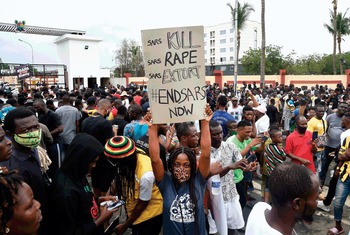
As dusk approaches, the protestors are peaceful and cheerful. There’s a festival atmosphere. Young men and women, many carrying the country’s green and white flag, are singing the national anthem, laughing, dancing. Some chant ‘soro soke’, the phrase that has become a battle cry of the movement. Many are live streaming the moment on their mobile phones. An organiser stands on a platform. Calling for ‘a peaceful protest’, he is met with cheers of agreement and a sea of waving flags.
Unexpectedly, the lights above the tollgate go off. In the gloom, a series of shots ring out. There is confusion, fear. The young protestors start moving, down the road, away from the gate. More shots. Young people are lying on the ground trying to avoid bullets, several bleeding heavily, some moaning in pain. A small group tries, unsuccessfully, to revive a still body. Among the chaos and dread, live video streaming continues: ‘They are shooting at us, they are shooting at us’, says a voice, filming the bullet casings in her hand. According to a BBC reporter who was at the scene, there was ‘continuous shooting’ for at least 25 minutes before she was allowed to leave, but only after showing her press credentials.1
A few days later, CCTV images come to light. They show truckloads of Nigerian security forces pulling up at the tollgate. Dismounting, they move towards the peaceful protestors and some fire indiscriminately into the crowd. At first the security services will deny this happened. Later there is a partial admission, in the face of overwhelming video evidence, that some soldiers were at the scene and may have had a mix of live and blank rounds in their weapons.2 There is confusion as to how many people have been killed. The government denies there were any fatalities; protestors, families and Amnesty International say at least 12 young people died.3 More than a year later a specially formed judicial panel submits an official report that describes the scene as a ‘massacre’.4
***
Twenty days before the killings, on 1 October 2020, Nigeria marks 60 years since independence from British colonial rule. It should be a time of celebration, but many young people feel far from euphoric.5 Jobs are thin on the ground, the currency is devaluing fast, food inflation is causing further hardship, Boko Haram is a growing force in the north and bandit kidnappings are a continuous threat. The police, widely seen as incompetent at best, criminally dangerous at worst, are an added challenge rather than any kind of resource. Journalist and writer Fisayo Soyombo’s tweet from that day captures the mood of many: ‘Today, Nigeria’s 60th Independence Day, I am sad, spent, drained, despondent, crest-fallen. And I am angry. Everything. It is Day 2 into the abduction of my bosom friend and his colleague, with a cold-blooded criminal telling me it’s N100million or they will be killed today.’6
This despondency perhaps reflects why, one week later on 8 October, the shooting of a young man at the hands of the SARS unit,7 filmed and shared on Twitter and other social media, has the effect of galvanising a generation. The #endSARS movement has been rumbling along for years. Allegations of brutality by the unit have been long documented and the #endSARS hashtag was first created in 2017. But growing smartphone ownership and the concurrent growth in the use of social media, along with widespread youth discontent with poor governance, means the 2020 protests achieve a mass not seen before.
‘In 10 years, everything has changed for young people’, says Ndeye Diagne, who heads up marketing research specialist Kantar in Nigeria and oversaw the group’s continent-wide research into changing social attitudes. ‘Social media is deeply entrenched and has provided access to the world like never before. It is a key change agent that has given Gen Z a unique opportunity.’
An #endSARS protest in Lagos in October 2020
As mobile internet penetration continues to grow across Africa, so has the use of social media. According to Kantar’s research, in Nigeria, 75 per cent of those who have access to the Internet use social media, in particular WhatsApp, Instagram, Facebook, YouTube and Twitter. Facebook is the most visited website in Africa – as of December 2020, there were more than 233 million subscribers on the continent.8
Age has long been venerated across Africa and young people are traditionally deferential to older people in their family and society at large. Social media is upending this. The Soro Soke generation is using social media to push back against tradition and fight for change for causes ranging from the climate crisis to police brutality, sexual abuse and minority rights. For this generation, social media is also a megaphone that amplifies their political thoughts. A survey among people aged 15–34 in Ghana, Kenya, Nigeria, South Africa and Uganda finds that two-thirds of those surveyed are posting about politics.9
‘Social media has given young people new ways of interacting and new expectations of how it’s possible to live’, says Diagne. ‘Gen Z are able to speak out about their frustrations, they are not afraid to try and change things. They are more fearless even than the millennial generation right before them. They use technology to speak their truth. They see how things work in other parts of the world and they want things to change here. The things older generations have lived with and tolerated, younger generations want to change, and they believe it can change.’
Climate activist Olumide Idowu, 29, founded Climate Wednesday on Twitter in 2013. ‘I haven’t missed a Wednesday since we started’, he says. ‘Every week we hold a video conversation and it’s also available on Facebook and YouTube. We talk to people about climate justice and how they can fight for their environmental rights. Each month it’s a different topic – for example, we did a month on agriculture, where we covered how farmers can be more environmentally friendly and we covered topics like GMO crops.’
Twitter has enabled Idowu to spread the climate message across Nigeria and West Africa. ‘Maybe we can’t come and meet you in your state or your country, but we can share our knowledge on social media. People are live sharing, people are watching from everywhere, and it’s a real-time discussion.’
Cross-border engagement is significant, says Nigerian writer Ayo Sogunro, because while African leaders have always had spaces for cross-continental conversations, ordinary Africans have rarely had such opportunities.10 ‘[I]n a continent where opportunities for international engagement between everyday people is severely limited, social media provides a space – for increasing numbers of Africans though far from all – to connect, to redefine African values, to recognise shared inequities and ambitions, and to stand up against authoritarianism, racism, patriarchy, injustice, and other daily discriminations’, Sogunro writes.11
Professor Alcinda Honwana is a Mozambican anthropologist and Centennial Professor at the London School of Economics. A leading scholar on youth-led protests in Africa, she has studied movements across the continent – from a drive for greater local government representation in Tunisia to a hip-hop-led movement raising political awareness in Angola. She points to the power of social media in enabling comparison and in driving change by offering this generation a level of pan-African and global connectivity that has never been possible before. Speaking at her 2021 University of Oxford Annual Africa Studies lecture, she said: ‘The internet has enabled comparison with other lives and the contradictions can feel intolerable’, she says.
Influencer and entrepreneur John Obidi, 34, voices the same sentiment. ‘Social media is our window to the world’, he says. ‘Now we can connect globally and see how alike we are globally too. We can see global trends; we can identify as global human beings. Before Twitter, we had only one version of democracy. Now we can see what Germans or Americans, or Iraqis or Afghanis think about democracy. We don’t just base our world view on our lives, but how people live in other places also. In Nigeria we don’t have a big tradition of protest but in 2020 we saw protests against bad governance and police brutality. I think that was influenced by what we saw with Black Lives Matter and other movements abroad. Without social media we wouldn’t have seen the models operating in other places.’
Diagne calls Gen Z ‘the hashtag generation’. ‘They believe that #AfricaMatters. From #endSARS to #FixGhanaNow, they are using social media to disrupt, to surprise and to change Africa for the better’, she says. ‘And because of the size of the cohort they are starting to be taken seriously.’
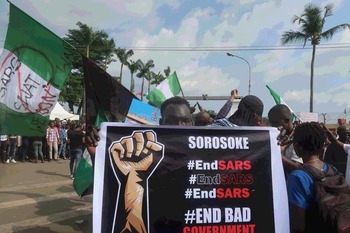
An #endSARS protest in Lagos in October 2020
***
Osinachi, 30, is a successful artist. Slight in build, he wears his hair close to his head in short, neat dreadlocks. When we meet, he’s dressed in a traditionally cut suit in a simple white fabric. He is stylish, and his demeanour is confident yet also unassuming. He seems an unlikely target for police profiling but says he’s regularly been the victim of police harassment. ‘As a young person, I can’t just drive out of my house and believe I won’t be harassed by the police’, he says. ‘They profile me because I have dreads and drive an SUV and they try to rip me off. It’s crazy. This is what led to the #endSARS protests. There was so much profiling and extortion of young people. The system is entirely broken.’
Photographer Uzor, 28, agrees. ‘Every single young person has a story about the police. There is no one who doesn’t understand, no one who hasn’t had some problem’, he says. ‘Armed robbers take you, walk you to the bank and make you withdraw your money. Then the police come, take you and walk you to the bank and make you withdraw all your money. Tell me, what is the difference between them?’
Rinu Oduala, 23, a key organiser of the protests, says young women also face harassment. ‘It is not just young males. Females bear the brunt of police brutality. We are raped, tortured and killed.’ Perhaps because of this, as the #endSARS protests gather pace, an organising committee emerges formed largely of young women from a group called the Feminist Coalition. The women establish a 24-hour helpline that people can call in emergencies, they provide legal services to those in need and even set up a radio station. Funmi Oyatogun, 29, is part of the committee. ‘At one stage we had to tell people only to call the helpline about #endSARS issues, we were getting calls asking for our help with all sorts of things’, she says.
All of the group’s costs are met by fundraising. The women release a publicly accessible, daily summary of their accounts, showing the amounts received and how it is being disbursed.12 When the government freezes the committee’s bank account, the group continues raising funds using cryptocurrency.
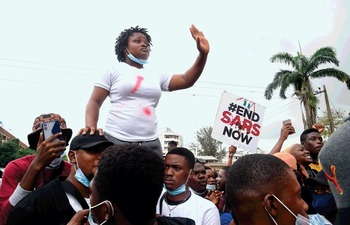
‘Women are at the heart of the 2020 #endSARS movement’, says Oduala. ‘And with the presence of women, the dynamic changed. The strong women of Feminist Coalition raised US$400,000 and used it to feed protestors, to pay for ambulances and pay legal costs and to provide mental health support. It was accountable and very effective. I believe it showcased and helped us visualise what a future Nigeria could look like with good governance, transparency and accountability.’
Rinu Oduala speaks at an #endSARS protest in Lagos in October 2020
Oduala’s point is echoed by others. The organisers’ high level of accountability – something sorely missing from the country’s moribund public sector institutions and from government at all levels – helped drive the popularity of the movement, even across older age groups. Tamara Ojeaga, 39, did not take part in the protests but as she watched events unfold she found the transparency and organisation inspiring. ‘The organisation was next level’, she says. ‘They used bitcoin and cryptocurrency for donations and were fully transparent in reporting where donations were spent. They made it obvious that this country can actually work if we want it to. It gave me such hope.’
The organising committee also uses social media extensively: to call young people to action, to fundraise and to bring the issue to global attention. By October 2020, 48 million #endSARS tweets are posted in just 10 days.13 Engagement with the cause comes from around the world – Twitter founder Jack Dorsey tweets in support and the company also designs a logo, a fist wrapped in the Nigerian flag, for the movement.
The majority of Nigeria’s mainstream media outlets – which have close links to government officials and the Nigerian state – give the #endSARS movement little or no coverage.14 But this has limited impact. Young Nigerians, like others in their cohort around the world, largely ignore mainstream media outlets and instead turn to social media for information. During #endSARS it becomes clear that the future of activism across the continent and the growth of youthful participation in politics and civil society are directly linked to the ability of activists to amplify their causes across social media platforms. ‘Social media has created a unique kind of space that is not subject to the physical control of the military or police’, writes Sogunro. ‘If African activists can utilise this space effectively, they can play a major part in shaping African society for the next generation.’15
Threatened by the power of platforms such as Twitter, the frequency and duration of internet shutdowns by governments across Africa is steadily increasing.16 In June 2021, the Nigerian government suspended Twitter in the country, ostensibly because the platform deleted a tweet by President Buhari that it deemed abusive. Most young Nigerians believe the deleted tweet was a much-sought-after excuse for a ban that had been on the cards since the rise of the #endSARS protest movement.
‘Since the government suspended Twitter in Nigeria, the coordination and organisation of the movement has been a bit restrained’, says Oduala. ‘Twitter was one of the last places where we could express ourselves. Closing it down was a way for the government to target mass movements organised by young Nigerians. They saw the ability of social media platforms to help organise protests and so they closed it down.’
Technology entrepreneur Iyinoluwa Aboyeji, 31, believes the political establishment is threatened by the financial and organisational freedom that technology more broadly offers young people. ‘We have been very much attacked as an industry by the political establishment because of the challenge we represent to their power’, he says. ‘When we can take someone’s income from 40,000 naira (US$80) to US$80,000 in a two and a half year period, it is very dangerous to the establishment. That was what #endSARS was really about – it was a challenge to the establishment by people who could finance their own revolution. And that made everyone in power worried and scared. Especially because the protestors were leveraging modern technology tools, which made it very difficult to stop the machine.’
***
As October 2020 progresses, the machine powers on and the movement grows daily. Protests spread from Lagos across the country, including to Abuja, the capital. The government begins to take notice. It’s clear that someone feels threatened. On 20 October, the shootings take place.
‘There is a huge division between politicians and youth’, says Ojeaga. ‘It’s generational and attitudinal. Today’s politicians are ex-military and it’s either their way or the highway. There is an oppression mentality at the top.’
‘The government was scared, they were shaking, they were worried about what might happen if we continued’, says Oyatogun. ‘Our president said that young people were trying to unseat him. But we were not. We just want to feel safe. We were naїve. We didn’t think they would actually shoot at us, kill us. The older ones with long memories, they warned us, they remember from before how it can be.’
After the shootings, the movement comes off the streets. The government freezes the bank accounts of key activists, some have their passport seized. Several activists leave the country in fear. ‘The shootings broke something in us. They were traumatic, and many haven’t recovered from the experience’, says Oduala. ‘Some young Nigerians are living in fear for their lives. People like DJ Switch, who was at the height of her career, are leaving the country. My personal bank account was frozen, and my passport was seized, along with those of 19 others. We had to have legal tussles with the government to overturn these things.’
A judicial enquiry into the shootings is convened. ‘I was the youngest person on the judicial panel looking into the shootings’, says Oduala. ‘It brought me face to face with how the government works, with criminals in police uniforms, with the broken judiciary system. Hearing the horrors that people went through, of so many lives and families ruined forever by policemen who are still in service today was a traumatic experience.’
In November 2021 the judicial panel releases its report. It finds that the army ‘shot, injured and killed unarmed, helpless and defenceless protesters, without provocation or justification’, conduct that was exacerbated by ‘its refusal to allow ambulances [to] render medical assistance to victims who required such assistance’. It also alleges cover-up attempts: ‘The police officers also tried to cover up their actions by picking up bullets’, the report says, and it goes on to accuse Nigerian authorities of tampering with CCTV footage and removing the bodies of the dead from the scene.17
Although the report recommends that those involved in the Lekki Tollgate shootings face ‘appropriate disciplinary action and be stripped of their status’ before being dismissed, to date no one has faced prosecution or accepted responsibility for the killings. There is no clarity on who ordered the security services to confront the protestors or who authorised the shootings.
***
Although #endSARS may be off the streets, youth discontent rumbles on, and not just in Nigeria. As Honwana points out: a new wave of global social movements is being led by young Africans. In the same way that a wave of European Baby Boomers took to the streets demanding social change as teenagers and young adults in the student protests of 1968, this cohort of young Africans are at the forefront of similar protests. Speaking at the 2021 University of Oxford Annual Africa Studies lecture, Honwana said: ‘From Tunisia and Egypt to Senegal and Angola, young people are fighting for a greater political voice, for access to job opportunities and for broader systemic change’.
Some 93 per cent of Gen Z respondents to Kantar’s Africa Life survey in five countries across sub-Saharan Africa agree with the statement ‘our society needs a common purpose’. ‘Young people believe that standing for something is essential and they want to stand for something bigger than themselves’, says Diagne. ‘They are also looking for real leadership and are seeing and celebrating new heroes, such Emma Theofelus of Namibia, the continent’s youngest minister in government at 23.’
In Nigeria, #endSARS is the country’s most significant protest movement since pro-democracy rallies in the 1990s, and for many young Nigerians it constituted a real political awakening. The protests brought recognition that young people could be a powerful political force, combined with the more brutal insight that the establishment will respond violently to perceived challenges. And there is a growing belief among this cohort that it is young people who will build the country they are looking for.
‘I think young people have the power to make things better despite the government. The #endSARS protests are a testament to that. Despite the massacre, it was really impactful. These guys at the top saw the power of young people coming together’, says Osinachi.
Nigeria is vast and heterogeneous, composed of different religions and different ethnicities and successive governments have used a strategy of dividing to conquer, setting different interest groups against each other. The #endSARS movement, in contrast, united young people across ethnic and religious divides. ‘The movement brought people together from across regions and across religions and gave us a new-found sense of unity’, says Oduala. ‘It is a spirit that binds young Nigerians. We are doing things differently. We are having frank conversations about the rights of people with disabilities, about LGQBT rights. We have put aside tribal and religious differences. This sentiment sets us apart from older generations.’
Another factor that distinguishes this generation is their coming of age during a time of democracy – only a few are old enough to properly remember Nigeria’s period of military rule, which ended in 1999 – and their rejection of the existing political class, which even today contains many members of the pre-democracy juntas.18
‘There were civil wars and dictators in the lifetime of the older generation that really limited how they were able to express themselves’, says 32-year-old Michael Elégbèdé. ‘Even today, if you look at #endSARS, our own government killed us with no repercussion. That was the norm in the past. But that’s not going to stop this generation. They are trying to use the old ways, to bring us into line with abuse and threats. But it is not working. And it’s not going to work. And that’s what is differentiating this generation from the past.’
There is a growing perception among young Nigerians that street-led protests are not enough on their own and that young politicians need to become a part of the system in order to change it from within. Tonye Isokariari, 34, has been involved in politics since 2010, when he was part of the Goodluck Jonathan presidential campaign. ‘For the first time, during the #endSARS protests, the government was jittery over young people’s involvement. If we can come together like that across the board, we can take back our country’, says Isokariari. ‘We need to gather a lot of young people who have shown capacity, who have shown they are there to serve, so that we can change the system from within. A lot of times when you are outside making noise, nothing happens. We have to do it from inside, stirring the water from within.’
The challenge moving forward will be to see if this moment of activism and protest can be translated into a long-term political movement. ‘We could have done a lot more’, says 25-year-old activist S. I. Ohumu. ‘It’s understanding that shouting is not the only thing. There is a social change system and everyone has a role to play. There are the disruptors, the people who love Twitter and make a lot of noise and go to protest. But that is only the first step. We also need mediators who are willing to compromise. People who are able to build bridges. Compromise is not necessarily a bad word.’
Ibrahim Faruk, 35, is programme manager at the Youth Initiative for Advocacy, Growth and Advancement (YIAGA), a non-profit organisation based in Abuja that promotes good governance and aims to increase youth participation. He agrees with Ohumu that greater engagement with the political system is needed. ‘There are conversations that need to be had with the National Human Rights Commission, with the Police Service Commission, organisations like that’, he says. ‘If you are not sitting at the table, you are just making noise from the outside and while that is very important it’s also important to engage with the systems and institutions. It’s something that many young people don’t like to do, or don’t want to do because they have lost trust in those organisations. But how else can we get these institutions to reform if we do not engage one way or another?’
Ohumu concedes that politics and corruption are synonymous in Nigeria but says ‘it’s time to get over that’. ‘If young people don’t get into those spaces, we will not innovate out of a bad situation’, she says. ‘We young people are plenty and we are building wealth, so we can fund things, too. If we can fund #endSARS we can fund elections. It’s a matter of political will. We just have to be interested.’
Oduala is confident that change is coming. ‘Before the shootings, we had begun to hope for a new Nigeria. A Nigeria where young people have a seat at the table of power, a Nigeria where young people can walk free on the streets, a Nigeria where the common man can get justice’, she says. ‘The fight might be off the streets and off the TV, but it hasn’t stopped or lost importance. Young Nigerians are very stubborn and don’t give up. #endSARS is a movement not a moment and our hearts are still in the movement. We are not backing down. We will take every avenue available to enact the change we want and deserve – we will vote, we will go to the street, we will use social media. We are fighting for system change and justice. We are showcasing that we can bring about change and we are enacting the kind of change we seek.’


 Open access