

Introduction
Ice shelves control much of the interaction between the Antarctic ice sheet and the surrounding oceans. The collapse of the Larsen B and Larsen A ice shelves highlights the need to improve our understanding of the processes affecting ice shelf behaviour. The distribution of marine sediments beneath ice shelves, including their physical properties and the planktic organisms present, is a useful proxy to describe sub-ice shelf circulation of water masses. Aside from the sediments collected from the now open marine environment where the Larsen Ice Shelf was located (described by Pudsey & Evans Reference Pudsey and Evans2001, Gilbert & Domack Reference Gilbert and Domack2003, Domack et al. Reference Domack, Duran, Leventer, Ishman, Doane, McCallum, Amblas, Ring, Gilbert and Prentice2005), few sea-floor samples have been collected from beneath existing ice shelves. However, the recent Australian National Antarctic Research Expeditions (ANARE) Amery Ice Shelf–Ocean Interaction Research (AMISOR) hot water drilling programme (Craven et al. Reference Craven, Allison, Brand, Elchiekh, Hunter, Hemer and Donoghue2004) has now provided several seabed samples from different locations beneath an existing Antarctic ice shelf, and provides unique data on the sedimentology of the sub-ice shelf environment.
Details of the AM02 sediment core, collected during the 2000/2001 field season, were reported by Hemer & Harris (Reference Hemer and Harris2003). During the summer of 2003/2004, a second sediment core (AM01b) was collected from beneath the Amery Ice Shelf at location 69°25.86′S, 71°26.77′E. The AM01b site is adjacent to the site of the AM01 grab sample reported by Hemer & Harris (Reference Hemer and Harris2003), and is located approximately 100 km south of the floating ice shelf edge and 50 km west of the AM02 site (Fig. 1). The sea-floor at the AM01b site is 840 m below the ice shelf surface, which is ~65 m above sea level (the ice shelf is approximately 480 m thick). The basal ~200 m of the ice shelf at AM01b is marine ice, indicating that the site is a region of net basal freeze, and has consequently been assumed to be a region of barotropic outflow. In contrast, AM02 was a site of net basal melt, and was assumed to have barotropic inflow (Hemer & Harris Reference Hemer and Harris2003).
Map of Prydz Bay and the Amery Ice Shelf (lightly shaded = AIS). Locations of core sites are shown, along with the location of grounding line features reported by Domack et al. (Reference Domack, O'Brien, Harris, Taylor, Quilty, DeSantis and Raker1998), and other locations mentioned in the text. Contours of bathymetry are shown at 200 m. intervals to 1000 m. depth. Inset shows the location of the Amery Ice Shelf in Antarctica.

Numerical idealized sub-ice shelf thermohaline circulation modelling studies (Grosfeld et al. Reference Grosfeld, Gerdes and Determann1997) stress the importance of depth-integrated barotropic circulation on the ice shelf basal melt and freeze pattern. From this, Harris (Reference Harris2000) speculated that the barotropic circulation may also influence the pattern of biogenic sedimentation in the sub-ice shelf cavity. Results presented by Hemer & Harris (Reference Hemer and Harris2003) indicated that sub-ice shelf sedimentation would be biogenic on the eastern side of the Amery Ice Shelf where barotropic inflow sweeps phytoplankton beneath the ice shelf from Prydz Bay and predominantly siliciclastic on the western side where outflow dominates.
This paper reports results obtained from the AM01b and AM02 sub-ice shelf sediment cores. The cores provide new data that contribute to the interpretation of both modern and Late Quaternary sub-ice shelf sedimentation. We present observations of an undisturbed sub-ice shelf environment beneath an existing ice shelf and suggest that the dominant circulation pattern over time beneath the Amery Ice Shelf may not be the same pattern deduced solely from observations of modern conditions. This manuscript describes the physical sedimentology of the sub Amery Ice Shelf sediments, and the planktic organisms which assist in the description of the sub-ice shelf circulation. A companion manuscript (Post et al. in press) describes the benthic biota beneath the permanent major embayed Antarctic ice shelf.
Methods
Access holes ~40 cm in diameter were hot water drilled through the ice shelf at sites AM01b and AM02 as part of the AMISOR program (Craven et al. Reference Craven, Allison, Brand, Elchiekh, Hunter, Hemer and Donoghue2004). A purpose-built “Wintle” corer, a gravity corer designed to be deployed through the ice shelf holes (having a maximum diameter of 12 cm), was used to collect the sediment cores. The AM02 core processing was described in Hemer & Harris (Reference Hemer and Harris2003) (Table I). The AM01b core is 47 cm long. The AM01b core was X-rayed to examine any sediment structures present, and passed through a GEOTEK MS-2 multi-sensor core logger which measured physical properties at 1 cm intervals. The multi-sensor core logger includes a magnetic susceptibility (MS) Bartington loop sensor, and a gamma-ray source and detector for the determination of bulk sediment density. The AM01b core was then split, imaged, and visually logged. Four accelerator mass spectrometer (AMS) 14C dates were obtained from the core by the Institute of Geological and Nuclear Sciences, Lower Hutt, New Zealand. These were derived from three bulk organic samples (with dilute HCl pre-treatment) from locations down-core (0–2, 18–19, and 43–44 cm), and one shell sample (Brachiopod) from 4.5–5.5 cm down-core. Two samples (18–19 cm and 43–44 cm) were also prepared as palynological slides and examined to assess contamination by organic matter recycled from Permian, Mesozoic and Cainozoic sediments in the Lambert graben (Truswell Reference Truswell1991, Macphail & Truswell Reference Macphail and Truswell2004). Bulk grain size distributions were determined on a sub-sample from each facies (15 samples) by laser diffraction using a Malvern laser particle sizer. Quantitative diatom assemblages in the samples were determined using the method of Armand (Reference Armand1997).
14C ages, and calibrated ages of sub-ice shelf sediments.

* Calibrated using the Intcal 04 dataset (Hughen et al. Reference Hughen, Baillie, Bard, Bayliss, Beck, Bertrand, Blackwell, Buck, Burr, Cutler, Damon, Edwards, Fairbanks, Friedrich, Guilderson, Kromer, McCormac, Manning, Ramsey, Reimer, Reimer, Remmele, Southon, Stuiver, Talamo, Taylor, van der Plicht and Weyhenmeyer2004) in the CALIB 5.0 program (Stuiver & Reimer Reference Stuiver and Reimer1993). A reservoir correction was applied by subtracting 1300 yr (Ingolfsson et al. Reference Ingolfsson, Hjort, Berkman, Bjorck, Colhoun, Goodwin, Hall, Hirakawa, Melles, Moller and Prentice1998).
The fossil content of 11 sub-samples was assessed from the >150 µm size fraction as an indicator for advection. The >150 µm fraction is considered a more robust measure of significant advection to the site, compared to the inclusion of smaller/lighter fossils. Taxa were identified to phylum or class level, and counted as numbers per gram of sediment. Eleven categories were recognized - Porifera, Bryozoa, Polychaeta (Annelida), scaphopods (Mollusca), Ostracoda (Crustacea), benthic and planktic Foraminifera, pteropods (Mollusca), Gastropoda (Mollusca), Brachiopoda and Radiolaria (described in more detail by Post et al. Reference Post, Hemer, O'Brien, Roberts and Craven2007). The main mineral constituents in the >150 µm fraction were also recorded.
Results
The AMOlb core, shown in Fig. 2, has four lithological units (Fig. 3):
Laminated units: The lower 20 cm of the 47 cm core (26–47 cm) consists of alternating layers of laminated silt (41–47 cm, 36.5–40 cm, 30–35.5 cm; with Munsell colour 5Y 3/2), and laminated sands (laminated muddy coarse sand; 40–41 cm, laminated fine sand; 35.5–36.5 cm, 26–30 cm, all with Munsell colour 5Y 4/2). The laminated units exhibit cross-bedding (Fig. 2), and are characterized by the relative absence of diatoms (expected low biogenic opal content), bulk density in excess of 1000 kgm-3 (maximum value: 1697.1 kgm-3), and magnetic susceptibility values in the range of 220–284 SI units. Layers of laminated sand are associated with slightly reduced bulk density, and slightly increased magnetic susceptibility in comparison to the laminated silt layers. The middle laminated sand layer (35.5–36.5 cm) is not as coarse as the other sand layers, with a lower percentage of sands displayed in the grain-size distribution. The calibrated 14C age at 43–44 cm of over 28 000 yr bp is quite old, probably the result of higher amounts of recycled organic matter than in overlying units. The dark colour of the silts stems from abundant recycled carbonized wood, derived from Lambert Graben sediments (Franklin Reference Franklin1997).
a. Photographic image of AM01b core. b. X-ray image of AM01b core.

Visual AM01b corelog and down-core profiles. a. Visual core log showing facies succession (different facies are represented by different shades of grey, and are described in the text). Numbers shown are uncorrected radiocarbon dates (with error limits). Laboratory reference numbers are listed in Table I. b. Corrected Age vs Depth plot for core AM01b. c. Dry Bulk Density (DBD; kg m-3). d. Absolute Diatom Abundance (valves per gram of dry weight sediment). e. Magnetic Susceptibility (MS, SI units). f. Grain-size distribution. Percentage in size fraction as indicated by the colour bar. Core contains 10 layers, as indicated. The lower units contain multiple laminations. The upper unit is a siliceous mud and ooze layer.

Muddy, sandy gravel (gms) unit: A light olive grey (5Y 3/2), poorly-sorted muddy sandy gravel (muddy diamicton) overlies the laminated units at 22–26 cm. It is characterized by the largest bulk density through the core (1841 kgm-3), an absence of diatoms (assumed low biogenic opal), and increasing down-core magnetic susceptibility (143–220 SI). This is the only unit of core AM01b with sediment in the very coarse sand size class in the mud/sand fraction.
Massively bedded fine sand (Smf) unit: An olive grey (5Y 4/2), massively bedded fine sand unit (19–22 cm) overlies the muddy, sandy gravel unit. A 1 cm cobble is located at 21 cm. This layer has reduced dry bulk density (649–1120 kgm-3) and magnetic susceptibility (102–143 SI). Absolute diatom abundance increases upwards through this unit up to approximately 28×106 valves per dry gram of sediment.
Siliceous mud and ooze (SMO) unit: Above 19 cm, the sediment consists of a massively bedded, olive grey (5Y 4/2) siliceous mud and ooze (SMO), with bioturbation present above 17 cm. Dry bulk density and magnetic susceptibility decrease upwards through the unit (maximum values are 670 kg m-3 and 110 SI, respectively). Absolute diatom abundance (ADA) shows a general increase up the core through the unit with a maximum value of 160 ×106 valves g-1 occurring at the surface. However, an ADA maxima of 99 × 106 valves/g occurs at 12.5 cm, and a minima of 34 × 106 valves/g at 8.5 cm. A gap in the sediment core (rupture) is present in the core at 7 cm. Above 7 cm, the core is highly bioturbated, with burrows. Large fragments of bryozoans are present at the surface, and a brachiopod shell is preserved at 5.5 cm. Other shell and spicule fragments are preserved between 4–7 cm.
The AMS 14C age obtained from the whole brachiopod shell (4.5–5.5 cm) was 1527 ± 30 yr bp (NZA 22385) reflecting the ocean reservoir age at the site, and is similar to the accepted value of 1300 yr for sediments surrounding the Antarctic continent (Ingolfsson et al. Reference Ingolfsson, Hjort, Berkman, Bjorck, Colhoun, Goodwin, Hall, Hirakawa, Melles, Moller and Prentice1998). The AMS 14C ages obtained from the bulk acid insoluble organic matter in surface (0–1 cm) sediments and at 18–19 cm depth were measured at 3923 ± 30 yr bp, and 13529 ± 50 yr bp (uncalibrated) respectively (NZA 22654 and 2655, respectively; Table I), which confirm the SMO unit to be of Holocene age. The older surface age (3923 ± 30 yr bp) reflects dilution of the 14C signal of the bulk sample by 14C-poor recycled, ancient organic matter. This has the effect of increasing the apparent surface age of the core, unlike the cleaned brachiopod shell. Assuming contamination is constant throughout the SMO unit, down-core bulk carbon ages may be corrected by subtracting the surface age. Correcting the ages for the SMO unit gives a linear age-depth profile. Some confidence can be placed in this because the dated brachiopod shell occurs at a depth with a corrected age of 2590 yr bp, which is consistent with its measured age. These resulting corrected ages from the SMO unit give a linear age-depth profile consistent with the uncontaminated brachiopod age from the core. The anomalous age is that of the laminated unit. Its relatively great age derives from its high content of recycled organic matter that also gives it its dark colour (Franklin Reference Franklin1997).
The diatom assemblage observed in the upper SMO unit of core AM01b is similar to that observed in the AM02 core. Dominant species include Fragilariopsis curta, Thalassiosira antarctica resting spores, and heavily silicified species F. kerguelensis and Eucampia antarctica (Fig. 4). The absolute diatom abundance, and the diatom assemblage of the surface sample of the AM01b core is significantly different to that observed in the AM01 sample reported by Hemer & Harris (Reference Hemer and Harris2003). Similarly, significant differences are observed in surface 14C ages (Hemer & Harris (Reference Hemer and Harris2003) reported a surface age of 11722 ± 60 yr bp for the sample from the AM01 site). The AM01 sample was retrieved from remnant material contained on the outside of the Wintle corer. The depth of origin of this material can not be confirmed, and therefore data recorded from the new AM01b core surface samples is deemed to be more reliable.
AM01b diatom assemblage, and absolute diatom abundance (thick black line) plotted against corrected age. The white portion of the area graph represents the remaining diatom species which have an insignificant abundance on their own.

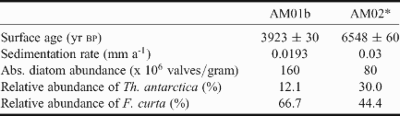
In the AM01b surface sample, the absolute diatom abundance (ADA) is 160 × 106 valves g-1 dry weight sediment, and the relative abundance of F. curta and T. antarctica is 66.7% and 12.1% respectively (Fig. 4). In the AM02 core, Hemer & Harris (Reference Hemer and Harris2003) report the ADA to be ~80 × 106 valves g-1 dry weight sediment, and the relative abundances of F. curta and T. antarctica to be 44.4% and 30% respectively. Both cores AM01b and AM02 indicate strong negative correlation between F. curta and T. antarctica abundances down-core (AM01b, R = -0.79), and strong positive correlation between the ADA and F. curta abundance down-core (AM01b, R = 0.71). The results from AM01b are therefore consistent with that proposed by Hemer & Harris (Reference Hemer and Harris2003) that increased relative abundance of T. antarctica, decreased relative abundance of F. curta, and decreasing ADA appears to represent conditions more distal from open water in front of the ice shelf and/or stronger input from the grounding line.
The lower part of the core, from 28 to 46 cm is almost devoid of fauna apart from a trace number of planktic foraminifera (2 individuals gram-1) at 46 cm in the core (Fig. 5). At 21 cm, a significant number of the planktonic foraminifera Neogloboquadrina pachyderma (s.) occur (75 individuals gram-1). Abundances of N. pachyderma (s.) reach a maximum at 17 cm (310 individuals gram-1), along with maximum abundances of a planktonic pteropod (120 individuals gram-1). Radiolaria also occur in minor abundances in the upper 17 cm of the core. The abundance of N. pachyderma gradually decreases upwards through the rest of the core, to an abundance of 67 individuals gram-1 at a depth of 3 cm.
Abundance of the planktonic foraminifera Neogloboquadrina pachyderma, pteropods, absolute diatom abundance and diversity, mean grain size, and the core X-ray of core AM01b. Major increases in the deposition of planktonic organisms (foraminifera, pteropods and diatoms) occur from 21 cm, associated with a reduction in siliclastic input.

The composition of the sediment in the lower 27 cm of the core is dominated by angular quartz grains, with mica and other mineral grains (Fig. 5). The quartz content decreases gradually from 21 to 17 cm, with a low abundance of mica only at 13 cm in this upper portion. Lonestones of 3–5 cm in diameter were recorded at 13 cm and 8 cm.
Discussion
The stratigraphy of core AM01b reflects two periods of sedimentation: The lower units of the core indicate strong cross-bedding of predominantly terrigenous sediment, indicating an early phase of current-worked deposition, probably derived from melting near the grounding zone. The upper units of the core contain more diatom-rich SMO, suggestive of a period of marine-dominated deposition at the site.
Core AM01b contains evidence of bedload sediment transport beneath an Antarctic ice shelf, exhibited by the cross-bedding in the laminated units. The strong laminae observed in the laminated unit, Gms and Sfm units near the bottom of the core indicate that the sediment has been strongly reworked by oceanographic processes. Two processes are capable of producing the laminations:
1. the site may have been in close proximity to the grounding line and experiencing the effects of tidal pumping as the ice shelf rose and fell with the tides, leading to strong currents which reworked the sediments.
2. Thermohaline flow of meltwater near the grounding zone either reworking the bed directly or entraining seawater in the rising plume and creating an inflow towards the grounding zone as part of the ice-pump circulation (Helmer & Jacobs Reference Hellmer and Jacobs1992).
The median grain size in the coarsest layers is 0.1–0.4 mm (Core facies Sfm from 35–36 cm. and Gms from 40–41 cm). According to bedload transport formulae (Miller et al. Reference Miller, McCave and Komar1977), currents of 0.3–0.4 ms-1 are required to mobilize sediments in this size range. Hemer et al. (Reference Hemer, Hunter and Coleman2006) indicate that maximum tidal current speeds away from the zone of tidal pumping beneath the Amery Ice Shelf are 0.26 ms-1, and thermohaline flow speeds are approximately 0.05 ms-1 (Williams et al. Reference Williams, Grosfeld, Warner, Gerdes and Determann2001). Thus, deposition of core facies Sfm and Gms is most likely to have occurred within the zone influenced by grounding line dynamics due to a combination of tidal pumping and the thermohaline ‘ice pump’ circulation. The SMO layer in both cores developed once the ice shelf had retreated further south. The retreat of the ice front enabled a source of marine sediments to be sufficiently close to the core sites. The retreat of the grounding line removed the influence of tidal pumping and deepened the sub-ice shelf cavity at the sites so that currents became too weak to maintain sediment in suspension, allowing deposition of the transported material.
Implications of planktonic organisms for sub-ice shelf circulation
The lower portion of AM01b (46 to 21 cm) is virtually devoid of fauna, with minor diatom abundance and only trace amounts of other fauna in the >150 µm fraction. The presence of the few modern diatoms implies that the ice sheet was not grounded over the site during this interval. However, the low numbers of diatoms and the absence of other fauna implies that the ice shelf front was along way north of the core site at this time, preventing the influx of a sufficient food source to sustain a seabed community (Fig. 6; Post et al. Reference Post, Hemer, O'Brien, Roberts and Craven2007).
Schematic model of changes in the extent and grounding line position of the Amery Ice Shelf in relation to the AM01b core site. At 28 cm in the core, cross-bedded sediments and the presence of gravel sand deposits imply that the grounding line is located within close proximity to the core site, with sediment deposition influenced by a combination of tidal pumping and thermohaline flow. The only organisms present at this time are rare diatom frustules. A reduction in siliciclastic input at 17 cm in the core indicates a significant retreat of the grounding line, while increased input of diatoms and planktonic foraminifera imply a reduction in the ice shelf extent. Mobile organisms also appear at this time (Post et al. Reference Post, Hemer, O'Brien, Roberts and Craven2007). Towards the surface of the core filter feeders are abundant (Post et al. Reference Post, Hemer, O'Brien, Roberts and Craven2007), implying consistent advection of organic matter via bottom currents to the site. The core outline includes bedding interpreted from the core X-ray. The age for the lower depth (~14800 yr bp) is extrapolated based on the upper two dates.

Planktic organisms, including the planktic foraminifera Neogloboquadrina pachyderma, radiolaria, pteropods and diatoms also reach high abundances at ~8570 yr bp (corrected). Lifecycle requirements mean that many planktic organisms are not viable beneath ice shelves, particularly those which require light for photosynthesis (Kellogg & Kellogg Reference Kellogg and Kellogg1988). Although the foraminifera N. pachyderma survives in sea-ice cavities by feeding on trapped diatoms (Dieckmann et al. Reference Dieckmann, Spindler, Lange, Ackley and Eicken1991), it is very unlikely that planktic foraminifera would survive beneath an ice shelf, where conditions are hostile to diatoms. These planktic organisms therefore indicate strong sub-ice shelf currents which advect these organisms at least 100 km beneath the ice shelf from the open marine environment. It is likely these currents also supplied the pelagic food sources and oxygen required to sustain filter feeders (e.g. Kellogg & Kellogg Reference Kellogg and Kellogg1988), which first appear in the AM01b core at the time of maximum planktic foraminifera abundance (Post et al. Reference Post, Hemer, O'Brien, Roberts and Craven2007). Thus, while the basal freeze and melting patterns beneath the ice sheet imply an outflow from the AM01b site seaward (Fricker et al. Reference Fricker, Popov, Allison and Young2001), this must be countered at depth by strong inflow of waterbearing suspended organic matter and oxygen, consistent with an overturning ice-pump circulation (Fig. 6, Hellmer & Jacobs Reference Hellmer and Jacobs1992).
The penetration of planktic organisms and the establishment of filter feeders at ~8570 yr bp implies a significant retreat of the ice shelf front at this time; sufficient to allow currents to transport suspended planktic particles. Studies beneath the McMurdo Ice Shelf show that in that setting, currents which are strong enough to supply sufficient material to support a diverse and abundant fauna penetrate only 100 km from the calving zone (Kellogg & Kellogg Reference Kellogg and Kellogg1988). Beyond this distance the current strength is insufficient to support a diverse and abundant faunal community. Other studies from the Ross Sea and McMurdo Sound also indicate the importance of shallow-water currents in supporting the benthic fauna (Dayton & Oliver Reference Dayton and Oliver1977). Sites of shallow-water inflow 22 km from the open ocean support a high diversity and density of filter feeders (including Porifera, Ectoprocta, bryozoans etc), whereas areas with predominantly current outflow, though with minor advection of chlorophyll from the east, have only rare occurrences of filter feeders. Samples collected from beneath the Ross Ice Shelf, 400 km from open water, contain no recent microfauna (Ronan et al. Reference Ronan, Lipps and DeLaca1978, Webb et al. Reference Webb, Ronan, Lipps and DeLaca1979).
The decrease in planktic foraminifera in the upper part of Amery core AM01b may reflect a weakening of the current strength, or increasing distance to the edge of the ice shelf. Domack et al. (Reference Domack, Jull and Nakao1991) describe a mid-Holocene (8000–4000 yr bp) advance of East Antarctic outlet glaciers associated with increased ice accumulation caused by climate warming during this period. Such an advance has the potential to reduce marine influence of sedimentation to the AM01b site. The relatively high diatom abundances in the upper section implies that the currents reaching the site are still sufficient to transport these lighter particles, thereby sustaining the filter feeder community.
Diatom assemblage
The palaeo-depositional environment of inner Prydz Bay, East Antarctica was reconstructed using diatom assemblages and sediment facies from a 352 cm gravity core (GC29; Fig. 1) for the past 21 320 14C yr bp by Taylor & McMinn (Reference Taylor and McMinn2002). Prior to 11 650 14C yr bp, Taylor & McMinn suggest an ice sheet was grounded over the site. Between 11 650 and 2600 14C yr bp, they describe a diatom assemblage dominated by T. antarctica resting spores and F. curta which had no modern day analogue. These species indicate a more open marine setting than present. Qualitatively, the fossil (down-core) diatom assemblage of GC29 (Taylor & McMinn Reference Taylor and McMinn2002) is similar to the sub-ice shelf assemblage found at AM01b and AM02 (i.e. reduced relative abundance of F. curta, and increased relative abundance of T. antarctica and F. kerguelensis). Quantitatively, cluster analysis using the methods described by Taylor & McMinn (Reference Taylor and McMinn2002) to assess the similarity in diatom assemblages between GC29, AM02 and AM01b indicates differences between datasets, which would appear to reflect the different operators, rather than dissimilarity in the assemblages themselves. We conclude that the qualitative agreement between diatom assemblages is worthy of further research, and to investigate these relationships, the task of counting all samples again by the same operator (or with some quantified measure of the agreement between operators included) is required.
The observed qualitative similarity may be explained by considering the depositional setting of the three cores. Core GC29 sampled sediment from the southern eastern flank of the Four Ladies Bank in Svenner Channel. O'Brien & Leitchenkov (Reference O'Brien and Leitchenkov1997) used sub-bottom profiler records to interpret the sediment as a drift formed by sediment reworked from Four Ladies Bank by iceberg scouring and the prevailing currents, and deposited in deeper water on the side of the Bank. Sediments deposited at the sub-ice shelf sites AM01b and AM02 are also likely to be products of similar current reworking processes. Thus, the similarity between the diatom assemblage from down-core GC29 and the sub-ice shelf sediments results from similar processes acting to produce the deposits. Extension of a floating ice shelf over the site of GC29 is not required to explain the similarities between the sediments.
Sedimentation rates and sub-ice shelf circulation patterns
Age determination of the AM01 core indicate a sedimentation rate of the SMO facies in the upper part of the core of 0.02 mm a-1 during the Holocene. This value is approximately two thirds the sedimentation rate at AM02 (0.03 mm a-1; Hemer & Harris Reference Hemer and Harris2003) for the same period, and approximately one third the accumulation rate in Prydz Bay (0.06 mm a-1; Franklin Reference Franklin1997).
AM02 has a greater sedimentation rate, but a lower concentration of diatoms in the SMO than AM01b (Table II), suggesting the AM02 surface unit contains relatively greater terrigenous content than the AM01b surface unit. The greater surface age of core AM02 is consistent with this observation, as greater contamination of the bulk age could be expected with a higher terrigenous component. The increased terrigenous component at AM02 may indicate closer proximity to coastal areas on the eastern side of Prydz Bay. Mobile sediment advected beneath the Amery Ice Shelf might come from these areas by scouring of shallow banks, ice rafting from ice cliffs or from meltwater plumes coming from basal melting of small ice shelves.
Comparison of surface conditions of two sub-ice shelf cores.
* From Hemer & Harris (Reference Hemer and Harris2003).
The older surface age at AM02 with respect to AM01b contradicts the interpretation presented by Hemer & Harris (Reference Hemer and Harris2003) that the older surface age is associated with regions of surface outflow or basal freezing. The diatom deposition rate provides an estimate of the sedimentation rate if the terrigenous component were removed, and is proportional to the product of the absolute diatom abundance and the sedimentation rate (valves deposited per annum). The calculated diatom deposition rate is 3.09 × 10⁶ valves per annum at AM01b and 2.4 × 10⁶ valves per annum at AM02, suggesting greater deposition of marine derived sediments at AM01b than AM02. Greater absolute diatom abundance, and an increased relative abundance of Fragilariopsis curta at the expense of Thalassiosira antarctica also indicate a greater marine influence at AM01b than AM02. These results are opposite to what is expected from the pattern of basal freeze and melt, which are commonly interpreted as barotropic outflow at AM01b and inflow at AM02 (Williams et al. Reference Williams, Warner and Budd1998). Consequently, it appears marine deposition is more strongly controlled by the overturning baroclinic circulation than the depth averaged barotropic circulation. Assuming a two layer baroclinic model, the inflow in the bottom water layer is roughly uniform across the entire width of the ice shelf. Evidence of this is observed by the presence of SMO across the width of the ice shelf, with variability controlled by local topography. Outflow in the surface water layer controls the melt/freeze patterns on the ice shelf base, with variation controlled by the local topography of the ice shelf draft. Whitehead et al. (Reference Whitehead, Quilty, McKelvey and O'Brien2006) speculated that the old surface age at AM02 reflected sediment starvation once baroclinic circulation was established. The results from AM01b suggest that this is not the case.
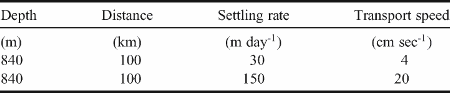
The presence of planktonic foraminifera at the AM01b site can be used to assess the strength of landward currents beneath the ice shelf. The well-preserved nature of the foraminiferal tests suggests that they were transported in suspension, before reaching the seabed, and were therefore either living or recently dead at the time of advection beneath the ice shelf. The presence of cytoplasm would also make the shells more buoyant, requiring slower currents to transport them than for empty tests (Takahashi & Bé Reference Takahashi and Bé1984). This factor therefore also suggests that the foraminifera were either living or recently dead at the time of their transportation. Based on a maximum diameter of the shells of 200 µm, and the range of sinking speeds measured for species of similar morphology (Takahashi & Bé Reference Takahashi and Bé1984), we can calculate the range of current speeds which would be required to transport N. pachyderma (Table III). This calculation indicates that speeds of between 4 and 20 cm sec-1 are required to transport N. pachyderma 100 km from the shelf edge to the sample site. The lower range of transport speeds calculated for N. pachyderma is consistent with simulations of current circulation beneath the Amery Ice Shelf of 5 cm sec-1 for southward flowing currents (Williams et al. Reference Williams, Grosfeld, Warner, Gerdes and Determann2001).
Range of current speeds estimated to transport tests of N. pachyderma over a depth of 840 m and to 100 km. The range of settling rates is based on calculations in Takahashi & Bé (Reference Takahashi and Bé1984) for tests containing cytoplasm.
Conclusions
A second sediment core collected from beneath the Amery Ice Shelf, East Antarctica allows more refined interpretation of sub-ice shelf sedimentation patterns. Sedimentation rates of biogenic siliceous mud and ooze are greater at the melt site (AM02) than the freeze site (AM01b), however diatom deposition rates are greater at AM01b than AM02. Hence, the increased sedimentation rate at AM02 is a result of terrigenous input, which is most likely a result of increased proximity of AM02 to the grounding line. AM02 exhibits a significantly older surface age (6548 14C yr bp) than AM01b (3923 14C yr bp), owing to the reworked terrigenous material contained in the bulk sample. It is found that the influence of marine sedimentation does not necessarily correspond with the freeze/melt pattern of the ice shelf base, which has been described in previous studies of the sub-ice shelf sedimentation (Harris Reference Harris2000, Hemer & Harris Reference Hemer and Harris2003). Consequently, the sedimentation beneath the Amery Ice Shelf is characterized by the overturning baroclinic circulation, rather than being strongly influenced by the depth-integrated circulation.
Laminations in the lower half of the AM01b core provide the first evidence of bedload sediment transport occurrence beneath an Antarctic Ice Shelf. Grounding line dynamics are suggested to be the likely cause of such an energetic environment. At the present time, SMO is deposited in a quiescent setting, isolated from the influence of the grounding line, in the interior of the ice shelf cavity.
Qualitatively, the sub-ice shelf diatom assemblage observed in both sub-ice shelf cores AM01b and AM02 has been found to be similar to a nearby open water, current re-worked assemblage in eastern Prydz Bay (GC29; Taylor & McMinn Reference Taylor and McMinn2002). Quantitative comparison between the diatom assemblages of the three cores displays differences between datasets, which are likely to reflect differences between operators rather than dissimilarity in the data. We have proposed that the relationships between the environments be more thoroughly investigated to determine the uniqueness, or otherwise, of a sub-ice shelf diatom assemblage.
Well preserved planktonic foraminifera in the sub-ice shelf sediments provide further evidence of the landward currents beneath the Amery ice shelf. Calculated rates of advection from the marine environment to the site of deposition are consistent with oceanographic models of sub-ice shelf circulation.
During the summer of 2005/2006, a further two sediment cores were collected (AM03 and AM04, Fig. 1) and analysis of these cores will commence shortly. The network of sub-Amery Ice Shelf sediment cores is expected to increase our understanding of sub-ice shelf circulation and sedimentation patterns, and provides a unique dataset for the study of sub-ice shelf marine life.
Acknowledgements
The authors would like to thank Ben Galton-Fenzi (Antarctic Climate and Ecosystems Co-operative Research Centre), Dr Andrew Ruddell (previously of the Antarctic Co-operative Research Centre) and Hugh Tassel (Geoscience Australia) for provision of sub-ice shelf geometry data, Tony Watson and Alex McLachlan who carried out technical analysis of core data, Dr Andrew Heap, Dr John Marshall, Dr Amy Leventer and Dr Eugene Domack for their reviews of an earlier version of this manuscript, and personnel who have assisted with the AMISOR program, both in the field, and with technical input in Australia. The sub-ice shelf sediments were first collected as part of the AMISOR geoscience program under an ASAC grant (ASAC 1210) to Dr Peter Harris (Geoscience Australia), as part of the larger AMISOR program. MAH, PEO, ALP and PTH publish with the permission of the Chief Executive Officer, Geoscience Australia.



