

Introduction
From The 1960s through the 1990s, architect John Habraken and a few like-minded architects developed the Open-Building framework because they were concerned about centralized control of the built environment and wanted to return autonomy to individual inhabitants while letting them cooperate in producing public goods. At the same time, Elinor and Vincent Ostrom and researchers from various fields started the Bloomington School of Political Economy. They were also concerned about centralized control of the political and physical environments and wanted to increase self-governance. Habraken and the Bloomington school worked without being aware of one another's work to improve governance of the built environment and increase people's ability to self-govern. This article attempts to bring the two perspectives into dialogue by comparing and contrasting Elinor Ostrom's design principles with the Open-Building framework. This increases our understanding of both perspectives by showing their similar but distinct views on how to balance individual autonomy and group-produced public goods, how to balance change and stability, and how to view nested enterprises.
The Bloomington School and Open-Building perspectives focus on increasing people's freedom by giving them the autonomy and skills to contribute to their own private and public spaces rather than confining them to a monocentric top-down social order. Both don't think that failures necessarily call for stronger social control but are an opportunity to learn about the appropriate scale and scope of public services to increase stability, freedom, and autonomy.
In contrast to Habraken (Reference Habraken1998) views public and private spaces as relative and nested. They are relative in that a space is private to those who are not allowed to enter but public to those who do have the right to enter. For example, in a condominium, a condo owner's unit is a private space, and condominium amenities are public spaces. However, condominium amenities are private spaces for nonmembers of the condominium. Private and public spaces are nested in the sense that, for example, moving downward in a hierarchy, people need permission to enter other people's houses and additional permission to enter their bedrooms or use their desks. However, moving upward in a hierarchy, unless they are prisoners, people in a territory have the right to leave the bedroom to the house and leave the house to the street.
Unlike Habraken (Reference Habraken1998) and Open-Building focus on disentangling spaces to increase inhabitants' autonomy. For example, disentangled boundaries in multitenant buildings lower people's repair costs since utility access is available from public areas rather than neighbours' units. Likewise, separating the base building from the inhabitant-controlled infill increases users' autonomy and helps them interact better with the community. The base building is where agents have space for their residential or commercial units. Infill is the items within an agent's unit, such as non-load-bearing walls and the rooms.
Disentangling spaces to increase user autonomy is consistent with Sen's (Reference Sen1999) and Nussbaum's (Reference Nussbaum2013) capability approach, in which people should be able to live in ways they value. Nussbaum argues that strengthening people's capabilities is essential for social development and cultural coexistence. The capability approach implies that urban planners should be flexible in supporting users' capacity to affect the built environment.
However, Horowitz (Reference Horowitz2021) writes that many common interest developments (CIDs), such as homeowner associations (HOAs), condominiums, and housing cooperatives, limit inhabitants' ability to transform their built environment. Likewise, Kendall (Reference Kendall and Kendall2022) writes that giving residents control over their own units in multiunit residential buildings is difficult because, compared with other types of buildings, there are more territorial subdivisions, regulatory burdens, and entangled mechanical, electrical, and plumbing systems. He adds that balancing building governance and individual autonomy is difficult because group members want consensus about how to manage the building, but expressing individual preferences reduces consensus and predictability, so group members often argue that entanglement requires more centralized control, degrading residents' autonomous decision-making and polycentric building governance.
Aligica and Tarko (Reference Aligica and Tarko2012) define polycentricity as a social system characterized by (1) many autonomous decision-making centres with shared goals, (2) an overarching system of rules or institutional/cultural framework, and (3) spontaneous order generated by evolutionary competition. Likewise, Open-Building looks at the built environment as polycentric. This article shows how Open-Building uses five design principles to create more stable and cooperative built environments. According to these principles, designers should (1) have territorial clarity, (2) separate design tasks but conform to social structure, (3) work within the hierarchical structure of the built environment, (4) share common understanding and themes, and (5) design for change.
Shepard (Reference Shepard2023) writes that John Habraken was influenced by being born and raised in Indonesia, where he observed indigenous people build and maintain their own vernacular architecture, and during World War II, he and his family were interned for two years in a Japanese prison camp. Observing the spontaneous order of the Indonesian people's self-built kampong housing and his confinement in a prison camp affected Habraken's view that the built environment is self-organizing and the importance of giving users the freedom and autonomy to affect their own built environment.
Section ‘Habraken's open-building as a polycentric system’ compares Open-Building with Ostrom's design principles. Section ‘Comparing Ostrom's design principles with Habraken's open-building’ shows how Open-Building views the built environment as a polycentric political system in which agents act within the physical order, territorial order, and order of understanding. Section ‘Designing for change’ considers ways to balance stability and change. Section ‘Share common understanding and themes’ considers how designers use shared understanding, patterns, and themes to design the built environment, and it conveys Christopher Alexander's, Habraken's, and Ostrom's views on nested territories and polycentric governance. Section ‘Working within the hierarchical structure of the built environment’ discusses how designers can use hierarchical levels to design physical space and territories and how territory and public and private spaces affect design. Section ‘Separating design tasks but conforming to social structure’ discusses how separating design tasks but conforming to the social structure is important to polycentricity. Section ‘Territorial clarity: knowing the boundaries is vital to innovation and distribution of control’ considers how territorial clarity is vital to innovation and governance.
Habraken's open-building as a polycentric system
Even though Habraken's Open-Building and Ostrom's common's governance developed independently, Habraken and the author developed Figure 1 during a series of personal communications about how Habraken would draw a diagram similar to Ostrom's IAD and SES diagrams to illustrate Open-Building. Habraken studied Ostrom's Institutional Analysis and Development (IAD) and social-ecological system (SES) diagrams, and then he and the author created Figure 1 to illustrate Open-Building. Habraken didn't think there were focal action situations but rather that changing information in one order area may trigger changes in other orders, with feedback going back and forth until the situation is in balance.
Open-building framework for the description of agents' control of objects and spaces.

In other words, Habraken (Reference Habraken1998) looks at the built environment as a polycentric system in which agents act within the physical order, territorial order, and order of understanding. In the physical order (concerning form and live configurations), agents decide how to change built configurations, the arrangement of objects, and the distribution of agents. Habraken defines a configuration as a group of elements that are combined and arranged in various ways. Live configurations are configurations controlled by a single agent, such as things under one agent's control in a room. For example, two live configurations exist when two people sharing an office have their own desks and books.
In the territorial order (concerning place and territories), agents decide on territorial control, the movement of things, and what to allow into (or exclude from) different spatial/territorial levels. In the order of understanding (concerning understanding and people), agents control physical form and territories through shared preferences and rules about transforming objects, moving objects, and controlling territory. The order of understanding considers (1) agents' shared understandings and preferences for controlling territory and transforming or moving configurations and (2) the formal and informal agreements used to control territory and transform configurations. Shared understanding creates mutual preferences and coherent environments.
Habraken (Reference Habraken2021b) writes that an agent's goal at most building sites is to balance stability and change. In the physical order, agents seek stability and the ability to transform their sites. In the territorial order, agents seek stability but also seek to expand their territories, which creates conflict. In the territorial order, the solution is to restrict horizontal crossings but balance this restriction with agents' right to always enter public spaces. In the order of understanding, shared rules and habits increase stability and reduce conflict and fragmentation. Thus, Open-Building is a political system that seeks to balance stability and change.
The arrows in Figure 1 show how the three orders affect each other. The order of understanding affects the physical order when agents choose rules on configurations, the arrangement of configurations, and the distribution of agents. The order of understanding also affects the territorial order by creating rules concerning occupation, territorial arrangement, and the distribution of agents. The physical order affects the territorial order by constraining the location of boundaries. It also affects the order of understanding because objects' physical properties affect agents' understanding of the objects. The territorial order affects the physical order by constraining the location of configurations. It also affects the order of understanding because agents see the world from the perspective of the territories they control. The dashed lines show that actions in each order have feedback effects on the other orders.
Comparing Ostrom's design principles with Habraken's open-building
Table 1 compares Ostrom's (Reference Ostrom1990) principles for long-lasting commons governance with Habraken's Open-Building design principles. Tarko (Reference Tarko2016) expands on Ostrom's eight principles by adding culture at the metaconstitutional level and splitting Ostrom's second principle, proportional equivalence between benefits and costs, into the principles of local fit and fairness. Column 1 shows these ten principles at the operational, collective-choice, constitutional, and metaconstitutional levels.
Comparing Ostrom's and Habraken's design principles

Habraken focused on designing for change so users can more easily change their built environments, while Ostrom's design principles encourage long-lasting commons governance.Footnote 1 Similarly, Habraken's principle of designing for change concerns balancing change and permanence. Changing an element of the built environment is possible because part of the environment does not change. One way of firmly fixing a few things while allowing for long-term change is to separate requirement planning and building design into long-, medium-, and short-term perspectives. The long-term perspective focuses on the base building, the medium-term perspective focuses on the infill, and the short-term perspective focuses on the fixtures, finishes, and equipment. Macchi (Reference Macchi and Kendall2019) argues that disentangling long-, medium-, and short-term decisions creates transparency and helps focus on what is essential and relevant.
Habraken's principle of sharing a common understanding and themes is similar to Ostrom's principle of culture, which states that people share a common understanding of rules and values. Tarko (Reference Tarko2016) includes the principle of shared understanding and culture at the metaconstitutional level. As discussed below, a shared understanding of themes, patterns, systems, and types facilitates self-organization and coherent variation, balances what people share and what they do individually, creates social contracts, and improves communication and cooperation.
Habraken's principle of hierarchy and working within the hierarchical structure of the built environment is similar to Ostrom's principle of polycentricity and hierarchically nested levels. As discussed in section ‘Working within the hierarchical structure of the built environment’, a hierarchy of levels includes the urban tissue, base buildings, and infill. Higher levels determine the constraints and themes that affect lower-level designs. For example, the urban tissue creates the environment and dominates the buildings within the urban tissue, and the buildings create the environment for – and dominate the infill within – the building. The urban tissue is longer lasting than the buildings, and the buildings are longer lasting than the infill. Separation also can lead to new businesses that specialize in producing the infill.
Habraken's principle of separating design tasks but conforming to the social structure is similar to Ostrom's principle of subsidiarity and higher governance units' recognition of self-governance rights. Kendall (Reference Kendall and Kendall2022) writes that separating design tasks allows each dwelling in a multi-occupant building to be fully independent. Much like detached buildings, units in multi-occupant buildings need to be alterable or replaceable independently of other units. Increased density creates more technical, social, and legal friction. Supporting the independence of each unit in large projects helps establish the units as the basic cells in the environment and increases the importance of the individual or household unit. However, Habraken (Reference Habraken1998) notes that with their top-down thinking, housing experts consider separating design tasks a complication rather than a means of increasing freedom.
Kendall (Reference Kendall and Kendall2022) writes that many designers argue that separating infill and giving infill control to users is complicated, expensive, and inefficient and limits architecture's quality, in turn limiting the adoption of Open-Building principles. Alexander (Reference Alexander1979) writes that not including user control of their spaces creates a situation where the design abstracts from critical features, and thus, architects do not make correct decisions. Their clients, usually developers and housing agencies, need user representatives to help develop the infill and the base buildings (Kendall, Reference Kendall and Kendall2022).
Habraken's principle of territorial clarity and control of space is similar to Ostrom's principle of excludability. Both Ostrom and Habraken write that clear membership, territorial boundaries, and the ability to control entry and exclude nonmembers are essential to territorial control.
Designing for change
As shown in Table 1, Ostrom focuses on the design principles for long-lasting commons governance, while Habraken focuses on designing for change. Both focus on giving users autonomy. Balancing permanence and change is essential to the built environment, as change during the building process is costly. Change and permanence go together. City blocks last centuries, while the buildings and spaces within the blocks change much more frequently. One reason the city block changes much less frequently than the walls within the block is that it takes more people to agree to change the city block than to change an interior wall. It is harder to change higher levels than lower levels. However, when there is a consensus that the city block should change, it will change.
As discussed above, Open-Building designs for change by (1) a shared understanding that residents should have autonomy, (2) separating design tasks and separating infill from the building level, and (3) recognizing territory and having clear territorial and hierarchical boundaries. Separating design tasks includes distinguishing the common physical and spatial parts from the individually controlled physical and spatial parts. Disentangling products, systems, and components is also vital to innovation. From a technical perspective, Open-Building seeks products, specifications, and systems that can be installed or removed easily and a clear separation between long-term and short-term systems.
In Open-Building, agents try to balance stability and change through vertical and horizontal relations. In vertical relations, agents observe how higher-level constraints limit their freedom to act on the elements under their control, and agents consider what restrictions their decisions will impose on lower levels. In horizontal relations, relationships between live configurations are on the same level.
5. Share common understanding and themes
As shown in Table 1, designers share common understanding and themes at the metaconstitutional level. Habraken views the built environment as a self-organizing emergent system, and an important part of self-organization is appropriately applying themes, patterns, types, and systems. In the epilogue to his book Structure of the Ordinary, Habraken (Reference Habraken1998) wrote:
‘Built environment has always been self-organizing. …Despite our increasing ability to effect large-scale change and our escalating ambitions, built environment follows its own laws. That reality renders our practice thoroughly thematic. … Most difficult of all for environmental professionals may be learning to use forms of understanding and to speak of them freely. … To find pride in continuity, in variation on a common theme. …We tend to record the innovative while discounting the familiar. But the former, which initially depends on the latter, may eventually transform it. We should therefore seek to understand our present environments, so radically different from those in the past, as the result of a collective search for new thematic knowledge. …The idea that a living environment can be invented is outmoded: environment must be cultivated. This requires proper use of levels, judicious articulation of territory, and creative applications of types, patterns, and thematic systems. It must also ensure well-modulated distribution of control, compatible with an increasingly mobile and informed humanity. After all, it is by the quality of the common that environments prosper and by which, ultimately, our passage will one day be measured.’ (Habraken, Reference Habraken1998: 326–327).
Open-Building cultivates the everyday environment by designing with themes. Sharing themes creates a coherent structure and unifying idea or image (Table 2, row 1). Agents' independently deciding to share themes is why old cities and towns have a coherent structure. For example, cities such as Amsterdam, London, Kyoto, Paris, Tunis, and Venice are distinguishable because their tissue levels create recognizable main themes (Habraken, Reference Habraken1998). Their recognizable tissue levels come from the similarity and variation in the houses, streets, squares, canals, and geographic features, such as rivers and hills. Recognizable main themes also come from the similarity and variety of materials used, colour, detailing, ornamentation, and proportions. Shared understanding and themes are essential to the design process and help ensure coherent variation among designers. As with musical improvisation, designing with themes creates variation on the theme, shared values determine the amount of variation allowed, and themes change over time (Habraken, Reference Habraken1998).
Methods of shared understanding

Shared themes about physical form range from explicit contracts, laws, standards, and building codes to implicit customs, conventions, and habits (Habraken, Reference Habraken1998). Thus, both requirements imposed by higher-level agents and peer-to-peer horizontal agreements create shared preferences and themes. For example, instead of top-down control, urban architect Van Olphen asked the architects designing the apartment buildings in Katwijk's inner harbour to create collective agreements on shared themes and discuss each others' designs (Habraken, Reference Habraken, Eberle and Troger2021a). Regulators may also require that agents do or not do certain things concerning the choice, combination, and distribution of elements under their control.
Themes, patterns, systems, and types are similar to Buchanan and Tullock's (Reference Buchanan and Tullock1962: xvii) definition of a constitution, where a constitution is a set of rules people determine in advance and through which they conduct subsequent actions. In creating constitutional-level, collective-choice, and operational-level rules, Buchanan and Tullock (Reference Buchanan and Tullock1962) assume agents bear decision-making costs and external costs in making these collective-choice decisions. Buchanan and Tullock (Reference Buchanan and Tullock1962) define decision-making costs as the costs a person expects to bear because of participating in deciding on a proposal and external costs as costs a person expects to endure because of other people's actions. Interdependence costs are decision-making costs plus external costs. As the number of people required to take collective action increases, expected decision-making costs increase. However, sharing themes, patterns, systems, and types reduces agents' decision-making and external costs.
Buchanan and Tullock (Reference Buchanan and Tullock1962) write that relatively homogeneous groups will have lower decision-making costs and accept less restrictive rules than more heterogeneous groups.Footnote 2 Similarly, Habraken (Reference Habraken1998) writes that having common understanding and themes means agents typically choose to conform to socially determined shared patterns, types, and systems, which are created through agreement and, in turn, create coherence and variety. In other words, shared understanding facilitates cooperation. For example, shared understanding reduces the need for strict land-use regulation, increasing agents' freedom to make decisions at the building and dwelling levels. Shared understanding decreases the need for a great deal of explicit negotiation, confirmation, documentation, and agreement. Shared themes, patterns, systems, and types also create a shared understanding for making value judgments (Habraken, Reference Habraken1998).
Designing with themes balances what people share and what they do individually. An essential part of higher-level decisions is deciding what forms lower levels should share. A higher-level design creates a shared context for lower-level designs and creates thematic constraints, in which designers' higher-level choices are based on their assumptions of lower-level use. Designers should generate a range of possible variants at each level to determine what the design offers potential inhabitants. For example, the base-building designer must assess the building's capacity for various infill variations. But to avoid excess uniformity, designers should not think of the single best lower-level solution and repeat it to create the higher-level form (Habraken, Reference Habraken, Eberle and Troger2021a).
Patterns help designers create a shared understanding with the people who inhabit, pay for, and manage what the designers are designing (Alexander, Reference Alexander1979; Habraken, Reference Habraken1998). Agents also use patterns to create and repair artefacts in an always-changing built environment (Alexander, Reference Alexander1979: 355). Alexander (Reference Alexander1979: 182) writes that a pattern is a rule describing what agents must do to produce the thing it defines (Table 2, row 2). A pattern includes three aspects: (1) the relationships that define it, (2) the knowledge of how to apply it, and (3) the problem it solves. For example, regarding a hillside-terrace pattern, (1) it follows the contours of the land, and the terraces are spaced a similar distance apart; (2) it includes information on how to build the terraces; and (3) it helps solve a hillside erosion problem.
A shared understanding of patterns governs the acts that create and maintain the city and its parts (Alexander, Reference Alexander1979: 358). Even nonexperts who share patterns can build houses, remodel rooms, and help plan cities. For example, nonexperts created informal settlements and old cities such as Amsterdam, London, and Kyoto with coherent themes because they knew how the patterns fit together (Alexander, Reference Alexander1979). On the other hand, Alexander (Reference Alexander1979: 235–38) notes that when experts, such as architects and planners, take control, patterns often become abstract and out of touch with reality.
A system is something in which some parts chosen from a predetermined set are distributed following rules of selection and relation. Systems have thematic qualities such as classical, gothic, modernist, and international designs and configurations (Habraken, Reference Habraken1998). Systems also include utilities such as plumbing systems and telecommunication systems. When agents choose a system, they also choose to follow the rules for that design and configuration, and specialists have the professional knowledge, expertise, and skills to execute the agreed-upon meaning and system efficiently.
Since parties agree to work with certain parts in certain ways, systems create a social contract among those applying the system (Habraken Reference Habraken1998). Bowker and Star (Reference Bowker and Star1999) and Habraken (Reference Habraken1998) write that operating in a system means joining a social body in which societies of agents create and maintain the system. Changing a system means convincing others to change their mode of operation. In other words, a system is a collective property a social group shares, though people can make parts of the system their own. Some of the most resilient and durable systems seem to lack formal authorship or professionalism. For example, the mud-brick vaulting systems of upper Egypt lasted for millennia but died out when professionals convinced agents to shift to more modern ways of building (Habraken, Reference Habraken1998).
Before modern times, designers, builders, and clients worked with a limited and well-established range of systems with fixed ways to build and design, which changed slowly and endured over lifetimes. Currently, designers, builders, and clients work with various systems in building technologies, utilities, and transportation. When agents challenge and no longer take implicit customs, conventions, and habits for granted, consensus may require explicit regulations and bylaws. In other words, when there is less mutual understanding and dispersed control among diverse groups, the amount of documentation and regulation required increases. For example, before modern times, the construction of cathedrals was not formally documented since they had unified control. Codification and documentation are necessary for skyscrapers since they are produced with dispersed control by different agents. Since modern agents often do not have a shared understanding of what an urban environment should look like, their freedom to design in any conceivable shape means that urban tissues can look chaotic. This chaos increases the demand for explicit regulation (Habraken, Reference Habraken1998).
Types are integrated wholes, which include themes, patterns, and architectural and technical systems (Table 2, row 4). Examples of types include skyscrapers and suburban houses. Internal use can also determine types, such as hospitals, hotels, and apartment buildings. Types can bring efficiency to interdisciplinary cooperation by giving agents in different occupations and positions a shared context and understanding of a project, which reduces the need for rules and specifications. However, coordination problems multiply the further people move from sharing a typology. Avoiding coordination problems is why people often resist random or significant changes and prefer deliberate cultivation of gradual change on what is already known.
Designers often need to balance more than one type. For example, Jacobs (Reference Jacobs1994) writes that healthy cities balance the attributes of two shared values: the Guardian and Commercial Syndromes. Guardian Syndrome attributes imply continuity and stability, while Commercial Syndrome attributes imply innovation and trade. Krier (Reference Krier2009: 29) writes that traditional architecture distinguishes between symbolic institutional public buildings and utilitarian private buildings. Bertaud (Reference Bertaud2018) argues that planners need to see things from both the planning and commercial perspectives.
Buchanan and Tullock (Reference Buchanan and Tullock1962) assume that external costs decrease as a group moves to unanimous agreement since people will not support a proposal if they are worse off. However, to suppress dissent and get their preferred policies passed, Horowitz (Reference Horowitz2013) argues that social entrepreneurs create simplified stories of villains causing harm to innocent victims. For example, Horowitz (Reference Horowitz2021) writes that in CIDs, such as HOAs and condominiums, the community boards focused on the negative aspects of dissident tenants, and the dissident tenants focused on the abuse of power by the boards. Likewise, Krier (Reference Krier2009) argued that when modernist architecture dominated, they ridiculed and dismissed nonmodernist structures and undermined traditional building techniques and materials. Unfortunately, dismissing the shared values of other groups led to excessive uniformity and the loss of building techniques. Undermining traditional building techniques also undermined the restoration of nonmodernist buildings.
Working within the hierarchical structure of the built environment
As shown in Table 1, the Open-Building design principle of working within the hierarchical structure of the built environment is similar to Ostrom's principle of nested enterprises and polycentricity. The hierarchical structure of the built environment is also related to Buchanan and Tullock's (Reference Buchanan and Tullock1962) argument that the proper size of the collective unit depends on comparing the additional decision-making costs from moving to a higher level and the spillover costs from keeping the activity at a lower level. Buchanan and Tullock (Reference Buchanan and Tullock1962: 113–114) write that a person's choices create external effects on others in their group, neighbourhood, city, state, and nation. People can reduce social costs by organizing the collective activity at the lowest level consistent with the size of the externality that the collective activity is trying to eliminate. Smaller units will typically choose more inclusive decision-making rules than larger units. Buchanan and Tullock (Reference Buchanan and Tullock1962) also write that people's ability to choose between locations limits external costs and decision-making costs.
In Open-Building, a hierarchy of levels is a tool to help determine the responsibilities of the various parties and how to structure the control distribution. Levels help designers decide who should be responsible for each level and each subsystem, as sometimes users do a better job and sometimes professionals do. Levels also help the system change more efficiently over time, facilitate innovation, and allow greater autonomy. Higher levels are more challenging to change than lower levels. Separating levels allows lower levels to be more flexible and adaptive. Meanwhile, higher levels are more stable and allow for longer-term standards and consensus.
Levels also help designers consider capacity. Designers look to higher levels to respect the existing context and look downward to evaluate and determine the capacity and possibilities for lower-level spaces. The urban designer considers the capacity of various street widths to carry traffic, park cars, and plant trees and plants. The designer also considers the capacity of lot sizes for different kinds of buildings. The designer does not determine the lower-level design choices but has an idea of their possibilities. In other words, the designer looks at lower levels to frame and affect the work of agents who will later work within the context the designer creates.
Column 1 in Figure 2 shows the nested nature of levels in the physical order. Furniture/equipment is nested in the infill/partitioning. The infill/partitioning is nested in the building.Footnote 3 The building is nested in the urban tissue, which includes roads, streets, pipes, squares, and parks. The urban tissue is nested in the urban structure, which comprises the town's major roads and infrastructure. Van der Werf (Reference Van der Werf2020) describes values in Open-Building design as consisting of (1) private values (related to a household's infill), (2) collective values (related to a neighbourhood's base buildings), and (3) public values (related to a city district's urban tissue). The tissue level creates the main theme, and people then develop variations on that theme in the base-building and infill levels.
A hierarchy of levels within the physical systems and territories.

Column 2 shows the nested nature of levels in the territorial order. A person experiences a room as a combination of infill/partitioning and furniture/equipment, a dwelling as a combination of a building and infill/partitioning, and a neighbourhood as a combination of a building and the tissue/roads/blocks. Levels are related to Ostrom's (Reference Ostrom1990) idea of nested enterprises, in which a room is nested within a dwelling, a dwelling is nested within a neighbourhood, and a neighbourhood is nested within a town (Wilson et al., Reference Wilson, Ostrom and Cox2013).
Various professions are responsible for designing the physical system levels. For example, roads and neighbourhoods are subjects of urban design, the base building and infill are subjects of architectural design, and the furniture/equipment is a subject of interior design. Moreover, dwellings and environmental systems do not always include all levels. For example, traditional Nubian houses use niches for sleeping and sitting but do not have partitioning or furniture.
Instead of looking at a building as a single unit that cannot be divided, Open-Building looks at a building as infrastructure in a hierarchy with different levels of intervention. A hierarchy of levels increases the ability to have well-organized control distributions and separate design tasks. Distributed control also creates interfaces between vertical and horizontal levels that need cooperation and clear agreements. Interfaces often lead to boundary frictions, especially when unconventional practices, uncertainty, and new agents exist. Distributed control requires contracts with clear separation and monitoring of design tasks (Kendall, Reference Kendall and Kendall2022). However, centralized control also requires interfaces – between the architect, engineer, design team, client, and builder.
Supply configurations such as gas, electric, water, and drainage conduits pass through multiple levels, such as water flowing from the urban structure down to the furniture/equipment level, where consumers can access it. Supply configurations must also follow the rules imposed by utility companies and regulatory agencies.
Utilities that move through various territories create technical entanglements. For example, sewer and water pipes that pass through neighbouring territories create rigidity in decision-making during design and legal and social conflict during maintenance. Pipes in multitenant housing can be disentangled from neighbouring units by requiring unit owners to put utilities under a raised floor or above the ceiling.
Another way to disentangle supply configurations is to move away from the building level to the infill and furniture levels since they are easier to change (Habraken, Reference Habraken1998). Changing technologies on the furniture level is generally easier than on the infill level, and changing technologies on the infill level is usually easier than on the building level. For example, standard power outlets and plugs enable electrical equipment to be disentangled from the electrical system, achieve autonomy, and increase innovation. In other words, plugs disentangle refrigerators, lamps, and computers from the electrical system, allowing for more innovation.
Systems separation allows designers to weigh trade-offs between change versus stability and present versus future (Macchi, Reference Macchi and Kendall2019). It also increases the ability to design for long-run innovation. Macchi writes that separating buildings into three levels compartmentalizes risks, so fixing a problem on one level will not hurt the whole. However, upper levels dominate lower levels, so a change in the building may affect the infill or the furniture/equipment.
When two configurations at different levels are combined, the lower-level configuration becomes part of the higher-level configuration (Habraken, Reference Habraken2021b). Integrated configurations also restrict options. For example, suppose users are not allowed to move furniture or partitioning. In that case, the furniture and partitioning operate at the building level.
In the physical order, higher-level forms dominate lower-level forms. Streets typically dominate buildings, which dominate rooms, which dominate furniture. Changing the configuration of streets means demolishing buildings, and moving walls in a house means rearranging furniture. However, if a renter persuades the building owner to move the walls, this does not mean that the renter dominates but that a lower-level player influences a higher-level player. In other words, a change in urban design changes the building, but a change in a building may not change the urban design.
Likewise, building codes and supply configurations are examples of vertical relations in which lower-level agents follow the rules imposed by higher-level agents. In contrast, individual houses on a street or condominium units in a building are examples of horizontal relations that constrain or are constrained by forms on the same level.
Ostrom (Reference Ostrom2010) categorizes resources into four types based on excludability and subtractability. Excludability is how easy it is to exclude others from using the resource. Subtractability is when a user's use of the resource subtracts from the amount available to others. Private goods are subtractable and excludable, and toll (or club) goods are excludable but not subtractable. Public goods are neither subtractable nor excludable, and common-pool resources are subtractable but not excludable.
Like Ostrom (Reference Ostrom2010), Habraken views understanding the nature of goods and spaces as essential to the design process. In considering public and private space, Habraken (Reference Habraken1998) focuses on excludability, not subtractability. He also focuses on how levels affect public and private space.
Habraken's focus on excludability implies that private spaces combine private and toll (or club) goods, and public spaces combine public goods and common-pool resources. Similarly, Ostrom (Reference Ostrom2003) writes that Musgrave (Reference Musgrave1959) also asserted that the exclusion principle could divide goods between public and private.
Figure 3 illustrates how Habraken (Reference Habraken1998) views public and private space. Area A is a territory that includes territories B1, B2, and B3. For example, territory A may be a neighbourhood with house lots B1–B3, a hotel with rooms B1–B3, a condominium with units B1–B3, or a house with three bedrooms.
Included territories in A result in public and private spaces.

A space is private to those who are not allowed to enter but public to people from included territories who have the right to enter. Territory A includes three private spaces: B1, B2, and B3. Public space is the space that remains after subtracting the private space. In other words, the public space is area A−B.
Public space is also used by people from private spaces, such as B1, B2, and B3, who do not individually control the public space (Habraken, Reference Habraken1998). In a condominium, the owner's unit is a private space, and condominium amenities are public spaces. However, the amenities are private spaces for nonmembers of the condominium.
Figure 3 illustrates vertical and horizontal relationships in a territorial hierarchy. A vertical relationship exists between a territory and its included territory (or territories). An agent's movement from B2 to A and from A to B3 is vertical. A horizontal relationship exists between B2 and B3.
Figure 4 shows an increase in territorial depth by including two private spaces, C1 and C2, in B2 (Habraken, Reference Habraken1998). Space B2−(C1 + C2) is public space to the included territories C1 and C2 but private space to the territories not included in B2. Territory A still has three private spaces: B1, B2, and B3. The public space is area A−B. People in private spaces such as C1 and C2 need to be able to exit to higher-level public space B2 before moving into public space A.
Including territory C in territory B results in public and private spaces in B.

C1 and C2 could be apartments in an apartment building where B2 is an atrium, courtyard, or lobby, and A is the street. To the tenants in apartment C2, lobby B2 and street A are both public spaces since they can move freely to the lobby and the street. In other words, lobby B2 is a private space for those not granted entry and a public space for the tenants and their guests.
People from the included territories (C1 and C2) communally share the public spaces (B2 and A). Household members share the living room, and apartment renters share the common spaces. People can move upward in the territorial hierarchy to increasingly public spaces. For example, people can move from the bedroom to the living room and from the living room to the park.
To increase stability and mutual well-being, agents who control different private spaces on the same level usually interact vertically and avoid horizontal relations (Habraken, Reference Habraken1998). For example, a person in C1 visiting their neighbour in C2 usually goes to the public space (B2) and then to their neighbour's house. Figure 4 shows that creating new private spaces, C1 and C2, and avoiding horizontal contact creates a new shared public space, B2. The public space can control access to the included private spaces but must allow exit. In other words, creating new private spaces also creates a shared public space above it.
Architecture traditionally ignores the importance of levels (Habraken, Reference Habraken1998). Ignoring levels is one reason mass housing, whether provided by the government or private developers, usually does not let inhabitants have input into the dwelling layout. Those leading large-scale projects often want greater vertical control because of the uncertainty created by significant changes in design conventions and building habits. Architects who wanted to express their individuality and creativity also made the built environment more rigid and less adaptable.
Separating design tasks but conforming to social structure
Separating design tasks but conforming to the social structure is an essential Open-Building design principle. As shown in Table 1, separating design tasks is similar to Ostrom's subsidiarity principle, in which higher governance levels recognize the governance rights of lower levels. The infill level allows the tenant space to be more independent from the base building and can reduce costs for users in installing infill and modifying their housing units (Habraken, Reference Habraken1998). Deciding what belongs to the base building and the infill is both a technical question about lifespan, form, and space and a political question about how much freedom and autonomy occupants can exercise (Habraken, Reference Habraken1998). Occupants include households, office units, and workshops. The separation of design tasks needs to correspond to the social structure based on what is common and what is decided independently by each decision-maker.
Examples of including an infill level to increase independent tenant spaces include Finland's Arabianranta district, where the builder created the buildings and helped owners choose the location and size of the unit and the infill (Franke, Reference Franke and Kendall2022). Owners then select from predetermined materials and finishes at various prices. In Japan, Morita and Kim (Reference Morita, Kim and Kendall2022) write that, to help their apartment buildings attract tenants, some building owners support do-it-yourself (DIY) tenant activities supported by professional designers and artisans. The owners found that tenant DIY-ers tend to be more attached to their dwellings and live in their residences longer. In Russia, people demolished the standard interior uniformly planned units and built their own infill (Koreneva, Reference Koreneva and Kendall2022). To reduce costs, developers asked architects to design empty buildings. Developers then helped new owners choose and install their infill. However, Koreneva (Reference Koreneva and Kendall2022) wrote that in Russia's social housing, Open-Building is impractical and burdensome because government regulations do not allow for planning for change and variety, and even though Open-Building is a net positive for the premium market, Open-Building principles are typically illegally implemented.
Separating levels allows for different types of construction, where the building level is a form of long-term infrastructure investment with (1) longer-term use, (2) shared service-related design, (3) heavy construction, and (4) long-term financing (Kendall, Reference Kendall and Kendall2022). In comparison, the infill level is a shorter-term investment with (1) shorter-term use, (2) user-related design, (3) lightweight components, and (4) short-term financing. The most resilient buildings allow for partitioning, high load bearing, high floor heights, and vertical and horizontal expansion to facilitate long-term infrastructure investment.
By separating levels, agents can start constructing the building before finishing the infill-level plans, which shortens the project's critical path, reduces risk, and saves money (Kendall, Reference Kendall and Kendall2022). Separating design tasks reduces risk because developers can more easily change building use if market demand changes. Separating design tasks may also make small local builders and developers more competitive. Krier (Reference Krier2009: 434) finds that smaller builders and developers have lower operating costs, shorter development phases, and better knowledge of local materials and labour markets.
Separating design tasks reduces maintenance and repair costs in apartment buildings where utilities are in public spaces accessible from the corridors. Avoiding horizontal boundaries may be more effective when agents perceive buildings as three-dimensional neighbourhoods containing independent dwellings. Habraken (Reference Habraken1998) wrote that not crossing horizontal boundaries is usually more cost-effective and gives greater autonomy and flexibility. However, public space is rarely available for conduits such as federal highways that run through various jurisdictions, so many territories are made into public spaces to create a place for the highways (Habraken, Reference Habraken1998).
However, higher governance levels often do not want to recognize the governance rights of lower levels in the built environment. For example, professionals usually do not want to listen to and include users unless they are co-investors since there are many users to interact with and because users come and go, change their minds, and disagree on priorities. Likewise, conflict often happens when agents want to act independently and autonomously, such as when tenants rearrange their spaces even though it affects people in adjacent units. Condos, which are essentially places with divided control, are especially prone to legal disputes partly because dwelling units are insufficiently independent (Kendall, Reference Kendall and Kendall2022). Many architects hesitate to work on condos because of these disputes and the higher malpractice insurance premiums.
Likewise, to simplify the design process, some designers push for not including the infill level since moving from centralized to distributed control disperses risk but often adds organizational complexity, stress, and conflict (Kendall, Reference Kendall and Kendall2019). On the other hand, moving the partitioning and conduits to the building level reduces long-run adaptability and openness to innovation (Macchi, Reference Macchi and Kendall2019).
Territorial clarity: knowing the boundaries is vital to innovation and distribution of control
Ostrom's (Reference Ostrom1990) first principle for successfully managing common resources is that resource boundaries and group membership should be well-defined. Likewise, as shown in Table 1, a vital part of Open-Building design is clarity about territory, territorial boundaries, and who controls what space. Territorial control is the ability to defend a space from unwanted intrusion – in other words, the ability to restrict entry.
In Open-Building, control is the exclusive power of an agent to change some part of the environment or to limit access to a space. Control is the central operational relationship between people, their space, and the material that creates the built environment. Territory helps us understand who controls what, and the question of who controls what and when is central to design. Change results from agents exercising control, such as moving books and furniture or tearing down and adding walls. A person in a retirement home has some control over some things and not others. What she can and cannot control is an essential question in designing her environment.
Habraken's focus on control is similar to Ostrom's focus on property rights. Ostrom (Reference Ostrom2003) identifies five property rights as most relevant for using common-pool resources (Table 3). First, access is the right to enter a given physical area and enjoy nonsubtractive benefits, such as walking and socializing. Second, withdrawal is the right to get resource units from the resource system, such as catching fish or using water. Third, management is the right to regulate the use and improve the resources, including building and maintaining facilities. Fourth, exclusion is the right to determine who has access rights and how to transfer access rights. Fifth, alienation is the right to lease or sell withdrawal, management, and exclusion rights.
Ostrom's classes of property rights and property rights holders
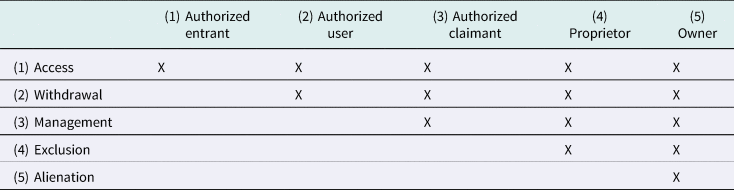
The first of Ostrom's (Reference Ostrom2003) five classes of property rights holders are authorized entrants, such as guests who only have access rights. Second, authorized users have access and withdrawal rights. However, those with exclusion and management authority may limit the timing, location, methodology, and amount authorized users can withdraw. Third, authorized claimants have access, withdrawal, and management rights. Fourth, proprietors have the right to access, withdraw, manage, and exclude but do not have alienation rights. Fifth, owners have all five property rights.
Rather than authorized entrants or users, Habraken (Reference Habraken1998) uses the term guests, where guests are agents admitted from higher levels of the territorial hierarchy. Guests, such as neighbours and foreigners, may be denied entry, and when allowed access, their use of the space is temporary. Once guests or people from included territories enter the public space, they can walk in public parks, enter public museums, and drive on public roads.
Habraken (Reference Habraken1998) adds that even though territorial control is the ability to exclude, it typically does not allow confinement. Agents have unrestricted freedom to exit, except during curfews or when they are in prison. The combined principles of selective entry and unrestricted exit mean people need permission to enter another person's home and additional permission to enter their bedroom but can freely move from the bedroom to the house and from the house to the street. Also, when higher-level agents limit what goes into their included territories, lower-level agents are expected to accept the limitations. For example, when owners do not allow pets, any pets renters have in their apartments are considered contraband.
People require limited management rights and access rights from those with those rights when pipes leak into neighbouring apartments or when they renovate their apartments and need utility access through adjacent units. Utility access from public areas and within apartments reduces the need for temporary management and access rights from neighbouring territories. From Buchanan and Tullock's (Reference Buchanan and Tullock1962) perspective, when people can repair and maintain their utilities and houses without needing management and access rights from neighbouring territories, repair and maintenance decisions change from collective to private choices.
Habraken (Reference Habraken1998) argues that direct horizontal relationships and contested boundaries are often sources of friction, instability, and unpredictability, while stable built environments avoid open and direct horizontal relations between live configurations.Footnote 4 As discussed above, to avoid conflict, people typically do not directly cross their shared territorial boundary into their neighbour's territory. They usually go up in the territorial hierarchy and then down again into an included territory, such as visiting a neighbour by going to the public street and then, if the neighbour grants entry, into their house. Utilities typically avoid horizontal relations by placing their public access on public streets and entering individual houses from the public access. The built environment also separates live configurations through formal separations such as walls or dividers, informal separations such as territorial markers, and social norms such as politeness, civility, and deference.
Sometimes, agents must share control of horizontal crossings, such as at international border crossings. People's desire to move quickly with few obstacles has created large-scale public spaces and reduced transaction costs (Habraken, Reference Habraken2021b). Examples of large-scale public spaces include highways, railroads, and unlocked city and neighbourhood gates. Having one worldwide jurisdiction with the same regulations, no barriers to trade, and firms directly distributing to households could also lower transaction costs. The disadvantage would be the loss of diversity and polycentric governance (Ostrom, Reference Ostrom1990).
Conclusion
To Design for environmental change, design methods based on Habraken's framework focus on designing buildings to offer a greater ability to accommodate change – both during the process of implementation (potentially reducing risk by giving the various parties greater decision-making flexibility) and during the extended life of the building (thus reducing the functional specificity of the asset). Increasing the capacity of a building's included spaces to change enables the building to accommodate various configurations, allowing lower-level configurations (for example, tenant spaces in office buildings or independent dwellings in an apartment building) to change without requiring changes to the higher-level (shared) configuration. While Habraken focuses on designing for change, Ostrom concentrates on stable and long-lasting commons governance. Ostrom's concept of long-term stability is at the commons level, similar to the importance of long-term stability that Open-Building stresses at the building and urban-structure levels. Both frameworks' design tools aim to create adaptable and self-organizing environments.
Habraken and Ostrom agree that a common understanding of rules, values, and themes is vital. Habraken's stress on having territorial clarity and controlling space is similar to Ostrom's stress on the importance of clear membership and territorial boundaries. Habraken's principle of working with the hierarchical structure of the built environment gives an alternative perspective to Ostrom's principle of polycentricity and hierarchically nested levels; according to his principle, disentangling the infill level from the base building gives agents on the lower levels greater freedom and capability to adapt and control their own environments. Habraken's principle of separating design tasks but conforming to the social structure is similar to Ostrom's subsidiarity principle, in which higher governance levels recognize the governance rights of lower levels.
What agents control and how they are involved are essential issues. Control of the physical environment is about transforming a built form. Territorial control is about the movement of things and governance of territory. Shared understanding is about agents' shared preferences in transforming objects, moving objects, and controlling territory.
The environment reflects the shared values of agents constrained by material, technical, social, and economic conditions. Both Ostrom and Habraken argue that agents can cooperate in organizing the shared environment with minimal external control. They also emphasize the importance of shared rules, meanings, and elements.
Habraken focuses on vertical and horizontal relations to improve cooperation and reduce conflict. In vertical relations, agents look upward to determine the constraints imposed by the higher level and how they limit agents' freedom to act on the elements under their control, and agents look downward in the hierarchy to consider what constraints agents' decisions will impose on the level below them. Habraken (Reference Habraken1998) writes that avoiding horizontal relations tends to reduce conflict.
Habraken (Reference Habraken1998) argues that integrating configurations (exerting unified control) reduces variation and diversity. Uniformity exists because a single agent controls several configurations, and conformity occurs when agents share patterns, types, or systems.
Future research on Open-Building can improve our understanding of creating and transforming natural and built environments. Research on relative public goods, different ways to design an environment to offer greater capacity to accommodate change, and the effect on diversity, resilience, and innovation of dividing or integrating configurations/domains may be especially beneficial.
Acknowledgements
The author thanks John Habraken, Stephen Kendall, Thijs Bax, Harry David, and Seminar Participants at the Public Choice Meetings for comments.



