INTRODUCTION
This article examines the violent conflicts between Aguleri and Umuleri communities in Anambra State, Nigeria. Aguleri and Umuleri are neighbours, belonging to the same ethno-liguistic group and claiming descent, by different pathways, from a common ancestor.Footnote 1 Nonetheless, they are regarded as different sub-groups of the larger Igbo ethnic group of south-eastern Nigeria (Afigbo Reference Afigbo1981; Idigo Reference Idigo1990).Footnote 2 Administratively, they are separate autonomous communities (Idigo Reference Idigo1990; AELGA 2007; ASG 1997). Protracted land struggles and perceived historical inequalities in access to social, economic and political resources – horizontal inequalities – have promoted a collective feeling of difference between the two groups, and this has erupted in spasmodic bloody conflicts.
On 30 September 1995 the two communities engaged in a bloodbath. The immediate cause of the confrontation was an attempt by Dan Ekwevi, an Umuleri man, to build a fuel-dispensing station on Aguleri land. To Aguleri, Ekwevi's action was a violation of the territorial integrity of Aguleri and must therefore be rebuffed, even violently. Four years later, on 3 April 1999, violence broke out again when Umuleri people set out to disrupt the funeral ceremony of Mike Edozie, the Aguleri man who, according to Umuleri, was the architect of the 1995 mayhem. This escalated to retaliatory assaults on Aguleri. There has been a long history of deadly skirmishes between the two disputing communities – destructive conflicts having occurred in 1920, 1934 and 1964 – but the 1999 episode marked a watershed in these conflicts because it was the bloodiest and most protracted. It became a war which dragged on for over three months, and the personal intervention of the newly elected president, Obasanjo, was necessary before the two sides agreed to suspend hostilities.
Several scholars have offered different explanations of conflicts in Africa and why they remain bloody and intractable. Most often, African conflicts are attributed to the termination of the Cold War and the advent of globalization; to sustained population growth amid ‘environmental scarcity’ (Kaplan Reference Kaplan1994; Homer-Dixon Reference Homer-Dixon1999); to violent youth culture (Richards Reference Richards1996); to democratic struggles (Ake Reference Ake2000); to group grievances (Stewart Reference Stewart2000); or to a struggle for resources by elites (Collier and Hoeffler Reference Collier and Hoeffler1996). These perspectives, combined with the economic crisis thesis at the national level, constitute the mainstream analytical scheme for understanding the proliferation of ethnic and communal conflicts in Nigeria (Osaghae Reference Osaghae1995; Egwu Reference Egwu and Nnoli1998; Jega Reference Jega2000; Obi Reference Obi2001; Yakubu et al. Reference Yakubu, Adegboye, Ubah and Dogo2005).
Assumptions of the economic crisis argument state that ethnic and communal conflicts thrive under conditions of economic crisis, poverty and structural adjustment. Jega (Reference Jega2000: 25) encapsulates the gist of the perspective:
Under conditions of economic crisis, and subsequently structural adjustment, there has been a swift decline in the ability of the state to provide for the basic socio-economic needs of the people. … Thus under these conditions, groups have tended to rely on identity-based politics to struggle for access to the state and the resources that it controls, in order to protest exclusion and oppression, as well as to demand basic rights and socio-economic provisioning.
Much as the connection between economic crisis, poverty and Nigeria's structural adjustment programme (SAP) helps to explain the causes of conflict, the analysis has its limitations. Its weakness lies in its failure ‘to explain why conflicts have arisen in some areas and are absent elsewhere even though there has been uniform implementation of SAP across the country’ (Ukiwo Reference Ukiwo2005: 17).
Some intervening variables such as inequality, which would have explained the differential occurrences of conflicts, have been interrogated inadequately or completely missed out. It is the perception of inequality rather than actual inequality that leads to violent action. ‘It is not so much deprivation or disadvantage’, notes Osaghae (Reference Osaghae1995: 13) ‘that engenders ethnic action, it is rather the prospects of advancement from them.’ Furthermore, Kofi Annan, former UN Secretary-General, contends that
Simple inequality between rich and poor is not enough to cause violent conflict. What is highly explosive is … horizontal inequality; when power and resources are unequally distributed between groups that are also differentiated in other ways – for instance by race, religion or language. So-called ‘ethnic’ conflicts occur between groups which are distinct in one or more of these ways, when one of them feels it is being discriminated against, or another enjoys privileges which it fears to lose. (Quoted in Østby Reference Østby2008: 143)
Yet the relevance of horizontal inequality in accounting for the multitude of ethnic and communal conflicts in Nigeria has been glossed over by scholars who sometimes assume, albeit erroneously, that inequality ‘is evident for all to see’ (Ukiwo Reference Ukiwo2005: 17).
This article highlights narratives of horizontal inequalities and how they provide impetus for Aguleri and Umuleri conflicts. Horizontal inequality refers to unequal access of culturally defined groups to economic and political resources. The article is organized as follows: the next section focuses on the interface of inequalities and conflicts. The third section provides a background to the conflicts under consideration. The fourth shows how horizontal inequalities can be applied usefully to analyse these communal conflicts. Other variables such as one group's perception of the ‘personality’ of another, and memories of war between them, are also considered before a conclusion draws the main points together and summarizes my findings.
The focus on Aguleri and Umuleri conflict has two main justifications. First, it departs from the tradition of studying so-called ‘indigene’ and ‘settler’ conflicts, which has characterized many studies of communal conflicts in Nigeria (Otite and Albert Reference Otite and Albert1999). Since both communities are indigenous groups, who speak the same language and share almost the same culture, analysing conflicts between them will definitely contribute new insights to the genre of communal conflicts. Second, the conflict has enjoyed a long history, marked by Christian missionary adventurism, European mercantilist interests, colonialism and contemporary post-colonial politics and administration. It therefore promises a rich history of colonially induced socio-political inequalities – consolidated by the post-colonial state – between the two feuding communities.
INEQUALITIES AND CONFLICTS
At least since de Tocqueville, scholarly debates have been focused on the relationship between inequalities and conflicts (de Tocqueville Reference de Tocqueville1954; Russett Reference Russett1964). Disagreements notwithstanding, all contributors to this debate share the view of inequality as linked in some way to political instability and social conflicts. Though interest in this link waned for a period (Cramer Reference Cramer2003), over the past few years increasing socio-economic inequalities between regions of the world, coupled with a corresponding increase in identity conflicts, have reignited interest in the phenomenon (Langer et al. Reference Langer, Mustapha and Stewart2009).Footnote 3 The result is the emergence of the greed and grievance hypotheses (Collier and Hoeffler Reference Collier and Hoeffler1996) and horizontal inequality as important frameworks for explaining the relationship between inequalities and conflicts.
The concept of horizontal inequality focuses on inequalities among groups rather than individuals or households, who display vertical inequality. The idea of horizontal inequality and its relationship with conflict was popularized by Frances Stewart. It identifies deprivation and unequal distribution of resources and opportunities along culturally defined group boundaries as important triggers of conflicts and wars (Stewart Reference Stewart2000). In this regard, Abner Cohen concludes:
Men may and do certainly joke about or ridicule the strange and bizarre customs of men from other ethnic groups, because these customs are different from their own. But they do not fight over such differences alone. When men do, on the other hand, fight across ethnic lines it is nearly always the case that they fight over some fundamental issues concerning the distribution and exercise of power, whether economic, political or both. (Cohen Reference Cohen1974: 94, quoted in Stewart Reference Stewart2000: 4)
Thus, horizontal inequalities have been held responsible for conflicts and civil wars in Brazil, Sri Lanka, Uganda and Côte d'Ivoire (Stewart Reference Stewart2000; Langer Reference Langer2004). Although studies of inequalities in post-colonial Nigeria highlight educational, economic, income and political inequalities particularly at the federal, regional and state levels (Ekeh and Osaghae Reference Ekeh and Osaghae1989; Suberu Reference Suberu2001; Mustapha Reference Mustapha2004), failure to link inequalities and communal tensions to the wider machination of the colonial state remains a major weakness of Nigerian studies.
Studies have also failed to differentiate between the ubiquitous ethnic conflicts and the more localized communal violence inspired by inequalities (Ukiwo Reference Ukiwo2009). Even though inequalities at federal and regional levels provide justification for ethnic conflicts, most of the more protracted and sanguinary communal conflicts – like the Ife–Modakeke and Aguleri–Umuleri examples – are motivated by perceptions of group inequalities at the local and state levels. Analysis of horizontal inequality and communal conflicts, which would have addressed these shortcomings, seems to be virtually non-existent.Footnote 4 Studies that connect the federal, state and local narratives of inequalities and communal conflicts in colonial and post-colonial Nigeria are therefore required.
Despite their attraction and relevance in understanding modern conflicts, studies of horizontal inequality tend to have serious limitations. They only provide insight into particular cases of conflict and are incapable of making generalizations about universal relationships between inequalities and conflicts, partly because of the frequent unavailability of data on group inequalities. Where data exist, they are likely to be inaccurate (Østby Reference Østby2008; Murshed and Tadjoeddin Reference Murshed and Tadjoeddin2009). Moreover, the studies cannot explain why some societies, despite experiencing situations that might be thought to predispose them to conflict, manage to avoid it. It would appear that there is no linear relationship between horizontal inequalities and conflicts – and, where a relationship exists at all, there are always intervening variables accounting for conflicts.
Hence it is important to emphasize both horizontal inequalities and the contexts in which they can transform into conflicts. But caution should be exercised in relying on group inequality data, which, for most developing countries, are generally considered to be inaccurate and the result of the mechanistic neo-classical econometrics applied to process the data. It therefore makes sense to incorporate the more realistic and humanistic political economy and history of group inequality into studies of horizontal inequality and conflict. That is the primary ambition of this article. It argues that historically established social relations that lie behind observable manifestations of inequality are critical in understanding the consequences of inequality and the causes of conflicts. The article explores how historical narratives of horizontal inequalities, memories of previous violent conflicts, and the perception of the personality constitution of Aguleri have promoted Aguleri–Umuleri conflicts. Umuleri memories of previous wars and its perception of Aguleri as impetuous and aggressive are identified as intervening variables.
BACKGROUND TO THE CONFLICTS
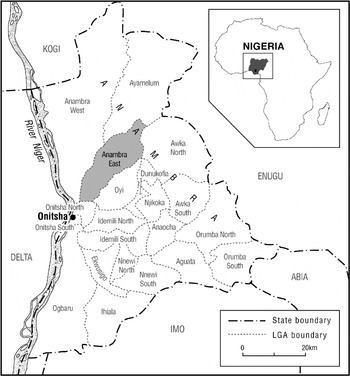
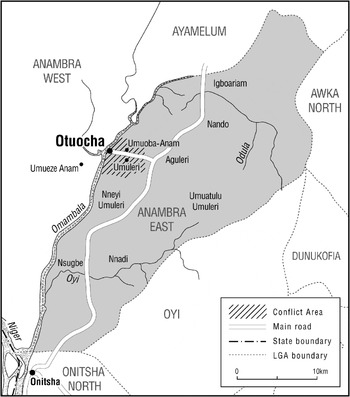
Aguleri and Umuleri originated from a common ancestor, Eri (Jeffreys Reference Jeffreys1956), and constitute sub-groups of the ‘Umueri tribe’ (Afigbo Reference Afigbo1981). The colonial administration grouped each of the communities as autonomous towns within Onitsha Division; presently they still exist as separate autonomous communities located in Anambra East Local Government Area (AELGA) with headquarters in Otuocha, Anambra State (see Figures 1 and 2).Footnote 5 Neither of the communities is a ‘settler’, although each, in its narratives, attempts to distort its account of the myth of origin to present itself as ‘indigene’ and the other as ‘settler’.Footnote 6
Anambra East Local Government Area, a part of Anambra State

Otuocha, Umuoba-Anam, Aguleri and Umuleri communities

In the late nineteenth century, European Christian missionaries, merchant companies and British colonial authorities made inroads into the communities. Otuocha, a riverine territory owned by both communities, provided settlement for the foreigners. Proximity to the Anambra River,Footnote 7 a tributary of the Niger, made Otuocha both an entry port for European Christian missionaries from nearby Onitsha – the trading centre that set the commercial heartbeat of south-eastern Nigeria – and an attractive entrepôt for British and French mercantile companies like the Royal Niger Company, John Holt and Compagnie Française de L'Afrique Occidentale (CFAO). After a punitive attack on Aguleri and Umuleri in 1892, the Royal Niger Company resumed cordial relations with the communities (Isichei Reference Isichei1976; Idigo Reference Idigo1990).Footnote 8 Later, in 1900, Britain established colonial administration in Otuocha, Aguleri and Umuleri. New institutions were erected and new rules and regulations guiding political, commercial and social relations were enacted. Intensive missionary and trading activities urbanized the hitherto rustic settlement of Otuocha and further attracted local migrants from neighbouring Igbo communities like Umuoba-Anam and distant Hausa, Nupe and Yoruba groups who eagerly desired land in order to settle and trade in Otuocha.Footnote 9
These developments had severe consequences for Otuocha as well as Aguleri–Umuleri relations. First, Christian missionary activities which ensured unequal distribution and access to educational institutions laid the foundations of future horizontal inequalities between Aguleri and Umuleri, especially in the provision and acquisition of Western education and social amenities. Second, growing migration and urbanization instigated by trading and missionary activities placed increasing demands on Otuocha land. The missionaries needed land to build schools and churches to educate and evangelize the local population; European companies required more land to establish trading posts; local migrants requested land to settle on in order to trade and enjoy the peaceful and cosmopolitan lifestyle in Otuocha; and the colonial authorities sought to establish unquestionable control over all lands in Otuocha. Third, as in most agrarian societies, land and communities in Igboland are interwoven. Apart from its relevance to agrarian production, land is linked to identity as it binds the living to the dead and unborn members of the group. Emotional attachment to land is intensified by the scarcity of land that characterizes most Igbo communities (Afigbo Reference Afigbo1981), including Aguleri and Umuleri. With rapid urbanization, modernization and a British colonial land policy that promoted land privatization and commercialization against communal ownership, land increasingly acquired monetary value and conferred immense wealth and power on its owner under both colonial and post-colonial dispensations. Ownership, control and access to Otuocha land translated into improvement in the everyday lives and opportunities of individuals and their communities. Under these circumstances, an intense struggle for Otuocha land escalated among the emerging and growing number of land speculators, on the one hand, and between Aguleri and Umuleri communities on the other.
HORIZONTAL INEQUALITIES AND CONFLICTS
Although land is a major cause of the dispute, horizontal inequalities have deepened existing rifts and protracted the conflict. Narratives of horizontal inequalities are drawn from the history of missionary adventures and unequal access to Otuocha land, which further influenced access to political and employment opportunities, including basic social services, in the embattled communities during the colonial and post-colonial periods.
Aguleri pre-eminence is attributable to its early acceptance of Christianity and acquisition of missionary education. Onyekomeli Idigo, the forebear of the Idigo dynasty, personally invited Roman Catholic missionaries to Aguleri (Idigo Reference Idigo1990). In doing so, he offered his subjects a rare opportunity; Aguleri hosted the first church and educational institutions established by the missionaries in the territory. These institutions produced Aguleri elites like Raphael Idigo, Matthew Eziagulu, Iwene Tansi and Chinwuba. Skilled in written and spoken English, they became active in the missionary and colonial public service. After a stint in the civil service, Idigo became a Warrant Chief, whose area of jurisdiction included Umuleri; Tansi trained as a clergyman;Footnote 10 Chinwuba earned a degree in law from Britain; and Eziagulu represented Aguleri in Otuocha land litigations. In addition to exhibiting British mannerisms, these personalities were at home with colonial bureaucratic niceties, which they deployed in their relations with colonial administrators and in currying official favour. Umuleri had no such calibre of men.
Partly because of Idigo's friendly attitude and the positive mien of Aguleri to the missionaries, the bulk of missionary activities and projects were concentrated in Aguleri. Beyond inviting the Roman Catholic missionaries to Aguleri, Idigo and his family members embraced Christianity, having renounced traditional worship and Idigo's position as ‘the priest of Aroh, a deity which drives off the old year and announces the appearance of the new year’ (Idigo Reference Idigo1990: 17). Thereafter, Idigo granted a piece of land to the missionaries to settle in Aguleri. Inspired by this gesture, the missionaries established a settlement for the new converts which also became a haven for Aguleris fleeing from Ada headhunters and slave raiders from Ohafia and Abam in present-day Ebonyi State.Footnote 11 This prompted a spate of Aguleri conversion to Christianity, establishment of churches, educational institutions and infrastructure in Aguleri (Idigo Reference Idigo1990).
As a result, missionary education came later to Umuleri than to its neighbour. Umuleri leaders, for a long time, were drawn from elders and chiefs with minimal education, who lacked knowledge of the workings of the colonial civil service and barely understood the mindset and temperament of British colonizers. Adegunle Soetan, Umuleri counsel, drew attention to this fact when he declared:
The people of Aguleri had an advantage over the people of Umuleri, that is to say the privilege of early contact with the Roman Catholic Church Missionary Fathers who settled early in Aguleri, and so they were more or less educated while the people of Umuleri are illiterates and uneducated … Idigo is highly educated and … imbibed a great deal of Western civilization.Footnote 12
Umuleri had little access to public offices and political positions, and possessed no more than a slight understanding of administrative procedures and British etiquette.
Anglo–Umuleri relations deteriorated rapidly as Umuleri was always on a collision course with colonial officials. A good example was the case of M. E. Amete. Amete was Umuleri member of Umuigwedo Native Court of Appeal in the Onitsha District. His community appointed him secretary of the Umuleri Emergency Front, which championed the struggles of the community to claim ownership of Otuocha land. On behalf of his community, he petitioned the District Officer in 1950. Paragraph 6 of the petition stated that ‘in the event of unnecessary delay, continued mistake, or refusal to take appropriate actions, we shall not be held responsible for any unpleasant action we may be compelled to take’. The wording of the paragraph was interpreted by the District Officer as constituting a serious threat to the colonial authorities. Noting that Amete's conduct was ‘unbecoming of a member of the Native Court’, the District Officer accused Amete of addressing him in an ‘irresponsible language’ and threatened to strip him of his post. To retain his privileged position, Amete quickly apologized to the authorities and thereafter isolated himself from the struggles of his community.Footnote 13
Education not only fostered the hegemony of Idigo and Aguleri in Aguleri–Umuleri relations, but also gave Aguleri undue advantage over Umuleri in filling employment opportunities. In 1910, when Idigo became Warrant Chief, he relied on his exalted position and rapport with colonial officials to facilitate the appointment of many Aguleri to respectable positions in the Native Administration – a partisan service to his own community that earned him hatred among Umuleri members of the Native Administration.Footnote 14 In 1942, his excesses were reported to the District Officer, who conceded that ‘Idigo and his kind did secure for his families and friends most of the job openings’, but observed that ‘that sort of thing has gone, I hope, for all time’.Footnote 15 Idigo was neither investigated nor cautioned. As some Aguleri have argued, Idigo may have extended certain favours to Umuleri, considering that some of his ‘friends’, in-laws and relatives were from Umuleri where he took a wife.Footnote 16
Also, Aguleri contends that the appointment of Ebenezer Agbata as the first Chairman of Anambra County Council in 1963 was an indication of the fact that Umuleri, despite Aguleri advances, had its own fair share of employment opportunities and appointments to top political positions. With new forms of democratic governance in post-colonial Nigeria, the post of a county chief executive was no mean position. The occupant controlled enormous clout in government and could determine who got government jobs, contracts and social infrastructure. In the words of Ike Manafa, the Iyasere of Aguleri, ‘Agbata was not an exception as he was instrumental in securing job placements to many Umuleri during his tenure.’
At the onset of colonialism, colonial officials favoured land privatization and commercialization. By the beginning of the twentieth century, however, they reverted to communal ownership of land following the adoption of the indirect rule policy (Phillips Reference Phillips1989; Mbajekwe Reference Mbajekwe and Falola2002). Even so, Warrant Chiefs and traditional leaders, instead of families and communities, became key figures in managing and administering land. Emphasis on communal ownership of land as conceived by the British remained in force until the demise of colonial rule in 1960. In a meeting with Aguleri councillors in 1954, the Onitsha District Officer reiterated the colonial land policy, stating that ‘in accordance with the instrument and Local Government Ordinance, all powers for transaction in all alienation of Aguleri lands is vested in the chiefs and elders of Aguleri and that the council members, land owners and Aguleri electorate shall have no say in alienation of Aguleri lands’.Footnote 17
Idigo, indeed, extended his control beyond Aguleri to the disputed Otuocha land. On behalf of Aguleri, he secured approval of colonial officials to sell and grant Otuocha land to European companies even though ownership of the land was the subject of litigation. Between 1924 and 1932, Aguleri sold or leased portions of Otuocha land to the Royal Niger Company, John Holt and CFAO, and appropriated rents accruing to them.Footnote 18 Umuleri enjoyed no such favour. It was denied access to the land and barred from engaging in any transaction involving Otuocha land. Aguleri emerged from each land transaction richer and able to finance the numerous court cases over land.
In any case, the financial implication of the leases and grants was not lost on Umuleri. Establishing the link between unequal access to the land, rents and the disputes, Adegunle Soetan, in his petition to the authorities, asserted that ‘it is repugnant to the feelings of your petitioners that their erstwhile customary tenants, namely the Eziagulu people of Aguleri, through the influence of Idigo should enrich themselves with proceeds of leases improperly granted to European firms’.Footnote 19 Umuleri felt frustrated that it could not have unrestrained access to Otuocha land while Aguleri grew richer and stronger from rents accruing to its leases of this land.
Aguleri has dismissed Umuleri claims to Otuocha land as frivolous. The etymology of Otuocha as rendered by Aguleri seems to remove every shade of doubt about its ownership of Otuocha. According to an Aguleri interviewee, ‘Otuocha is derived from the words ‘Otu’ and ‘Ocha’, meaning ‘waterside’ or ‘beach’ and ‘white’ in the local language respectively. He notes that
Otuocha means ‘white (man) beach’. It was the Father of Eze Idigo I of Aguleri [Onyekomeli], the first man to meet with the white men on the banks of the river [Anambra] that named the territory Otuocha because the beach served as the first port of entry by the Europeans to the territory. (Elder, Aguleri community)
The Umuleri version argues that Otuocha ‘is a misnomer, the right name being “Otuoche” ’.Footnote 20 Umuleri asserts that Otuoche is derived from two words ‘Otu’, meaning waterside and ‘Oche’, abbreviated from Onyeche of Umuleri, who lived in Otuocha prior to the arrival of the Royal Niger Company. Otuoche simply means ‘Onyeche waterside’ but was corrupted by the Europeans who mispronounced it as ‘Otuocha’.
In spite of these unresolved controversies, colonial authorities officially treated the disputed land as if it was owned solely by Aguleri. This was manifested in both words and actions. Colonial administrators inscribed ‘Otuocha Aguleri’ rather than ‘Otuocha’ on milestones indicating mileages to Otuocha and billboards showing locations of important establishments such as the Royal Niger Company, John Holt, CFAO, the Post Office and the Native Authority Dispensary in Otuocha. Otuocha was also presented in official correspondence as an Aguleri possession. S. P. L. Beaumont, Acting Resident Officer of Onitsha Province, described Otuocha as ‘Otuocha, the Aguleri waterside town’.Footnote 21 For Umuleri, such a comment not only reflected the mindset of the colonial government on Otuocha but clearly amounted to bequeathing Otuocha to Aguleri.
In all, Aguleri interviewees accept the fact that its first contact with the missionaries and Western education placed it in a privileged position, but deny using such advantages to oppress Umuleri. They maintain that Aguleri merely used historical accidents and opportunities to its advantage. Umuleri, they argue, would have done the same, if not worse, had it been exposed to similar opportunities and advantages. Furthermore, they do not judge the actions of their leaders as entirely driven by the need to promote the collective interest of Aguleri. Making reference to particular cases, some of which have been highlighted earlier, they argue that the actions of leaders like Idigo were primarily motivated by self-interest. In 1940, some Aguleri elites led by Agbalaka accused Idigo of financial corruption and proceeded to institute legal action against him.Footnote 22 It is thus unfair to perceive all actions of Aguleri leaders as representing the aspirations of the community, and then proceed to condemn Aguleri as oppressive.
The fortunes of Umuleri have not changed much even in the post-colonial epoch. In spite of the higher population figures and school enrolment estimates for Umuleri, educational facilities are better provided in Aguleri than in Umuleri. While the projected population figure for Aguleri is 12,716, Umuleri's is 14,883 (AELGA 2007: 17).Footnote 23 Similarly, estimates of primary school enrolment are 3,126 and 3,026 pupils for Umuleri and Aguleri respectively (ibid.: 33). Yet there are 12 primary schools in Aguleri and 10 in Umuleri. Although the communities have three secondary schools each, Umuleri schools are the product of communal development efforts.Footnote 24 Communal development initiatives are common among Igbo communities; nevertheless, Umuleri has seized such initiatives to reduce inequalities and the social infrastructural gap existing between it and Aguleri.
In the realm of politics, Umuleri remains an underdog in any political calculation involving Aguleri. In 1964, Paul Ndigwe, an Aguleri, who represented both communities in the Eastern Regional House of Assembly, obtained government authority to change the official name of Otuocha to ‘Otuocha Aguleri’ (Chinwuba Reference Chinwuba1981). Umuleri detested this government action, which tactically confirmed Aguleri as the owner of the disputed land. More annoying was the fact that the opinion of Umuleri was neither sought nor consulted in taking the decision. Umuleri therefore violently protested against the change of nomenclature. It attacked Aguleri and pulled down billboards and milestones which bore ‘Otuocha Aguleri’ on them (Chinwuba Reference Chinwuba1981).
Since the local government reforms introduced by Obasanjo in 1976 and the subsequent creation of local government areas, specifically Anambra Local Government, Umuleri is yet to produce a local government chairman. Aguleri has held the post during four separate periods.Footnote 25 Generally in Africa, occupation of executive political positions is important for dispensing patronage and favours to networks of clients, often bound together by communal and primordial affinities (Joseph Reference Joseph1991). The more-privileged Aguleri elites have been considerably favoured over their less-privileged Umuleri counterparts. Besides prioritizing Aguleri interests, most Aguleri political appointees have acted like Ndigwe by taking advantage of their powerful positions in government to embark on actions that jeopardize Umuleri aspirations.
Allegations of political marginalization by Umuleri have received strong condemnation from Aguleri. Aguleri sees itself as having suffered greater injustice and political marginalization than Umuleri, especially in the delineation of electoral wards and allotment of councillorship positions in the local government council. Because allotment of political wards derives mainly from official population figures, Aguleri believes that given accurate population figures it should have been allotted a greater number of wards than Umuleri. Unfortunately this is not the case; both communities have three wards respectively. Short of blaming Umuleri for what it considers a gross underestimation of its population in the 1991 census, Aguleri, however, contends that Umuleri has benefited from the situation. Assigning equal numbers of wards to Aguleri and the less-populated – by Aguleri judgment – Umuleri amounted to deprivation and injustice.
That is not all. The White Paper on the Moses Nweje Judicial Commission of Inquiry mandated by the Anambra State government to investigate the 1995 Aguleri–Umuleri disturbances put the blame on Mike Edozie, an Aguleri and chairman of the Anambra Local Government Caretaker Committee. The Paper observed:
Government strongly deprecates the role of Chief Mike Edozie, who failed to take advantage of his mother hailing from Umuleri and his father from Aguleri to procure intelligence that would have averted the conflict. As a public officer of the Local Government Area he betrayed the trust reposed on him by his various acts of omission and commission. (Anambra State Government 1997: 7)
The violent disturbances began when Dan Ekwevi, an Umuleri man, attempted to erect a petrol-dispensing station on a portion of land he bought from a fellow Umuleri, named Nguka, who had earlier bought the land from Ikeli, an Aguleri. It should be noted that the controversial portion of land is not located in the contested Otuocha land; in fact, they are several metres apart.
Having purchased the land outright from Nguka, Ekwevi was its legal owner. However, several years of bitter land struggles have left an unwritten but strictly observed rule in land relations between indigenes of the two communities. The rule frowns at any form of land transaction between Aguleri and Umuleri, be it usufruct, outright sale or purchase of lands in the communities.Footnote 26 This rule was flouted in the first transaction involving Nguka and Ikeli. But so long as the land remained undeveloped the breach went unnoticed, and peace reigned until Ekwevi took ownership of the land and began to develop it. Moreover, Ekwevi's actions came on the heels of bitter altercations over attempts by Aguleri to site development projects on the disputed land (ibid. 1997). In this context, the steps taken by Ekwevi, although on a separate plot of land, ignited violence (ibid.). Aguleri resented what it felt was a contravention of the unwritten rule and an unwarranted interference in Aguleri territory by Ekwevi. Swiftly, Aguleri youths stormed the construction site, attacked the builders, and later engaged Umuleri youths in a fight that soon engulfed the two communities.
Much as the Commission found Edozie culpable, it stipulated no specific punishment for him. The state government then directed that Edozie be ‘severely rebuked for his actions’ (ibid.). But the government refrained from specifying what that meant in practical terms, thus fuelling speculations of conspiracy between Aguleri and the government against Umuleri. Arguing that ‘it was not a mere coincidence that the Aguleri invasions of Umuleri (1995 and 1999) were hatched and executed at the time when Aguleri men were Chairman or Deputy Chairman of the Local Government’, the Umuleri General Assembly identified the well-entrenched Aguleri interest in government circles as responsible for the non-implementation of the state government's White Paper (Umuleri General Assembly 2000).
In 1999, Umuleri launched a violent attack on Aguleri. Although Umuleri suffered defeat in the 1995 crisis, it saw the Nweje Commission Report and the resultant recommendations of the White Paper as victory on its part. Despite this, the state government demonstrated little or no interest in implementing the recommendations. In addition, Umuleri was not in haste to forgive or forget Edozie who, instead of using his position as the Chief Executive Officer of AELGA to avert the 1995 disturbances, tacitly supported his Aguleri kinsmen against Umuleri. It therefore desperately sought for an opportunity to take vengeance on Edozie and Aguleri. The opportunity came with the death of Edozie. As Aguleri prepared to bury him, Umuleri youths attacked sympathizers and mourners attending the funeral night vigil in his honour. The official record of properties destroyed in the 1999 confrontations was not made publicFootnote 27 but the Nweje Report put the estimate of public buildings and properties lost to the 1995 crisis at 250 million naira, while damage to privately owned properties and buildings reached billions of naira. Some of the properties destroyed were identified as Umuleri Community Bank, Umuleri Post Office and Our Lady of Victory Church, Umuleri.Footnote 28
While Umuleri condemned the Anambra State government for failing to implement its own White Paper, Aguleri bitterly contested the submissions of the Nweje Report and the White Paper that proceeded from it, insisting that the Commission ‘was very biased in its findings and recommendations in favour of Umuleri’.Footnote 29 Aguleri summarized its position this way:
the key point of our case is that the disturbances erupted because of the illegal activities of Umuleri people and in particular one Dan Ekwevi who was constructing a petrol filling station on a land belonging to the Eziagulu people of Aguleri and that his thugs fired guns at Aguleri people who went to find out why.Footnote 30
In a protest letter to the Anambra State government secretary, Ike Chinwuba, as Aguleri legal counsel, stated that the Report was ‘not the true representation of what happened at the Commission of Inquiry’.Footnote 31 Chinwuba threatened to take the matter to court if government failed to review the decisions of the panel. In 1998 Aguleri instituted a court action against the Anambra State government. This further compounded the dilemma of the government on what to do with its White Paper.
The complicity of the colonial and the post-colonial governments, their policies and agents in many communal conflicts has been noted by Agbese (Reference Agbese, Mbaku, and Mwangi2001) and Onwuzuruigbo (Reference Onwuzuruigbo2009). Ake (Reference Ake1985) and Joseph (Reference Joseph1991) identify ‘limited autonomy’ as a unique feature of the state in Africa. Lack of autonomy weakens the state capacity to mediate conflicts in Nigeria. Joseph attributes this lack of autonomy to the fact that the state is a ‘magnet for all facets of political and economic life, consuming the attention of traders, contractors, builders, farmers, traditional rulers, teachers, as much as that of politicians or politically motivated individuals in the usual senses of these terms’ (Joseph Reference Joseph1991: 1). Rather than mitigating conflicts, the state is itself enmeshed in them. Under the circumstances, communal conflicts remain intractable, and the state maintains an unenviable record of poor management of conflicts within its borders.
Put together, the 1995 and 1999 episodes are both reflection and culmination of the longstanding tradition of unequal access to education, Otuocha land, and political positions in Aguleri and Umuleri relations. Certainly, these inequalities are not fundamental causes of the conflict – which have been identified as internecine struggles for land – but it is clear that they have featured strongly as critical issues in the conflicts, simultaneously feeding and prolonging them. They also represent a strong indictment of the colonial authorities and the post-colonial Nigerian state in perpetuating inequalities and disruptive conflicts in Aguleri and Umuleri. Beyond the increasing presence of horizontal inequalities, there are other factors such as how the Aguleri people are perceived and painful memories of previous violent encounters impinging on the interface of horizontal inequalities and conflicts in Aguleri and Umuleri relations. By providing platforms for mobilization and violent engagement, these factors ensure the sustenance and intractability of the conflicts.
PERSONALITY PERCEPTION AND MEMORIES OF WAR
Groups respond to their objective situations in diverse ways. For example, studies have attributed outcomes of ethnic relations in Calabar to the ‘peaceful nature’ of Calabar people and the accommodative character of the dominant Efik group (Ukiwo Reference Ukiwo2009). Also, ‘inferiors revolt in order that they may be equal and equals that they may be superior’ (a proposition discussed in Sigelman and Simpson Reference Sigelman and Simpson1977: 106). It is not only resentment on the part of the deprived and weak that ignites conflicts. The relatively privileged may attack the less privileged for fear that the latter may agitate for balanced or even greater opportunities.
The perception of Aguleri as aggressive, brave and warrior-like is considered as a relevant factor in the conflict. This impression of Aguleri has been formulated in Nzekwu's (Reference Nzekwu1964: 75) description of Aguleri as:
the land of boastful people who, though slow to decide on a course of action, are unwavering in their decisions; a land of industrious … skilled acrobatic dancers and fine wrestlers … wrestlers are fattened to add weight so as to make it difficult for their opponents lift them off the ground.
Indeed, as Isichei (Reference Isichei1976: 163) asserted, the Aguleri monarch, Onyekomeli Idigo, was the only local leader in the area who displayed the rare courage of meeting with officials of the National African Company – later the Royal Niger Company – in 1884, when they first arrived at Otuocha. Other leaders took to their heels on sighting or hearing news of the presence of the Europeans in their communities (Idigo Reference Idigo1990). Umuleri further harped on these stereotypes, labelling Aguleri as ‘envious, belligerent and greedy’ while portraying themselves as ‘hardworking, peaceful and law-abiding’.Footnote 32 These qualities of Aguleri are strongly believed by Umuleri to be instrumental in sustaining the conflict and are also seen as responsible for the involvement of Aguleri in several land conflicts with other neighbours such as the Umuoba-Anam and Obale communities in Kogi State (ibid.; Ibeanu Reference Ibeanu and Imobighe2003). Although such stereotypes and prejudices are common enough between rival groups, they help to shed light on some of the maze-like recurring intricacies of the conflicts.
Aguleri leaders do not share the opinions that Umuleri and other commentators like Nzekwu seem to hold about them. They see themselves as peace-loving people, living in the midst of land-hungry and hostile neighbours like Umuleri. Consequently, Aguleri over the years has equipped and prepared itself to ward off external aggressors or land-hungry marauders intruding into its territorial space. It is this state of perpetual preparedness for the inevitable external aggression that critics of Aguleri describe as brutal, ruthless and headstrong. As Egwuchi Iwawba, the Akum of Aguleri, sees it, ‘we are neither violent nor aggressive; we are lovers of peace surrounded by hostile neighbours. We fight only to protect ourselves from the aggression of Umuleri.’ Pointing to the 1932, l964, 1999 – and to some extent the 1995 – rounds of bloody confrontation, Aguleri leaders emphasized the persistence of Umuleri belligerence against Aguleri.
The other factor has to do with bitter memories of previous violent encounters between the communities. Although this approach is not as popular as the emphasis on rival perceptions, there have been efforts to explain the nascent proliferation of ethnic and communal conflicts in terms of age-old rivalries and hatred aggravated by narratives of atrocities perpetrated during past violent conflicts (Agbese Reference Agbese, Mbaku, and Mwangi2001). To understand the conflicts we need to take into consideration past episodes of devastating violence that have occurred in the communities and how they are recreated and sustained in the memories of men and women who were active participants in previous conflicts, and their formative influence on those not even born at the time of earlier crises.
Women bear the burden of wars and crises more painfully than men; they are the ones who get raped, and lose their children and husbands in wars. Declich's study of gender and memories of war violence in Somalia offers insight into the ‘divergent and gendered effects of the experience of war violence on the memories of people's lives’ (2001: 165). The burden of women during the 1999 clash was complicated by the existence of marriage relationships between indigenes of Aguleri and Umuleri. The two communities have a long-standing tradition of marrying among themselves. Many interviewees confirmed that most mothers and wives of Aguleri men are indigenes of Umuleri, just as many women who are mothers and wives in Umuleri come from Aguleri. At the height of the crises, these categories of women were accused by their husbands’ kinsmen of divulging vital security information to their parents, brothers and relatives in either Aguleri or Umuleri. Consequently, they were viewed and treated as saboteurs. To discourage their alleged sabotaging activities and regain the confidence of their husbands’ kinsmen, the women were compelled to take a traditional oath of secrecy irrespective of their religious persuasion.
There were also allegations of abduction of women. The aim of the abduction was to break their marriages, for, according to Fagbemi and Nwankwo (Reference Fagbemi and Nwankwo2002: 63), they were ‘subjected to ritual oaths meant to bind them from returning to their marriages’. Apart from these ill-treatments, there were threats to the lives of many women still living with their spouses in such marriages. An Aguleri women's leader whose natal home is Umuleri noted:
It was a trying moment for us. I mean for some us from Umuleri but married in Aguleri. We were put under a lot of pressure to take ritual oaths by our husbands. It was a horrible experience but some of the women took it [the ritual oath] even against their will.
Yet women sustain the tempo of the conflict through recounting and narrating these painful experiences of previous bloody confrontations between Aguleri and Umuleri to their children. Women were fond of narrating and recounting their harrowing experiences painstakingly and diligently to their children (see Onwuzuruigbo Reference Onwuzuruigbo2007). The ritualization of war narratives around dates, events and persons undoubtedly increases the propensity and intensity of the war. ‘Look at that house’ (pointing to the vandalized and burnt part of the family house). ‘It was burnt during the crisis’, stated a female interviewee from Umuleri who also lost her husband in the crisis. ‘At this my age is it possible for me to build another house? My children must be told what happened to it.’ While memories of war, in the case of Somalia, for instance, are embedded in the cultural archive and historical narratives through several songs rendered strictly in the ‘feminine context of girls’ initiations’ (Declich Reference Declich, Schmidt and Schroder2001: 170), here memories of war violence are embedded and conveyed through narrative discourses and almost ritualized explanatory schemes suggesting that warlike actions should avenge previous violent acts. Having suffered greater devastation and destruction from previous and present confrontations, Umuleri, in plotting revenge, appears to have adopted this method, wittingly or unwittingly: repeated accounts of the ruination of Umuleri are amplified and used as a platform for mobilization.
Even when they are not articulated, memories of war are always deposited in a group's social memory and cultural archive. Lindgren (Reference Lindgren and Richards2005: 165) notes that ‘when people narrate experiences in the present, they do not only recall information, they engage in meaning-making practice where individual experiences are connected to larger political and economic process’. Telling and retelling emotionally charged experiences of war and violence help in depositing such narratives in the individual's social memory. Above all, it also serves, in this case, as a constant reminder of the viciousness of the enemy and the destructive character of the war. But individuals share their memories with others, and over time they emerge as a standardized collective memory within the cultural archive of a group. Such collective memories, histories and cultural archives are often regarded as tokens of communal and ethnic identity. In times of tension and crisis, collective memories and history, drawn from the cultural archive, provide justification for engaging in violent actions.
CONCLUSION
This study has drawn attention to the relative neglect of horizontal inequalities in understanding and explaining communal conflicts in Nigeria. Yet the underlying causes of many intractable bloody conflicts among and between communities are connected to unequal access to political and administrative positions, education and job opportunities, social amenities and infrastructure, some of which have historical roots in the colonial era and continued well into the post-colonial dispensation (Ukiwo Reference Ukiwo2009). As Stewart has observed, when inequalities cut across culturally defined borders they become powerful tools of mobilization for group conflicts (Stewart Reference Stewart2000). Nonetheless, the attraction of horizontal inequality as a framework for conflicts has limitations: first, it is incapable of making generalizations about a universal relationship between horizontal inequalities and conflicts; and, second, it is often mediated by extraneous factors.
Conflict studies applying the horizontal inequality perspective are often limited to case studies (Stewart Reference Stewart2000; Langer Reference Langer2004). In Nigeria, the few but recent studies of horizontal inequalities prefer to highlight historical narratives of the nexus between inequalities and specific cases of conflicts rather than the mechanistic econometrics applied to the study of group inequalities by economists (Stewart Reference Stewart2000; Ukiwo Reference Ukiwo2006). This way, the studies are able to project the more realistic and humanistic political economy and history of group inequality and conflicts. They are also able to identify the context in which extraneous factors intrude on the interface of horizontal inequalities and conflict (Harneit-Sievers Reference Harneit-Sievers2002; Ukiwo Reference Ukiwo2006).
Ukiwo (Reference Ukiwo2009), for instance, identifies ‘homeland’ discourse as interfering in the context of inequalities and violent group mobilization involving communal and ethnic groups in Calabar and Warri. He notes:
whereas the Efik claim ‘senior brother’ status to the Qua and Efut (in the case of Calabar), the Itsekiri justify their pre-eminence on their position as ‘overlord’ to Urhobo and Ijaw ‘enclaves’ in Warri. It is not surprising therefore that while the ‘senior brother’ accepted inclusive frameworks that guaranteed his position as primus inter pares, the ‘overlord’ insisted on exclusive frameworks. The ‘overlord’ contests the rights of ‘settlers’ to recognition but the ‘senior brothers’ accept the right of the ‘younger brothers’ to the common patrimony.
In the conflict under study, Umuleri identifies the more aggressive and warrior spirit of Aguleri as providing the context of conflicts in which Aguleri seeks to maintain its dominance over Umuleri. For its part Umuleri seems to be propelled by memories of previous conflicts in which it has incurred severe losses and devastation in contesting Aguleri overlordship. Whichever way, these are critical factors that compound the interface of horizontal inequalities and recurring bloody conflicts between Aguleri and Umuleri.
ACKNOWLEDGEMENT
Special thanks go to the editors and the two anonymous reviewers of this journal, whose comments on the earlier version of the article improved its overall quality. I remain grateful to Professor U. Isiugo-Abanihe for giving me a space in which to express myself.