Introduction
Exaggerated reactivity to uncertain threat (U-threat) has emerged as a key individual difference factor related to psychopathology (Grillon et al. Reference Grillon, Pine, Lissek, Rabin, Bonne and Vythilingam2009; Grupe & Nitschke, Reference Grupe and Nitschke2013; Shankman et al. Reference Shankman, Nelson, Sarapas, Robison-Andrew, Campbell, Altman, McGowan, Katz and Gorka2013). Broadly, uncertainty about future threats diminishes our ability to avoid danger or prepare for its impact, resulting in increased anxiety (Grupe & Nitschke, Reference Grupe and Nitschke2013). When confronted with a U-threat, individuals experience a generalized feeling of apprehension and hypervigilance that is not associated with a clearly identifiable source, referred to as anticipatory anxiety (Barlow, Reference Barlow2000; Davis et al. Reference Davis, Walker, Miles and Grillon2010). This is in contrast with certain, or predictable threat (P-threat), which is signaled by a discrete cue and elicits a phasic response to an identifiable stimulus that is time-locked to the threat, referred to as fear (Barlow, Reference Barlow2000; Davis et al. Reference Davis, Walker, Miles and Grillon2010). P- and U-threat therefore elicit distinct aversive states that are mediated by overlapping, but separable neural circuits (Davis, Reference Davis2006; Alvarez et al. Reference Alvarez, Chen, Bodurka, Kaplan and Grillon2011; Grillon et al. Reference Grillon, Heller, Hirschhorn, Kling, Pine, Schulkin and Vythilingam2011).
Although U-threat is universally appraised as more aversive than P-threat (D'Amato, Reference D'Amato1974; Lejuez et al. Reference Lejuez, Eifert, Zvolensky and Richards2000), individuals differ in their response to uncertainty due to the degree in which individuals can tolerate the salience of unknown information (Carleton, Reference Carleton2016a ). This response style is also related to several psychiatric disorders (Grupe & Nitschke, Reference Grupe and Nitschke2013); specifically, panic disorder (Carleton et al. Reference Carleton, Fetzner, Hackl and McEvoy2013), social anxiety disorder (Boelen & Reijntjes, Reference Boelen and Reijntjes2009), obsessive -compulsive disorder (Holaway et al. Reference Holaway, Heimberg and Coles2006), post-traumatic stress disorder (Oglesby et al. Reference Oglesby, Boffa, Short, Raines and Schmidt2016), and depression (Gentes & Ruscio, Reference Gentes and Ruscio2011). Reactivity to U-threat is therefore a transdiagnostic construct and has recently been proposed as a higher-order, fundamental individual difference factor underlying anxiety and neuroticism (Carleton, Reference Carleton2016b ).
To date, most of the research regarding reactivity to U-threat has been in relation to internalizing psychopathologies; however, two studies, involving three separate samples, from our laboratory have demonstrated that individuals who engage in excessive, problematic alcohol use also display heightened reactivity to U-threat. In two community samples, we found that greater levels of current problematic alcohol use were associated with greater startle eyeblink potentiation (i.e. aversive reactivity) to U-threat (Gorka et al. Reference Gorka, Lieberman, Phan and Shankman2016). Additionally, in a sample of anxiety disorder patients, we demonstrated that individuals who had a remitted diagnosis of alcohol dependence exhibited greater startle potentiation to U-threat, but not P-threat, relative to individuals who had no lifetime diagnosis of alcohol use disorder (AUD; Gorka et al. Reference Gorka, Nelson and Shankman2013). These studies together suggest that when sober, current and remitted problematic drinkers are especially reactive to U-threat and display higher levels of anticipatory anxiety relative to non-problematic drinkers.
A major motive for alcohol use is the reduction or avoidance of aversive affective states (Koob, Reference Koob2003, Reference Koob2013), and individuals who are hyper-reactive to U-threat may find alcohol intoxication to be especially reinforcing, promoting ongoing use once it is initiated (Khantzian, Reference Khantzian1997; Baker et al. Reference Baker, Piper, McCarthy, Majeskie and Fiore2004). As such, heightened reactivity to U-threat may be a pre-existing vulnerability factor for problematic alcohol use that precedes heavy drinking and connotes risk for continued use. Heightened reactivity to U-threat may reflect a specific pathway to problematic drinking (at least for a subset of individuals) and be a viable, objective prevention target. To date, however, this theory has yet to be directly tested and it is unknown whether heightened reactivity to U-threat is a vulnerability factor for problematic drinking or if it is exclusively an acquired factor that emerges after exposure to heavy drinking (Koob & Le Moal, Reference Koob and Le Moal2001; Koob, Reference Koob2003; Koob & Volkow, Reference Koob and Volkow2010).
If heightened reactivity to U-threat is a vulnerability factor then it should be present prior to the onset of problematic drinking, be evident in individuals who are ‘at-risk’ for AUD, and be associated with well-defined indicators of risk (Ingram & Luxton, Reference Ingram, Luxton, Hankin and Abela2005). These criteria can be tested in numerous ways including prospective designs and twin studies. Another useful approach is the family study design. While a family study cannot distinguish between genetic and environmental influences, a positive family history of AUD is one of the most robust risk factors for the development of problematic drinking and AUD onset in offspring (Kendler et al. Reference Kendler, Davis and Kessler1997; Merikangas et al. Reference Merikangas, Stolar, Stevens, Goulet, Preisig, Fenton, Zhang, O'Malley and Rounsaville1998). If an individual has first-degree relatives with AUD, they are ‘at-risk’ for developing AUD in their lifetime (Zubin & Spring, Reference Zubin and Spring1977), and the higher the AUD density, or familial aggregation, the greater the personal risk (Hasselbrock et al. 1982). Thus, family history of AUD is a proxy for ‘level of risk’ (Rosenberg et al. Reference Rosenberg, Sweeney, Squires-Wheeler, Keshavan, Cornblatt and Erlenmeyer-Kimling1997; Nelson et al. Reference Nelson, McGowan, Sarapas, Robison-Andrew, Altman, Campbell, Gorka, Katz and Shankman2013). If an individual's trait or characteristic is associated with their family history of AUD, then that trait is a vulnerability factor for AUD.
The aim of the current study was to address this important gap in the existing research by examining whether heightened reactivity to U-threat is a vulnerability factor for AUD using a family study design. The sample included biological, young adult sibling pairs, and all their first-degree family members. Both of the individuals in the sibling pair completed a well-validated threat-of-shock task designed to probe reactivity to U- and P-threat (Shankman et al. Reference Shankman, Nelson, Sarapas, Robison-Andrew, Campbell, Altman, McGowan, Katz and Gorka2013). Startle eyeblink potentiation was collected during the task as a measure of aversive responding. We hypothesized that startle potentiation to U-threat would be positively associated with family history of AUD, regardless of individuals’ AUD status, suggesting that reactivity to U-threat is a vulnerability factor.
In order to test the generalizability of the association between reactivity to U-threat and risk for AUD, we also explored whether startle potentiation to U-threat was associated with family history of an illicit substance use disorder (SUD). Although the majority of substance use research on this topic has been centered around alcohol, there are a few preliminary studies indicating that reactivity to several forms of uncertainty (e.g. threats and rewards) is related to vulnerability to multiple forms of substance use (Hogle et al. Reference Hogle, Kaye and Curtin2010; Hefner et al. Reference Hefner, Moberg, Hachiya and Curtin2013; Bradford et al. Reference Bradford, Curtin and Piper2015). We therefore speculated that startle potentiation to U-threat would be positively associated with family history of any illicit SUD, regardless of an individuals’ SUD status.
As an additional aim, we also explored whether heightened startle potentiation to U-threat is familial and correlated amongst adult, sibling pairs. Several prior studies have suggested that self-reported intolerance of uncertainty is trait-like (see Carleton, Reference Carleton2016a ); however, no study has investigated whether startle reactivity to U-threat is heritable and/or ‘runs in families,’ which should be the case if it is a vulnerability factor that is transmitted through families. Because heightened reactivity to U-threat is conceptualized as a dispositional factor that connotes risk for problematic alcohol use (and potentially other psychiatric disorders; Hong & Cheung, Reference Hong and Cheung2015; Carleton, Reference Carleton2016a ; Shihata et al. Reference Shihata, McEvoy, Mullan and Carleton2016), we anticipated that startle potentiation to U-threat would be correlated amongst biological siblings and thus reflect a familial individual difference factor.
Method
Participants
The current family study was designed to recruit adult probands with a range of psychiatric diagnoses and symptoms. All participants were recruited via advertisements from the community and clinics in the Chicagoland area, designed to target different psychiatric populations in an effort to enroll a diverse sample. In order to assess individuals in the peak risk window for psychopathology (Kessler et al. Reference Kessler, Berglund, Demler, Jin, Merikangas and Walters2005), inclusion criteria included being added 18–30 years, and having at least one biological sibling in the same age range who was also able to participate. The protocol specified that at least one additional immediate family member (i.e. mother, father, or a third sibling) would also be willing and able to participate in the clinical interview portion of the study only. Available additional (>3 individuals noted) family members were offered the opportunity to participate in the clinical interview portion of the study in an effort to obtain clinical diagnostic information on all immediate family members. Exclusion criteria for the probands (i.e. siblings) included a personal or first-degree family history of mania or psychosis, a medical or neurological illness that may impact psychophysiological functioning (e.g. epilepsy), an inability to read or write English, a history of serious head trauma, and left-handedness. Additional family members were only required to demonstrate the ability to provide written informed consent.
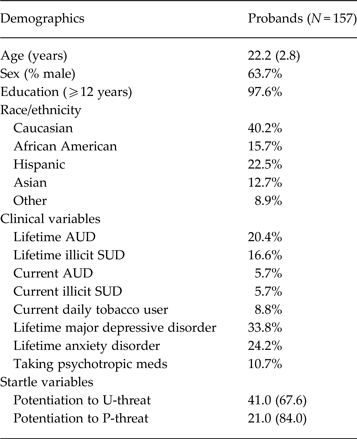
A total of 157 families, and 458 total individuals, were included in the study and provided adequate startle eyeblink data from both siblings and had available family diagnostic information (see Table 1). A subset of probands (i.e. non-family members) from this larger, primary study were included in Gorka et al. (Reference Gorka, Lieberman, Phan and Shankman2016), which demonstrated that within young adults, greater startle potentiation to U-threat was associated with greater levels of problematic drinking. All participants provided written informed consent after review of the protocol as approved by the university Institutional Review Board. Probands and family members completed a semi-structured clinical interview (detailed below) and a battery of questionnaires, and probands additionally completed a set of laboratory tasks.
Demographics and clinical characteristics of probands

AUD, Alcohol use disorder; SUD, any illicit substance use disorder; U-threat, temporally unpredictable threat; P-threat, temporally predictable threat.
Assessment of psychopathology
Lifetime diagnoses of Axis I disorders, including AUD and SUD, were assessed via the Structured Clinical Interview for DSM-5 Disorders (SCID-5; APA, 2015) by trained assessors, supervised by a licensed clinical psychologist. All proband interviews were conducted in person. To increase feasibility, family members had the option to complete the SCID in person or via telephone, which has been shown to have high inter-method reliability (Rohde et al. Reference Rohde, Lewinsohn and Seeley1997). The diagnosis of SUD included any illicit or recreational substance such as cannabis, crack/cocaine, heroin, methamphetamine, ‘club drugs’ (e.g. ecstasy) and non-medical prescriptions. A subset of participants (n = 51) returned to the laboratory 2 weeks later to repeat the same interview for measures of test–retest reliability of DSM-5 diagnoses, which were excellent for lifetime AUD and SUD (k = 0.84 and 0.87, respectively).
Laboratory procedures and threat task
All individuals tested negative for acute alcohol intoxication. Details of these procedures have been published previously (Gorka et al. Reference Gorka, Nelson and Shankman2013, Reference Gorka, Lieberman, Phan and Shankman2016) and are briefly noted here. Participants first completed a 2-min habituation task during which six startle probes were administered. Conventional steps next included shock electrode placement on participants’ non-dominant hand and a second habituation task to ensure that attachment of the shock electrodes did not re-potentiate early startle. Afterwards, a shock work-up procedure was completed in which participants received increasing levels of shock intensity until they reached a level that they described as ‘highly annoying but not painful.’ Ideographic shock levels were used to ensure equality in perceived shock aversiveness (Rollman & Harris, Reference Rollman and Harris1987; max = 5 mA).
Participants then completed the threat task modeled after the No-Predictable-Unpredictable (NPU) task developed by Grillon et al. (Schmitz & Grillon, Reference Schmitz and Grillon2012), extensively used in our laboratory (Gorka et al. Reference Gorka, Nelson and Shankman2013, Reference Gorka, Liu, Sarapas and Shankman2015; Shankman et al. Reference Shankman, Nelson, Sarapas, Robison-Andrew, Campbell, Altman, McGowan, Katz and Gorka2013), and in the prior studies assessing the association between reactivity to U-threat and alcohol use (e.g. Moberg & Curtin, Reference Moberg and Curtin2009; Gorka et al. Reference Gorka, Lieberman, Phan and Shankman2016). The task includes three within-subject conditions – no shock (N), predictable shock (P), and unpredictable shock (U). Text at the bottom of the computer monitor informs participants of the current condition by displaying: ‘no shock’ (N), ‘shock at 1’ (P), or ‘shock at any time’ (U). Each condition lasted 145 s, during which a 4-s visual countdown (CD) was presented six times. The interstimulus intervals (ISIs; i.e. time between CDs) ranged from 15 to 21 s (mean = 18.0 s) during which only the text describing the condition was on the screen. During the N condition, no shocks were delivered. During the P condition, participants received a shock every time the CD reached 1. During the U condition, shocks were administered at any time. Startle probes were presented during the CD (1-2 s following CD onset) and ISI (4-13 s following ISI onset). Each condition was presented two times in a randomized order (counterbalanced). All participants received 24 total electric shocks (12 in P and 12 in U) and 60 total startle probes (20 in N, 20 in P, and 20 in U).
Startle data collection and processing
Startle data collection and processing has been published previously (Shankman et al. Reference Shankman, Nelson, Sarapas, Robison-Andrew, Campbell, Altman, McGowan, Katz and Gorka2013; Gorka et al. Reference Gorka, Lieberman, Phan and Shankman2016) and are briefly noted here. Data acquisition used BioSemi Active Two system (BioSemi, The Netherlands) and PSYLAB (Contact Precision Instruments, UK). Acoustic startle probes were 40-ms duration, 103-dB bursts of white noise presented binaurally through headphones. Electric shocks lasted 400 ms and were administered to the wrist of the participants’ (non-dominant) left hand.
Startle responses were recorded from two 4-mm Ag/AgCl electrodes placed over the orbicularis oculi muscle below the left eye. The ground electrode was located at the frontal pole (Fpz) of an electroencephalography cap that participants were wearing as part of the larger studies. One startle electrode was placed 1-cm below the pupil and the other was placed 1-cm lateral of that electrode. Data were collected using a bandpass filter of DC 500 Hz at a sampling rate of 2000 Hz.
Blinks were processed and scored according to published guidelines (Blumenthal et al. Reference Blumenthal, Cuthbert, Filion, Hackley, Lipp and Van Boxtel2005). Data were high-pass-filtered (28 Hz), rectified, and then smoothed using a 40 Hz low-pass filter. Peak amplitude of the blink reflex was defined within 20-150 ms following the probe onset relative to baseline. Each peak was identified by software but examined by hand to ensure acceptability. Blinks were scored as non-responses if EMG activity during the 20- to 150-ms post-stimulus time-frame did not produce a blink peak that was visually differentiated from the pre-stimulus baseline activity. Blinks were scored as missing if the baseline period was contaminated with noise, movement artifact, or if a spontaneous or voluntary blink began before minimal onset latency. Blink magnitude values were used in all analyses. Consistent with prior studies (e.g. Gorka et al. Reference Gorka, Nelson and Shankman2013, Reference Gorka, Lieberman, Phan and Shankman2016), we created startle potentiation scores for the P- and U-threat conditions to account for baseline individual differences in startle magnitude. For P-threat, we subtracted startle magnitude during NCD from PCD. For U-threat, we subtracted startle magnitude during NCD from UCD. Both threat potentiation scores account for baseline response during the control condition and are matched on visual stimuli (i.e. the CD was on the screen); however, it is necessary to note that results are the same whether UCD or UISI is used to quantify U-threat reactivity.
Data analysis plan
In order to test whether startle reactivity to threat is a vulnerability factor, we chose one individual from each biological sibling dyad to be specified as the proband. The other individual in the dyad was treated as a family member. If one of the individuals in the dyad had a lifetime illicit SUD or AUD and the other did not, the ‘healthy’ individual was specified as the proband and the ‘ill’ individual as the family member. Otherwise, specification was done at random. This process was done in an attempt to minimize the extent to which proband reactivity to U-threat would be impacted by current AUD/SUD status. Regardless, proband AUD and illicit SUD status were included as covariates in subsequent analyses (as in some families, both siblings had an AUD or SUD).
Once probands were selected, two diagnostic family history variables were created. The first was a dichotomous variable which reflected whether or not any immediate family member (of those interviewed) had a lifetime diagnosis of the disorder (yes/no). The second was a diagnostic family density score which was calculated by dividing the total number of individuals within a given family with a lifetime diagnosis of the disorder by the total number of family members in the study, consistent with other family studies (e.g. Klein et al. Reference Klein, Glenn, Kosty, Seeley, Rohde and Lewinsohn2013). Both of these variables were made for AUD-only and any illicit SUD and were used as the dependent variables in subsequent analyses.
For the dichotomous family history variables, we conducted binary logistic regression analyses. Proband age and sex were included as covariates. Proband startle potentiation to U-threat and P-threat were entered as separate predictors. For the family density variables, we conducted hierarchical linear regression analyses. Identical to above, proband age and sex were included as covariates and proband startle potentiation to U-threat and P-threat were entered as separate predictors. In all models, proband AUD (or illicit SUD) status was also entered as a covariate to ensure that reactivity to U-threat provided incremental validity to the prediction of family history of the disorder over and above proband diagnoses.
We next tested whether startle potentiation to threat was familial. To do so, we used the startle data from both siblings within the dyad and ran ICC analyses for U- and P-threats. Of note, we tested within dyad correlations for raw startle magnitude (i.e. NCD, PCD and UCD) and startle potentiation (i.e. PCD – NCD and UCD – NCD) to comprehensively assess patterns of familiarity across the different task conditions.
Results
Descriptives
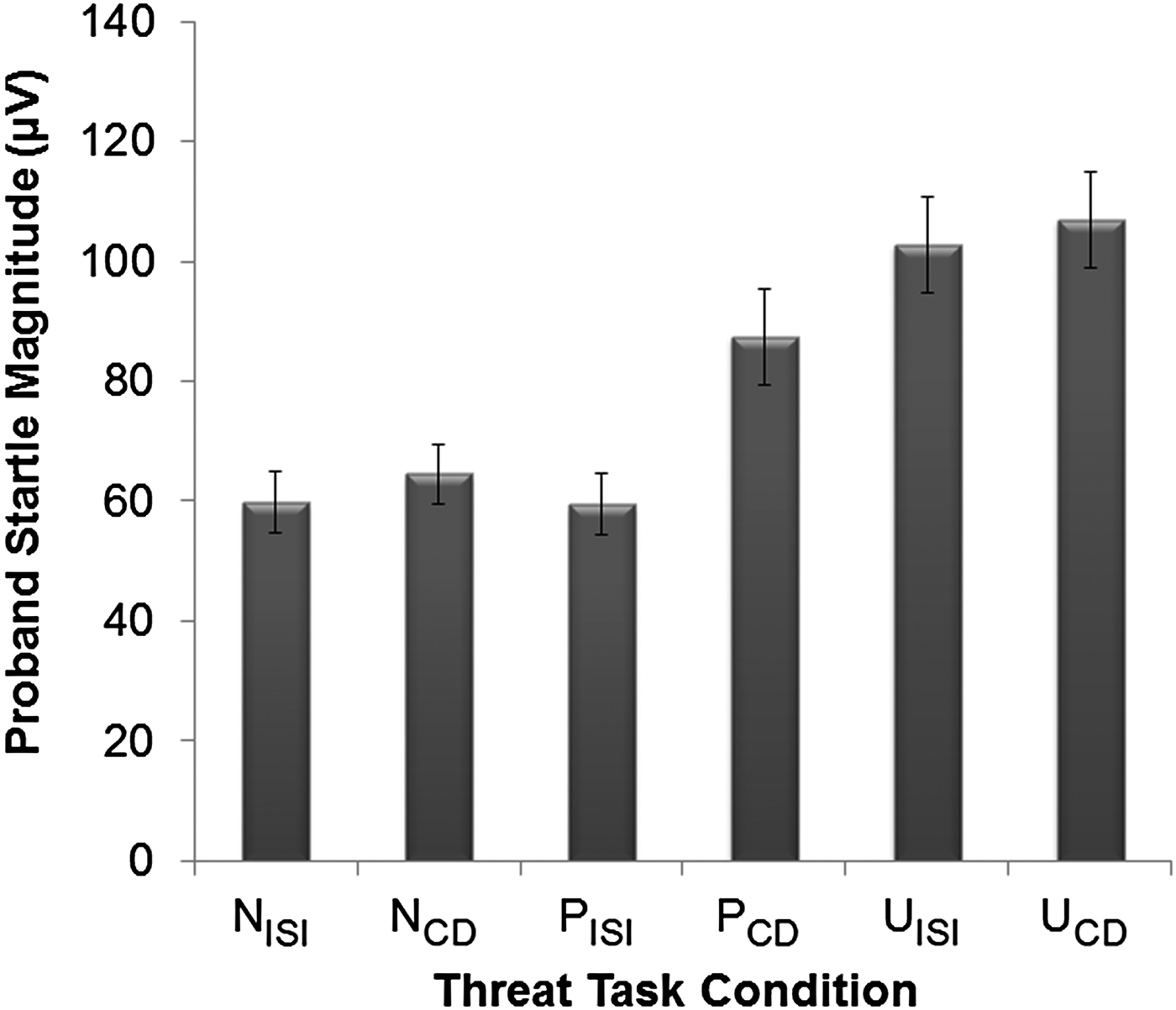
Participant demographic and clinical information is presented in Table 1. Mean startle potentiation during the task is displayed in Fig. 1. On average, families in the study included 2.9 ± 0.9 individuals. At least one parent was interviewed for 69 families (44%) and all included at least one sibling. Of the 157 probands, 32 had a lifetime diagnosis of AUD (nine current) and 26 had a lifetime diagnosis of a separate SUD (nine current). A total of 91 probands (58%) had a lifetime diagnosis of a mood or anxiety disorder. With regards to families, 73 (46.5%) were positive for AUD, 22 (14.0%) were positive for illicit SUD, and 90 (57%) were positive for a mood or anxiety disorder. Prevalence of proband mood and anxiety disorders did not differ between families with positive and negative history of AUD or SUD (all p’s > 0.13).
Startle as an indicator of vulnerability
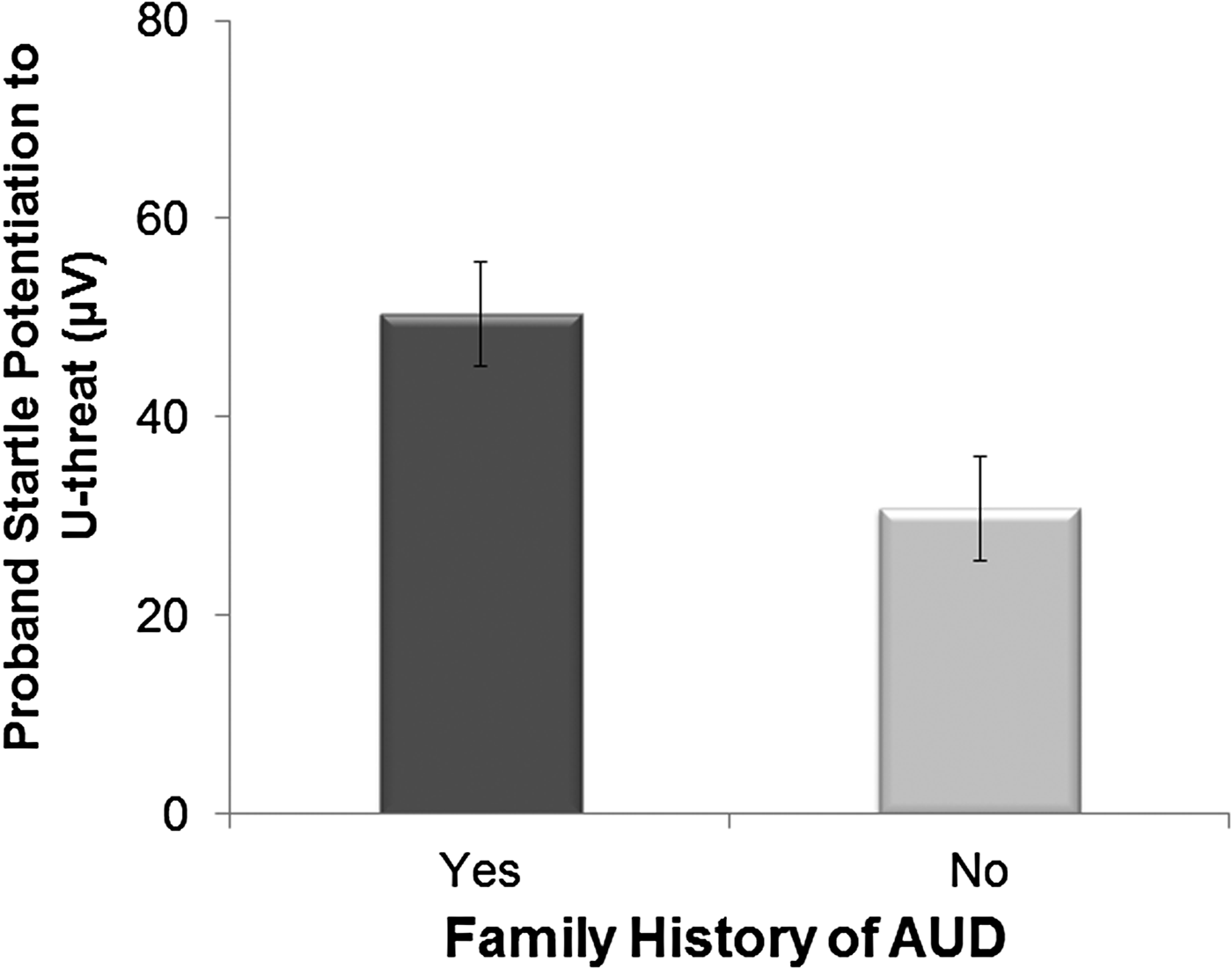
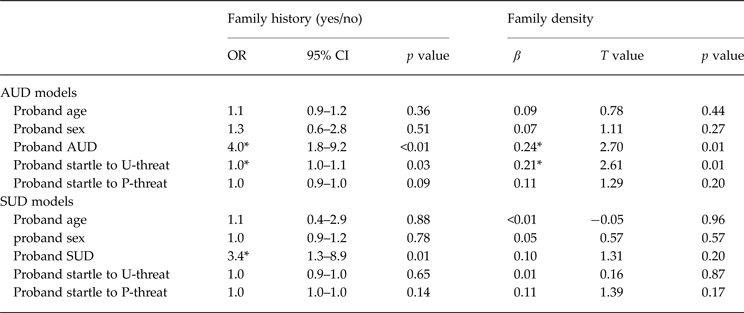
Results from all models are presented in Table 2.Footnote 1 Footnote † With regard to AUD, results indicate that probands with a lifetime diagnosis of AUD were more likely to have a positive family history and a greater family density of AUD. Startle potentiation to U-threat, but not P-threat, was also positively associated with both AUD family history and family density (Fig. 2) independent of proband diagnostic status. When the 32 probands with a lifetime diagnosis of AUD were excluded from the model (rather than controlled for), results were the same.
Bar graph illustrating mean startle magnitude during each condition, by cue type, of the startle task. N, No threat; P, predictable threat; U, uncertain threat; ISI, interstimulus interval; CD, countdown. Bars reflect standard error.

Bar graph depicting mean startle potentiation to uncertain threat for probands with a positive and negative family history of alcohol use disorder. Means are adjusted for proband lifetime alcohol use disorder. Bars reflect standard error. U-threat, Uncertain threat; AUD, alcohol use disorder.

Results assessing whether startle potentiation to P- and U-threat are associated with family history and family density of AUD and illicit SUD

AUD, Alcohol use disorder; SUD, any illicit substance use disorder; OR, odds ratio; CI, confidence interval; U-threat, temporally unpredictable threat; P-threat, temporally predictable threat.
*p < 0.05.
The illicit SUD analyses also indicate that probands with a lifetime diagnosis of an illicit SUD were more likely to have a positive family history of illicit SUD. Contrary to our hypotheses, however, neither startle potentiation to U-threat or P-threat were associated with SUD family history or family density.
Sibling startle correspondence
Raw startle magnitude across N, P and U, and startle potentiation to P- and U-threat was correlated within sibling pairs. For raw startle magnitude, the correspondence ranged from moderate to high across conditions: NCD magnitude (ICC = 0.38, 95% CI 0.13–0.56, F 1,156 = 1.62, p < 0.01); PCD magnitude (ICC = 0.62, 95% CI 0.46–0.73, F 1,156 = 2.61, p < 0.01); UCD magnitude (ICC = 0.35, 95% CI 0.10–0.54, F 1,156 = 1.55, p < 0.01). For startle potentiation (i.e. difference) scores, correspondence for P-threat was robust (ICC = 0.63, 95% CI 0.50–0.74, F 1,156 = 2.67, p < 0.01). Correspondence was moderate but significant for startle potentiation to U-threat (ICC = 0.35, 95% CI 0.10–0.52, F 1,156 = 1.52, p < 0.01).
Discussion
The current investigation utilized a family study design to address two important gaps in the existing literature by testing whether startle potentiation to U-threat was associated with risk for problematic alcohol use, defined by family history of AUD, and exploring the extent to which startle potentiation to U-threat (and P-threat) was correlated amongst biological, adult siblings. The current results support the hypothesis that heightened reactivity to U-threat is a familial vulnerability factor for AUD. Independent of probands’ own AUD status, startle potentiation to U-threat was positively associated with family history and density of AUD (i.e. risk), and this association was more robust for U-threat, relative to P-threat, and AUD, relative to SUD. In addition, within biological siblings, startle potentiation to U-threat (and P-threat) was moderately correlated, indicating that this individual difference factor is familial.
Results indicate that heightened startle potentiation to U-threat is associated with risk for AUD, beyond being a marker of current or past problematic drinking. This fits with the broader theory which posits that individuals who display heightened reactivity to U-threat find alcohol to be stress relieving and therefore reinforcing, which in-turn promotes continued use. Indeed, Curtin and colleagues have consistently demonstrated that acute alcohol intoxication effectively, and selectively, dampens startle potentiation to U-threat, but not P-threat (Moberg & Curtin, Reference Moberg and Curtin2009; Hefner & Curtin, Reference Hefner and Curtin2012; Bradford et al. Reference Bradford, Shapiro and Curtin2013; Hefner et al. Reference Hefner, Moberg, Hachiya and Curtin2013). Alcohol may therefore target the psychophysiological processes that mediate anticipatory anxiety, providing relief to individuals who are hypersensitive to U-threat leading to negative reinforcement for continued use (Kassel et al. Reference Kassel, Jackson and Unrod2000; Baker et al. Reference Baker, Piper, McCarthy, Majeskie and Fiore2004; Koob, Reference Koob2013). Interestingly, human and rodent research indicates that exaggerated reactivity to U-threat may be driven by the bed nucleus of the stria terminalis (BNST), which is highly sensitive to alcohol withdrawal and stress-induced alcohol reinstatement (see Avery et al. Reference Avery, Clauss and Blackford2016 for a review). The BNST is therefore a likely target of alcohol's acute and chronic effects and individual differences in BNST reactivity may underlie the association between startle potentiation to U-threat and problematic drinking.
The current findings regarding risk were relatively specific to U-threat and AUD. This is consistent with our prior results indicating more robust relation between binge drinking and reactivity to U-threat relative to P-threat (Gorka et al. Reference Gorka, Lieberman, Phan and Shankman2016), and Curtin and colleagues’ studies demonstrating that alcohol has a more robust ‘stress-dampening’ effect on reactivity to U-threat relative to P-threat (Moberg & Curtin, Reference Moberg and Curtin2009; Hefner et al. Reference Hefner, Moberg, Hachiya and Curtin2013). Together, data implies that acute alcohol intoxication targets the biobehavioral processes engaged by threat uncertainty (rather than threat in general); making individuals with deficits in this system at baseline vulnerable to alcohol's reinforcing effects.
To date, considerably less research has investigated the links between reactivity to U-threat and substances other than alcohol. However, it has been demonstrated that heavy marijuana users exhibit heightened aversive reactivity to uncertain reward (Hefner et al. Reference Hefner, Starr and Curtin2015), and that within smokers, nicotine deprivation increases startle potentiation to U-threat but not P-threat (Hogle et al. Reference Hogle, Kaye and Curtin2010). In the current study, reactivity to U-threat was not associated with risk for illicit SUDs. These null findings may have resulted from the small number of families with positive SUD histories leading to a potentially underpowered analysis to detect group differences and/or from the possibility that vulnerability for only some (e.g. cannabis, alcohol) but not all SUDs (e.g. cocaine) are associated with reactivity to U-threat. The current study did not have the sample size to examine specific SUDs separately, and future studies should therefore address this important question.
Although reactivity to U-threat is related to risk for alcohol abuse, other studies indicate that reactivity to U-threat is not specific to risk for AUD. For example, heightened startle potentiation to U-threat has previously been observed in individuals with depression (Grillon et al. Reference Grillon, Franco-Chaves, Mateus, Ionescu and Zarate2013; although see Shankman et al. Reference Shankman, Nelson, Sarapas, Robison-Andrew, Campbell, Altman, McGowan, Katz and Gorka2013) and anxiety disorders (Grillon et al. Reference Grillon, Lissek, Rabin, McDowell, Dvir and Pine2008, Reference Grillon, Pine, Lissek, Rabin, Bonne and Vythilingam2009), and is associated with risk for internalizing disorders defined by positive family history (Nelson et al. Reference Nelson, McGowan, Sarapas, Robison-Andrew, Altman, Campbell, Gorka, Katz and Shankman2013; Grillon et al. Reference Grillon, Dierker and Merikangas1998, Reference Grillon, Warner, Hille, Merikangas, Bruder, Tenke, Nomura, Leite and Weissman2005). Reactivity to U-threat and perhaps the broader construct of intolerance of uncertainty (Carleton, Reference Carleton2016a ), is therefore a likely shared vulnerability factor, and a target for prevention for AUD, many internalizing disorders, and/or comorbid AUD-internalizing psychopathology.
In addition to demonstrating associations with risk, the current study is the first to show that startle potentiation to U- and P-threat are correlated amongst first-degree relatives, and therefore, to some extent aggregates within families. It is possible that this aggregation is the result of genetic factors and/or shared experiences/family environment and the relative impact of each of these factors in the current study cannot be quantified. Regardless of why it aggregates within families, the fact that startle potentiation to threat is correlated amongst siblings suggests that it may have trait-like properties and be considered an individual difference factor that emerges relatively early in adulthood (as all participants were 30 years or younger) before the onset of more chronic, extended patterns of problematic alcohol use. Several twin studies have shown that overall startle magnitude is heritable and that genetics account for up to 67% of the variance in overall startle (Anokhin et al. Reference Anokhin, Heath, Myers, Ralano and Wood2003, Reference Anokhin, Golosheykin and Heath2007; Hasenkamp et al. Reference Hasenkamp, Epstein, Green, Wilcox, Boshoven, Lewison and Duncan2010), though results for emotion-modulated startle have been less consistent (see Carlson et al. Reference Carlson, Katsanis, Iacono and McGue1997 but also Anokhin et al. Reference Anokhin, Golosheykin and Heath2007 and Vaidyanathan et al. Reference Vaidyanathan, Malone, Miller, McGue and Iacono2014). Future studies are needed to determine if and how differences in startle potentiation between affective pictures and U-threat may contribute to the heritability and familiarity of this specific affective response tendency.
Limitations
The current results should be interpreted in the context of several noteworthy limitations. First, diagnostic information was only available for family members who completed the clinical interview. Although this approach leads to less false-positives by using ‘gold standard’, clinical interviews to evaluate lifetime psychopathology, it leaves the possibility for false-negatives as family members who were not interviewed may have had AUD/SUD histories that were not accounted for in the analyses. Second, the family study design cannot distinguish between genetic and environmental influences, and thus the specificity and magnitude of effect of these two sources remains unclear. Third, risk for problematic alcohol use was defined by family history of AUD diagnoses rather than more continuous measures of problematic or ‘risky’ patterns of drinking. This has several advantages, as AUD is well-defined and a clear metric of disordered alcohol use, but as the field begins to view problematic alcohol use on a continuum (APA, 2015), it will be necessary to consider how reactivity to U-threat relates to risk beyond AUD diagnoses. Fourth, the effect size of the AUD family history finding is moderate and it is still unclear whether startle reactivity to U-threat holds promise as a viable prevention and intervention target. Lastly, the sample included individuals, and families, with a range of psychiatric disorders and it is unclear the extent to which this may have impacted the current pattern of results. We did not ‘co-vary’ out non-SUD proband diagnoses as this would remove critical variance associated with risk for AUD given the high co-occurrence between AUD and other forms of psychopathology (Miller & Chapman, Reference Miller and Chapman2001). In general, the present study reflects the first step in a line of research focused on elucidating the role of reactivity to U-threat in problematic alcohol use and additional prospective research causally relating U-threat reactivity to the onset of problematic drinking is needed.
Conclusions
In sum, the current study suggests that heightened reactivity to U-threat is a familial vulnerability factor for AUD. This adds to a growing literature suggesting that exaggerated reactivity to U-threat contributes to the motivation to use alcohol. The findings also add to the broader literature suggesting that reactivity to uncertainty is a dispositional factor connoting risk for multiple forms of psychopathology (see Shihata et al. Reference Shihata, McEvoy, Mullan and Carleton2016 for a review). Because startle potentiation is both psychometrically reliable and relatively easy-to-record (Shankman et al. Reference Shankman, Nelson, Sarapas, Robison-Andrew, Campbell, Altman, McGowan, Katz and Gorka2013), studies should continue to test whether it can be a viable tool for evaluating alcohol abuse risk and disease status. Future research should also consider the possibility of targeting the biobehavioral processes that mediate reactivity to U-threat in an effort to prevent and/or ameliorate problematic drinking behaviors and other related psychiatric symptoms.
Acknowledgements
This study was supported by grants from National Institute of Mental Health (S.S., grant no. R01 MH098093); and the National Institute on Alcohol Abuse and Alcoholism (S.G., grant no. F31 AA 22273-01A1).
Declaration of Interest
None.