Since the early 1990s, the world trading system has witnessed a sharp increase in the number of preferential trade agreements, leading to a phenomenon known as the ‘new regionalism’.Footnote 1 Although the exact number of preferential trade agreements that have been signed over the last half century is disputed, most observers agree that currently roughly 300 agreements are in force. The importance of this development for participating, as well as for excluded, countries has stimulated a substantial scholarly literature that explains the spread of agreements with reference to a large number of factors. Among them are the stagnation of the process of multilateral trade liberalization, the search for economies of scale, the desire to signal commitment to specific trade and economic policies and the protection of foreign direct investments. Some agreements are also seen to have been driven by the geopolitical interests of the participating countries.
We offer an explanation for the new regionalism that sees preferential trade agreements mainly as a response to the preferential trade policies of other countries. In this view, countries excluded from an agreement try to avoid the negative consequences of trade diversion by signing new agreements.Footnote 2 The specific argument that we propose, which we label ‘the protection-for-exporters argument’, builds on the assumption that exporters lobby more against certain losses of foreign market access than in favour of potential opportunities. Given this differential propensity to lobby, discrimination abroad is expected to lead to a shift in the balance between exporters and import-competitors in a country. A shift in the balance between these two interests, in turn, brings about changes in the trade policies pursued; that is, governments are now expected to implement trade policies to protect exporter interests. One way of doing so is to sign preferential trade agreements with countries that are already party to such agreements.
We test the protection-for-exporters argument against alternative explanations in a quantitative analysis of the proliferation of preferential trade agreements among 167 countries between 1990 and 2007. In carrying out this analysis, we introduce several improvements with respect to data and method to the quantitative literature on preferential trade agreements. For one, we have designed a test of the protection-for-exporters argument that captures the causal logic of countries responding to trade diversion as directly as possible. Second, we have established a new list of trade agreements, which represents an improvement on the datasets used in previous studies in terms of completeness and inclusion of recent agreements (up to and including 2007). Finally, we have exercised particular caution in controlling for alternative explanations to avoid overestimating the explanatory power of our own argument. The findings provide strong support for our argument. The choice by different countries to enter into preferential trade agreements is indeed interdependent. Such interdependence increases with the negative externalities from existing agreements.
Beyond speaking to the literature on regionalism in the world economy, we also strive to make a contribution to a growing number of studies on policy diffusion and policy interdependence.Footnote 3 Increasingly, scholars of international relations are realizing that dyads do not act in isolation, and are trying to model the interdependence among them.Footnote 4 For example, policy interdependence has been shown to be a driving force behind the diffusion of bilateral investment treaties.Footnote 5 We add to this literature by taking seriously a recent call to accept that ‘space is more than geography’ when operationalizing the impact that a dyad's decision to pursue a trade agreement has on other dyads.Footnote 6 In particular, we pay attention to extra-dyadic relationships when calculating the degree of dependence between two observations.
Our article is of relevance for broader debates about the governance of international economic relations as well. In fact, preferential trade agreements are far more than agreements that regulate trade in goods. Many of the more recent agreements encompass hundreds of pages of detailed rules on a variety of topics, such as intellectual property rights, investments and standard setting. That such far-reaching agreements are often signed in reaction to agreements concluded by other countries is a significant finding. It shows that governments tie their hands on a large number of topics because their country's dependence on foreign markets compels them to do so. Our assessment of the new regionalism is, hence, far less benign than that reached by scholars in the neoliberal institutionalist tradition, who see the spread of trade agreements as an expression of functional international co-operation.
The protection-for-exporters argument
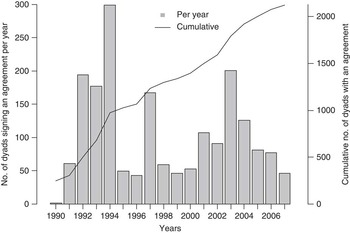
Over the past twenty years, the number of dyads forming part of a preferential trade agreement has increased sharply (see Figure 1). Whereas in 1990 only 245 pairs of countries had a preferential trade agreement between them, the number stood at 2,123 in 2007.Footnote 7 With up to 13,861 dyads in our dataset, this means that 15.3 per cent of all dyads have a preferential trade link.Footnote 8 In terms of the number of actual agreements, we consider 247 trade agreements signed between 1990 and 2007. This number is composed of 159 bilateral, eighty-six plurilateral and two inter-regional (the Andean Community–Mercosur agreement signed in 2004 and the European Free Trade Association–Southern African Customs Union agreement signed in 2006) agreements. Among the plurilateral agreements, we coded sixty-three agreements between a regional trading entity and an individual country. These are agreements signed by trading entities, such as the Caribbean Community, the European Free Trade Association (EFTA), the European Union (EU) and Mercosur, with third countries.
The proliferation of preferential trade agreements, 1990–2007

Owing to its large number of member countries and agreements concluded with third countries (we have twenty-three such agreements in the database for the period 1990–2007, some of which have been superseded by accession agreements), the EU accounts for a sizeable number of dyads with trade agreements. Although the EU's increasing membership and continued attractiveness as a partner for preferential trade agreements is itself support for our argument, the process that we aim to explain is not limited to the EU. Our data show that across the world, the number of agreements being signed has increased over the last two decades. In particular, a growing number of South–South agreements and agreements involving Asian countries have come into existence over the last few years.
What explains this proliferation of preferential trade agreements across the world? The protection-for-exporters argument that we set out to respond to this question builds on a series of studies on the external effects of preferential trade agreements.Footnote 9 Common to these studies is the assumption that preferential trade policies hurt outsiders by way of trade diversion.Footnote 10 When witnessing the costs, outsiders react, either by joining a preferential trade agreement or by setting up an alternative one. Over time, this leads to the spread of preferential trade agreements. Although, so far, most studies that developed this argument have treated states as unitary actors, our explanation provides domestic underpinnings for this logic. As will become evident, basing the argument in domestic politics changes expectations about policy outcomes. Following a statist approach, an excluded country reacts to a preferential trade agreement between foreign countries whenever the costs from trade diversion exceed the gains that it may reap from the agreement, for example, because of accelerated economic growth in the preferential trading area. By contrast, following our political economy argument, an excluded country reacts even if it gains in the aggregate, as long as the costs are large enough for a group of exporters to engage in political activity.
The protection-for-exporters argument starts with the assumption that trade policy-making is shaped by competition between two constituencies, namely, exporters and import-competitors. Exporters benefit from better foreign market access and import-competitors from continued protection of their sector against foreign competition. While potentially both trade policy constituencies can engage in lobbying, asking politicians to consider their interests when implementing trade policies, we assume that exporters often fail to become politically active. Exporters are likely to face uncertainty with respect to the potential benefits from engaging in lobbying for better foreign market access because they tend to have too little information about and to underestimate the potential opportunities they may be missing in a foreign market.Footnote 11 Moreover, even if they are aware of a missed opportunity, they face uncertainty about the willingness of a foreign government to reduce its trade barriers in exchange for concessions.Footnote 12 This uncertainty is even further enhanced by the fact that trade negotiations tend to take place over a substantial period of time, making it difficult to know the competitive situation of an exporter at the time the agreement enters into effect. As a result, it is difficult for an exporter to predict whether she, or rather another exporter from the same country, will reap the potential benefits of better foreign market access. In the case of plurilateral agreements, the benefits of trade liberalization may even go to an exporter from another country.Footnote 13 In short, it can be expected that uncertainty inhibits exporters from lobbying for gains. Only a few exporters will manage to become politically active, ensuring that the balance of domestic interests is biased in favour of import-competing interests.Footnote 14
Exporters’ incentives to mobilize are substantially different when facing losses, caused, for example, by the creation of a preferential trading arrangement among foreign countries that leads to trade diversion.Footnote 15 In this situation, rather than having to invest in monitoring foreign markets to gather information about export opportunities, they can simply react in a fire-brigade manner to any losses that they experience from the trade policy choices of foreign countries. Moreover, they can be quite certain about the consequences of their lobbying activity. If they manage to achieve the re-establishment of the market conditions that existed before the creation of the preferential trade agreement, they should be able to regain their share of that market. Exporters’ uncertainty in lobbying against losses, consequently, should be lower than the uncertainty in lobbying for gains. The expectation derived from this reasoning, then, is that a stronger lobby effort by exporters should be visible in response to losses than in pursuit of potential gains.Footnote 16
Existing research confirms the plausibility of this expectation. Even as long ago as 1966, Raymond Vernon affirmed that ‘threat in general is a more reliable stimulus [for enterprises] to action than opportunity is likely to be.’Footnote 17 More recently, I. M. Destler stressed that ‘It is the embattled losers in trade who go into politics.’Footnote 18 In fact, ample evidence exists for changes in the balance of domestic interests in response to discrimination abroad. For example, in Japan, import-competing interests opposed to preferential trade agreements dominated trade politics throughout the 1990s. Their influence was only broken when Japanese exporters mobilized in response to losses abroad.Footnote 19 In particular, exporters became active in lobbying against discrimination in Mexico and Chile, two countries that had signed agreements with both the United States and the European Union.Footnote 20 Another example is the mobilization of South Korean firms in response to the signing of the China–Taiwan Economic Cooperation Agreement in 2010. The discrimination that this agreement is expected to cause has created significant business demand for a South Korea–China trade agreement that is likely to overcome opposition among South Korean farmers.Footnote 21
What effect does such a shift in the balance of domestic interests have on trade policy choices? We assume that a government, independent of whether or not it is democratically legitimized, will take into account the balance of domestic interests when formulating its trade policy, even if domestic interests do not perfectly translate into government policies.Footnote 22 The balance of domestic interests is an important consideration for decision makers because organized interests that are dissatisfied with government policy may reduce their support for government and/or increase their backing for the opposition, thus threatening decision makers’ hold on office. Among the many tactics open to interest groups to influence election campaigns are reducing or increasing campaign contributions and providing or withholding policy-relevant information. They can also make use of outside lobbying that aims at alerting public opinion to a specific issue, which in turn may shape a candidate's chances of re-election. In 2010, for example, American business lobbies, such as the Business Roundtable and the National Association of Manufacturers, engaged in public campaigns that stressed the loss of jobs resulting from the failure of the United States to ratify trade agreements with South Korea and Colombia.
The expectation, then, is for governments to pursue policies that satisfy import-competing interests in the absence of foreign discrimination. By contrast, in the presence of foreign discrimination, the government is no longer only attentive to the interests of import competitors, but is also concerned about the protection of exporters’ interests. In this situation, the country should enter into negotiations for a trade agreement with the country in which exporters face losses of market access. In response to the exporter lobbying discussed above, Japan, for example, concluded preferential trade agreements with Mexico (2004) and Chile (2007).
The strength of the protection-for-exporters effect depends on the amount of trade diversion that an agreement between two countries causes for an excluded country. The larger the trade diversion the more politically active we expect exporters to be, and the more eager the government of an excluded country should be to sign an agreement with the member country in which it faces discrimination. To clarify, the likelihood of an agreement between two countries is not simply a function of the number of agreements that these countries have signed with third countries but of the agreements’ cumulative discriminatory effect. In other words, preferential trade agreements should not have an effect on the trade policy choices of excluded countries unless they generate trade diversion. If we were to see that preferential agreements spread to countries that do not suffer from trade diversion, this would be an indication that an alternative diffusion mechanism is at play, a question that we take up below.
Although so far we have only explained changes in individual countries’ preferences with respect to signing a preferential trade agreement, the successful conclusion of trade negotiations requires agreement between at least two countries. Why would a member country of a preferential agreement accept the conclusion of a trade agreement with an excluded country? Our argument is that the member country will accept an agreement only if its exporters face discrimination in the excluded country and hence are also politically active (the inverted logic). Following this logic, for example, the European Union–Mexico agreement (2000) came about because the European Union faced discrimination in Mexico, as did Mexico in the European Union.Footnote 23 The argument thus can be formulated in the form of the following hypothesis:
HYPOTHESIS: The more discrimination that countries A and B face in each other's markets, the higher the probability of a preferential trade agreement between them.
Any explanation relying on such a snowball or domino effect begs the question of why the initial event came about; in this case, why the initial agreement was signed. In line with the protection-for-exporters argument, we suggest that, in some cases, governments may be able to design an agreement that imposes costs on third countries rather than domestic import-competing interests.Footnote 24 In such a case, in the absence of opposition from import-competitors, governments may find it beneficial to conclude an agreement. An initial agreement may also come about between adjacent countries, since here exporters’ uncertainty about the potential benefits of trade liberalization is likely to be at its most minimal. For some of the initial agreements, an explanation may also require consideration of factors exogenous to the argument, such as the geopolitical interests of countries.
Countries could also be expected to conclude preferential trade agreements in a pro-active manner because they expect to benefit from the external effect that we describe here. In fact, there are some historical examples of countries using preferential trade agreements to put pressure on third countries. Some evidence suggests that the United States used the threat of preferential liberalization as part of the Asia Pacific Economic Cooperation (APEC) pact to force the European Union into accepting the conclusion of the Uruguay Round.Footnote 25 The empirical record, however, suggests that in most cases decision makers do not anticipate the external consequences of a preferential trade agreement. In some cases, they were even surprised by these effects. Few observers, for example, predicted that the deepening of European integration in the 1980s would cause concern among third countries.Footnote 26
Although we have formulated our argument using the example of bilateral agreements, the logic also applies to plurilateral preferential agreements. For exporters in third countries, the effects of plurilateral and bilateral agreements are similar, with the only major difference being that a plurilateral agreement threatens access to several markets at the same time. The precise reaction of an excluded country to such a plurilateral agreement will depend on its export interests. If it only faces discrimination in one country, it will seek to conclude a bilateral agreement with that country.Footnote 27 If it faces discrimination in more than one market, however, it may decide to apply for accession to an existing agreement.
In solely concentrating on the probability of a negotiated agreement between an excluded and a member country, we ignore three alternative courses of action that an aggrieved country could pursue. First, it may threaten retaliation against countries that engage in preferential trade policies. When the European Union moved towards a deepening of integration in the late 1980s, the United States responded with threats to all proposals that had the potential of imposing costs on its exporters. The Deputy Secretary of State, John C. Whitehead, referred to the ‘potent retaliation ability’ of the United States, to counter discrimination in the European Community.Footnote 28 However, only structurally powerful countries can make use of such threats. Weaker countries responded to the Single Market Programme with requests for bilateral agreements, a response that we capture with the argument presented here.
A second possible reaction to discrimination is a call for multilateral trade liberalization. Again, the American response to European integration best illustrates this tactic. The creation of the European Economic Community in the late 1950s caused concern among American exporters. Instead of signing a preferential agreement with the new trading entity, the United States used the Kennedy Round of world trade negotiations (1964–67) to reduce discrimination resulting from the European move. Finally, a government may decide to compensate exporters that face costs from trade diversion by way of a subsidy. World trade rules, however, impose strict limits on the use of subsidies; moreover, governments violating these rules have to fear the imposition of countervailing duties, which are explicitly allowed by World Trade Organization (WTO) rules.Footnote 29 Disregarding these alternative tactics, which may all be driven by the aim of protecting exporter interests in the face of foreign discrimination, may lead us to underestimate the external effect of preferential trade agreements.
Data and operationalization
Several qualitative case studies have shown the plausibility of the argument that countries respond to discrimination from preferential trade agreements. By contrast, only a few studies have tried to quantitatively test the idea.Footnote 30 Although these studies provide interesting insights, they are characterized by a series of shortcomings. Early quantitative studies, for example, did not explicitly model the spatial interdependence at the heart of the theoretical argument. More recent studies that do so either restrict the analysis to a small sample of countries or use a very rough proxy for the potential trade diversion caused by an earlier agreement.Footnote 31 Our aim is both to build on and to go beyond this literature by designing a test that captures the trade diversion logic that underlies our argument as closely as possible, establishing an up-to-date list of trade agreements, and controlling for alternative diffusion mechanisms.
Our database of preferential trade agreements covers 167 countries and all years from 1990 until 2007. We limited the analysis to agreements concluded from 1990 onwards for three reasons: first, as is evident from Figure 1 above, relatively few agreements were signed between 1945 and 1990. By including these years, we would capture little additional variation in our dependent variable. Second, if the dataset were to be extended to the years prior to 1990, we would most likely overestimate the degree of spatial interdependence. As explained below, in our measure of spatial interdependence, we include the dependent variable, lagged by one year. As the other two variables that are included in this measure (namely, trade and trade competition) vary little over time, we would potentially face a serious problem of auto-correlation if we considered a longer time period. Third, our decision to limit the time period was also driven by the practical problems of calculating spatial weights in a dataset that would be increased to more than 500,000 observations if we considered all years since the 1950s and of finding reliable data (in particular, dyadic and sectoral trade data) for all countries in earlier years.
With respect to country coverage, we have tried to include as many countries as possible in our analysis. Nevertheless, we have had to exclude some (mostly small) countries owing to data restrictions, for example, in the Caribbean region (Antigua and Barbuda, Saint Kitts and Nevis) and also in the Republic of China (Taiwan). This leads to the elimination of a few dyads with preferential trade agreements. We also exclude Montenegro, as it only came into existence in 2006 and, hence, would have been in the database for only two years. A few other countries that became independent after 1990 enter the database in the year of their independence. In total, we consider up to 13,861 dyads per year for a total number of 237,644 observations. The dyads included in the analysis are non-directional, that is, we do not distinguish between the country pair Albania–Argentina and the reverse country pair Argentina–Albania. Doing so makes sense as we expect that an agreement only comes about if there is an incentive for both sides to engage in and conclude trade negotiations. Even if there is significant pressure on one side, a preferential trade agreement may not be signed if the other side feels little or no pressure to do so.
For each dyad, we coded whether or not it signed a trade agreement in a specific year. Opting for the year of signature rather than the year of entry into force of an agreement makes sense, as signing an agreement is an important indication that governments respond to exporter lobbying. The year of signature is also important for the effect that agreements have, as it is at this moment that we expect exporters in third countries to start worrying about the expected negative consequences for them. We invested substantial effort in establishing a comprehensive and up-to-date list of trade agreements signed between 1990 and 2007. Largely (but not solely) relying on three different databases, namely the list of regional trade agreements notified with the WTO, the Tuck Trade Agreements Database, and the McGill Faculty of Law Preferential Trade Agreements Database and excluding agreements that do not include concrete steps towards the establishment of a preferential trading area, we found that 1,878 dyads formed a preferential trade agreement between 1990 and 2007.Footnote 32 This collection of data on membership in preferential agreements is significantly more comprehensive than that used in similar studies.Footnote 33
We do not consider new agreements signed between two countries that already have a preferential link.Footnote 34 This is a significant restriction especially for European dyads, many of which have participated in a stepwise deepening of integration. In addition, many bilateral agreements between the European Union and third countries across Europe were later converted into accession treaties. All Central and Eastern European countries, for example, signed bilateral free trade agreements with the European Union in the 1990s. Our decision to limit ourselves to the analysis of the first agreement between two countries leads us to disregard the accession of twelve of these countries to the European Union between 2004 and 2007. While such a deepening of integration can have effects similar to those captured by our theoretical argument (and can be a reaction to preferential trade agreements among third countries), we decided to exclude these cases from our analysis to secure unit homogeneity, as the political economy of deepening an agreement may be different from the political economy of an initial agreement.
The decision to limit ourselves to the analysis of the first agreement between two countries also requires us to drop country pairs from the analysis that already formed part of an effective preferential trade agreement in 1990. The agreements that we consider to have been effectively implemented as of 1 January 1990 are: the European Union (with twelve member countries); the EFTA; the agreements between the EU and EFTA countries; the agreements between the EU and Cyprus, Israel and Malta; the agreements between the United States and Canada and Israel; the agreements between Australia and New Zealand and Papua New Guinea; the Caribbean Community; and the South African Customs Union. The 245 dyads that participated in these agreements are excluded from the analysis. We did not drop dyads that formed part of agreements such as the Latin American Integration Association (LAIA, 1980) and the Economic Community of Central African States (ECCAS, 1983) even though they were formally in existence in 1990. The reason for doing so is that these agreements have never been effectively implemented. The LAIA, for example, did not lead to any significant preferential tariff reductions (although it did give rise to a series of partial scope agreements that we include in our analysis) and ECCAS was suspended right after having been signed because of military conflict in the area.Footnote 35 Such agreements, which only exist on paper, should neither contribute to the domino effect we are interested in nor keep participating countries from signing new agreements among themselves.
Operationalizing Trade Diversion and Policy Diffusion
We capture the external competitive effect of preferential trade agreements by way of a spatial weight matrix. A spatial weight matrix measures the impact of a policy change in a dyad on all other dyads. It uses specific factors, such as spatial proximity or degree of economic interdependence, to weigh the importance of a policy change in one unit for other units.Footnote 36 In our case, the policy change is whether a dyad signed an agreement between one and five years ago. The variable is lagged by one year to avoid a simultaneity bias. This may lead to an underestimation of the spatial effect, if countries already react to other countries’ announcement of negotiations of preferential trade agreements. The Dominican Republic–Central American Free Trade Agreement (DR–CAFTA) illustrates this effect. The Dominican Republic initially was excluded from the agreement signed between the United States and five Central American countries in May 2004. Fear of discrimination is a plausible reason for the Dominican Republic's decision to also engage in negotiations with the United States, leading to the signing of DR–CAFTA in August of the same year. With our operationalization, we fail to capture the policy interdependence that shaped the outcome. The reason for the five-year cut-off point is that the external effect of a preferential trade agreement should disappear after some time, because exporters either are successful in convincing their government to reach an agreement with the members of a preferential trade agreement or adapt to the new situation.Footnote 37
We weigh the influence of the policy change on other dyads in a way that approximates as closely as possible the theoretical logic underlying the protection-for-exporters argument. Our hypothesis leads us to the expectation that the pressure on excluded country B to respond to the preferential trade agreements signed by country A depends on the potential for trade diversion it faces in that country. What we want to capture is the potential for trade diversion, as the actors do not have access to post hoc estimates of trade diversion. The potential for trade diversion, in turn, is mainly determined by the amount of exports from B to A and the degree of competition between the exports of B and those of the countries that have a preferential agreement with country A.Footnote 38 On the one hand, the impact of a preferential agreement will be particularly severe for countries with major export interests in one of the member countries. The greater the share of exports concerned, the greater the potential costs, and the greater also the political power of the exporters concerned. We use the share of B's total exports going to A to capture this effect. A potential problem with this operationalization is that export shares are partly endogenous to our argument. The share of B's exports going to A will decrease in the aftermath of the latter signing a preferential trade agreement with country C if B's exports compete with those of C. We deal with this potential endogeneity problem by lagging the trade data by one year.
On the other hand, the extent to which the exports of the excluded country B directly compete with those from C in the market of A is an important determinant of trade diversion. For example, the European Union should have reacted to the North American Free Trade Agreement by signing an agreement with Mexico, as it exports similar goods to that country as does the United States.Footnote 39 In fact, this is what happened in March 2000. That it did not sign an agreement with the United States also supports our logic, as the European Union's exports to the United States do not compete with those from Mexico. To capture this effect, we disaggregated trade flows to the sector level and then assessed whether countries export the same basket of goods.Footnote 40
In the form of a formula, the spatial weight for the undirected dyad AB is:Footnote 41



where  and
 are the competitive distances for the two directed dyads. PTA is a dummy variable that takes the value 1 if country A (B) signed an agreement with countries C, D and so on between one and five years ago. The competitive distances are zero if there is no connection between countries A and B. Equation 3 shows that we take the smaller of the two pressures for the directed dyads AB and BA to arrive at the score for the undirected dyad. Doing so captures the idea that an agreement will only come about if exporters from both countries are discriminated against in the other's market. The mean value across all dyads of this variable varies over time, from 0 in 1990 to 0.021 in 1997 and to 0.0014 in 2007.Footnote 42
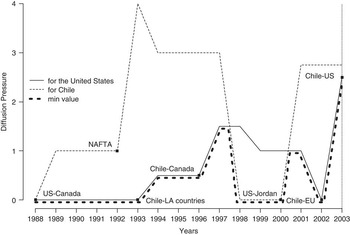
Figure 2 provides a schematic representation of how this variable may change for a dyad by looking at the country pair Chile–United States (the figure is an abstraction and does not show all the agreements signed by the two countries in this period). Initially, the signature of the United States–Canada agreement (1988) and, in particular, of NAFTA (1992) should have increased the pressure on Chile to sign an agreement with the United States. In fact, shortly after the conclusion of NAFTA, there was talk of Chile becoming a member of that agreement.Footnote 43 At that time, however, the United States felt hardly any pressure to sign an agreement with Chile. The agreements between a series of Latin American countries (among them, Bolivia, Colombia and Venezuela in 1993) and Chile only had a minor impact on the United States, because these countries exported little to Chile and because their exports did not compete with those from the United States in the Chilean market. Our counter-factual expectation is that if Chile had signed a trade agreement with a direct competitor of the United States, a Chile–United States trade agreement would have already come about in the 1990s.Footnote 44 In the absence of such an agreement, the United States only became willing to sign an agreement with Chile in 2003, one year after that country signed a trade agreement with the European Union, a major competitor of the United States.
The spatial weight for the dyad Chile–United States (schematic representation)

Alternative Diffusion Mechanisms
Besides reaction to trade diversion, several alternative causal mechanisms could drive the diffusion of trade agreements. In the empirical analysis below, we control for the possibility that diffusion is a result of either emulation or security externalities. Emulation, which is defined as ritualistically ‘following or doing oppositely of others’,Footnote 45 results from a demonstration effect.Footnote 46 Such an effect is most likely among countries that are close either geographically or culturally, because there is more communication between geographically close countries and because it is easier to relate to the experiences of culturally close actors. The expectation, thus, is that the probability of a preferential trade agreement between countries A and B grows with the number of preferential agreements in which A and B participate and the diminishing distance, either geographic or cultural, between the two countries. We capture the geographical distance argument by multiplying the reciprocal of distance by the number of agreements that the other country signed within the past five years.Footnote 47 Building on work by Zachary Elkins, Andrew Guzman and Beth Simmons, we construct three different spatial weight matrices to capture cultural distance.Footnote 48 Each of the matrices uses a different proxy for cultural distance: whether two countries share the same predominant language, predominant religion and a common colonial past.
Diffusion of trade agreements could also result from security externalities. Neorealist International Relations theory argues that the anarchic structure of the international system makes states apprehensive of increases in the power of other states, as these states may use their new capabilities to attack and defeat them.Footnote 49 Whenever preferential trade agreements stimulate trade flows between two countries, they lead to a more efficient allocation of resources and thus free up some resources for military use.Footnote 50 The increasing wealth and power of member countries should be of concern to excluded countries that are military rivals. An agreement between two countries may thus force other dyads to follow suit, with the aim of retaining their current relative position vis-à-vis these countries. According to this view, what we should witness is the development of rival trade blocs that mirror security alliances. To capture this effect, we calculate a spatial weight matrix that increases the probability of two countries signing an agreement if they had a military conflict with a third country in the period since the Second World War. The more trade agreements this third country signed in the past five years, the higher the pressure on its military rivals to sign a trade agreement.
Control Variables
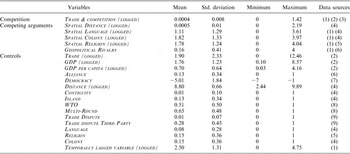
We also control for a series of characteristics of the dyad under analysis that could influence the probability of two countries signing an agreement and the context in which a dyad considers concluding an agreement. Doing so is vital to avoid overestimating the effect of the spatial lags, as parallel policy choices may be a result not only of spatial interdependence, but also of correlated unit-level factors or the exogenous shocks that are common to various dyads.Footnote 51 In line with previous studies in the field, we hence include several economic, geographical and political control variables in our model. Most of these variables are lagged by one year to avoid endogeneity problems.Footnote 52
With regard to the variables capturing the economic conditions in place at the time a pair of countries is considering signing an agreement, we first control for the amount of trade between them (Trade). An increase in trade may boost the probability of two countries forming a preferential trade agreement as large trade flows are likely to be accompanied by relation-specific investments, which would result in traders becoming more dependent on access to each other's markets. These traders then may ask for a preferential trade agreement to lock in the existing situation and to forestall either sides adoption of protectionist trade policies.Footnote 53 Trade may also be a factor because the positive welfare effects of a preferential trade agreement should be more significant for country pairs having large trade flows before the conclusion of the agreement.Footnote 54
We also take into account the size of the economy of the two countries in order to capture the idea that the larger the countries participating in a preferential trade agreement the greater the economic gains. As Scott Baier and Jeffrey Bergstrand argue, a preferential agreement between two large economies increases the volume of trade relative to the increase between two smaller economies in more ways than one.Footnote 55 In addition, a more sizeable increase in trade between two large countries causes a larger net expansion of demand and, as such, a larger rise in real income. We capture this idea by including the gross domestic product (GDP) of the smaller of the two countries in a dyad (GDP). A further economic factor that may influence the likelihood of an agreement between a pair of countries is their level of development. The more developed the two countries the easier they should find it to conclude an agreement. There are two reasons for this expectation. First, a country with a highly developed economy is less dependent on tariff revenues. Second, a developed country is in a better position to compensate groups within that society that face adjustment costs arising from trade liberalization.Footnote 56 The variable that captures this argument is the GDP per capita of the less developed of the two countries (GDP per Capita).
Two control variables capture domestic and international political conditions. At the international level, military allies would be expected to be more likely to sign an agreement than other pairs of countries (Alliance). At the domestic level, previous research has shown that democratic pairs of countries tend to sign more preferential trade agreements than non-democratic or mixed pairs.Footnote 57 We use the seven-point Freedom House scale of democracy to measure this variable.Footnote 58 The Freedom House index has the advantage of covering all the countries for the full duration of our dataset.Footnote 59 We invert the values provided by Freedom House so that 1 is the value for a completely oppressive regime and 7 the value for a completely free regime (Democracy ).
Further, we include three variables that capture the geographic position of the two countries. For one, as trade costs increase with distance, geographically proximate countries are more likely to form a preferential trade agreement than geographically distant countries.Footnote 60 We thus incorporate the (natural logarithm of the) distance in kilometres between the two capitals of the pair of countries in our model (Distance). In addition, neighbouring countries can be expected to be more likely to sign an agreement. On average, adjacent countries have closer economic and stronger political ties. Following this reasoning, we expect countries that share a common border to be more likely to sign an agreement (Contiguity). Finally, we control for whether at least one of the two countries is an island, as the specific geographical circumstances of such countries may influence their likelihood of signing an agreement (Island ).
Four control variables account for the position of the countries in, and the general state of, the international trading system. As members of the WTO tend to have more similar trade policies than countries that do not form part of this international organization, dyads in which both countries are WTO members should be more likely to conclude an agreement (WTO). In addition, we consider the possibility that countries’ propensity to conclude preferential trade agreements increases during WTO-sponsored multilateral trade negotiations (WTO round). We also control for the argument that involvement in trade disputes may influence a pair's likelihood to conclude a trade agreement. Having a trade dispute with the other side should decrease the probability of an agreement (Trade Dispute), whereas having a dispute with a third party should increase it (TradeDispute Third Party).Footnote 61
Furthermore, we use three proxies to capture the cultural distance between the two countries, as culturally similar countries may find it easier to negotiate an international agreement. These proxies are common principal language, same religion and common colonial heritage (Language, Religion and Colony). Finally, we include the (natural log of the) sum of the number of agreements signed by the two countries prior to time t to control for potential endogeneity resulting from the inclusion of a lagged dependent variable as an independent variable in our model.Footnote 62
Findings
We use survival analysis, and more specifically, a Cox proportional hazards model with standard errors adjusted for clustering on dyads, to examine our argument.Footnote 63 The advantage of using the Cox model over the various survival models on offer is that it does not require us to make assumptions about the shape of the underlying survival distribution.Footnote 64 As described above, our model includes a spatial lag to capture the external competitive effect of the decision by two countries to sign an agreement, several alternative spatial lags, and control variables for both the dyad under consideration and potential external shocks.Footnote 65 We thus estimate the following equation:

where hijt is the hazard rate for two countries i and j at time t, h 0 is the baseline hazard, β 1 and β 2 are vectors of coefficients, wij ,t −1yij ,t . is a vector of spatial lag terms that are temporally lagged as described above, xij ,t −1 is a vector of control variables that are lagged by a year, and εij ,t is the error term. As is common practice in recent research on the statistical analysis of panel data with a binary dependent variable, we base significance tests on Huber (robust) standard errors.Footnote 66 These standard errors can take account of possible heteroscedasticity and potentially unequal variances across dyads.
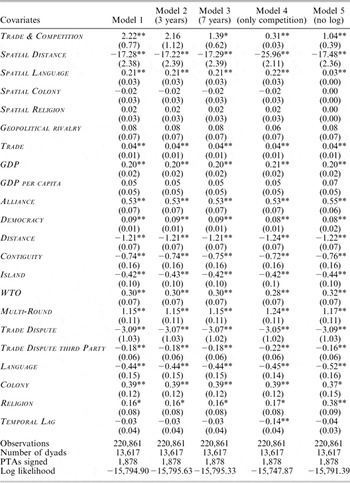
The findings are very supportive of our argument (see Model 1 in Table 1). The coefficient for the trade and competition variable has the right sign and is highly statistically significant. Of the alternative spatial weight terms, only two, namely the ones capturing geographic distance and common language, are statistically significant. Interestingly, if two countries are geographically close and have signed trade agreements in the past five years, they are less likely to sign an agreement with each other than countries that are geographically more distant. The finding that a country is influenced by the agreements concluded by other countries that share a common language is more intuitive. The lack of support for the geopolitical rivalry argument also is remarkable. In the post-Cold War world, it seems, countries do not react to agreements concluded by countries that may pose a military threat.
The Diffusion of Preferential Trade Agreements

Notes: The table reports coefficients from a Cox proportional hazards model. Robust standard errors, adjusted for clustering on dyads, are in parentheses. ** Statistically significant at 1 per cent, * statistically significant at 5 per cent.
Turning to the remaining variables, many of those that have been emphasized in previous research also turn out to be significant in this model, giving added plausibility to our findings. Looking first at the variables capturing economic conditions, as expected, a pair of countries with a strong trade link is more likely to form a trade agreement. The economic size of two countries also has an impact on the likelihood of them signing an agreement. By contrast, the level of economic development of the two countries considering the conclusion of a trade agreement does not play a role. Security concerns equally have an effect on the probability of signing a preferential trade agreement, as countries that form part of the same alliance are more likely to sign a trade agreement. Democracy, moreover, is statistically significant, which is in line with previous research. As the original study on the role of democracy in the conclusion of trade agreements only had data up to 1992, whereas our database covers agreements until 2007, our findings provide important support for this earlier study.Footnote 67 The finding that distance reduces the likelihood of an agreement between two countries is intuitive. The same applies to the result that country pairs of which at least one is an island are less likely to conclude an agreement. By contrast, the strongly statistically significant negative sign of the estimated coefficient for contiguity is somewhat surprising. A potential explanation for this result is that contiguity does not add anything to the likelihood of two countries signing an agreement that is not already captured by distance between, trade flows between and often a similar culture in neighbouring countries.Footnote 68
With respect to the variables capturing the influence of the international trading system on the decision of two countries to conclude an agreement, dyads in which both countries are members of the WTO are more likely to sign trade agreements. Moreover, countries are more likely to sign an agreement in tandem with negotiations at the WTO level. The effect of a trade dispute between pair of countries on their proneness to sign an agreement has the right sign and is statistically significant. Surprising, given the findings reported in a study by Mansfield and Reinhardt, is the result that two countries are less likely to sign an agreement if they have a trade dispute with third countries.Footnote 69 Moreover, all three variables capturing the cultural distance between two countries are statistically significant, although the finding that common language reduces a dyad's probability of signing an agreement is unexpected. Finally, the temporal lag variable that controls for potential endogeneity is not statistically significant.
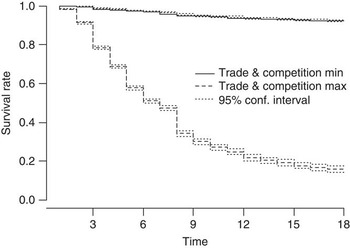
Figure 3 illustrates the magnitude of the effect that we estimate.Footnote 70 It shows the effect of an increase in the value of the trade and competition variable from the smallest to the largest value. At the minimum, a dyad's survival rate declines from 1 to 0.92 over the eighteen-year period. At the maximum, by contrast, the drop is from 1 to 0.15. This sizeable difference is an indication of the strength of the effect that we find. A comparison of the predicted probabilities of a dyad signing an agreement for low and high values on the trade and competition variable provides a further illustration of the magnitude of the effect of this variable. Taking the mean predicted survival probability for all dyads with a value larger than the mean on the trade and competition variable, the overall prediction is for 111 dyads (with the 95 per cent confidence interval going from 100 to 122) forming a preferential trade agreement each year. By contrast, when using the mean predicted survival probability for those dyads with a value lower than the mean on the trade and competition variable, only fifty-four dyads (the 95 per cent confidence interval goes from 46 to 62) are expected to sign an agreement each year. The expected number of preferential agreements thus doubles for dyads that face significant trade diversion as a result of preferential trade agreements between other countries.
The substantive effect

Robustness Checks
We undertook a series of tests to examine the robustness of these results to changes in operationalization. First, we estimated models in which we assume that preferential trade agreements have an impact on third countries for, respectively, between one and three (Model 2 in Table 1) and between one and seven years (Model 3) after their signature. These changes control for the robustness of our initial hunch of a five-year effect. Whereas in the three-year model the coefficient just misses the 95 per cent confidence level (p = 0.053), in the seven-year model the variable is statistically significant. These findings indicate that our five-year cut-off point is reasonable and that countries need some time to negotiate preferential trade agreements in response to discrimination. A further important result of these models is that the estimated coefficients for all other variables are not affected by these changes in our independent variable of interest.
Second, we checked whether our results are robust to a different operationalization of potential for trade diversion. Specifically, we calculated a spatial weight term that only includes the competition and PTA terms from Formulas 1 and 2, thus excluding trade shares. The reason for doing so is that exporters may not be concerned about the size of the trade flows affected by a preferential trade agreement from which they are excluded, but only about the fact that they compete with the third country in that market.Footnote 71 Doing so does not change the substantive findings (Model 4 in Table 1). In fact, the model is highly robust to this change. Third, we ensured that our results are not influenced by the decision to log the spatial variables (Model 5 in Table 1). Again, the main results reported previously are not affected by this robustness check. Finally, we omitted the three variables capturing cultural distance between two countries (language, religion and colony) to check whether this influences the findings for the alternative diffusion mechanisms.Footnote 72 Even in this model, however, the spatial lags capturing diffusion via a common colonial heritage and geopolitical rivalry do not have a statistically significant effect on the signing of new preferential trade agreements.
Conclusion
We have argued that exporters increase their level of political activity in response to trade diversion resulting from the creation of preferential trade agreements from which they are excluded. The mobilization of exporters, in turn, brings about a change in the balance of domestic interests that encourages the government to pursue a preferential trade agreement with the country in which its exporters face discrimination. The new regionalism, in this reading, can be seen as a process driven by countries responding to trade diversion. The main contribution of this article is the design and execution of a quantitative test of this argument that captures the trade diversion logic as directly as possible. The empirical results are very supportive; the formation of preferential trade agreements is indeed an interdependent process and seems to be largely driven by countries responding to the negative externalities of existing agreements. This finding of preferential trade agreements as largely defensive instruments is in line with the conclusion of a related study, namely that such agreements may ‘benefit members as much by locking in the status quo as by improving it’.Footnote 73
In future research, the present analysis could be extended by considering the fact that preferential trade agreements, especially those that include investment provisions, threaten both trade and foreign direct investment flows. The North American Free Trade Agreement, for example, not only created problems for Japanese companies exporting to Mexico but also for Japanese companies interested in investing in that country.Footnote 74 Two extensions of the empirical analysis presented here would capture this effect. On the one hand, by looking at investment flows, it should be possible to calculate the potential for investment diversion resulting from a preferential trade agreement. On the other hand, as investment diversion is most likely in cases in which an agreement includes an investment chapter, being able to specify exactly which agreements do so would help tackle this point. A future study may thus provide an even more comprehensive examination of the argument presented here.
The article has broad implications for the study of International Relations and International Political Economy. It presents a causal mechanism that explains how the policies of one country can influence the balance of domestic interests in another country. An analogous effect could be hypothesized to be at work whenever the policies of a group of countries have negative externalities for an excluded country. More specifically, co-operation between two or more countries that discriminates against third countries should have a pull effect that is comparable to that captured in this article for the case of preferential trade agreements. The European Higher Education Area, which aims at making European higher education more attractive, provides an illustration of this point. In this case, a co-operation effort that started with four countries in 1998 has grown to encompass no fewer than forty-seven member countries in 2010. One reason for the pull effect may be that the co-operation made some university systems more attractive to international students than others. Also outside of the trade realm, the spread of international agreements may thus be driven by a similar logic to the one detailed here.
Data for Model 1

Sources: (1) see Note 33; (2) IMF, The World Economic Outlook (IMF Data and Statistics, 2008). 〈http://www.imf.org/external/pubs/ft/weo/2009/02/weodata/index.aspx〉; (3) World Bank, World Development Indicators (World Bank Data&Statistics, 2009). 〈http://publications.worldbank.org/WDI/〉; (4) CEPII, Dataset (2006). 〈http://www.cepii.fr/anglaisgraph/bdd/bdd.htm〉; (5) Encyclopedia Britannica, Encyclopedia Britannica Book of the Year (Chicago: Encyclopaedia Britannica, 2001); (6) Correlates of War dataset; (7) Freedom House, Freedom in the World (Washington, D.C.: Freedom House, 2007); (8) World Trade Organization, Members and Observers (2008). 〈http://www.wto.org/english/thewto_e/whatis_e/tif_e/org6_e.htm〉; (9) Henrik Horn and Petros C. Mavroidis, WTO Dispute Settlement Database (2006). 〈http://go.worldbank.org/X5EZPHXJY0〉.