Introduction
Type 1 diabetes mellitus (DM type 1) is a chronic disease caused by an autoimmune process that leads to destruction of β-cells, insulin deficiency and hyperglycemia. Diabetes management includes subcutaneous application of insulin, repeated blood glucose measurements, and carbohydrate counting, all with the aim to reach normal blood glucose levels and to avoid acute and long-term complications. These goals can only be achieved with knowledge, discipline, mental skills, self-control, and a psychic and social equilibrium (Diabetes Control and Complications Trial Research Group; Anonymous, 1994). Especially during puberty, owing to the related physiological, psychological and social changes, these requirements are difficult to maintain (Allen et al. Reference Allen, Tennen, McGrade, Affleck and Ratzan1983; Johnson et al. Reference Johnson, Silverstein and Rosenbloom1986; La Greca, Reference La Greca and Routh1988; La Greca et al. Reference La Greca, Auslander, Greco, Spetter, Fisher and Santiago1995; McConnell et al. Reference McConnell, Harper, Campbell and Nelson2001; Tubiana-Rufi, Reference Tubiana-Rufi2001; Schoenle et al. Reference Schoenle, Schoenle, Molinari and Largo2002; Delamater, Reference Delamater2007; Gerstl et al. Reference Gerstl, Rabl, Rosenbauer, Gröbe, Hofer, Krause and Holl2008).
Stress (Lloyd et al. Reference Lloyd, Dyer, Lancashire, Harris, Daniels and Barnett1999), inadequate social support (Schiffrin & Mortimer, Reference Schiffrin and Mortimer2001), poor coping skills (Peyrot & McMurry, Reference Peyrot and McMurry1992), depression, poor self-esteem (Schiffrin & Mortimer, Reference Schiffrin and Mortimer2001) and externalizing problems (Leonard et al. Reference Leonard, Jang, Savik, Plumbo and Christensen2002) seem to have a negative impact on self-care and glycemic control. On the other hand, family cohesion and adaptability (Leonard et al. Reference Leonard, Jang, Savik, Plumbo and Christensen2002; Urbach et al. Reference Urbach, LaFranchi, Lambert, Lapidus, Daneman and Becker2005), positive coping strategies (Beardsley & Goldstein, Reference Beardsley and Goldstein1993; Amer, Reference Amer1999), younger age of onset, social support (Amer, Reference Amer1999) and adequate self-regulatory behavior (Stewart et al. Reference Stewart, Lee, Waller, Hughes, Low, Kennard, Cheng and Huen2003) favourably influence glycemic control.
There are conflicting data about the interaction between diabetes and neurophysiological functioning in children and adolescents. Especially recurrent severe hypoglycaemia is suspected to be responsible for long-term cognitive impairment (Hannonen et al. Reference Hannonen, Tupola, Ahonen and Riikonen2003). Recent data suggest that diabetes itself may be associated with neurobehavioral and neuropsychological changes (Ryan, Reference Ryan1988) such as decreased information processing speed and conceptual reasoning abilities (Northam et al. Reference Northam, Anderson, Werther, Warne, Adler and Andrewes1998), learning (Northam et al. Reference Northam, Anderson, Werther, Warne, Adler and Andrewes1998; Hannonen et al. Reference Hannonen, Tupola, Ahonen and Riikonen2003), problem-solving skills, mental and motor speed, eye–hand coordination (Ryan, Reference Ryan1988) and attention deficit (Ryan, 1988,Reference Ryan2006). Duration of the disease has been related to compromised learning capacity (Fox et al. Reference Fox, Chen and Holmes2003), school performance (Dahlquist & Källen, Reference Dahlquist and Källen2007), performance intelligence quotient (IQ) (Holmes & Richman, Reference Holmes and Richman1985) and memory skills (Hershey et al. Reference Hershey, Lillie, Sadler and White2003). In this context, four neurobehavioral risk factors have been identified: age at diagnosis (Ryan, Reference Ryan1988; Rovet & Alvarez, Reference Rovet and Alvarez1997), occurrence of school-related problems (Ryan, Reference Ryan1988; Hagen et al. Reference Hagen, Barclay, Anderson, Feeman, Segal, Bacon and Goldstein1990), degree of metabolic disturbance, and severe episodes of hypoglycemia (Ryan, Reference Ryan1988; Northam et al. Reference Northam, Anderson, Jacobs, Hughes, Warne and Werther2001; Hannonen et al. Reference Hannonen, Tupola, Ahonen and Riikonen2003). DM type 1 has also been connected with altered hypothalamo-pituitary-adrenal axis regulation and serotonergic neuronal changes (Price et al. Reference Price, Kelley, Ryan, Meltzer, Drevets, Mathis, Mazumdar and Reynolds2002). Although the exact mechanisms underlying this diabetic encephalopathy are only partially known, chronic metabolic and vascular changes appear to play an important role (Brands et al. Reference Brands, Kessels, de Haan, Kappelle and Biessels2004). Hypoglycemia may lead to neuron damage in the medial temporal region, and especially the hippocampus (Price et al. Reference Price, Kelley, Ryan, Meltzer, Drevets, Mathis, Mazumdar and Reynolds2002; Akyol et al. Reference Akyol, Kiylioglu, Bolukbasi, Guney and Yurekli2003). In contrast to these findings, neither severe hypo- nor hyperglycemia were related to short-term (18 months) effects on cognition and executive functions (Wysocki et al. Reference Wysocki, Harris, Mauras, Fox, Taylor, Jackson and White2003). Northam et al. (Reference Northam, Bowden, Anderson and Court1992) found no relationship between neuropsychological functioning and age at onset of diabetes, poor metabolic control or major metabolic crises.
To date it is not clear if non-optimal glycemic control [GC-N; high hemoglobin A1c (HbA1c) values] is related to neuropsychological deficits, e.g. of executive functions or to psychological maladjustment, problems of self-control, of compliance with medical care or an external attributional style. We therefore investigated children and adolescents with DM type 1 and a group of non-diabetic controls in order to evaluate influences of neuropsychological and clinical factors. The aim of our study was to find out if there is a relationship between metabolic control and clinical neuropsychological function. Our primary hypotheses were that patients with diabetes show more cognitive impairment than non-diabetic controls, and that better cognitive functioning is associated with better metabolic control in adolescents with DM type 1.
Method
Subjects, materials and method
We prospectively investigated 70 children and adolescents with DM type 1 and 20 age-matched non-diabetic non-clinical controls. The patients were divided into two groups for patients with acceptable glycemic control (GC-A) and with GC-N. We used an HbA1c of 8.0% (i.e. 7.0% plus a margin of 15%) as the limit between GC-A and GC-N patients. This value meets clinical experience and was also confirmed by a cluster analysis of our HbA1c values. In addition, many pediatric diabetologists will accept HbA1c target levels of less than 8% in adolescents for clinical reasons. This appears reasonable because the mean HbA1c level observed at the centers participating in the Hvidore Study (Mortensen & Hougaard, Reference Mortensen and Hougaard1997) was mostly <8.0%. In our study, 36 patients had GC-A [HbA1c range 5.9–8.0%, mean HbA1c 6.9%, mean age 14.0 (s.d.=2.6) years] and 34 patients GC-N [HbA1c range 8.2–11.6%, mean HbA1c 9.3%, mean age 15.6 (s.d.=1.9) years]. Long-term glycemic control (mean HbA1c over the last 12 months) was 6.9 (s.d.=0.7) % (GC-A patients) v. 9.4 (s.d.=1.00) % (GC-N patients) (r=0.914). During this period two patients of the GC-A group had an HbA1c level above 8.0% (8.0 and 8.2%); none of the GC-N patients had an HbA1c level of less than 8%, indicating that the actual HbA1c was representative for the glycemic control of the patients. The control subjects were aged 11–18 [mean 15.1 (s.d.=1.9)] years.
All patients were consecutively recruited from our diabetes out-patient clinic over a period of 1.5 years (February 2004 until July 2005). The non-diabetic controls were recruited from our pediatric out-patient clinic if they were aged 9–19 years and presented for minor health problems. Patients and controls were included if they and their parents gave their informed consent to participate in our study, and if they were willing to perform the required psychological tests. Exclusion criteria were mental retardation, previous or present psychotic, bipolar or neurological disorders or poor German language skills. The clinical (International Classification of Diseases; ICD-10) diagnoses were assessed according to the Multiaxial Classification of Child and Adolescent Psychiatric Disorders. The study protocol was approved by the local ethics committee.
All children and adolescents were assessed by highly trained research clinical psychologists. We documented sociodemographic data, age at onset of DM type 1, and glycemic control as measured by HbA1c levels (determined by DCA-2000 Analyser®; Bayer AG, Leverkusen, Germany). For the statistical analysis, the school education was classified according to the achieved level into four classes: 1, primary education; 2, secondary education; 3, special school education; 4, vocational education. The parental occupation was classified into four classes according to Thompson & Hickey (Reference Thompson and Hickey2005): 1, upper middle class (academics, self-employed); 2, lower middle class (employees and public officials); 3, working class (craftspeople); 4, lower class (housewives, retired and unemployed).
All children and adolescents completed a number of standardized psychological tests assessing:
(1) Intelligence.
(2) Wechsler Intelligence Scale for Children – III (WISC-III) German version (Tewes et al. Reference Tewes, Rossmann and Schallberger2000) or Wechsler Adult Intelligence Scale – Revised (WAIS- R) German version (Tewes, Reference Tewes1991). Control subjects for reasons of available test time completed only three of 13 WISC-III subtests.
(3) Neuropsychological factors.
(4) Concept formation and cognitive flexibility [Wisconsin Card Sorting Test (WCST); Grant & Berg, Reference Grant and Berg1993].
(5) Interference [Stroop Color-Word Task (S-CWT) German version; Bäumler, Reference Bäumler1985]; data analysis included analysis of covariance with the covariate age because the data were not standardized for age).
(6) Psychomotor speed and mental flexibility [Trail Making Test part A (TMT-A) and B (TMT-B); Reitan, Reference Reitan1979].
(7) Personality factors.
(8) Behavioral problems and competence [Youth Self-Report (YSR) German adaptation; Döpfner et al. Reference Döpfner, Plück, Bölte, Lenz, Melchers and Heim1998].
(9) Child Behavior Checklist (CBCL; Achenbach & Edelbrock, Reference Achenbach and Edelbrock1983), parents' ratings of the patients' individual behavioral adjustment.
Scores were evaluated age related with the exception of the WCST.
In order to prevent an impact of hypo- or hyperglycemia on the psychological test, patients were instructed to report ‘abnormal’ (<60 or >200 mg/dl) blood glucose values if measured prior to the psychological testing. In addition, they were well trained to detect and report symptoms of hypoglycaemia.
Statistical analysis
Data were analysed using SPSS 14.0 for Windows (SPSS Inc., Chicago, IL, USA). We assessed descriptive statistics and analysed differences between groups by t test for independent samples, Mann–Whitney U or Kruskal–Wallis tests, χ2 analysis, and analysis of variance and covariance, depending on the distribution of variables and scales. We used linear regression analysis and logistic stepwise multivariate regression analysis to find out predictors for GC-A or GC-N and to assess the explanatory power of each predictor variable while controlling for effects of the others. All tests were applied two-tailed; significant results were accepted at an α level of 0.05.
Results
All 70 patients with GC-N (n=34, 48.6%) and GC-A (n=36, 51.4%) took part in the assessments. Five patients of the GC-N group and six patients of the GC-A group did not complete all psychological assessments because of poor motivation; for the same reason, one patient of the GC-N and four of the GC-A group did not complete all neuropsychological assessments.
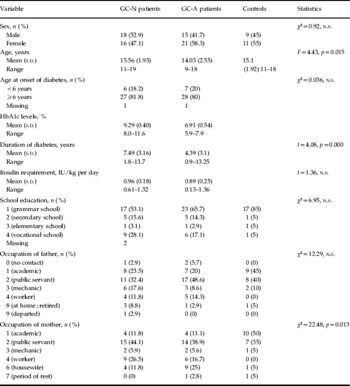
The mean duration of DM type 1 was 7.49 (s.d.=3.16, range 1.8–13.7) years in the GC-N and 4.39 (s.d.=3.1, range 0.9–13.2) years in the GC-A patients (t=4.08, p=0.000). There were no differences of insulin requirements between the two groups: the mean requirement was 0.96 (s.d.=0.18, range 0.61–1.32) international units (IU=6 nmol) insulin/kg per day in the GC-N group and 0.89 (s.d.=0.25, range 0.13–1.36) IU/kg per day in the GC-A group.
Sociodemographic variables (Table 1) were similar in both groups with the exception of age and duration of illness: GC-N patients were older and had a significantly longer duration of illness.
Sociodemographic data

GC-N, Non-optimal glycemic control; GC-A, acceptable glycemic control; n.s., non-significant; s.d., standard deviation; HbA1c, hemoglobin A1c; IU, international units.
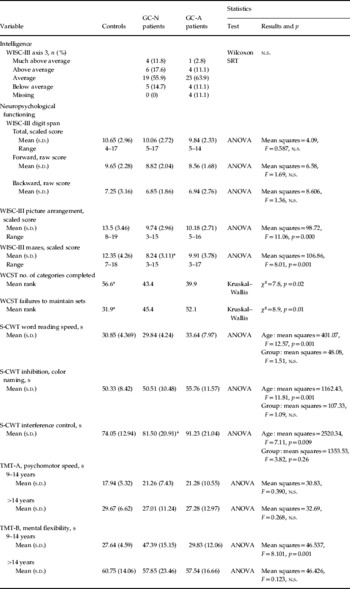
Data of selected neuropsychological variables are listed in Table 2.
Intellectual functioning and neuropsychological variables
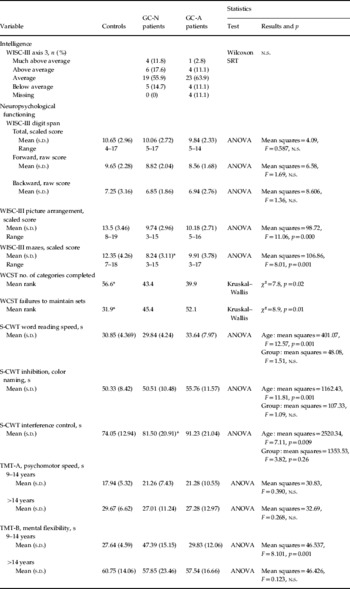
GC-N, Non-optimal glycemic control; GC-A, acceptable glycemic control; WISC-III, Wechsler Intelligence Scale for Children – III; SRT, signed ranks test; n.s., non-significant; s.d., standard deviation; ANOVA, analysis of variance; WCST, Wisconsin Card Sorting Test; S-CWT, Stroop Color-Word Task; TMT-A, Trail Making Test Part A; TMT-B, Trail Making Test Part B.
* Significantly different from that of the GC-A patients (p<0.05, Mann–Whitney U test).
Intelligence
Nearly all patients had normal intellectual capacity (Table 2). The distribution of the total IQ was similar to normative samples and similar in GC-A and GC-N patients.
Neuropsychological functioning (executive functions, Table 2)
Short-term memory (WISC-III digit span) was normal and similar in patients with diabetes and controls.
There were significant differences between the three groups concerning anticipation (WISC-III picture arrangement task), problem-solving capacity (WISC-III mazes task), concept formation (WCST number of categories completed), cognitive flexibility (WCST failures to maintain sets), word reading speed (S-CWT subtest 1), inhibition (S-CWT subtest 2), interference control (S-CWT subtest 3), psychomotor speed (TMT-A) and mental flexibility (TMT-B).
Age significantly affected the performance in the three S-CWT subtests.
There were no differences between the two groups of patients except for the mazes task (subtest WISC-III) where GC-A patients performed better, for one subtest of the S-WCT (interference control) where GC-N patients scored better, and for flexibility (TMT-B test) where GC-N patients aged less than 15 years scored better.
Duration of DM type 1 and age at onset (age <6 years or ⩾6 years) had no significant effect on intellectual function and neuropsychological variables.
Psychosocial adjustment
We found significant differences between the three groups in the CBCL variables ‘somatic complaints’ [χ2(2)=15.018, p=0.001], ‘internalizing problems’ [χ2(2)=6.466, p=0.039] and ‘activities’ [χ2(2)=8.572, p=0.014], and in the YSR variable ‘activities’ [χ2(2)=6.329, p=0.042].
Between the two groups of patients there was a significant difference in the CBCL variable ‘somatic complaints’ (mean range GC-N group 30.81 v. GC-A group 20.72, z=−2.511, p=0.012) but there was no difference in the YSR.
Linear regression analysis for predictive variables of psychometric scores showed significant effects for the YSR factor delinquent behavior (β=0.155, t=2.255, p=0.031) in the GC-N patients. Self-reported delinquent behavior increased and attribution of diabetes management to luck and chance decreased in relation to the duration of DM type 1.
Logistic regression analysis assessing the influence of psychological and neuropsychological variables for predicting metabolic control revealed a significant effect of the variables ‘age at onset’ [age <6 years or ⩾6 years: β(1)=3.833, odds ratio (OR)=46.22, p=0.006] and duration of DM type 1 [β(1)=−0.608, OR=0.544, p=0.000]. Younger age at onset (age <6 years) was associated with better glycemic control. Glycemic control was worse in patients with a longer duration of DM type 1. We also found significant effects of the CBCL factor ‘anxious/depressed’ [β(1)=−0.476, OR=0.621, p=0.046], signifying that parents reported that anxious/depressed behavior was related to GC-N, and for the YSR factors ‘withdrawn’ [β(1)=−3.481, OR=0.031, p=0.042], ‘somatic complaints’ [β(1)=−4.145, OR=0.016, p=0.027] and ‘internalizing score’ [β(1)=4.114, OR=61.198, p=0.029]. Gender, age, CBCL and YSR competence scores, and neuropsychological variables were not related to glycemic control.
Discussion
We found significantly impaired executive functions in children and adolescents with DM type 1 independent of the quality of metabolic control and the duration of the disease. This indicates that our patients had impaired abilities of planning, adapting and reacting to varying environmental conditions. Our findings especially point at problems in concept formation, cognitive flexibility, anticipation, problem-solving capacity, word reading speed, eye movement inhibition and interference control. These findings add to existing knowledge of diabetes-related cognitive impairment and impairment of attention, psychomotor speed and information processing (Northam et al. Reference Northam, Anderson, Jacobs, Hughes, Warne and Werther2001; Brands et al. Reference Brands, Kessels, de Haan, Kappelle and Biessels2004).
Northam et al. (Reference Northam, Anderson, Jacobs, Hughes, Warne and Werther2001) found reduced attention processing speed and executive dysfunction in children with onset of diabetes at less than 4 years of age. In our children age at onset of diabetes was not related to executive dysfunction.
Executive functions were disturbed at various levels in all patients with DM when compared with non-diabetic control subjects and with age-related standards. Executive dysfunction in children with normal intellectual abilities is not related to differences in IQ (Willcutt et al. Reference Willcutt, Doyle, Nigg, Faraone and Pennington2005). Most of our patients had average intellectual abilities. Therefore possible differences in IQ or social class between our patients and the non-diabetic controls (in whom we did not perform IQ tests) are not important.
Neurophysiological abnormalities (Ryan, Reference Ryan1988; Northam et al. Reference Northam, Anderson, Werther, Warne, Adler and Andrewes1998) and problems of school performance (Dahlquist & Källen, Reference Dahlquist and Källen2007) have previously been described as independent of glycemic control. More recent studies (McCarthy et al. Reference McCarthy, Kindgren, Mengeling, Tsalikian and Engvall2003) found associations between poor metabolic control and lower academic achievement and school performance. We found influences of glycemic control in two executive functions: problem-solving capacity (mazes task) and cognitive flexibility (TMT-B in children less than 15 years of age, Table 2).
In contrast to previous studies (Holmes & Richman, Reference Holmes and Richman1985; Ryan et al. Reference Ryan, Vega and Drash1985; Northam et al. Reference Northam, Anderson, Werther, Warne, Adler and Andrews1999; Fox et al. Reference Fox, Chen and Holmes2003; Hershey et al. Reference Hershey, Lillie, Sadler and White2003; Dahlquist & Källen, Reference Dahlquist and Källen2007) we found no association between neuropsychological changes and duration of DM type 1.
Disturbed executive functions, especially problems of anticipation (present in 20% of our patients) could explain difficulties in treatment compliance at least in some adolescent patients (Jonson et al. Reference Johnson, Silverstein and Rosenbloom1986; Jacobson et al. Reference Jacobson, Hauser, Wolfsdorf, Houlihan, Milley and Watt1987, Reference Jacobson, Hauser, Lavori, Wolfsdorf, Herskowitz, Milley, Bliss, Gelfand, Wertlieb and Stein1990; Kovacs et al. Reference Kovacs, Goldston, Obrosky and Iyengar1992). The fact that our younger patients achieved better glycemic control may be explained by the predominant parental control of diet and insulin administration in this age group (Mortensen & Hougaard, Reference Mortensen and Hougaard1997; Urbach et al. Reference Urbach, LaFranchi, Lambert, Lapidus, Daneman and Becker2005; Gerstl et al. Reference Gerstl, Rabl, Rosenbauer, Gröbe, Hofer, Krause and Holl2008). In fact, glycemic control was mainly related to two background variables: age at onset (<6 years of age) and duration of DM type 1. Younger age at onset and shorter duration of illness predicted better glycemic control. This is in agreement with previous reports of Amer (Reference Amer1999) and of Daviss et al. (Reference Daviss, Coon, Whitehead, Ryan, Burkley and McMahon1995).
We found no clinical or psychosocial predictors of treatment effectiveness and only a few small differences between GC-A and GC-N patients. This underlines that competence and adherence factors are important for diabetes control (Daviss et al. Reference Daviss, Coon, Whitehead, Ryan, Burkley and McMahon1995).
Our patients exhibited good psychosocial adjustment, independent of the HbA1c levels as documented by self-report and parental ratings. Most patients seemed to be resistant against psychopathological consequences of their chronic disease: compared with normative data, both groups neither exhibited internalizing nor externalizing behavioral problems. Our results suggest that most of the studied children were in a stable mental condition and well adapted to their disease. This is consistent with data of Martínez Chamorro et al. (Reference Martínez Chamorro, Lastra Martínez and Luzuriaga Tomás2001) who also found appropriate psychosocial adjustment and, compared with non-diabetic controls, no higher levels of depression and anxiety in children and adolescents with diabetes (Schiffrin & Mortimer, Reference Schiffrin and Mortimer2001). In contrast to Schiffrin & Mortimer (Reference Schiffrin and Mortimer2001) and Leonard et al. (Reference Leonard, Jang, Savik, Plumbo and Christensen2002), we found no influence of behavioral problems on glycemic control.
Physical complaints of the patients (Weglage et al. Reference Weglage, Grenzebach, Pietsch, Feldmann, Linnenbank, Deneke and Koch2000) were only reported by the parents (CBCL) but not by the patients themselves (YSR).
Our study bears various limitations: first, our sample is highly selected and comprises patients who regularly attend out-patient visits. Second, we did not perform subgroup analyses because of the relatively small number of patients in such subgroups. Third, we used self-assessment questionnaires that depend on the cooperativeness and forthrightness of our study participants. However, various parameters can only be assessed by cooperation-dependent methods, and the use of an extensive standardized test battery that included neuropsychological and psychosocial measures from various sources (self and parental rating) may be considered an accessible optimum. Fourth, we only investigated a few aspects of executive functions. Fifth, our data were collected cross-sectional and thus do not allow conclusions about trends or long-term problems. In addition, we used cross-sectional HbA1c levels for discriminating the two patients groups. Thus it may not be excluded that a few patients were by chance assigned to a specific group. From our experience this could have been the case only for single patients.
Future research, hopefully stimulated by our results, should focus on aspects such as larger subgroups, long-term effects, and additional tests for identifying factors predicting metabolic control.
In summary, our study describes various impairments of cognitive function in children and adolescents with DM type 1. The importance of these deficits must be further investigated but may be relevant for diabetes counselling.
Acknowledgements
None.
Declaration of Interest
None.