
Introduction
Depictions of big cats—lions and leopards—are relatively common in Near Eastern iconography, particularly during the Bronze and Iron Ages (c. 3000–50 BC). The association of these depictions with the power, status and authority of rulers has been widely documented (Watanabe Reference Watanabe and Paravre2000, Reference Watanabe2002; Strawn Reference Strawn2005). Such feline imagery was used by rulers as a symbol of power, demonstrating their control over territories, subjugation of foreign enemies, and the mastery of the wild boundaries of civilisation. This is seen most prominently in images of lion hunts and of caged lions representing domination and conquest (McMahon Reference McMahon2009: 118). In addition to iconographic representations, the remains of big cats have also been attested archaeologically across this region. These remains date from the Pleistocene onwards and suggest a natural distribution of lions (Panthera leo) and leopards (P. pardus) across Anatolia, the Levant and Mesopotamia (Schnitzler & Hermann Reference Schnitzler and Hermann2019). Lions were extirpated from these regions during the nineteenth century AD, while leopards retained a minimal presence in the Southern Levant (Schnitzler Reference Schnitzler2011: 238).
The widespread iconographic repertoire of big cats in the ancient Near East raises questions as to the significance and interpretation of the archaeological remains of these animals. Do the remains of big cats, recovered from across the Near East, represent the hunting of local predators for the protection of people and property? Are they the remains of elite hunting for sport? Or, given the depictions of big cats in the iconographic record and their association with status, might social and political significance have been attached to the physical remains of these animals? And if, for example, these physical remains represent an extension of the iconographic repertoire, does this affect reconstructions of the past distributions of these species? For example, if skins or trophies were exchanged and displayed, these finds might not reflect the natural distribution of these animals. The recent discovery of zooarchaeological remains of both lion and leopard, at the Iron Age site of Tel Burna (Israel), prompts the investigation of these questions locally and, in the context of a survey of other archaeological finds of big cats in the region, across the wider Near East.
Big cats in the ancient Near East
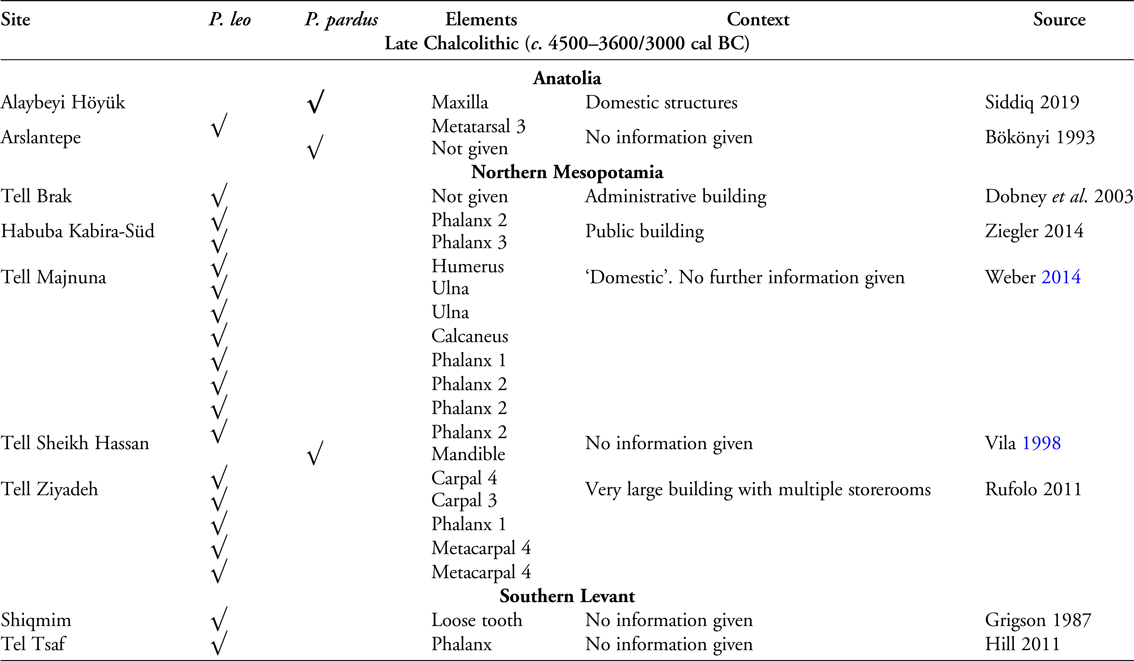
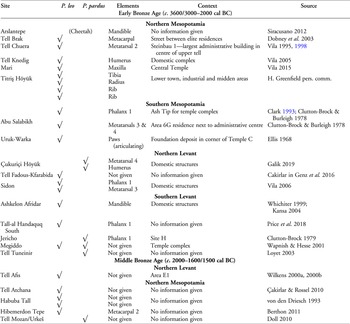
Visual representations of big cats are found across the Near East from as early as the Neolithic period (c. 7000 cal BC; Galik et al. Reference Galik, Horejs and Nessel2012: 274). These representations take many forms, primarily depicting big cats as wild or predatory hunters but also evoking mythical aspects, and are found on such diverse media as decorated pottery, figurines, stamps and seals. Beginning in the later Chalcolithic period (c. 3500 cal BC), with the rise of the first states in Uruk, Mesopotamia, depictions of big cats begin to incorporate associations of physical power and temporal authority (Watanabe Reference Watanabe and Paravre2000, Reference Watanabe, Recht and Tsouparopoulou2021; McMahon Reference McMahon2009). Lions (and leopards) are largely depicted as dangerous creatures of the wild (Watanabe Reference Watanabe2002; Strawn Reference Strawn2005; Galik et al. Reference Galik, Horejs and Nessel2012: 280) or as demonstrations of the power and status of rulers, or states more generally (Strawn Reference Strawn2005; McMahon Reference McMahon2009: 116–8; Watanabe Reference Watanabe, Recht and Tsouparopoulou2021). These themes need not be mutually exclusive—iconographically, lions and leopards are symbols of power, regardless of whether that power is wild and dangerous or organised and domestic (Watanabe Reference Watanabe2002, Reference Watanabe, Recht and Tsouparopoulou2021; Galik et al. Reference Galik, Horejs and Nessel2012). This can be seen in the depictions of caged lions, indicating the military powers of rulers, or in scenes of lion hunts, demonstrating the power of individuals who control both their political and natural environments (Watanabe Reference Watanabe and Paravre2000, Reference Watanabe2002; Strawn Reference Strawn2005; McMahon Reference McMahon2009). In Mesopotamia, the association of lions with political power occurs as early as the Chalcolithic or Early Bronze Age (see Tables 1 and 2; McMahon Reference McMahon2009: 121). Whereas, in other regions—the Levant and Anatolia—depictions of big cats primarily emphasise the animals’ wild or mythological aspects, up until the Late Bronze Age when depictions systematically begin to include the association of lions with power, status and authority (Strawn Reference Strawn2005; Ornan & Lipschits Reference Ornan and Lipschits2020).
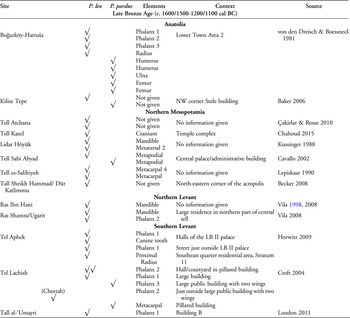
Details of big-cat skeletal remains and their find contexts (where known) from the Late Chalcolithic (c. 4500–3600/3000 cal BC) Near East. See OSM for full list of references.

Details of big-cat skeletal remains and their find contexts (where known) from the Early (c. 3600/3000–2000 cal BC) and Middle Bronze Age (c. 2000–1600/1500 cal BC) Near East. See OSM for full list of references.

The big cats of Tel Burna
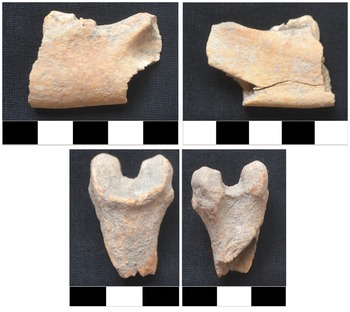
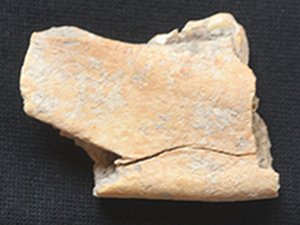
Tel Burna is located in the lowlands of Judah (known as the Shephelah), in a region intensively settled during the Bronze and Iron Ages (c. 3500–701 cal BC). The site controlled one of the major east–west routes in this region and its significance in the Iron Age stems from its location between the principal Philistine city, Gath (Tell es-Safi), to the west (Maeir Reference Maeir2012), and the main Judahite administrative centre, Lachish, to the east (e.g. Locatell et al. Reference Locatell, Shai, Uziel and Hagemeyer2022). The identification of the site as the biblical city of Libnah (Uziel & Shai Reference Uziel and Shai2010; McKinny & Dagan Reference McKinny and Dagan2013; Shai Reference Shai, Lipschits and Maeir2017; Suriano et al. Reference Suriano, Shai and Uziel2021) correlates with the discovery of Iron Age II casemate fortifications (measuring 70 × 70m) surrounding the summit, accentuating the site's role as a border fortress (Maeir & Shai Reference Maeir, Shai, Galon, Kriemerman, Streit and Mumcuoglu2016; Shai Reference Shai, Lipschits and Maeir2017). Excavations conducted at Tel Burna since 2010 have thus far exposed several strata from the Iron Age IIA to IIC (tenth to sixth centuries BC), the material culture of which strongly supports the identification of the site as a Judahite town (Shai Reference Shai, Lipschits and Maeir2017). At the centre of the site, excavations have revealed a large structure (Building 32417) dating to the Iron Age IIB (c. 840–701 BC; Shai et al. Reference Shai, Cassuto, Dagan and Uziel2012; Shai Reference Shai, Lipschits and Maeir2017). This structure was likely occupied by the local governor or regional leader (Maeir & Shai Reference Maeir, Shai, Galon, Kriemerman, Streit and Mumcuoglu2016; Shai Reference Shai, Lipschits and Maeir2017). One fragment of a mandible from a leopard (Panthera pardus) and one proximal phalanx of a lion (P. leo) have been recovered from this building (Figure 1).
Lion and leopard bones recovered from Building 32417 at Tel Burna, with scale in centimetres. Top: lateral (left) and medial (right) views of mandible fragment of a leopard (Panthera pardus). Bottom: anterior (left) and posterior (right) views of proximal first phalanx of a lion (Panthera leo) (figure/photography by J.S. Gaastra).

Big-cat hunting: ideal or real?
The identification of the remains of both lion and leopard at Tel Burna can be used as a proxy for how we might best understand the presence of big-cat remains recovered from archaeological contexts in the ancient Near East. Zooarchaeological remains of lions and leopards have been recovered from archaeological contexts in this region from as early as 500 000 years ago (Bar-Yosef & Belmaker Reference Bar-Yosef and Belmaker2011: 1320). The reconstruction of the past ranges of both species based on archaeological finds has largely assumed that these remains were recovered from within the animals’ natural distributions and that the animals were hunted locally as part of human management of the landscape (e.g. Schnitzler Reference Schnitzler2011; Schnitzler & Hermann Reference Schnitzler and Hermann2019). However, the depiction of big cats and big-cat hunting scenes in the iconographic record, suggests that these animals might not have been merely a local nuisance managed for the safety of human residents and their livestock. The presence of big-cat remains within the central building—and only this building—at Tel Burna further questions the interpretation of such remains as the by-product of the management of local predators. It is also possible that the hunting of big cats might have been a local elite pastime.
The inclusion of big cats in Near Eastern iconography also raises the question of whether the physical remains of these animals held any symbolic significance, which may have led to the curation or even trade of skins and/or skeletal elements, potentially moving remains beyond the natural ranges of these species (Clark Reference Clark and Green1993; Vila Reference Vila1998).
In order to understand the significance of the remains of big cats at Tel Burna, and across the wider region, it is necessary to collate and compare the distribution of other zooarchaeological finds of lions and leopards from sites across the Near East. As the iconographic or symbolic association of big cats and big-cat hunting with elites was unknown prior to the Chalcolithic (in Mesopotamia; extending to the Levant and Anatolia by the Late Bronze Age), we start our study with material from Neolithic contexts as a baseline, and then extend down through the Chalcolithic, Bronze and Iron Ages.
Materials and method
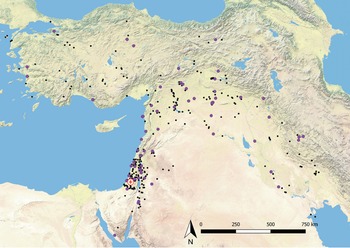
The present article reports on results obtained from the compilation of published zooarchaeological literature from five regions of the Near East (Anatolia, Northern and Southern Mesopotamia, and the Northern and Southern Levant) covering a time span from the Neolithic to the Iron Ages (c. 9600–50 cal BC). These were taken from an existing database of published zooarchaeological data for the Holocene Near East (e.g. Gaastra et al. Reference Gaastra, Greenfield and Greenfield2020, Reference Gaastra, Welton, de Gruchy and Lawrence2021). A total of 311 sites provided 958 faunal samples, which have been allocated to broad chronological phases—e.g. Neolithic, Chalcolithic, Late Bronze Age, and the samples for each chronological phase, including those from different phases of the same site, are hereafter referred to as ‘phase-samples’—for ease of comparison. The geographical distribution of zooarchaeological finds included in this study is shown in Figure 2, with the locations of sites with big-cat remains highlighted. To identify any patterns in the geographical or temporal distribution of faunal remains of leopards and lions, and to determine whether changing patterns may indicate a shift in hunting and/or use of these animals from the Chalcolithic onwards, the zooarchaeological remains and their specific archaeological contexts are examined in detail and compared with the iconographic record.
Map showing the locations of sites included in this study. All sites included in the comparative database are shown as black dots with those containing remains of either leopard (P. pardus), lion (P. leo) or cheetah (Acinonyx jubatus) shown as purple dots. The location of the site of Tel Burna is shown by a red and white + (figure by J.S. Gaastra).

Where information is available, the remains are classified according to the body portion represented: ‘head’ (cranium and mandible), ‘feet’ (carpals, tarsals, metapodials and phalanges) and ‘body’ (i.e. post-cranial elements apart from the feet, ribs, vertebrae and limbs). Where such information is unavailable, remains are classified as ‘not known’. These bodily portion categories allow for the discrimination of elements which may be associated with preserved skins (‘head’ and ‘feet’) from those which would indicate the presence of a complete carcass (‘body’). This distinction is possible due to the common practice of retaining the bones of the head and feet when skinning and preserving animal furs as pelts. This technique, often employed in the preservation of skins from large predators, maintains the distinctive head shape of the animal and emphasises their impressive claws (Weber Reference Weber, McMahon and Crawford2014). Lion bones recovered from multiple sites across the region are noted by multiple zooarchaeologists as having potentially derived from preserved skins (Clark Reference Clark and Green1993; Vila Reference Vila1998; Weber Reference Weber, McMahon and Crawford2014), but the frequency or extent of such potential practices remains unknown.
Results
Details of big-cat remains recovered from post-Neolithic sites, including both the specific skeletal elements and the archaeological contexts from which they were recovered (where known), are given in Tables 1 to 4. Bibliographical information for all sites and samples used in the comparative database can be found in the online supplementary material (OSM). The results demonstrate that the zooarchaeological remains of big cats are present across all regions of the Near East, but are not abundant. From the complete dataset of 958 phase-samples from 311 sites, big-cat remains are present in 80 phase-samples from 70 sites, or 8.4 per cent of samples from 22.5 per cent of sites. Chronological differences between these samples are evident. For the Neolithic period (22 sites/48 phase-samples/53 remains) leopards (Panthera pardus: 50 remains/94%) predominate over those of lions (P. leo: 3 remains/6%). After the Neolithic, lions become predominant. Across the Chalcolithic, Bronze and Iron Ages (51 sites/56 phase-samples/111 remains), the remains of lions (91 remains/82%) clearly outnumber leopards (18 remains/16%). Tel Burna is among a small group of sites (10 out of 51) that feature the remains of both lion and leopard (Tables 1 to 4). In addition, the remains of cheetah (Acinonyx jubatus), an animal believed never to have been native to the ancient Near East, were additionally identified from two site phase-samples (Early Bronze Age Arslantepe and Late Bronze Age Lachish).
Details of big-cat skeletal remains and their find contexts (where known) from the Late Bronze Age (c. 1600/1500–1200/1100 cal BC) Near East. See OSM for full list of references.

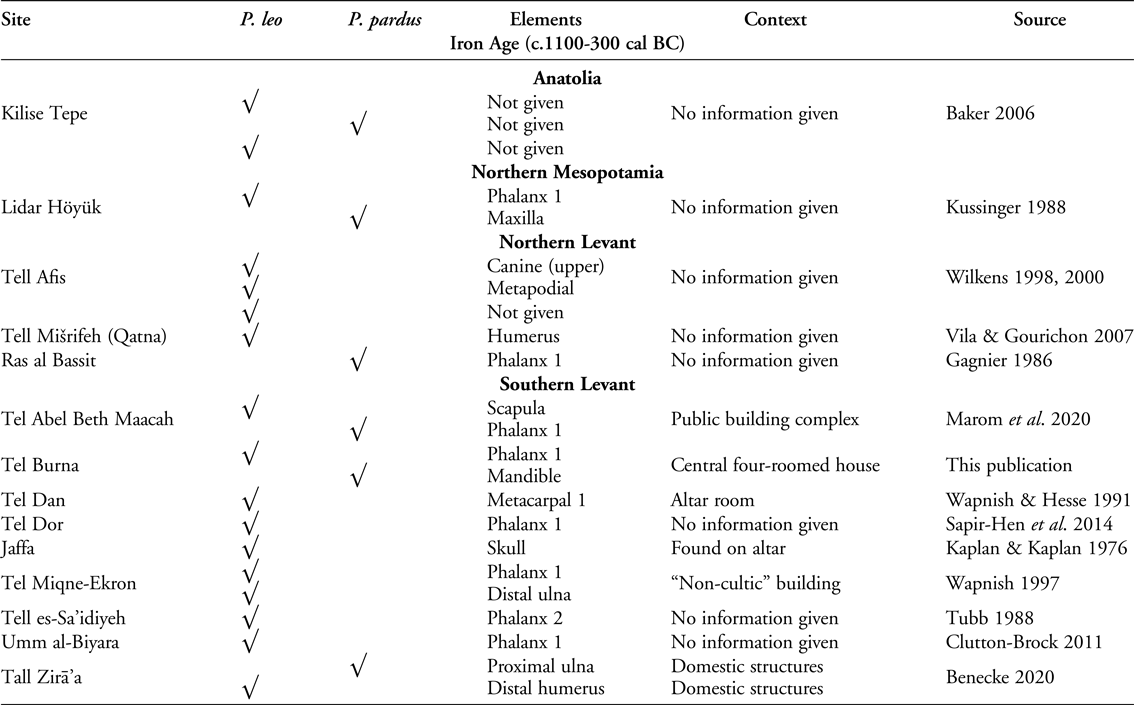
Details of big-cat skeletal remains and their find contexts (where known) from the Iron Age (c. 1100–300 cal BC) Near East. See OSM for full list of references.

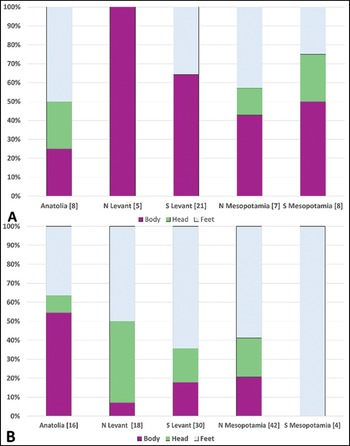
The remains of lions and leopards have been recovered from Neolithic sites across all areas of the Near East (Figure 2). Within these areas, 25–100 per cent of Neolithic big-cat remains can be identified as belonging to a specific portion of the skeleton (Figure 3, A). Remains from the ‘body’ (e.g. ribs, vertebrae and limbs) are found in higher proportions in the Levant and Mesopotamia, while 50 per cent of remains from Anatolia come from ‘feet’ elements. Remains from the ‘head’ are found less frequently in the Neolithic, representing 25 per cent of identifiable remains from Anatolia and Southern Mesopotamia, 15 per cent of remains from Northern Mesopotamia, and being entirely absent in the Levant. These patterns reflect the number of potential skeletal elements which may be present from each category: the ‘body’ (limbs and torso) of animals contains more identifiable bones than those within the ‘feet’ category, which in turn contains more identifiable elements than the two elements (cranium and mandible) of the ‘head’ category.
Proportion of skeletal elements identified as belonging to the body (including limbs), head or feet of big cats recovered from Neolithic (A) and post-Neolithic (B) sites in the Near East, grouped by region (figure by J.S. Gaastra).

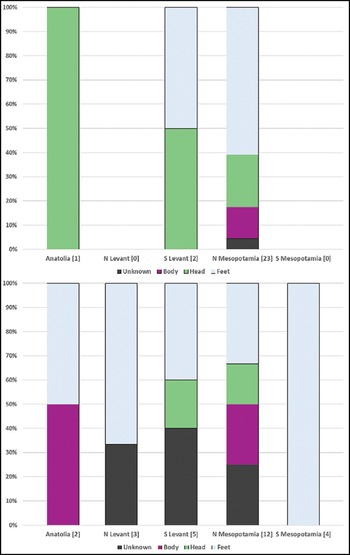
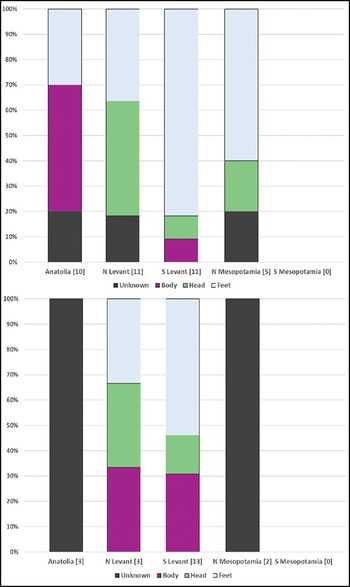
Following the Neolithic, when lion remains predominate, a different pattern emerges in the frequencies of body portions represented in the recovered remains (Figure 3, B). Big-cat remains from the Chalcolithic period (Figure 4, top) are uncommon (26 remains). Where the specific element recovered is identifiable, all are from the ‘head’ or ‘feet’ with evidence of elements from the body category present only from Tell Majnuna (3 remains). During the Early and Middle Bronze Ages (Figure 4, bottom), where skeletal elements can be identified, they are predominantly from the ‘head’ and ‘feet’ (15 of 19 remains/79%). Elements from the ‘body’ (4 of 19 remains/21%) are both the least common and most geographically restricted with all but one (Tall Knēdiğ) of these elements from either Anatolia or the adjacent Turkish Euphrates region.
Proportion of skeletal elements identified as belonging to the body (including limbs), head or feet of big cats recovered from Chalcolithic (top) and Early/Middle Bronze Age (bottom) sites in the Near East, grouped by region (figure by J.S. Gaastra).

During the Late Bronze Age, remains from the head and feet continue to dominate assemblages, although this is not consistent across all regions (Figure 5). Skeletal elements from Anatolia are predominately from the ‘body’ (5 of 8 remains/63%), rather than the ‘head’ or ‘feet’. This is the inverse of the situation in Northern Mesopotamia where elements from the ‘head’ and ‘feet’ dominate (4 of 4 remains/100%), as is also seen in the Northern (12 of 12/100%) and Southern (10 of 11/91%) Levant in this phase (Figure 5, top). In contrast with the preceding (Early/Middle Bronze Age) phase, ‘body’ elements from big cats are also represented in finds from the Southern Levant (1 of 11 remains/9%), albeit in much lower proportions than in Anatolia. The Late Bronze Age pattern continues during the Iron Age (Figure 5, bottom), although specific skeletal elements are only identified in the Northern and Southern Levant, remains of the ‘head’ and ‘feet’ continue to dominate the assemblages (2 of 3 remains/67% and 9 of 13/69%, respectively). Skeletal elements from the ‘body’ continue to be represented at lower frequencies in both the Northern (1 of 3/33%) and Southern (4 of 13/31%) Levant. Specific skeletal elements are not reported for Iron Age samples from either Anatolia (Kilse Tepe) or Northern Mesopotamia (Lidar Höyük). The presence both of ‘head’ and ‘feet’ elements from Iron Age Tel Burna therefore fits within a wider pattern across the Southern Levant and the ancient Near East, of the dominance of big-cat ‘head’ and ‘feet’ elements in Iron Age assemblages.
Proportion of skeletal elements identified as belonging to the body (including limbs), head or feet of big cats recovered from the Late Bronze Age (top) and Iron Age (bottom) sites in the Near East, grouped by region (figure by J.S. Gaastra).

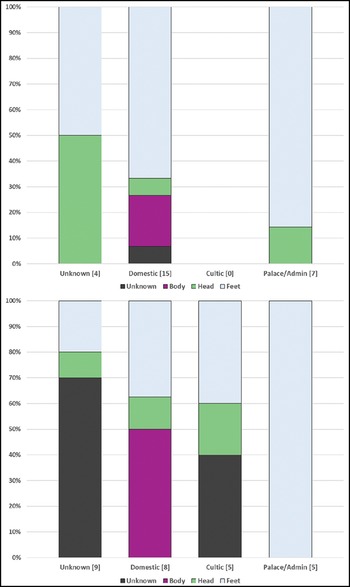
While detailed descriptions of find contexts are available for less than three-quarters of individual skeletal elements identified (82 remains of 111/74%), clear patterns are evident from those remains with identifiable context types. During the Chalcolithic period (Figure 6), where the specific context is known (22 of 26 remains), big-cat bones are largely recovered from domestic contexts (i.e. inside or between houses, 15 remains of 22/68%). The exception to this pattern is the remains from Late Uruk ‘colony’ sites of Northern Mesopotamia (7 of 22 remains/32%), where big-cat bones come exclusively from palace/administrative building contexts.
Proportion of skeletal elements identified as belonging to the body (including limbs), head or feet of big cats recovered within different context types at Chalcolithic (top) and Early/Middle Bronze Age (bottom) sites in the Near East (figure by J.S. Gaastra).

In the Early and Middle Bronze Ages where contextual information is available (19 elements) these come primarily from domestic contexts (9 of 19 remains/48%) followed by cultic contexts (e.g. temples and altars, 5 of 19 remains/26%) and palace/administrative contexts (5 of 19/26%). When skeletal elements are compared by context, it can be seen that all ‘body’ elements come solely from domestic contexts (5 of 9/56%). In contrast, big-cat remains in palace/administrative contexts are represented only by the remains of ‘feet’, and only in Mesopotamia. Elements from cultic contexts are represented by both the ‘head’ (1 remain) and ‘feet’ (2 remains) where skeletal element is known.
During the Late Bronze Age (Figure 7) contextual information is available for 28 of 37 individual remains. Of these, 10 (36%) come from domestic contexts and are geographically limited to Anatolia (8) and the Southern Levant (2). In contrast with earlier periods, the majority of remains now comes from palace/administrative contexts (17 of 28 remains/61%) across both Mesopotamia and the Levant, with only one bone (4% of those with contextual information) recovered from a cultic context (a lion cranium from Tell Kazel). As in the Early and Middle Bronze Ages, body elements are only found in domestic contexts, irrespective of region (6 of 10 remains/60%). Where skeletal element is known (15 of 15/100%), big-cat remains found in palace/administrative and cultic contexts come only from the heads and feet of animals. This pattern continues in the Iron Age, where contextual information is available for 14 of 21 elements. As with body portion data, contextual information for material from this period is available only for the Northern and Southern Levant. Here, big-cat remains are primarily represented in palace/administrative (7 of 14/50%) and domestic (5 of 14/36%) contexts. As with previous phases, finds recovered from palace/administrative and cultic contexts comprise only elements from head or feet (7 of 7/100%). Elements from the body, as with earlier periods, come entirely from known domestic contexts where they predominate (4 of 5/80%).
Proportion of skeletal elements identified as belonging to the body, head or feet of big cats recovered within different context types at Late Bronze Age (top) and Iron Age (bottom) sites in the Near East (figure by J.S. Gaastra).

Discussion
The clear post-Neolithic shift towards an increased representation of lions over leopards in zooarchaeological remains across the Near East suggests a change towards the selective hunting of lions. But the over-representation of elements from the head and feet of these animals, and the location of these remains within palace/administrative or cultic buildings, indicates that not all big-cat remains may relate solely to the disposal of hunted animals. Bones of the head and feet are often retained during the preservation of animal pelts and later enter the archaeological record when the pelts are discarded and decomposed (e.g. Clark Reference Clark and Green1993; Vila Reference Vila1998). The disproportionate representation of these elements, coupled with their often non-domestic depositional contexts, suggests that these elements may have come from preserved skins. The recurrent association of big-cat remains with palace/administrative or cultic buildings suggests that the display of such preserved skins may have served as part of a wider repertoire of big-cat symbolism along with the visual representations of big-cat hunting observed across the ancient Near East. The physical presence of the lion and leopard bones at Tel Burna in Building 32417 can, therefore, be seen as a classic example of the use of big cats to display and strengthen the authority of elites and rulers. The location of these remains within the administrative building and ruler's residence of an Iron Age border fortress-town in the western periphery of Judah, can be seen as part of a specific programme to display the power and authority both of the local leader and the nascent state.
Zooarchaeological evidence for the use of big-cat remains as symbolic displays of power appears at different periods across the Near East. This symbolism is first evident in Mesopotamia from as early as the Chalcolithic period. The use of big-cat remains is less clear for Southern Mesopotamia, largely due to the comparative dearth of zooarchaeological samples available for this region (Figure 3). In the Levant, by contrast, no such iconographic use of remains is indicated during the Chalcolithic, Early or Middle Bronze Ages. It is only in the Late Bronze and subsequent Iron Ages that this form of use of big-cat remains becomes evident through increased representation of skeletal elements from the head and feet, such as those recovered from the ruler's residence at Tel Burna. During these periods, iconographic associations of big cats with power and authority also begin to appear in these regions. In Anatolia, evidence for the curation and display of big-cat remains is lacking throughout sequences from the Neolithic to Late Bronze Age. Here, instead, the persistent presence of remains in domestic contexts, primarily from lower town areas, suggests the hunting of local predators rather than elite sport hunting or the display of curated remains. Whether or not this changed during the subsequent Iron Age cannot be determined given the present lack of data.
Conclusions
By collating zooarchaeological evidence for big cats across the ancient Near East, this study shows that the physical remains of these animals were incorporated into the symbolic repertoire of the region alongside their iconographic depiction on a variety of media as symbols of the power and control of rulers. These physical remains of big cats would have functioned as symbols of elite power and control in the same manner as did their iconographic representations. Skins, as portable items of display, could have been traded—or gifted—across the Near East. This signals a note of caution for the uncritical use of archaeological lion and leopard remains in the reconstruction of these animals’ natural past distributions. The distribution of remains from parts of the body which could not have come from skins (e.g. ribs, limbs), however, does strongly suggest the continued presence of these animals in the wild throughout the region and periods studied here; in the Southern Levant, for example, such remains suggest that both taxa remained present from the Neolithic period to the Iron Age. The remains recovered from Tel Burna are therefore likely to have been either hunted locally prior to their display, or brought to the site as skins from elsewhere in the immediate region. How common such animals were across the landscape, however, remains more difficult to quantify given strong indications for the curation and display of preserved skins and an uneven zooarchaeological record across the region. The low representation of skeletal elements from the body, rather than head or feet, across Mesopotamia is an example of this. While remains from Southern Mesopotamia are particularly under-represented (likely due to a shortage of zooarchaeological research across this region), even across comparatively well-represented Northern Mesopotamia, skeletal elements other than those from the ‘head’ or ‘feet’ of big cats have been found only at three sites dating from the Early Bronze Age (Table 2).
Lions and leopards seem to have been present across all studied regions of the ancient Near East, from the Neolithic period to the Iron Age. When the specific skeletal elements and their contexts are examined, it becomes apparent that these physical remains of lions and leopards can be considered as components of the Near Eastern symbolic and iconographic repertoire—with the skins (containing preserved head and foot bones) of big cats used to signal power and authority in the same manner as their artistic representations. Rather than evidence of the local control of dangerous predators, the big-cat bones from Tel Burna can now be seen as part of the wider regional symbolic tradition of power, expressed both through iconographic representation and the physical display of big cats.
Acknowledgements
The authors would like to thank all project partners and participants, as well as the two anonymous but very helpful reviewers whose comments and suggestions have helped to improve this article.
Funding statement
The research was funded by grants of the Israel Science Foundation (Grant No. 522/16; 257/19; I.S.).
Supplementary material
To view supplementary material for this article, please visit https://doi.org/10.15184/aqy.2023.129.