Introduction
Aquatic ecosystems are typically vulnerable to natural and anthropogenic stressors (Birk et al., Reference Birk, Chapman and Carvalho2020). Among the main stressors, various elements (mainly heavy metals) can become highly toxic for biota as soon as their concentrations exceed natural values (Merian et al., Reference Merian, Anke, Ihnat and Stoeppler2004). Due to their uptake by biota and potential toxic effects on it, studies using living organisms as bioindicators for metals pollution have shown a great interest in recent decades. Bioindicators are helpful for quantification of bioavailable fraction of pollutants and for elucidating the uptake and storage mechanisms of pollutants in organisms (Hamza-Chaffai, Reference Hamza-Chaffai2014). Many strategies have been developed to monitor and evaluate the impact of metals in aquatic ecosystems and various organisms, animals in particular, have been used in monitoring programs. Molluscs, especially bivalves, are well known for their ability to accumulate huge amounts of metals and other kinds of pollutants (Rosenberg & Resh, Reference Rosenberg, Resh, Rosenberg and Resh1993; Sures et al., Reference Sures, Taraschewski and Rydlo1997; Kefi et al., Reference Kefi, Mleiki, Maâtoug Béjaoui and Trigui El Menif2016). Their feeding behaviour as active filter feeders and their tolerance to a large range of environmental conditions made bivalves good candidates for aquatic pollution biomonitoring.
Recently, in addition to the previously mentioned free-living sentinel species, parasites and host–parasite systems were found to be sensitive bioindicators for aquatic pollution. Among different helminths, acanthocephalans of fish have been promoted as sensitive sentinels for metal pollution in aquatic environments (summarized in Sures et al., Reference Sures, Nachev, Pahl, Grabner and Selbach2017). Acanthocephalans can accumulate trace elements thousands times higher than their fish hosts and their ambient environment (Sures, Reference Sures2004, Reference Sures and Rohde2005; Nachev et al., Reference Nachev, Zimmermann, Rigaud and Sures2010) and, therefore, they can be even more efficient in environmental monitoring than free-living sentinel organisms such as mussels (Sures et al., Reference Sures, Taraschewski and Rydlo1997). According to Sures (Reference Sures2003), they constitute ideal sentinels and a sensitive tool for monitoring metal availability in aquatic ecosystems. However, the majority of studies focused on freshwater ecosystems, while marine ecosystems and specifically lagoons have rarely been considered (Nachev & Sures, Reference Nachev and Sures2015). Lagoons with their differing environmental conditions can harbour many different species of fish, including mugilids (Bone & Moore, Reference Bone and Moore2008). Mugilids are known to be hosts for acanthocephalans belonging to the genus Neoechinorhynchus, such as the species Neoechinorhynchus agilis (Jithendran & Kannappan Reference Jithendran and Kannappan2010; Tkach et al., Reference Tkach, Sarabeev and Shvetsova2014).
The aim of the present study was to assess the element concentrations in two mugilid fish species (Mugil cephalus and Chelon ramada) from brackish water habitats and in their acanthocephalan parasite N. agilis. In addition, we tried to evaluate the potential risk to human health since those two fish species are frequently taken for human consumption. This field survey was performed in one of the most important coastal lagoons in Tunisia (Ichkeul Lagoon), which is known to be impacted by combined pollution from natural and anthropogenic sources (Ben Mbarek, Reference Ben M'barek2001; Ouchir et al., Reference Ouchir, Ben Aissa, Boughdiri and Aydi2016). Both the water and sediments in this lagoon contain high concentrations of heavy metals such as copper (Cu), iron (Fe), lead (Pb) and zinc (Zn) (Ouchir et al., Reference Ouchir, Ben Aissa, Boughdiri and Aydi2016; Yazidi et al., Reference Yazidi, Saidi, Ben Mbarek and Darragi2017).
Material and methods
Sample collection
Two different mullet species, M. cephalus and C. ramada, were caught from Ichkeul Lagoon, northern Tunisia, by local fishermen in the period from March 2016 to September 2017. After collection, they were transported immediately to the laboratory and examined for acanthocephalans. Tissue samples (muscle, liver, intestine) were taken carefully with the aid of stainless steel scissors and forceps. The acanthocephalans were removed from the fish intestine and the remaining intestinal tissue was washed with distilled water to avoid any remains of worms and gut content. All samples and parasites were stored at −20°C until further analyses.
Analytical procedure
Samples of fish tissues and parasite were digested using the microwave digestion system Mars 6 equipped with 20 ml MARSXpress PFA vessels (both CEM Corporation, Kamp Lintfort, Germany). The procedure consists of placing a previously homogenized amount of the sample (up to 250 mg of wet weight) into vessels, into which 4 ml of nitric acid (65% HNO3, sub boiled) was added. The vessels were heated for 90 min at 170°C using the microwave digestive system. Subsequently, the clear sample solution was brought to 5 ml volume with deionized water (Merck Millipore, Burlington, USA) in a volumetric glass flask. The elements, silver (Ag), arsenic (As), cadmium (Cd), cobalt (Co), Cu, Fe, manganese (Mn), nickel (Ni), Pb, selenium (Se), vanadium (V) and Zn have been quantified in mullet's tissue and their parasite N. agilis using inductively coupled plasma mass spectrometry (ICP-MS) (Elan 6000, Perkin Elmer, Waltham, USA; for details on instrument settings and calibration, see Nachev et al., Reference Nachev, Zimmermann, Rigaud and Sures2010). The analytical procedure was validated using standard reference materials (1566b Oyster tissue, National Institute of Standards and Technology, USA; DORM 3, National Research Council, Canada) and detection limits for the investigated elements were calculated as the three-fold standard deviation of concentrations determined in ten procedural blanks.
Data analysis and statistical treatments
Bioconcentration factors (BCF) were calculated according to Sures et al. (Reference Sures, Siddall and Taraschewski1999) as follows: BCF = (C[N. agilis] / C[host tissue]). The detection limit was used to calculate the BCF in the case when the tissue concentrations were below the detection limits. In order to compare the element concentrations in fish tissues parasites, a Wilcoxon matched pair's test was applied. All statistical analyses were carried out using SPSS statistical package software version 20.0 (IBM SPSS Statistics for Windows, Version 20.0. Armonk, NY: IBM Corp. IBM Corp. Released 2012).
Results
Analytical procedure
Mean concentrations of the analysed elements in the standard reference materials and the detection limits are listed in table 1. The recovery rates of all 12 elements were within the 20% deviation range.
Trace metal concentrations in standard reference material, accuracy and detection limits determined by ICP-MS analyses.

SD, standard deviation.
Element concentrations in mullets and their acanthocephalan
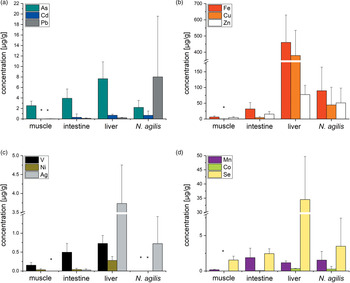
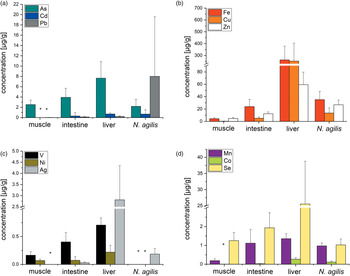
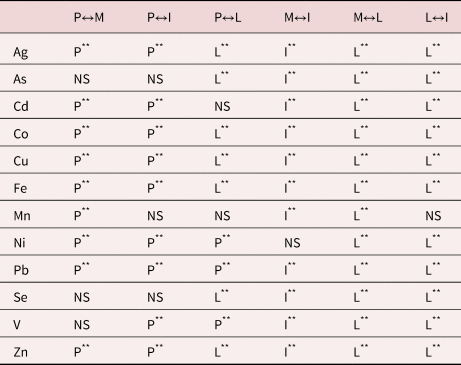
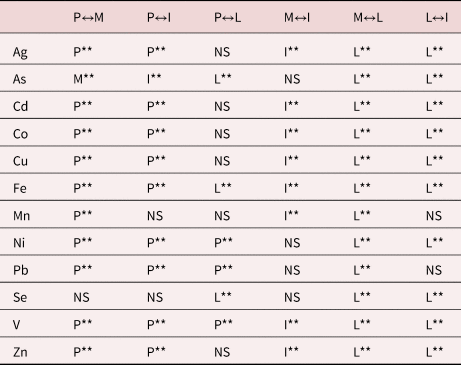
The metal analysis revealed that the concentrations of some elements like Ni, Pb and V were significantly higher in the acanthocephalan than the fish tissues for both mullet species. With the exception of the elements As, Se and V, all other elements were found in significantly higher concentrations in N. agilis compared to the muscle and intestine of both fish hosts (tables 2 and 3; figs 1 and 2). Comparisons of element concentrations between fish tissues showed that for both mullets muscle accumulated the lowest amounts of metals, followed by the intestine and then the liver.
Mean (± standard deviation) element concentrations (A–D) in tissues of the grey mullet Mugil cephalus and its acanthocephalan Neoechinorhynchus agilis. *Concentrations of Cu, Cd, Pb and Ag in muscle samples and concentrations of Ni and V in N. agilis are not displayed as they were below the detection limit.

Mean (± standard deviation) element concentrations (A–D) in organs of Chelon ramada and its intestinal parasite Neoechinorhynchus agilis. *Concentrations are not displayed as they were below the detection limit.

Differences between element concentrations in Mugil cephalus organs and the acanthocephalan Neoechinorhynchus agilis.

M, muscle; I, intestine; L, liver; P, Parasite (in M. cephalus).
** Significant at P ≤ 0.01 (Wilcoxon matched-pair test).
NS, Not significantly different (Wilcoxon matched-pair test).
Differences between element concentrations in Chelon ramada organs and its acanthocephalan Neoechinorhynchus agilis.

M, muscle; I, intestine; L, liver; P, Parasite (in C. ramada).
**Significant at P ≤ 0.01 (Wilcoxon matched-pair test).
NS, Not significantly different (Wilcoxon matched-pair test).
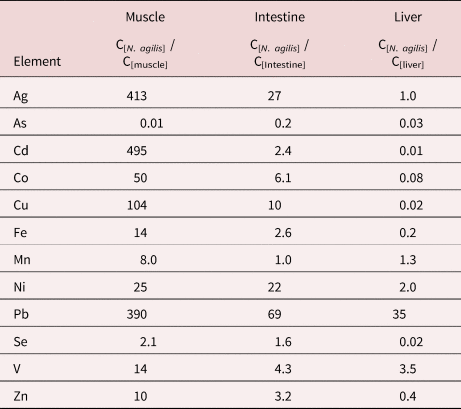
According to mean BCFs, five elements (Ag, Mn, Ni, Pb, V) in the M. cephalus–N. agilis system were overall present in higher levels in the parasites (BCF > 1). Different patterns of metal accumulation capacities were observed for the analysed host tissues. The lowest metal accumulation level was observed in the muscle in comparison to the parasites. The metal accumulation capacity of N. agilis with respect to the host muscle was the highest for Cd (up to 495 times higher) followed by Ag (up to 413 times higher) and Pb (up to 390 times higher). The metal accumulation capacity of the parasites with respect to the intestine in decreasing order was as follows: Pb > Ag > Ni > Cd > Cu > Co > V > Zn > Fe > Se > Mn. Regarding the liver, the metal accumulation capacity of the parasites was the highest for the Pb (up to 35 times higher in the acanthocephalan), followed by Ni and V (up to 3.5 times higher in parasites); for the rest of the elements, the mean concentration factors values were lower in parasites (BCF ≤ 1) (table 4).
Bioconcentration factors C[N. agilis] / C[M. cephalus tissue] for Neoechinorhynchus agilis calculated with respect to different host (Mugil cephalus) tissues.

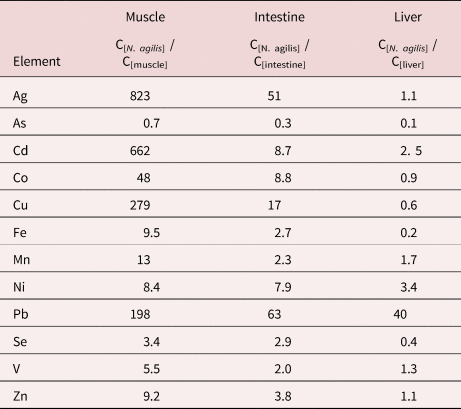
The calculated BCFs for the C. ramada–N. agilis system showed an almost similar metal accumulation pattern, but less pronounced than the one observed for the M. cephalus–N. agilis system. The highest metal accumulation capacity of N. agilis with respect to the host muscle was recorded for Ag (up to 823 times higher), followed by Cd (up to 662 times higher), and for the rest of elements the decreasing order of the metal accumulation capacity of the acanthocephalan was as follows: Pb ˃ Ni ˃ Co ˃ Mn ˃ Fe ˃ Zn ˃ Se ˃ As ˃ V. Concerning the intestine and the liver, the highest BCF observed for the parasite was for Pb. The acanthocephalan was able to accumulate this toxic element up to 198 times higher than muscle and up to 40 times higher than liver (table 5).
Bioconcentration factors C[N. agilis] / C[C. ramada tissue] for Neoechinorhynchus agilis calculated with respect to different host (Chelon ramada) tissues.

Discussion
The results of the elements analysis in the two mullet species M. cephalus and C. ramada showed a difference in the distribution of the metals’ concentrations in host tissues. The liver was the organ that accumulates the highest amount of metals compared to intestine and muscle.
Mullet fish, known by their euryhaline character, have been extensively studied for their ability to accumulate metals (Storelli et al., Reference Storelli, Barone, Storelli and Marcotrigiano2006; Chouba et al., Reference Chouba, Kraiem, Njimi, Tissaoui, Thompson and Flower2007; Fernandes et al., Reference Fernandes, Fontainhas-Fernandes, Peixoto and Salgado2007; Annabi et al., Reference Annabi, El Mouadeb and Herrel2017; Genç & Yilmaz, Reference Genç and Yilmaz2017). According to Waltham et al. (Reference Waltham, Teasdale and Connolly2013), the flathead grey mullet is widely used around the world to monitor pollution in aquatic ecosystems. During our study, the muscle, the intestine and the liver of the fish were examined for metal accumulation. A significant difference was observed in the concentrations of the majority of elements when the tissues of the fish were compared. This variability can be explained by the difference in the physiological role of each organ of the fish (Olsson et al., Reference Olsson, Kling, Hogstrand, Langston and Bebianno1998). Indeed, metals are distributed throughout the cells, but some compartments are particularly important for metal storage. Mechanisms of elements’ uptake depend on the nature of the metal and its affinity to the proteins of the cell. Low levels of an element concentration in an organ (like muscle for example) can be attributed to the low level of binding proteins in this organ (Olsson et al., Reference Olsson, Kling, Hogstrand, Langston and Bebianno1998). With respect to the tissues of the two hosts examined in this study, most of the elements were present at the highest levels in the liver and the lowest concentrations were recorded in the muscle. In comparisons to liver, the element concentrations in the intestinal tissue were medium to low. This distribution of concentration patterns in fish tissues was very similar to that found in M. cephalus, collected in the Ghar el Melah Lagoon in Tunisia (Chouba et al., Reference Chouba, Kraiem, Njimi, Tissaoui, Thompson and Flower2007). According to this study, the liver accumulated the greatest amount of Cd, mercury and Pb compared to the rest of the organs and tissues of the fish analysed. This finding does not seem surprising since many previous studies have shown the great importance of the liver in detoxifying the organisms of different pollutants (Sures & Taraschewski, Reference Sures and Taraschewski1995; Storelli et al., Reference Storelli, Barone, Storelli and Marcotrigiano2006; Yilmaz, Reference Yilmaz2009; Al-Hasawi, Reference Al-Hasawi2019). The liver is a metabolically active organ that stores and removes enormous amounts of metals, in contrast to the non-active tissue of the muscle that has a low metal-carrying capacity (Squadrone et al., Reference Squadrone, Prearo, Brizio, Gavinelli, Pellegrino, Scanzio, Guarise, Benedetto and Abete2013). During our work, the concentrations of most elements in the muscle were lower compared to those in the intestine and the liver, and according to FAO (1983) can be considered as appropriate for human consumption.
During our survey, we were interested in studying the accumulating capacity of different elements not only in the muscle, liver and intestine of the two mullet species M. cephalus and C. ramada, but also in their associated acanthocephalan parasites. The parasite N. agilis was found to be able to accumulate significantly higher amounts of toxic elements (such as V, Pb and Ni) compared to different host tissues.
With respect to the BCFs, in both host–parasite systems examined, the acanthocephalan demonstrated significant accumulation capacity for Ag (up to 2714 times more than muscle), and for Pb (up to 32 times more than the liver). This great ability of acanthocephalans to accumulate non-essential elements has been demonstrated in previous studies conducted on the acanthocephalan Pomphorhynchus laevis found in its host Squalius cephalus collected from the Ruhr River (Sures et al., Reference Sures, Taraschewski and Jackwerth1994a) as well as in other studies on the same parasite in the barbel fish Barbus barbus from the Danube River in Bulgaria (Nachev et al., Reference Nachev, Zimmermann, Rigaud and Sures2010). The results found during our investigations are in agreement with the aforementioned studies, with the exception that the accumulating capacity of Pb in the acanthocephalans of the chub and the barbel was greater than that found in N. agilis of the two examined mullets. This may be related to differences in metal concentrations in the different aquatic environments surveyed as well as differences in their salinity. In fact, lagoon environments have a greater salinity than freshwater environments, and this can have an effect on metal bioaccumulation in aquatic organisms. Water salinity has been shown to affect the biological availability of trace metal elements in sediments as well as in aquatic organisms (Du Laing et al., Reference Du Laing, De Vos, Vandecasteele, Lesage, Tack and Verloo2008). For example, a study on the flounder Platichthys flessus from marine habitats (acclimated to sea water) and from fresh water demonstrated that salinity lowered the accumulation of metals in fish (Stagg & Shuttleworth, Reference Stagg and Shuttleworth1982). Fish in sea water had lower Cu concentrations than those in fresh water (Stagg & Shuttleworth, Reference Stagg and Shuttleworth1982). Another study by Reynolds et al. (Reference Reynolds, Smith, Chowdhury and Hoanga2018) revealed similar results, indicating that following an increase in salinity in the fish habitat, a decrease in the rate of accumulation of metals can be observed. These authors have empirically proven that the BCFs in fish tissue are much higher in the low-salinity environment. This may explain the differences in levels of accumulation of metals between lagoon-dwelling acanthocephalans and other freshwater conspecifics. Additionally, the taxonomic position of Neoechinorhynchus rutilii might affect its metal accumulation capacity. Until now, most of the published data on acanthocephalans considered members of the Palaeacanthocephala, whereas studies on eoacanthocephalans are scarce. There are only a few studies that have addressed metal accumulation in eoacanthocephalan species (e.g. Paratenuisentis ambiguus – Sures et al., Reference Sures, Taraschewski and Jackwerth1994b, Reference Sures, Zimmermann, Sonntag, Stüben and Taraschewski2003; Zimmermann et al., Reference Zimmermann, Sures and Taraschewski1999, Reference Zimmermann, Messerschmidt, Von Bohlen and Sures2005). Although these studies also showed higher metal concentrations in P. ambiguus compared to its eel host, BCFs were much lower as compared to palaeacanthocephalans. It can be hypothesized that the differences in tegument organization of eoacanthocephalans and palaeacanthocephalans might be responsible for differences in metal accumulation. However, the comparison of metal accumulation in eoacanthocephalans and palaeacanthocephalans is still based on an insufficient number of studies in order to draw any conclusion.
With regard to the acanthocephalan N. agilis, compared to its hosts M. cephalus and C. ramada, a considerable uptake of Ag by the intestinal parasite was observed. This resembles the result described previously in the study of metal accumulation in the marine acanthocephalan Aspersentis megarhynchus from Notothenia coriiceps collected from presumably low-polluted areas in the Antarctic (Sures & Reimann, Reference Sures and Reimann2003). According to this study, Ag levels in the acanthocephalan examined were approximately 20 times higher than in the intestine of the fish and 36 times higher than in the liver. The presence of high levels of this non-essential element in the present study indicates an anthropogenic pollution threat of the brackish environment surveyed. Additionally, significant differences in the accumulation rate were observed between the liver and the acanthocephalan in both host species for V, Ni and especially Cd and Pb. For these last two elements, considerable quantities have been recorded in N. agilis. This result was in accordance with other studies conducted on the two acanthocephalans Acanthocephalus lucii and P. laevis in their hosts (perch and chub), indicating the high capacity of these parasites to accumulate Cd and Pb compared to their hosts (up to 2700 times more than muscle) (Sures & Taraschewski, Reference Sures and Taraschewski1995; Sures & Siddall, Reference Sures and Siddall1999; Sures & Siddall, Reference Sures and Siddall2001). In our case, the significant Pb contamination in the Ichkeul Lagoon, in the tissue of the mullets and their acanthocephalan, was expected due to the presence of an old lead mine and a metallurgical company ‘Elfouledh’ near the lagoon. The latter is responsible for the release of large quantities of Pb and Cd, which considerably increased the pollution levels in the lagoon (water column, sediments) (Ouchir et al., Reference Ouchir, Ben Aissa, Boughdiri and Aydi2016). Regarding the rest of the metals, although their source remains unclear, their presence can be attributed mainly to urban inputs, the influx of agricultural products and the discharging of wastewater through wadis that flow into the lagoon (Ouchir et al., Reference Ouchir, Ben Aissa, Boughdiri and Aydi2016; Ben Salem et al., Reference Ben Salem, Ben Said, Mahmoudi, Duran and Monperrus2017).
In conclusion, the results found during the present study confirm the possibility of the use of parasites, mainly acanthocephalans, in the bio-monitoring of aquatic ecosystems. Host–parasite systems can be considered a promising tool for the assessment of metal pollution in brackish or marine environments, where the bioaccumulation potential of parasites remains less investigated in comparison with freshwater ecosystems (summarized by Sures et al., Reference Sures, Nachev, Pahl, Grabner and Selbach2017). Therefore, it is highly recommended that future studies consider the parasite load of aquatic organisms in order to increase the effectiveness of environmental monitoring programs.
The present study addresses for the first time the capacity of the absorption and accumulation of elements in the tissues of M. cephalus and C. ramada mullets and their acanthocephalan N. agilis. The results are preliminary and support future research to elucidate the most effective bio-indicative properties in brackish environments that are poorly studied.
Acknowledgements
The authors would like to thank Mr Nejib Chaabouni and all of the other fishermen and management staff from ‘Société Tunisie Lagunes’, Ichkeul Lagoon, Tinja, for providing live fish.
Financial support
None.
Conflicts of interest
None.
Ethical standards
The authors assert that all procedures contributing to this work comply with the ethical standards of the relevant national and institutional guides on the care and use of laboratory animals.