As one of the least predictable natural disasters, earthquakes cause catastrophic public health problems. These include high casualties (2,565,840 deaths and 159,107,195 injuries between 1900 and 2014) and epidemics of communicable and noncommunicable diseases.Reference Leaning and Guha-Sapir 1 - 3 Such public health problems have drawn considerable attention, much of which now focuses on the impact of earthquakes on ischemic heart disease (IHD). IHD is already a leading cause of global disease burden, accounting for 13% of global deaths.Reference Kelly, Narula and Fuster 4
Although several previous studies have explored the correlation between earthquakes and IHD,Reference Kai-Sen, Qi and Ping 5 - Reference Leor and Kloner 12 little is known about short- and long-term hospitalization patterns at the population level. Hospitalization not only reflects urgent and serious conditions in patients, it is also the leading cost category for IHD in the health care system. In Canada, the United States, and the United Kingdom, it accounts for 40% to 76% of direct IHD costs.Reference Tarride, Lim and DesMeules 13
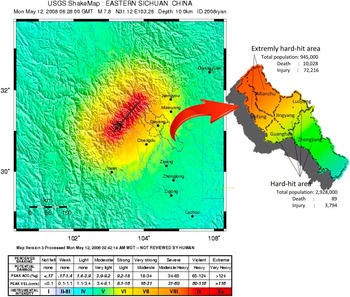
On May 12, 2008, the southwestern region of China was struck by an earthquake of magnitude 8.0 on the Richter scale. With 10,117 deaths and 76,010 injuries, the city of Deyang was disastrously affected (Figure 1).Reference Huang, Deng and He 14 , 15 Several years after this earthquake, a unique opportunity arose to explore the relationship between earthquakes and IHD through the hospitalization data from the city government, which provides an indicator of medical demands. We therefore examined whether the earthquake had affected IHD hospitalization and evaluated the earthquake’s impact with regard to short- and long-term hospitalization incidence rates and also costs. This study was intended to help understand how earthquakes affect IHD and how medical demand regarding IHD should be met after an earthquake.
Map of the Hard-Hit and Extremely Hard-Hit Areas of the May 12, 2008, Earthquake.

METHODS
Data Acquisition
The medical records of hospitalization for IHD were acquired from the Urban Employee Basic Health Insurance (UEBHI) program, which works under the responsibility of the Deyang municipal human resources and social security bureau. The UEBHI program is a nationwide social health insurance program for government and nongovernment employees; in Deyang, it covers more than 95% of the city’s workers. Because the designated average reimbursement ratio for hospitalization exceeds 80%, patients are strongly motivated to report their hospitalizations.
We included all records of hospitalization for IHD from January 1, 2005, to December 31, 2014. As well as the location, name, and level of the relevant hospitals, the records specified unique identification, gender, age, date of birth, date of admission, date of discharge, diagnosis, and costs.
Definition of Diseases
All definitive diagnoses of hospitalization were confirmed at discharge and classified according to the International Statistical Classification of Diseases and Related Health Problems, 10th revision (ICD-10). Diagnoses of IHD comprised I-20 (angina pectoris), I-21 (acute myocardial infarction), I-22 (subsequent myocardial infarction), I-23 (certain complication following acute myocardial infarction), I-24 (other acute ischemic heart disease), and I-25 (chronic ischemic heart disease).
Study Design
Our retrospective study reviewed the number and costs of hospitalizations for IHD over the past 10 years (2005-2014) and evaluated the short- and long-term impacts of the earthquake. The annual incidence of hospitalization was adjusted for age distribution, taking the 2008 Chinese population as a standard. 16 All costs were converted into US dollars (constant in 2010). 17
For the short-term effect, we used the following equation, which used the average number and costs registered in 2007 and 2009 as a basis for estimating the values that would normally have been expected for 2008:
 $$Expected\,2008\,value\,{\rm =(}Registered\,2007\,value\,{\plus}\,Registered\,2009\,value{\rm )}/2$$
These expected values were used as a control for the values registered in 2008. The rate of change was calculated by using the following equation:
 $$Rate\,of\,change\,{\rm =}\,100\,\%\,{\times}(registered\,value\,{\minus}\,expected\,value)/expected\,value$$
To evaluate the long-term effect on the basis of the severity of casualties, the city was divided into 2 areas by the China Earthquake Administration 15 : an extremely hard-hit area comprising Shifang and Mianzhu counties and a hard-hit area comprising Guanghan, Jingyang, Luojiang, and Zhongjiang counties (Figure 1). The differences between the long-term effects in these areas were estimated.
Statistical Analysis
Analyses were performed by using SPSS software version 16.0 (SPSS Inc., Chicago, IL); a P value <0.05 was considered to be statistically significant. Continuous variables were expressed as mean±SD, and categorical variables were expressed as percentages. The characteristics among groups were compared by using the independent-samples t-test for continuous variables between registered and expected 2008 values, and the chi-square test for categorical variables.
RESULTS
We reviewed a total of 19,083 medical hospitalization records on IHD. These covered more than 200 designated and undesignated medical institutions from 2005 to 2014. To calculate the annual incidence of hospitalization per 100,000, we also obtained data on the number of people in the population covered by UEBHI in Deyang for each year (Table 1).
Characteristics of Hospitalization Due to Ischemic Heart Disease in Deyang from 2005 to 2014

a Adjusted by age.
b US dollars, in constant 2010 US dollars.
c P<0.001 relative to the average adjusted annual hospitalization incidence for 2005 to 2007 (329.20 per 100,000), Mantel–Haenszel chi-square test.
Short-Term Effects
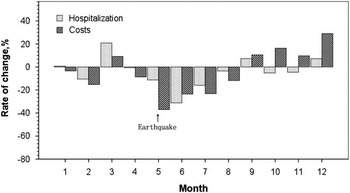
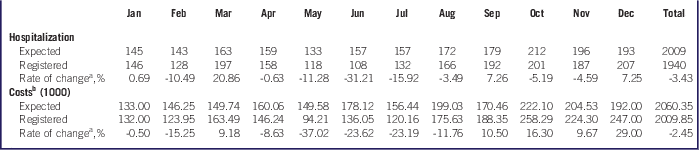
In 2008, the actual annual registered number of hospitalizations (1940) was similar to that expected for a normal year (2009); the costs of hospitalization (US $2,009,850) were also similar (US $2,060,350; Table 2). This was despite the fact that the actual registered number and costs of hospitalizations had decreased for the first several months after the earthquake (Figure 2 and Table 2).
Hospitalizations and Costs for Ischemic Heart Disease in the 12 Months After the 2008 Sichuan Earthquake.

The Monthly Number and Costs of Hospitalization Due to Ischemic Heart Disease for Registered and Expected 2008 Values in Deyang

a Calculated with the following equation: rate of change =100% × (registered value - expected value)/expected value.
b US dollars, in constant 2010 US dollars.
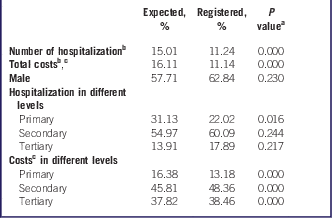
To describe this decrease more accurately, we compared the number and costs of hospitalizations in the 60 days after the earthquake. This showed that the registered number and costs of hospitalizations in that period accounted for a significantly lower proportion of the whole year than would normally have been expected in the same period (P=0.000; Table 3). On the basis of the equation for rate of change, the registered costs were estimated to have decreased by 32.53% and the number of hospitalizations by 27.81%.
Proportions of Number and Cost of Hospitalization for Ischemic Heart Disease Within 60 Days of the Earthquake for Registered and Expected 2008 Values in Deyang

a Chi-square test.
b Account for the proportion of total number in the whole year.
c US dollars, in constant 2010 US dollars.
In the 60 days after the earthquake, the proportion of hospitalizations in primary hospitals was significantly lower than expected for the same period (P=0.000). The proportions of costs at the 3 hospital levels (primary, secondary, and tertiary) differed significantly between registered and expected values, although their directions varied: costs were higher in secondary and tertiary hospitals but lower in primary hospitals (P=0.000; Table 3).
Long-Term Effects
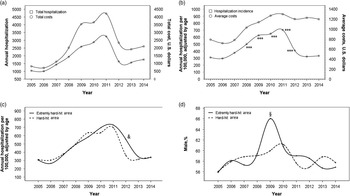
Table 1 shows annual hospitalization for IHD in Deyang city from 2005 to 2014. After the 2008 earthquake, both the annual total number and annual costs of hospitalizations increased (Figure 3A). Relative to the average for 2005 to 2007 (329.20 per 100,000), the annual age-adjusted hospitalization incidence rates were significantly higher in all 5 years from 2008 to 2012 (P=0.000; Table 1; Figure 3B). The relative risk (RR) increased in 2008 (1.32; 95% confidence interval [CI]: 1.23–1.43), in 2009 (1.93; 95% CI: 1.80–2.07), in 2010 (2.02; 95% CI: 1.88–2.16), in 2011 (2.19; 95% CI: 2.05–2.35), and in 2012 (1.26; 95% CI: 1.17–1.35).
Annual Total Number and Costs of Hospitalizations, Annual Age-Adjusted Hospitalization Incidence Rates, Incidence Rates in the Extremely Hard-Hit and Hard-Hit Areas, and Ratio of Hospitalization Among Males in the Extremely Hard-Hit and Hard-Hit Areas. *** P=0.000 for 2008, 2009, 2010, 2011 and 2012, relative to the age-adjusted average hospitalization incidence from 2005 to 2007, Mantel–Haenszel χ2 test. & P<0.05, independent-samples T test. § P<0.05, χ2 test.

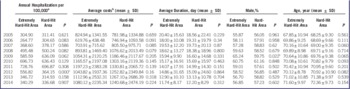
Although the age-adjusted hospitalization rate in the 2 earthquake areas increased equally for the first 4 years after the earthquake, the incidence rate in the extremely hard-hit area was significantly higher than in the hard-hit area (556.82 vs. 364.15 per 100,000; P=0.000) in the fifth year after the earthquake (Table 4 and Figure 3C). In the second year after the earthquake, the ratio of hospitalization among males in the extremely hard-hit area was also significantly higher than in the hard-hit area (65.24% vs. 59.75%, P=0.022; Table 4 and Figure 3D). The average cost and duration of hospitalization and the average age at hospitalization did not differ significantly between the 2 groups.
Characteristics of Hospitalization Due to Ischemic Heart Disease Between Extremely Hard-Hit area and Hard-Hit Areas in Deyang From 2005 to 2014

a Adjusted by age.
b US dollars, in constant 2010 US dollars.
c P<0.05, independent-sample t-test.
DISCUSSION
Hospitalization is a valuable indicator of disease burden for various diseases, including IHD. On the basis of systematic and reliable data over 10 years, our study reports on the number and cost of hospitalizations for IHD before and after the 2008 Sichuan earthquake in a population of over 300,000.
There are 2 major findings. First, in the short term (60 days after the earthquake), hospitalization for IHD was reduced. Second, for 5 years after the earthquake, hospitalization increased steadily in terms of annual number and costs. The trend then decreased to pre-earthquake levels.
As improvements in rescue techniques and living conditions have reduced the risk of traumatic and infectious diseases epidemics in the past few decades, more attention has turned to the impact of earthquakes on chronic diseases, such as IHD. Several studies have reported results, and their conclusions vary. For example, in the 3-week period following the 2011 Great East Japan earthquake, the number of patients with acute coronary syndrome was significantly higher than that in 2009 or 2010.Reference Nozaki, Nakamura and Abe 9 Similarly, Tsuchida et alReference Tsuchida, Kawashiri and Teramoto 11 reported a higher incidence of acute coronary syndrome during the 35 days after the 2007 Noto Peninsula earthquake (Japan) than in the previous 3-year period. Similar results were also reported in patients with acute myocardial infarction (AMI) after the 2011 Great East Japan earthquake,Reference Nakamura, Nozaki and Fukui 10 the 1999 Ji-Ji (Taiwan) earthquake,Reference Tsai, Lung and Wang 18 and the 1994 Northridge earthquake (USA).Reference Leor and Kloner 12 On the basis of all these results, it might seem safe to conclude that earthquakes are likely to promote the occurrence of IHD.
In our study, however, the evidence of the hospitalization records showed that, for 60 days after the earthquake, the number and costs of hospitalizations were lower than expected. This disparity might be explained by different study designs, such as end points, the time intervals used to measure events, earthquake magnitudes, demographic characteristics, and data sources. Possibly the most notable of these is the data source. First, our study evaluated the impact of an earthquake on IHD hospitalization events in a very large population, whereas most previous studiesReference Nozaki, Nakamura and Abe 9 - Reference Leor and Kloner 12 were restricted to inpatient data. From the point of view of public health preparedness, our study results were therefore more relevant. Second, because our study covered all 3 levels of hospitals—primary, secondary, and tertiary—they provided an integral profile of hospitalization. Our study is therefore very different from previous studies that used data from a single or a series of secondary or tertiary hospitals.Reference Nozaki, Nakamura and Abe 9 - Reference Leor and Kloner 12
Our findings are also supported by other studies. Dobson et alReference Dobson, Alexander and Malcolm 19 reported no increase in hospitalization for myocardial infarction or other ischemic heart disease for 4 months following the 1989 Newcastle earthquake (Australia). Similarly, on the basis of daily deaths due to IHD and atherosclerotic cardiovascular disease after the 1994 Northridge Earthquake (United States), Kloner et alReference Kloner, Leor and Poole 6 found that the decrease in the number of cardiac deaths at the population level was greater in the 14 days after the earthquake than the increase on the day of the earthquake.
This finding of a short-term decrease after an earthquake may be explained as follows. As previous studies have shown,Reference Kario, McEwen and Pickering 20 - Reference North, Oliver and Pandya 22 earthquakes can trigger emotional stress disorder and promote IHD events that include psychobiological processes, hemodynamic responses, autonomic dysfunction, neuroendocrine activation, and inflammatory responses. However, people with great stress disorder can exhibit avoidance or escape behaviors, which have been proved to be markers of post-traumatic stress disorder after disasters.Reference North, Oliver and Pandya 22 During times of great panic, dread, or loss, patients with IHD may ignore or deny cardiac symptoms that would normally force them to visit doctors. For patients with identified cardiac symptoms, it would be inconvenient (and also more dangerous) for them and their families to be admitted to the hospital rather than remain in shelters. The failure of medical systems and the collapse of infrastructure such as transportation and electrical power may also contribute to this phenomenon of suppressed medical demand after disaster, a phenomenon that describes the decrease in hospitalization for IHD after an earthquake rather than a decrease in actual occurrences of IHD.
Our study also reported the very-long-term impact of earthquake on IHD (7 years after the earthquake). In the first 5 years after the 2008 earthquake (2008–2012), the number and costs of hospitalizations increased noticeably. A similar result was found by Peters et al,Reference Peters, Moscona and Katz 23 who reported a 3-fold increase in the percentage of admissions for AMI during the 6 years after Hurricane Katrina (United States, 2005), whereas Nakagawa et alReference Nakagawa, Nakamura and Oyama 24 found a significant increase (14%) in mortality from AMI 3 years after the Niigata Chuetsu earthquake (Japan, 2004).
The longer-term IHD effects of earthquakes include emotional stress and lifestyles changes. The links between emotional stress and psychobiological processes such as endothelial cell dysfunction, inflammatory responses, or platelet activation have been described elsewhere.Reference Kario, McEwen and Pickering 20 - Reference North, Oliver and Pandya 22 These factors are known to promote coronary plaque disruption, myocardial ischemia, cardiac dysrhythmia, and thrombus formation.
Changes in lifestyle have also been found to be related to exposure to earthquakes. For example, increased tobacco consumption, alcohol abuse, and increases in body weight have been noted after disasters,Reference Erskine, Daley and Stevenson 25 - Reference Tsubokura, Hara and Matsumura 27 all of which can contribute to the atherosclerosis process. As expected, our data showed that IHD rates continued to increase for longer in the extremely hard-hit area than in the area with less severity.
It should also be pointed out that the consequences of the earthquake—such as post-traumatic stress disorder and collapsed infrastructures, which significantly suppressed medical demand in first 60 days—continue to have a long-term impact on hospitalization. In theory, however, such impacts dissipate over time. The relatively slow increase in medical demand in the first years after the earthquake and the sharp drop in the fifth year may thus be explained by a combination of the earthquake itself and its consequences in the longer term.
Because our study used short- and long-term IHD hospitalization data, it reflects public health needs in different situations. In the short term, quick medical responses are required in urgent and critical conditions; in the long term, more attention is required for primary or secondary prevention. Although the existing legal provisions in China, 28 Japan, 29 and the United States 30 , 31 all emphasize that specialized interventions—such as physical trauma therapy, adequate local nursing care, and infection control—are requiredReference Leaning and Guha-Sapir 1 in the acute phase after a disaster (such as an earthquake), public health frameworks have provided cardiologists with little guidance for responding to earthquakes in short and long terms.
The value of our study therefore lies in the fact that, by evaluating the impact of an earthquake on IHD both in short and long terms, it allows us to draw the 2 following conclusions. First, in the short term after an earthquake, it may be reasonable not to place special emphasis on the IHD service, except for a few patients with acute cardiac events triggered by the sympathetic nervous system, who are more likely to be admitted to secondary or tertiary hospitals. Second, the end of rescue and reconstruction does not necessarily mean the end of the impact of earthquake on IHD, which may last years, increasing the disease burden in the population. Therefore, to reduce the adverse effects of earthquakes on IHD over the long term, specific targeted interventions should be developed.
Limitations
Our present study had several limitations. First, it did not include the medical records of outpatients. Second, our study would have been more persuasive in proving short- and long-term impacts of an earthquake on IHD if a control group had been included with data from an area not affected by the earthquake. However, differences in insurance policies and baseline conditions made it extremely difficult to identify an appropriate control group. Third, the objective population of our study was limited to government and nongovernment employees, who might differ from the general population in various ways, such as their average age, education, and income. One final issue should be noted. Although the association between earthquakes and IHD has been shown by various studies, including our own, there remains the possibility that methodological issues—especially the lack of variables that are well-established factors in IHD—could provide other explanations for the association between the timing of the disaster and the changes in IHD service use and costs.
CONCLUSION
The 2008 earthquake led to important changes in hospitalizations for IHD, which, possibly due to psychological or socioeconomic factors, were suppressed in the short term (ie, the first 60 days after earthquake). However, in the 5 years after the earthquake, the number and costs of hospitalizations increased significantly, especially in the extremely hard-hit area. These findings suggest that IHD hospitalizations differ in the short and long terms after an earthquake and that the medical resources for IHD after an earthquake should be distributed dynamically over time.
Acknowledgments
We gratefully acknowledge the help from staff at UEBHI for providing us with their unique, authoritative data and also their expertise in health insurance. We thank David Alexander for his careful reading of the manuscript.
Funding
This research received grants from the European Commission Contract (Enhance: 308438, Brussels, Belgium); the China Scholarship Council (CSC; grant number: 201406240049, Beijing, China); the National High-tech Research and Development Program of China (grant number: 2012AA02A510, Beijing, China); the National Natural Science Foundation of China (grant number: 81370219, Beijing, China); and the Supporting Project of Sichuan Provincial Department of Science and Technology (grant number: 14ZC1845, Sichuan, China).