


INTRODUCTION
The first decades of the twentieth century saw the emergence of mass movements mobilizing in the name of Islam. From North Africa to the Indonesian archipelago, Islamist movements were on the leading edge of national liberation struggles, and would go on to play prominent roles in post-independence politics: winning national elections, developing sophisticated social welfare activities, and occasionally waging violent insurgencies. Yet, despite the extensive outpouring of academic and journalistic writing on the rise of organized political Islam, little is known about the conditions under which these movements emerged and the local ecologies that facilitated their growth. This is part of a more general shortcoming in the literature on Islamism: While significant attention has been paid to the biographies and ideologies of Islamist movements and their leaders, little if any research has systematically evaluated the social and political contexts of this activism (Masoud Reference Masoud2014 is a notable exception). As Ketchley and Biggs (Reference Ketchley and Biggs2017) argue, in rare instances when systematic data on Islamist movements is available, it is worth the painstaking effort to reconstruct these contexts.
This article examines the rise of organized political Islam in interwar Egypt.Footnote 1 We consider three claims in particular: First, that Islamist movements initially developed in areas that had undergone social and demographic transformations in the period leading up to the Second World War (Ayubi Reference Ayubi1991; Ayoob Reference Ayoob2009; Moaddel Reference Moaddel2005; Gershoni and Jankowski Reference Gershoni and Jankowski2002); second, that the first Islamists found support amongst Muslims who had come into contact with the West and, in particular, amongst those Muslims living in areas where Christian missionaries were active (Baron Reference Baron2014; Cleveland Reference Cleveland2014; Sharkey Reference Sharkey2008, Reference Sharkey, Marzouki and Roy2013); and third, that the early sites of Islamist activism were patterned by state presence and the available economic infrastructure (Lia Reference Lia1998; Munson Reference Munson2001). While all of these explanations are widely cited in the literature, previous studies have not accounted for variation in where the first Islamist movements established an organizational presence.
We address this shortcoming by combining a unique cache of historical data with a mixed methods research design. In 1937, the Egyptian Muslim Brotherhood’s Arabic-language newspaper published a nationwide inventory of the organization’s chapters, furnishing microlevel data on over 200 branches. This provides an unparalleled insight into the early sites of activism and recruitment by one of the world’s most influential Islamist movements. We locate branches in their social and economic context by using contemporaneous census records for over 4,000 subdistricts. The annual reports of British and American missionaries active in Egypt during this period allow us to test for the effect of Christian proselytization on the sites of branch formation. Newly digitized workforce statistics on the distribution of employees in state administration provide a measure of state presence. Finally, maps and timetables of the country’s rail network account for the role of economic infrastructure in the organizational development of the Muslim Brotherhood. We bring these materials together using an ecological approach, inspired by recent research on social movements and contentious politics in Western contexts (Biggs and Knauss Reference Biggs and Knauss2012; Kawalerowicz and Biggs Reference Kawalerowicz and Biggs2015), to identify the characteristics of subdistricts and districts that made branch formation more or less likely. Because our quantitative analysis is ecological, it is inevitably silent on the processes of Islamist expansion. To further examine how organized political Islam initially developed, we then expand on the statistical findings through a focused qualitative examination of the Muslim Brotherhood’s activities, as reported in the movement’s Arabic-language publications.
We find that Muslim Brotherhood branches were more likely to be established in subdistricts with higher rates of literacy and fewer agricultural workers, supporting claims that Islamism initially found support amongst the urban middle classes. We can detect no statistically significant effect of Christian missionary activity in patterning branch formation, and the presence of large European populations in a district significantly reduced the likelihood that a branch would be established, challenging arguments that attribute the growth of political Islam to contact between Muslims and the West. Finally, our quantitative results show that Brotherhood branches were more likely in areas where there were fewer state employees, and in those neighborhoods and hamlets connected to the Egyptian rail network. Qualitative evidence from the Muslim Brotherhood’s publications, including the travel itineraries of the Brotherhood’s leadership, also points to the rail network as a crucial pathway for the growth of the movement. A close examination of those sources suggests that the Muslim Brotherhood deliberately exploited the railway to reach new constituencies and consolidate newly formed branches. Early Islamist activism, in other words, conforms to the general pattern seen in the emergence of social movements and mass politics in other contexts: the rise of organized political Islam was inextricably linked to the availability of economic and state infrastructure.
The article proceeds as follows. In the next section, we examine the literature on the rise of organized political Islam to isolate three distinctive groups of theories that purport to explain the contexts in which Islamist movements initially coalesced. After describing the data and analysis, we present the results. Subsequent sections provide an interpretation and discussion of our findings, as well as a brief description of robustness checks on the data. A final qualitative section draws on Arabic-language material from the Muslim Brotherhood’s publications, as well as biographies of the movement’s membership, to expand upon a key finding from the quantitative analysis—that Egypt’s rail system was a vital channel for the movement’s organizational development. We close by suggesting potential areas for future research.
THE RISE OF ORGANIZED POLITICAL ISLAM
By the eve of the Second World War, mass-based Islamist movements had emerged across the Muslim world. These groups, including the Khilafat movement in India, the Sarekat Islam in Java, and the Muslim Brotherhood in Egypt, commanded memberships in the hundreds of thousands and provided new outlets for Muslims’ social grievances and political aspirations (Alavi Reference Alavi1997; Burke Reference Burke1972; Khalid Reference Khalid1999; Lia Reference Lia1998; Minault Reference Minault1982; Noer Reference Noer1973; Özcan Reference Özcan1997; Qureshi Reference Qureshi1999; Reetz Reference Reetz2006; Shiraishi Reference Shiraishi1990). In this section, we sort the extensive and diverse literature on the rise of organized political Islam into theoretically supported hypotheses that are amenable to testing with subnational ecological data (see Snyder Reference Snyder2001). We are interested in identifying where Islamist movements first established an organizational presence, and so we focus on three principle clusters of explanations: demographic change, cultural reaction, and institutional context, respectively.
Demographic Change
The early twentieth century is synonymous with social and demographic transformations across the Muslim world. Urbanization, expanding educational opportunities, and the belated introduction of print capitalism brought the simultaneous emergence of itinerant social classes and new idioms of contentious politics (Aydin Reference Aydin2007; Cole Reference Cole, Fawaz and Bayly2002; Gershoni and Jankowski Reference Gershoni and Jankowski2002, Reference Gershoni and Jankowski2009; Keddie Reference Keddie1983; Khuri-Makdisi Reference Khuri-Makdisi2010; Laffan Reference Laffan2003; Metcalf Reference Metcalf2014; Ryzova Reference Ryzova2014; Watenpaugh Reference Watenpaugh2014). Against this backdrop, a recurring theme of the literature on early political Islam is that the first Islamist movements drew disproportionate support from the newly literate middle classes (Ayoob Reference Ayoob2009; Karpat Reference Karpat2001; Moaddel Reference Moaddel2005; Robinson Reference Robinson1993). Such accounts depict Islamism as a vehicle for the advancement of upwardly mobile Muslims who lacked representation in the formal political process (Lapidus Reference Lapidus1997; Baer Reference Baer, Warburg and Kupferschmidt1983; Calvert Reference Calvert2008; Goldberg Reference Goldberg1981; Masoud Reference Masoud2014; Munson Reference Munson2001). This suggests the following empirical implication:
• H1a: Islamist movements were more likely to be present in areas with higher literacy rates.
A related claim is that Islamist movements initially mobilized in areas marked by the internal migration that characterized this period. Islamism, several scholars have suggested, was particularly attractive for those economic migrants cut free from traditional rural networks of family and tribe and thrust into the tumult of unfamiliar urban environments (Fischer Reference Fischer1982; Kepel Reference Kepel2006). In parallel, a variety of authors claim that Islamists have been historically absent from areas where the agrarian economy predominates, in part because of the persistence of folk forms of Islam and other traditional social configurations that proved resistant to the Islamist message (Ayubi Reference Ayubi1980; Kupferschmidt Reference Kupferschmidt1982, Reference Kupferschmidt1987). We express these implications as the following:
• H1b: Islamist movements were more likely to be present in areas with higher levels of population growth.
• H1c: Islamist movements were less likely to be present in areas where the agrarian economy predominated.
Grievance-based explanations relate the initial appeal of Islamist movements to socioeconomic deprivation (Schulze Reference Schulze2002; Woltering Reference Woltering2002). The years following the First World War saw significant disruption of traditional economies resulting from the war effort and the incorporation of colonial societies into the world capitalist system (Owen Reference Owen1993). Muslims, in these interpretations, turned to Islamist movements as a reaction to their declining economic position and to gain access to Islamists’ social welfare activities (Munson Reference Munson2001). Parallels to this argument can be found in the literature on more contemporary Islamist mobilization, which attributes Islamist activism to economic immiseration and a lack of employment opportunities (Gambetta and Hertog Reference Gambetta and Hertog2016; Roy Reference Roy1994). If unemployment and economic deprivation are associated with political Islam, we would expect:
• H1d: Islamist movements were more likely to be present in areas with higher levels of economic deprivation.
Cultural Reaction
A separate vein of research relates local forms of Islamist activism to the cultural threat that Westernization supposedly poses to traditional Islamic values (Dekmejian Reference Dekmejian1995; Gershoni Reference Gershoni and Dann1988; Keddie Reference Keddie1983; al-Sayyid Marsot Reference al-Sayyid Marsot1984). One strand of this large literature explicitly focuses on the way that first-hand experience or contact with the “West”—usually European émigré communities or businesses—spurred the organizational growth of Islamic countermovements. John Voll (Reference Voll1994, 182), for instance, suggests that the appeal of political Islam was greatest for those “who had already had significant contact with Westernizing ideas and institutions.” This argument features prominently in the literature on the rise of the Muslim Brotherhood (Goldberg Reference Goldberg1981; Husaini Reference Husaini1956). In his widely cited account of the Brotherhood, Richard Mitchell (Reference Mitchell[1969] 1993, 7) notes how the large European presence in the movement’s birthplace of Ismailia, where even the street signs “were written in the language of the economic occupation,” provoked the Brotherhood’s founding members into action. Charles Wendell (Reference Wendell1978, 2) similarly points to the intense and continuing contact between Western officials and the local Muslim population in Ismailia—specifically the “prosperous offices and villas of the European town alongside the squalid homes of the ‘native’ quarter’—as a key factor in the birth of the movement. The Muslim Brotherhood’s founder would later describe the European presence in Ismailia as “a delicious food and healthy resource,” which contributed to the appeal of the movement (al-Banna Reference al-Banna1939). This supposed reaction has led some scholars to brand those who comprised the first Islamist movements as “emotional xenophobes” (Harris Reference Harris1964, 148). One testable implication of the “Western contact” hypothesis is that Islamist movements first established an organizational presence in those places where contact between the Muslim population and Europeans was most intense. This can be summarized as:
• H2a: Islamist movements were more likely to be present in areas where the proportion of Europeans was larger.
Islamist mobilization, a newer set of scholars argues, is more correctly understood as a reaction to one specific manifestation of Western encroachment: the proselytization efforts of Christian missionaries. Beginning in the late nineteenth century, American and European missionary societies had established a significant presence across the Middle East and North Africa, aimed at converting both indigenous Orthodox Christians and Muslims (Makdisi Reference Makdisi2008; Sedra Reference Sedra2011; Okkenhaug Reference Okkenhaug2015; Carter Reference Carter1984). The prominence of anti-Christian missionary rhetoric in the Muslim Brotherhood’s early speeches and writings has been well chronicled (Sharkey Reference Sharkey2008, Reference Sharkey, Marzouki and Roy2013). In a recent study, Beth Baron explicitly relates the Brotherhood’s expansion to their concerted efforts to counter Christian missionaries present in Egypt at the time. As she writes, “The Muslim Brotherhood founded some of its earliest branches in towns around Ismailia and along the Suez Canal, where missionaries had been aggressively proselytizing” (Reference Baron2014, 125). Refining H2a to account for specific contact with Christian missions, we might expect that:
• H2b: Islamist movements were more likely to be present in areas where Christian missionaries were more prevalent.
An alternative hypothesis, related to proselytization, focuses on religious competition. Islamists frequently highlight the supposedly pernicious influence exerted on Muslim society by religious minorities, especially Jews and Christians (Ayubi Reference Ayubi1991; Kepel Reference Kepel2006; Roy Reference Roy1994). This dynamic is tied to European colonialism, which was perceived to be favoring and promoting the interests of non-Muslims to the detriment of indigenous Muslim populations. If religious competition and sectarian animosity was a factor in Islamist mobilization, we should expect:
• H2c: Islamist movements were more likely to be present in areas where the proportion of non-Muslims was higher.
Institutional Context
A third family of explanations keys the rise of organized political Islam to the emergence of centralized states and the development of national economies. The dynamics of modern contentious politics, in general, are entwined with the growth of states and economic markets (Tilly Reference Tilly1990, Reference Tilly2008; Tarrow Reference Tarrow2011, Reference Tarrow2015). For the purposes of the discussion here, we are interested in how state and economic infrastructure simultaneously facilitated and circumscribed the contexts of early Islamist mobilization. In defining infrastructure and state presence, we follow Michael Mann’s classic typology (Reference Mann1984), and concentrate on the role played by centrally organized services and systems of transport in shaping Islamist organizational presence.
A common argument is that Islamist movements operate where the state is weak or lacks infrastructural capacity—an assertion that has become common currency in scholarship that seeks to explain the proliferation of Islamist welfare activities (Wickham Reference Wickham2002; Berman Reference Berman2003). The key premise here is that Islamist movements act as an alternative to the state, providing much-needed services that the state might otherwise be expected to administer (Munson Reference Munson2001; Davis and Robinson Reference Davis and Robinson2012). Discussing the post-1967 Middle East, Lisa Wedeen (Reference Wedeen2003, 55) notes how “as the state has retreated economically in the Middle East, Islamist movements have tended to fill in the gaps, providing goods and services states do not proffer.” Similarly, scholars suggest that movements like the Muslim Brotherhood initially thrived in areas where the state lacked the resources to survey and monitor them (Heyworth-Dunne Reference Heyworth-Dunne1950). If either hypothesis is correct, one key empirical implication is that:
• H3a: Islamist movements were more likely to be present in areas where state infrastructure was less extensive.
Social movements must generate and sustain some degree of personal connection between individuals (McAdam Reference McAdam1986; Wickham Reference Wickham2002). For this reason, the rise of modern mass politics is ineluctably tied to the availability of economic infrastructure, and in particular those “agents of change” (Weber Reference Weber1976) that underpin the development of national economies: communication, transportation, and distribution networks. Still, the role of economic infrastructure in shaping the contexts of mobilization has, until recently, largely eluded systematic investigation, despite a preponderance of evidence pointing to the importance of road and river transport networks (Hobsbawn and Rudé Reference Hobsbawn and Rudé1968; Rudé Reference Rudé1964; Charlesworth Reference Charlesworth1983), stagecoach lines (Skocpol Reference Skocpol1997), and railroads (Pethybridge Reference Pethybridge1972) in the rise of mass politics (other notable exceptions are Hedström, Sandell, and Stern Reference Hedström, Sandell and Stern2000 and Cunningham and Phillips Reference Cunningham and Phillips2007). Those studies suggest that economic infrastructure, while not intended to facilitate mobilization, can nonetheless create opportunities for citizens and subjects to become involved in activism (Tarrow Reference Tarrow2011, chap. 4). At the same time, the topography of a country’s economic infrastructure can also delimit a movement’s outer orbit. As Charles Tilly (Reference Tilly2004, 104) notes in his history of the social movement, “transportation breakthroughs such as intercity steam trains, electrical cars, and jet aircraft facilitated social movement contact at a distance but [also] impeded contact with like-minded people who lived far away from major transport lines.” This suggests that Egypt’s extant transport infrastructure shaped the Muslim Brotherhood’s ability to reach populations. Therefore we should expect that:
• H3b: Islamist movements were more likely to be present in areas that were accessible by transport networks.
We now turn to examining these hypotheses as they relate to the initial contexts of Muslim Brotherhood activism in interwar Egypt. In the following sections, we provide a brief overview of the Brotherhood’s history, before introducing a series of new data sources on the period and describing our method for analyzing them.
THE EGYPTIAN MUSLIM BROTHERHOOD
Beginning in the late nineteenth century, Islamic thinkers began to articulate a religiously based critique of the contemporary Muslim world (Hourani Reference Hourani1962; Keddie Reference Keddie1983; Kurzman Reference Kurzman2002). In the interwar period, these arguments would take organizational form as mass social movements, most prominently the Muslim Brotherhood in Egypt. Following its founding in 1928, the Brotherhood would grow to establish cognate movements in nearly every country with a Muslim population. In the process they would become, in Brynjar Lia’s (Reference Lia1998, 1) words, “the mother organization of all modern Islamist movements.”
The founding and growth of the Muslim Brotherhood must begin with the story of its founder, Hassan al-Banna, who arrived in the Suez Canal city of Ismailia to teach Arabic in 1927. It was here that he began to articulate an activist message that aspired to convert Egyptians’ supposedly “anesthetized faith” to a version of Islam that was “burning, blazing, [and] intense” (al-Banna cited in Wendell Reference Wendell1978, 44). Al-Banna’s down-home preaching style and personal charisma began to attract acolytes among Ismailia’s growing population, and, in March 1928, six of these men would form the Muslim Brotherhood (Lia Reference Lia1998, 36). As the movement grew, al-Banna refined his message of comprehensive religious reform and nested it within a regimented and formal organizational structure, emphasizing, “deep faith, precise organization, [and] uninterrupted work” (al-Banna cited in Wendell Reference Wendell1978, 33). The new movement’s appeal was prodigious and it quickly spread to towns and villages along the Suez Canal. In 1933, al-Banna was transferred from Ismailia to central Cairo, marking the first transition in the movement’s history (Lia Reference Lia1998, 21–53; Mitchell Reference Mitchell[1969] 1993, 1–11).
In Cairo, the Brotherhood’s headquarters quickly became a hotbed of activity. Members lectured in mosques throughout the swelling metropolis, established a printing press and magazine, and al-Banna and the movement’s early leadership began undertaking ever longer trips in a bid to establish new branches throughout the country (Lia Reference Lia1998, 129–50). As the Brotherhood grew, they also began to weigh in on national political issues, including demanding the application of Islam in widening spheres of public life. This politicization escalated with the outbreak of the Arab Revolt in Palestine in 1936, during which Brotherhood branches began to propagandize and fundraise in the cause of the Palestinians (Awaisi Reference Awaisi1998; Gershoni Reference Gershoni1986; Mayer Reference Mayer, Kedourie and Haim1982, Reference Mayer1983). During this early period, the Brotherhood was able to organize with relative impunity, thanks in large part to the movement’s good relations with Egypt’s monarchy, who saw the movement as a possible counterweight to the authority of the newly elected parliament (Gershoni and Jankowski Reference Gershoni and Jankowski2009; Heyworth-Dunne Reference Heyworth-Dunne1950; Lia Reference Lia1998, Tripp Reference Tripp1984, chap. 3).Footnote 2
The Muslim Brotherhood took the opportunity offered by the outbreak of World War Two to further up their political engagement, especially through criticism of foreign occupation. However, the movement’s increasing popularity and prominence brought with it more scrutiny from both the British and Egyptian authorities, leading to a period of tribulation that included Hassan al-Banna’s “internal exile” from Cairo to Qena, in Southern Egypt. This antagonism reached its height in October 1941, when Hassan al-Banna was briefly detained for publicly criticizing the regime (Lia Reference Lia1998, 256–61). This incident, according to Richard Mitchell (Reference Mitchell[1969] 1993, 23), marked a shift in relations between the Brotherhood and the authorities: “from that time no government in Egypt avoided clashing with the Society of the Muslim Brothers.”
We focus on this critical early period of the Muslim Brotherhood, beginning with the group’s founding in 1928 and ending with its first confrontation with the Egyptian state. This period, which Richard Mitchell (Reference Mitchell[1969] 1993, 12) calls the group’s “Rise to Power,” was a time of both qualitative and quantitative change. It was during this period, Krämer (Reference Krämer2014, 36) observes, that “the Society of the Muslim Brothers was gradually transformed from a benevolent society . . . to a social movement with the attributes of a mass-based political party.” By 1944, British intelligence estimated that the movement comprised half a million members (Lia Reference Lia1998, 154). Richard Mitchell (Reference Mitchell[1969] 1993, 328) reports that during the “peak period” of 1946–49, the Brotherhood’s membership ranged between 300,000 and 600,000, with potentially as many as 2,000 branches established by 1949. To put this into perspective, the 1947 Egyptian census reported a national population of just under 19 million. If these estimates are accurate, then, within two decades of the movement’s founding, potentially as many as 3% of Egypt’s population were Muslim Brothers, making the Brotherhood one of the largest social movements in the world at that time.
Yet, despite the Muslim Brotherhood’s tremendous growth and increasing involvement in national politics, the social and institutional factors contributing to the movement’s rise during the interwar years have remained elusive. In suggesting a more intense study of this period, Gershoni (Reference Gershoni1986, 367) reminds us that scholars:
[h]ave not properly explained how a small religious organization, which in the early 1930s was still a peripheral, almost anonymous body devoid of all political ambitions, became, by the close of the decade, the most powerful and highly organized Islamic force in Egypt.
In what follows, we take up this call by combining an array of underutilized primary source material from the period with newer analytical techniques to identify the social and institutional ecologies that facilitated this mobilization.
DATA AND METHOD
To study the early contexts of Islamist activism, we draw on two branch surveys published in the Muslim Brotherhood’s Arabic-language newspapers. The first survey appeared in the 11 June 1937 edition of Jaridat al-Ikhwān al-Muslimīn (reproduced in Amin Reference Amin2003, 424–39). This is apparently a complete record of the Brotherhood’s branches established up until that point. A second branch survey appeared in a different Muslim Brotherhood newspaper (al-Ta’āruf) on 18 May 1940.Footnote 3 To evidence the processual dynamics of the movement’s expansion, we also draw on the print editions of the Brotherhood’s newspapers published between 1933 and 1940, as well as Arabic-language memoirs published by the movement’s early membership.
We can locate Muslim Brotherhood branches in their social and institutional context using census data and workforce statistics. The Egyptian Ministry of Finance carried out a nationwide census in March 1937, an English-language, district-level summary of which is widely available.Footnote 4 The American University in Cairo and the Egyptian National Library hold 18 Arabic-language appendices to that census, which contain socioeconomic and demographic data at the subdistrict level, as well as labour force statistics that do not appear in the district-level summary. Annual reports for the three largest missionary societies active in Egypt during this period—the United Presbyterian Church of North America (1931), the Church Missionary Society (1931), and the Egypt General Mission (1931)—detail the number of Christian missionaries in a district.Footnote 5 During this period, Egypt possessed an advanced railway system, which was itself the product of the country’s integration into the global capitalist economy (Barak Reference Barak2013; Hobsbawm Reference Hobsbawm2010; Goldfinch Reference Goldfinch2003). Princeton University holds a timetable and station-by-station route map published by the Egyptian State Railway (1936), and this allows us to account for the extent of Egypt’s transport infrastructure. To our knowledge, these materials have not been previously analyzed together.
Dependent Variable
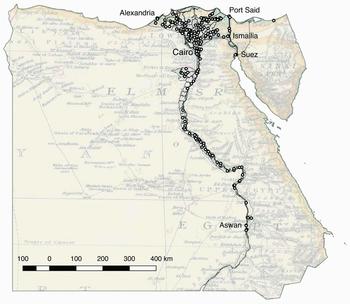
The dependent variable is the presence or absence of a Muslim Brotherhood branch in a census subdistrict (no subdistrict contained more than one branch). Each subdistrict was roughly equivalent to a large neighborhood; the median subdistrict contained 2,632 people. Of the 212 Muslim Brother branches listed in the 1937 survey, eight are missing information. We were able to locate the remaining 204 branches (96%) in their census subdistrict.Footnote 6 In 1937, there were 4,230 census subdistricts in Egypt; the Muslim Brothers had a branch in nearly 5% of them (Figure 1 maps the location of each branch).Footnote 7
Spatial Distribution of Muslim Brotherhood Branches, March 1937

The presence or absence of a Muslim Brotherhood branch is modeled using multilevel logistic regression. To account for clustering, the model introduces random intercepts at the district level; districts contained from two to 90 subdistricts, with a median of 28. There were 142 districts in Egypt during this period; missing observations for remote and sparsely populated districts reduces the number of observable subdistricts to 4,180 located in 134 districts. Two branches are dropped from the analysis as a result of missing observations at the district level. The number of Muslims in a subdistrict is the offset variable. With twice as many Muslims in a subdistrict, we expect that it will be twice as likely that a Muslim Brotherhood branch will be present. The inclusion of the offset naturally excludes areas with no Muslims, reducing the number of subdistricts where a branch was possible to 4,178.
Independent Variables
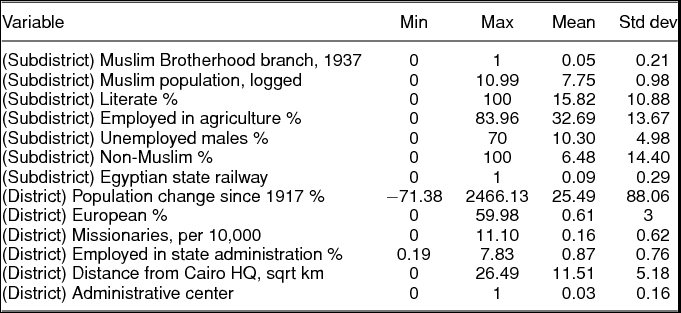
Table 1 provides descriptive statistics for all variables (Online Appendix Table 1 is the correlation matrix). From the 1937 census we construct a series of ecological indicators at both the subdistrict and district levels, which are measured as percentages using a population denominator. Literacy is measured as the percentage of the population over five years of age in a subdistrict who can read and write. H1a suggests that this variable should be positively associated with Muslim Brotherhood branch formation. To test H1b, we enter a variable recording district-level population change since 1917. If political Islam took root in districts with higher levels of migration, this variable should be positive. The percentage of a subdistrict’s population employed in agriculture (farming, hunting, and fishing) accounts for the agrarian economy. Following H1c, we expect this variable to be negative. The percentage of male unemployment in a subdistrict is our measure for economic deprivation. H1d leads us to expect that this variable will be positively associated with a Muslim Brotherhood branch being present.
Summary Statistics

Each observation comprises one subdistrict in one district
H2a leads us to enter a variable measuring the percentage of Europeans (British, French, Italian, and Greek) in a district. As per H2b, to test for the impact of Christian missionaries, we sum the personnel reported in missionary reports and then transform the count into a ratio of missionaries to the district’s total population. Following H2c, the percentage of non-Muslims (Christians and Jews) in a subdistrict measures interreligious animosity and competition. The literature that identifies Muslim contact with Westernization as a factor in the development of political Islam would predict that these variables will all be positively correlated with a Muslim Brotherhood branch being present.
To test H3a—that Islamist movements mobilized where the state lacked infrastructural capacity—we enter the percentage of a district’s population employed in state administration (including police officers, civil servants, and government officials). This assumes that state officials worked in the district where they lived; a reasonable assumption for this time period. H3b suggests that transport infrastructure played a vital role in patterning the contexts of Islamist mobilization. Travel during the interwar years was primarily conducted using the state-owned railway network, and so we enter a binary variable charting the presence of a train station in a subdistrict.Footnote 8
We also add two control variables. Because the movement’s leadership will have struggled to reach geographically isolated areas, we include a control variable measuring the distance (transformed to its square root) between a district’s centroid and the district centroid in Cairo where the Muslim Brotherhood’s headquarters was located.Footnote 9 We also expect social movements to establish an organizational presence close to political power, and so we enter a binary variable at the district level for a governorate’s administrative center.
RESULTS
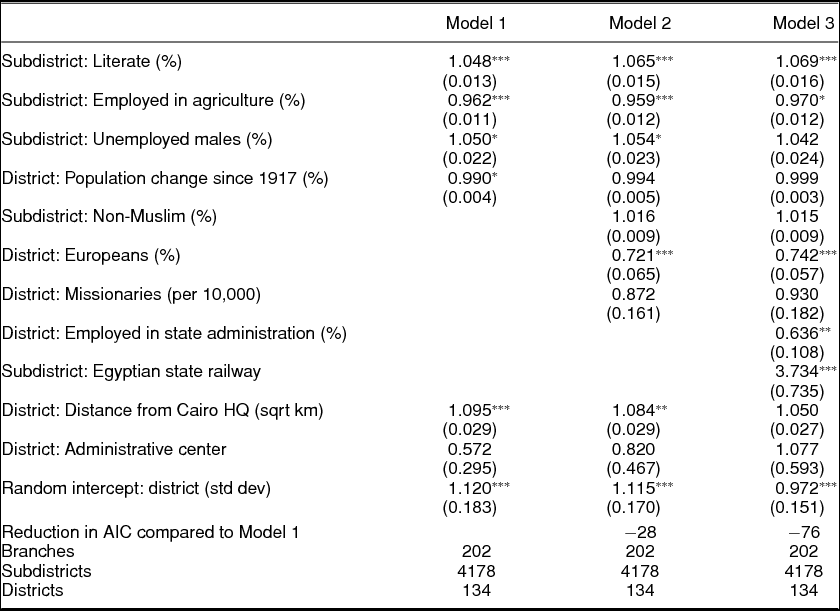
Table 2 presents the results, with coefficients expressed as odds ratios. Model 1 begins with the social and demographic contexts of branch formation; Model 2 adds indicators for the presence of Europeans, missionary activities, and religious competition; Model 3 adds indicators for state development and economic infrastructure. Each subsequent model represents an improvement in fit, as indicated by a diminution in Akaike information criterion (AIC).
Predicting the Probability of a Muslim Brotherhood Branch (1937)

Multilevel logistic regression, with ln(Muslim population) as offset
Standard errors in parentheses; ***p < 0.001, **p < 0.01, *p < 0.05
Model 1 offers mixed support for demographic explanations. H1a is strongly affirmed: Muslim Brotherhood branches were more likely to be present in subdistricts with higher literacy rates. In contrast, H1b is not supported. Population change unexpectedly reduces the probability of branch formation. H1c and H1d are supported. Branches were less likely in subdistricts with more employment in agriculture and more likely in subdistricts with higher rates of male unemployment. The probability of a branch increases with distance from the movement’s headquarters in Cairo, suggesting that the Brotherhood initially grew outside the capital. Districts that hosted administrative centers were less likely to host a Muslim Brotherhood branch, although this is not statistically significant.
Model 2 introduces indicators for contact with Westernization and religious competition. H2 receives no support. The percentage of Europeans in a district is significantly negatively associated with the existence of a Muslim Brotherhood branch, contrary to H2a. In other words, the Brotherhood was less likely to have an organizational presence in districts where Europeans were present in large numbers. H2b is also not supported: the presence of Christian missionaries in a district is negatively associated with the presence of a Muslim Brotherhood branch, although this is not significant (p = 0.45). The percentage of non-Muslims in a subdistrict is (modestly) positively associated with Muslim Brotherhood branch existence, but this falls outside of the bounds for accepted statistical significance at p < 0.05. With the inclusion of measures for Westernization, the unexpected negative association between branch formation and population change loses statistical significance.
Model 3 adds indicators for state presence and economic infrastructure. All other hypotheses remain unaffected, with the exception of H1d. In that case, the indicator for deprivation remains positive but slips just outside the bounds of accepted statistical significance (p = 0.07). H3a is strongly supported. Muslim Brotherhood branches were more likely to appear in districts with fewer adults employed in state administration, our measure for state presence. H3b is also strongly supported. The presence of a train station is a substantive and significant predictor of a Muslim Brotherhood branch at the subdistrict level. Net of all other factors, the odds of a Muslim Brotherhood branch being present was 3.7 times greater in subdistricts where there was a train station (as compared to subdistricts without a train station). When we account for the presence of the railway and the extent of state infrastructure, the effect of distance from the Brotherhood’s headquarters is Cairo is diminished and loses statistical significance.
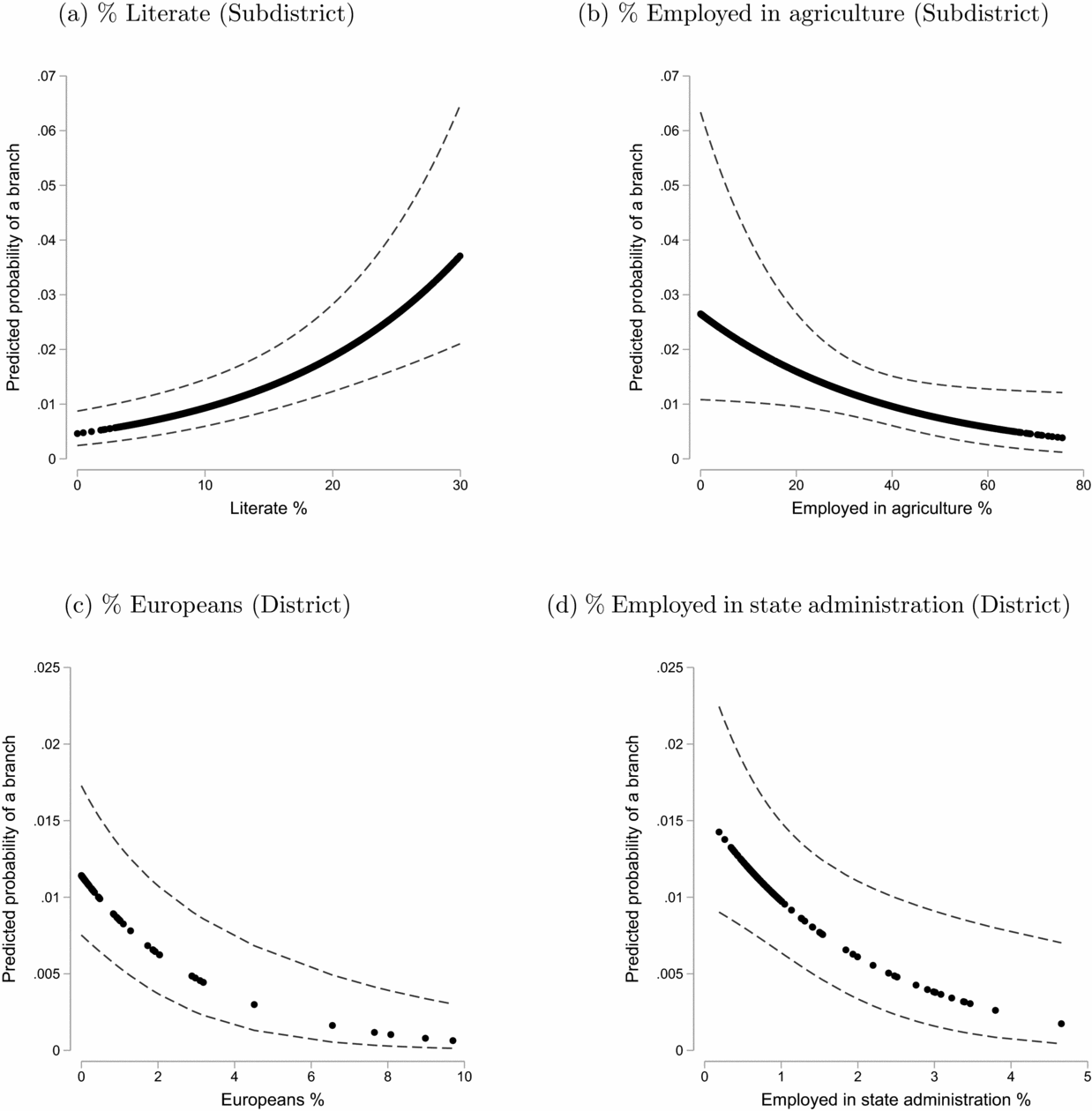
Figure 2 shows the magnitude of the effect of the statistically significant continuous variables from Model 3.Footnote 10 Holding all other variables constant at their median values, increasing the percentage of literacy in a subdistrict from 7% to 28% (the 10th to the 90th percentiles) quadruples the predicted probability of a Muslim Brotherhood branch from 0.007 to 0.032 [Figure 2(a)]. The inverse holds for employment in agriculture. Increasing the percentage of agricultural workers in a subdistrict from 10% (the 10th percentile) to 48% (the 90th percentile) more than halves the probability of a Muslim Brotherhood branch existing from 0.02 (note that the 95% confidence interval extends to 0.010) to 0.007 [Figure 2(b)].
How Branch Formation Varied by Literacy, Employment in Agriculture, Europeans, and Employment in State Administration

The proportion of Europeans in a district is negatively associated with branch presence. At the 10th percentile—indicating a subdistrict within a district where Muslims had few opportunities to come into contact with Europeans—the probability of a branch is 0.011. At the 90th percentile—a subdistrict within a district where Muslims had more opportunities to come into contact with Europeans—the probability decreases to 0.010 [Figure 2(c)]. At higher values, this association is more pronounced. At the 95th percentile—a subdistrict within a district where Muslims had even greater exposure to Europeans—the probability of a Muslim Brotherhood branch being present falls to 0.006. The likelihood of Islamist presence is also related to the number of state officials in a district [Figure 2(d)]. At the 10th percentile—a subdistrict within a district where 0.5% of the population work in the state’s bureaucratic machinery—the probability of a branch is 0.012. At the 90th percentile—a subdistrict within a district where 1% of the population is employed in state administration—the predicted probability of a Muslim Brotherhood branch decreases to 0.009. Again, at higher values, this association is more pronounced. For subdistricts located in districts where 2% of the population were employed as state officials (the 95th percentile), the predicted probability of a Muslim Brotherhood branch being present decreases to 0.006.
ROBUSTNESS
The maximum likelihood estimator used in logistic regression can give biased estimates if there are only a small number of events on the rarer of the two outcomes (Allison Reference Allison2012; King and Zeng Reference King and Zeng2001). This is a concern as Muslim Brotherhood branches were present in less than 5% of subdistricts. Thus, as an initial robustness check, we reanalyze the original 1937 survey using penalized logistic regression.Footnote 11 The results are presented in Online Appendix Table 2. Literacy remains significantly positively associated with the presence of a Muslim Brotherhood branch, while the sign for agriculture remains negative but loses statistical significance, at p < 0.05. Interestingly, our measure for H3b remains positive but regains significance in the full model. The percentage of the population who were European remains significantly negatively correlated with Islamist presence, as does the percentage of the population employed as state officials. The presence of a train station also remains a substantive and significant predictor of a Brotherhood branch being present in a subdistrict. We also reanalyzed our data using logistic regression with robust standard errors clustered at the district level. This provides substantively and statistically similar results to Online Appendix Table 2.Footnote 12 Taken together, our principle findings remain unaltered; however, the sensitivity of the results regarding agriculture and deprivation to model specification prompts us to take these findings as indicative and in need of further corroboration.Footnote 13
Our findings as they relate to the “Western contact” hypothesis are provocative. One objection might be that measuring the percentage of Europeans at the district level does not adequately account for the distribution of Europeans at the subdistrict level. To test for this, we can rerun Model 3, substituting our district level indicator of percentage Europeans for a variable measuring the percentage of non-Egyptians in a subdistrict. Note that this variable is inferior as it includes the small number of non-Egyptian Arabs resident in Egypt during this period. Regardless, net of all other factors, the percentage of non-Egyptians in a subdistrict remains significantly negatively associated with a Muslim Brotherhood branch being formed (p < 0.05).
Another objection may be that these findings are simply picking up state presence. Here, one interpretation for the negative association between contact with the West and Islamist presence is that Europeans were more likely to live in areas where the state’s infrastructure was more extensive (note, however, that these variables are only modestly correlated and that we are already controlling for a governorate’s administrative center). To rule this out, we can rerun Model 3, replacing our control for administrative centers with a dummy variable for districts where 1% or more of the population were employed as state officials (at and above the 90th percentile). Even after we “dummy-out” those areas where the state’s machinery was especially concentrated, the percentage of Europeans living in a district remains significantly negatively correlated with a Muslim Brotherhood branch being established (p < 0.001). We get substantively similar results if we substitute the percentage of Europeans in a district with the percentage of non-Egyptians in a subdistrict (p < 0.05). Rerunning the analysis on a subset of the data—excluding those districts where 1% or more of the population were employed as state officials—does not alter the result. An interaction term between the percentage of Europeans and the percentage of the population employed as state officials in a district offers no improvement (p = 0.48).
We can also test for the specific role of the British military in determining the contexts of Muslim Brotherhood branch formation. In 1936, the year before the publication of the Muslim Brotherhood’s branch survey, the Egyptian and British authorities signed the Anglo-Egyptian treaty, which led to a significant reduction in the number of British troops in the country. A classified British military report (War Office 1927) provides information on the locations and capacity of military barracks in the period before the diminution in troop numbers. Rerunning the analysis above, the historic presence of a British military barracks in a district is actually negatively associated with a Muslim Brotherhood branch being established, but this is not statistically significant and does not alter other findings. To proxy for the number of British soldiers in a district, we can also use the listed capacity of each barracks (tested both as an unbounded count and as a count transformed to its square root). While the sign for both variables is positive, neither are statistically significant nor affect other results. A second British military report (War Office 1938) provides information on the locations of British military barracks after the 1936 treaty was signed. This variable is again negatively associated with a Muslim Brotherhood branch being founded, but it also does not approach statistical significance at p < 0.05. All other findings are robust to its inclusion.
Another concern relates to the role of social networks in driving branch formation. One plausible objection is that Muslim Brotherhood branches were more likely to be established in areas where the movement’s early leadership had preexisting relationships with the local community. We can at least partially account for this by coding dummy variables for the home districts and governorates of the early leaders of the movement (listed in Lia Reference Lia1998, 40-3; we also coded the home district and governorate of al-Banna’s father, a noted religious figure). Rerunning Model 3, the home districts of the Brotherhood’s early leadership are positively associated with a Brotherhood branch being present, but this does not approach statistical significance (p = 0.22). All other findings remain unchanged. To account for kinship networks that spanned multiple districts within the same governorate, we also tested a dummy variable for the home governorate of the movement’s first leaders. Again, the coefficient is positive, but just fails to achieve statistical significance at p < 0.05, while all other findings remain unaffected. Taken together, these findings provide some modest evidence against the role of social networks in patterning branch formation, and suggest that, by 1937, the Muslim Brotherhood had become a mass movement with a truly national presence (see Figure 1), reaching constituencies that lay beyond the personal networks of the movement’s founders.
1940 Branch Survey
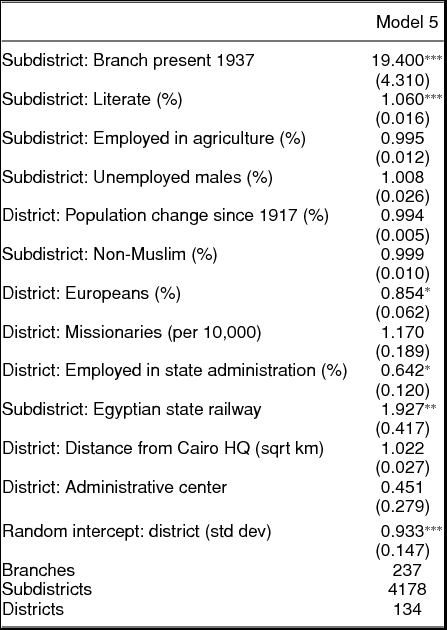
Our analysis can be replicated for the second Muslim Brotherhood branch survey that appeared in 1940. That survey records 260 branches, of which 238 can be reliably assigned to a census subdistrict. There was significant turnover in the three years separating the surveys, a product of internal schisms in the movement and leadership quarrels culminating in a formal split in 1939 (Lia Reference Lia1998, 247–50). Of the branches surveyed in 1937, 96 (45%) had folded or ceased to be affiliated with the movement by 1940, while 122 new branches appeared. This presents a novel opportunity to see if the contexts of Muslim Brotherhood mobilization remained constant, despite significant upheaval within the movement itself. To establish whether the same factors identified in Table 2 are relevant for the newly formed branches, we rerun the analysis on this new branch survey, entering a dummy variable for subdistricts with branches in 1937.Footnote 14 Table 3 presents the results.
Predicting the Probability of a Muslim Brotherhood Branch (1940)

Multilevel logistic regression, with ln(Muslim population) as offset
Standard errors in parentheses; ***p < 0.001, **p < 0.01, *p < 0.05
Again, branches were more likely in subdistricts with a higher literacy rate. The sign for employment in agriculture remains negative, but is no longer statistically significant. Branches were significantly less likely in districts with large European populations and with more adults employed in state administration. The presence of a train station in a subdistrict remains a substantive and significant predictor of a Muslim Brotherhood branch being present. Despite the high rate of branch turnover, our findings suggest that there was no significant change in the social and institutional ecologies of Islamist mobilization in the three years since the first Muslim Brotherhood survey was published. These findings are robust to penalized logistic regression (see Online Appendix Table 3).
DISCUSSION
Before discussing the implications of these findings, we should acknowledge their limitations. Unfortunately, no data are available on other relevant characteristics of the Muslim Brotherhood, such as the number of Brothers in each branch or the professional backgrounds of a branch’s membership, which would allow for a comparison with the underlying population (see Ketchley and Biggs Reference Ketchley and Biggs2017). In the absence of such information, readers should be alert to the risk of committing an ecological fallacy: our analysis can only illuminate the local contexts in which branches were formed, not the precise characteristics of individuals who joined them. Our ecological approach is also silent on the processual dynamics of the movement’s growth and mobilization (McAdam, Tarrow, and Tilly Reference McAdam, Tarrow and Tilly2001). Despite these limitations, our analysis has the great advantage of identifying the characteristics of subdistricts and districts that made the establishment of a Muslim Brotherhood branch more or less likely.
The tendency for Muslim Brotherhood branches to be present in areas with higher literacy rates and fewer workers employed in agriculture is consistent with the image of organized political Islam emerging among newly literate people living at a distance from the traditional agrarian economy. However, our findings as they pertain to Western contact run counter to the received wisdom about the initial contexts of Islamist mobilization. Qualitative accounts of the rise of the Brotherhood often spotlight the presence of large European populations such as those found in the Suez Canal city of Ismailia as a key factor in the rise of the movement.Footnote 15 We find, however, that subdistricts in districts with large European populations were significantly less likely to host a Muslim Brotherhood branch. One potential reason for this divergence is that prior analysis has not adequately accounted for variation in the spatial distribution of Europeans. According to the 1937 census, Europeans comprised 8% of Ismailia’s population (above the 95th percentile). However, districts in Cairo and Alexandria with comparably sized European populations hosted few if any Muslim Brotherhood branches. Viewed from this perspective, the birthplace of the Muslim Brotherhood appears atypical of the social and political conditions associated with the movement’s emergence elsewhere. One important implication of this finding is that contact between Muslims and Western populations seems to have inhibited, rather than impelled, Islamist growth during this period.
This is not wholly unexpected. As Mansoor Moaddel (Reference Moaddel2005, 198) notes, sizable European émigré communities had resided across the Middle East and North Africa for several decades before the emergence of organized political Islam. If Islamist mobilization was a traditionalist reaction by Muslims who had come into contact with an alien Western culture, he asks, why did it emerge after this encroachment peaked? Similarly, the number of missionaries in Egypt appears to have been in decline during the formative early years of the Brotherhood (see Online Appendix Figure 1). Here, one interpretation might be that the Muslims most susceptible to joining Islamist movements were those who experienced Westernization vicariously, such as through newspapers or word-of-mouth, rather than in their everyday life. In other words, instead of Muslims who lived and worked in close proximity to Europeans during the interwar period, it was those who read about European transgressions in Palestine or heard local shaykhs inveigh against missionaries’ attempts to convert Muslims, yet who had few opportunities to encounter Europeans in the flesh, who were most prone to join a movement like the Muslim Brotherhood (al-Anani Reference al-Anani2013; Gershoni Reference Gershoni and Dann1988). This mechanism would be consistent with scholarly research on exposure to immigration and the far right in Europe, which finds that support for anti-immigrant sentiment tends to operate at a distance from immigrant populations (Biggs and Knauss Reference Biggs and Knauss2012; Kaufmann and Harris Reference Kaufmann and Harris2015).
The presence or absence of state infrastructure is an important explanation for variation in Islamist presence. The likelihood of a Muslim Brotherhood branch existing increased as the percentage of state officials decreased, our proxy for the extent of state infrastructure and administration. This finding tallies with other studies of Islamist mobilization, which portray organized political Islam as a religious social movement that provides functions and services that might otherwise be fulfilled by the state. However, as Melani Cammett and Pauline Jones Luong (Reference Cammett and Luong2014) note, this dynamic is frequently cited, but rarely if ever empirically demonstrated (Brooke Reference Brooke2017 is an exception). In this, our article provides concrete evidence that organized political Islam emerged in areas where the state lacked capacity, an important precondition for welfare-centric arguments about Islamists’ appeal and mobilization.
Even after taking into account other characteristics, the available economic infrastructure of the day profoundly influenced where the Muslim Brotherhood established an organizational presence. Research on social movements has shown that economic infrastructure—including ports, road networks, and the railway—often occupies a key space in the ecology of modern contentious politics (Silver Reference Silver2003). The transport networks that underpin economic activity are even more important in a geographically large country such as Egypt, as prior work has shown that distance poses a key handicap to the creation and maintenance of effective organizations (Stasavage Reference Stasavage2010). As the quantitative results presented in Tables 2 and 3 suggest, Egypt’s rail infrastructure allowed the Muslim Brotherhood to surmount these difficulties. We now look to expand on this finding using qualitative evidence from the Brotherhood’s early years in a bid to better understand the role played by the railway network in facilitating the rise of organized political Islam in interwar Egypt.
PROCESS TRACING EARLY ISLAMIST EXPANSION
Shortly after its founding, the Muslim Brotherhood boasted 50 branches, concentrated along the Suez Canal and in the Nile Delta (al-Banna Reference al-BannaND, 14-5). The number of branches grew dramatically once the movement’s early leadership moved to Cairo so that, by the Brotherhood’s second decade, it boasted over 200 chapters located in 20 of Egypt’s 23 governorates. To further illuminate the role of economic infrastructure in determining these first sites of Islamist activism, we turn now to evidence from the Muslim Brotherhood’s Arabic-language publications. Here, qualitative evidence and process tracing compliments our ecological findings, by providing an insight into the dynamics of Islamist expansion during this critical period of early growth (George and Bennett Reference George and Bennett2005; Bennett and Checkel Reference Bennett and Checkel2014).
“When the Train Finally Stopped People Were Shaking Our Hands and Kissing Us”
As the Muslim Brotherhood’s figurehead and charismatic leader, Hassan al-Banna’s travels across Egypt were frequently chronicled by the Brotherhood’s various publications. However, he rarely went alone; often accompanying him were various movement figures including members of the Majlis al-Shura and what later became the Guidance Bureau.Footnote 16 In the below analysis, we spotlight al-Banna’s peregrinations across the rail network in an attempt to understand how Egypt’s economic infrastructure contributed to the process by which the movement grew.Footnote 17 As a first cut at using this rich historical record, we reviewed the Muslim Brotherhood’s early periodicals, including al-Nadhīr and Jaridat al-Ikhwān al-Muslimīn. Between August 1933 and September 1939, these organs printed a number of al-Banna’s detailed itineraries as he traversed the county by rail, establishing new branches and visiting existing ones. Figure 3 plots a selection of these journeys on a map of Egypt, along with the number of days al-Banna spent traveling and the number of stations visited.
Hassan al-Banna’s Rail Visits, 1933–9

These rail journeys were critical to the organizational growth of the Muslim Brotherhood. Hassan al-Banna was notorious for crafting short weekend trips, often up and down the canal and into the Nile Delta, to accommodate his teaching responsibilities during the working week (Ushama Reference Ushama1995, 33). On one of his earliest tours in August 1933, recorded by the Muslim Brotherhood’s newspaper, al-Banna disembarked at 14 train stations in the Delta, covering 1,000 km in two weeks [see Figure 3(a)]. And, as Figure 3 shows, following the transfer of the movement’s headquarters to Cairo, al-Banna began to embark on more extensive journeys as the movement looked to strengthen its organizational presence in the governorates south of Cairo. In February 1939, for example, al-Banna spent over a month traversing Egypt’s rail network, stopping at 33 stations and traveling over 1,500 km in the process [see Figure 3(e)]. These journeys were often advertised in advance, with detailed itineraries announcing the names of stations that were to be visited, as well as arrival and departure times (see for example, al-Nadhīr [1358b] 1938).
Firsthand accounts of these trips recorded in memoirs and the Muslim Brotherhood’s publications suggest that a stop on one of these tours was often characterized by pomp and pageantry designed to maximize the movement’s profile.Footnote 18 In his history of the early Brotherhood, Brynjar Lia (Reference Lia1998, 131) relates how members of the Brotherhood’s youth wing sometimes staged rallies at the train station to meet al-Banna, who would then lead a delegation of Muslim Brothers through the main street of the town or village chanting the Brotherhood’s hymn, “Ya Rasul Allah” (O God’s Prophet). One of Banna’s traveling companions recorded the scene in one Southern Egyptian district: “When we arrived to Meghagha train station there were crowds cheering loudly saying “God is great!” and “Thanks be to God!” and when the train finally stopped people were shaking our hands and kissing us, and we felt so much love” (cited in al-Nadhīr [1358d] 1939). In contexts unused to public street politics, these raucous scenes “must have attracted the attention of the local community and made al-Banna’s arrival an event of some note” (Lia Reference Lia1998, 131).
These travels grew in importance as the organization expanded, becoming not only a means for establishing new branches but, by visiting existing branches, a critical mechanism for sustaining the intense personal and social bonds that gave the movement coherence. One of al-Banna’s biographers notes how he would schedule trips to visit even those villages inhabited by a single Muslim Brother (al-Guindi Reference al-Guindi1978, 285–286). These visits became part of the group’s repertoire, and were undertaken by local branches’ own “rover battalions” (jawāla) or “traveling units” (firaq al-rahāla) who would visit sick members of the movement or use short trips to learn about the residents of nearby towns (see, e.g., al-Nadhīr [1357] 1938, [1358c] 1939). Hassan al-Banna himself acknowledged these frequent journeys as a crucial factor in the Brotherhood’s transformation into a national movement. In a speech to the Muslim Brotherhood’s fifth conference, al-Banna (Reference al-Banna1939) reflected on the growth of the organization over its first decade. As he reminded the audience, he and his compatriots had “issued the call to the nation, gave lessons often, traveled constantly, distributed many publications, met regularly, wrote in the older versions of the Brotherhood’s paper and also in the weekly al-Nadhīr.” Later in the same speech, al-Banna returned to this theme of travel to emphasize how his own unflagging efforts to visit far-flung places had helped to grow the movement:
Few know that the Brotherhood’s preacher leaves work [in Cairo] on Thursday afternoon and then is speaking to the people in Minya by that evening, then is giving the Friday sermon in Manfalout, then is lecturing in Asyut, then following evening prayers is speaking in Sohag, and then returns home with a full and peaceful heart, thanks be to God. . .
Al-Banna’s efforts also suggest the limited extent to which the expansion of the Muslim Brotherhood relied on the extant personal connections of the movement’s leadership. The author of an early Arabic-language biography notes how al-Banna pursued the organizational development of the Muslim Brotherhood with almost a sense of fatalism, relying on a persistence of faith and strength of character “to enter a village to establish a branch there, despite the fact that he knows no one there” (al-Guindi Reference al-Guindi1978, 30). Another early chronicler summarized how, in these journeys, al-Banna would “never pass by a village, a town, a hamlet, nor any group of dwellings without visiting it, spending the night and meeting with the people in their mosques, their houses, and their homes” (Husaini Reference Husaini1956, 12). David Commins (Reference Commins and Rahnema1994, 147) concurs, writing in his study of Hassan al-Banna that he would travel “throughout the country by train, automobile, and cart [and] pray in the village mosque and then talk with people about religion.” Here, al-Banna’s efforts to establish new branches sometimes led him to places where he was a complete stranger, and so he always carried with him on his train journeys a bag of toiletries and a pillow. As he explained to one of his acolytes, this was because he could well end up in a village where he would have to sleep at the mosque because he knew no one there (al-Guindi Reference al-Guindi1978, 283).
Local social networks were not unimportant to the development of the Muslim Brotherhood, however. On these tours, al-Banna’s retinue often included Muslim Brothers who were familiar with the area, in part because this would help him to understand the concerns and dispositions of the locals (Lia Reference Lia1998, 131).Footnote 19 And once in a village or town, Hassan al-Banna was adept at targeting and co-opting local social networks and infrastructures into his own movement (Langohr Reference Langohr2005). Ziad Munson (Reference Munson2001, 498), for example, notes how “traditional social networks were maintained and incorporated into the individual branches of the group, allowing the Muslim Brotherhood to gain access to lines of communication and commitment originally developed outside of the organization.”Footnote 20 Brynjar Lia explicitly relates the Brotherhood’s organizational growth to the movement’s ability to embed newly formed branches within preexisting social networks. This was necessary because, “In traditional villages and provincial towns, those relatively untouched by the process of modernization and industrialization, the religious elite still held an enormous influence over the local populace. Winning the support of the local elite was therefore of fundamental importance” (Reference Lia1998, 132). This sentiment clearly comes through in how al-Banna planned his journeys around Egypt. For example, one report published in the Brotherhood’s newspaper noted how the first stop for a Brotherhood delegation after praying the dawn prayer was the “elites in the city, doctors and businessmen.” As that delegation continued to wind their way southward along the Nile, establishing new branches and visiting existing ones, each stop followed the same general pattern: a speech at the train station or mosque, then a visit to important local notables, such as a court judge, professor, member of the police force, or renowned sheikh (cited in al-Nadhīr [1358d] 1939).
Against this backdrop, Egypt’s national and local transportation infrastructure appears to have served as a crucial link between the demographic factors that spurred the growth of the Brotherhood—such as the aspirations of the country’s literate middle classes—and the purposive, top-down organizational efforts of the movement’s tireless leadership. Both the quantitative and the qualitative evidence align on this point, showing how Egypt’s preexisting economic infrastructure allowed the Muslim Brotherhood to break into isolated social networks, and translate local grievances into organized activism. Here, the capillaries of Egypt’s relatively cheap and widespread rail system constituted what Peter Hedström and colleagues (Reference Hedström, Sandell and Stern2000) have called a “mesolevel network,” which served to connect preexisting and potential members of a social movement who might otherwise have existed beyond the possible range of everyday interpersonal ties. By bridging geographic and social space in this way, Egypt’s railroad system facilitated and empowered the rise of organized political Islam.
CONCLUSION
Organized political Islam is one of the most consequential social and political phenomena of the twentieth century. Marshaling both qualitative and quantitative evidence, we have provided the first systematic investigation of the contexts of early Islamist activism. We find that Muslim Brotherhood branches in interwar Egypt were more likely to be present in areas with higher numbers of literate individuals and fewer workers employed in the agrarian economy. In contrast to much of the received wisdom on the rise of political Islam, we find little support for arguments that organized Islamism took root in areas where there was greater contact between Muslims and the West. Most notably, our results suggest that the reach and development of state and economic infrastructure profoundly shaped the organizational development of the Muslim Brotherhood. On the one hand, this is a story of the uneven growth of the modern administrative state: Brotherhood branches were more likely to exist in areas where the state’s infrastructural presence—proxied by the percentage of the population employed in state administration—was weak. On the other hand, the economic infrastructure that paved the way for Egypt’s incorporation into the world capitalist economy also played an important role in patterning the early contexts of Islamist activism. Net of all other factors, we find that a strong predictor of organizational presence was whether or not a rail station was located in that subdistrict. And a reading of the rich textual record left by Arabic-language memoirs and the movement’s own publications reinforces the importance of this infrastructure in the rise of organized political Islam. Not only are contemporaneous accounts in the Brotherhood’s newspapers spotted with reports and itineraries of the leadership’s rail travels across the country, but in their own writings and speeches the Muslim Brotherhood’s leadership highlighted these journeys as an innovative means by which they grew the movement.
These findings suggest that the Muslim Brotherhood was a modern social movement that consciously appropriated the existing economic infrastructure of the day to mobilize literate populations in areas where the state had only a titular presence. In this, our account aligns with qualitative studies of other early mass-participation Islamist movements, which stress the importance of literate middle class constituencies (Minault Reference Minault1982; Noer Reference Noer1973; Qureshi Reference Qureshi1999; Reetz Reference Reetz2006). And specific accounts of the Islamist Khilafat movement in colonial India and the Sarekat Islam in Dutch-controlled Indonesia also highlight the role of rail networks, alongside other forms of economic infrastructure, in the initial development and growth of these movements (Van der Veur Reference Van der Veur2006, 188, 266; Minault Reference Minault1982, 20). It will, of course, require census data, alongside other historical sources, such as Christian missionary reports and maps of available transportation infrastructure, to more fully arbitrate the extent to which our findings apply to these cases.
The Muslim Brotherhood’s similarities to other social movements also raises an important puzzle for future research. The dynamics of competition (and potentially cooperation) are important to organizational development and vitality (McAdam, Tarrow, and Tilly Reference McAdam, Tarrow and Tilly2001), but the political and movement ecology of our article is rather barren: we examine only the relationship between the emergence of organized political Islam and the Christian missionary movement. Yet interwar Egypt was a hothouse of social, religious, and political activism, encompassing groups like Young Egypt (Misr al-Fatat) (Jankowski Reference Jankowski1975; Shalabi Reference Shalabi1981), the Wafd (Deeb Reference Deeb1979; Quraishi Reference Quraishi1967), and the Young Men’s Muslim Association (Gershoni Reference Gershoni1986, 379–82). By the end of the interwar period these competitors had dwindled, while the Brotherhood had emerged as a dominant sociopolitical force, “so diversified as to be virtually representative of every group of Egyptian society” (Mitchell Reference Mitchell[1969] 1993, 12). To what extent was the Muslim Brotherhood inspired by such movements, and what factors explain the Brotherhood’s relative success and resilience? As scholars become more concerned with uncovering the precise ways in which Islamist groups are advantaged over their non-Islamist competitors, such a comparison would seem to hold great promise (Brooke Reference Brooke2017; Cammett and Jones Luong Reference Cammett and Luong2014; Masoud Reference Masoud2014; Pepinsky, Liddle, and Mujani Reference Pepinsky, Liddle and Mujani2012).
Two additional areas of future inquiry are also worth highlighting. One outstanding question is the role local religious figures played in the rise of organized political Islam. Qualitative material, including an array of primary sources, points to the role of mosques and religious lectures in the growth of the Muslim Brotherhood. In such accounts, prominent shaykhs associated with the group frequently spoke on religious topics at the Brotherhood’s headquarters in Cairo, and traveled around the country delivering sermons and lectures. While the Muslim Brotherhood is often understood as a lay movement of the middle classes, there is suggestive evidence of a hitherto unappreciated dynamic in which formal figures of Islamic religious authority lent credibility and legitimacy to the movement. Secondly, and as noted earlier, we lack systematic data on the movement’s membership. In its absence, a study of the microlevel processes of branch formation holds notable potential for testing and expanding on our conclusions.
Finally, this article continues a growing trend in comparative politics to excavate underutilized historical evidence and couple it with newer analytical tools to examine matters of distinct contemporary importance. Recent research in this vein has shed light on the political divergence of the West and the Muslim World (Blaydes and Chaney Reference Blaydes and Chaney2013), the persecution of religious minorities (Braun Reference Braun2016), the role of combat veterans during episodes of ethnic cleansing (Jha and Wilkinson Reference Jha and Wilkinson2012), the dynamics of local resistance to foreign rule (Ferwerda and Miller Reference Ferwerda and Miller2014; Kocher and Monteiro Reference Kocher and Monteiro2016; Lawrence Reference Lawrence2013), and state strategies of counterrevolution (Weyland Reference Weyland2016). This trend holds particular promise for political scientists of the Middle East, where systematic contemporary data is notoriously scarce, and sometimes even potentially dangerous, to acquire (Brooke Reference Brooke and Lynch2016; Brown Reference Brown2015). It is our hope that this article will encourage others to look to similar sources and methods to revisit important moments and episodes in the region’s history.
SUPPLEMENTARY MATERIAL
To view supplementary material for this article, please visit https://doi.org/10.1017/S0003055417000636.
Replication materials can be found on our Dataverse at: https://doi.org/10.7910/DVN/UJYEAD.




Comments
No Comments have been published for this article.