IntroductionFootnote 1
Recent calls for the revival of research interest on the part of historians in Africa’s pre-colonial past, and actual efforts at interdisciplinary collaboration among some scholars of southern Africa, raise the possibility of renewed conversations between archaeologists and historians and the prospect of fresh understanding of different aspects of the continent’s deeper past.Footnote 2 To facilitate such exchanges, and to guard against the sense of disappointment and even bewilderment that appears to have followed previous efforts at interdisciplinary dialogue in the 1960s and 1970s, and which eventually triggered doubts about shared parentage, historians and archaeologists will need to be fairly explicit about both their expectations and the limitations of their own sources, datasets and methods.Footnote 3 This paper is an attempt to encourage just such a self-critical engagement, with particular reference to the potential contributions that archaeology can make to understanding changing characteristics of labor in eastern Africa over the last five centuries. This particular focus was inspired by an invitation to contribute to the ongoing research of the Global Collaboratory on the History of Labour Relations as described elsewhere in this issue – an invitation I was initially hesitant about accepting because of uncertainties as to whether archaeology could contribute in any meaningful way. As elaborated below, there are certainly many limitations to archaeological data that need to be acknowledged before embarking on such a project. Yet, as I aim to illustrate here, once these caveats are addressed not only can archaeologists make useful contributions to scholarly understanding of the longue durée of labor history on the African continent, but also it is essential that they do so.
The need for historians and archaeologists to engage in a critical conversation about the nature of their sources, the relative methodological strengths and weaknesses of their respective disciplines, and their current theoretical underpinnings is particularly necessary when documentary sources are scarce – as is the case for much of eastern Africa prior to the nineteenth century. For a field of historical enquiry, such as labor relations history, which relies heavily on the availability of census returns and similar statistical and demographic baseline data, the absence of such documentary sources can thus appear to be a severe impediment to research, with the result that most studies limit discussion to the eras immediately prior to colonial rule and onwards. The greater time depth of archaeological sources might thus offer one solution to this problem. However, labor historians wishing to make use of archaeological data have to contend with a number of problems. Baldly stated, the main ones are as follows:
i. Epistemic differences between the material sources used by archaeologists and the written and oral sources employed by historians;
ii. The uneven patterns and intensity of archaeological research – which in eastern Africa has only recently included consideration of the periods after c. 1500;
iii. The variable spatial distribution and survival of archaeological materials;
iv. Contrasting theoretical frameworks and research concerns between the two disciplines.
In an effort to address these, this paper begins with a discussion of the relative strengths and limitations of archaeological data and what, potentially, might be learned from them about past labor practices and their organization. This is followed by a preliminary attempt to estimate in general terms the relative proportions of Tanganyika’s population between c. 1500–1900 that comprised each of the four major categories of labor relations (non-working, reciprocal, tributary and commodified) in the taxonomy of labor relations employed by the Global Collaboratory on the History of Labour Relations (see the article by Hofmeester, Lucassen and Ribeiro da Silva). Owing to the scarcity of relevant archaeological data sets for this time period, this section relies heavily on the late precolonial documentary sources as summarized by Koponen.Footnote 4 Where relevant archaeological material is available, this is used to add further texture to the argument and additional temporal depth. Because archaeologists have rarely asked the same kinds of questions of their data as historians, this section is intended to be indicative of the potential for such studies rather than a definitive statement on the substantive evidence. The paper concludes with some suggestions concerning future directions for research that could strengthen some of the arguments developed below.
Inferring Labor Categories from Archaeological Data
Archaeology is a poor source of information regarding the specifics of labor history, but can offer a rich and varied seam of knowledge about the generalities of labor, especially in terms of the range of subsistence and productive activities that characterize a society or community in a particular place or era. Archaeology is also an excellent source of information about, and a means of studying, the consequences and effects of human labor on both the external world, whether that is a humanly constructed one or part of the natural environment, and on human bodies.
Unfortunately, in the discipline as whole there has been relatively little explicit consideration or theorization about the archaeology of labor relations per se. Most discussions extend little further than some consideration of the division of labor, especially between men and women or between elites and commoners. For some archaeologists, “labor” is simply equated with energy expenditure. Thus, from this perspective the higher value ascribed to finely crafted artifacts, for instance, is treated purely in terms of the amount of energy expended on their production rather than on a host of other possible variables.Footnote 5 Where archaeologists have drawn on Marxist theory in their interpretation of spatial and material variation in the archaeological record, rather more explicit consideration has been accorded to the wider significance of labor relations in the past.Footnote 6 Archaeologists concerned with the study of the archaeology early Western capitalist and industrializing societies have likewise attempted more detailed analyses.Footnote 7 However, even these approaches rarely offer any clear guidelines on how it might be possible to differentiate between different categories except in a general sense.
There is, nonetheless, a growing body of archaeological perspectives on certain forms of labor, especially relating to the identification of craft specialists and slaves. Additionally, the spatial diversity of the material practices and culture of collectives, whether this is at the limited spatial scale of individual households, or the far more extensive one of the state, kingdom or similar political entity can often provide a rough guide to the organization of labor. At the settlement level, the reconstruction of the range of activities conducted within individual households and their spatial distribution can provide important insights into the gendered division of labor and evidence for craft specialization.Footnote 8 Within-site spatial analysis of different building types may also reveal the existence of special purpose buildings or spaces associated with different administrative functions or other non-subsistence related forms of activity, thereby attesting to the likely existence of some form of tributary or commodified labor relations.Footnote 9 Scaling up to the wider landscape, comparison of assemblage compositions between different sites, regional analysis of the spatial distribution and density of different artifact types, and identification of manufacturing and extraction sites can likewise serve as proxy indicators of the existence of certain kinds of exchange relationships and hence associated types of labor.Footnote 10 Similarly, it is often possible to identify the existence of market-based systems of exchange and monetized economies from surviving physical evidence, both of which at least raise the possibility of the existence of some kinds of commodified labor. These approaches are worth reviewing here, as the existence of both slaves and craft specialists are certainly potentially discernable in East Africa’s archaeological record of the last five centuries, and there is a least some material evidence to suggest the existence of monetized, market-based exchange from the late first millennium onwards, albeit in a quite localized area.
-Craft Specialists
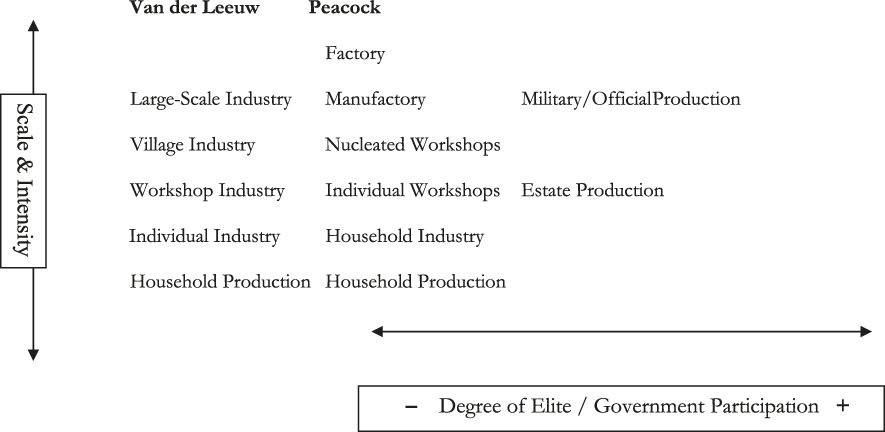
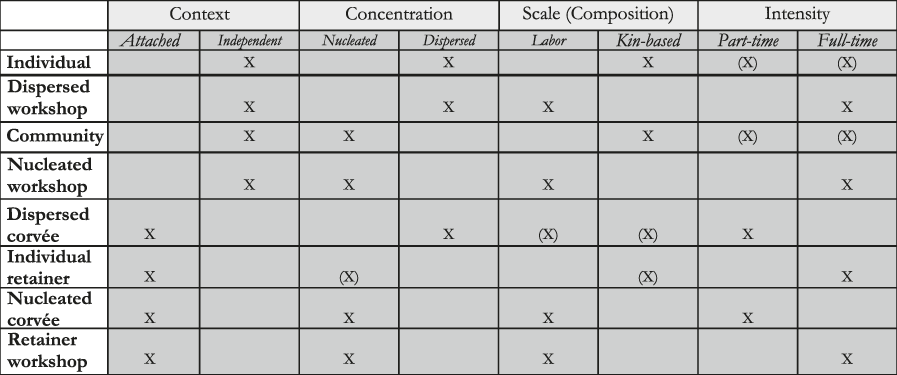
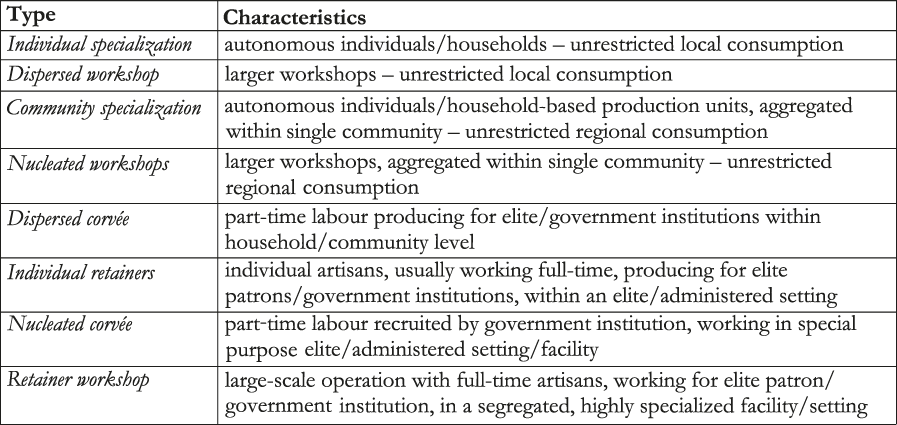
Although less work has been conducted on this topic with reference to pre-colonial sub-Saharan African societies, various models have been developed for other areas concerning different types of craft specialization and their potential archaeological “signatures.” Since these different kinds of craft specialization typically entail different systems of production, their archaeological identification can thus serve as a proxy indicator of certain labor relations. In an early study, Van der Leeuw, for example, noted that the scale and intensity of specialization can range from craft activities organized and conducted at the household level to those undertaken within the context of large scale industrial settings (Figure 1).Footnote 11 A further feature of note about craft specialization is whether such craft activities develop independently to meet utilitarian, economic needs, or whether they emerge under some form of political control. These different types are sometimes referred to in the archaeological literature as “independent” and “attached” respectively. Peacock’s typology although based on Van der Leeuw’s model, incorporates this distinction (Figure 1).Footnote 12 Costin has further developed these typologies based on the intersection of four variables (contexts, concentration, scale, and complexity, see Figure 2) and has offered more precise definitions of the different types that are known cross-culturally (Figure 3).Footnote 13
Typologies of craft specialisation as proposed by Van der Leeuw and Peacock (Adapted from: Costin 1991, “Craft Specialization,” Figure 1.2 and Figure 1.3).

Costin’s typology of different forms of specialized labor (Source: Costin, “Craft Specialization,” Table 1.1).
Costin’s typology of craft specialisation (Costin, “Craft Specialization,” 8–9).
In terms of the archaeological identification of these different categories, both direct and indirect evidence may be available for any setting. In terms of direct evidence, Costin argues that variations in the form and spatial location of production loci, variations in the composition and density of manufacturing debris, and differential ratios between finished and unfinished materials are among the best indicators.Footnote 14 Indirect evidence for different forms of specialization may be provided by evidence for the standardization of artifact forms; variable levels of skill and artistry used in the manufacturing process; evidence for greater efficiency (including in terms of energy expenditure) in production; and variations in the regional patterning of their geographical distribution.Footnote 15
-Market Exchange
Geographical distance-decay models of the effects of distance on the availability of exchanged items and associated graphic expressions of fall-off and distribution patterns coupled with the physical evidence for imported materials have been used widely to reconstruct different trade and exchange systems.Footnote 16 Some of these exchange systems would have required trading specialists, full-time merchants, individuals responsible for the transport of products from production centers to the market, tax collectors and a range of other forms of non-subsistence labor. Aside from evidence for imported items, associated physical evidence may include money (although not all money was used as a generalized standard of exchange value), market places, shops, bulk storage facilities and ship-wrecks containing cargos.Footnote 17 More critically, archaeologists have long held to the view that all or most societies participated in exchange, but only socially complex societies had trade that was elite-driven and controlled. Recently, Oka and Kusimba have argued against the universal nature of such a view by emphasizing the need to consider the social aspects of trade relations and how these may influence archaeological patterning.Footnote 18 For example, they point to evidence from different geographical areas and time periods where networks of trading specialists (i.e. individuals or family units who derived a significant part of their livelihood from trade/commerce) existed as semi-independent agents linked to other agents through embedded social, commercial, and political relationships. These networks tend to be self-organizing and self-regulating, and less concerned with establishing a trade monopoly, and more with ensuring sustainable production and distribution over the long-term. Such a network, they argue, developed along the Swahili coast from the latter part of the first millennium until its disruption following the entry of the Portuguese and other European powers after 1500.
-Slavery and Slave Trading
Much of the research on slavery in Africa still relies heavily on documentary and oral sources and uses archaeology more as a means to materialize the practices of slave trading and ownership than as an independent source of evidence. This is perhaps understandable given that their marginal status generally meant that slaves left far fewer material traces of their presence than other labor categories. Moreover, even where material evidence has been interpreted as indicative of either slave trading or slave ownership, alternative explanations can usually be forwarded as well. Thus, for instance, while it is possible that iron shackles recovered from Swahili-era sites attest to the presence of captives destined to become slaves, they could equally have been used for restraining wrongdoers. In the absence of supporting documentary evidence, verification of the presence of slaves may thus be hard to achieve. Nonetheless, as many studies now demonstrate, including several on the African continent, new information about the lives of slaves, the wider impacts of slave raiding and the organization of slave trading can be gleaned from analysis of material evidence at multiple spatial scales, and when several different material and landscape indicators occur together convincing arguments for the presence of slavery can be made.Footnote 19
With these observations in mind, the following sections offer some tentative reconstructions of the approximate proportions of the four major categories of labor relations as inferred from different data sets.
Tentative Reconstruction of Labor Relations in Tanganyika, c. 1500–1900
In view of the scarcity of detailed archaeological studies for mainland Tanzania as a whole for the period c. 1500–1900, this section draws heavily on the available ethnohistoric information about the end of this period, as summarized by Koponen, combined with information concerning late nineteenth- and early twentieth-century population densities and their spatial distribution.Footnote 20 Wherever possible, relevant archaeological data are drawn into the discussion in a supplementary fashion. The overall intent is to provide a rough sketch of the approximate proportions of the different major categories of labor that existed by 1500, the basis for inferring their existence and where the greatest diversity of labor relations are likely to have been located. The basic approach is thus an iterative one, wherein the nineteenth-century and early twentieth-century data provide a baseline against which the more patchy archaeological data for earlier periods can be compared and contrasted. Once again, it is important to stress that the objective is purely to highlight what we can reasonably infer to have been minimally the case in different parts of the country and at different time periods. Further research that uses archaeological approaches more systematically to reconstruct past labor relations might well indicate significant differences between the start and end of this period, however, and this possibility must be kept in mind here.
-Population Size and Distribution
The overall demographic structure of the national or regional population and its spatial distribution provide an important starting point for the reconstruction of past labor relations. As noted by Karin Pallaver elsewhere in this issue, the total population of Tanganyika was likely around 3,600,000–3,800,000 in 1900, and perhaps in the region of 2,500,000–3,000,000 in 1800. Gillman’s Reference Gillman1936 map (Figure 4) of population distribution (when the total population was around 4,825,000) provides a useful visual synopsis of where the highest concentrations lay.Footnote 21 These include Buhaya west of Lake Victoria; the Mwanza-Tabora/Singida corridor; Kondoa; the foothills of Mounts Kilimanjaro and Meru; the lower Pangani basin and adjacent Usambara and Pare mountains; sections of the central and southern coastal strip, especially around Dar es Salaam, Kilwa Kivinje and Mtwara/Lindi; the Morogoro area; and southern Mbeya around Lake Nyasa. By and large, those areas with higher population densities in the late nineteenth and early twentieth century roughly correlate with the distribution of societies known to have been hierarchically structured. These areas, therefore, are likely to have had more categories of labor relations than those where more egalitarian social structures prevailed. A characteristic of these societies, for instance, was that a small section of the population had significant administrative responsibilities that would have made up their primary daily routine. Such functionaries included advisors, rain-makers, healers, and other court officials. Unfortunately, insufficient archaeological research has been conducted in any of the areas associated with nineteenth century kingdoms however, making it impossible at present to add to what is already known from oral history about the origins of these different labor categories.Footnote 22
Population Map of 1934 showing overall distribution of population (Source: Gillman, “A Population Map,” plate II, reproduced with kind permission from The American Geographical Society).
Gillman saw the prime reason for the variations in population density being environmental, and especially due to differences in the availability of water. While environmental factors were certainly important and potentially limiting factors, social factors were equally significant. Thus, for example, many of the areas with the highest population densities were chiefdoms and small kingdoms characterized by hierarchical social structures. The population of Karagwe (present-day Northwestern Tanzania), for instance, was estimated by the Germans at the time of conquest to be around 150,000; the combined Haya states amounted to 200,000; Unyamwezi and Usumbwa together comprised around 250,000 in 1891, divided between one hundred fifty chiefdoms; and the Shambaa kingdom may have amounted to perhaps 100,000.Footnote 23 There were no large states on the scale of those found in Uganda around the same time, however, and a great majority of the other distinct “ethnic” communities comprised no more than a few tens of thousands, and in some cases merely a few thousand or less. Even in moderately densely populated areas there was likely a degree of spatial variation, if the twentieth century data are a reliable indicator – as among the Chagga, who were divided into as many as thirty chiefdoms, and in the 1940s had an average population density of 144 person per kmFootnote 2, with a range between 94 and 292.Footnote 24 We should also note that the distribution of areas of dense population concentrations shifted over time. Thus, even the density maps produced in the early part of the twentieth century are not necessarily a good guide to where there were dense concentrations of population in earlier periods – the example of Engaruka being a case in point.
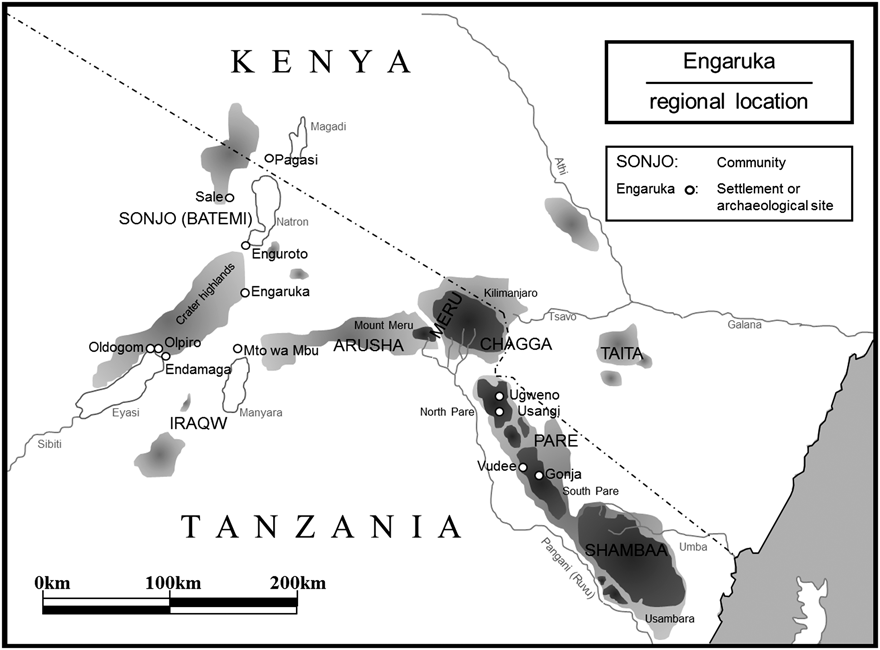
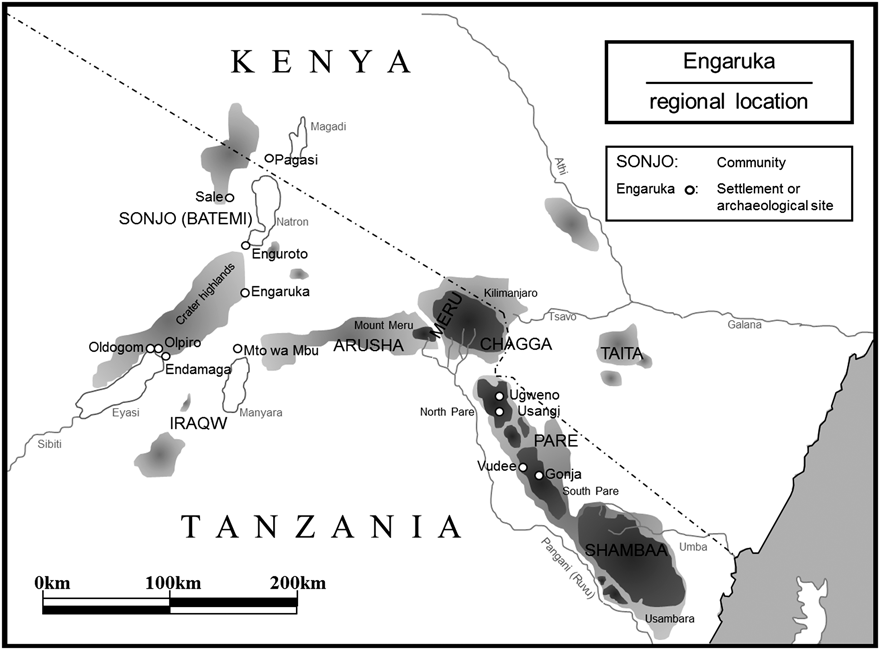
Dating to between the thirteenth to eighteenth centuries, Engaruka (Figure 5) comprises almost 2,000 ha of stone-lined fields, terraces and irrigation channels extending roughly due east from the foot of the western escarpment of the Rift Valley. These are associated with seven distinct village sites on foot-slopes of the escarpment, and numerous stone enclosures (some of which were used for penning livestock) and stone cairns (some were agricultural clearance cairns, others had different purposes). The economy was primarily an arable one, which relied on the irrigated cultivation of sorghum, supplemented by the husbandry of large and small stock, the manure from which may have been employed to maintain soil fertility.Footnote 25 The spatial extent of Engaruka has encouraged much speculation as to the size of population it supported, and over the decades figures between a quarter of a million inhabitants to between 4,000 and 5,000 individuals have been proposed.Footnote 26 A more recent calculation derived from the number of house platforms, suggested that the figure may have been somewhere between c. 7,000 and 11,600.Footnote 27 This too can be criticized as it assumes that all of the houses were occupied coevally – which has not yet been demonstrated.Footnote 28 There is also accumulating evidence which indicates that the maximum extent of the fossil field and irrigation systems is a poor guide to the actual spatial extent of the system at any one moment during its five hundred year history.Footnote 29 The total area of fossil fields, in other words, is a poor indicator of the labor needs of the system as some parts may have been abandoned by the time other sections were brought into production.
Location of Engaruka and other localities (names of ethnicities in capitals) in Northern Tanzania and Southern Kenya with evidence for agricultural intensification. (Source: Stump, “The Development and Expansion,” Figure 1, reproduced with permission from the author).
Owing to the greater visibility of certain kinds of archaeological sites along the Indian Ocean seaboard, often referred to in the literature as “Swahili stone-towns,” and the greater intensity of archaeological research at such sites, it is perhaps easier to make some general inferences about the division of labor and size of the coastal population immediately prior to 1500 than it is for much of the interior. This said, despite the existence of numerous small towns with well laid out stone-built houses, courtyards, mosques, wells, town walls and other visible structural features, which might make the task of estimating population sizes perhaps slightly easier than at sites lacking stone architecture, archaeologists have been unusually cautious in their estimates, and even only marginally less so in their efforts at inferring the social organization of these settlements and prevailing divisions of labor. Thus, neither of the most recently published general syntheses of the archaeology of the wider Swahili coast considers the likely population size of different settlements in any detail.Footnote 30 Current estimates are instead more general, with most researchers agreeing that for the Swahili coast as a whole up to five general classes of settlement may have existed. These ranged from small hamlets c. ≤ 1.0 ha in extent, through villages (≤2.5 ha), small towns (2.5–5.0 ha), towns (5.0-15.0 ha) and “cities” (≥ 15 ha).Footnote 31 The largest of these, such as Kilwa, are considered to have supported populations above c. 15,000, while the smaller towns may have had populations in excess of 5,000 at their peak.Footnote 32 Regional surveys, such as those by Helm to the north of Mombasa, Kenya, and Wynne-Jones around Kilwa, southern Tanzania, also indicate the filling out of the settlement landscape from the middle of the first millennium to c. 1750, which would suggest a general, steady rise in the size of the coastal population.Footnote 33
Labor Relations According to the Taxonomy
If we wish to apply the labor relations taxonomy of the Collaboratory it is important to note that the written sources are virtually silent on the composition of the non-working population, even in the late nineteenth century. From the available data, we can infer that this section of the total population likely comprised just two out of the three defined categories – those who could not work or were not expected to work (Labrel 1), because of age or some disability, and those who did not work because of affluence (Labrel 2), especially in some of the larger coastal “Swahili” towns. It is unlikely that a concept of “being unemployed” existed, primarily because most labor took place within a context of household production. As a rough estimate, over the period in question the entire non-working component is likely to have comprised between one and two percent of the total population.
As for the working population, by 1500 the bulk of the population in what is now mainland Tanzania were either cultivators, pastoralists, or mixed farmer-herders, along with some small pockets of hunter-gatherer-fishers. The latter groups exchanged their products for commodities and probably also for food (such as cereals and vegetables). However, hunting also remained a component of some farming communities, such as the Safwa and Fipa.Footnote 34 The Yao and Mwera are both known to have engaged extensively in hunting, and in the Mwera case large hunts involved the collaboration between several villages and the use of nets.Footnote 35 The bulk of the rural population would have been engaged principally in subsistence activities, supplemented by surplus production for market exchange through a combination of barter and, in some localities, the use of special purpose money. The greater proportion of their work would have been undertaken as reciprocal labor, including household and agricultural slaves (Labrel 6), although various forms of tributary labor (Labrels 9–11) are also known. By the nineteenth century, and quite probably significantly earlier, some specialist elephant hunting communities such as the Makua had emerged, and specialist fishing communities (such as the Jiji on Lake Tanganyika who supplied neighboring communities with supplies of freshwater sprats) are also known to have existed.
Concerning reciprocal labor, the nature of the available archaeological sources for the periods after 1500, and the nineteenth century documentary records both suggest that in all areas other than the coastal towns most of the individuals who worked (approximately 75 and 85 percent of the total population) were engaged in reciprocal labor. At the household level (Labrels 4-6), household heads, other household kin producers and servants (Labrels 5a and 5b) and certain categories of “domestic slaves” (Labrel 6) were primarily engaged in subsistence farming and herding activities. Gendered divisions of labor typically assigned child care, food preparation and household maintenance activities to adult and sub-adult females, who would have been assisted by servants/domestic slaves where present. In farming societies, these groups would have also been responsible for fetching firewood and water, and many agricultural tasks such as sowing, weeding, tending gardens, and harvesting. Adult and sub-adult males typically performed the heavier duty agricultural tasks, such as clearing new fields, and where these existed were perhaps primarily responsible for building and maintaining irrigation channels and agricultural terraces. They also often undertook many of the other agricultural tasks, such as hoeing, weeding, and harvesting.
Irrigation and terrace using agronomies are known from a variety of locations across northern Tanzania while in other locations, such as the Mbulu Highlands inhabited by Iraqw, other forms of agricultural intensification are attested. In North and South Pare, some of the terracing and irrigation furrows appear to have been constructed during the eighteenth century, although oral genealogies and recent preliminary archaeological work suggest a date of broad inception around 1500.Footnote 36 Furrow irrigation in Usambara may be as much as three hundred years old, while a seventeenth century or earlier date has been proposed for the establishment of the irrigation schemes and associated larger polities on Mount Kilimanjaro.Footnote 37 The spatial extent, scale, and engineering of these systems all hint at the need for significant labor investments at particular times. While the available records are silent on this matter for the earlier periods of their history, more recent observations can provide an indication of these. For example, in their discussion of the history and management of Chagga irrigation systems on Mount Kilimanjaro, Stump and Tagseth note that in the recent past annual repairs to one irrigation furrow took a workforce of sixty men three days to complete, and a group of twenty men might typically spend sixty to a hundred and twenty hours to remove silt from c. 2 km of irrigation furrow two or three times a year.Footnote 38 Stump’s own observations in North Pare suggest annual labor investments of up to a hundred and twenty hours per annum to clean sediments from just a single reservoir (ndiva), and in excess of three hundred person hours p.a. to maintain a 6x4m structure. Since there are well over one hundred extant versions of these features in the modern landscape, the hours spent just on their maintenance over a year is likely to be between 12,000–30,000 hours. Despite the obvious demands on labor these systems create, it would be mistaken to assume, as has often been the case, that these systems required some form of centralized authority in order to operate. Indeed, all of the available ethnographic and historical data indicates that management of these systems was organized largely by consensus at the level of individual clans, with various social sanctions and perhaps the associated ritual symbolism of the life-giving powers of water, providing the necessary mechanisms to encourage active participation.Footnote 39
Males, especially young adult and sub-adults, were typically responsible for tending livestock, and are likely to have been responsible for any hunting. In strongly pastoral societies, such as the Maasai, the young adult males also formed the warrior age set with responsibilities for protecting the community and undertaking both punitive and opportunistic raids on other sections and societies. Based on the available evidence from neighboring parts of Kenya, this aspect of pastoralist social organization may only have emerged after the fourteenth century, but in the absence of archaeological investigation of pastoralist sites from the past millennium it is not possible to confirm this was also the case in Tanzania.Footnote 40
From the documentary sources two broad categories of community based redistribution laborers can be identified, namely those who had administrative and juro-political responsibilities within the community – typically hereditary leaders and/or groups of elders, and those who specialized in some form of craft production or provided a service of some kind in exchange for food or other payments in kinds (Labrel 7). As discussed above, archaeological data can be used to infer the existence of craft specialists, and there is evidence for these at Swahili sites along the coast and on sites further inland. The existence of administrative elites can sometimes also be inferred archaeologically, but for the period in question there has been no relevant work on this topic on Tanzanian sites.
Perhaps the most widespread of such craft specialists (but nonetheless restricted to certain societies) were iron smelters and blacksmiths, who are known to have existed among many societies, often associated with a particular clan – as among the Pare and Shambaa. In some cases (as among the Pare where different clans were responsible for smelting, smithing, and charcoal production) there was quite a sophisticated division of responsibilities, with members of different clans having responsibility for the different stages of production, in others all these tasks were undertaken by the same individuals. Thus in Pare, for instance, various lineages of the Washana clan were involved in iron production, and by the late nineteenth century were renowned for the quality of their products.Footnote 41 The smelting of iron was largely the responsibility of the Wafinanga lineage.Footnote 42 Most of this was undertaken in the foothills and adjacent lowlands, where the magnetite sand used as the main ore source was readily available, especially along the lines of erosion gullies. Some of the highland residents were also involved in washing and fining the ore preparatory to smelting. The smithing of iron to make tools, in contrast, was undertaken in the highlands by another lineage, the Wanyindo lineage. Another lineage, the Wakamoto, provided the charcoal used for smelting and received in return livestock and/or finished metal tools. Some of the finished products were exchanged directly by the smelters in local markets such as those at Taveta and Mruma, or else with local residents for livestock and agricultural produce. Iron bars were also exchanged at these markets and with Washana smiths.Footnote 43 Blacksmiths are also known to have been contracted to make tools such as hoes from ore gathered and supplied by the person commissioning the work, retaining at least one of the finished items as payment. Finished items were also exchanged with neighbouring groups, including Maasai herders and Shambaa farmers.
Iron ores are not evenly distributed; consequently as regional exchange networks expanded, those societies with access to suitable ores and with an established iron smelting tradition, tended to be those where full-time iron working specialists developed, such as among the Pare, Rangi, Fipa, Haya and Nyamwezi, among others. Their products were likely exchanged in local markets, although oral sources indicate that they were also traded further afield; for instance, Zigua traders were likely responsible for distributing the iron goods manufactured in Pare further afield.Footnote 44 In central Tanganyika, Rangi of the Kondoa area are also known to have travelled to neighboring areas to exchange their wares. There is even some tentative evidence that the iron tools used at Engaruka could have come from here as there are no known local sources of iron and no evidence for iron smelting, even though iron tools were clearly used.Footnote 45 In fact, there are no local sources either of potting clay at Engaruka, and at least some of the pots used there also seem to have been obtained from potters working in the Kondoa area to the south.Footnote 46
In a few localized areas other full-time, non-food producing, specialists seem to have existed – most notably near the Uvinza salt springs close to Ujiji where different sections of the labor force were engaged in carrying and boiling the brine, making pots, cutting and fetching firewood, and packing salt. In 1898, German records suggest that annual output had reached 350,000 kilograms and that up to twenty thousand individuals were engaged in the industry.Footnote 47 Much of this workforce was made up of seasonal itinerants, who travelled from as far afield as Burundi. Salt was exchanged locally for food and fuel, but the main stimulus for the growth of the industry from at least 1850 onward was the expansion of the long-distance caravan trade between the coast and the interior. The three Vinza chiefs who controlled the springs also profited from this trade by levying a tax amounting to one-tenth of the annual output and charging road tolls and ferry charges.
The antiquity of these groups of specialized producers is unknown. The earliest iron working sites in Tanzania date to around 500 BC in Buhaya and the first few centuries AD further west and south in the Usambara Mountains.Footnote 48 It is generally assumed that while this was a specialized rather than generalized craft from the outset, except perhaps in Buhaya it was not until after 1000 that iron production was intensified and the exchange of iron products integrated into regional, rather than purely local, exchange systems. Unfortunately, even in comparatively well studied areas such as North Pare there is as yet insufficient archaeological data to assess this assumption. Regarding salt production, there is some evidence that after 1000 extraction around the Ivuna salt pans, near Lake Rukwa in southern Tanzania was quite intensive, most probably for long-distance exchange: dating to between the thirteenth to fifteenth centuries, the extent of the archaeological deposits here are considerable and contain a mass of pottery, food bones, the remains of house floors, several burials, plus some imported glass beads.Footnote 49
Rather more archaeological attention has been given to reconstructing the internal organization of some of the coastal “Swahili” towns and inferring the range of social categories and the division of labor within them, although at times some of these interpretations have relied more on later ethnography than actual archaeological evidence. Nonetheless, based on Horton’s work at Shanga in the Lamu archipelago, northern Kenya, it is highly probable that in at least some of these towns there existed by the ninth and tenth century a clan based society, with an identifiable urban elite (who were among the earliest adopters of Islam), maritime traders and merchants, specialized craftsmen (such as blacksmiths), pastoralists and fishermen (and women, who may well have been responsible for shell-fish collection), farmers and slaves.Footnote 50
Intriguingly, craft-related activity (such as for blacksmithing, bead manufacture, and potting) is well represented in the artefact assemblages from the early archaeological horizons at these towns. In contrast, by the fifteenth and sixteenth century much of this evidence is scarcer, and assemblages are more heavily dominated by imported material.Footnote 51 One possible implication of this is that labor divisions had become more distinctive and perhaps more socially nuanced, with the result that lower status individuals no longer had as much opportunity to reside within the stone-town parts of these settlements. Since it is the stone-built areas of these towns that have received most archaeological attention, the nature of craft specialization and its organization in the areas of mud-and-wattle housing remains poorly known. Some insights can be gleaned from recent work on the islands of Pemba and Songo Mnara, which can be extrapolated to other sites along the coast, albeit with some caveats in mind. Thus, for example, the seventh to tenth century settlement of Tumbe, Pemba Island, has produced extensive evidence for local specialized craft production, including the grinding of glass beads, while at Songo Mnara in the fifteenth century cloth production seems to have been important.Footnote 52
The percentage of the total population engaged in full-time tributary labor is difficult to estimate, but seems unlikely to have been higher than 10 percent prior to the nineteenth century. In ranked societies, many individuals would have had to pay some form of tribute to members of the ruling elite in return for their physical and spiritual protection. Hence, a proportion of their labor would have been directed toward such commitments. The main type of more formal tributary labor was tributary slavery (Labrel 11), although some of these might be better categorized as obligatory laborers (Labrel 8).
The use of slaves and other forms of unfree labor has a long history in eastern Africa, as has the trade in captives and other individuals who were eventually destined to work as slaves elsewhere in the region and in other parts of the world. The antiquity of slavery and slave trading across the region is nonetheless uncertain, and both the institution and the slave trade were subject to historical change.Footnote 53 Variations in the precise meaning of vernacular terms for different categories of unfree labor, and misconceptions of the nature of the relations between “owners” and “the owned” on the part of European observers further complicate matters when it comes to differentiating between some of the proposed taxonomic categories. This is well illustrated by Hartwig’s study of the changes in slavery between the seventeenth and nineteenth centuries in Bukerebe, at the south-eastern end of Lake Victoria.Footnote 54 Here, as early as the seventeenth century, a category of servitude that can be roughly equated with “domestic slavery” was in existence. Known as either aberu (males), or abazana (females), these were individuals who no longer possessed an identity defined through clan membership because of famine, war, or wrongdoing. These were not necessarily permanent conditions, however, as anyone with this status could be redeemed either by their kin, or through developing good relations with their master who might provide them with land from which they could produce a millet crop over several years so as to pay for their redemption. As the demand for slaves on the East African coast and in the ivory trade escalated during the latter part of the nineteenth century, however, these categories of aberu/abazana were expanded to include four additional types.Footnote 55 While these statuses had existed prior to the expansion of long-distance trade in the area in the nineteenth century, during this period a variety of factors encouraged a shortage of labor at the same time as demand was increasing for labor to produce a crop surplus in order to access the new trading opportunities. The result was that the deliberate acquisition of servile persons and their retention became increasingly common.Footnote 56 In Bukerebe, then, the nineteenth century trade in slaves seems to have transformed the institution of slavery from being an incidental element within society to being economically pivotal to that society. Comparable changes can be traced in Unyamwezi and elsewhere in mainland Tanzania.Footnote 57
The main categories of commodified labor (Labrels 12-18) were probably i) merchants and traders – who may have also been employers on a small scale; ii) some self-employed groups such as specialist artisans/craft workers (such as masons) and fishermen; although after the expansion of the caravan trade from the mid-nineteenth century other specialist groups such as porters and elephant hunters emerge; and iii) slaves (Labrel 17) – especially from the mid- to late nineteenth century onwards, and mostly restricted to the coastal plantations controlled by Swahili, Arab and Omani patricians.
Commodified labor was likely rare until the nineteenth century (perhaps involving between one and five percent of the total population) and likely restricted to the coastal zone, although recent research has demonstrated that slaves owned by proprietors and engaged in labor production for the market (Labrel 17), were present among coastal Swahili by the sixteenth century and the export trade in slaves was almost certainly in existence significantly earlier. As Thomas Vernet has discussed at some length, the boundaries between chattel slaves and tributary ones were indistinct.Footnote 58 Demand for agricultural slaves was relatively low, as labor needs could be met in other ways and even where they were present, slaves probably worked alongside client labor. Prior to the development of plantations commencing in the late eighteenth century and escalating during the second half of the nineteenth century with the expansion of clove production, most chattel slaves were on offshore islands in the wider Swahili world, notably Pemba and the Comores. Some, perhaps, would have been present around Kilwa given its trading importance. The marked rise in global demand for elephant ivory and other produce such as copal, from the 1840s, along with a parallel expansion of the external slave trade and the growth of plantation slavery along the coast, also encouraged increased commodification of labor in parts of the interior.Footnote 59 The rise of specialized caravan porters among the Nyamwezi is the best documented example of this (see the discussion in Karin Pallaver’s contribution to this special section), but household craft and agricultural production may also have become partly commodified as individuals became oriented toward obtaining imported trade goods.Footnote 60
Prior to the expansion of the caravan trade, most traders and merchants (Labrels 12 & 13) would have resided in the coastal towns, which would have also housed a range of different specialist masons, fishermen, and artisans. As discussed above, these full-time specialists are likely to have first emerged in reciprocal relations of production at the household level during the latter part of the first millennium. A combination of material evidence and the urban setting of these activities combine to suggest that labor relations were no longer based on tributary principles and were instead governed to an extent by market principles. Most intriguingly, the later (i.e. eleventh or twelfth centuries) pre-European contact levels at many of the excavated Swahili stone-towns indicate a relocation of commercial exchange away from open, public spaces to domestic contexts. This has been interpreted as indicating increased control over international trade by a small cohort of wealthy merchant families and clans, and might therefore be one of the clearest material indicators of beginnings of commodified labor and the existence of Labrels 12 and 13.Footnote 61 Much more work on the nature of these changes, with careful comparative analysis of coeval assemblages from a range of site types and size classes is needed, however, to verify this. Moreover, as Fleisher notes, whereas the Sultans of Kilwa had sufficient control over the trade with the interior that they were able to levy taxes on the local movement of goods along the coast, and the international trade at such entrepôts were likely governed by market principles at some level, there is limited physical or documentary evidence to suggest the existence of formal market places at such sites prior to the later centuries.Footnote 62
Another possible material indicator of commodification is the development of coinage. Initially produced in silver then later also copper and more rarely gold, coinage was minted at certain of the Swahili sites from the late first millennium onwards. The existence of a “trimetallic system” with different spatial distributions and obvious variations in availability, with copper coins being very common but mostly restricted to the Kilwa region, silver coins being scarcer but having a wider distribution along the Swahili coast, and gold coins being rare, raises the possibility of the existence of different spheres of exchange; specifically, copper coins for local exchange in the Kilwa region; silver for trade along the Swahili coast; and gold for use in international, trans-oceanic exchange.Footnote 63 However, the exact purpose of the gold and silver issues is a matter of debate, especially as their small size and weight would have restricted their exchange value relative to most of the other currencies in circulation over the same time period elsewhere in the Indian Ocean world.Footnote 64 There are good grounds, nonetheless, to believe that the copper coinage in circulation at Kilwa and on adjacent islands such as Songo Mnara, was used as money for small, everyday purchases as part of the household economies of these settlements.Footnote 65 Whether labor was monetized at this early date, is impossible to tell from the archaeological sources, however.
As is well documented, the institutions and structures of the slave trades on the East African coast underwent several changes over the course of two millennia. Additionally, the impacts of the slave trade on social structure and organization, even in the nineteenth century, were by no means uniform across the region.Footnote 66 It is evident from the sources that the period after 1500 witnessed an expansion of trading networks and the development of several different slave systems. These included various forms of “open slavery” where slaves were considered as belonging to their owner’s lineage (as for example was the case in the Portuguese prazo system), plantation chattel slavery, Asian-style closed systems, various manifestations of Islamic slavery, and bonded servitude.Footnote 67 The dominant system in any particular locality also changed over time, as has been well documented, for instance, for the Lower Pangani basin.Footnote 68 Fugitive slave (‘watoro’) settlements also developed, some of which were quite long-lasting but have yet to receive the attention from researchers they deserve.Footnote 69 By the end of the nineteenth century, German sources indicate a minimum population of over 384,000 “slaves” (or c. 9.6 percent of the total population) in Tanganyika as a whole. These were concentrated in the coastal districts, especially those of Lindi, Kilwa and Pangani, and in Tabora district in the center of the country (for further discussion of the nineteenth century evidence, see Karin Pallaver’s contribution to this section).Footnote 70
Conclusion
This paper has endeavored to capture some of the difficulties that can be associated with using archaeological data to reconstruct past divisions of labor and the demographic structure of past societies, with particular reference to the current state of research in eastern Africa and particularly mainland Tanzania. Several of the challenges derive directly from the nature of archaeological materials and the level of indeterminacy as to function, social significance, and date that archaeologists commonly have to accommodate within their arguments. It is perhaps for this reason that archaeologists, whether in East Africa or elsewhere, rarely frame their research questions or interpretations in a manner that might contribute to a better understanding of the history of labor relations. This said, as this summary has highlighted, careful reading of archaeological evidence can provide insights on the nature and history of labor relations that are not always available from documentary sources. For example, it is clear that by 1500 a small proportion of the total population of mainland Tanganyika were engaged in a form of commodified labor. These groups were likely all restricted to the coastal towns, and would have included stone masons, various craft specialists and perhaps fishermen. It is quite probable that all of these also engaged in forms of reciprocal labor at the household level. Craft specialists working either full-time or part-time (often on a seasonal basis) existed in other areas in the interior, especially blacksmiths and probably also potters and in a few localities those engaged in some form of natural resource (including salt and wildlife products such as ivory and skins) extraction and/or processing. In those areas with more hierarchical social structures, these specialists would have been required to pay some of the products of their labor as tribute to the ruling elite or their patrons. However, they also exchanged their products at local and regional markets and in some cases may have engaged in some itinerant trading, as might have been the case with smiths and perhaps potters from the Kondoa area. In this sense, it might be argued that their labor was partly commodified. Overall, however, until the nineteenth century the bulk of the population were engaged in a combination of reciprocal and tributary labor.
Only very crude estimates of the proportions of those engaged in different categories of labor can be generated at present, given the very sparse nature of the available archaeological data, although the potential is there for developing more robust estimates in the future. Making the best use of this potential, however, will need archaeologists to work more closely with historians and historical demographers than has been the case in recent decades (especially in eastern Africa), and a general reorientation of some of their research questions away from a preoccupation with origins and broad socio-cultural trends to more localized studies of social and economic context. Recent developments in “bioarchaeology” and “historical ecology” also offer considerable scope for improving understanding of the environmental and human consequences of labor and its organization. These are opportunities that both disciplines should grasp. But, as matters stand, it is sad to reflect that the best synopsis of the range of different labor categories and population estimates for mainland Tanzania and the islands of Zanzibar and Pemba remains that presented in Juhani Koponen’s Reference Koponen1988 book People and Production in Late Precolonial Tanzania, which brought together a wealth of data from early documentary sources covering the nineteenth century. I suspect that, if pushed to describe how they imagined Tanzania’s societies were structured in the sixteenth century, most archaeologists would paint a picture that diverged little from that provided in Koponen’s study. Perhaps it is time this changed.
Paul J. Lane is Professor of Global Archaeology at Uppsala University. He is an archaeologist specialising in the later Holocene archaeology of sub-Saharan Africa, with particular reference to Eastern Africa and Southern Africa. His research interests include the emergence of food production, the archaeology of pastoralism and landscape historical ecology. Current projects include a multi-sited archaeology of the nineteenth century ivory trade between East Africa, Europe and North America and its longer-term socio-ecological legacies. E-mail: paul.lane@arkeologi.uu.se