


Introduction
Autism spectrum disorder (ASD), characterized by deficits in social communication as well as restricted interests and/or repetitive behaviours (American Psychiatric Association, 2013), demonstrates variable prevalence rates such as 1 in 59 children (Baio et al., Reference Baio, Wiggins and Christensen2018), 1 in 100 (Baird et al., Reference Baird, Simonoff, Pickles, Chandler, Loucas, Meldrum and Charman2006), and 62 in 10,000 (Elsabbagh et al., Reference Elsabbagh, Divan, Koh, Kim, Kauchali and Marcín2012). Lecavalier (Reference Lecavalier2006) approximated that more than 60% of youth with ASD also exhibit emotion dysregulation. Similarly, Mazefsky et al. (Reference Mazefsky, Herrington, Siegel, Scarpa, Maddox, Scahill and White2013) reported heightened difficulties with emotion dysregulation and negative affect (e.g. anger, anxiety) in children with ASD that can manifest in disruptive outbursts (e.g. tantrums), causing both child and caregiver distress. As such, targeting these problematic behaviours through affective education and skill building is an imperative component of intervention.
Emotion dysregulation impacts many domains of functioning and has been studied widely in both typical development (TD; e.g. Eisenberg and Moore, Reference Eisenberg and Moore1997; Gross, Reference Gross1998) and various types of psychopathology (e.g. anxiety disorders, psychopathy). Recently, researchers have begun to suggest that impairment in emotion regulation abilities may underlie heightened levels of internalizing and externalizing behaviours reported in the ASD population, such as anxiety and aggression (White et al., Reference White, Mazefsky, Dichter, Chiu, Richey and Ollendick2014).
In comparison with TD peers, individuals with ASD demonstrate general difficulties with expressing emotions and regulating negative mood states (Klin and Volkmar, Reference Klin and Volkmar2003; Yirmiya et al., Reference Yirmiya, Gamliel, Pilowsky, Feldman, Baron-Cohen and Sigman2006). Some studies have indicated limited utilization of effective regulation strategies for children with ASD. For example, Konstantareas and Stewart (Reference Konstantareas and Stewart2006) contrived a mildly frustrating situation for young children (3–10 years) with ASD (i.e. removal of preferred item) and found that use of adaptive strategies was lower in comparison with TD children, while use of maladaptive strategies was higher than expected. Similarly, a study that produced mild frustration in 3- to 7-year-old children through the use of a puzzle with no solution evidenced similar results, along with shorter duration of task persistence for those with ASD (Jahromi et al., Reference Jahromi, Meek and Ober-Reynolds2012).
Similarly, in adolescence and adulthood, individuals with ASD demonstrate more frequent use of inappropriate strategies relative to TD individuals (Samson et al., Reference Samson, Huber and Gross2012, Reference Samson, Hardan, Podell, Phillips and Gross2015). Additionally, these deficits in emotion regulation have been associated with increased levels of psychopathology, such as anxiety and depression, in adolescents with ASD (Mazefsky et al., Reference Mazefsky, Borue, Day and Minshew2014). As such, emotion dsyregulation problems appear to persist throughout development in ASD, thus establishing that this area of deficit may require intervention for many individuals on the spectrum (Mazefsky et al., Reference Mazefsky, Herrington, Siegel, Scarpa, Maddox, Scahill and White2013).
In considering intervention for problematic expressions of negative affect, cognitive behavioural therapy (CBT) has shown benefits for individuals with ASD, but is typically implemented with school-aged, adolescent or adult participants (Dawson and Burner, Reference Dawson and Burner2011; Scarpa et al., Reference Scarpa, White and Attwood2013b). Previous literature indicates that CBT for younger children is most helpful when it is developmentally appropriate (Kendall and Choudhury, Reference Kendall and Choudhury2003; Weisz and Kazdin, Reference Weisz and Kazdin2010; Scarpa and Lorenzi, Reference Scarpa, Lorenzi, Scarpa, White and Attwood2013). The Stress and Anger Management Program (STAMP) is a group CBT derivative of the Exploring Feelings program (Sofronoff et al., Reference Sofronoff, Attwood and Hinton2005, Reference Sofronoff, Attwood, Hinton and Levin2007), which was originally created for children aged 9–13 years. STAMP is unique in that it is the first CBT for children with ASD as young as 5 years, providing affective education, skill-building and cognitive restructuring components of traditional CBT in an engaging and developmentally appropriate group format (e.g. singing, stories), meeting once weekly for 9 weeks. Specifically, children are motivated via behavioural techniques to confront negative cognitions regarding maladaptive emotional judgements through the weekly introduction of new tools or coping strategies, which are added to the ‘Emotional Toolbox’. Additionally, STAMP draws upon the strength of having concurrent parent and child therapy groups (i.e. parent group meeting weekly as standard component of the intervention, in parallel to a weekly child group), wherein parents receive psychoeducation about autism and emotion regulation while observing via live video feed the tools being taught to the children by therapists (Hassenfeldt et al., Reference Hassenfeldt, Lorenzi and Scarpa2015). Parent involvement in the therapeutic process has become nearly standard within ASD treatment (Frankel and Myatt, Reference Frankel and Myatt2003; Research Units on Pediatric Psychopharmacology [RUPP] Autism Network, 2007).
When analysed at the group level in a small, waitlist-control pilot trial, those that participated in STAMP showed significant group differences compared with the waitlist group. Specifically, children showed a large effect for decreases in negativity and lability (d = .80), as well as a medium effect (d = .57) for decreases in duration of emotional outbursts and large effect (d = .81) for frequency of outbursts per hour as a result of treatment. Parents also reported significantly improved confidence in how they and their child were able to cope with anger and anxiety. Despite these heartening findings in the pilot group, the program has not been evaluated at the individual level in terms of response to treatment. The present report identifies significant individual change from pre- to post-treatment, serving as additional preliminary evidence of the efficacy of STAMP in improving emotion regulation in young children with ASD. Ultimately, we aim to identify mechanisms of therapeutic change and participant characteristics to help refine or supplement STAMP in order to increase response to treatment.
Method
Participants
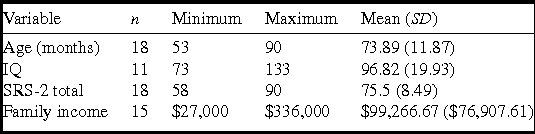
Participants included 18 children (16 boys; 14 Caucasian, four did not report ethnicity) between 53 and 90 months (mean = 73.89, SD = 11.87) at screening (see Table 1). At least one parent of each child also participated in the study, which took place in a university-associated community clinic and a hospital, both located in the United States. Children were required to have a community ASD diagnosis (i.e. diagnosed by specialized medical team, research clinic or paediatrician), have fluent verbal language, and be able to follow simple instructions (e.g. staying seated when asked to do so). As a result, the children who participated in the current study presented as higher functioning in that they were not language impaired and were able to tolerate a group setting (e.g. listen to songs and stories with the group, play simple group games, stay in the room). The majority of parents had at least a college education (70.6%, n = 17). The sample consisted of seven treatment groups, with two to four child and parent dyads per group. Data from all groups were combined to consider response to treatment.
Descriptive data for sample

SRS-2, Social Responsiveness Scale, second edition.
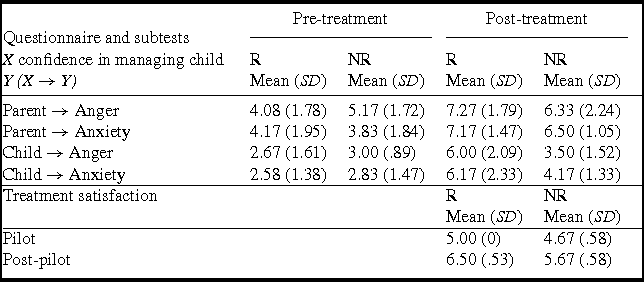
Pre-treatment and post-treatment confidence and satisfaction

R, treatment responder group; NR, treatment non-responder group.
Measures
ASD characteristics
The Social Responsiveness Scale, second edition (SRS-2; Constantino and Gruber, Reference Constantino and Gruber2012) was completed by parents to assess each child's social impairments, awareness of others, ability to engage in reciprocal social communication, and other features of ASD. The SRS-2 is a 65-item, 4-point scale (0 = not true, to 3 = almost always true) and provides a T-score that indicates degree of deficits in reciprocal social interactions and mannerisms. Higher scores are associated with more symptomatology. Parent-reported T-scores on the SRS-2 for child participants ranged from 58 to 90 (mean = 75.5, SD = 8.49).
Negative affect measures
Parents reported on their child's negative affect using the Lability/Negativity (LN) subscale of the Emotion Regulation Checklist (ERC; Shields and Cicchetti, Reference Shields and Cicchetti1997). The ERC is a 24-item, 4-point scale (1 = never, to 4 = almost always) where reporters evaluate a variety of emotional states that may be displayed in childhood, including outbursts, anger and sadness. Higher scores on the LN subscale denote greater negative affect and distress.
Consistent with the LN subscale construct, parents also documented their child's anger or anxiety-related outbursts for seven consecutive days with a Behavioral Monitoring Sheet. Outbursts were defined as episodes where a child was unable to maintain emotional control and behaved or spoke inappropriately out of anger or anxiety. For this measure, parents noted duration (in minutes) and intensity (1 = least to 10 = most intense) of each outburst. Frequency was determined by number of documented outbursts divided by total time monitored, averaged over 7 days.
Confidence in managing anger/anxiety (see Appendix)
Parents completed four questions on a 10-point Likert scale created for this study to assess confidence in their ability to manage their child's anger/anxiety, as well as the perception of their child's self-confidence in managing his or her own anger/anxiety (1 = least to 10 = most confident). The questions were selected to specifically target parent confidence in self and child implementation of treatment targets, as opposed to using previous measures, such as the Parenting Sense of Competence, which target a broad set of skills versus the narrower skills targeted in this measure. For pre- and post-treatment time points, there were four total ratings: parent confidence in managing child's anxiety, parent confidence in managing child's anger, parent perception of child's self-confidence in managing his/her own anxiety, and parent perception of child's self-confidence in managing his/her own anger (see Table 2).
Cognitive functioning
A trained research assistant administered the Kaufman Brief Intelligence Test, second edition (KBIT-2; Kaufman and Kaufman, Reference Kaufman and Kaufman2004) to determine an estimate of a child's verbal and non-verbal intelligence. This protocol determined eligibility in groups that followed the initial pilot study; as a result, information on cognitive functioning is only available for 11 of the 18 participants. Analyses revealed no significant differences in parent report of child characteristics at baseline (i.e. LN subscale, parent and child confidence in managing child anger and anxiety, SRS-2) between the groups of children who received cognitive testing versus those who did not.
Treatment evaluation
All parents completed a questionnaire on perceived satisfaction and usefulness of the treatment and treatment components after participating in the STAMP program; however, parents in the post-pilot groups received a modified and elongated version (see Table 2). Specifically, parents in the pilot group were asked to indicate their level of satisfaction with STAMP with a 5-point Likert scale ranging from 1 = not satisfied to 5 = very satisfied. Parents in the post-pilot groups were asked to rate their overall feeling about STAMP with a 7-point Likert scale ranging from 1 = very negative to 7 = very positive. All parents also provided responses to open-ended questions regarding perceived strengths and weaknesses of the program.
Procedures
Interested participants completed an eligibility screening and provided informed consent as approved by the university's Institutional Review Board (IRB). Parents completed the SRS-2 prior to treatment and the ERC, confidence scales and Behavioral Monitoring Sheets before and after treatment. Children and parents participated in nine hour-long, weekly group sessions (see outline of program in the STAMP Treatment Manual). Concurrent parent and child groups were led by trained master's or doctoral level clinicians and supervised by a licensed clinical psychologist, who assessed fidelity of implementation for 14 components in each session (see Scarpa et al., Reference Scarpa, Wells and Attwood2013a for additional details). A 5-point rating scale (1 = not well, 5 = very well) was used to determine quality of treatment implementation. All STAMP groups presented here demonstrate high fidelity to treatment (overall groups mean = 4.8). Each child group session included singing, stories and an interactive lesson; all session components focused on a specific topic that offered strategies to understand and better manage anger/anxiety (e.g. the ‘thinking tools’ session encouraged children to address maladaptive thoughts in a developmentally appropriate manner). During the concurrent parent group session, another clinician discussed session material, home assignments and issues regarding applying treatment strategies to other settings.
Data analysis
Parent-report of child lability/negativity (LN) and outburst frequency, intensity and duration were used in treatment responder analyses to serve as a strong, multi-modal avenue for ascertaining response to treatment. The Reliable Change Index (RCI; Jacobson and Truax, Reference Jacobson and Truax1991) criterion, which determines treatment gains on an individual level, was used to assess whether children who undertook treatment decreased in overall LN. Specifically, the RCI determines whether post-treatment change was significant, over and above measurement error. Cronbach's alpha was obtained from the literature and utilized in RCI calculations to be in concordance with recommendations that suggest the use of internal consistency reliability estimates in RCI calculations in clinical samples, rather than test–retest reliabilities (Martinovich et al., Reference Martinovich, Saunders and Howard1996; Tingey et al., Reference Tingey, Lambert, Burlingame and Hansen1996; Bauer et al., Reference Bauer, Lambert and Nielsen2004). RCIs of –1.96 or less indicated a significant reduction (i.e. improvement) in LN scores post-treatment.
A child was classified as a ‘treatment responder’ if he or she met at least two of the following four criteria: (1) statistically significant post-treatment decrease in LN, using the RCI; (2) greater than 20% decrease in average intensity of outbursts; (3) greater than 20% decrease in frequency of outbursts; or (4) greater than 20% decrease in average duration of outbursts. A 20% reduction in outburst frequency, intensity, or duration was deemed a clinically significant change to occur within a 2-month period of time.
Finally, due to sample size and variability, Mann–Whitney U-tests were used to determine any between-group differences based on responder status. Wilcoxon signed rank tests were used to determine any pre–post differences in study measures. When multiple comparisons were conducted, a Bonferroni correction was used. Specifically, when analysing pre to post change in parent and child confidence in managing anger and anxiety, four analyses were run within each group. As a result, a p value of .0125 (i.e., .05 divided by 4) was used to determine significant findings.
Results
Treatment responder status
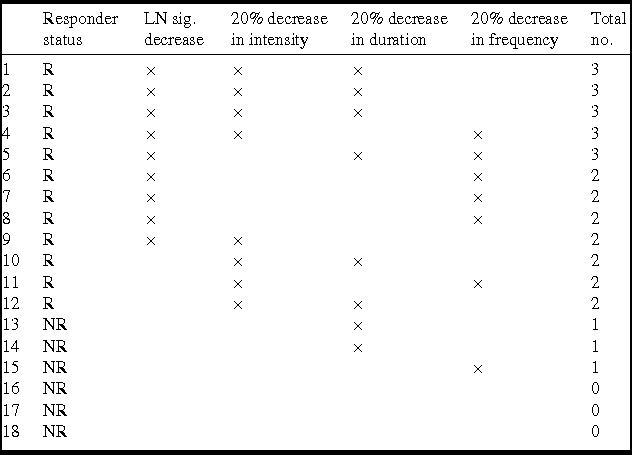
Using the above-mentioned criteria, 12 child participants were classified as treatment responders (see Table 3). Nine of the treatment responders were classified based on a reliable change in RCI (i.e. statistically significant reduction in LN) and significant decreases in at least one behavioural monitoring measure. Three treatment responders did not show a significant change in LN but demonstrated a 20% or greater decrease in at least two behavioural monitoring measures (see Table 3). Within the treatment responder group, patterns emerged in the behavioural monitoring data (see Table 3). Patterns suggested parallel decreases in duration and intensity of outbursts, while decreases in frequency were not associated with changes in intensity or duration. Specifically, within the group of eight parents who endorsed significant decreases in intensity of child emotional outbursts, five also reported a reduction in episode duration. Three of the 12 treatment responders decreased in frequency only, without concomitant decreases in intensity and duration. No treatment responders demonstrated significant decreases in all three of the behavioural measures. Parents of three children in the treatment non-responder group reported significant decrease in one behavioural monitoring component, demonstrating some treatment gains.
Individual responder status breakdown

LN sig. decrease, significant decrease in lability/negativity sub-scale from Emotion Regulation Checklist; R, responder group; NR, non-responder group; Total no., total number of criteria met to classify responder status.
Mann–Whitney tests indicated that the treatment responder and treatment non-responder groups did not significantly differ in age, U = 33.50, p = .82; cognitive ability, U = 8.00, p = .50; SRS T-score, U = 29.50, p = .55; initial LN, U = 21.50, p = .18, or initial parent and child confidence in managing anger and anxiety (all p-values > .05). Wilcoxon signed rank tests indicated that in the treatment responder group, there was a statistically significant pre to post increase in parent-reported confidence in their child's ability to manage anger, Z = –3.08, p = .002, and anxiety, Z = –3.08, p = .002, and in their own ability to manage their child's anger, Z = –2.95, p = .003, and anxiety, Z = –2.96, p = .003, n = 12. In contrast, the treatment non-responder group showed no significant change (i.e. after Bonferroni correction) in parental confidence in their child's ability to manage anger, Z = –.82, p = .41, or anxiety, Z = –1.84, p = .07, nor in parental confidence in their own ability to manage their child's anger, Z = –1.82, p = .07, or anxiety Z = –2.21, p = .03, n = 6.
Mann–Whitney tests were also used to determine differences in treatment satisfaction between the treatment responder group and the non-responder group. When comparing the two treatment responder groups who participated in the pilot project, there was no significant difference between the groups in rating of satisfaction (Z = –1.15, p = .25). Similar results were yielded with the post-pilot groups as well (Z = –1.83, p = .07).
Treatment evaluation findings
Responses to open-ended questions from post-treatment evaluations yielded important insights into the perceived satisfaction and efficacy of the STAMP treatment. Regarding changes they had seen in their child, parents in the treatment responder group provided enthusiastic findings, with some noting changes in their own emotion regulation and patience. Two parents in the treatment responder group found ways to bridge the gap between the therapy room and the classroom, whereas this was not noted in the treatment non-responder group. Parents in the treatment responder group made multiple references to the parent training component of STAMP, describing the psychoeducation, support and skills training components as helpful.
Seven parents in the treatment responder group specifically mentioned the coping tools as being the most helpful part of the program, while one parent in the treatment non-responder group noted that ‘identifying tools’ was the least helpful part of the program for her child. Parents in the treatment non-responder group noted specific difficulties with generalization of skills and one indicated only ‘occasional’ use of the coping strategies by the child. When parents were asked to describe potential improvements, a mother in the treatment non-responder group indicated that the program should be more tailored to each child's individual needs. In contrast, four parents in the treatment responder group asked for follow-up sessions, more time for discussion, or longer sessions. Parents in this group also seemed to answer the satisfaction surveys more completely, which could suggest conscientiousness or more dedication to the program, especially in terms of homework completion.
Discussion
Although limitations exist, the current study adds to the evidence that some children with ASD and no language impairment between the ages of 4 and 7 years can benefit from a group CBT program by significantly decreasing levels of emotion dysregulation in terms of negative affect expression. Two-thirds of the families who participated in the STAMP program reported a significant decrease in negative lability and/or outburst frequency, intensity, or duration. Overall, when properly implemented, STAMP can provide parents with increased confidence in their ability to manage negative affect in their children, as well as in their children's ability to use newly learned strategies to regulate their emotional outbursts. Additionally, most children experienced decreases either in outburst intensity and duration, or in frequency, but not in all three simultaneously. This pattern suggests that dimensions of negative affect expression are important to assess and may change differentially. Additional research is needed to improve results for a greater number of children.
Age and cognitive ability did not differ significantly between treatment responder and non-responder groups, although no child was intellectually impaired as required by eligibility. Other factors (e.g. developmental maturity, level of parent involvement) may relate to treatment response beyond chronological age or intellectual ability. While the primary focus of the treatment is imparting skills to children, additional focus may need to be centred on the parents. Anecdotally, in post-treatment evaluations, parents of treatment responders reported that the parent components of the group were very helpful, that they saw changes in their own emotion regulation due to participation in the parent group, and that they had or planned to have conversations about STAMP skills with their child's teacher. As such, monitoring parent level of emotion regulation, involvement in implementing the strategies with their child outside of sessions, and extension of practising may be potential ways to improve treatment efficacy. This implication is consistent with the finding that parents of treatment responders, but not treatment non-responders, experienced significant increases in their confidence to help their child manage anger or anxiety.
While it is promising that almost 70% of our sample responded to treatment, this study also notes considerable room for improvement. Treatment responder status relied solely on parent-reported information within a relatively small sample size, which may have limited generalizability of results. Similarly, although an operational definition of child outbursts was provided on the Behavior Monitoring Sheet, parents may have significantly varied on their interpretation of unacceptable behaviors (e.g. yelling vs physical aggression). In addition, cognitive measures were only attained for a subset of the sample, making it difficult to determine if cognitive ability played a role in treatment response. Future directions will need to include a large randomized control trial to allow for greater power to run more in-depth analyses of the differentiating characteristics between treatment non-responders and responders (e.g. co-morbid diagnoses in child participants, more detailed information about the child's school performance and behaviours, educational/occupational information for parent participants). A better understanding of the parents and children who responded best to treatment would increase knowledge of (1) who could benefit from this treatment in a clinical setting, and (2) how it could be modified for other potential subgroups (i.e. those with less verbal language). Expanding to a larger, more ethnically diverse sample with cognitive data for each child participant would also improve generalizability. Including outside reporters (e.g. teachers) and observational or behavioural data may also help reduce bias and objectively identify differences. Future adaptations, such as expanding the program to take place in the school environment or to include teacher participation, would be particularly helpful for children who struggle more with emotion regulation at school rather than at home. Finally, clarifying which families respond optimally could lead to important adaptations for enhancing efficacy.
Overall, this study illustrates the positive behaviour and affective effects of a CBT treatment for young children with ASD. To our knowledge, STAMP is the only CBT treatment for individuals with ASD at this age. While it could be argued that children this young are unable to understand the complex techniques of CBT, we show that developmentally appropriate adaptations, including parent training, allow many young children with ASD to gain skills and knowledge leading to decreased negativity and emotional outbursts in response to anger and/or anxiety. Our initial explorations suggest that the parent component is important and thus future work might focus on strategies to further enhance parental empowerment and education.
Main points
(1) This paper analyses the proportion of young children with ASD who respond to a parent assisted group cognitive behavioural treatment.
(2) We identify factors that may distinguish them from children who do not respond.
(3) Findings emphasize the utility of including parents in treatment and assessing parenting factors (e.g. confidence) when measuring change in child outcome.
Acknowledgements
We would like to thank the families who participated in this study and made this research possible.
Conflicts of interest
Dr Angela Scarpa receives royalties from Guilford Publications for the sale of ‘CBT for Children and Adolescents with High-Functioning Autism Spectrum Disorder’ and from Jessica Kingsley Publishers for the sale of ‘Exploring Feelings for Young Children with High-Functioning Autism or Asperger's Disorder: the STAMP Treatment Manual’. The remaining authors have no conflicts of interest with respect to this study.
Ethical statement
All participants provided informed consent and permission was received from the Virginia Tech Institutional Review Board (reference no. 07–600). Authors have abided by the Ethical Principles of Psychologists and Code of Conduct.
Financial support
This research received no specific grant from any funding agency, commercial or not-for-profit sectors.
(1) Review the literature on CBT efficacy for children with ASD.
(2) Present a methodology for classifying children with ASD as treatment responders and non-responders to group CBT treatment.
(3) Present data indicating that inclusion of parenting factors may play an important role in group CBT for young children with ASD.
Appendix
| (1) On a scale from 1 to 10, please rate how confident you feel in managing your child's anger. | |||||||||
| 1 | 2 | 3 | 4 | 5 | 6 | 7 | 8 | 9 | 10 |
| Not at all confident | Extremely confident | ||||||||
| (2) On a scale from 1 to 10, please rate how confident you perceive your child is able to manage his/her own anger. | |||||||||
| 1 | 2 | 3 | 4 | 5 | 6 | 7 | 8 | 9 | 10 |
| Not at all confident | Extremely confident | ||||||||
| (3) On a scale from 1 to 10, please rate how confident you feel in managing your child's anxiety. | |||||||||
| 1 | 2 | 3 | 4 | 5 | 6 | 7 | 8 | 9 | 10 |
| Not at all confident | Extremely confident | ||||||||
| (4) On a scale from 1 to 10, please rate how confident you perceive your child is able to manage his/her own anxiety. | |||||||||
| 1 | 2 | 3 | 4 | 5 | 6 | 7 | 8 | 9 | 10 |
| Not at all confident | Extremely confident | ||||||||



Comments
No Comments have been published for this article.