

Introduction
For over half a century, the United States has prodded its distant allies to settle their differences and cooperate with one another in order to counterbalance the rise of potential hegemons in their regions. Its efforts have been met with varying degrees of success. On the one hand, the major countries of Western Europe have managed to forge and maintain what is perhaps the most successful military coalition the world has ever seen. By comparison, US allies in other key regions have made only limited progress towards forging robust security partnerships. For example, although the widening imbalance of power driven by China's rise creates strong pressures for security cooperation in Northeast Asia, South Korea, and Japan have only taken slow and agonising steps towards that end.Footnote 1 Likewise, American partners in the Gulf Cooperation Council (GCC) remain unable to furnish a regional solution to the spectre of Iranian military dominance.Footnote 2
Such contrasts suggest an intriguing puzzle for International Relations (IR) theorists: why are regional powers sometimes reluctant or unable to share their military assets, coordinate doctrines and war plans, and enter into formal cooperative agreements (that is, alliances) when the common threat of hegemony presumably gives them ample reason to do so? In other words, what explains the ‘stunting’ of regional security cooperation against potential hegemons? Despite considerable attention devoted to examining power shifts and alliance politics, scholars have yet to arrive at a unified answer to this question. Neorealist scholars, in particular, have come under fire for their failure to resolve a puzzle so intimately connected to their classic balancing hypothesis. As Jack Levy and William Thompson point out, evidence of coalition-formation or ‘external balancing’ against potential hegemons ‘falls far short of the axiomatic tendency for balancing that some [neorealists] have suggested’.Footnote 3
In this article, I introduce an original neorealist hypothesis about regional security cooperation against hegemonic threats, namely, that it is likely to be stunted when an unbalanced distribution of material resources – that is, power – exists between prospective partners. The logic is straightforward: because cooperation to deter a potential hegemon depends critically on the efficient aggregation of warfighting assets, it often demands disproportionate increases in the capabilities of member states that possess the material ingredients of military force in abundance. Thus, from the perspective of some regional powers, although security cooperation raises the chances of effectively resisting the potential aggressor, it can also facilitate the relative strategic expansion of a materially superior partner that may become yet another threat in the future. This anticipated distributive effect incentivises materially inferior powers to delay or obstruct regional cooperative efforts, suggesting that neighbouring states confronting a shared hegemonic threat will cooperate most reliably when a relatively balanced architecture of power prevails between them.
To establish the plausibility of this argument, I trace the process of French security policymaking towards West Germany during the first two decades of the Cold War. This case offers a good place to begin testing my theory for several reasons. In the first place, an abundance of historical data makes the Franco-German case highly amenable to causal inference via process-tracing, which depends critically on being able to map out ‘who knew what, when, and what they did in response’.Footnote 4 Over the past three decades, a substantial historiography has sought to reassess the foreign policy of France's postwar Fourth Republic with declassified archival materials on both sides of the Atlantic.Footnote 5 I am thus able to draw on this extraordinarily detailed literature, along with primary assessments offered by contemporary policymakers and intelligence analysts, to construct a credible causal account of France's postwar policy vis-à-vis West Germany.
More importantly, the case presents a tough test for my argument. Given the political conditions of the early Cold War, few major IR theories predict outcomes for the Franco-West German relationship that are diametrically opposed to vigorous security cooperation. For received neorealism, the fact that France and West Germany were grossly outmatched by a hostile Soviet Union in terms of military and industrial power should have supplied their leaders with ample motivation for security cooperation from the beginning of the postwar era. While the pair's relationship had been infamously antagonistic over much of the preceding century, many realists would nonetheless be surprised to see two countries failing to set their hard feelings aside in the face of a threat as immense as that posed by Moscow.Footnote 6 Indeed, prominent realist accounts tend to depict a postwar Franco-German partnership that arose more or less methodically in response to the shared Soviet menace.Footnote 7 Couple this with the recognition that the two regional powers shared, among other things, political and cultural raw materials for a common regional identityFootnote 8 as well a powerful offshore security patron (that is, the United States) willing to support their joint ventures,Footnote 9 and it arguably appears from the perspective of existing theories that the eventuation of a cohesive continental security bloc was overdetermined. Even if a theory that expects counterhegemonic security cooperation to falter when material resources are distributed in an unbalanced fashion between prospective partners (as I show to have been the case for France and West Germany during the first decade of the Cold War) is generally valid, it might fail regardless when so many confounding variables are arrayed against it. Obtaining successful prediction despite such unfavourable conditions would be highly suggestive for the explanatory power of my argument across a wide range of regional and historical settings.Footnote 10
Apart from its methodological advantages, the postwar Franco-West German case is worth re-examining due to its intrinsic importance for theory and policy. France's modern relationship with Germany looms large in contemporary discussions of regional security cooperation, due to the widespread acknowledgement that the so-called European security community was built on the foundation of Franco-German rapprochement. Note, for instance, that it has become routine procedure for advocates of East Asian regionalism to stress the role that gestures of self-reflection, atonement, and reassurance extended by West Germany to its neighbours played in propelling Europe to overcome its historical animosities and cultivate bonds of regional integration. Germany's postwar rehabilitation into the European community of nations was made possible, in this view, by ‘a readiness in Germany to face [its] history openly and squarely’, as Prime Minister Angela Merkel once pointedly remarked to her Japanese counterpart Shinzo Abe.Footnote 11 The implication is that the progress of regional security cooperation in East Asia will turn on the success of Japan's efforts to assuage the memories of its wartime aggression that continue to afflict the region's politics.
While the redressing of wartime guilt is a valuable end in itself, however, I show that it is difficult to locate the origins of the Franco-German (and by extension, the European) security community in West Germany's efforts at historical atonement or, for that matter, any outstanding transformation that its national character supposedly underwent in the aftermath of the Nazi period. For one thing, during much of the decade following the collapse of the Third Reich, France did not see the de-Nazified, democratised West Germany as a suitable military partner and tirelessly worked to limit its involvement in Europe's fledgling alliance system. This led exasperated proponents of Western European unity to blame the French for hampering counter-Soviet security cooperation with ‘paralysis and procrastination’.Footnote 12 And contrary to popular belief, when substantial security cooperation finally began between the two powers, it did so before the onset of West Germany's world-renowned acts of contrition. The true turning point in Franco-German relations, I argue, is rather found in the relatively obscure but nonetheless dramatic growth in economic and military power that France experienced vis-à-vis its German neighbour starting in the mid-1950s. Continental cooperation gained momentum after this point as policymakers in Paris progressively outgrew the fear that accepting Bonn as a security partner would catalyse German strategic ascendancy in Western Europe. In this and other ways, revisiting the story of how France came to embrace West Germany as a military partner in the standoff against the Soviet Union offers useful correctives to standard explanations of international cooperation that draw inspiration from this landmark case.
The remainder of this article proceeds as follows. I first elaborate my main hypothesis and its associated causal logic. Second, I test my argument with evidence from the historical trajectory of security cooperation between France and West Germany during the Cold War. Third, I assess the validity of competing explanations. The conclusion summarises my findings and discusses their implications for theory and policy.
The argument: Hegemonic threats and the intra-coalition balance of power
This article examines the dynamics of regional security cooperation, that is, acts of military support and coordination that take place among states inhabiting a contiguous geographic region. Such acts are, in principle, distinct from cooperation that assumes the permanent involvement or guidance of extraregional powers. To illustrate, the post-Cold War security cooperation that has occurred among European Union (EU) member states under the Common Security and Defence Policy (CSDP) has been described as being motivated by the desire to enhance distinctly European capabilities, boosting the organisation's ability to act autonomously from US leadership.Footnote 13
Balance of power considerations have a profound impact on the way neighbouring states treat one another while collectively facing a potentially hegemonic adversary.Footnote 14 In principle, the rise of a potential hegemon creates strong incentives for states to cooperate, since this increases their ability to deter or defeat a common enemy. Not only does security cooperation enable states to signal to a shared adversary that they are committed to jointly mobilising their military resources in the event of a conflict, but it also acts as a force-multiplier by allowing a group of states to exploit complementary comparative advantages in the way of producing and employing military capabilities.Footnote 15 Importantly, while the force-multiplying effect of security cooperation is usually imagined as accruing to the coalition as a whole, in practice the intra-coalition division of labour can be expected to leave individual member states with varying levels and types of capabilities depending on the amount and quality of resources they can funnel into the collective effort to produce security.
The logic of force-multiplication that lies at the heart of security cooperation implies a second, less appreciated effect: states that possess superior ex ante material resources tend to enjoy greater gains in military capabilities vis-à-vis their materially inferior partners. There are two interrelated reasons why states might expect this to be the case. In the first place, since a coalition's aggregate military capabilities hinge critically on the amount of wealth and manpower it can mobilise to field large, well-equipped armies,Footnote 16 cooperation to improve its combined force production usually entails disproportionate growth in the standing force levels of members with larger economies and populations. It is simply cheaper and easier for states abundantly endowed with these ‘factors of production’ to build additional units of military capability than for those in which the same factors are relatively scarce – in other words, they have a comparative advantage in producing the most substantive elements of military force. If, as David Lake argues, security cooperation along the lines of comparative advantage requires states to ‘redeploy their efforts toward their most productive uses, increase the total defence effort obtained, and reap the gains from the other's comparatively less expensive (more efficient) defence efforts’,Footnote 17 cooperative efforts to increase military output should lead materially privileged members to make larger gains in military capabilities than their partners by lowering political obstacles to the disproportionate mobilisation of economic and demographic resources.
Second, once materially privileged states succeed in translating their socioeconomic resources into military power, they should be expected to acquire a comparative advantage in force employment as well. A coalition becomes more militarily effective to the extent that its most powerful combat forces are strategically flexible, that is, ‘mobile and capable of promptly engaging’ the enemy across the theatre of operations.Footnote 18 Especially for a group of states bent on maximising the capabilities arrayed against a potential hegemon, there are often clear efficiency gains to be achieved by enabling a stronger partner to manoeuvre its forces freely throughout the anticipated theatre, make rapid-fire command decisions in response to shifts in the battlefield situation, or even preposition troops and equipment in partner territories, particularly when the alternative is to stretch thin a weaker state's meagre assets against those of the preponderant adversary. Accordingly, cooperating to improve the effectiveness of a coalition's military posture frequently amounts to facilitating disproportionate growth in the strategic flexibility of members that are able to contribute greater numbers of battle-ready forces.
Importantly for my purposes, the materially inferior state has reasons to fear the capability-enhancing effects that security cooperation will have for its regional partner, despite the fact that this same outcome will unquestionably increase its chances of successfully deterring or defeating their shared adversary. First, and most obviously, states fear that their partners may someday turn around and attack them from a reinforced strategic position. Consider cooperation to allow a stronger partner's troops to exert improved mobility and initiative on the battlefield, say, by relaxing previously recognised limits on their regular area of operations. Even if, in principle, doing so improves the coalition's overall military readiness, the ensuing strategic expansion may just as well enable the same member to attack or coerce its partner more effectively later on. The same dilemma arises in contemplating whether to encourage a resource-rich partner to build larger and deadlier forces, or even in merely allowing it to do so without significant political opposition. In all such circumstances, states fear that ‘minds can be changed, new leaders can come to power, values can shift, new dangers and opportunities can arise’.Footnote 19
Second, even if states can dismiss the prospect of future war with their prospective coalition partner, they must worry that enhanced military capabilities will grant it undue bargaining clout within the coalition. In 1995, James Fearon reasoned that a state might fail to avoid the costs of conflict with an external rival ‘not because it fears being attacked in the future but because it fears the peace it will have to accept after the rival has grown stronger’.Footnote 20 In the context of coalition politics, a powerful state that can credibly communicate its current peaceful designs may nonetheless be unable to persuade its partners that it will refrain from making progressively unpalatable demands in the future as the dictates of military efficiency lead the coalition to reorient its readiness posture towards dependence on the materially superior member's capabilities. They will be particularly concerned that such dependence will allow the superior partner to entrap the rest of the coalition in costly conflicts over issues of secondary importance.Footnote 21
In sum, balancing via regional security cooperation generates two important effects that bear upon a state's security. On the one hand, it generally increases the collective ability of participating states to check an aspiring potential hegemon. Regional powers that are approximate equals in terms of material resources are well positioned to pursue such security benefits, à la received neorealism. On the other hand, when the distribution of power between regional military partners is relatively unbalanced, security cooperation tends to prompt disproportionate growth in the capabilities of coalition members with greater ex ante endowments of military and socioeconomic resources. The reason is that the force-multiplying effects of security cooperation are normally achieved by capitalising on the ability of such privileged states to expand their force levels and strategic flexibility. Because the anticipated consequences of the second effect are often nearly as worrisome to regional powers as those implied by a failure to bring about the first, the materially inferior members of putative coalitions should be reluctant to cooperate intimately with neighbouring states that enjoy substantially larger endowments of ex ante power. Enthusiastic overtures on the part of powerful states for cooperation will be met by foot-dragging and obstructionism on the part of their underprivileged neighbours, who find it difficult to trust their partners from using their revamped advantages against them in the future. Unbalanced power is therefore conducive to stunted cooperation – at worst, it will fail to materialise at all, but even at best proceed in a slow and agonising manner.
Two clarifications are in order. First, the hypothesised effect of power imbalance on security cooperation should be primarily observed at the regional level, since the risks anticipated by weak states tend to be considerably dampened when it involves cooperation with extraregional powers. Phenomenal advances in technology notwithstanding, land power remains the principal tool of coercion and warfare in international politics.Footnote 22 Since large bodies of water sharply limit a state's ability to forcibly project land power, weak states recognise that extraregional powers are likely to find aggression against them difficult and strategically gratuitous, both in the immediate and longer terms. In fact, weak powers frequently go to great lengths to ‘invite’ extraregional great powers into their region's security affairs, since the benefits of their strategic involvement often far outweigh the costs.Footnote 23 This assessment shifts dramatically when it comes to relations with geographically proximate actors.
Second, it follows naturally from my core argument that the strengthening of a weaker state's relative power position vis-à-vis its prospective coalition partners should lead it to become more enthusiastic about regional cooperation against the potential hegemon, albeit only to the extent that the new cooperative activities do not nullify its recent gains in power. While closing the material gap with a resource-rich partner can be difficult, it is not impossible; the weaker state could conceivably experience significant gains in relative power through rapid economic growth,Footnote 24 dedicated military mobilisation drives,Footnote 25 retrenchment from costly strategic distractions,Footnote 26 or the acquisition of nuclear weapons.Footnote 27 The bottom line is that weak states that experience success in their internal balancing efforts can be expected to become progressively more accommodating of regional security cooperation as well, as they gain confidence that its distributive effects will not skew the intra-coalition balance of capabilities against them. In short, there is reason to think that good things tend to happen together in counterhegemonic balancing. I argue that this is what happened in postwar Europe.
Taking stock, my power-centric argument highlights a previously neglected mechanism that can blunt incentives for regional security cooperation against hegemonic threats: the fear that cooperation might facilitate the strategic expansion of a powerful partner that may pose yet another threat in the future. Early works posited a virtually ‘automatic’ or law-like tendency for coalitional balancing against disproportionately powerful states.Footnote 28 Later scholars identified reasons why this tendency might not be as efficient or reliable as these writers presumed. John Mearsheimer, for example, notes that states often ‘prefer buck-passing to balancing’, that is, refraining from fully committing to checking the adversary in the hope that another state will bear the brunt of the task.Footnote 29 Stephen Walt argues that exceptionally weak states might ‘bandwagon’ with the threatening power when there is ‘no possibility of outside assistance’.Footnote 30 However, studies suggest that temptations for both buck-passing and bandwagoning are least prevalent when a group of continental states face an exceptionally powerful adversary with formidable offensive capabilities in their vicinity, as was the case in postwar Western Europe.Footnote 31 My theory explains why some states might be reluctant to embrace regional security cooperation even while, in principle, recognising the value of such cooperation in the face of such a threat. It may also explain why extraregional great powers like the United States have historically found it difficult to promote autonomous security arrangements among distant allies as an alternative to their own permanent involvement in the region's balance of power.
Evidence from postwar Franco-West German relations
The history of France's postwar approach to security cooperation with the Federal Republic of Germany (FRG)Footnote 32 can be analytically distinguished into two periods: a first period, roughly extending from the immediate end of the Second World War to the mid-1950s, in which Paris showed only lukewarm support for and sometimes actively resisted US-led efforts to forge a military coalition between the continental powers as a counterweight to the Soviet Union; and a following period during which it became much more enthusiastic about security cooperation with Bonn. To claim that evidence from this case corroborates my argument, I must show two things: first, that the early recalcitrance displayed by France's decision-makers was very much informed by the fear of facilitating West Germany's strategic expansion, and that this fear was itself driven by the perception that France was significantly inferior to West Germany in crucial dimensions of material power; and second, that the rapprochement of the next period was closely associated with the easing of this perceived imbalance.
The first period: Stunted cooperation
The balance of power: West Germany's latent superiority
France's security policy in the early postwar period was dominated by two central concerns. First and foremost, its leaders had to contend with the sudden rise of the Soviet Union as a potential hegemonic threat. By one estimate, Soviet military strength was nine times that of France by 1950, and three times that of a hypothetical ‘continental coalition’ comprising France, West Germany, Italy, Belgium, the Netherlands, and Luxembourg. Such military capabilities were buttressed by a massive economy, which, already Europe's biggest in 1945, nearly doubled over the next five years in terms of industrial output to outmatch the French economy by a ratio of three to one.Footnote 33 The need to build a powerful Western European security coalition in view of this threat was clear to French policymakers. As one diplomat wrote in March 1948, a formidable collective line of defence comprising ‘men and steel’ needed to be erected in order to dissuade the Soviets from attempting to dominate the continent in one fell swoop.Footnote 34
France's second concern was Germany's lingering potential for military dominance. While thoroughly undermined as a military power by the allied forces for the time being, all parties involved in its postwar treatment had no doubt that Germany retained the latent ability to once again pursue great powerdom and aggression in Europe. French policymakers were especially worried about ‘how powerful Germany would be ten or twenty years later’.Footnote 35 Truncated as it was, West Germany still possessed a marked population advantage over France, and the productive potential of its key industrial regions such as the Ruhr and the Rhineland was so enormous that giving Bonn free rein over them was seen as ‘tantamount to inviting domination’ in the long term.Footnote 36 As if to confirm these fears, the economic productivity of the western half of Germany grew at an astonishing pace, surpassing that of France before the turn of the decade (Table 1).
Average annual GDP growth in France and West Germany (1950–65) (percentages).

Source: Calculations use Gross Domestic Product (GDP) data from the Maddison Project Database (ver. 2013). See J. Bolt and J. L. van Zanden, ‘The Maddison Project: Collaborative research on historical national accounts’, Economic History Review, 67:3 (2014), pp. 627–51.
France's power position, by contrast, stagnated well into the first half of the 1950s. As a US intelligence brief noted in 1953, ‘the postwar increase in French industrial production [was] less than that of any other industrial country in Western Europe’.Footnote 37 The report also pointed out that ‘French military units are far below acceptable NATO standards of readiness’. Compounding the problem was the fact that ‘a large percentage of regular noncommissioned and company grade officers [were] in Indochina’ and that ‘growing budgetary problems’ would ‘decrease the rate at which these obstacles are overcome’.Footnote 38 Given its ‘social, political, and economic weaknesses’, another assessment argued, it was unlikely that France would be able to maintain ‘at least parity of strength and influence with respect to Germany’ while simultaneously pursuing other critical objectives such as ‘maintain[ing] domestic economic stability and politically tolerable standards of living’.Footnote 39
Strategic assessments: Confronting the logic of harnessing West German power
What complicated France's situation was that, as Cold War tensions continued to deepen, many Western leaders – particularly those in the United States – became increasingly determined to harness Germany's material resources for the defence of Western Europe. As Marc Trachtenberg and other historians have demonstrated, the overarching objective of US grand strategy during the first two decades of the Cold War was to build an integrated military and economic bloc in Western Europe as an independent ‘European solution’ to the Soviet menace, the realisation of which, it was hoped, would obviate the need for a permanent American military presence on the continent.Footnote 40 And as long as American policymakers were committed to the goal of leaving European defence to the Europeans, it made little sense that Germany should be precluded from contributing its enormous demographic and industrial prowess to the Western defence effort, however odious its recent offences. US analysts estimated in 1953 that ‘[i]f no restrictions were imposed on the size of West German armed forces … a peacetime force of about a million men could be supported by the present manpower and financial resources of the country without causing serious economic dislocation.’Footnote 41 The same could not be said for any of its neighbours. Thus, as early as 1949, strategists as distinguished as George Kennan were routinely arguing that ‘a program for the defence of the continent which attempts to leave out of account the military experience and skills and energies of the Germans is not a sound one’.Footnote 42 Such arguments were supported by compelling military considerations. As Trachtenberg summarises,
Including German territory in the area of military operations was necessary if the western armies were to have any room for manoeuvre at all – and they needed to be able to manoeuvre, since fixed positions would be quickly overwhelmed [by a Soviet conventional attack] … but if West German territory were included in the area to be defended, even more troops would be required, and no one but Germany could supply them.Footnote 43
By the turn of the decade, there was widespread agreement among Western policymakers that to build up the Western coalition against the massive Soviet Army would, for all intents and purposes, mean building up West Germany's military capabilities.
Nonetheless, French leaders made little effort to conceal their fears of a resurgent Germany during this period. Such fears, in the first instance, involved the prospect of once again facing a German military threat. ‘It is hard for you to understand the difference’, General Charles de Gaulle remarked to the American ambassador to France in July 1945, ‘you are far away and your soldiers will not stay long in Europe … it is a matter of life and death for us; for you, one interesting question among many others’.Footnote 44 Moreover, even if an American troop commitment to Europe could prevent a rearmed Germany from attacking its neighbours for now, as many in France grudgingly acknowledged, it would still be insufficient for keeping the giddy West Germans from trying to use their increased bargaining leverage to drag their partners into a costly diplomatic or military confrontation with the Soviets in an effort to recover their eastern territories. British Ambassador to France Oliver Harvey recounted this fear to his government after conversing with one Quai d'Orsay official in October 1950: ‘Whatever was said now as to the number of German divisions, he was sure that in two years Germany would have the largest army in Europe and would be in a position to dictate to us once more … [they] might seek to detach themselves and threaten to go over to the East if we did not support them, or alternatively, they would push us into an aggressive war for the restitution of the lost provinces.’Footnote 45
Regional security cooperation: Opposing, then delaying
France often found itself playing ‘the unenviable role of spoiler’ in Western European security cooperation initiatives during this period.Footnote 46 Its struggle, in the first instance, manifested in attempts to deny Bonn membership in the North Atlantic Treaty Organization (NATO). To be sure, many French policymakers privately recognised that a West German military contribution was desirable in principle, but nonetheless tried to impress upon their allies that this must only happen ‘when we can be certain that this German contribution, instead of strengthening our security, will not compromise it instead’.Footnote 47 As Foreign Minister Robert Schuman explained to US Secretary of State Dean Acheson, the main concern was that ‘a serious problem of balance [would] arise within the future European community’. Specifically, ‘the demographic superiority of Western Germany, the rapid recovery of the Ruhr industries and of the German economy as a whole [were] in different degrees, elements of unbalance, to which we must apply correcting factors’.Footnote 48 Embracing Bonn as a military partner before such ‘correcting factors’ could be implemented would grant Bonn a disproportionate influence within NATO on the basis of its contributions. This would not only allow Germany to shed the constraints on its strategic autonomy hitherto imposed by the allies and ‘recover a complete freedom’, but also risk ‘a radical alteration in the [defensive] character of the alliance’ since the Germans ‘would be led by its very structure to advance territorial claims’.Footnote 49 French leaders were determined to go to great lengths to prevent this from happening. Should West Germany be allowed into NATO despite French objections, Prime Minister René Mayer threatened the Americans in February 1953, France's next course of action would be to ‘destroy the effectiveness’ of the arrangement ‘by being so strongly in opposition that in practical effect the lines of communication between Germany and the Atlantic would be broken’.Footnote 50
At the same time, French leaders recognised that their ability to indefinitely suppress West Germany's military recovery was limited. Particularly following the outbreak of the Korean War in June 1950, frustrated murmurs in Washington were clearly indicating that the allies’ patience with French recalcitrance was wearing thin. In April 1950, for example, US High Commissioner for Germany John McCloy reported to the State Department his feeling that ‘however painful to some non-Germans’, Western strategic developments would have to ‘decisively exhibit the trend … towards full [FRG] membership in NATO’.Footnote 51 The French deputy high commissioner for Germany thus admonished in July 1950 that ‘[it is] of the utmost urgency for us to come up with our own solution to this problem while the Americans are still open to suggestion’.Footnote 52
The solution France settled on was, first, ‘to create a powerful French force in the shortest possible time in order to maintain our preponderance’ in Western Europe, and second, ‘to buy enough time for this to work’.Footnote 53 In practice, this meant that as its own military modernisation proceeded apace, France would work to implement measures that, while ostensibly supporting the effort to build up European strength, were in fact designed to delay the onset of full-blown military cooperation with the Germans. This was the motivation behind the Pleven Plan – France's October 1950 proposal for the creation of an integrated European army.Footnote 54 The original French vision for what came to be known as the European Defence Community (EDC) required all West German troops to be organised at the level of the integrated force's smallest national units (that is, battalions) and placed under the strict oversight of a supranational Council of Ministers. Other member states were meanwhile allowed to maintain independent forces outside of the supranational framework.Footnote 55 This undoubtedly amounted to ‘military and political nonsense’, given the restrictions it portended for the substantive capabilities of the future West German forces.Footnote 56 In order to realise the battlefield mobility and initiative needed for the Western coalition to stand a chance against the Soviets, a NATO report argued in December 1950, it was essential to field ‘national elements … [i]n which the fighting arms, supporting arms and administrative services are welded into a single fighting formation capable of fighting a sustained major action with its own resources; it should be able to fight so independently that the soldier can be inspired by … his compatriots’ fighting powers’.Footnote 57
But to deny this to the Germans was precisely the point. As British participants in the negotiations observed, although the Pleven Plan ‘apparently implied acceptance by the French of the principle of German rearmament’, it was obvious that their real aim was ‘to play for time’ on the issue’.Footnote 58 Indeed, when the Americans were not present, many French officials often admitted that the Pleven plan was ‘a “canard” to deflect [the] Americans from [the] immediate rearmament of Germany’ and that there was ‘[n]othing sacrosanct about [the] plan’. The ‘[h]eart of the matter’, the British assessed, was that a West German army would materialise ‘in a comparatively short time’ if the Americans had their way, while the French sought to prolong the process as much as possible.Footnote 59
Remarkably, a modified version of the French proposal was eventually accepted by all of France's Western partners. Although US pressure (and German protests) succeeded in ameliorating its most glaringly anti-FRG elements, the terms of the EDC agreement signed in Paris by the European powers in May 1952 still imposed significant constraints on West Germany's military potential. The Federal Republic's contributions to the future European army were limited to 12 divisions vis-à-vis France's 14, and a weighted voting procedure was designed for the Council of Ministers whereby decision-making power within the EDC's organs would be directly proportional to the size of each member's financial and manpower contributions. In addition, West Germany was prohibited from manufacturing nuclear, biological, and chemical weapons; any type of guided missile beyond the short-range variety; and aircraft for its 85,000-man air force.Footnote 60
However, even security cooperation in this nakedly qualified form proved to be too much for France, whose National Assembly rejected the Treaty of Paris in August 1954 by a vote of 319 to 264. Evidently, what led the French to kill the brainchild of their own plan were lingering fears that, over time, the sheer magnitude of West Germany's potential contributions to the EDC would inevitably create pressures to loosen the constraints on its military capabilities within the community and allow the Germans to dominate the very institution that was designed to control them. As de Gaulle argued in February 1953, it was hard to believe that the Germans would be strictly held to ‘limitations written on paper’ when Washington appeared ready to support virtually any proposal that promised to help the US ‘[place] as many troops as possible in Europe … [and] to bring home, as soon as possible, as many of its soldiers as possible’.Footnote 61 This was especially true since France's own assessments were indicating that it would have enormous difficulty fielding ‘the fourteen divisions foreseen by the Treaty of Paris, whereas Germany would easily be able to provide its twelve’.Footnote 62
Indeed, there was intense suspicion in France that this was precisely the future that the West Germans had in mind. Why else, French leaders had to wonder, would they be so enthusiastic about a concept so plainly designed to keep them in a strategic straitjacket? To many, the answer was obvious. West German chancellor Konrad Adenauer was the most vocal proponent of the EDC in Europe, de Gaulle argued, because through it he would ‘[achieve] the probability of German military hegemony, which introduces the possibility of a Reich leading the West one day on a 20th century crusade [for the recovery of] Prussia, Saxony and, undoubtedly, other things as well’.Footnote 63 Former Prime Minister Edouard Daladier echoed this fear before the National Assembly, stating that ‘if Germany prefers the European Army, it is because she had the certainty of establishing her hegemony over Mittel-europa, reconstituted by our efforts’.Footnote 64 In short, as James McAllister argues, the EDC had been ‘designed as a mechanism to alleviate fears of German power and advance the cause of unity’ but produced ‘exactly the opposite effect because it focused attention on the fact that even a truncated West Germany would still be the strongest power in the region’.Footnote 65
France's rejection of the EDC treaty left NATO – complete with Bonn as a member – as the only viable means to counterbalance Soviet power. Thus it was that a decade of stillborn initiatives for security cooperation in Europe culminated in a compromise far removed from the ‘European solution’ envisioned by US policymakers: West Germany entered the Atlantic Alliance in May 1955, but its allies retained far-reaching rights to intervene in its domestic and foreign affairs; important restrictions remained on the size and quality of Bonn's military forces, along with the prohibition on its right to develop nuclear weapons; and the powers of the American Supreme Allied Commander Europe (SACEUR) over the NATO military system were substantially reinforced to limit the newly formed Bundeswehr's freedom of action.Footnote 66
The sources of France's vacillation between obstructionism and disingenuous moves towards cooperation that led to this roundabout outcome are difficult to grasp from a perspective focused solely on the threat of Soviet hegemony, but become clear once one sees that Paris was trying to make the best of a bad situation. Having delayed West Germany's involvement in the European security system for as long as they could, the French had ultimately conceded that a NATO inclusive of West Germany but nonetheless dominated by American power would still be preferable to one whose centre of gravity was eventually bound to shift to the Germans. A 1953 note drafted by high-ranking French diplomats put the matter concisely: ‘The essential idea that appears to emerge from a comprehensive examination of the problem is that, in matters of defence, it is in the Atlantic, not the European, framework that we must build in order to keep our place in the Alliance and our positions in the world.’Footnote 67 For the time being, in any case, the drive to construct an independent European security system as a counterweight to Soviet power had come to a grinding halt.
The second period: Robust cooperation
The balance of power: France's relative growth
While the threat of Soviet domination persisted,Footnote 68 France experienced uplifting developments in core dimensions of material power beginning in the latter half of the 1950s. First, during a period that would come to be known as les trente glorieuses, the French economy enjoyed one of the highest growth rates in the world, outpacing that of West Germany starting in the early 1960s (Table 1).Footnote 69 Thus it was that de Gaulle, who assumed the French presidency in 1958, was later able to claim that ‘[f]or ten years I [presided] over a successful achievement in terms of the country's economic and financial prosperity and progress such as it had not experienced for more than half a century.’Footnote 70 While West Germany would retain an absolute economic lead, then, its wirtschaftswunder unfolded alongside France's own economic miracle in this new period.
Second, France's conventional military power was considerably reinforced. Not only did the raw number of troops increase from 802,000 in 1955 to over one million over the next half-decade,Footnote 71 but France also started to bring home its expeditionary forces from Indochina in 1954.Footnote 72 This latter development was crucial; the historian Irwin Wall estimates that the net drain on military resources that France incurred as a result of the colonial commitment between 1947 and 1954 ‘was roughly equivalent to the amount of Marshall Plan and military aid the French received from Washington’.Footnote 73 Its termination markedly improved France's ability to keep forces-in-being stationed in Europe.
Third, and perhaps most significantly, France saw the steady progress of its nuclear weapons project in the half-decade following the EDC debacle. As early as 1957, a US National Intelligence Estimate (NIE) observed that France possessed ‘the capacity for a modest nuclear weapons program’ that would support ‘an annual production rate of three nominal-size bombs in 1958’.Footnote 74 The State Department's Office of Intelligence Research (OIR) added that ‘[i]t seems unlikely in the extreme that any other “fourth country” would be able to produce nuclear weapons in advance of the French.’Footnote 75 It thus became apparent throughout the late 1950s that a momentous qualitative difference between the two continental states was in the offing. De Gaulle, for one, was sufficiently emboldened by October 1958 to declare: ‘Everybody knows that we now have the means of providing ourselves with nuclear weapons … France will [no longer] accept a position of chronic and overwhelming inferiority.’Footnote 76 And in February 1960, France detonated a 70-kiloton device over an Algerian desert.
The collective impact of these trends meant that the French nightmare of being left in the dust as a rearmed West Germany arrogated the region's power never came to pass. What instead came to characterise Western Europe's political landscape throughout the remainder of the Cold War was gradual convergence between its two most substantial actors in both the latent and military dimensions of national power and, at least after 1960, marked French dominance in one critical dimension, namely, nuclear weapons.
Strategic assessments: Shifting perceptions of West Germany
As encouraging projections about their country's relative power position came to be appreciated by French policymakers, an air of confidence gradually settled over Paris in regard to political relations with Bonn. For instance, in October 1958, one of de Gaulle's advisors remarked to an American official that being ‘less important militarily than France’, West Germany would ‘have to get used to the fact that France will play the leading role on the continent’.Footnote 77 French diplomats soon began to report apprehensions in Bonn regarding ‘French pretensions to supremacy in Western Europe’ and intentions to ‘relegate Germany to second fiddle’.Footnote 78 At one point, Konrad Adenauer himself reportedly became infuriated upon being briefed on French Prime Minister Michel Debré's comment that ‘states without nuclear bombs are satellite states’.Footnote 79
Importantly, however, France's emergent confidence was accompanied by a newfound enthusiasm for continental cooperation. In light of the strides France was making in terms of economic, conventional, and especially nuclear power, West Germany's latent strength appeared less intimidating. In the minds of French policymakers, this translated into an increasingly comfortable margin of safety that allowed them to relax their conception of West Germany as a potential threat and reimagine it as a partner in the grander struggle against the Soviet Union. Thus, in November 1958, prominent French diplomat Jean Monnet stressed to a US official ‘that today practically all Frenchmen support [a cooperative Franco-German] relationship’.Footnote 80 Similarly, three months after coming to power, the once virulently anti-German de Gaulle told Adenauer that there could only be ‘one possible or indeed desirable partner for France in Europe: Germany’.Footnote 81
Regional security cooperation: Embracing West Germany
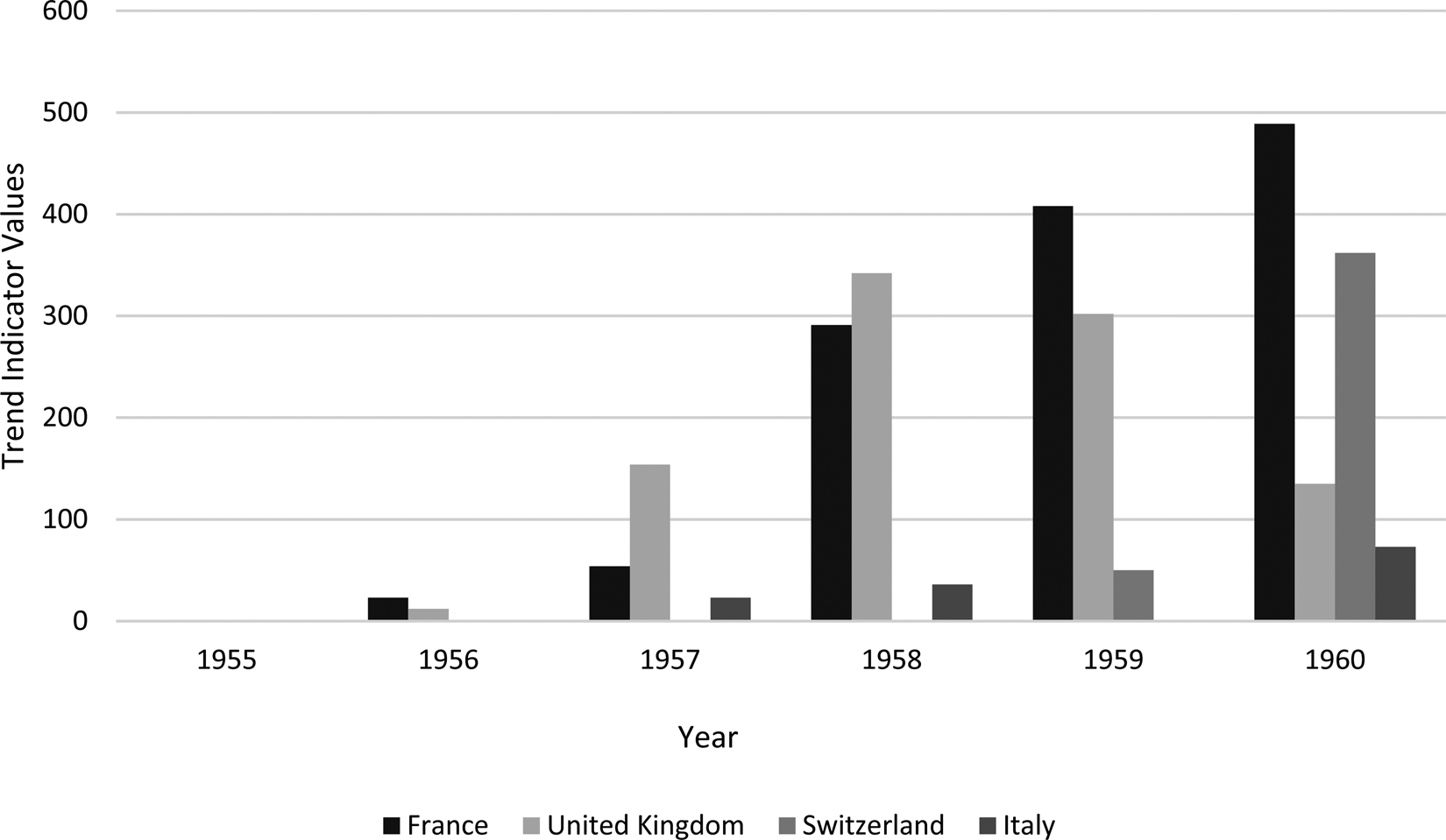
Between the late 1950s and the mid-1960s, a series of exchanges and agreements between France and West Germany placed relations between the two countries ‘on foundations and in an atmosphere hitherto unknown in their history’, as de Gaulle proudly wrote in his memoirs.Footnote 82 The pattern of regional arms transfers offers a visible indicator of France's changing security policy orientation during this period. In 1957, US intelligence analysts took note of a budding ‘French interest in standardizing non-nuclear weapons with Germany’.Footnote 83 French weapons sales to West Germany increased approximately twentyfold during that half-decade, and by 1960 France had firmly established itself as the Bundeswehr's leading regional supplier of arms (Figure 1).
European arms sales to West Germany (1955–60).
Note: The Trend Indicator Value (TIV) represents a consistent unit by which the international transfer of conventional weaponry can be tracked over time.
Source: Stockholm International Peace Research Institute (SIPRI) Arms Transfers Database, available at: {https://www.sipri.org/databases/armstransfers}.

Notable developments took place across other aspects of security policy as well, particularly after 1960. Adenauer's visit to France in July 1962 was celebrated with a Franco-German armoured manoeuvre exercise, the first time in history that French and German forces had manoeuvred with – rather than against – each other ‘on the blood-soaked battlefields of the Champagne’, as the press observed at the time.Footnote 84 Then, in January 1963, de Gaulle and Adenauer signed the historic Élysée Treaty, agreeing to hold regular high-level defence consultations, develop integrated concepts in strategy and tactics, expand the scale and scope of military personnel exchanges, and reinforce cooperation in the development and financing of arms projects.Footnote 85
For a brief period, France even signalled a willingness to help West Germany build its own nuclear weapons. Exploratory efforts at Franco-German nuclear collaboration began with the France-Italy-Germany (FIG) accord, signed by the defence ministers of France, West Germany, and Italy in November 1957 with the stated goal of creating a ‘European strategic entity’, that is, a joint nuclear deterrent capable of operating outside of the NATO framework.Footnote 86 Although cooperation under this accord was broken off upon the arrival of de Gaulle's government in June 1958, even de Gaulle seemed more or less open to the prospect of seeing West Germany arm itself with nuclear weapons during the early years of his tenure.Footnote 87 Such remarkable developments led American onlookers to wonder whether ‘the great political purpose of controlling German power’ had ‘now been totally abandoned’ by the French.Footnote 88
However, the subsequent demise of Franco-German nuclear cooperation showed that this was by no means the case. By the mid-1960s, France had turned decidedly against the idea of any kind of West German nuclear weapons capability, not only abandoning all discussions of possible bilateral nuclear collaboration but also stubbornly opposing US plans that granted Bonn even limited involvement in NATO nuclear planning.Footnote 89 The problem with promoting European strength via West Germany's nuclearisation, as the French came to see it, was that once Bonn laid its hands on an independent nuclear programme, its scientific and industrial base would allow its arsenal to quickly catch up to and perhaps overtake that of France in terms of quantity and quality.Footnote 90 This, in turn, would undermine the continental balance of power that France had worked so hard to achieve over the previous decades – a balance that largely rested on the fact that it possessed nuclear weapons and Germany did not. This was the conclusion De Gaulle arrived at by 1964: ‘I am not going to give our bombs to Germany! You can be quite sure that I will not give up the enormous advantage we have … by virtue of the fact that we are the only ones who are armed with nuclear weapons and are thus in a position to defend ourselves!’Footnote 91
Summary of the evidence
On the whole, my theory fits the trajectory of security cooperation between postwar France and West Germany quite well. For much of the first decade of the Cold War, French leaders balked at initiatives for regional security cooperation involving West Germany, driven in large part by ‘their fear of being quickly outdistanced by their German neighbours’. This fear, Acheson properly observed, was itself grounded in an ‘inferiority complex relative to the German birth rate and industriousness’.Footnote 92 An unmistakable shift then began to take hold in the late 1950s, following marked improvements in France's projected military and economic power position vis-à-vis West Germany. Franco-German cooperation thereafter increased to unprecedented levels across key areas of security policy, culminating in the signing of the Élysée Treaty in 1963. A notable exception to this trend was nuclear weapons cooperation, which Paris considered but ultimately rejected out of fear of undermining its hard-earned power position vis-à-vis Bonn. In the final analysis, balance of power considerations determined the upper bound of how far along the path of regional security cooperation France was willing to go.
Alternative explanations
I now address explanations suggested by prominent alternative theories.
West German antimilitarism and contrition
Constructivist critics might argue that West Germany's postwar commitment to an ‘antimilitarist’ foreign policy, coupled with the perceived sincerity of its contrition over wartime wrongdoings, provided enough reassurance for France to accept the FRG as an equal partner in the European security community.Footnote 93 My study indicates that postwar French leaders patently did not believe that West Germany had become an antimilitarist nation ‘unwilling to once again sanction the use of force in the name of the nation and the state’ throughout the first two decades of the Cold War.Footnote 94 ‘[N]o doubt there are men of good faith in Bonn’, Schuman told the North Atlantic Council in September 1950, ‘but there were also such men in Weimar.’Footnote 95
French concerns were not unfounded. West Germany persistently looked for opportunities to rebuild its strategic vitality during this entire period. Although it is true, for example, that Bonn made a non-proliferation pledge in order to gain entry into NATO in 1955, there is substantial evidence today that West German political leaders saw the pledge only as an expedient to temper French opposition and expected the restriction to wither away with time.Footnote 96 Bonn only renounced its nuclear ambitions in the mid-1960s due to a combination of Soviet threats and American coercion.Footnote 97 Needless to say, it is not very antimilitaristic to want nuclear weapons.
Moreover, Germany's acclaimed willingness to atone for its crimes came about too late in history to have affected Franco-German security cooperation. As Jennifer Lind has carefully documented, it was only in the mid-1960s that West German politicians began to embrace full responsibility for Nazi-era crimes, heralding a society-wide process of ‘working through the past’ (Vergangenheitsbewältigung).Footnote 98 Across-the-board security cooperation between France and West Germany had long been in progress by then. French leaders, at the end of the day, saw the essence of the ‘German problem’ not as one that had to do with the FRG's national character or identity, but one that had to do with its power. ‘Germany remains Germany’, de Gaulle once put it, ‘that is to say, a great people in massive numbers installed in the centre of Europe … The demon of war could again tempt her one day, if the chance were offered to recover her grandeur.’Footnote 99
US security patronage
Unlike for the class of explanations discussed above, there are good reasons to believe that the United States played a significant role in promoting Franco-West German security cooperation.Footnote 100 Even in the early postwar period, the French sometimes felt compelled to make qualified advances towards regional security cooperation out of fear that the impatient United States would otherwise unilaterally build up West Germany's power and withdraw its own forces from Europe, thereby realising France's worst nightmare of being left alone on the continent facing both the immediate threat from the Soviet Union and the latent threat from the Germans. ‘What we don't want is the Wehrmacht’, Bidault told a reluctant Pleven while urging him to accept American modifications to his initial plan for the European Army, ‘but what we do want is to be defended.’Footnote 101
However, it is also clear that US patronage by itself could not motivate France to fully embrace West Germany as a security partner. This is underscored by the fact that the Americans were quite willing to throw around the weight of their security guarantee in order to get the French into line during the early postwar years, and yet were ultimately only able to extract disappointing concessions in the way of cooperation with the Germans.Footnote 102 A case in point is again the EDC plan, which came to form ‘the projected backbone of U.S. national security policy for Western Europe’.Footnote 103 Washington deployed all manner of coercive pressure in order to bring the European Army to life. In one infamous case of allied arm-twisting, Secretary of State John Foster Dulles publicly declared that America would conduct an ‘agonizing reappraisal’ of its strategy towards Europe should France fail to ratify the EDC treaty and ‘move onward to more complete and organic forms of union’ with West Germany.Footnote 104
An important point emerges: given the extraordinary lengths to which the United States was willing to go in order to encourage a Franco-West German security partnership during the early postwar period, the fact that its efforts bore such little fruit should come as a surprise to ardent believers in the ‘offshore sponsorship’ thesis. The French rejected the EDC treaty knowing full well that ‘four years of American planning and diplomatic manoeuvring [would] come to naught’ as a result.Footnote 105 In the latter postwar period, however, the eagerness of a newly empowered France for continental solidarity became so heightened that it became a source of routine annoyance for the Americans. Generally speaking, France during this period has been portrayed by historians as doggedly trying to woo the West Germans into a closer continental partnership at the expense of their relationship with the United States.Footnote 106 In short, US security patronage proved neither potent enough spur French enthusiasm for security cooperation with West Germany nor to determine its direction and pace once it gained momentum.
Fears of preventive aggression
A third alternative explanation – less known among IR scholars but nonetheless powerful – attributes France's early reluctance on regional security cooperation to fears of preventive aggression by the Soviet Union. The argument, mainly advanced by historians Michael Creswell and Marc Trachtenberg, holds that French policymakers in the pre-1955 period would not have been so fiercely opposed to accepting West Germany as a military partner if not for the possibility that such a move would trigger a devastating preventive attack by the Soviet Union. Creswell and Trachtenberg argue ‘that this was perhaps the most important reason that [French leaders] believed West German rearmament needed to be delayed’.Footnote 107
As alternatives to the account laid out in this article go, the ‘preventive threats thesis’ is the strongest.Footnote 108 In private deliberations, European officials articulated over and over again their fear of provoking the Soviets into taking forceful action against what they would quite reasonably perceive as the revival of a deadly adversary. France was the most vocal in this regard. A central question for ‘every thoughtful Frenchman’, Prime Minister René Pleven told US leaders in January 1951, was ‘why the Russians, who are fully informed on the military build-up in the West, [would] not attack in Europe before this program is completed’, especially since the Soviets would presumably have ‘a real fear of a Germany once again able to inflict terrible damage on the Soviet Union similar to that done during the last war’.Footnote 109 Moscow went to great lengths to stoke such anxieties. In late 1950, for example, a Soviet diplomat told a Swiss counterpart that the decision to rearm the FRG would be regarded as ‘equivalent to the crossing of the Thirty-eighth Parallel by U.N. forces’, which had precipitated Chinese intervention in the Korean conflict.Footnote 110
That said, the fact that France's fears of Soviet preventive aggression were real does not mean that its approach to regional security cooperation was not also informed by genuine concerns about West German power. As Mark Sheetz writes, ‘the weight of the evidence … is too massive to dislodge’ this view.Footnote 111 Consistent with my theory, for example, Creswell and Trachtenberg also find evidence that the French were deeply apprehensive about ‘weaken[ing] the allies’ bargaining position vis-à-vis the West Germans, who would be in a position to lay down conditions’ unless France became strong enough to counterbalance West Germany's military contributions.Footnote 112 Moreover, although the threat of Soviet preventive aggression persisted into the second decade of the Cold War,Footnote 113 France became visibly more enthusiastic about security cooperation initiatives involving West Germany during this time. A perspective focused solely on the Soviet threat has difficulty explaining this change, while one that highlights shifts in France's relative power position does better. In short, although preventive threats thesis is powerful, it cannot provide a complete account of the rise of security cooperation in Western Europe unless joined by a theory of the intra-coalition balance of power. As historian Talbot Imlay argues, there is little reason ‘why it must be one or the other and not both’ in this case.Footnote 114
Conclusion
This article has introduced a neorealist logic that endogenises the incidence of stunted regional security cooperation against potential hegemons. States that face a common threat under anarchy do not only concern themselves with deterring or defeating the immediate rival, but also worry a great deal about how their cooperative efforts will impact their capabilities vis-à-vis one another. They will be particularly wary of security cooperation that involves neighbours with relatively larger endowments of material resources, anticipating that much of the coalition's gains in military capabilities are likely to be achieved through an expansion of the latter's force level and strategic flexibility. Regional security cooperation against hegemonic threats will therefore experience delay and obstruction when the distribution of power between prospective partners is relatively unbalanced and, conversely, proceed robustly when a more balanced power architecture obtains. This argument receives considerable initial support from my case study of France's postwar approach to security cooperation with West Germany.
Future research should explore the theory's generalisability and test the conditions under which its mechanisms take effect. How well does the theory travel to security cooperation dynamics in other global regions? Intriguing anecdotes suggest grounds for fruitful inquiry. For example, one analyst observes that a ‘dirty little [secret] of the Persian Gulf is that GCC unity [in the face of the Iranian threat] is a fiction … Bahrain wants powerful missiles not to make it an effective member of the Peninsula Shield Force but so that it can strike Qatar if it ever feels the need’.Footnote 115 Extending this article's basic logic could help illuminate the sources of such insecurities. Future works might also examine whether the intra-coalition dynamics identified by my theory appear during times of war, which is widely assumed to magnify incentives for tight-knit cooperation. Historical anecdotes are again suggestive. As the Second World War neared its end, for example, some Western European leaders advocated sending Western occupation forces to Eastern Europe even though it was clearly more efficient – from a strictly military standpoint – to let their Soviet ally stabilise the area by itself.Footnote 116 Their shared struggle against Nazi Germany notwithstanding, many allied strategists recognised long before the onset of the Cold War that ‘[a] Russian state from the Urals to the North Sea can be no great improvement over a German state from the North Sea to the Urals.’Footnote 117 The theory and evidence laid out in this article may offer new avenues for thinking productively about such cases.
My findings also suggest important lessons for contemporary security issues. In particular, they should prompt policymakers and scholars to rethink the sources of the difficulties the US has encountered in trying to promote regional military cooperation in some corners of the globe. By way of illustration, consider again the contemporary South Korea-Japan relationship. For some time now, the standard explanation for why security cooperation between America's two key Northeast Asian allies has been slow to materialise despite the threat posed by China's rise has been focused on the so-called ‘history problem’. The South Koreans have declined to embrace security ties with Japan, the narrative goes, because the experience of colonisation has led them ‘to assume an identity as victims of Japanese aggression’, which has been periodically reinforced by Tokyo's callous attitude towards admitting and atoning for its historical crimes.Footnote 118
That a history problem exists in South Korea-Japan relations is undeniable. What is less clear from the perspective laid out in this article is that it is the fundamental driver of stunted security cooperation in Northeast Asia, as opposed to one of its symptoms. I would urge analysts who are inclined to believe that redressing ‘history’ is all that it would take for South Korea and Japan to make headway in regional security cooperation to think carefully about what such a policy would actually entail for the two states. Notwithstanding its persistent economic and demographic troubles, Japan today still boasts a Gross Domestic Product (GDP) well over three times as large as that of South Korea and possesses the region's leading air force and navy despite only allocating about 1 per cent of its GDP to defence.Footnote 119 Thus, the most obvious way for a Northeast Asian balancing coalition to close the increasing regional gap in military and economic capabilities driven by the rise of China would be to mobilise Japan's massive material resources in order to accelerate its rebirth as a major military power. From a pure military efficiency standpoint, a good case can also be made for enabling Japanese forces to expand their regular area of operations to include larger swaths of the East Sea, and perhaps the Korean peninsula itself.Footnote 120 Is it really necessary to invoke a history problem – or an otherwise ‘sui generis or culturally determined’ explanansFootnote 121 – in order to see why Seoul might be reluctant to support a policy with such implications?
Acknowledgements
For valuable advice on previous drafts, the author thanks John Mearsheimer, Austin Carson, Paul Poast, Michael Creswell, Jack Levy, James McAllister, and Marc Trachtenberg. In addition, Ólafur Björnsson, Nicholas Campbell-Seremetis, Elsy Gonzalez, Mariya Grinberg, Robert Gulotty, Kyle Haynes, Bastian Herre, Samuel Houskeeper, D. G. Kim, Do Young Lee, Dong Sun Lee, James Lee, Andres Uribe, Kevin Weng, Diana Wueger, and three anonymous reviewers provided insightful and constructive comments. This study also benefited from feedback at the University of Chicago's Workshop on International Politics (WIP), the Midwest Political Science Association (MPSA)'s annual conference, and the New Wave Realism conference at the Ohio State University's Mershon Centre for International Security Studies.
Joshua Byun is a PhD candidate at the University of Chicago and a 2021–2 Hans J. Morgenthau Fellow at the University of Notre Dame's International Security Center. His primary research focuses on questions related to grand strategy and alliance politics.