


On 9.16.5.0.0 (April 9, 756), K’ahk’ Yipyaj Chan K’awiil of Copan dedicated an intricate stone temple that towered atop his predecessor’s monumental hieroglyphic stairway like a crown jewel. Along an interior wall of the shrine, known to archaeologists today as Str. 10L-26, a team of scribes had sculpted a hieroglyphic text whose relatively straightforward linguistic message about the building’s dedication contrasted sharply with its highly complex, full-figure rendering (Figure C.1).Footnote 1 The Classic Maya were not the first literate Mesoamericans to render signs in their writing system as living beings. They were, however, the only ones to extend the practice to such diverse forms and complex hieroglyphic sequences.Footnote 2 Like their counterparts in ancient Egypt, Classic Maya full-figure hieroglyphs manifested as potentially disruptive beings that scribes tamed or brought to order through the practice of writing.Footnote 3 Often shown with their limbs entangled and sometimes facing each other, the animated signs were mobile, active, and emotive, and they may have been attributed personhood.Footnote 4 Their dynamic bodies gave visual expression to the hieroglyphs’ other-than-human origins and to the ritual engagement that their creation entailed.
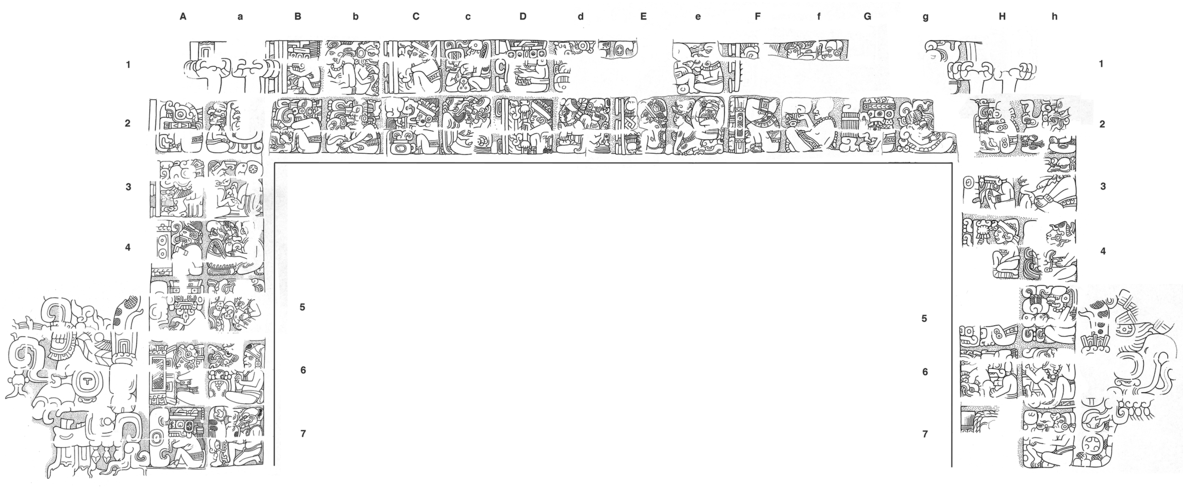
The Temple Inscription in Str. 10L-26-1st at Copan, featuring parallel texts in a Teotihuacan-style pseudo-script (columns A–H) and Classic Maya hieroglyphs (columns a–h).
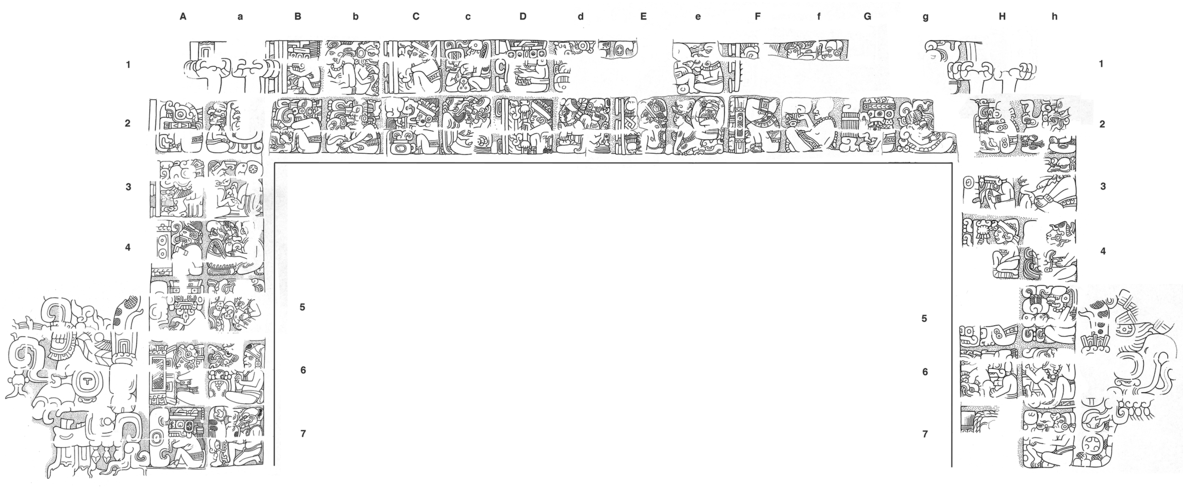
The text in Str. 10L-26 was not unprecedented by virtue of its complex full-figure style, which was uncommon across the Classic Maya lowlands but had been embraced at Copan and a few other polities.Footnote 5 Instead, K’ahk’ Yipyaj Chan K’awiil’s scribe-sculptors distinguished this full-figure text by pairing it with a parallel text in the graphic code of faraway Teotihuacan (Figure C.1).Footnote 6 The foreign version occupies pride of place in the temple, its single columns written to the left of, and thus read before, the corresponding columns of Maya hieroglyphs.Footnote 7 What’s more, it was composed not with a real, extant script but with a conjectured one. The component signs hardly resemble Teotihuacan’s as-yet undeciphered writing system, which belonged to the script tradition of central Mexico and Oaxaca.Footnote 8 As David Stuart has argued, the pseudo-hieroglyphic “font” is better understood as a Late Classic Maya rendering of how Copan scribes imagined Teotihuacan writing would have looked like, generations after the distant civilization’s decline.Footnote 9 Consequently, the Teotihuacan-style text operates more as a transliteration, not a translation, of the Classic Maya one.
Given sufficient time and energy, viewers well-versed in Classic Maya hieroglyphs could have identified enough graphic similarities between the twin full-figure texts to realize that they were intended to appear as if they communicated the same message.Footnote 10 In terms of linguistic content, however, the only obvious visual correspondences concern numbers. Quantities rendered in anthropomorphic form in the Maya inscription appear as simple bar-and-dot sequences in the Teotihuacano version, a clear nod to the latter format’s ubiquity across Mesoamerican traditions (Figure C.1). Otherwise, K’ahk’ Yipyaj Chan K’awiil’s artists emphasized graphic over lingual similarities. The central Mexican equivalents of several Classic Maya signs related to conflagration, including logographs for k’ahk’ “fire” and the theonym K’awiil, similarly feature volutes that evoke flames (blocks B/b2, C/c1–2, G/g2, H/h2, Figure C.1). Likewise, a fishy variant of the syllable u that occupies the left side of blocks a5 and a7 in the Maya text, where it denotes the third-person singular ergative pronoun u-, appears in blocks A5 and A7 as a blocky, lobed bracket (Figure C.1).Footnote 11
For all the graphic correspondences, however, it is almost certain that the Teotihuacan-style text, unlike its Classic Maya companion, was not linguistically decipherable for viewers at Late Classic Copan – nor would it have been parsable for Early Classic inhabitants of the central Mexican metropolis. The question of which language native Teotihuacanos spoke remains open. Today, most historical linguists posit a language from the Uto-Aztecan or Otomanguean families, neither of which shares a common origin with Mayan languages.Footnote 12 In other words, it is improbable that Teotihuacanos would have had a pronominal cognate in the same syntactic position as or with a vowel quality similar to Classic Mayan u-, or that any other signs in Str. 10L-26’s central Mexican-style inscription would have been phonetically comparable to the signs in the corresponding Maya glyph block. Moreover, all evidence indicates that the writing system used at Teotihuacan during its Early Classic fluorescence encoded minimal grammatical information, much like later Aztec, Toltec, and other related writing systems, and in clear functional contrast to Maya hieroglyphs.Footnote 13 In their Teotihuacano transliteration, the Copan artists privileged a graphic similarity that smoothed over probable differences in phonetic quality and even grammar between the languages that the two scripts ostensibly recorded. The goal was not to translate a text from one code into another; instead, the paired texts in Str. 10L-26, taken together, conveyed a single message that neither the Classic Maya nor the Teotihuacan-style signs could communicate alone.
K’ahk’ Yipyaj Chan K’awiil’s parallel inscriptions distinguish the Late Classic Maya and Teotihuacan civilizations by juxtaposing writing, not language. In particular, the scribe-artists “evoked the idea of ethnic otherness, of another place” by incorporating features typical of Teotihuacano iconography into the transliterated text.Footnote 14 The full-figure signs in the Teotihuacan-style version project cultural foreignness through body posture. The anthropomorphic central Mexican full-figure hieroglyphs squat, knees bent vertically in front of their chests, whereas most animated Maya hieroglyphs sit cross-legged.Footnote 15 Several Teotihuacano signs also break the so-called fourth wall.Footnote 16 Looking out at the viewer rather than straight ahead – or, on rare occasion, behind – to the surrounding text, a few foreign characters brazenly defy the conventions of comportment and reader engagement to which the Classic Maya hieroglyphs dutifully adhere (blocks A5 and D1, Figure C.1).Footnote 17 A few emit speech scroll-like curls from their mouths, perhaps a visual clue that the sounds emerging from their mouths were unfamiliar to Maya ears (blocks A3, A4, and C2, Figure C.1).
Nonetheless, the Late Classic Maya creators of the Str. 10L-26 texts did not consider the cultural distance between themselves and Early Classic Teotihuacanos to be insurmountable. Their full-figure transliteration into an imagined Teotihuacan script still acknowledged that the central Mexican hieroglyphs were, an other-than-human technology. Just as the scribes understood their own script to be a creation of their gods, they modeled many elements in the Teotihuacan-style transliteration after central Mexican deities. Most full-figure signs in both texts represent other-than-human beings whose names and qualities are not known to us. Some Classic Maya full-figure signs, however, do embody identifiable deities, among them an aspect of the Maize god, the lightning god K’awiil, and the so-called Caban god (blocks b1, b2, c2, Figure C.1).Footnote 18 Similarly, several figures in the transliteration bear the goggle-rimmed eyes, missing lower jaw, and prominent incisors of the central Mexican storm god who also appears at Teotihuacan (blocks A4–5, A7, B1–2, G2, H2–3, H6, Figure C.1).Footnote 19
Scribe-sculptors working in K’ahk’ Yipyaj Chan K’awiil’s temple even correlated some hieroglyphic metapersons directly across the two cultures. This strategy is most apparent in other-than-human Teotihuacan-style signs with traits that mirror their Maya counterparts. The Teotihuacano rendering of K’awiil, for instance, combines the characteristic flaming torch emerging from the Classic Maya god’s forehead with central Mexican-style goggled eyes (blocks B2–b2, H2–h2, Figure C.1). Similarly, a full-figure version of the Maya logograph K’AHK’ “fire” appears in the Teotihuacano text as an other-than-human being squatting behind a large torch that burns brightly from both vertical ends (blocks G2–g2, Figure C.1).Footnote 20 Likewise, the large parrot variant of the Maya syllabic hieroglyph a appears in the paired text as a large-billed bird with broad wings (blocks A3–a3, Figure C.1).Footnote 21 In short, the artisans at Copan did not need to be familiar with the roster of divine beings that had been worshipped at Early Classic Teotihuacan to visualize a common other-than-human origin for the two civilizations’ scripts. Despite their temporal and geographic distance from the flourishing central Mexico metropolis, K’ahk’ Yipyaj Chan K’awiil’s artists understood the fundamental differences between the writing systems to be formal, not ontological.
The cultural-graphic juxtaposition in the Str. 10L-26 text makes monumentally clear that the Classic Maya considered their hieroglyphic script a harbinger of a flourishing civilization that was both advanced and uniquely theirs. They also located its particular identity in the other-than-human beings whom the practice of writing engaged. The full-figure Maya hieroglyphs embody metapersons whose familiar portraits look and behave much differently from the foreign icons in the Teotihuacan-style text. The latter gush blood from their jaws, hunch forward with crossed arms, or face out into the sacred space with a toothy stare; the former, in contrast, almost always look to the viewer’s left, stretch their arms, and avoid meeting the viewer’s gaze. With their creation, K’ahk’ Yipyaj Chan K’awiil’s scribe-sculptors implied that to write hieroglyphs, whether in Late Classic Copan or in Early Classic Teotihuacan, was to engage other-than-human members of the cosmos. At the same time, reading the paired texts obliged Maya viewers at Copan to confront the untranslatability of Teotihuacan gods, who were just as foreign to them as the faded civilization’s language.
The other-than-human patrons of Classic Maya hieroglyphs, in contrast, were beings whose zoomorphic, theomorphic, and anthropomorphic features embodied the ritualized practice in which historical scribes engaged. The work of producing texts enlisted cultural knowledge about signs, their meanings, and their uses that was itself a limited resource associated strongly, if not exclusively, with royal and sub-royal elites. Yet the human bearers of this knowledge – the historical scribe-artists who drafted codices, sculpted stone monuments, carved wooden lintels, painted ceramics, and molded stucco panels – were almost never the focus of the inscriptions that they composed or the imagery accompanying them. Instead, Classic Maya representations emphasized the process of writing, not (mortal) writers or their written products. Like the deified full-figure forms rendered on the walls of Str. 10L-26, illustrations of other-than-human scribes at work evoked the hieroglyphic script’s primordial origins and the veneration owed to its progenitors.
Scribe-artists’ underrepresentation in the media that they produced belies the active role that they played in Classic Maya religious culture, not only as practitioners of rites surrounding hieroglyphic production but as creators of ritual objects. In elaborating the altars, stelae, and other artifacts integral to elite ceremony, they sometimes drew on concepts from those same performances to inform their crafting. The ceremonial act of bundling or covering monuments and other precious surfaces in woven reed mats – a ritual widespread across Mesoamerica, beyond the Maya region – offers a particularly explicit instance of such crossover. Scribe-artists skeuomorphically integrated the perishable weave into more lasting creations that cited, in a durably visible way, a performance whose physical presence was otherwise fleeting. By integrating hieroglyphs and the mat motif to compose inscriptions like those on Stela J at Copan, in turn, they evoked the religious salience of both bundling and hieroglyphic writing, as well as their distinctive contributions to both practices.
Ritual played a core role not just in the creation and practice of hieroglyphic writing but in its transmission through Classic Maya time and space. Ritual diplomacy, which entailed joint ritual performance by representatives of multiple polities, facilitated the spread of religious and scribal culture, both in parallel to and beyond more formal political negotiations. Although Classic Maya kings and queens across the lowlands all drew on a shared religion to justify and exercise their authority, the rituals they performed varied between and even within dynasties. Travelers to foreign kingdoms thus encountered religious practices, gods, ideas, and ritual artifacts that may have been unknown to them. They also shared their own traditions with their counterparts. Those who did not leave their home polities, in turn, benefited from material, visual, written, or verbal representations of what their colleagues had experienced on the road, as well as from exchange with visiting foreigners. Because the Classic Maya institution of divine kingship did not rely on a single ritual for its maintenance, ritual diplomacy offered a forum for participants to demonstrate their locally salient practices or to observe those of another kingdom. It also offered a means for elites to maintain relatively coherent hieroglyphic and religious traditions across polity lines.
Yet Classic Maya rituals were not the sole purview of royal or even sub-royal elites; they were accessible in many cases to a broader swath of actors whose own practices, although more difficult for scholars to discern today, also shaped the co-transmission of writing and religion across the lowlands. Nagualism, a tradition of other-than-human relations that linked human members of society with shape-shifting way beings or co-essences, was practiced across precolonial Mesoamerica but is especially well-attested in Classic Maya imagery and texts. The distribution of hieroglyphic references and the diversity of graphic presentation across the lowlands suggest that scribal engagement with the way tradition was widespread, decentralized, and varied. At the same time, production of co-essence portraits on painted ceramics concentrated in a handful of Late Classic dynastic centers. It thus seems that this component of nagualism, at least, was locally meaningful and inconsistently linked to dynastic identity. The vessels’ portability meant that metaperson imagery, sometimes accompanied by hieroglyphic references to the other-than-human beings’ political affiliation, could circulate far beyond the bounds of the kingdoms – and royal courts – in which they originated. Nonetheless, scribe-artists in most Classic Maya polities either lacked the religious knowledge required to produce such illustrations themselves, or more likely, simply used it in other ways. Ritual engagement with nagualism took many forms, even among the artisans who were tasked with creating its hieroglyphic and visual representations.
If we, from our position in the twenty-first century, accept the premise that production of Classic Maya hieroglyphs was a mode of ritual engagement, how does our understanding of writing or religion change? Which features gain importance, and who become the primary actors when (re)writing its histories? A shift in perspective does not negate the basic reality that Classic Maya writing and religion were inseparable from politics or relations of power. It does, however, aid us in reconceptualizing where that power was located and how it was negotiated. Dynastic kings and their associates instrumentalized the hieroglyphic script to record generations of ritual performances in which they performed authority that they already claimed and invested in its perpetuation. Limited access to information needed to interpret these inscriptions, in turn, meant that knowledge of ritual precedent and its proper practice was an unequally distributed privilege. In claiming intimate knowledge of and access to the metapersons with whom they shared their cosmos, Classic Maya rulers, scribes, and other elites legitimized their place at the top of the human hierarchy. At the same time, they laid bare the foundations of that privilege by revealing their dependence on those same other-than-human beings, who were themselves neither invincible nor infallible.
Hieroglyphic writing and other visual arts were also a crucial medium through which the gods and ancestors were made enduringly present. Like other divine portraits, animated hieroglyphs such as those inscribed on the walls of Str. 10L-26 at Copan offered a direct, visual encounter with the other-than-human to viewers – some of whom may not have been eligible themselves to partake in royal rituals in that space. In composing the parallel texts, K’ahk’ Yipyaj Chan K’awiil’s artisans actively extended religious participation to those who entered the temple. At the same time, they sculpted so many hieroglyphs in metaperson form that those viewers likely perceived the script’s entanglement with religion more loudly than the signs’ literal linguistic message. By rendering much of the text in full-figure form, the scribes hinted that what distinguished the Early Classic inhabitants of far-off Teotihuacan from their own community at Copan was not as much the former’s foreign language or the unfamiliar signs that recorded it as the other-than-human beings whom they venerated.
Most means by which Classic Maya scribe-artists articulated hieroglyphic writing and religion were more subtle, however. They integrated motifs derived from ritual practice, such as that of the woven reed mat, into their inscriptions; innovated hieroglyphic representations for subjects and objects of ritual practice previously unknown to them, like the patron gods of Copan or the shell-plated ko’haw helmet; or selectively assigned political affiliation to regionally known metaperson characters, including shape-shifting co-essences. It is thus with some confidence that we can posit that other-than-human engagement was a central component of hieroglyphic practice, even though we will probably never be able to reconstruct most of the specific rituals in which scribes engaged as part of their work with the script.
As an other-than-human technology, hieroglyphic writing reminded even those unable to read its linguistic message of the ruler’s role as mediator between the community and the gods and ancestors. For the Classic Maya, the numinous could not be separated from the political. Yet until death transformed him into an ancestor, the king remained a member of his people’s world and thus of the reciprocal relations that linked them, and himself, with their metaperson counterparts. As assertively as Classic Maya royal elites proclaimed a special relationship with the other-than-human realm, their hieroglyphic inscriptions and (self-)portraits reveal that none of them – not the king or queen, nor their heirs, nor those who served in their court – were anything other than human. They depended on the ritual practitioners who guided maintenance of mutually beneficial metaperson-relations, on the gods and ancestors who received and reciprocated offerings, and on the people who raised crops, fought in battles, transported goods, and labored at construction sites. They also depended on the scribes who documented their achievements, ritual and otherwise, such that they were legible to noble peers, subordinates, and successors.
Co-transmitting writing with ritual and other aspects of religion relied on interpersonal, direct contacts between scribes. It also depended on indirect encounters through material culture and word of mouth. Some mobility of people and goods across the lowlands would have been motivated by ritual practice, including pilgrimage. Other movement would have been prompted by factors such as trade, diplomacy, natural disaster, or warfare. Eliding religion from our interpretations of these interactions, or, conversely, omitting these interactions’ from our understanding of religion, yields an incomplete picture of Classic Maya civilization. As in other areas of the world where writing first emerged, religion was a driver of cultural communication and change in the precolonial Maya lowlands, including development of the hieroglyphic script. Scribe-artists did not merely document the activities or knowledge of religious specialists; they actively participated in ritual performances, integrated their observations into ways of writing, and shaped religion as they did so. Writing and religion were mutually sustaining spheres of Classic Maya culture. Acknowledging this complementarity opens the door to a history that embraces both other-than-human actors and the often-anonymous craftspeople on whose works we rely to study the past.

 Open access