The 1995 Great Hanshin and Awaji Earthquake resulted in a large number of casualties, creating a massive demand for medical care. In response to this demand, the Japanese government decided to establish Disaster Medical Assistance Teams (DMATs) to function as “mobile, trained medical teams that can be rapidly deployed during the acute phase of a sudden-onset disaster.” The Fire and Disaster Management Agency works with local communities to create a system that can respond precisely and in a practical and effective manner.Reference Kondo, Koido and Morino 1 Effective cooperation between the local government, police, emergency fire response teams, military personnel, and DMATs is essential to reduce the rates of preventable disaster death. However, cooperation has been difficult to achieve due to little mutual understanding between the DMATs and other organizations and a lack of common knowledge, theory, and language regarding disaster response.
Accordingly, in 2011, the Japanese Association for Disaster Medicine developed a mass casualty life support (MCLS) course to resolve these issues.Reference Yanagawa, Kon and Otomo 2 , Reference Yanagawa, Morino, Iwama, Takayama, Kondo, Koido, Homma and Otomo 3 The MCLS course contains 4 parts (lecture, simulation drill, skills training, and test) and 10 modules, emphasizing the establishment of command and control, safety, communication, and assessment before executing triage, treatment, and transportation. The MCLS is a 1-day course, and up to 30 people can participate at once. Participants certified by the Japan Prehospital Trauma Evaluation and Care (JPTEC) program are preferred, but such certification is not essential. The MCLS was first held in Nagasaki prefecture in August 2011, and as of March 2016, over 500 courses have been held all over Japan. Emergency medical technicians (EMTs), firefighters, military personnel, doctors, and nurses have taken part in the MCLS courses. In Shizuoka prefecture, the first MCLS was held in 2012. Two or 3 MCLS courses are held annually in Shizuoka, and as of March 2016, 11 have been held in total. However, this rate is not sufficient to allow all EMTs in Shizuoka to attend an MCLS course. While one might assume that attending such a course will be beneficial, no studies have actually examined whether MCLS course participants perform more useful or effective first aid in real or mock mass casualty situations than do those without a history of course attendance.
In the present study, we investigated the difference in first aid activity during mass casualty training at the fire department of Numazu City in Shizuoka prefecture between ambulance service members who had and had not attended the MCLS course.
METHODS
The protocol of this retrospective study was approved by our institutional review board, and the examinations were conducted in accordance with the standards of good clinical practice and the Helsinki Declaration. Our hypothesis was that attending the MCLS course would likely improve the quality of performance in a mass casualty situation.
The mass casualty training was held at the fire department of Numazu City in 2015. Twenty-one ambulance service parties participated in this training. Each ambulance service party consisted of 3 members, including 1 chief EMT and 2 staff. In none of these 21 parties had all 3 members taken the MCLS course. All members had received JPTEC education. In 9 parties, the chief EMTs had attended the MCLS course. In 8 parties, one or both of the staff had attended the MCLS course. In 13 parties, either the chief EMT or the staff had attended the MCLS course. Among the members who had attended the MCLS course, the duration from taking the course to undergoing the mass casualty training ranged from 2 weeks to 2 years. Accordingly, the parties, which included the members who had attended the MCLS course, consisted of heterogeneously trained crews. To test our hypothesis, we retrospectively compared the performance of the ambulance service parties with crew members who had undertaken the educational course with those who had not. Specifically, we retrospectively analyzed the following: (1) the difference in the first aid activity for mass casualty training among the chief EMTs of each ambulance service with or without a history of MCLS course education, (2) the difference in the first aid activity for mass casualty training among the staff members with or without a history of MCLS course education, (3) the difference in the first aid activity for mass casualty training among all members of each ambulance service with or without a history of MCLS course education, and (4) the correlation between the number of members in the ambulance service who had a history of MCLS course education and the total score for first aid activity for mass casualty training.
The scenario was a collision between a minibus and a common automobile, with an outbreak of 10 mock wounded patients with green to red tags. Before starting the mass casualty training, the ambulance service members who had attended the MCLS course taught the principles of MCLS to other members who had not attended the course. First, all members of each ambulance party were lectured on the details of the mass casualty incident for 3 minutes. They then started to evaluate the situation, performed appropriate activities at the scene during the initial period, and provided START triage for the mock wound patients for 10 minutes.Reference Bhalla, Frey and Rider 4 Throughout the training, 5 examiners evaluated their performance.
Eight points were awarded as follows: (1) declaration of mass casualty incident and establishing command and control system at the scene, (2) ensuring the safe management of the ambulance service itself, (3) ensuring the safe management of the scene, (4) setting zone and place, (4) ensuring the safe management of the survivors, (5) collecting information concerning the mass casualty incident and ensuring the quality of the information, (6) cooperating with other members of the ambulance service, (7) ensuring the quality of the report concerning the mass casualty incident, and (8) ensuring the quality of the support requests in response to the mass casualty incident. Each point was scored as 1 (could not perform at all), 2 (below average), 3 (average), 4 (above average), or 5 (was able to perform perfectly). The minimum score was 8 and the maximum was 40. In addition, the rate of executing START triage for the 10 mock patients and the hit rate for triage were also evaluated. Each mock patient was categorized as green (minor), yellow (delayed), red (immediate), or black (diseased) by examiners. If a member of the ambulance party correctly identified the patient’s category (eg, green for green), it was defined as a hit. The same 5 examiners from independent groups throughout the study evaluated every party. A score was assigned after a consensus had been obtained among the examiners. Their level of agreement was not assessed.
We used the JMP 12 software program (SAS Institute Inc) for statistical analyses. Each of the 8 evaluated points was analyzed by Wilcoxon signed-rank test. The total score of the 8 evaluated points, the triage execution rate, and the triage hit rate were analyzed by an unpaired Student’s t-test. The correlation between the number of members in the ambulance service who had taken the MCLS course and the total score for first aid activity for the mass casualty training was then analyzed by the correlation method. A P value of <0.05 was considered to indicate a statistically significant difference. In addition, given that the number of examinations was small, a P value ≤0.1 was also described. All of the data are presented as the median (interquartile range) or the mean±standard deviation.
RESULTS
For the 8 evaluated points, all parties achieved perfect scores concerning safety management for the ambulance service itself and the collection of information and quality assurance.
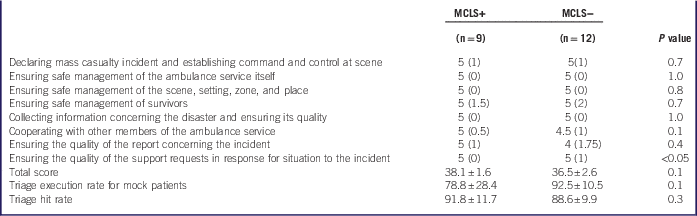
The results of the evaluation items for chief emergency technicians among ambulance service parties with or without a history of attending an MCLS educational course are shown in Table 1. The average score concerning the support request in response to a disaster situation was significantly higher for course attendees than for nonattendees. In addition, the average total score and cooperative management score tended to be higher for course attendees than for nonattendees, although not significantly so. In contrast, the triage execution rate tended to be lower for course attendees than for nonattendees, but also not significantly so.
Results of the Evaluation Items for Chief Emergency Technicians Among Ambulance Service Parties With or Without a History of Attending an MCLS Educational CourseFootnote a

a Abbreviation: MCLS, mass casualty life support.
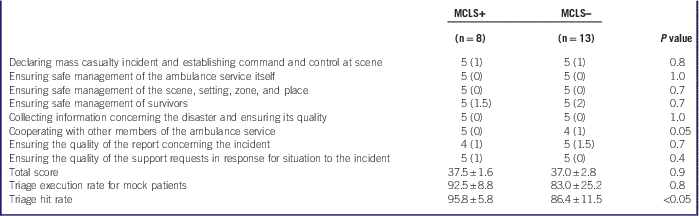
The results of the evaluation items for staff members among ambulance service parties with or without a history of attending an MCLS educational course are shown in Table 2. The average hit rate for triage was significantly higher for course attendees than for nonattendees. In addition, the average score for cooperative management tended to be higher for course attendees than for nonattendees, although not significantly so.
Results of the Evaluation Items for Staff Members Among Ambulance Service Parties With or Without a History of Attending an MCLS Educational Coursea

a Abbreviation: MCLS, mass casualty life support.
Concerning differences in first aid activity for mass casualty training with or without having attended an MCLS course among all members of each ambulance service, the average score for cooperative management was significantly higher for course attendees than for nonattendees (median [interquartile range]: 5 [0.5] vs 4 [1.75], P<0.05). The correlation between the number of members in the ambulance service who had attended the MCLS course and the total score for first aid activity for mass casualty training indicated a weak positive correlation (R=0.3, P=0.1).
DISCUSSION
This study showed that attending an MCLS course resulted in improved first aid performance, including support requests by the chief EMT, improvement in START triage by the staff, and improvement in cooperative management among all members. Accordingly, attending the MCLS course may improve final the outcome of an actual mass casualty incident. Most reports investigating the effectiveness of education concerning mass casualty incidents have conducted pre- and post-test evaluations, just after the course ended.Reference Sammut, Cato and Homer 5 - Reference Wolf, Bigalke and Graf 8 This study was not a pre- and post-test study but a comparative study of observations from independent groups. However, in the present study, we found that education concerning mass casualty incidents was effective in improving performance even though the evaluation was not performed immediately after the education. Usually, some degree of degradation in knowledge and skills concerning life support will occur, unless remedial training is provided as often as required and training equipment is available at the office to allow for self-study and practice.Reference Ishikawa, Ohsaka and Omori 9 Of note, however, before the mass casualty training, the members who had attended the MCLS course educated those who had not on the principles of the course. This may have prevented any degradation of knowledge and skills obtained during the MCLS course, subsequently improving the party’s cooperative performance.
The main points evaluated here concerned the establishment of command and control, safety, communication, and assessment. The management of command and control, safety, communication, and assessment was mainly determined by the chief EMT. Accordingly, the chiefs who had attended the MCLS course, which emphasized the importance of establishing command and control, safety, communication, and assessment before executing triage, treatment, and transportation in a mass casualty situation, tended to score higher on their total performance in the mass casualty training. The staff members who had attended the MCLS course had a high hit rate for triage, possibly because the chief EMTs led the party and could not perform triage themselves, instead delegating triage to the staff who had attended the MCLS course.
Several limitations associated with the present study warrant mention, including the time lag after the training was administered to participants and the small sample size, small number of examinations, and performance of the evaluation using simulation training. In addition, the makeup of the ambulance crews may have been a limitation associated with this study, as these crews consist of heterogeneously MCLS-trained crews that could have resulted in cross-contaminated skill levels among crew members. This would make measuring individual performance more difficult and introduce the potential to statistically adjust the clustering issue associated with measuring subjects (crew members) belonging to distinct groups. Furthermore, before starting the mass casualty training course, the ambulance service members who had already attended the MCLS course educated other members who had not attended the course on the basic principles of MCLS. This might have resulted in a beneficial effect, because some of the largest differences between the MCLS-trained and untrained individuals turned out to be different than initially expected. Future studies should examine whether attending the MCLS course helps to improve the response to an actual mass casualty incident using a large number of examinations.
CONCLUSION
Attending an MCLS course resulted in an improvement in total performance, including support requests by the chief EMT, improvement in START triage by the staff, and improvement in cooperative management among all members. Attending the MCLS course may help to improve the ultimate outcome of an actual mass casualty incident.
Funding
This research was supported by a MEXT (The Ministry of Education, Culture, Sports, Science and Technology)-Supported Program for the Strategic Research Foundation at Private Universities 2015-2019 for the constitution of a total research system for comprehensive disaster medical management, corresponding to wide-scale disaster.