




No CrossRef data available.
Article contents
First among equals: why some habitats should be considered more important than others during marine reserve planning
Published online by Cambridge University Press: 18 May 2009
Summary
Reserve selection algorithms (RSAs) are a powerful tool for marine conservation, but need biological realistic constraints. A common constraint is that the RSA aims to include the same percentage area of each habitat in the reserve network. The example of Caribbean reefs is used to argue that there is significant additional scope to set specific areal targets for each habitat type, as in many terrestrial case studies. Ten Caribbean habitats are weighted by data on their biodiversity, functional value to ecosystem processes and ecosystem services. These weightings vary depending on the criteria used, and are particularly distinct for ecosystem services. Furthermore, a percentage goal for a habitat can be achieved in multiple ways by including different combinations of habitat patches from across a seascape. RSAs may treat these combinations equally, but some habitat patches are more ‘valuable’ than others because, for example, high abundances of grazers make the benthic community resilient. Incorporating some of these considerations into RSAs is relatively easy, while others are more difficult. However, establishing how to integrate patterns of biodiversity, and ecological processes, functions, goods and services across seascapes into RSAs offers opportunities to improve the design of networks of reserves.
Information
- Type
- EC Perspectives
- Information
- Copyright
- Copyright © Foundation for Environmental Conservation 2009
References
Airamé, S., Dugan, J.E., Lafferty, K.D., Leslie, H., McArdle, D.A. & Warner, R.R. (2003) Applying ecological criteria to marine reserve design: a case study from the California Channel Islands. Ecological Applications 13: S170–S184.CrossRefGoogle Scholar
Arponen, A., Heikkinen, R.K., Thomas, C.D. & Moilanen, A. (2005) The value of biodiversity in reserve selection: representation, species weighting, and benefit functions. Conservation Biology 19: 2009–2014.CrossRefGoogle Scholar
Arponen, A., Moilanen, A. & Ferrier, S. (2008) A successful community-level strategy for conservation prioritization. Journal of Applied Ecology 45: 1436–1445.CrossRefGoogle Scholar
Ball, I.R. & Possingham, H.P. (2000) MARXAN (V1.8.2): Marine Reserve Design Using Spatially Explicit Annealing, a Manual. Brisbane, Australia: University of Queensland.Google Scholar
Brooks, T.M., da Fonseca, G.A.B. & Rodrigues, A.S.L. (2004) Protected areas and species. Conservation Biology 18: 616–618.CrossRefGoogle Scholar
Chan, K.M.A., Shaw, M.R., Cameron, D.R., Underwood, E.C. & Daily, G.C. (2006) Conservation planning for ecosystem services. PLoS Biology 4: 2138–2152.CrossRefGoogle ScholarPubMed
Cowen, R.K., Paris, C.B. & Srinivasan, A. (2006) Scaling of connectivity in marine populations. Science 311: 522–527.CrossRefGoogle ScholarPubMed
Egoh, B., Rouget, M., Reyers, B., Knight, A.T., Cowling, R.M., van Jaarsveld, A.S. & Welz, A. (2007) Integrating ecosystem services into conservation assessments: a review. Ecological Economics 63: 714–721.CrossRefGoogle Scholar
Fernandes, L., Day, J., Lewis, A., Slegers, S., Kerrigan, B., Breen, D., Cameron, D., Jago, B., Hall, J., Lowe, D., Innes, J., Tanzer, J., Chadwick, V., Thompson, L., Gorman, K., Simmons, M., Barnett, B., Sampson, K., De'ath, G., Mapstone, B., Marsh, H., Possingham, H., Ball, I., Ward, T., Dobbs, K., Aumend, J., Slater, D. & Stapleton, K. (2005) Establishing representative no-take areas in the Great Barrier Reef: large-scale implementation of theory on marine protected areas. Conservation Biology 19: 1733–1744.CrossRefGoogle Scholar
Fraschetti, S., D'Ambrosio, P., Micheli, F., Pizzolante, F., Bussotti, S. & Terlizzi, A. (2009) Design of marine protected areas in a human-dominated seascape. Marine Ecology Progress Series 375: 13–24.CrossRefGoogle Scholar
Game, E.T., McDonald-Madden, E., Puotinen, M.L. & Possingham, H.P. (2008 a) Should we protect the strong or the weak? Risk, resilience, and the selection of marine protected areas. Conservation Biology 22: 1619–1629.CrossRefGoogle ScholarPubMed
Game, E.T., Watts, M.E., Wooldridge, S. & Possingham, H.P. (2008 b) Planning for persistence in marine reserves: a question of catastrophic importance. Ecological Applications 18: 670–680.CrossRefGoogle ScholarPubMed
Graham, N.A.J., Dulvy, N.K., Jennings, S. & Polunin, N.V.C. (2005) Size-spectra as indicators of the effects of fishing on coral reef fish assemblages. Coral Reefs 24: 118–124.CrossRefGoogle Scholar
Grober-Dunsmore, R., Frazer, T.K., Lindberg, W.J. & Beets, J. (2007) Reef fish and habitat relationships in a Caribbean seascape: the importance of reef context. Coral Reefs 26: 201–216.CrossRefGoogle Scholar
Harborne, A.R., Mumby, P.J., Kappel, C.V., Dahlgren, C.P., Micheli, F., Holmes, K.E. & Brumbaugh, D.R. (2008) Tropical coastal habitats as surrogates of fish community structure, grazing, and fisheries value. Ecological Applications 18: 1689–1701.CrossRefGoogle ScholarPubMed
Harborne, A.R., Mumby, P.J., Micheli, F., Perry, C.T., Dahlgren, C.P., Holmes, K.E. & Brumbaugh, D.R. (2006 a) The functional value of Caribbean coral reef, seagrass and mangrove habitats to ecosystem processes. Advances In Marine Biology 50: 57–189.CrossRefGoogle ScholarPubMed
Harborne, A.R., Mumby, P.J., Żychaluk, K., Hedley, J.D. & Blackwell, P.G. (2006 b) Modeling the beta diversity of coral reefs. Ecology 87: 2871–2881.CrossRefGoogle ScholarPubMed
Heijnis, C.E., Lombard, A.T., Cowling, R.M. & Desmet, P.G. (1999) Picking up the pieces: a biosphere reserve framework for a fragmented landscape. The Coastal Lowlands of the Western Cape, South Africa. Biodiversity and Conservation 8: 471–496.CrossRefGoogle Scholar
Klein, C., Wilson, K., Watts, M., Stein, J., Berry, S., Carwardine, J., Smith, M.S., Mackey, B. & Possingham, H. (2009) Incorporating ecological and evolutionary processes into continental-scale conservation planning. Ecological Applications 19: 206–217.CrossRefGoogle ScholarPubMed
Klein, C.J., Steinback, C., Scholz, A.J. & Possingham, H.P. (2008) Effectiveness of marine reserve networks in representing biodiversity and minimizing impact to fishermen: a comparison of two approaches used in California. Conservation Letters 1: 44–51.CrossRefGoogle Scholar
Knight, A.T., Cowling, R.M. & Campbell, B.M. (2006) An operational model for implementing conservation action. Conservation Biology 20: 408–419.CrossRefGoogle ScholarPubMed
Leathwick, J., Moilanen, A., Francis, M., Elith, J., Taylor, P., Julian, K., Hastie, T. & Duffy, C. (2008) Novel methods for the design and evaluation of marine protected areas in offshore waters. Conservation Letters 1: 91–102.CrossRefGoogle Scholar
Leslie, H., Ruckelshaus, M., Ball, I.R., Andelman, S. & Possingham, H.P. (2003) Using siting algorithms in the design of marine reserve networks. Ecological Applications 13: S185–S198.CrossRefGoogle Scholar
Lindeman, K.C., Diaz, G.A., Serafy, J.E. & Ault, J.S. (1998) A spatial framework for assessing cross-shelf habitat use among newly settled grunts and snappers. Proceedings of the Gulf and Caribbean Fisheries Institute 50: 385–416.Google Scholar
Margules, C.R. & Pressey, R.L. (2000) Systematic conservation planning. Nature 405: 243–253.CrossRefGoogle ScholarPubMed
Moberg, F. & Folke, C. (1999) Ecological goods and services of coral reef ecosystems. Ecological Economics 29: 215–233.CrossRefGoogle Scholar
Mumby, P.J. (2006) Connectivity of reef fish between mangroves and coral reefs: algorithms for the design of marine reserves at seascape scales. Biological Conservation 128: 215–222.CrossRefGoogle Scholar
Mumby, P.J., Broad, K., Brumbaugh, D.R., Dahlgren, C.P., Harborne, A.R., Hastings, A., Holmes, K.E., Kappel, C.V., Micheli, F. & Sanchirico, J.N. (2008) Coral reef habitats as surrogates of species, ecological functions, and ecosystem services. Conservation Biology 22: 941–951.CrossRefGoogle ScholarPubMed
Mumby, P.J., Edwards, A.J., Arias-González, J.E., Lindeman, K.C., Blackwell, P.G., Gall, A., Gorczynska, M.I., Harborne, A.R., Pescod, C.L., Renken, H., Wabnitz, C.C.C. & Llewellyn, G. (2004) Mangroves enhance the biomass of coral reef fish communities in the Caribbean. Nature 427: 533–536.CrossRefGoogle ScholarPubMed
Mumby, P.J., Hastings, A. & Edwards, H.J. (2007) Thresholds and the resilience of Caribbean coral reefs. Nature 450: 98–101.CrossRefGoogle ScholarPubMed
Pressey, R.L., Cabeza, M., Watts, M.E., Cowling, R.M. & Wilson, K.A. (2007) Conservation planning in a changing world. Trends in Ecology and Evolution 22: 583–592.CrossRefGoogle Scholar
Pressey, R.L., Cowling, R.M. & Rouget, M. (2003) Formulating conservation targets for biodiversity pattern and process in the Cape Floristic Region, South Africa. Biological Conservation 112: 99–127.CrossRefGoogle Scholar
Roberts, C.M., Andelman, S., Branch, G., Bustamante, R.H., Castilla, J.C., Dugan, J., Halpern, B.S., Lafferty, K.D., Leslie, H., Lubchenco, J., McArdle, D., Possingham, H. P., Ruckelshaus, M. & Warner, R.R. (2003) Ecological criteria for evaluating candidate sites for marine reserves. Ecological Applications 13: S199–S214.CrossRefGoogle Scholar
Rossi, E. & Kuitunen, M. (1996) Ranking of habitats for the assessment of ecological impact in land use planning. Biological Conservation 77: 227–234.CrossRefGoogle Scholar
Rouget, M., Cowling, R.M., Pressey, R.L. & Richardson, D.M. (2003) Identifying spatial components of ecological and evolutionary processes for regional conservation planning in the Cape Floristic Region, South Africa. Diversity and Distributions 9: 191–210.CrossRefGoogle Scholar
Sala, E., Aburto-Oropeza, O., Paredes, G., Parra, I., Barrera, J.C. & Dayton, P.K. (2002) A general model for designing networks of marine reserves. Science 298: 1991–1993.CrossRefGoogle ScholarPubMed
Stewart, R.R., Ball, I.R. & Possingham, H.P. (2007) The effect of incremental reserve design and changing reservation goals on the long-term effliciency of reserve systems. Conservation Biology 21: 346–354.CrossRefGoogle Scholar
Williams, J.C., ReVelle, C.S. & Levin, S.A. (2004) Using mathematical optimization models to design nature reserves. Frontiers in Ecology and the Environment 2: 98–105.CrossRefGoogle Scholar
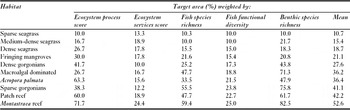
Table 1 Potential target weightings (minimum % of each habitat to be contained within a marine reserve network) for 10 common reef habitats in the Bahamian archipelago based on five different criteria considered by reserve selection algorithms. Minimum target area for any individual habitat is 10%. Data derived from Mumby et al. (2008).
 You have
Access
- 6
- Cited by
Marine and terrestrial nature reserves are vital tools for conserving biodiversity, and increasingly for protecting ecosystem processes, goods and services (Chan et al. Reference Chan, Shaw, Cameron, Underwood and Daily2006; Pressey et al. Reference Pressey, Cabeza, Watts, Cowling and Wilson2007). Despite a number of major questions still remaining about the optimal design of these reserves, simultaneous consideration of a range of data sets during the planning process generally relies on increasingly sophisticated reserve selection algorithms (RSAs) that suggest the ‘best’ places for new reserves (for example Leslie et al. Reference Leslie, Ruckelshaus, Ball, Andelman and Possingham2003; Williams et al. Reference Williams, ReVelle and Levin2004). However, RSAs oversimplify the biological realities of complex ecosystems because of factors such as a lack of understanding of how ecosystems function and imperfect input data. The outputs from these RSAs are only as good as the data they have to work with and the biological realism of the constraints placed upon them. A common constraint is that an identical minimum percentage of each habitat should be contained in a reserve or reserve network; this is enshrined at a range of scales, including capturing 10 or 12% of each global biome (see review of Pressey et al. Reference Pressey, Cowling and Rouget2003). There are also a number of terrestrial and marine examples that have used this approach at more local scales. For example, in the Florida Keys, Leslie et al. (Reference Leslie, Ruckelshaus, Ball, Andelman and Possingham2003) had protection of 20% of each of 23 habitats as a key target. In South Africa, three different patterns of conservation areas were designed to examine the effect of capturing either 10, 25 or 50% of the original extent of each vegetation type (Heijnis et al. Reference Heijnis, Lombard, Cowling and Desmet1999). Standardized targets for all habitats have been criticized as unrealistic (Brooks et al. Reference Brooks, da Fonseca and Rodrigues2004; Stewart et al. Reference Stewart, Ball and Possingham2007), but are often used in the absence of a clear rationale for doing anything else. While some marine reserve projects have adjusted the target of some habitat types to take into account, for example, protection of larger proportions of vulnerable, diverse or rare habitats (Sala et al. Reference Sala, Aburto-Oropeza, Paredes, Parra, Barrera and Dayton2002; Airamé et al. Reference Airamé, Dugan, Lafferty, Leslie, McArdle and Warner2003; Fernandes et al. Reference Fernandes, Day, Lewis, Slegers, Kerrigan, Breen, Cameron, Jago, Hall, Lowe, Innes, Tanzer, Chadwick, Thompson, Gorman, Simmons, Barnett, Sampson, De'ath, Mapstone, Marsh, Possingham, Ball, Ward, Dobbs, Aumend, Slater and Stapleton2005; Fraschetti et al. Reference Fraschetti, D'Ambrosio, Micheli, Pizzolante, Bussotti and Terlizzi2009), this more sophisticated approach lags behind terrestrial work. In terrestrial systems, there is a relatively long history of assessing the relative values of habitats (see Rossi & Kuitunen Reference Rossi and Kuitunen1996), refining conservation targets (for example Pressey et al. Reference Pressey, Cowling and Rouget2003) and also weighting individual species along with generating benefit functions for under- and over-representation of sites containing each species (Arponen et al. Reference Arponen, Heikkinen, Thomas and Moilanen2005; see Leathwick et al. Reference Leathwick, Moilanen, Francis, Elith, Taylor, Julian, Hastie and Duffy2008 for a marine example). I aim to show that, as RSAs become more powerful and our understanding of marine ecology continues to advance, using specific minimum percentages for marine habitats is both increasingly possible and offers opportunities to improve the design of reserve networks. Furthermore, because of the variation within habitats, the efficacy of reserve networks will depend on more detailed consideration of which patches are included to make up the prescribed area of each habitat type. I illustrate these ideas by considering reserve planning for Caribbean coral reefs, and particularly reef fishes.
When considering reef communities and the question of whether some habitats will be more important to include in marine reserves, what varies among habitats? Perhaps most obviously, different habitats on coral reefs support more or less diverse communities, which is an important consideration given that protection of biodiversity is an aim of most marine reserve networks (Roberts et al. Reference Roberts, Andelman, Branch, Bustamante, Castilla, Dugan, Halpern, Lafferty, Leslie, Lubchenco, McArdle, Possingham, Ruckelshaus and Warner2003). If we assume that a larger proportion of a habitat is preferential because it improves the representation and persistence of species in that habitat (‘more equals better’; Margules & Pressey Reference Margules and Pressey2000), then it makes sense to try to include larger amounts of, for example, diverse coral-rich forereefs and smaller amounts of seagrass beds with more depauperate communities. This is a relatively simple concept but is rarely applied in marine reserves, which is surprising given that it is relatively straightforward. The clear, shallow water of coral reef seascapes allows the use of high-resolution remote-sensing platforms to generate relatively accurate habitat maps detailing the extent and nature of each habitat patch. Furthermore, patterns of species richness of different reef habitats are relatively robust and well documented (for example Mumby et al. Reference Mumby, Broad, Brumbaugh, Dahlgren, Harborne, Hastings, Holmes, Kappel, Micheli and Sanchirico2008 for the Caribbean). Similarly, different habitats have different functional values for ecosystem processes (Harborne et al. Reference Harborne, Mumby, Micheli, Perry, Dahlgren, Holmes and Brumbaugh2006a) and provide different ecological goods and services (Moberg & Folke Reference Moberg and Folke1999). Conservation planners are also likely to want a larger area of a habitat that is most important for a particularly valuable ecological process or service. However, designing any network of marine reserves inevitably involves a series of trade-offs to account for a range of biological and socioeconomic factors that need to be considered in any marine conservation project (Fernandes et al. Reference Fernandes, Day, Lewis, Slegers, Kerrigan, Breen, Cameron, Jago, Hall, Lowe, Innes, Tanzer, Chadwick, Thompson, Gorman, Simmons, Barnett, Sampson, De'ath, Mapstone, Marsh, Possingham, Ball, Ward, Dobbs, Aumend, Slater and Stapleton2005; Klein et al. Reference Klein, Steinback, Scholz and Possingham2008). It is also vital to consider the practicalities of implementing the outputs of RSAs in the real world (Knight et al. Reference Knight, Cowling and Campbell2006), but a critical first step is to establish what an ‘ideal’ solution would be.
To demonstrate how weightings for each habitat might be derived for 10 common Caribbean habitats, I have generated target weightings (minimum percentage of each habitat to be contained within a marine reserve network) for each habitat based on biodiversity, functional value to ecosystem processes and ecosystem services data (Table 1). For each individual criterion, the minimum target weighting was 10%. This value was assigned to the habitat with the lowest value for the criterion and, for example, the weighting for a habitat with twice the value for that criterion would receive a weighting of 20%. Clearly, other criteria could be used to derive weightings and, rather than take a mean weighting, the relative importance of each could be altered (for example the weighting for fish species diversity could be twice as important as the weighting for fish functional diversity). The habitat weightings could also take into account the complementarity of the biodiversity in the different habitats (Mumby et al. Reference Mumby, Broad, Brumbaugh, Dahlgren, Harborne, Hastings, Holmes, Kappel, Micheli and Sanchirico2008), variations in the threats faced by each habitat or area (Pressey et al. Reference Pressey, Cabeza, Watts, Cowling and Wilson2007) and the different species-area curves that will affect the relationship between area conserved and species representation in each habitat. Empirical data combined with increasingly powerful ecosystem models will help prioritize and refine selection criteria during reserve planning.
Potential target weightings (minimum % of each habitat to be contained within a marine reserve network) for 10 common reef habitats in the Bahamian archipelago based on five different criteria considered by reserve selection algorithms. Minimum target area for any individual habitat is 10%. Data derived from Mumby et al. (Reference Mumby, Broad, Brumbaugh, Dahlgren, Harborne, Hastings, Holmes, Kappel, Micheli and Sanchirico2008).
Rather than provide absolute weightings for different habitats, I aim to illustrate three points (Table 1). Firstly, deriving the weightings was relatively easy with some field data and a literature and expert review, and these are likely to offer more biologically realistic targets than simply aiming to include, for example, 20% of each habitat type in a reserve network. Secondly, the weightings provide some insight into the relative importance of different habitats and, for example, highlight the importance of including a large proportion of Montastraea reefs in RSAs if feasible. Finally, the weightings vary depending on which criterion is used. For example, the weightings based on ecosystem services were not correlated with any other criterion (Pearson correlation p > 0.25), which is interesting given the increasing desire to conserve ecosystem services (Chan et al. Reference Chan, Shaw, Cameron, Underwood and Daily2006; Egoh et al. Reference Egoh, Rouget, Reyers, Knight, Cowling, Jaarsveld and Welz2007). The ranges also vary considerably, with a maximum target of 59.4% for Montastraea reef if considering fish diversity, but 82.5% if considering benthic diversity. Importantly, such weightings are also easy to include within a widely used RSA such as Marxan (Ball & Possingham Reference Ball and Possingham2000).
Target weightings for a habitat can be achieved in myriad different ways by incorporating differently sized patches from different reefs. RSAs typically consider all solutions equivalent, although may be constrained so that the reserve network is not too fragmented and, therefore, too difficult and costly to establish. However, this is a gross oversimplification, as research has demonstrated that intra-habitat variation can be significant and can alter the functional value of that patch. For example, Harborne et al. (Reference Harborne, Mumby, Kappel, Dahlgren, Micheli, Holmes and Brumbaugh2008) demonstrated that intra-habitat variation, including changes in the presence/absence of species and species abundances, was limited among reefs on the same island, but was significant among islands. Furthermore, this variation translated into important inter-island differences in fish functional groups and the key ecosystem process of parrotfish grazing. However, particularly important in the context of marine reserve planning was that intra-habitat variation of a given habitat was positively correlated to its species richness, and species-rich habitats need to be replicated more frequently in reserve networks spanning multiple islands to capture this variation. Explanations for this intra-habitat variation are still poorly understood, but some data are available and can be used to help design reserve networks. The role of certain seascape variables enriches fish communities significantly, such as the availability of nursery habitats and feeding grounds close to a reef (Mumby et al. Reference Mumby, Edwards, Arias-González, Lindeman, Blackwell, Gall, Gorczynska, Harborne, Pescod, Renken, Wabnitz and Llewellyn2004; Grober-Dunsmore et al. Reference Grober-Dunsmore, Frazer, Lindberg and Beets2007). Similarly, patch reefs can support different assemblages of young grunts and snappers depending on their cross-shelf position (Lindeman et al. Reference Lindeman, Diaz, Serafy and Ault1998). Techniques including size-spectra analysis can also be used to estimate fishing pressure from field data (Graham et al. Reference Graham, Dulvy, Jennings and Polunin2005) and indicate areas where key fishery targets are likely to be highly exploited. The work of Fraschetti et al. (Reference Fraschetti, D'Ambrosio, Micheli, Pizzolante, Bussotti and Terlizzi2009) is a good example of considering patches of the same marine habitat differently within RSAs depending on human impacts.
If a planner wished to improve incorporation of intra-habitat variation into a reserve network, could this be done within current RSAs? Along with replicating reserves at island scales, some patterns are relatively easy to include with spatially explicit algorithms, such as for calculating the connectivity of different reefs to nursery habitats (Mumby Reference Mumby2006). Such data could allow RSAs to prioritize, for example, habitat patches that are well connected to nursery habitats or prime habitat for juveniles, and likely to contain more fishes producing larvae that might settle on surrounding fished reefs. More generally, marine conservation planners need to follow the lead of terrestrial researchers and consider the abiotic gradients that control species turnover or beta diversity and the ecological and evolutionary processes that underpin the patterns of biodiversity and the persistence of species (Margules & Pressey Reference Margules and Pressey2000; Pressey et al. Reference Pressey, Cowling and Rouget2003, Reference Pressey, Cabeza, Watts, Cowling and Wilson2007; Rouget et al. Reference Rouget, Cowling, Pressey and Richardson2003; Klein et al. Reference Klein, Wilson, Watts, Stein, Berry, Carwardine, Smith, Mackey and Possingham2009). The nature and spatial dimensions of these gradients and processes are poorly understood even in well-studied terrestrial ecosystems (Pressey et al. Reference Pressey, Cowling and Rouget2003), and virtually unknown for many marine ecosystems. However, for example, wave exposure is an important control of beta diversity on reefs (Harborne et al. Reference Harborne, Mumby, Żychaluk, Hedley and Blackwell2006b), and reserves stratified by exposure regimes are likely to capture important inter- and intra-habitat variability in biodiversity and ecological functioning. These established gradients would be best analysed with novel statistical techniques that establish the relationship between environmental gradients and community richness and composition to benefit reserve planning (Arponen et al. Reference Arponen, Moilanen and Ferrier2008). Additional stratification by acute hurricane disturbances can also be incorporated, given that risk of disturbance can vary at smaller spatial scales than conservation planning efforts (Game et al. Reference Game, McDonald-Madden, Puotinen and Possingham2008a). Advances in predicting larval supply across seascapes through a combination of data on larval fish behaviour, detailed oceanographic models and increased computing power (Cowen et al. Reference Cowen, Paris and Srinivasan2006) also provide intriguing opportunities to design reserves that incorporate this critical influence on the population dynamics of coral reef species.
Despite predicting detailed intra-habitat variation across seascapes being problematic, with some field data large-scale patterns for many variables can be established (for example among islands or possibly among reefs). Importantly, if the abundance of particularly important fish functional groups can be established, even at large scales, then it may be possible to incorporate emergent habitat properties into RSAs. For example, parrotfishes are currently the major grazer of macroalgae on Caribbean reefs and their abundance is a critical parameter dictating the resilience of coral-rich forereefs (Mumby et al. Reference Mumby, Hastings and Edwards2007). Resilience of forereefs will be affected by a range of factors, but field data on parrotfish grazing pressure and coral cover can give insights into the probability of a reef heading on a trajectory towards domination either by coral or by macroalgae (Mumby et al. Reference Mumby, Hastings and Edwards2007). Combining this information on reef resilience with likely patterns of disturbance (such as from hurricanes and bleaching events) and new research on how to design reserve networks in the context of spatially variable risks of disturbances and differing resilience (Game et al. Reference Game, McDonald-Madden, Puotinen and Possingham2008a, Reference Game, Watts, Wooldridge and Possinghamb) offers exciting possibilities for maximizing the long-term efficacy of marine conservation initiatives. However, integrating factors such as resilience into RSAs are much harder than incorporating other considerations because this requires prioritizing resilient coral-rich forereefs rather than simply aiming for a target percentage of those forereefs (i.e., protecting lots of low resilience forereefs is not the same as protecting a few highly resilient reefs). Incorporating resilience into RSA is further complicated by the strategy of protecting the most resilient reefs not always being optimal (Game et al. Reference Game, McDonald-Madden, Puotinen and Possingham2008a). However, solving this complex problem, and establishing how to integrate other patterns of biodiversity, and ecological processes, functions, goods and services across seascapes into RSAs, offers opportunities to significantly improve the design of networks of reserves and improve the efficacy of marine conservation initiatives.
Acknowledgements
This work was supported by NERC Fellowship NE/F015704/1. Thanks to Peter Mumby, Ian Elliott and other members of MSEL for discussions that led to the ideas contained in this paper, and to Trevor Willis for offering the opportunity to write it. Four anonymous reviewers significantly improved the manuscript.