




No CrossRef data available.
Article contents
- Abstract
- INTRODUCTION
- RESERVE CRISES DURING THE INTERNATIONAL GOLD STANDARDFor a general reference to the history of this period, see Timberlake (1961), Martin (1968, 1973), Temin (1969), and Huffman and Lothian (1984).
- A SINGLE-CURRENCY WORLD
- A WORLD WITH COUNTRY-SPECIFIC OUTSIDE CURRENCIES
- CONCLUSIONS
- References
INTERNATIONAL RESERVES CRISES, MONETARY INTEGRATION, AND THE PAYMENTS SYSTEM DURING THE INTERNATIONAL GOLD STANDARD
Published online by Cambridge University Press: 25 October 2005
Article contents
- Abstract
- INTRODUCTION
- RESERVE CRISES DURING THE INTERNATIONAL GOLD STANDARDFor a general reference to the history of this period, see Timberlake (1961), Martin (1968, 1973), Temin (1969), and Huffman and Lothian (1984).
- A SINGLE-CURRENCY WORLD
- A WORLD WITH COUNTRY-SPECIFIC OUTSIDE CURRENCIES
- CONCLUSIONS
- References
Abstract
I model an international payments system with a financial center and periphery to reproduce various aspects of the International Gold Standard. This period was characterized by frequent crises associated with scarce stocks of reserves, high short-term interest rates with subsequent gold inflows, and transmission of output contractions across countries. I find that a common international currency and no legal restrictions on exchange help the periphery share reserves with the financial center, improving the world's welfare and mitigating output losses due to reserve crises. Also, the center has incentives for restrictive rediscounting while the periphery has motives for developing central banking.
Keywords
Information
- Type
- ARTICLES
- Information
- Copyright
- © 2005 Cambridge University Press
INTRODUCTION
A reserve crisis is a lack of nominal means of payment, preventing otherwise risk-free debt from being repaid at par in one country. The International Gold Standard (1821–1931) was a period of severe and frequent crises associated with scarce stocks of reserves. This period was characterized by a fixed-exchange-rate regime in which countries redeemed domestic currencies in gold, with the United Kingdom as the world's financial center. Could a reserve crisis in one country have affected output and welfare in another country through the operations of international financial markets during the International Gold Standard? During the same period, what were the implications of sharing a common outside currency in the transmission of reserve crises across countries? This paper constitutes an effort to answer these questions by focusing on the cases of the United Kingdom and the United States. However, the questions considered in this paper are of more than just historical interest, especially considering that in the past decade, economies open to international capital flows1
These are, mostly, economies classified as developed markets and emerging markets by the IMF. See Fischer (2001).
Bordo (1984) argues that, during the International Gold Standard, declines (rises) of the domestic money stock led to increases (falls) in short-term interest rates and, consequently, inflows (outflows) of reserves from abroad. Huffman and Lothian (1984), when analyzing historical data for the United Kingdom and the United States, found a clear association between decreases in the rate of growth of money and output:
In almost all of the episodes a clear-cut association is evident between monetary decelerations and movements in output. That association, moreover, does not appear to be simply a reflection of reverse causation.2
Huffman and Lothian (1984, pp. 478–479).
Those authors also point out two additional findings. First, the magnitude of the reductions in the money supply conformed to the severity of the decline in output. Second, flows of specie reserves and price and capital-market adjustments played an essential role in the transmission across countries of these monetary and real downturns.
In contrast to the studies described, this paper focuses on output declines associated with reductions in the stocks of reserves, not reductions in the overall money supply. The paper can be thought of as comparing the experiences of the United Kingdom and the United States in two different periods with two distinct international monetary arrangements: the Antebellum period (before 1862) and the Greenback period (1862–1879). During both periods the United Kingdom was the world's financial center. In both periods, there were financial crises in which the origin of the business contractions was a drain of specie reserves in the United Kingdom, followed by a reaction of the Bank of England.3
Although the historical evidence presented by Bordo (1984) and Huffman and Lothian (1984) can be thought as relevant to the purpose of this paper, I do restrict my attention only to crises that originated by drain of reserves in the United Kingdom only for the purpose of comparability.
The crisis of 1866 was the only crisis, during the Greenback period, originating from a drain of specie reserves in the United Kingdom.


To address the questions posed, I model two countries, a financial center (United Kingdom) and a financial periphery (United States), under two monetary regimes: a common international currency versus separate national currencies. I build a model of an open-economy payments system: how payments are made, cleared, and settled between residents of different countries, and in which payments may involve multiple currencies. The focus is on financial crises caused by the inadequate supply of the means of payment (reserves), without which otherwise riskless debts fail to be repaid at par [see Freeman (1996a)]. This failure, in turn, affects the payments to factors of production (e.g., wages), with consequent real effects.
Freeman (2002) showed that output can be low simply because the nominal stock of reserves available is too low. Freeman's result raises the question of whether international financial integration can help: Is it possible to (partially or totally) overcome this nominal constraint on output through free access to international financial markets in a world with a common currency? As I show, the possibility of reserves sharing between a financial center (the United Kingdom) and a periphery (the United States) helps the periphery to increase output by importing (gold) reserves when its nominal money supply would otherwise be low. However, a reserve crisis originating in the United Kingdom is transmitted to the United States. These results help us understand the historical evidence for the United Kingdom and the United States during the Antebellum period.
How this situation differs from the one arising in the presence of two country-specific currencies depends on the presence or absence of foreign-exchange controls. When there are strong limitations on the use of foreign currency in the domestic country, the nominal constraint on output in the financial periphery (the United States) cannot be overcome: No trade occurs in the foreign-exchange markets, there is financial autarky, and the domestic output can be constrained by the nominal stock of domestic reserves. However, a reserve crisis originating in the United Kingdom is not transmitted to the United States. These results help us understand the historical evidence for the United Kingdom and the United States during the Greenback period.
The paper is organized as follows. In Section 2, I examine in more detail the historical observations for the United Kingdom and the United States during the International Gold Standard on crises that originated by a drain of reserves from the United Kingdom. In Section 3, I present a two-country, single-currency model of an international payments system. I then argue that international financial integration works to some extent to provide an “elastic currency” when some specific institutional arrangements are present. In Section 4, I consider a world with country-specific currencies, flexible exchange rates, and controls on foreign exchange. Finally, in Section 5, I match the historical evidence with the theoretical results found in Sections 3 and 4, and I present the main conclusions of the analysis.
RESERVE CRISES DURING THE INTERNATIONAL GOLD STANDARD5
The United Kingdom resumed gold convertibility in 1821 after the Napoleonic wars and remained continuously on gold until 1914. The United States established a de facto gold standard in 1834. However, the United States was off gold for a period of 17 years known as the Greenback period (1862–1879). This section presents the experiences of the United Kingdom and the United States in two distinct periods: the Antebellum period (before 1862) and the Greenback period (1862–1879). I restrict my attention to these two periods since they share the common characteristic that the United Kingdom was the world's financial center. In addition, in both periods there were crises originating from a drain of specie reserves in the United Kingdom, followed by a reaction of the Bank of England.
Antebellum Period
Table 1 presents information on the four crises that took place during the Antebellum period when both the United Kingdom and the United States were on gold: 1836, 1839, 1845, and 1856. These Antebellum crises share the following stylized facts: A drain of specie reserves in the United Kingdom was followed by (or coincident with) a business contraction there and a reaction by the Bank of England. The immediate effect was gold inflows from the United States to the United Kingdom, which caused a contraction in the specie stock and a financial crisis in the United States due to the lack of means of payments. The latter was followed by or coincident with a business contraction in the United States, which, in most of the cases, was more severe than the one in the United Kingdom. Hence, when both countries were on gold, it is noticeable that the scarcity of specie as means of payments was transmitted from the financial center (where they originated) to the financial periphery, with the subsequent transmission of the associated business contractions.
The policies implemented by the Bank of England during this period can be classified as follows: an increase in discount rates, quantitative restrictions, or a suspension of the Bank Charter of 1844 (known as Peel's Act). The discount rate was the tool used by the Bank of England when trying to sterilize gold flows by buying or selling domestic securities. Quantitative controls were used by the Bank of England as an attempt to restrict lending to the United States: The Bank of England would refuse to discount the bills of joint-stock banks or to handle acceptances of Anglo-American discount houses, even at the higher rates of interest, as observed in 1836. Finally, a suspension of the Bank Charter of 1844 would allow the Bank of England to issue “uncovered” notes, a policy somehow close to an elastic currency regime. This policy was in operation during the crises of 1845 and 1856.
The model that I present in Section 3 is consistent with these facts. In that environment, unforeseen shocks that reduce the availability of reserves in the financial center are transmitted to the periphery when there is reserves sharing and a common outside currency. This shock causes reductions in output in both the center and the periphery.
Greenback Period
Table 2 shows the sequence of events during the only reserve crisis that originated in the United Kingdom during the Greenback period, in 1866. The origin of the contraction was a drain of specie reserves in the Bank of England, followed by a sharp increase in the British discount rates. However, the monetary and business contraction that followed in the United Kingdom did not spread to the United States. The model presented in Section 4 of this paper is consistent with these facts. In that environment, the effects of liquidity shocks are confined to the financial center in the absence of reserves sharing, when there are country-specific outside currencies and full foreign currency controls.
A SINGLE-CURRENCY WORLD
In this section, I present a two-country model of an international payments system: the United States and the United Kingdom. Henceforth, the sub script 1 is associated with the United States and the sub script 2 is associated with the United Kingdom. Each country, in autarky, has the features introduced by Freeman (2002): a production economy with a payments system and a financial sector (bankers). Both countries share a fixed stock of outside currency, which I call gold but which has no intrinsic value.6
It is easy to “marry” the economy considered here with the commodity money model of Sargent and Wallace (1983); but for simplicity, I do not do that here.
This assumption is just a normalization that allows me to focus on reserve crises that originate in the United Kingdom.
Endowments, Preferences, and Production
A constant number of two-period-lived heterogeneous agents are born every period in each country. In each country, there is a central island surrounded by groups of outer islands. A central island is the only place where all contracts can be enforced and where a monetary authority resides.
In each country, there are three types of agents in each generation: capitalists, debtors, and bankers. Each of these types lives on a separate outer island. Thus, in Country i (i = 1, 2), there is a continuum of capitalists with unit mass, a continuum of debtors with unit mass, and a continuum of bankers with mass yi. I assume that y1 < 1. We will see that, in equilibrium, this assumption implies that the United States is liquidity constrained in autarky: Gold reserves will be insufficient to settle all debt at par. In addition, since the United Kingdom is the financial center, I assume that y1 < y2.
Each capitalist in each country is endowed when young with one unit of a specific good, and with an investment technology that allows her to transform one unit of the endowment good at time t (only if saved) into one unit of physical capital at t + 1. When old, she can use this capital together with hired labor to produce F(kit, Li,t+1) units of a final good, where kit and Li,t+1 denote, respectively, physical capital and labor used by a capitalist born in Country i at t. F(·, ·) is a constant-returns-to-scale and twice continuously differentiable production function with the following properties: FK > 0, FL > 0, FKK < 0, FLL < 0, and, FKL > 0. I also assume that both physical capital and labor are essential for production. Note that the investment and the production technologies are homogeneous across countries. Finally, the initial old capitalists in both countries are endowed with k0>0 units of physical capital each.
Each debtor and banker is endowed with one unit of nonstorable labor when young (and nothing when old). Labor is homogeneous across countries and agent types.
A capitalist born in Country i at t only wishes to consume when old the final good he produces (
. Her utility is monotonically increasing in this argument. A debtor born in Country i wishes to consume only the capitalist's endowment good when young (cit) and nothing when old; her utility is monotonically increasing in this argument. Finally, a banker born in Country i consumes only the services produced by other people's labor when old (ni,t+1), and her utility is monotonically increasing in this argument. For simplicity, I assume that each agent's utility is linear in its arguments.
In the initial period, there exists a fixed stock of M units of gold in the world, which is distributed equally among the initial old capitalists and bankers.
Interaction Between Countries and Trade and Travel Patterns
As I mentioned before, investment and production technologies are homogeneous across countries. However, I henceforth focus on the case in which the capitalists' endowment good, physical capital, and the capitalists' final good are island-specific. Therefore, the capitalists' endowment good, physical capital, and the capitalists' final good are not internationally mobile: Domestic young agents cannot lend/borrow from the rest of the world, there is no international trade of goods, and physical capital is country-specific. This assumption8
It can be shown that relaxing this assumption does not alter the nature of the results presented in this paper. A proof is available from the author upon request.
Similar results would be obtained without international labor mobility since the demand for labor is internationally mobile. A proof is available from the author upon request.
It is crucial to notice that each period has two parts. During the first part, we observe only intragenerational trade: A young agent trades with other young agents in the outer islands, and an old agent trades with other old agents at either one of the central islands. During the second part of the period, both intra- and intergenerational trade will take place: An old agent trades with other old agents at either one of the central islands, and then young workers trade with old agents.
In addition, notice that, when old, all the agents must travel to a central island. There are two elements to keep in mind as you read the description of the timing of events that will follow: First, the arrivals of the different types of old agents will not be synchronized, creating problems for both debt clearing and the payment to the factors of production. Second, note that the bilateral clearing of debt would require that the old debtors bring enough gold balances to the central island while the old capitalists are there. Bilateral clearing of debt will not always be possible, and thus debt will be cleared by third parties (banks).
I now describe the timing of events and the nature of transactions within a period.
First Part of the Period
At the beginning of each period, trade in the capitalists' endowment good takes place in both countries. Young debtors would like to buy some of this good from the young capitalists of their country. To do so, they issue debt for the nominal value of the amount of the good they want to purchase, to be repaid in gold (money).10
It may be useful to note at this point that in this environment, in equilibrium, the interest rate on the debt issued by the young debtors will be fixed by the rate of return on money (gold). Therefore, it will be the price of the young capitalists' endowment good that will adjust to clear the market for loans. This will occur because in each country the young debtors will use the loans only to purchase the goods of the island-specific capitalists' endowment good in their own country.
The old capitalists travel to the central island in their country. They can stay at a central island only for the first part of the period. However, at this time, none of the U.S.'s old debtors have arrived, and only a fraction λt+1 of the UK's old debtors have arrived at their own country's central island. This is the lack of synchronicity in arrival times mentioned earlier. Thus, the bilateral clearing of debt cannot occur at this time. The serially uncorrelated random variable λt+1 has a strictly stationary distribution with support on the interval (0, 1). The realization of λt+1 is known at the beginning of period t + 1. Notice that λt+1 will represent the availability of reserves in the financial center at t + 1. As mentioned earlier, we use a normalization that makes the two countries different in the following sense: Only the financial center displays random changes in the availability of reserves, so that we can focus on reserve crises that originated in the United Kingdom.
At the same time, the old bankers arrive at a central island. The old bankers can wait for the remainder of the old debtors to arrive during the next part of the period, but the old capitalists cannot. The old capitalists, instead of going back home with no gold balances, sell the debt in their hands to the old bankers in exchange for gold. Profit seeking by the bankers gives room for the opening of a resale market for debt. Moreover, the old bankers from either country are free to take reserves to any central island they want. Therefore, the old bankers use gold balances (reserves) to purchase debt from the old capitalists until the resale price of the debt is equalized across central islands. Figure 1 illustrates the transactions performed by the old agents during the first part of a period.

Travels and trade, old agents, first part of a period.
Notice that a lack of nominal means of payment may arise during the first part of a period at the world level. Specifically, there is a shortage of liquidity if the total reserves available in both central islands11
The total reserves available in both central islands at this time are given by the total of gold balances held by the old bankers.
Second Part of the Period.
At the beginning of the second part of a period, the remaining old debtors arrive at their own country's central island and repay their debt to the old bankers. Next, all the old agents go back to their own islands and the competitive labor market opens. Notice that the debt needs to be cleared before the labor market opens because both old bankers and old capitalists must carry gold balances in order to purchase labor. Figure 2 illustrates the transactions performed by the old agents during the second part of a period, before the labor market opens.

Travels and trade, old agents, second stage of a period before the labor market opens.
Finally, the labor market opens. Free mobility of labor across countries implies that young debtors and young bankers travel to the old capitalists' and old bankers' islands either in their own country or in the foreign country to supply labor inelastically in exchange for gold. Also, the nominal wage rate is equalized across both islands and countries. The old bankers purchase labor for consumption. The old capitalists use both the labor they purchased this period and the capital in which they invested when young to produce the final good, and they consume it.
Equilibrium
Behavior of Individual Agents
Debtors
Let pit denote the unit price (in gold) of the capitalists' endowment good faced by a young debtor born in Country i at time t, and cit her consumption of this good. Let wit be the nominal wage in Country i at t, dit the nominal value of the debt issued by a young debtor born in Country i at t, and mit her nominal balances of gold. The collapsed budget constraints that describe the debtor's behavior are

Capitalists
Let sit be the nominal value of the debt accepted by a young capitalist born in Country i at t and let kit be her investment in physical capital. A young capitalist born in Country i at t can either invest her endowment of the island-specific good or sell it to a young debtor. Her budget constraint is

Define Li,t+1 to be the amount of labor that a capitalist born in Country i at t buys when old and let qi,t+1 be the resale price of the debt on Country i's central island at time t + 1. The budget constraints that define the purchases of labor by an old capitalist born in the United States at t and an old capitalist born in the United Kingdom at t are, respectively,


An old capitalist born in Country i at t will use physical capital and labor to produce an island-specific final good. Let
denote her consumption of this good. Then,

A capitalist born in the United States maximizes (4) subject to (2) and (3a), taking q1,t+1, p1t and w1,t+1 as given. The (interior) solution for this problem is described by

Similarly, a capitalist born in the United Kingdom maximizes (4) subject to (2) and (3b), taking q2,t+1, p2t, and w2,t+1 as given. The (interior) solution for this problem is described by

Equations (5a) and (5b) require that the expected return on physical capital equal the expected return on gold reserves.
Bankers
Let m[bull ]it be the nominal balances of gold held by a young banker born in Country i at t. A young banker supplies labor inelastically in exchange for gold. Hence, the budget constraint faced by a young banker born in Country i is

When old, a banker born in Country i will use her balances of gold to purchase debt from the old capitalists. She can take any fraction xi,t+1 ∈ [0, 1] of her gold balances (reserves) to the other country's central island and purchase foreign debt, using the remaining reserves to acquire domestic debt. Once the old debtors repay their debt, an old banker born in Country i will spend all the profits earned in purchasing labor. She can buy labor from any country. Let ni,t+1 be the total consumption of labor by an old banker born in Country i at t. The budget constraint of an old banker is given by

Market-Clearing Conditions12 It can be shown that all the results in this section and in the remaining sections hold also for the case when no mobility of the labor supply is allowed across countries. We can assume international mobility in either labor supply or labor demand. Therefore, mobility of old bankers (labor demand) is sufficient, without mobility of workers (labor supply). A proof is available from the author upon request.
It can be shown that all the results in this section and in the remaining sections hold also for the case when no mobility of the labor supply is allowed across countries. We can assume international mobility in either labor supply or labor demand. Therefore, mobility of old bankers (labor demand) is sufficient, without mobility of workers (labor supply). A proof is available from the author upon request.
There is a single world market for labor. This market clears when the world aggregate supply of labor equals the world aggregate demand for labor:

On the other hand, in this environment the young workers (debtors and bankers) are the only holders of gold balances. Therefore, as a result of a single world market for labor, the market for gold is also integrated at the world level. This market clears when the world aggregate demand for gold equals the world fixed supply:

Equations (1), (6), and (9) imply that

In addition, free international mobility of the labor supply and competitive markets imply nominal wage equalization across countries, so that

However, the demand for the capitalists' endowment good is island-specific. This implies that the domestic markets for loans are not internationally integrated. Therefore, Country i's market for loans clears when

In equilibrium, the old bankers transfer reserves across central islands until the resale price of the debt is equalized across countries:

Also, in equilibrium, the debt offered by the old capitalists cannot exceed the balances of gold brought to the central islands by the old bankers. Therefore, at time t + 1, the resale market for debt clears when

Equation (14) holds with strict equality if there is a shortage of reserves with which to clear the debt:

If this is the case, the debt is sold at a discount (0 < qt+1 < 1). It follows that there is a shortage of reserves with which to clear the debt at period t + 1 when

If (16) holds for all possible realizations of λt+1, we say that the world economy is liquidity constrained. In contrast, we say that there are plentiful reserves in the central islands when

In this case, debt is sold at par (qt+1 = 1), and the value of debt sold clears this market. Thus, there are plentiful reserves at t + 1 if

If equation (18) holds for all the possible realizations of λt+1, we say that the world economy is not liquidity constrained. The analysis that follows focuses on the case in which (16) holds; that is, the world economy is liquidity constrained for all the relevant values of λt+1.
Finally, for a given qt+1, the short-run gross interest rate (liquidity premium) prevailing on the central islands between the departure of the old capitalists and the arrival of the old debtors is given by (1/qt+1).
General Equilibrium
The proof of the following proposition is straightforward and it is not included here.
PROPOSITION 1. In the liquidity-constrained world-integrated equilibrium with a common outside currency, the following holds as a result of arbitrage in the resale market for debt: (a) The financial center shares gold reserves with the financial periphery, and (b) the liquidity premium is such that (1/y2) < (1/qt+1) < (1/y1).
Thus, in equilibrium, the choice of physical capital by a capitalist born in the United States at t is given by

whereas the equilibrium choice of physical capital by a capitalist born in the United Kingdom at t is

Moreover, it also follows from Proposition 1 that, in equilibrium, the consumption of labor by old bankers born at t is equalized across countries:

Steady-State Equilibrium
In equilibrium, there is ex-ante and ex-post wage equalization across countries. Moreover, the nominal wage is constant over time. In addition, while the financial center (UK) shares gold reserves with the periphery (U.S.) during the first part of each period, nominal wage equalization across countries and a constant wage rate imply a constant end-of-period supply of gold in each country. Therefore, for any given initial distribution of the world supply of gold, no redistribution of wealth (gold) across countries occurs in equilibrium, and the world economy remains in a (stochastic) steady-state equilibrium after the first period.
Optimality
In this section, I state the conditions that must be satisfied by a Golden Rule allocation in the world economy. Then, I compare the steady-state integrated competitive equilibrium with a common outside currency with the Golden Rule allocation.
The Golden Rule
Consider a benevolent social planner who maximizes a weighted average of the agents' steady-state utility, subject only to feasibility constraints.13
The planner is not constrained by the timing of the transfers or by any settlement rule.


where γj, j = 1, 2, …, 6, are arbitrary weights. For the world economy to reach the Golden Rule allocation, the following must hold:

where kiGR and LiGR denote Country i's allocation of physical capital and labor, respectively, under the Golden Rule. Hence, when the world economy is in the Golden Rule allocation, the ratio of marginal product of labor to marginal product of capital in both countries must be equal.
Integrated Competitive Equilibrium and the Golden Rule
In this section, for the sake of comparability, I consider a steady-state competitive equilibrium where the young agents born at t know the value of λt+1 at the moment of making their decisions.
PROPOSITION 2. The liquidity-constrained world-integrated steady-state competitive equilibrium with a common outside currency does not satisfy the Golden Rule.
Proof. In the steady-state competitive equilibrium, the following holds:


From (25), (26a), and (26b), a necessary condition for the competitive equilibrium to coincide with the Golden Rule is the following:

However, from (1), (2), (11), (12), (19a), and (19b), equation (27) is satisfied if and only if

and p1t = p2t. Combining (1), (2), (11), and (12), I get

Thus, for p1t = p2t, k1t = k2t is also needed. From (19a) and (19b), this is true only when (28) holds.
Therefore, for the world economy to reach the Golden Rule allocation, not only must there be international financial integration, but in addition, the nominal constraint on output (the liquidity constraint) must not be operative. The latter is not true in the integrated equilibrium when the world economy is liquidity constrained.
The Effects of Unanticipated Drains of Reserves from the United Kingdom
This section discusses the effects, in a (stochastic) steady state, of an unanticipated drain of reserves from the United Kingdom on both capital-based output and profits earned by the reserves-holding sector.14
Capital-based output refers to the production of the island-specific final good by an old capitalist. Old bankers constitute the reserves-holding sector.
Let Yit denote the stationary real capital-based output in Country i at time t. Then,

PROPOSITION 3. In the liquidity-constrained world-integrated equilibrium with a common outside currency, unforeseen drains of reserves from the financial center (innovations that reduce λt) reduce (capital-based) output not only in the financial center but also in the periphery.
Proof. A sufficient condition for Proposition 3 to hold is that Y1t and Y2t are increasing in λt. Given the fact that ki remains constant when unforeseen changes in λt occur, it is easy to show that

Notice that, in the (stochastic) steady-state equilibrium, L1t = (y1 + y2)/(2 − λt) and L2t = [λt + (1 − λt)(y1 + y2)/(2 − λt)]. Also, FL(ki, Lit)>0, ∀i = 1, 2. It is easy to show that ∂L1t/∂λt>0 and ∂L2t/∂λt>0. Hence, it follows that

Next, define Πit as the gross real profits earned by the owners of gold reserves (old bankers) in Country i at time t:

PROPOSITION 4. In the liquidity-constrained world-integrated equilibrium with a common outside currency, unforeseen drains of reserves from the financial center (innovations that reduce λt) increase the gross real profits earned by the reserves-holding sector in both the financial center and periphery.
Proof. A sufficient condition for Proposition 4 to hold is that Π1t and Π2t are decreasing in λt. Using (33), it is easy to show that

Notice that, from (20), in the (stochastic) steady-state equilibrium n1t = n2t = (2 − λt)/(y1 + y2). It follows that ∂n1t/∂λt = ∂n2t/∂λt < 0. Then,

Thus, an unforeseen drain of reserves from the United Kingdom (financial center) is transmitted to the United States (financial periphery) when there is international financial integration (reserves sharing) and a common international currency. This shock causes a reduction in (capital-based) output not only in the United Kingdom (center) but also in the United States (periphery). In contrast, the owners of gold reserves in both countries benefit from this kind of shock. Notice that these results are consistent with the historical evidence presented in Section 2 for the Antebellum period.
Policy
In the presence of an unforeseen drain of reserves in the financial center, the severity of the decline in output is directly related to the scarcity in the stock of reserves available for purchasing debt. However, liquidity shocks have these effects only when the liquidity constraint is operative, that is, when y1 + y2 < 2 − λt holds. Moreover, the constraint on output is artificial in the sense that it is due only to a temporary lack of nominal liquidity that limits payments to factors of production (labor).
In this section, I discuss two possible policies: an elastic currency regime and a policy of restrictive lending. In the first case, I focus on a discount window that may be operated by any of the monetary authorities.15
For further discussion of alternative policies related to an elastic currency regime, see Freeman (1996b, 1999) and Green (1999).
An Elastic Currency Regime: a Discount Window
In this section, I show the potential benefits of appropriate discount window activity. Consider a discount window that is operated as follows: In the first part of period t + 1, the monetary authority lends fiat money16
The monetary authority could issue “gold certificates” instead, to be redeemed at the end of the period for money (gold). In this case, the gold certificates would be fully backed with gold by the monetary authority. For further discussion, see Freeman (1996b).

At the beginning of the second part of the period, old debtors arrive at their own country's central island to repay their debt to the old bankers. The old bankers are then able to repay the monetary authority's loan. Once the debt is repaid, the monetary authority can avoid inflationary pressures by removing from circulation the extra amount of fiat money lent to the old bankers. Notice that, if net transfers of fiat money across countries occurred when implementing this policy, some communication may be needed between the monetary authorities of both countries. In this event, either the other country's monetary authority may directly remove the extra money from circulation or it may send the extra money to the other central island for its retirement.
It is important to note that, by choosing rt+1, the monetary authority determines the extent to which the liquidity constraint is binding.17
For an example of the implementation of this policy (in the absence of a central bank) in Canada during the period between 1880 and 1910, see Champ et al. (1996). They construct a model where seasonal variations in the demand for liquidity and credit play a central role in generating banking panics and argue that these panics do not occur if private banks can issue bank notes backed by general assets.
An example of a close-enough policy but not as general is the suspension of the Bank Charter of 1844. As I mentioned earlier, this policy would allow the Bank of England to issue “uncovered” notes, a policy somehow close to an elastic currency regime. This policy was in operation during the crises of 1845 and 1856.
Restrictive Lending by the Financial Center
In this section, I show that a benevolent monetary authority in the financial center that cares only about its own residents has an incentive to implement capital controls. These incentives arise whenever the financial center is big enough: The center is not liquidity constrained in autarky18
This is the case where y2 ≥ (1 − λt) for all possible values of λt.
The monetary authority in the center can impose restrictions on the transfers of reserves as follows: This authority forces the old bankers born in the center to buy debt at par from the old capitalists born in the center. Once enough reserves have been used in the center to buy all available debt at par domestically, the old bankers born in the center are permitted to transfer the rest of their balances of gold to Country 1's central island, in which the debt is sold at a discount.
Events surrounding the crisis of 1836 provide an interesting example of the implementation of a policy of restrictive lending by the United Kingdom. Early in that year, the Bank of England was losing specie reserves at a rapid rate and the Governor of the Bank believed that the specie went to the United States.19
The gold outflow that the Bank of England experienced in 1836 did not go to the United States, but it is not known where it went. See Temin (1969).
See Temin (1969).
Why would the financial center's economic authority want to implement such a policy? The grounds for this policy are in its implications in terms of welfare. Once this policy is implemented, the financial center reaches an allocation that, for the center's capitalists and debtors, replicates the Golden Rule, but that is superior to the Golden Rule, in welfare terms, for the center's bankers.21
Notice that, in the Golden Rule allocation, the bankers do not earn positive net profits. On the other hand, under a policy of restrictive lending by the financial center, the bankers born in this country earn positive net profits.
However, they are better off relative to autarky.
The impact on the welfare of the periphery's debtors is ambiguous.
A WORLD WITH COUNTRY-SPECIFIC OUTSIDE CURRENCIES
In this section, I consider an environment similar to the one described in Section 3, but with two main differences: Each country has its own outside (fiat) currency and I allow the imposition of legal restrictions in the use of foreign exchange (foreign currency controls). Hence, the U.S. outside currency is called dollars, and I let M1 be the nominal supply of dollars. The UK outside currency is called pounds, and M2 denotes the supply of pounds. In addition, there is a legal restriction in Country i (i = 1, 2) by which all possible transactions in Country i must be performed and denominated using only Country i's outside currency; no other currency can be used. The results can be extended easily to cases in which there are different degrees of foreign currency controls.24
For the case of complete absence of restrictions on the use of foreign currency, it is easy to show that there will be international financial integration. However, the Kareken and Wallace (1981) result—the indeterminacy of the exchange rate—will hold.
Trade and Travel Patterns
The trade and travel patterns are affected by the presence of country-specific currencies and a legal restriction on the use of foreign exchange as a means of payment. The timing of travels and transactions remains unchanged relative to the one described in Section 3. However, the nature of some of the transactions will be modified as is described below.
In the first part of a period, when young debtors issue debt for the nominal value of the amount of the good they want to purchase, the presence of a foreign currency control restricts the denomination of the debt. Thus, it matters if the debt issued in a given country is denominated in dollars or in pounds.
In addition, the legal restriction in both countries and free labor mobility imply that young workers may need to carry a currency different than the one circulating in the country in which they are working. The need for a different currency arises from the fact that young workers working abroad must perform transactions in specific domestic locations the next period. Therefore, the operation of an exchange market is required for trading outside currencies. After supplying labor and exchanging currency, young workers go back to their own islands with the outside currency they earned working.
As before, a resale market for debt will open at the beginning of each period. However, the restrictions on the denomination of the debt along with restrictions on the use of foreign exchange determine that the old capitalists in a given central island accept only domestic currency in exchange for debt. This implies that both domestic and foreign old bankers must use only domestic currency to purchase debt. Thus, the operation of a foreign exchange market plays a crucial role in the sharing of reserves among countries.
At the beginning of the second part of a period, the remaining debtors arrive at their own country's central island and repay their debt to the old bankers using their own country's outside currency. Next, all the old agents go back to their own islands and the competitive labor markets open.
Finally, notice that the operation of a foreign-exchange market is needed twice within a period. The first one relates to the operation of the international market for gold reserves at the beginning of the period. The second corresponds to the operation of the international labor market, during the second part of the period.
Equilibrium and Optimality
In equilibrium, the young capitalists born in the United States accept the debt offered to them only if it is a promise of receiving dollars next period, since they must purchase labor using only dollars. Similarly, the young capitalists born in the United Kingdom only accept debt that promises pounds next period. Thus, because of the presence of full foreign currency controls in both countries, in equilibrium, U.S. debt is dollar-denominated and UK debt is pound-denominated.
On the other hand, young workers born in the United States (United Kingdom) work only for dollars (pounds), regardless of their location: The debtors must repay their debt using dollars (pounds) while the bankers must use dollars (pounds) to purchase labor.
By Proposition 1, the old bankers born in the United Kingdom have an incentive to take reserves to the U.S. central island. However, they must previously exchange their pounds for dollars (U.S. old capitalists accept only dollars). Unfortunately, because of the combination of the lack of synchronicity (at the heart of the financial crises discussed in this paper) and the legal restrictions on the means of payments to be used in both countries, at this time there are no agents in the United States—the only dollar holders—who will sell dollars for pounds. Therefore, no trade occurs in the exchange market at this stage,25
Because of the presence of foreign currency controls, the (shadow) exchange rate will be determined in the market. However, no one will trade at that exchange rate. For extensions of this case to similar environments, see Fujiki (2003).
Thus, in the environment described, the presence of full foreign currency controls in a world of country-specific currencies leads to a lack of trade in the foreign exchange markets. The latter precludes financial integration, preventing the operation of an international market of reserves: The countries cannot share reserves anymore and country-specific reserves (the autarkic situation) displace international reserves. This equilibrium is the autarkic (closed-economy) situation for both countries.
Moreover, in this autarkic equilibrium, the resale price of the debt will not be equal across countries. In addition, due to the short supply of reserves in at least one of the countries, the debt will not be always sold at par in equilibrium. This causes a difference in the marginal rates of substitution across countries. Therefore, from Proposition 2, the autarkic equilibrium allocation does not maximize the steady-state utility for the world economy.
Effects of Unanticipated Drains of Reserves from the United Kingdom
This section discusses the effects, in a (stochastic) steady-state equilibrium with financial autarky, of an unforeseen drain of reserves from the United Kingdom (financial center) on both capital-based output and the real profits earned by the reserves-holding sector. Because of the absence of financial integration, the results in this section will differ from the ones discussed in Section 3.5. Once again, the analysis focuses on the consequences of innovations in λt, which represent unforeseen and unpredictable changes in the availability of reserves in the United Kingdom (financial center) at time t.
The proofs for Propositions 5 and 6 follow directly from the proofs of Propositions 3 and 4, and are not included here.
PROPOSITION 5. In the liquidity-constrained equilibrium with no financial integration, country-specific outside currencies and full foreign currency controls, unforeseen drains of reserves from the financial center (innovations that reduce λt) do not affect capital-based output or gross real profits in the financial periphery.
PROPOSITION 6. In the liquidity-constrained equilibrium with no financial integration, country-specific outside currencies and full foreign currency controls, unforeseen drains of reserves from the financial center (innovations that reduce λt) will reduce capital-based output but will increase gross real profits in the financial center.
Thus, an unforeseen shock that reduces the availability of reserves in the United Kingdom (financial center) is confined to the United Kingdom in the absence of reserves sharing, when there are country-specific outside currencies and full foreign-currency controls. This shock causes a reduction in capital-based output only in the United Kingdom, while the owners of gold reserves in the United Kingdom benefit from this kind of shock. Notice that the results presented in this section are consistent with the historical evidence presented in Section 2 for the Greenback period.
CONCLUSIONS
This paper presents an environment in which common outside currencies and the absence of legal restrictions on foreign-exchange use may help a financial periphery to (fully or partially) overcome nominal constraints on output by allowing the sharing of reserves with a large financial center. However, financial integration also allows the transmission of liquidity shocks from the financial center to the periphery with consequences for real activity. Moreover, the analysis is consistent with the historical observations on financial crises in the United Kingdom and the United States during the Antebellum period. During this period, when both countries were on gold, we do observe that monetary and business contractions spread from the United Kingdom (the financial center) to the United States (the periphery). During these crises, the financial center will have incentives to implement a policy of restricting flows of specie. The events observed during the crisis of 1836 during the Antebellum period provide an example of the implementation of this kind of policy. An alternative to foreign financial dependence for the financial periphery is the development of its own central banking: the provision of the nominal means of payment needed via an elastic currency regime. The latter would be consistent with attainment of the Golden Rule when full liquidity is provided (i.e., when the reserves are not in short supply).
On the other hand, the presence of full foreign-currency controls in a world of country-specific currencies leads to an absence of trade in the exchange markets. This precludes financial integration and prevents the operation of a global market for reserves. The resulting equilibrium is autarkic. Such an environment replicates observations from the business contraction of 1866 (during the Greenback period), when the United States was off gold. In the financial crisis of 1866, the monetary and business contraction that originated in the United Kingdom was confined to the United Kingdom.
In loving memory of Scott Freeman, my mentor and a great friend who passed away while this paper was being revised. I would like to thank Amy Glass, Dror Goldberg, Pere Gomis-Porqueras, Dennis Jansen, Will Roberds, Michael Sadler, and Geneviève Verdier together with participants in the session on Monetary History in the Meetings of the Midwest Economics Association and two anonymous referees for very helpful comments and suggestions. I thank Scott Freeman and Bruce D. Smith very specially. All remaining errors are solely mine.
References
Bordo Michael D.
1984
The Gold Standard: the traditional approach.
In Michael D. Bordo and
Anna J. Schwartz (eds.),
A Retrospective on the Classical Gold Standard, 1821–1931,
pp. 23–
113.
NBER Conference Report.
Chicago and London:
University of Chicago Press.
Champ Bruce,
Bruce D. Smith &
Stephen Williamson
1996
Currency elasticity and banking panics: theory and evidence.
Canadian Journal of Economics
XXIX,
828–
864.Google Scholar
Fischer Stanley
2001
Exchange Rate Regimes: Is the Bipolar View Correct? Distinguished Lecture on Economics in Government.
American Economics Association and the Society of Government Economists.
Available at http://www.imf.org/external/np/speeches/2001/010601a.ht.
Freeman Scott
1996a
The payments system, liquidity, and rediscounting,
American Economic Review
86,
1126–
1138.Google Scholar
Freeman Scott
1996b
Clearinghouse banks and Banknote Over-issue.
Journal of Monetary Economics
38,
101–
115.Google Scholar
Freeman Scott
1999
Rediscounting under aggregate risk.
Journal of Monetary Economics
43,
197–
216.Google Scholar
Fujiki Hiroshi
2003
A model of the Federal Reserve Act under the International Gold Standard System.
Journal of Monetary Economics
50,
1333–
1350.Google Scholar
Green Edward J.
1999
Money and debt in the structure of payments.
Federal Reserve Bank of Minneapolis Quarterly Review
23,
13–
29.Google Scholar
Huffman Wallace E. &
James R. Lothian
1984
The Gold Standard and the transmission of business cycles, 1833–1932.
In Michael D. Bordo and
Anna J. Schwartz (eds.),
A Retrospective on the Classical Gold Standard, 1821–1931,
pp. 455–
507.
NBER Conference Report.
Chicago and London:
University of Chicago Press.
Kareken John &
Neil Wallace
1981
On the indeterminacy of equilibrium exchange rates.
Quarterly Journal of Economics
96,
207–
222.Google Scholar
Martin David A.
1968
Bimetallism in the United States before 1850.
Journal of Political Economy
LXXVI,
428–
442.Google Scholar
Martin David A.
1973
1853: The end of bimetallism in the United States.
Journal of Economic History
33,
825–
844.Google Scholar
Sargent Thomas J. and
Neil Wallace
1983
A model of commodity money.
Journal of Monetary Economics
12,
163–
187.Google Scholar
Temin Peter
1969
The Jacksonian economy.
New York:
W. W. Norton.
Timberlake Richard H. Jr.
1961
The specie standard and central banking in the United States before 1860.
Journal of Economic History
21,
318–
341.Google Scholar
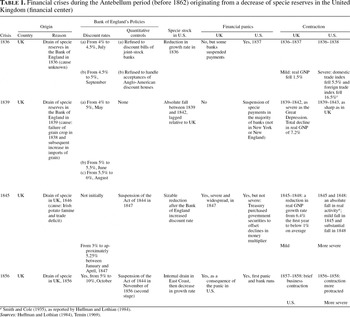
Financial crises during the Antebellum period (before 1862) originating from a decrease of specie reserves in the United Kingdom (financial center)
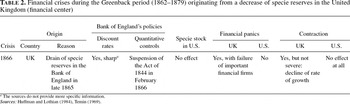
Financial crises during the Greenback period (1862–1879) originating from a decrease of specie reserves in the United Kingdom (financial center)
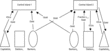
Travels and trade, old agents, first part of a period.
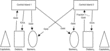
Travels and trade, old agents, second stage of a period before the labor market opens.
 You have
Access
- 2
- Cited by