INTRODUCTION
Mark-recapture research provides fundamental information that can be used to estimate population size, survival probability, growth, migration and recruitment of individual animals in the wild (White & Burnham, Reference White and Burnham1999; Kéry & Schaub, Reference Kéry and Schaub2012). For such mark-recapture research, external tags have been widely used, but loss of these external tags can prevent researchers from accurately estimating the above statistics of population status and dynamics (Amason & Mills, Reference Amason and Mills1981; McDonald et al., Reference McDonald, Amstrup and Manly2003). It is therefore necessary to evaluate tag loss in order to improve tagging methodology, select appropriate tag types, and improve estimates of population status and dynamics. Traditionally, tag loss has been estimated as a discrete rate by monitoring double-tagged animals with the assumption that each tag may be lost independently (Wetherall, Reference Wetherall1982). Recently, it has become possible to estimate quasi-continuous tag loss probability and to test temporal tag loss patterns (Rivalan et al., Reference Rivalan, Godfrey, Prévot-Julliard and Girondot2005; Oosthuizen et al., Reference Oosthuizen, De Bruyn and Bester2010).
Individual identification by tagging is a basic requirement for studying endangered migratory sea turtles and it provides insights into their individual growth rates (Hatase et al., Reference Hatase, Matsuzawa, Sato, Bando and Goto2004; Watson, Reference Watson2006; Tanaka, Reference Tanaka2009), movement patterns (Lazar et al., Reference Lazar, Margaritoulis and Tvrtković2004; Read et al., Reference Read, Wantiez, Werry, Farman, Petro and Limpus2014; Hayashi, Reference Hayashi2016), remigration intervals, frequency of nesting, population trends (Richardson et al., Reference Richardson, Hall, Mason, Andrews, Bjorkland, Cai and Bell2006; Stokes et al., Reference Stokes, Fuller, Glen, Godley, Hodgson, Rhodes, Snape and Broderick2014) and survival probability (Chaloupka & Limpus, Reference Chaloupka and Limpus2005; Dutton et al., Reference Dutton, Dutton, Chaloupka and Boulon2005; Troëng & Chaloupka, Reference Troëng and Chaloupka2007; Hatase et al., Reference Hatase, Omuta and Tsukamoto2013). For tagging sea turtles, various types of tags have been used. These include external tags of Inconel, Monel, titanium and plastic, and internal tags consisting of passive integrated transponders (PIT) (Chaloupka & Musick, Reference Chaloupka, Musick, Lutz and Musick1997; Balazs, Reference Balazs, Eckert, Bjorndal, Abreu-Grobois and Donnelly1999; Spotila, Reference Spotila2004). Loss of external tags by sea turtles has been recognized as a serious problem, and double (Mrosovsky, Reference Mrosovsky1976) or triple (McNeill et al., Reference McNeill, Schueller, Avens, Goodman Hall, Goshe and Epperly2013) tagging has been advocated. Applying more than one tag enables us to estimate tag loss rates, and differences in the tag loss rates among types of tags, tagging positions, species, growth stages, and/or study sites have been reported for sea turtles (Limpus, Reference Limpus1992; Bjorndal et al., Reference Bjorndal, Bolten, Lagueux and Chaves1996; van Dam & Diez, Reference van Dam and Diez1999; Troëng et al., Reference Troëng, Mangel, Reyes and Seminoff2003; Rivalan et al., Reference Rivalan, Godfrey, Prévot-Julliard and Girondot2005; McNeill et al., Reference McNeill, Schueller, Avens, Goodman Hall, Goshe and Epperly2013). Various factors affect the retention of tags (Balazs, Reference Balazs1982; Limpus, Reference Limpus1992), and preferred tag types have differed among studies. For example, Bjorndal et al. (Reference Bjorndal, Bolten, Lagueux and Chaves1996) reported no significant differences in retention of Monel and Inconel tags between nesting seasons. van Dam & Diez (Reference van Dam and Diez1999) found that plastic tags outperformed both Inconel and Monel tags, whereas Troëng et al. (Reference Troëng, Mangel, Reyes and Seminoff2003) reported higher retention for Inconel than Monel tags. The retention period of titanium tags was also suggested to be longer than Monel tags (Limpus, Reference Limpus1992; Parmenter, Reference Parmenter1993). Inconel tags have been preferred to titanium tags because of their relatively low cost (Balazs, Reference Balazs, Eckert, Bjorndal, Abreu-Grobois and Donnelly1999; Chan, Reference Chan2013), but differences in tag loss probabilities between these tags have not yet been quantified.
Tagging of sea turtles has a long history in Malaysia, going back to 1953 when tagging of green turtles (Chelonia mydas) was initiated in Sarawak (Hendrickson, Reference Hendrickson1958). Since 1993, a long-term turtle conservation programme has been carried out at Chagar Hutang beach on Redang Island, Terengganu, Malaysia (Liew & Chan, Reference Liew, Chan, Mosier, Foley and Brost2002; Chan, Reference Chan2010, Reference Chan2013). At Chagar Hutang, 200–1000 nests are deposited annually by green turtles (Chan, Reference Chan2010), and nearly all the nesting individuals are double tagged by personnel of the Sea Turtle Research Unit (SEATRU) of Universiti Malaysia Terengganu (Liew & Chan, Reference Liew, Chan, Mosier, Foley and Brost2002; Chan, Reference Chan2013). Two types of tags, titanium (1993–1999) and Inconel (1993–present), have been used for tagging. The tagging data of 21 years enabled us to evaluate the tag loss rate of nesting green turtles in detail from the perspective of tag type and tagging skill, and to make recommendations for the selection of appropriate tag types, improvements in tagging methodology, and methods for more accurately estimating the survival probability of nesting green turtles.
In this study, tagging data from nesting green turtles at Chagar Hutang were used to evaluate tag loss histories of green turtles that had been double tagged with the same types of tags (i.e. titanium or Inconel). We estimated tag loss probabilities and selected temporal tag loss patterns following the method used by Rivalan et al. (Reference Rivalan, Godfrey, Prévot-Julliard and Girondot2005), and compared titanium and Inconel tags based on these parameters. Differences in tag loss probability between titanium and Inconel tags were also investigated through tag loss histories of individuals tagged with both types of tags (i.e. titanium on one flipper and Inconel on the other flipper). In addition, we investigated the relationship between tag loss rate and tagging staff by comparing tag loss probabilities of green turtles double tagged with Inconel tags during the period when the tagging staff changed every year (1993–1997 and 2001–2005), to those when senior tagging staff were not changed (1998–2000 and 2006–present). Furthermore, estimated tag loss probabilities were incorporated into a mark-recapture model for estimating annual survival probability of nesting green turtles.
MATERIALS AND METHODS
Fieldwork and tagging experiments
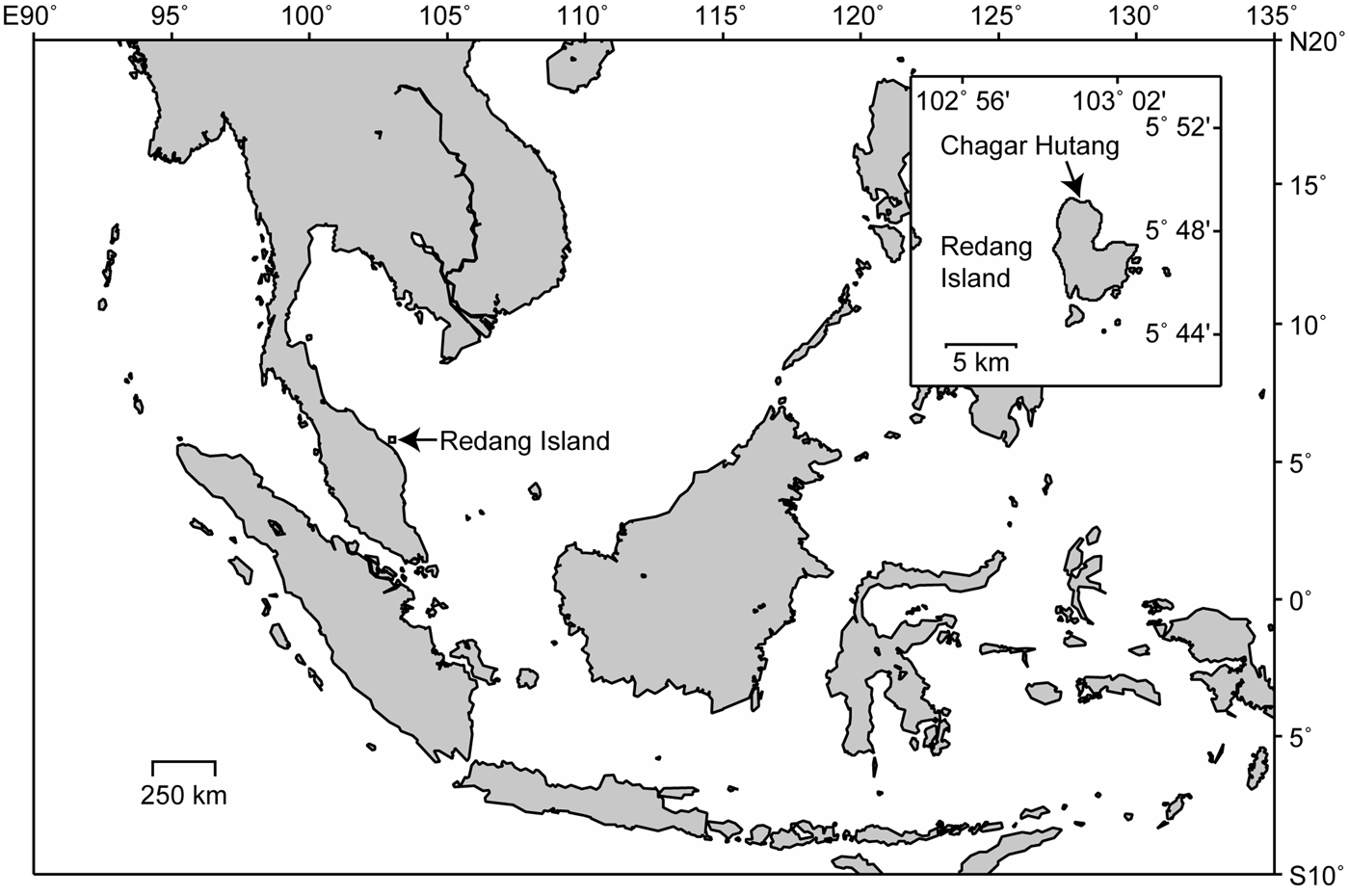
Tagging and monitoring of sea turtles has been carried out since 1993 at Chagar Hutang nesting beach (05°49′N 103°00′E), Redang Island, Terengganu, Malaysia (Figure 1), as part of the SEATRU project (Liew & Chan, Reference Liew, Chan, Mosier, Foley and Brost2002; Chan, Reference Chan2010, Reference Chan2013). Nightly beach patrols were conducted every night except during the monsoon season (i.e. November to February in general) by at least four research staff and eight volunteers in order to monitor and record the nesting activities of sea turtles. Since 2009, monitoring has also been conducted by research staff during the monsoon season when the sea conditions were calm, as the beach is only accessible via speedboat. When sea turtle landings on the beach were detected, the turtles were allowed to nest without disturbance. After oviposition, the turtles were checked for the existence of tags on their front flippers. If there were no tags, new Inconel (Inconel 625 Style 681c, National Band and Tag Company, USA) or titanium (4.5 cm, Stockbrands Company, Australia) tags were attached by piercing one of the first three large scales nearest to the body on both front flippers (Chan, Reference Chan2013). Only the research staff, not the volunteers, tagged turtles. Titanium tags were used during 1993–1999, and Inconel tags have been used from 1993 to the present. If the turtle was already tagged, the identification markings on the tags were recorded and checked to ensure that they were still in good condition. Identification markings on the tags were read twice by different research staff, recorded on a nesting data form, and later registered in the SEATRU database.
Geographic location of Redang Island and Chagar Hutang beach.

Estimation of tag loss probability
The green turtle tagging and monitoring data from 1993–2014 were used in this study. Tagging data for 2008 were corrupted and the original tagging records could not be retrieved, thus the 2008 dataset was not included in the analysis. Individuals with unclear tag information (e.g. inconsistency in reported identification markings of tags among observations), possibly due to errors in reading, noting or registering tag numbers in the database, were excluded from the analysis. Green turtles tagged previously by the Department of Fisheries in Malaysia (DoF) at neighbouring beaches sometimes nested at Chagar Hutang beach, but these individuals were also omitted from the analysis.
The turtles were separated into three groups according to tag type: (1) green turtles having both flippers tagged with titanium tags (double titanium group); (2) green turtles having both flippers tagged with Inconel tags (double Inconel group); and (3) green turtles having one flipper tagged with a titanium tag and the other tagged with an Inconel tag (titanium-Inconel group). The double Inconel group was further separated into two groups: (1) green turtles tagged during 1993–1997 and 2001–2005 when the tagging staff changed every year (double Inconel by different staff group); and (2) green turtles tagged during 1998–2000 and 2006–2014 when the senior tagging staff were not changed (double Inconel by same staff group). Senior tagging staff means the research staff working in the field for more than 2 years.
By using TAG_LOSS v3.2.3 (Rivalan et al., Reference Rivalan, Godfrey, Prévot-Julliard and Girondot2005), observations of tagged turtles in each group were converted to the minimum number of days that the turtle retained two tags (N 22), the number of days during which one tag was lost (N 21), the number of days that the second tag was retained (N 11), the number of days during which the second tag was lost (N 10), and the number of days during which both tags were lost after the last observation of both tags (N 20). Only the histories of double tags attached for the first time were considered; individual tags newly attached as replacements for lost or corroded tags were not used for estimating tag loss probability, although they were used for identifying individuals. For calculating N 10 and N 20, Rivalan et al. (Reference Rivalan, Godfrey, Prévot-Julliard and Girondot2005) originally used PIT tags, which we did not use at Chagar Hutang; in this study we used replaced tags to calculate those values.
Using the data from the double titanium group and double Inconel group, the daily tag loss probabilities of titanium tags and Inconel tags were estimated. In addition, daily Inconel tag loss probabilities were estimated using the double Inconel by different staff group and the double Inconel by same staff group. TAG_LOSS v3.2.3 was used for estimating the daily tag loss rate as a function of time as
 $$p(t) = (1 - {\rm min}_t )\,/\,\{ 1 + {\rm exp}(a_0 (a_1 - t))\} + {\rm min}_t $$
and
 $${\rm min}_t = a_4 /\,\{ 1 + {\rm exp}(a_2 (a_3 - t))\}$$
where t is time, and a 0–a 4 are model parameters (Rivalan et al., Reference Rivalan, Godfrey, Prévot-Julliard and Girondot2005). Following Rivalan et al. (Reference Rivalan, Godfrey, Prévot-Julliard and Girondot2005) and McNeill et al. (Reference McNeill, Schueller, Avens, Goodman Hall, Goshe and Epperly2013), these parameters were estimated under six models of tag loss using the gradient search implemented in TAG_LOSS v3.2.3, and the best model was selected using Akaike Information Criteria (AIC). These models were tag loss patterns with: (A) constant tag loss rate; (B) quasi-linearly changing tag loss rate; (C) high initial tag loss rate that decreased to an asymptote near zero; (D) high initial tag loss rate that decreased to an asymptote near a constant value above zero; (E) high initial tag loss rate followed by a gradually decreasing tag loss rate; and (F) high initial tag loss rate followed by a gradually increasing tag loss rate. When fitting each model, we first assumed that the probability of tag loss was equal for both tags (p (t) = p* (t)). Then, we assumed that the tag loss probability of the first lost tag and the second lost tag were different (p (t) ≠ p* (t)). In the latter case, we estimated models with the same tag loss patterns for the first lost tag and the second lost tag, and with different tag loss patterns of the first lost tag and the second lost tag; one of these was assumed to be the tag loss pattern selected in the analysis under the assumption that p (t) = p* (t).
From the titanium-Inconel group, the number of individuals that lost titanium tags prior to the loss of Inconel tags, and the number of individuals that lost Inconel tags prior to the loss of titanium tags, were counted. The values of N 22 and N 21 for these groups were then compared.
Estimation of survival probability
Survival probability of nesting green turtles was estimated based on annual encounter history using the multi-state recapture model (Hestbeck et al., Reference Hestbeck, Nichols and Malecki1991; Brownie et al., Reference Brownie, Hines, Nichols, Pollock and Hestbeck1993) implemented in the program MARK (White & Burnham, Reference White and Burnham1999). Two states, nesting and unobservable, were assumed. The parameters were survival probability (S), detectability (P), and transition probability from the unobservable state to the nesting state (ψ un), and from the nesting state to the unobservable state (ψ nu). For simplicity and identifiability, survival and transition probabilities were assumed to be time-invariant. Detectability in the unobservable state was fixed as 0. Survival probability and transition probabilities were evaluated (1) without an adjustment for tag loss, in which detectability in the nesting state was fixed as 1, and (2) with an adjustment for tag loss, in which detectability in the nesting state was equal to the estimated tag retention probability. Here, all green turtles nesting at Chagar Hutang beach were assumed to be identified because of the intensive nightly beach patrols (Liew & Chan, Reference Liew, Chan, Mosier, Foley and Brost2002; Chan, Reference Chan2010, Reference Chan2013). Tag retention probability was annually calculated as the cumulative probability of retaining at least one tag. Differences in tag retention probability among the double titanium group, the double Inconel by different staff group, and the double Inconel by same staff group were considered as differences in cohorts. In that analysis, the titanium-Inconel group was not included. Median ĉ, a variance inflation factor, was calculated in the program MARK, and confirmed to be less than 3 for testing goodness of fit (Lebreton et al., Reference Lebreton, Burnham, Clobert and Anderson1992).
RESULTS
Tag loss probability of titanium and Inconel tags
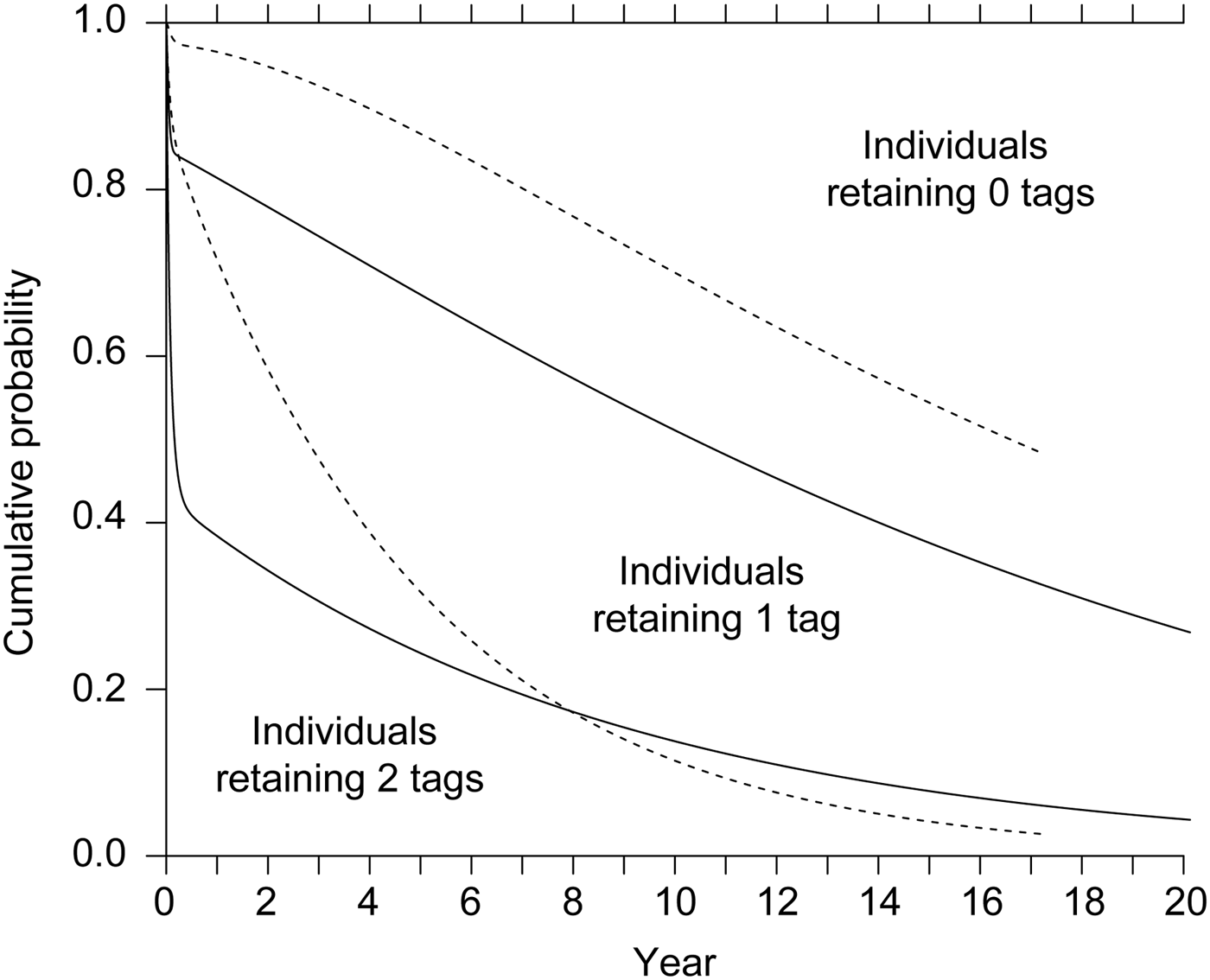
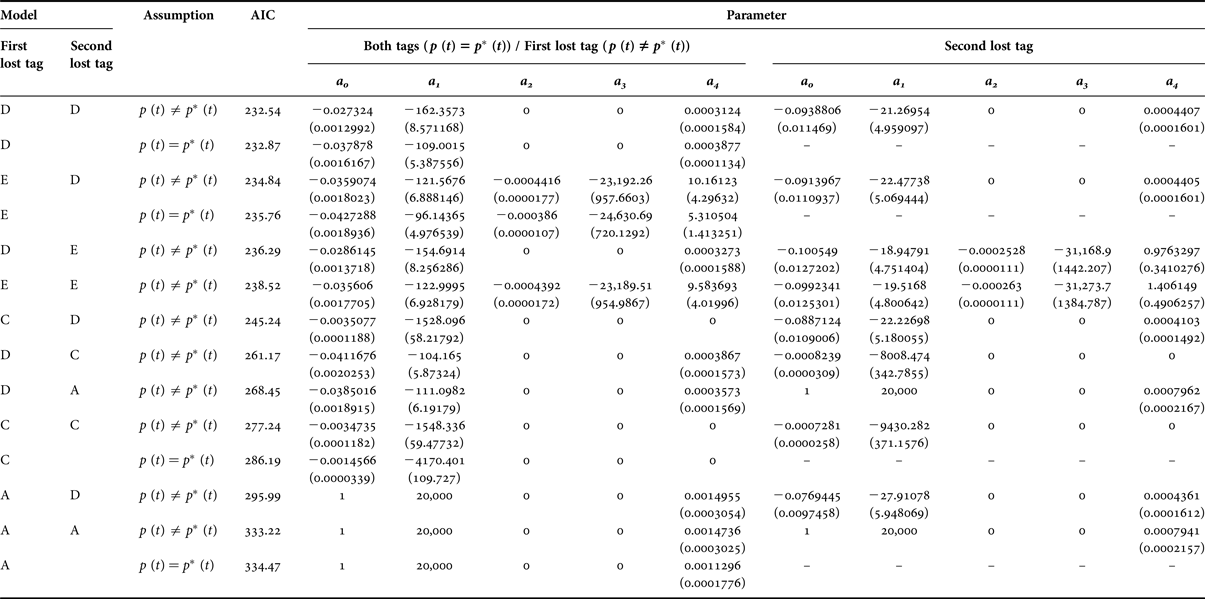
The double titanium group included 46 green turtles tagged in 1993. Tag loss model fitting indicated that model (D) was the best under the assumption of p (t) = p* (t) (AIC = 232.87) (Table 1). Models (B) and (F) failed to be fitted or resulted in the other models. The selected model estimated the initial daily tag loss rate at 1.55 × 10⁻² and the asymptotic constant tag loss rate at 1.94 × 10⁻⁴ after 458 days. When different tag loss probabilities between the first lost tag and second lost tag were assumed, model (D) fitted to both tags was selected (AIC = 232.54) (Table 1). The selected model estimated the initial daily tag loss rate at 1.15 × 10⁻² and the asymptotic constant tag loss rate at 1.56 × 10⁻⁴ after 604 days for the first lost tag, and the initial daily tag loss rate at 1.10 × 10⁻¹ and the asymptotic constant tag loss rate at 2.20 × 10⁻⁴ after 204 days for the second lost tag (Supplementary Materials Appendix A). The tag retention probability predicted by the model is illustrated in Figure 2. The selected model under the assumption of p (t) ≠ p* (t) had only a slightly smaller AIC value than it did under the assumption of p (t) = p* (t) (Table 1). The confidence intervals (CIs) defined by ±2 standard errors (SE) of p (t) and p* (t) largely overlapped (Supplementary Materials Appendix A).
Estimated cumulative probabilities for retaining titanium tags (solid line) and Inconel tags (dashed line).

Estimated tag loss models of the double titanium group. Standard errors are listed in parentheses. Models are ordered by AIC values.

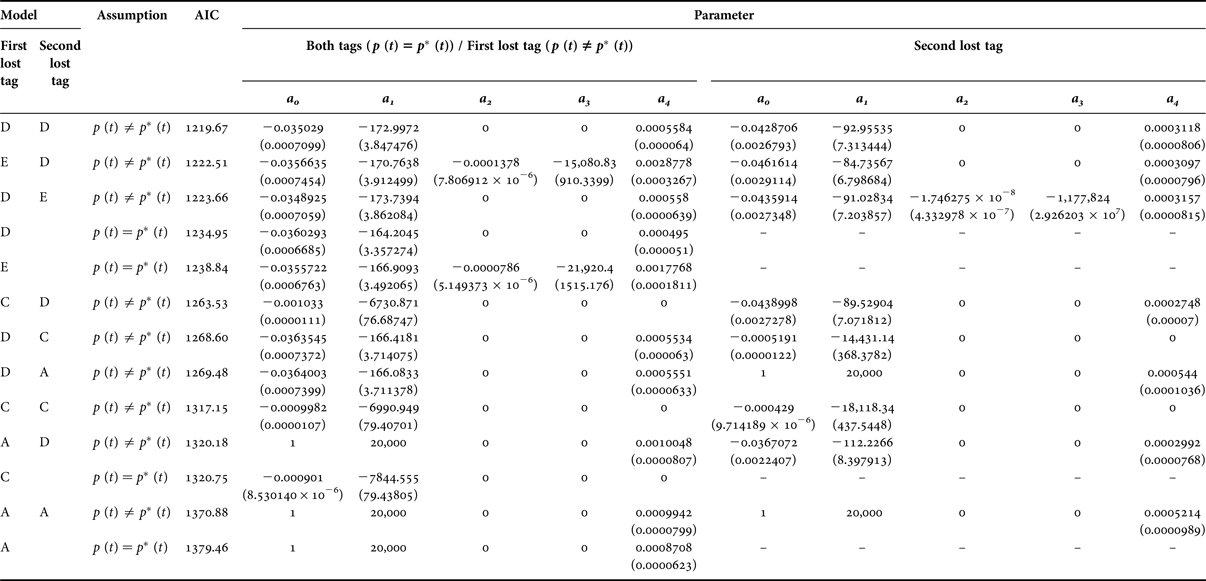
The double Inconel group included 742 green turtles tagged from 1995–2014. As with the titanium tags, model (D) was the best tag loss model for Inconel tags under the assumption of p (t) = p* (t) (AIC = 1234.95) (Table 2). This model estimated the initial daily tag loss rate at 2.84 × 10⁻³ and the asymptotic constant tag loss rate at 2.47 × 10⁻⁴ after 423 days. The assumption of p (t) ≠ p* (t) improved the model under the assumption of p (t) = p* (t). Under the assumption of p (t) ≠ p* (t), model (D) fitted to both tags was selected (AIC = 1219.67) (Table 2). The selected model estimated the initial daily tag loss rate at 2.53 × 10⁻³ and the asymptotic constant tag loss rate at 2.79 × 10⁻⁴ after 434 days for the first lost tag, and the initial daily tag loss rate at 1.77 × 10⁻² and the asymptotic constant tag loss rate at 1.56 × 10⁻⁴ after 394 days for the second lost tag (Supplementary Materials Appendix B). The tag retention probability predicted by the model is illustrated in Figure 2. The overlap of the CIs of p (t) and p* (t) were small (Supplementary Materials Appendix B). Models fitting to (B) and (F), in addition to the model fitting both tags to (E) under the assumption of p (t) ≠ p* (t), failed to be fitted or resulted in the other models.
Estimated tag loss models of the double Inconel group. Standard errors are listed in parentheses. Models are ordered by AIC values.

Tag loss probability of Inconel tags in relation to tagging staff
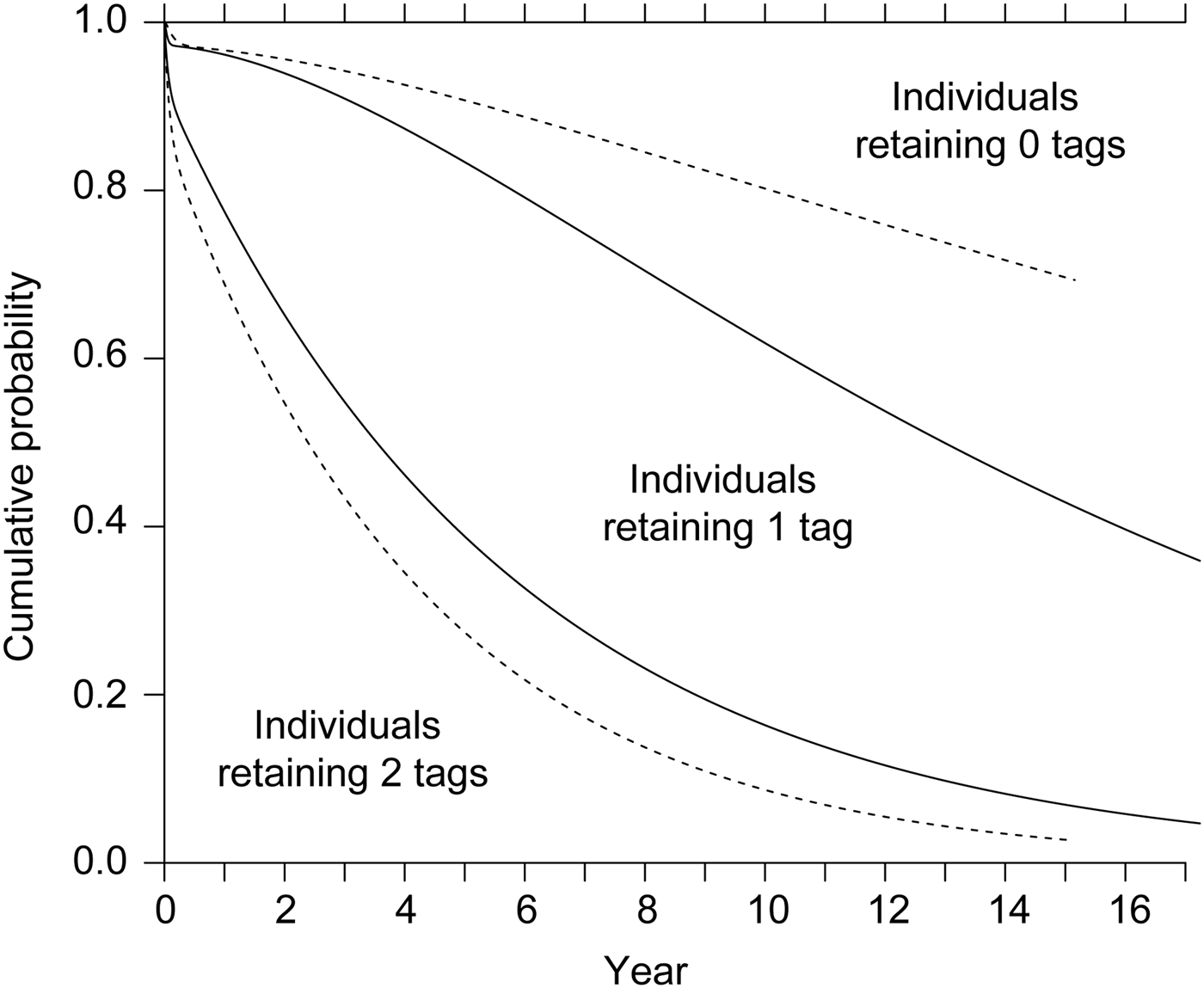
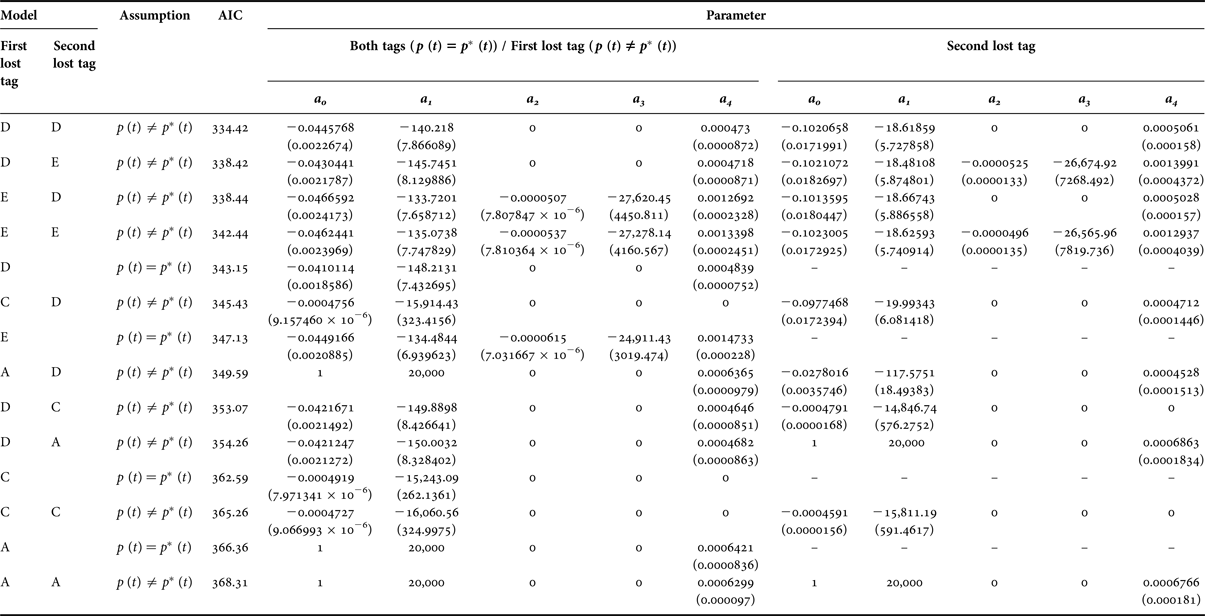
Among the 742 green turtles double tagged with Inconel tags, the double Inconel by different staff group included 159 individuals, and the double Inconel by same staff group included 583 individuals. For the double Inconel by different staff group, as with the estimations above, model (D) was selected with either p (t) = p* (t) assumed (AIC = 343.15) or not assumed (AIC = 334.42), and the assumption of p (t) ≠ p* (t) resulted in the better model (Table 3). The initial daily tag loss rate was estimated to be 2.44 × 10⁻³, and the asymptotic constant tag loss rate was estimated to be 2.42 × 10⁻⁴ after 374 days when p (t) = p* (t) was assumed. When p (t) ≠ p* (t) was assumed, the initial daily tag loss rates of the first lost tag and the second lost tag were estimated to be 2.08 × 10⁻³ and 1.19 × 10⁻¹, respectively, and the asymptotic constant tag loss rates of the first lost tag and the second lost tag were estimated to be 2.37 × 10⁻⁴ after 385 days and 2.53 × 10⁻⁴ after 193 days, respectively (Supplementary Materials Appendix C). The tag retention probability predicted by the model is illustrated in Figure 3.
Estimated cumulative probabilities for retaining Inconel tags applied during the period when the tagging staff changed every year (solid line), and during the period when the senior tagging staff were not changed (dashed line).

Estimated tag loss models of double Inconel by the different staff group. Standard errors are listed in parentheses. Models are ordered by AIC values.

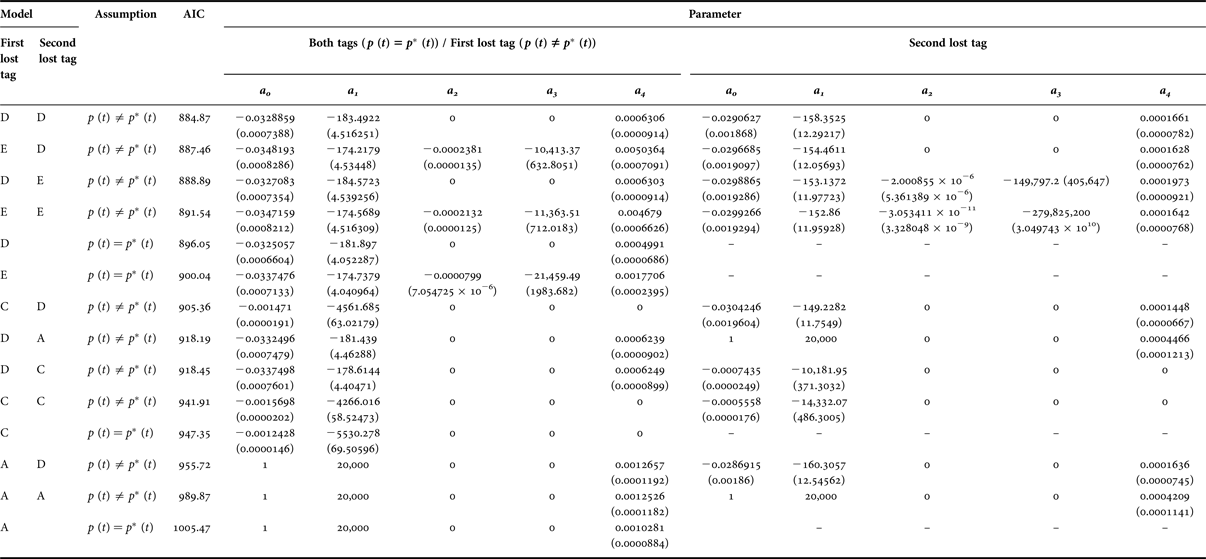
In the double Inconel by same staff group, model (D) was also selected with either p (t) = p* (t) assumed (AIC = 896.05) or not assumed (AIC = 884.87), and the assumption of p (t) ≠ p* (t) resulted in the better model (Table 4). The initial daily tag loss rate was estimated to be 2.86 × 10⁻³ and the asymptotic constant tag loss rate was estimated to be 2.50 × 10⁻⁴ after 481 days when p (t) = p* (t) was assumed. When p (t) ≠ p* (t) was assumed, the initial daily tag loss rates of the first lost tag and the second lost tag were estimated to be 2.63 × 10⁻³ and 9.73 × 10⁻³ respectively, and the asymptotic constant tag loss rates of the first lost tag and the second lost tag were estimated to be 3.15 × 10⁻⁴ after 472 days and 8.30 × 10⁻⁵ after 656 days, respectively (Supplementary Materials Appendix D). The tag retention probability predicted by the model is illustrated in Figure 3.
Estimated tag loss models of double Inconel by the same staff group. Standard errors are listed in parentheses. Models are ordered by AIC values.

Tag loss of titanium and Inconel tags attached to the same individuals
The titanium-Inconel group included 328 green turtles tagged from 1993–1999. Inconel tag loss prior to titanium tag loss was observed in 50 individuals, 12 of which were confirmed to have lost their Inconel tags in the same season they were first tagged (N 22 + N 21 ≤ 67 days). By contrast, titanium tag loss prior to Inconel tag loss was observed in 66 individuals, 30 of which were confirmed to have lost their titanium tags in the same season they were first tagged (N 22 + N 21 ≤ 93 days). The average and median N 22 and N 21 values for individuals that lost Inconel tags were 442.1 days (average N 22) and 53 days (median N 22), and 1330.9 days (average N 21) and 1060 days (median N 21). By contrast, the average and median N 22 and N 21 values for individuals that lost titanium tags were 292.7 days (average N 22) and 45 days (median N 22), and 775.9 days (N 21 average) and 325 days (N 21 median).
Survival probability
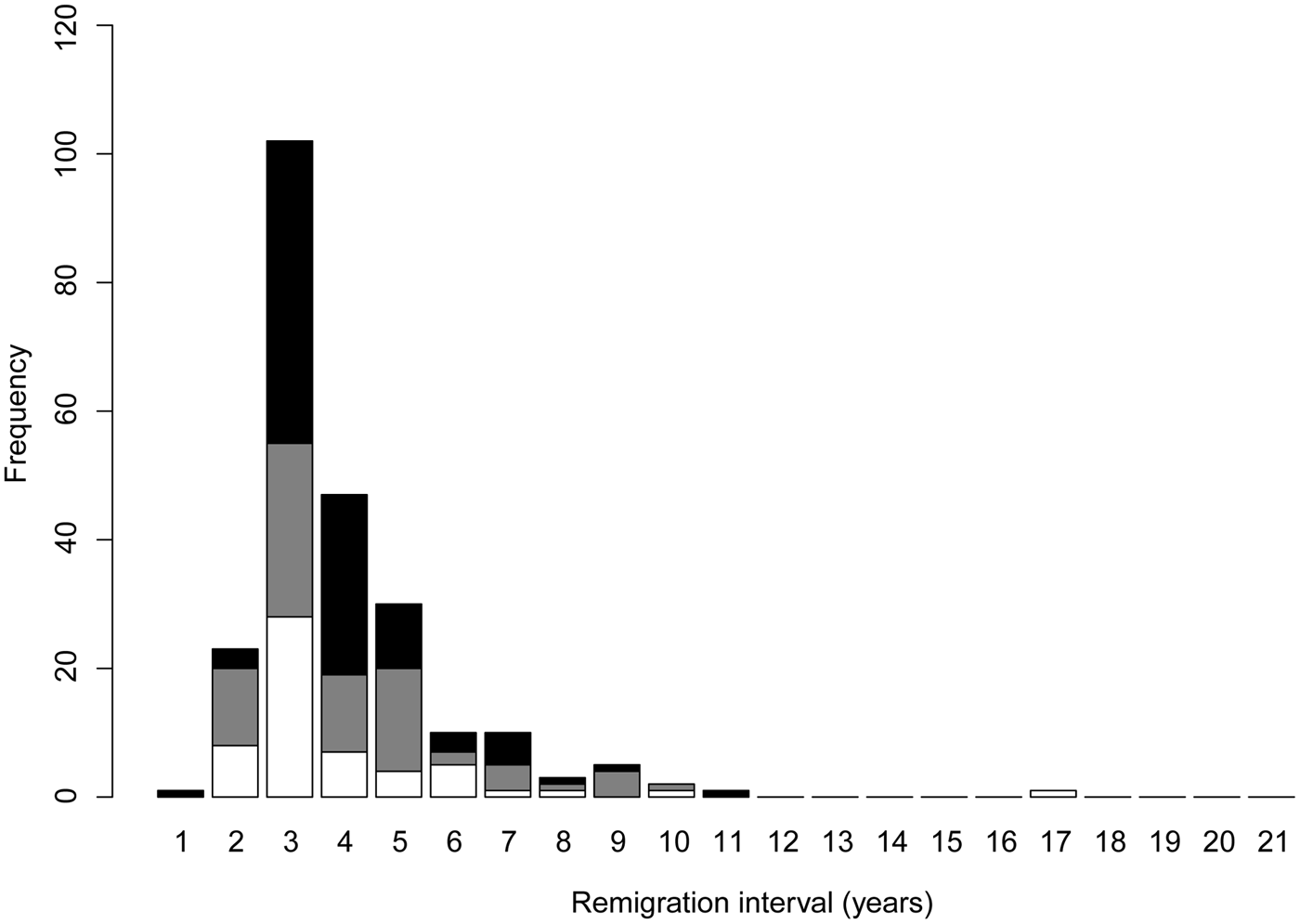
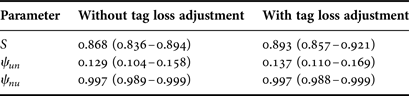
The encounter history of tagged green turtles showed that female green turtles remigrated to Chagar Hutang beach at intervals of roughly 2–5 years (Figure 4). Goodness of fit of the estimated multi-state models was not violated either with the adjustment for tag loss (median ĉ = 1.58) or without the adjustment for tag loss (median ĉ = 1.43). The estimated parameters are listed in Table 5. Annual survival probability adjusted for tag loss probability (0.893 with 95% CI of 0.857–0.921) was slightly higher than without the adjustment for tag loss (0.868 with 95% CI of 0.836–0.894).
Observed remigration interval of green turtles in the double titanium group (white), the double Inconel by different staff group (grey), and the double Inconel by same staff group (black) at Chagar Hutang beach.

Estimated parameters of survival probability (S), and transition probability from the unobservable state to the nesting state (ψ un), and from the nesting state to the unobservable state (ψ nu) in the multi-state recapture models.

DISCUSSION
For both titanium and Inconel tags, a model with a high initial tag loss rate followed by a constant rate was selected on the basis of AIC values. This tag loss pattern was also seen in leatherback turtles tagged using Monel tags in French Guinea (Rivalan et al., Reference Rivalan, Godfrey, Prévot-Julliard and Girondot2005), and in loggerhead turtles tagged using Inconel tags and PIT tags in the Western North Atlantic (McNeill et al., Reference McNeill, Schueller, Avens, Goodman Hall, Goshe and Epperly2013). In the latter case, a constant tag loss rate that may be attributable to the quality of tag application was found for the first lost tag (McNeill et al., Reference McNeill, Schueller, Avens, Goodman Hall, Goshe and Epperly2013). A constant tag loss rate may also be attributable to a lack of recaptures immediately following first tagging (McNeill et al., Reference McNeill, Schueller, Avens, Goodman Hall, Goshe and Epperly2013). In our study, green turtles that landed at Chagar Hutang were monitored every night during the non-monsoon seasons, and observations of landing of green turtles following first tagging in the same year resulted in an appropriate evaluation of tag loss immediately following first tagging. As noted by Limpus (Reference Limpus1992) and Rivalan et al. (Reference Rivalan, Godfrey, Prévot-Julliard and Girondot2005), tag loss in the short term could be attributed to errors in application or failure in locking the tags.
Titanium tags were expected to be retained for a long term (Spotila, Reference Spotila2004). In fact, titanium tags had been reported to outperform Monel tags (Limpus, Reference Limpus1992; Parmenter, Reference Parmenter1993) and Inconel tags in tag loss between seasons (Liew & Chan, Reference Liew, Chan, Mosier, Foley and Brost2002). In our study, the asymptotic constant tag loss probability of titanium tags was lower than that of Inconel tags under the model assuming p (t) = p* (t), and for the first lost tag under the model assuming p (t) ≠ p* (t). From the model assuming p (t) ≠ p* (t), the probability of retaining two titanium tags was estimated to be lower than the probability of retaining two Inconel tags until 2895 days after tag attachment, and then higher after that period (Figure 2). Long-term retention of well-applied titanium tags has been attributed to high resistance to corrosion and bio-compatibility (Cornelius, Reference Cornelius1977; Balazs, Reference Balazs, Eckert, Bjorndal, Abreu-Grobois and Donnelly1999). However, a higher initial tag loss rate was estimated for titanium tags than for Inconel tags. This may be due to the tag design, since the larger titanium tags were more difficult to handle and there was thus a greater possibility of error during application.
It should be noted that double titanium tags were used only in 1993 when the tagging and monitoring project first began at Chagar Hutang; therefore, errors in application might have occurred more often due to a lack of experience among the tagging staff. However, evaluation of the titanium-Inconel group indicated that titanium tags were lost earlier than Inconel tags in more individuals when both tags were attached to the same individual at the same time. The ratio of individuals that lost titanium tags during the season following first tagging (30 of 328 green turtles, 9.1%) was higher than that of individuals that lost Inconel tags (12 of 328 green turtles, 3.7%), and this resulted in lower average and median N 22 and N 21 values for individuals that lost titanium tags prior to Inconel tags. These results confirmed that the initial tag loss rate of titanium tags was higher than that of Inconel tags, at least at Chagar Hutang.
With respect to Inconel daily tag loss probability, the asymptotic constant values of the best model in this study (first lost tag: 2.79 × 10⁻⁴; second lost tag: 1.56 × 10⁻⁴) were lower than the values estimated for subadult and adult loggerhead turtles tagged on the rear flippers by Inconel tags in the Western North Atlantic (McNeill et al., Reference McNeill, Schueller, Avens, Goodman Hall, Goshe and Epperly2013) (first lost tag: 3.3 × 10⁻⁴ and 3.7 × 10⁻⁴; second lost tag: 6.0 × 10⁻⁴ and 4.4 × 10⁻⁴; note that different datasets selected different models in McNeill et al., Reference McNeill, Schueller, Avens, Goodman Hall, Goshe and Epperly2013). On the other hand, the probabilities of retaining two Inconel tags, or at least one Inconel tag 3 years after tagging, were estimated to be 0.48 and 0.92, respectively (Figure 2). The probability of retaining two Inconel tags is lower than that estimated using data obtained from Inconel tags on the rear flippers of subadult and adult loggerhead turtles (0.61) (McNeill et al., Reference McNeill, Schueller, Avens, Goodman Hall, Goshe and Epperly2013) and on the fore flippers of hawksbill turtles on their foraging grounds (0.82) (van Dam & Diez, Reference van Dam and Diez1999). It is difficult to reach a firm conclusion from this comparison because of various factors affecting the retention of tags (Balazs, Reference Balazs1982; Limpus, Reference Limpus1992), but these differences may be attributed to differences in species, growth stages and location of tag application.
One of the candidate factors affecting tag retention is the skill of the tagging staff, as suggested previously (Balazs, Reference Balazs, Eckert, Bjorndal, Abreu-Grobois and Donnelly1999; Troëng et al., Reference Troëng, Mangel, Reyes and Seminoff2003). In our study, the double Inconel by a different staff group exhibited a lower initial tag loss rate and a lower asymptotic constant tag loss rate for the second lost tag than did the double Inconel by the same staff group. This difference resulted in a higher retention probability for at least one tag in the double Inconel by a different staff group. The technical skill and supervision of the senior tagging staff thus resulted in more effective application of at least one of the two Inconel tags. The initial tag loss rate and the asymptotic constant tag loss rate of the first lost tag were similar between the two groups, possibly because of factors outside of human control or because of the difficulty of applying two tags with sufficient care. Until now, tagging staff have been trained mainly on-the-job at Chagar Hutang, but formal training of new staff will be helpful for improving tag retention probability.
As expected, adjustment for tag loss increased the expected annual survival probability. Expected survival probability with the adjustment for tag loss in this study was slightly higher than that estimated from nesting green turtles at Tortuguero, Costa Rica (0.85 with 95% CI of 0.83–0.87; Troëng & Chaloupka, Reference Troëng and Chaloupka2007). On the other hand, it was lower than that estimated from adult green turtles on their foraging grounds at Baja California, Mexico (0.98 with 95% CI of 0.84–0.99; Seminoff et al., Reference Seminoff, Jones, Resendiz, Nichols and Chaloupka2003) and at the southern Great Barrier Reef (0.95 with 95% CI of 0.92–0.98; Chaloupka & Limpus, Reference Chaloupka and Limpus2005). The differences may be attributable to regional variation in risk factors for mortality, but may also reflect the fact that some green turtles strayed to Chagar Hutang and departed to the neighbouring beaches for higher fidelity (Liew & Chan, Reference Liew, Chan, Mosier, Foley and Brost2002).
A transition probability from the nesting state to the unobservable state that was nearly equal to 1 was reasonable because female sea turtles do not nest every year in general (Hatase et al., Reference Hatase, Matsuzawa, Sato, Bando and Goto2004; Dutton et al., Reference Dutton, Dutton, Chaloupka and Boulon2005; Richardson et al., Reference Richardson, Hall, Mason, Andrews, Bjorkland, Cai and Bell2006; Stokes et al., Reference Stokes, Fuller, Glen, Godley, Hodgson, Rhodes, Snape and Broderick2014). Only one individual once remigrated to Chagar Hutang beach in consecutive years in this study. On the other hand, the transition probability from the unobservable state to the nesting state was lower than expected. The inverse of this probability is expected to indicate the remigration interval (Dutton et al., Reference Dutton, Dutton, Chaloupka and Boulon2005; Troëng & Chaloupka, Reference Troëng and Chaloupka2007), but the estimated value in this study corresponded to 0.137−1 = 7.30, higher than the observed remigration interval of 2–5 years. This gap may be attributed to green turtles that strayed to the neighbouring beaches (Liew & Chan, Reference Liew, Chan, Mosier, Foley and Brost2002) and remigrated to Chagar Hutang after irregularly long remigration intervals. In fact, some long remigration intervals of up to 17 years were observed.
In conclusion, long-term monitoring and tagging of green turtles enables us to assess differences in tag loss probabilities between titanium and Inconel tags. Tag loss probabilities were incorporated into the recapture model for estimating survival probability. Because of the higher initial tag loss rate of titanium tags, in addition to the higher cost of titanium tags (Balazs, Reference Balazs, Eckert, Bjorndal, Abreu-Grobois and Donnelly1999; Chan, Reference Chan2013), Inconel tags appear to outperform titanium tags, at least at Chagar Hutang. In addition, we determined that when tagging was performed by more highly trained and technically adept tagging staff, the quality of the application of at least one of two Inconel tags improved. These insights will contribute toward improving tagging programmes, increasing information on tagged turtles returning to nest, and prolonging the recognition of individuals. The green turtle is one of the major sea turtle species in South-east Asia, and tagging and re-sightings of green turtles have been widely conducted in this region (e.g. Sagun, Reference Sagun2004; Yasuda et al., Reference Yasuda, Tanaka, Kittiwattanawong, Mitamura, Klom-in and Arai2006; Pilcher, Reference Pilcher2010). The turtles that nest at Chagar Hutang possibly also nest on other neighbouring beaches (Liew & Chan, Reference Liew, Chan, Mosier, Foley and Brost2002). The effective sharing and standardization of tagging techniques, in addition to constructing a proper database of tag information, will shed light on growth rates, movement patterns, frequency of nesting, population sizes and population trends of green turtles in South-east Asia.
SUPPLEMENTARY MATERIAL
The supplementary material for this article can be found at https://doi.org/10.1017/S0025315417000224.
ACKNOWLEDGEMENTS
We gratefully thank the research assistants, field staff and volunteers who assisted in data collection and data recording. We are also much indebted to two anonymous reviewers for their constructive comments on the manuscript. We also acknowledge the use of the Maptool program from SEATURTLE.ORG to create the map in this paper.
FINANCIAL SUPPORT
This research was funded by the Ministry of Science, Technology and Innovation (MOSTI) under an Intensification of Research in Priority Areas grant (IRPA, grant number 01-02-04-173), the UMT Turtle Trust Fund (vote number 63130) and the Institute of Oceanography and Environment (INOS), UMT, Higher Institution Center of Excellence (HICoE).