Near the city of Puyo, in the Ecuadorian Amazon, Río Chico is a multicomponent mound site of eight tolas (artificial earthen mounds) clustered next to the Pastaza River (Figure 1). The area is part of the surrounding Andean foothills relief (Winckell Reference Winckell and Winckell1997) and the northern evergreen foothill forest ecosystem of the eastern Andean Mountains (MAATE 2013), with an average altitude of 906 m asl, steady rainfall, and an average temperature of 20°C. It is in a zone of Andosol soil, with nearby areas of Acrisol and Cambisol. Andosol soil is characterized by volcanic glasses and a dark-colored surface horizon (FAO/IIASA/ISRIC/ISSCAS/JRC 2012). Río Chico is a Humic Andosol, containing a large amount of organic matter. After its chance discovery in 2016 during construction of a secondary road, the site was investigated in 2018 by researchers from the Universidad Estatal Amazónica (UEA), the Museo Etnoarqueológico Municipal de Pastaza (MEMPA), and the Instituto Nacional de Patrimonio Cultural (INPC).
Río Chico site. (Color online)

Four distinct zones were identified based on the concentrations of ceramic material. In Zones 1 and 2, 21 shovel test pits of 60 × 60 cm were excavated. We found cultural material, mostly ceramic sherds, in five of these zones. In Zone 3, comprising a single tola, two of six shovel tests revealed cultural materials. In Zone 4, material was found in one of the three shovel tests. It should be noted that the site had been previously leveled with a backhoe, which cut into some of the tolas and removed from 0.5 to 6.0 m of earth.
Through his work at the Sangay site near the Sangay volcano in central Ecuador, Porras (Reference Porras1987) initiated research on settings in the Ecuadorian Amazon with a complex social organization capable of supporting large populations. The Sangay site, later renamed the Huapula site (Salazar Reference Salazar, Silverman and Isbell2008), has also been studied by Rostain (Reference Rostain1999) and Pazmiño (Reference Pazmiño, Clasby and Nesbitt2021). Excavations of the Santa Ana-La Florida (SALF) site farther south have also contributed to our understanding of the Upper Amazon past (Figure 2; Valdez Reference Valdez2013, Reference Valdez, Clasby and Nesbitt2021). SALF was occupied by the Maya-Chinchipe-Marañón culture, which was also found across the modern border in northern Peru. One important contribution to local and regional debates is the early origin and distribution of Theobroma cacao L. around 5300 BP (Zarrillo et al. Reference Zarrillo, Gaikwad, Lanaud, Powis, Viot, Lesur and Fouet2018).
Archaeological sites in the Ecuadorian Amazon. (Color online)

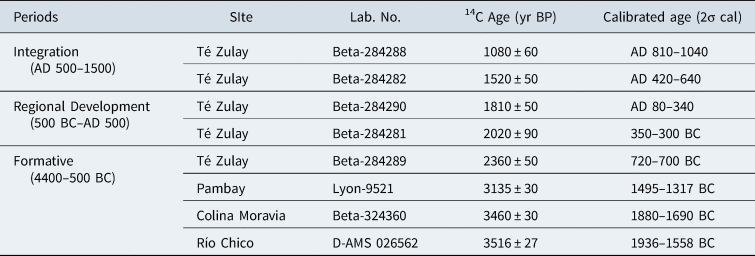
On the banks of the Pastaza River, about 3 km from the Río Chico site, lies the Té Zulay complex, a former tea estate whose archaeological remains were identified by Porras (Reference Porras1987) and then investigated more recently at the request of the INPC using lidar technology (Delgado and Vásquez Reference Delgado and Vásquez2016; Murillo Reference Murillo2006; Vásquez Reference Vásquez P.2010; see Figure 3). This investigation determined the number of tolas at Té Zulay and provided radiocarbon dates that point to three periods of occupation: the Late Formative, Regional Developmental, and Integration periods. In a report on two nearby hills, Rostain and coworkers (Reference Rostain, de Saulieu, Betancourt, Jiménez and Arroyo-Kalin2014) confirmed these periods by providing two earlier dates than Té Zulay (Table 1). On Colina Moravia, one of these hills, they reported new evidence for plant use in recent periods (about AD 0–1020).
Té Zulay complex and Río Chico site. (Color online)

Chronological Chart in the Upper Pastaza Valley.

Sources: Approximate periods for Ecuador adapted from Meggers (Reference Meggers1966) and Marcos (Reference Marcos, Raymond and Burger2003). Data from Vásquez (Reference Vásquez P.2010) and Rostain and colleagues (Reference Rostain, de Saulieu, Betancourt, Jiménez and Arroyo-Kalin2014).
Radiocarbon Dating and Analysis of Ceramic and Lithic Materials
Río Chico has at least three distinguishable cultural periods (Formative, Regional Developmental, and Integration) based on one radiocarbon date and relative dating based on ceramic styles. The Formative material was found at a depth of 3.5 m, and the only sample with absolute dating comes from charcoal (D-AMS 026562 [(3885–3607 (94.3%) / 1936–1558 (94.3%)]) scattered on a cultural occupation floor, presumably from a cooking area. At approximately the same depth but about 50 m away, a secondary burial was found that contained three small vessels inside a larger pot. The Regional Developmental occupation is indicated by ceramics, including very elaborate vessel forms and sherd fragments with a variety of decorative designs. The Integration period component is dominated by the corrugated ceramic style. Pottery fragments from the last two periods were found between 0.60 m and the surface. Bearing in mind that the terrain had been leveled for different uses, most of the ceramic fragments and all the lithic material were mixed at a superficial level.
A total of 836 potsherds were recovered, of which we inventoried 691 diagnostic sherds corresponding to the four identified distribution zones of the site. Most of the fragments—which had impression, incising, and appliqué techniques; varying thicknesses of temper (from fine to medium and coarse); and paste colors ranging from dark gray to red to light brown or beige (Figure 4)—show unique characteristics for the area: wavy lines (serpentine appliqué) and botanical motifs (incised palm-shaped designs with meander or flowers).
Ceramic pottery fragments and spindle whorl from Río Chico: (a) rim fragment with serpentine appliqué; (b) fragment with excised decoration; (c) fragment of the corrugated style; (d) fragment with punctated rows; (e) spindle whorl; (f) fragment with a button; (g) vessel rim with excised decoration; (h–i) fragments of the corrugated style; (j) rim fragment with incised palm-shaped designs with meander or flowers; (k) fragment with excised decoration; and (l) fragment with botanical motifs. (Color online)

The incised and dotted motifs, as well as some necks with fingernail printing, resemble the decorated ceramic fragments from Té Zulay and Colina Moravia. An analysis of the estimated firing temperature was done to provide an alternative relative dating method for the more common, scattered, and mostly superficial ceramics. Three groups of ceramics were identified: (1) pottery of thick and fine paste associated with open-air firing (up to 550°C), (2) pottery of thick and fine paste associated with hole-like structures (between 600°C and 800°C), and (3) pottery of fine paste and homogeneous color that require baking in oven-like structures (hotter than 950°C; INPC 2020). These groups point to two types of pottery elaboration and could be correlated with two cultures and periods: Regional Developmental and Integration. In contrast, the finest type of ceramics and more elaborated designs in the area are associated with earlier periods.
The Formative period secondary burial mentioned earlier was found by chance in Zone 1. It was associated with a coarse pot approximately 80 cm in diameter, inside of which were three smaller vessels. The period of one of these three vessels could not be determined by style (Figure 5a; 12 cm diameter), whereas the other two suggest a style related to the end of the Regional Developmental period and the beginning of the Integration period. Of these latter two, one vessel (Figure 5b; 13.8 cm diameter) has a red-orange slip, a rim with three superimposed bands, and parallel vertical incisions. The other (Figure 5c; 11.9 cm diameter) is anthropomorphic, in a clear Puruha style (around AD 300–1500) from the central Ecuadorian cordillera.
Small ceramic vessels in the secondary burial: (a) fine vessel with not determined period by style; (b) vessel with incisions and red-orange slip; and (c) Puruha style vessel. (Color online)

We recovered two spindle whorls, likely used to spin cotton and possibly to make clothing, as well as some palm fiber for hammocks, knotted bags, and fishing nets. Of the 10 lithic artifacts found, one is a kind of ax or small hoe (Figure 6e), and another has an unknown function but presumably is a type of hammer (Figure 6g). The remainder are well-finished felling and clearing simple axes (Figures 6b, 6f, and 6h) or axes with spikes (Figures 6a and 6c) or with shrinkage (Figure 6d), with mostly smooth and shiny surfaces and with shapes suitable for hafting a stick as a handle. Because of the lack of an exact cultural context, absolute dates, or definitive previous studies on the subject, it was not possible to determine their precise cultural affiliation.
Lithic artifacts from Río Chico and vicinity: (a) ax with spikes; (b) simple ax; (c) ax with spikes; (d) ax with shrinkage; (e) simple ax with perforation or small hoe; (f) simple ax; (g) unknown artifact; and (h) simple ax. (Color online)

Biocultural Remains
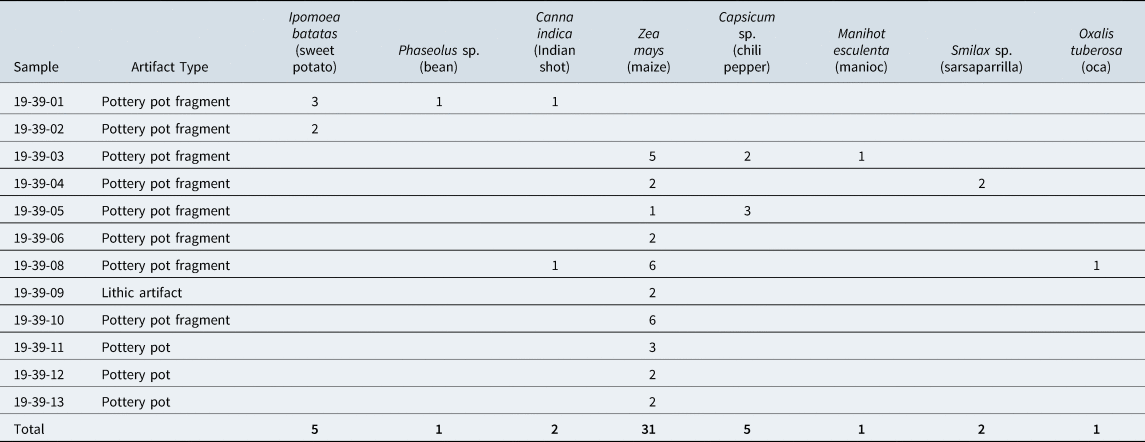
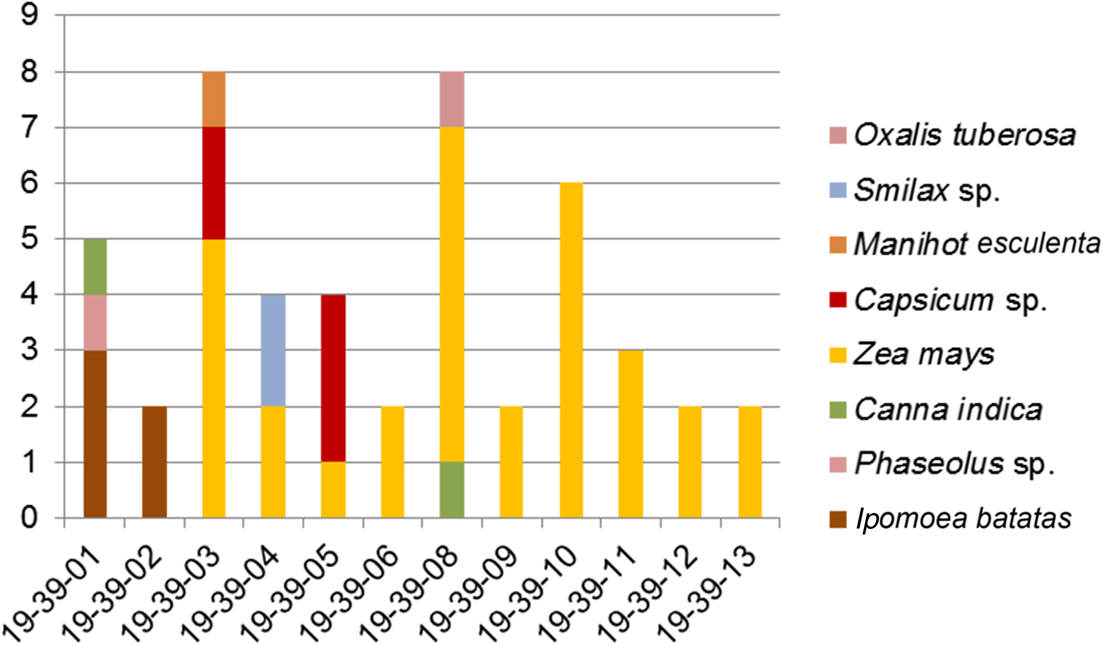
At the INPC Laboratory in Quito, eight plant taxa were identified from starches in 11 ceramic vessel samples and one lithic tool sample (Figure 7; Table 2). They correspond to both cultivated and wild plants. Most must have been used as food, except the sarsaparilla (Smilax sp.), which is used medicinally. Maize (Zea mays) was found in most of the samples and with greater frequency than the other taxa. Sweet potato (Ipomoea batatas), chili pepper (Capsicum sp.), and Indian shot (Canna indica) were found in two samples; beans (Phaseolus sp.), cassava (Manihot esculenta), sarsaparilla (Smilax sp.), and oca (Oxalis tuberosa) were each found in only one sample (Table 2).
Identified starches (selection): (a) Ipomoea batatas (sweet potato); (b) Canna indica (Indian shot); (c) Capsicum sp. (chili pepper); (d) Smilax sp. (sarsaparilla); (e) Manihot esculenta (cassava); and (f) Oxalis tuberosa (oca). (Color online)

Taxa per Sample.

Of the eight taxa, five (sweet potato, Indian shot, cassava, oca, and sarsaparilla) correspond to tubers or rhizomes, one (beans) to a leguminous plant, another to a cereal grain (maize), and another to a fruit (chili pepper). Four tubers, beans, and maize are potential sources of carbohydrates and were no doubt consumed as food. Because of its spicy flavor, chili pepper must have been used as a spice, and the sarsaparilla was probably used for the preparation of medicines. Being an Andean crop, the presence of oca is surprising. This is the first time that chili pepper, sarsaparilla, sweet potato, Indian shot, and oca have been identified in an archaeological site in the Pastaza basin.
In the nearby Colina Moravia site, Pagán Jiménez and Rostain (Reference Pagán Jiménez, Rostain and Rostain2014) reported yam (Dioscorea sp.), ulluco (Ullucus tuberosus), cacao (Theobroma sp.), cassava, maize, beans, and other leguminous plants for the period around AD 0–1020. Río Chico and Colina Moravia have three taxa in common: cassava, beans, and maize (Figure 8), with maize being the most represented taxon at both sites and also found at Té Zulay. This recurrence of maize is significant, including its finding in a Regional Developmental vessel (Figure 5b) and in a pottery fragment (Figure 4d). This chronological placement is late considering that, a little farther south, sediment analyses in the bed of present-day Lake Ayauchi revealed pollen grains and maize phytoliths dating to the Formative period, up to 5300 BP (Bush et al. Reference Bush, Piperno and Colinvaux1989; Piperno Reference Piperno1990). It is also worth recalling Roosevelt's (Reference Roosevelt1980) thesis that the introduction of maize in the Orinoco basin around 800 BC (Parmana site) was important for population growth and the establishment of complex societies. However, due to the nonsystematic nature of the findings and the difficulty of associating them with clear ceramic typologies, it cannot be inferred that maize was the staple food and the trigger for population growth after the Regional Developmental period at Río Chico.
Occurrence of identified starches. (Color online)

Finally, it is significant that plants like maize, chili pepper, Indian shot, beans, sweet potato, and oca were also identified farther north in the Tena River basin for the Integration period (INPC 2019). The first four plants were also found in the nearby Quijos Valley around 2,500 m asl for the same period (Cuéllar Reference Cuéllar2009). Farther south in the SALF site (1,100 m asl), identical plants—maize, chili pepper, manioc, beans, and sweet potato—were found beginning by about 5300–3460 BP. This is meaningful to the regional discussion about the origin, domestication, and dispersal of native Amazonian useful wild plants and crops, including manioc (more than 8000 BP) and chili pepper (more than 6000 BP) in the Andes Eastern foothills (Clement et al. Reference Clement, de Cristo-Araújo, d'Eeckenbrugge, Pereira and Picanço-Rodrigues2010).
Conclusions
Our preliminary results from Río Chico are important to our understanding of the Amazonian past for several reasons. Río Chico is a multicomponent site, having three distinguishable cultural periods. The recovery of an anthropomorphic vessel from the Puruha culture may be evidence of exchange or possibly kinship ties with the central Ecuadorian cordillera during the Regional Development and Integration periods, possibly indicating peer–polity interaction. Río Chico is thus far the only site in the Pastaza basin with remains of chili pepper, sarsaparilla, sweet potato, Indian shot, and oca, which indicates considerable plant biodiversity in the Regional Development and Integration periods. We also found evidence of other, more common crops in the diet of the cultures of the area, with maize being associated with social complexity and large populations. Río Chico is the oldest village-type mound site in the Pastaza River basin known so far, dating to around 2000 BC, which places it in the Formative period and, based on the site's tolas, in the small group of monumental sites of the Upper Amazon. Being close to the Té Zulay complex, a larger archaeological site with later dates (beginning by 700 BC), we suggest that Río Chico may be the precursor to and the cultural origin of that complex.
Acknowledgments
We thank the late Terence Winemiller, Tanya Winemiller, and Juan José “Pepe” Ortiz Aguilú for the drone images. Thanks to Florencio Delgado, María Soledad Plaza, Carolina Guevara, and Henrry Navarrete for other important aspects of the research. Without the collaboration of Cooperativa Reina Cumandá members and the students of the UEA, this report would not have been possible.
Funding Statement
None
Data Availability Statement
The pottery fragments and lithic artifacts of the Río Chico site excavation are curated in the MEMPA in Puyo, Pastaza, Ecuador.
Competing Interests
The authors declare none.