Introduction
Composting is an aerobic process of the degradation of organic matter; it is carried out under controlled conditions in order to transform polluting organic solid waste into a stable final product (organic compost) and safe to be used as fertilizer (Yang et al., Reference Yang, Han, Ruan, Chai, Jiang and Zheng2019). When working with most organic waste, composting can be considered a simple and effective process. However, when this method is applied to slaughterhouse waste, special conditions for the management of windrows are necessary so as to ensure the safety of operators and prevent the proliferation of flies and the spread of pathogens.
The use of static piles (without turning) in the initial phase of the slaughterhouse waste composting process is essential to avoid exposing the material to the environment (Sunada et al., Reference Sunada, Orrrico, Orrrico Junior, Centurion, Oliveira, Fernandes, Lucas Junior and Seno2015). Generally speaking, static piles have a low oxygen concentration in the central area of the pile, which ends up slowing down the composting process (Costa et al., Reference Costa, Costa, Olibone, Röder, Burin, Kaufmann and Ortolan2005). As such, the use of forced aeration is a preventive measure against the prevalence of anaerobic areas inside the static pile, thereby preventing the process from being delayed.
The temperature reached during the composting process is an important indicator of the decomposition rate of organic matter and the material sanitization efficiency. Nevertheless, high temperatures associated with an alkaline pH and centers with low oxygen can result in high nitrogen (N) losses in the piles of composting, mainly in the form of ammonia and nitrous oxide (Vázquez et al., Reference Vázquez, de la Varga, Plana and Soto2018). N losses are undesirable, given that, in addition to decreasing the quality of the final compost (Orrico Junior et al., Reference Orrico Junior, Orrico, Fava, Sunada, Schwingel, Garcia and Borquis2018), they also contribute to the increase in emissions of gases that are harmful to human health and the environment (Agyarko-Mintah et al., Reference Agyarko-Mintah, Cowie, Singh, Joseph, Van Zwieten, Cowie, Harden and Smillie2017a).
Therefore, the search for additives that help to decrease N losses in compost windrows has become more frequent. Biochar is an additive capable of retaining part of the gases produced during the composting process, in addition to playing a role in the retention of water and nutrients present in the environment (Cao et al., Reference Cao, Wang, Bai, Chadwick, Misselbrook, Sommer, Qin and Ma2019). In a study carried out by Awasthi et al. (Reference Awasthi, Wang, Chen, Wang, Zhao, Ren, Li, Awasthi, Shen, Li and Zhang2017), the authors noted that the inclusion of 12% of biochar (from wheat straw), in co-composting with sewage sludge, resulted in lower N volatilization in the form of ammonia.
Another additive that has shown satisfactory results with respect to N retention in compost windrows is crude glycerin (a byproduct of biodiesel) (Orrico Junior et al., Reference Orrico Junior, Orrico, Fava, Sunada, Schwingel, Garcia and Borquis2018). Crude glycerin is a highly degradable source of carbon (C), which can be used as a substrate for microbial growth, reducing the proteolysis existing in windrows composed of N-rich materials. The favorable effects of crude glycerin in compost were reported by Orrico Junior et al. (Reference Orrico Junior, Orrico, Fava, Sunada, Schwingel, Garcia and Borquis2018), who obtained the highest reduction of total solids (TS) and volatile solids (VS) and the lowest losses of N, by adding 6% of glycerin in windrows formed with laying hen manure. On the other hand, Fehmberger et al. (Reference Fehmberger, Dos Santos, Aloisio, Hermes, Zenatti and Bautitz2020) noted that, adding the maximum amount of glycerin tested (6% of TS), there was a less mass reduction (26.8%) and no improvements in N retention were observed during the composting process of poultry production residues (hatchery, effluents and litter).
The differences between the results reported using glycerin and biochar as additives are probably due to the characteristics of the composted wastes and the diversity of raw materials used for their production. Therefore, there are gaps to be filled using biochar and crude glycerin and the dosage that is most suitable for a given organic residue to be composted.
The efficiency of using additives for N retention in the composting of slaughterhouse waste still needs to be studied, as the permanence of this nutrient in the compost is one of the main characteristics that makes it valuable. As such, this work is based on the following hypotheses: (1) biochar and crude glycerin are effective at decreasing N losses during the composting of slaughterhouse waste in static piles, (2) the dosage of biochar and glycerin used to interfere with N retention during the composting process. Therefore, this study was carried out with the objective of assessing the efficiency of biochar and crude glycerin as additives during the composting process of slaughterhouse waste in static piles, receiving forced aeration.
Material and methods
Experiment site and characterization of waste and additives
This research was carried out in the Experimental Area and Agricultural Waste Management Laboratory of the Faculty of Agricultural Sciences of the Federal University of Great Dourados, which is located in the city of Dourados, MS, Brazil (latitude 22°11′38″ S, longitude 54°55′49″ W). According to the Köppen classification, the climate of the region is Cwa – a humid mesothermal climate, with hot and humid summers and dry winters.
The cattle slaughterhouse waste was provided by a commercial slaughterhouse located in the city of Ivinhema, MS, and collected immediately after the slaughter of the animals, being then transported for setting up the piles. The main components of the slaughterhouse waste were meat cuts, gastrointestinal tracts, and respiratory and reproductive systems. The bulking agent used in the formation of piles (C source) was grass hay (Brachiaria brizantha), considered unsuitable for animal consumption; this hay was crushed to obtain an average particle size of 2.5 cm. The initial characterization of both materials is presented on Table 1.
Characterization of the initial raw material and experimental treatments used in the composting of slaughterhouse waste using biochar and crude glycerin as additives

TS, total solids; VS, volatile solids; EE, ether extract; hem, hemicellulose; cel, cellulose; lig, lignin; NE, not evaluated.
The biochar used in the experiment contained 96.2% of TS and 75.7% of VS and was produced with eucalyptus sawdust, adopting the pyrolysis temperature, heating rate and residence time procedures described by Agyarko-Mintah et al. (Reference Agyarko-Mintah, Cowie, Singh, Joseph, Van Zwieten, Cowie, Harden and Smillie2017a). Meanwhile, the crude glycerin used in the experiment was composed as follows: density at 25°C = 1.23; pH = 4.80; moisture = 64 g kg−1; methanol = 31 g kg−1; glycerol = 853 g kg−1; and NaCl = 53 g kg−1.
Tested treatments and experiment methodology
A completely randomized design, with a time-based split-plot approach, was adopted for the development of this experiment. Five experimental treatments were assigned to the plots, as follows: control (without additives), added biochar to account for 5% of the TS, added biochar to account for 10% of the TS, added glycerin to account for 5% of the TS, and added crude glycerin to account for 10% of the TS. Different composting times (20, 50, 70 and 90 days) were assigned to the subplots.
The buried bag technique was adopted to ensure a more homogeneous sampling of the treatments over the various sampling periods. This technique is recommended in order to evaluate the biodegradation of materials in static composting piles, where turning cannot be performed frequently, as is the case for composting slaughterhouse waste or carcasses (Tkachuk et al., Reference Tkachuk, Krause, Mcallister, Buckley, Reuter, Hendrick and Ominski2009; Xu et al., Reference Xu, Inglis, Reuter, Leonard, Mcallister and Clark2011). Additionally, it allows for monitoring changes in the material chemical composition over time and accurately analyzing the role of additives on the biodegradation of materials in composting (Itavaara and Vikman, Reference Itavaara and Vikman1997).
These bags were made using nylon with a 30-μm mesh (Khan et al., Reference Khan, Clark, Bolan, Meier, Saint, Sánchez-Monedero, Shea, Lehmann and Qiu2017). They measured 25 × 35 cm and had a storage capacity of up to 1 kg of in natura substrate. Five bags were used for each experimental treatment, totaling 100 experimental bags. No bags were manufactured for time 0; only the composition of the initial material was assessed. The experimental bags were tied to colored threads (each treatment had a color), which were exposed on the outer side of the composting cell in order to facilitate the identification and removal of the bags throughout the experiment. The proportions of slaughterhouse waste and bulking agent in the composting base material was 3:1 (mass:mass). This proportion was selected in line with recommendations by Laos et al. (Reference Laos, Mazzarino, Roselli and Walter1998, Reference Laos, Mazzarino, Walter, Roselli, Satti and Moyano2002), so as to avoid the formation of leachate and allow for a better C:N ratio in the material at the beginning of composting.
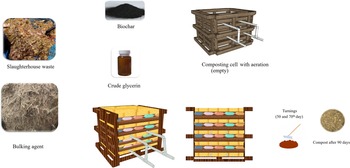
The pre-established doses of biochar and crude glycerin were added to this base material (bulking agent and slaughterhouse waste). The treatments were homogenized and placed inside the bags, which were distributed uniformly inside each composting cell (Fig. 1).
Schematic representation of the experiment.

The composting cells were built in wood cubes, with slits between the boards, which allowed for the natural circulation of air inside them. Each cell measured 1.20 × 0.58 m, with a height of 1.00 m (Fig. 1). Furthermore, they were all internally lined with sombrite® to avoid losing material through the wood cracks and allow for air to naturally come in. A total of five compost cells were used to incubate all the bags with the treatments.
The composting cells were assembled in alternating layers of the base material to be studied (slaughterhouse waste and bulking agent) and the bags with the treatments. The distribution was completed in the following order: the first layer (base) contained bulking agent, the second layer had the slaughterhouse waste, while the bags that contained the experimental treatments were then randomly placed on top (a repetition of each treatment per layer was used). The same sequence was maintained afterward, until the maximum pile height was reached, with the last layer being composed of bulking agent (Fig. 1). In total, four layers of slaughterhouse waste fit into each pile, allowing for exposing the various treatments to the existent conditions in different regions of the pile (base, middle and top). Each layer of waste had a thickness of about 10 cm, allowing for greater contact and a more homogeneous digestion environment along the pile profile.
PVC tubes with a diameter of 50 mm were inserted between the arranged layers of waste for aeration purposes. These tubes were perforated along their length so that they were able to conduct aeration along the entire profile of the pile (Fig. 1). These tubes were distributed horizontally, following the depth of the cell, with a distance of 25 cm and 55 cm from the base to the first and second tube, respectively. These two tubes were interconnected at the front of the composter in a single entrance, which was coupled to an air blower, thereby allowing for injecting air of 0.57 l min−1 kg−1 OM. The composting cells were kept inside a greenhouse, protected from direct sun and rain exposure.
The collection was carried out after 20 days of composting in order to estimate biodegradation, with random points being chosen for the removal of the bags. The removal of the bags was carried out carefully, so as to avoid excessive manipulation of the piles or composting material. These bags were weighed at the time of the formation of the piles and every time they were removed (after 20, 50, 70 and 90 days of composting). This allowed for controlling the material's biodegradation.
The total composting period lasted 90 days and the material was turned twice, at 50 and 70 days into the process. Each turning was performed by removing the entirety of the material from inside the piles and placing it on a plastic tarp for the homogenization and adjustment of the moisture content. The material was then returned to the compost cell. The temperatures in the field piles were measured daily, using a stem thermometer, at 10 random points along the base, middle and top of the composting cell.
The moisture conditions of the piles were evaluated (weekly) throughout the entire composting period, randomly selecting points for the collection of samples in the profile. This allowed for determining the TS, so that small amounts of water were added (thereby avoiding the formation of leachate) and moisture was kept within the ideal range of 40–60%. The composting process was completed when the temperature of the compost cells was equal to the temperature of the environment and solid reductions stabilized (90 days after the piles were set up). At the end of the process, the levels of macrominerals (P, K, Ca, Mg, S and Na) and microminerals (Zn, Mn, Fe, Cu and B) of each of the tested treatments were quantified.
Laboratory analysis
The TS and VS content analysis were measured in line with the methodology described by APHA (2012). The ether extract (EE) content was determined in accordance with the Randall method (INCT-CA G-005/1), described by Detmann et al. (Reference Detmann, Souza, Valadares Filho, Queiroz, Berchielli, Saliba, Cabral, Pina, Ladeira and Azevedo2012). The pH analysis was carried out in line with Brazilian Normative Instruction 17/2007 (MAPA, 2007). The cellulose, hemicellulose and lignin contents were determined according to the methodology proposed by Van Soest et al. (Reference Van Soest, Robertson and Lewis1991).
The C and N contents were determined using an elemental analyzer, model vario MACRO. The levels of micro- and macrominerals in the final compound were determined using an Inductively Coupled Plasma Optical Emission Spectrometer (ICP-OES), brand PerkinElmer, model Optima 8300 (Dual View).
Statistical analysis
The tested treatments were subjected to analysis of variance; a split was performed in the case of significant interactions, considering the treatments within each period with comparisons of means using orthogonal contrasts (C1 – control versus additives, C2 – biochar versus glycerin, C3 – 5% biochar versus 10% biochar and C4 – 5% glycerin versus 10% glycerin). As for the periods within each treatment, a polynomial regression analysis was performed. If the interaction was not significant, the factors were analyzed independently, with the treatments being compared using orthogonal contrasts and the period factor managed via polynomial regression.

In order to analyze the waste chemical composition at 90 days, a completely randomized design with three replications per treatment was arranged. The means were compared using orthogonal contrasts (C1, C2, C3 and C4). Furthermore, a principal component analysis was carried out as a complement with the goal of identifying the chemical components that define the treatments.

All analyzes were carried out using the R software, using the ExpDes.pt, FactoMineR and factorextra packages.
Results and discussion
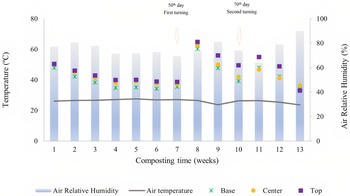
The weekly average temperatures (Fig. 2) reached by the composting piles with field capacity demonstrate the occurrence of three well-defined thermophilic phases. The first phase took place during the initial 2 or 3 weeks of the process, depending on the height of the evaluated pile profile (base, middle, or top), while the two following phases occurred soon after turning, at 50 and 70 days.
Weekly average temperatures of air and composting piles (at the base, middle and top) and relative humidity of air during the composting of slaughterhouse waste in static piles receiving forced aeration.

During the three occurrences of the thermophilic phase, the temperature peaks reached at the top, middle and base of the piles were 70.3, 68.6 and 65.6°C on day 4 of composting; 75.0, 72.6 and 72.9°C on day 52 of composting; and 75.5, 68.0 and 69.3°C on day 72 of the process, respectively. This behavior demonstrates the importance of turning throughout the process, even when there is forced aeration, which might have allowed for a new homogenization of the material in degradation and better conditions for its digestion. Due to the type of waste being composted, the temperature is essential, to discourage the activation of pathogenic agents (Valente, Reference Valente2016). Although the monitoring and moisture adequacy of the windrows throughout the composting process, during the turnings, it was found that the stacked material presented moisture close to 40%, which can inhibit microbial growth (Sanchez-Monedero et al., Reference Sanchez-Monedero, Cayuela, Roig, Jindo, Mondini and Bolan2018) and, consequently, the heating of the pile. Probably, for this reason, new temperature peaks were observed after the turnings. However, after the second turning, the temperature decreased rapidly due to the possible depletion of material for degradation and remained close to room temperature, thus characterizing the completion of the process (Asses et al., Reference Asses, Farhat, Hamdi and Bouallagui2019).
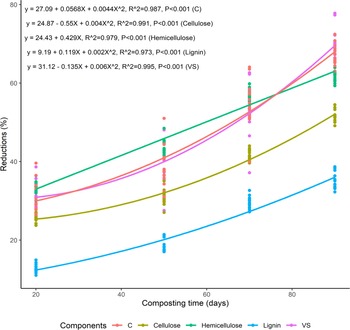
The reductions of VS, C, hemicellulose, cellulose and lignin were not influenced (P > 0.05) by the presence of additives in any of the composting evaluation periods, resulting in mean reductions of 69.1, 67.1, 62.1, 51.6 and 35.3%, respectively, 90 days into the process (Fig. 3). The fact that the additives did not have an effect on the reduction of organic constituents can be interpreted as a beneficial result; it demonstrates that the presence of additives did not change the environment conditions, allowing microorganisms to behave in a similar way when it comes to the degradation of the piled material. It is possible that, the temperature remaining within the thermophilic range for a long time, is due to the initial composition of the waste used for the experiment (Table 1).
Reduction (%) of volatiles solids (VS), carbon, hemicellulos (hem), cellulose (cel) and lignin (lig) in the composting of slaughterhouse waste using biochar or crude glycerin as an additive.

According to Insam and De Bertoldi (Reference Insam, De Bertoldi, Diaz, de Bertoldi and Bidlingmaier2007), degradation of organic components is maximized under thermophilic conditions, given that thermophilic bacteria and actinobacteria act in temperature ranges of up to 62°C, while the maximum growth for thermophilic fungi occurs between 35 and 55°C. Specifically, with respect to fungi, these authors highlighted that the supply of oxygen in the pile is more determinant for their establishment and survival than for that of bacteria. Given the development conditions of the composting trial, the degradation of plant cell wall components was essential for carbon reductions, since a considerable portion of the piles was composed of the bulking agent and the degradations of VS reached almost 70%. Therefore, it is possible to infer that there were satisfactory oxygen conditions in the piles, which possibly allowed the fungi to act in the environment, given their direct role on the degradation of fibrous fractions (Yu et al., Reference Yu, Xie, Khan and Shen2019).
The reductions in carbon confirmed by Fehmberger et al. (Reference Fehmberger, Dos Santos, Aloisio, Hermes, Zenatti and Bautitz2020) are in line with those observed in this study, as the authors found no impact on the reduction of carbon, obtaining an average of 62%, after including an amount of glycerin that accounted for up to 6% of the substrates. The decrease in carbon occurs mainly at the beginning of the process because it is in this phase that there is carbon that is more easily degradable. In addition, the rapid increase in temperature going into the thermophilic phase (>40°C) allows for the fast decomposition of compounds with low molecular weight carbon (Santos et al., Reference Santos, Fehmberger, Aloisio, Bautitz and Hermes2021). The greatest reduction observed by Orrico Junior et al. (Reference Orrico Junior, Orrico, Fava, Sunada, Schwingel, Garcia and Borquis2018) was under conditions consisting of 6% of crude glycerin added to laying hens waste, with a reduction of approximately 80%, which also represents the intensity of degradation of organic matter during the process. However, with respect to additions accounting for over 6% of the TS, the authors reported that glycerin became detrimental to the process as it fostered clusters of waste, decreasing aeration and, thereby, the degradation of organic material. It is possible that the results reported by both authors demonstrate the difference in the quality of crude glycerin, given that its composition depends mainly on the original raw material and the oil extraction efficiency for manufacturing biodiesel.
Given their large proportion of recalcitrant carbon, it is common to observe a reduction in the degradation of VS and C in the compost piles as the amount of biochar included increases. Yu et al. (Reference Yu, Xie, Khan and Shen2019) and Malinowski et al. (Reference Malinowski, Wolny-Koładka and Vaverková2019) observed a lower degradation of VS and C in piles that included biochar. However, no changes in the degradations of VS and C as a function of the addition of biochar were observed in this study. Similar results were obtained by Waqas et al. (Reference Waqas, Nizami, Aburiazaiza, Barakat, Ismail and Rashid2018) after adding 10 and 15% of biochar while composting food waste. According to the authors, the micro pores present in biochar contributed to the creation of a favorable environment for microbial growth and, thereby, greater biodegradation of the material.
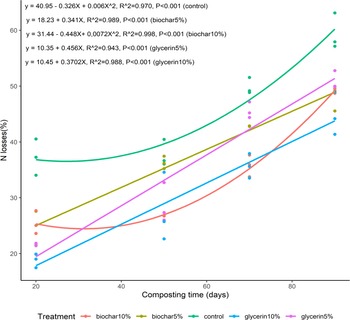
The distribution of N losses (Fig. 4) throughout the composting time allows for observing that the control yielded values above those of the groups containing additives over the composting period. Given that there were significant interactions between the additives and the different compost evaluation times, the results were split for orthogonal contrasts (Table 2).
N losses (%) in the composting of slaughterhouse waste using biochar or crude glycerin as an additive.

Reductions of N during the composting of slaughterhouse waste using biochar and crude glycerin as additives

C1, control vc aditives; C2, biochar versus glycerin; C3, biochar 5% versus biochar 10%; C4, glycerin 5% versus glycerin 10%.
Means followed by different letters differ from each other by the Tukey test (**: p < 0.01, *: p < 0.05 and ns: not significant).
When comparing the mean of the control group with the group containing additives, it was confirmed that, for all the evaluation times (20, 50, 70 and 90 days), the N loss was lower for the group containing additives (P < 0.05) (Table 2). This result is extremely favorable and motivating, as it demonstrates that the tested additives were efficient in retaining N during the composting of slaughterhouse waste. In a study carried out by Agyarko-Mintah et al. (Reference Agyarko-Mintah, Cowie, Singh, Joseph, Van Zwieten, Cowie, Harden and Smillie2017a), the authors demonstrated that biochar was efficient at promoting greater N retention during the composting of waste from laying hens; their experiment yielded reductions of 40 and 24% in N loss, when using biochar prepared from waste from laying hens or vegetables, compared to the control (without the use of biochar). The authors claimed that the improvement in losses is due to the absorption of organic N by the biochar, given reports of iron oxide and NH3 adhering to the biochar surface and pores (Agyarko-Mintah et al., Reference Agyarko-Mintah, Cowie, Van Zwieten, Singh, Smillie, Harden and Fornasier2017b).
Additional positive effects that encourage the use of biochar were observed by Malińska et al. (Reference Malińska, Zabochnicka-Światek and Dach2014), who evaluated NH3 emissions during the composting of sewage sludge with wood chips, with and without the addition of biochar; the authors confirmed that N emissions were minimized in the presence of biochar. Similarly, Chen et al. (Reference Chen, Liao, Wu, Liang, Mi, Huang, Zhang, Wu, Qiao, Li and Wang2017) and Janczak et al. (Reference Janczak, Malińska, Czekała, Cáceres, Lewicki and Dach2017) reported peak N losses by ammonia volatilization flow occurring during the thermophilic phase; however, losses were lower for the mixtures containing biochar. Due to its functional surface and the presence of numerous pores, biochar has a sorption capacity that may trap mineral N, and may decrease N2O production by impeding oxidation of NH4+ and/or reduction of NO3 (Agyarko-Mintah et al., Reference Agyarko-Mintah, Cowie, Singh, Joseph, Van Zwieten, Cowie, Harden and Smillie2017a).
The addition of crude glycerin to compost has been justified mainly given that it is a carbon source that is easily degraded by microorganisms, which can end up reducing the N loss by synchronizing its release with C degradation, better adjusting the C:N ratio of the material in composting (Orrico Junior et al., Reference Orrico Junior, Orrico, Fava, Sunada, Schwingel, Garcia and Borquis2018). These authors also observed greater N losses in the treatment tested without the addition of glycerin, with this loss being 30% higher when compared to the treatment with the highest amount of glycerin (12% of the TS). However, Fehmberger et al. (Reference Fehmberger, Dos Santos, Aloisio, Hermes, Zenatti and Bautitz2020) did not observe a significant effect for N reductions using up to 6% of glycerin inclusion in poultry processing residues. Similar behavior was verified by Santos et al. (Reference Santos, Fehmberger, Aloisio, Bautitz and Hermes2021) when composting pig carcasses and manure with the inclusion of 6% of crude glycerin, observing no differences with the glycerin inclusion on N reductions. Therefore, crude glycerin as an additive in animal production waste composting can be an alternative for future studies, to better elucidate its use and more appropriate inclusion.
With respect to the two groups of additives tested, there were lower N losses (P < 0.05), on days 20 and 50, in the group containing crude glycerin, when compared to biochar. However, no differences were observed on day 70, as similar reductions were yielded regardless of the additive source (Table 2). Some authors consider N losses presented in the first 20 days of composting to be more critical (Awasthi et al., Reference Awasthi, Wang, Ren, Zhao, Huang, Awasthi, Lahori, Li, Zhou and Zhang2016; Vázquez et al., Reference Vázquez, de la Varga, Plana and Soto2018); nevertheless, most studies refer to animal waste. In a study performed by Pagans et al. (Reference Pagans, Barrena, Font and Sánchez2006), N losses were assessed during the composting of animal slaughterhouse waste and significant losses were observed both at the beginning and end of the process. The losses presented in the last phase even surpassed those observed at the beginning of the process. Given that these losses are highly correlated to temperature, they were linked to the conduction of composting in static piles and the occurrence of turning throughout the process, since new temperature peaks were observed after each turning. Therefore, it is possible that, within the experimental condition of our work, the turnings performed at 50 and 70 days might have contributed to the intensification of N losses. This could have limited the effect of crude glycerin as an additive and equated it to biochar, although with better N retention performance for the additive group when compared to the control.
Based on the data presented in this work, the use of additives would reduce, on average, 17.51% of N losses, compared to the control treatment. As such, it would be possible to avoid the loss of 0.8 tons of N per year in a medium-sized cattle slaughterhouse, with a capacity for the slaughtering of 1500 animals per day and with an average production of 1125 kg of slaughterhouse waste per day.
In relation to the quality of the generated compost, the influence of the additive type and dose used during the process was confirmed (Table 3). Generally speaking, the inclusion of additives was observed to yield a concentration of the compost nutrients evaluated, which is a result considered to be favorable (Fig. 5). With the exception of Na, all other quantified elements were higher (P < 0.05) in compost containing biochar as an additive, when compared to those containing crude glycerin. In a study carried out by Kammann et al. (Reference Kammann, Schmidt, Messerschmidt, Linsel, Steffens, Müller, Koyro, Conte and Stephen2015), the authors highlighted the efficiency of biochar not only when it came to retaining N, but also P and K, which are nutrients required in larger quantities by plants, in addition to Ca, which was also verified in higher concentrations. Likewise, Jindo et al. (Reference Jindo, Suto, Matsumoto, García, Sonoki and Sanchez-Monedero2012) noted higher contents of Ca and Fe in compost obtained from combining waste from laying hens with biochar. The beneficial effects of the application of biochar during composting are related to improvements in water retention and cation-exchange capacity in the resulting compost, which, when applied to the soil, will positively affect the cycling of nutrients and reduction of leaching (Glaser, Reference Glaser2007).
Principal component analysis (PCA) biplot for the quality of compost resulting from slaughterhouse waste using biochar and crude glycerin as additives.

Macro- and micronutrient composition in compost resulting from slaughterhouse waste using biochar or crude glycerin as an additive

Means followed by different letters differ from each other by the Tukey test (**: p < 0.01, *: p < 0.05 and ns: not significant).
Crude glycerin resulted in compost with a greater concentration of Na (P < 0.05), when compared to the control or to compost that received biochar as an additive. Crude glycerin is a by-product of biodiesel production, for which NaOH is used as a catalyst, thereby resulting in glycerin with higher Na concentrations (Caixeta et al., Reference Caixeta, de Carvalho, e Colpa, de Andrade and Santos2017).
The presence of additives improved the quality of organic fertilizers obtained from the composting of slaughterhouse waste, not only increasing N retention, but also favoring the compost with higher concentrations of macro- and micronutrients. Therefore, research focused on the use of additives that mitigate nutrient losses during the composting process and/or that seek to improve compost quality should be encouraged in order to increase the use of organic fertilizers and decrease the use of synthetic ones.
Conclusions
Biochar and crude glycerin were effective at decreasing N losses during the composting process of slaughterhouse waste and are consequently recommended. Among the two groups of additives, the use of crude glycerin at a dose of 10% is recommended, as it was more efficient at retaining N. Analysis of crude glycerin must be performed before its recommendation as an additive for the composting process, as the efficiency of the biodiesel generation will contribute to determine its quality as an additive.
Biochar can be used at doses that account for 5 or 10% of the mixture, as these do not present differences in N losses. Nevertheless, the 10% dose yielded greater concentrations of macro- and micronutrients, which makes it more preferable.
Further work is required to understand the mechanisms involved in the additive's effects and their interactions, but the addition of biochar and glycerin will contribute to lowering N losses and increasing the fertilizer value of the final compost rendering it a more valuable product for agriculture.
Acknowledgements
This study was carried out with the financial support of the Coordination for the Improvement of Higher Education Personnel (Capes), National Council for Scientific and Technological Development (CNPq) and, the Great Dourados Federal University (UFGD).
Conflict of interest
The authors declare that they have no known competing financial interests or personal relationships that could have appeared to influence the work reported in this paper. The authors declare the following financial interests/personal relationships which may be considered as potential competing interests.