Introduction
Medical student exposure to otolaryngology – head and neck surgery is highly variable, often limited in medical curricula and mostly elective.Reference Ishman, Stewart, Senser, Stewart, Stanley and Stierer1,Reference Wong, Jang, Gilad and Levi2 Beyond exposure to otolaryngology – head and neck surgery content, relationships with otolaryngology faculty have been reported by students as one of the most important factors influencing their decision to pursue the specialty.Reference Wong, Jang, Gilad and Levi2 Furthermore, medical students, particularly those underrepresented in medicine, cite limited exposure to the field and lack of mentorship as primary barriers to pursuing otolaryngology – head and neck surgery.Reference Johnson, Hayden, Jackson, Harley and Harley3
As recent trends require students to invest more time and effort to apply for competitive surgical specialties like otolaryngology – head and neck surgery, early exposure and mentorship are critical.Reference Kaplan, Riedy and Grundfast4 We present initiatives implemented at our institution to engage early-career (first- and second-year) medical students with otolaryngology – head and neck surgery. These include: (1) a hands-on flexible laryngoscopy workshop to increase student interest in procedural specialties and knowledge of otolaryngology; and (2) a centralised online platform to access research and mentorship opportunities.
Methods and results
Flexible laryngoscopy skills workshop
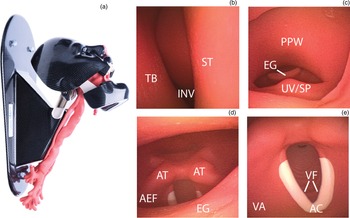
A 90-minute workshop was designed, comprising two parts: case-based didactics and hands-on laryngoscopy practice. The workshop was advertised via e-mail to student interest groups and campus diversity groups. For the first 30 minutes, the otolaryngology faculty presented three clinical cases on common otolaryngological complaints. In this interactive exercise, students participated by asking history-taking and physical examination questions. Each case incorporated a flexible laryngoscopy video of the patient encounter so that relevant anatomy and pathology could be discussed. For the remaining hour, four groups of three to five students learned the steps of flexible laryngoscopy from faculty members and residents, and practised with rhinolaryngoscopes on mannequins with high-fidelity nasal and laryngopharyngeal anatomy (Figure 1) (Ambu, Ballerup, Denmark). At the end of the workshop, participating students completed a survey (Appendix 1), deemed exempt by the Yale University Institutional Review Board.
(a) High-fidelity mannikin used during the workshop propped against a wall to recreate a patient in a sitting position (head rotated during workshop). (b) Nasal cavity with landmarks illustrating the turbinate (TB), septum (ST) and internal nasal valve (INV). (c) View of scope at the velopharynx illustrating the posterior pharyngeal wall (PPW), epiglottis (EG) and uvula of the soft palette (UV/SP). (d) View of scope at the oropharynx illustrating the epiglottis (EG), bilateral arytenoid (AT) and aryepiglottic folds (AEF). (e) View of the scope past the epiglottis illustrating the vallecula (VA), vocal folds (VF) and anterior commissure (AC).

Centralised platform for research and mentorship opportunities
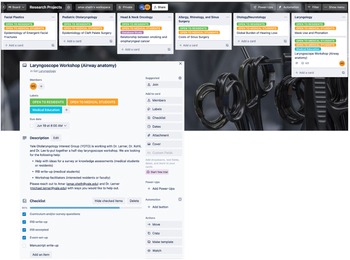
A centralised online platform was created using Trello Board, a web-based platform for shared notetaking, organisation and project planning. The application is a horizontal canvas split into columns of notecards (Figure 2). The board housed columns for each subspecialty (i.e. facial plastics, otology and neurotology, sleep surgery); each card provided details about team members, status and remaining action items for projects. Through this board, trainees can contact faculty members about projects of interest to them and recruit other team members for their own projects.
Sample Trello Board platform and project card with research projects categorised by otolaryngology – head and neck surgery subspecialty, showing team members and checklist of action items.

Discussion
We designed and implemented two initiatives to foster interest in otolaryngology – head and neck surgery among first- and second-year medical students. Previous work on medical education strategies, specifically regarding otolaryngology – head and neck surgery skills workshops, has focused primarily on fourth-year medical students who had already decided to pursue otolaryngology – head and neck surgery.Reference Dermody, Masciello and Malekzadeh5,Reference Keilin, Farlow, Malloy and Bohm6 Our flexible laryngoscopy workshop and centralised research platform have facilitated early-career medical students’ exposure to and interest in the field, increased comfort with procedures, and improved access to mentorship and research resources.
Flexible laryngoscopy is a skill that residents are expected to master early in training. It takes six attempts, on average, for a novice medical student to become competent in performing flexible laryngoscopy.Reference Laeeq, Pandian, Skinner, Masood, Stewart and Weatherly7 Simulation training and repeated practice have been shown to decrease both time to visualisation and the number of mucosal contacts.Reference Deutschmann, Yunker, Cho, Andreassen, Beveridge and Bosch8 Given the ubiquity and importance of competency with laryngoscopy, it was chosen as the cornerstone of our workshop.
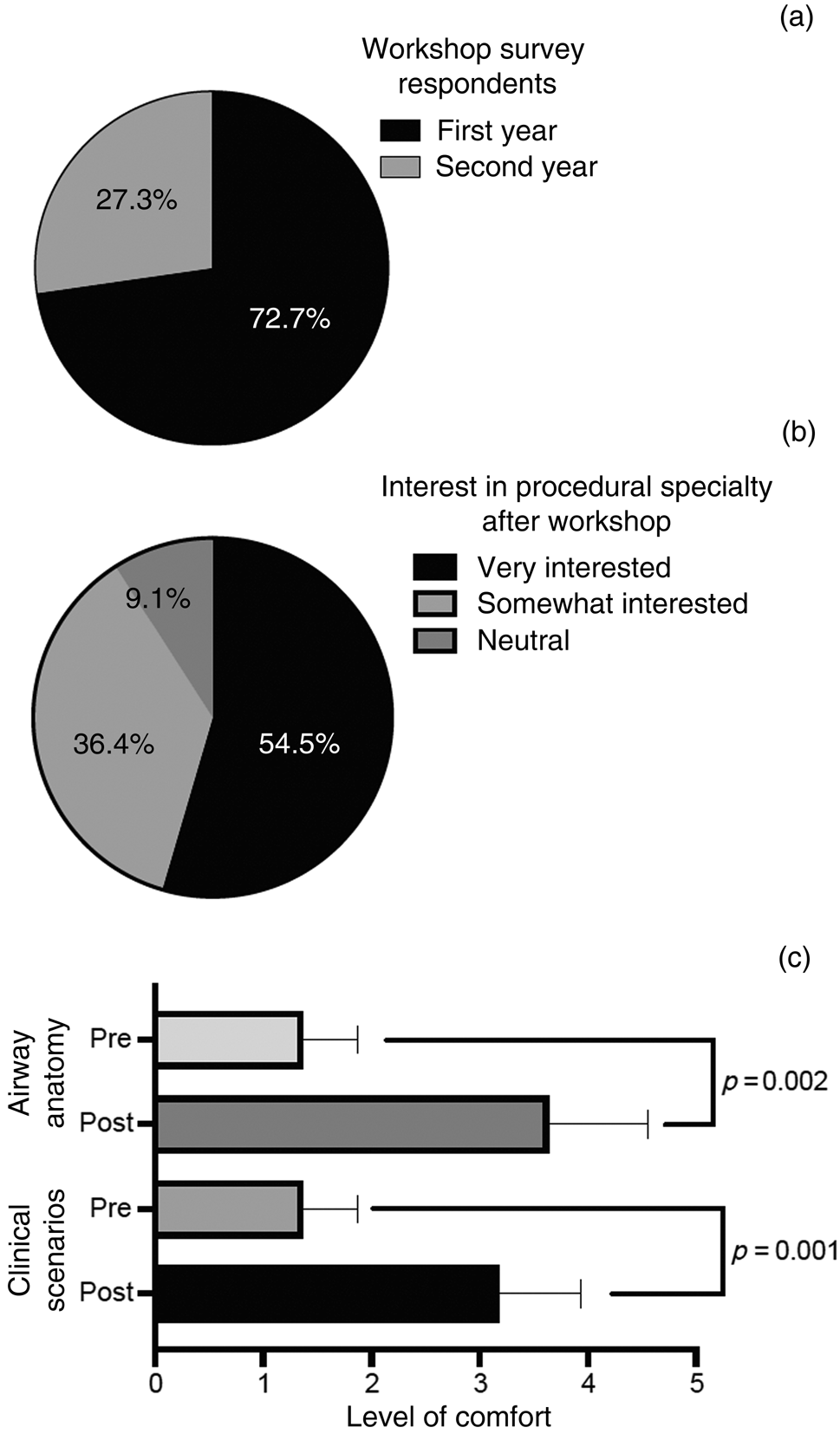
Eleven of 15 students who attended the workshop completed the survey (73.3 per cent response rate); students were in their first (72.7 per cent, n = 8) and second (27.3 per cent, n = 3) years (Figure 3a), with varying interest in procedural specialties (Figure 3b). Students’ perception of their knowledge of airway anatomy and related clinical scenarios significantly improved after the workshop (p = 0.001 and p = 0.002, respectively) (Figure 3c). All attendees indicated that the workshop increased comfort with procedures, and the students were ‘very likely’ to recommend the workshop to colleagues. Nearly half of the students (54.5 per cent) indicated they were ‘very interested’ in exploring otolaryngology – head and neck surgery further through an elective module after this workshop, indicating potential long-term effects of this initiative. The workshop enabled students to interact with otolaryngology – head and neck surgery residents and faculty, which may also facilitate mentorship.
(a) Workshop survey respondents’ number of year(s) in medical school. (b) Post-workshop interest in procedural specialty. (c) Comfort level with airway anatomy and clinical scenarios, before and after workshop. Bar plot size represents median. Wilcoxon matched-pairs signed rank tests were used to compare and test statistical significance (p < 0.05).

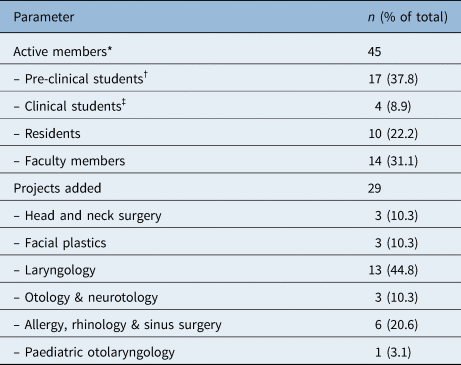
Contribution to scientific literature is an important consideration for the rigorous otolaryngology – head and neck surgery residency application process.Reference Kaplan, Riedy and Grundfast4 The centralised research platform using Trello Board facilitates the sharing of information about otolaryngology – head and neck surgery specific conferences, research-related resources and ongoing projects in the department. It is a community resource being used by numerous faculty members, residents and students at our institution (Table 1). This centralised platform serves to foster collaboration across all levels of training, and ultimately helps trainees to develop relationships with faculty members for research and career mentorship.
Cumulative Trello Board usage six months after implementation

*Active membership involves the creation, addition or modification of a research project card. †Medical students prior to the start of core rotations. ‡Medical students after the start or completion of core rotations.
Implementation of the initiatives presented here are a first step towards early exposure to otolaryngology – head and neck surgery. Students with several years of early exposure to a specialty, rather than a few short weeks during their third or fourth year of medical school, may be better equipped to determine if that specialty aligns with their career goals.Reference Sethia, Sheehan, Danforth, Essig, Teknos and Elmaraghy9 Formalised mentorship programmesReference Sethia, Sheehan, Danforth, Essig, Teknos and Elmaraghy9 that take place early in medical training and elective modules, both in-person and virtual,Reference Chao, Frost, Brody, Byrnes, Cannady and Luu10 can help students gain a more thorough understanding of the specialty and allow well-informed decisions about pursuing otolaryngology – head and neck surgery as a future career.
Conclusion
We present initiatives to enhance early-career medical students’ engagement with otolaryngology – head and neck surgery, including: a hands-on flexible laryngoscopy workshop, and a centralised platform for research and mentorship opportunities. The workshop was effective for increasing student interest in otolaryngology – head and neck surgery and procedural specialties. Expansion of such initiatives to other institutions can generate medical student interest, prepare them for clinical rotations and help address barriers to diversifying otolaryngology – head and neck surgery.
Acknowledgements
This project was developed in collaboration with Ambu (Ballerup, Denmark), who provided mannikins and flexible laryngoscopes for use. HPS and AHS received funding from the Yale School of Medicine Office of Student Research; MZL received funding from the Yale Department of Surgery.
Competing interests
None declared
Appendix 1. ‘YOTO’ Laryngoscope Workshop
[Start of block: default question block]
Q2. Dear Student,
Thank you for participating in the Otolaryngology Skills Workshop. We hope to expand this workshop and would greatly appreciate your input on what went well and what can be improved.
Your participation is voluntary. All answers provided are confidential and identities of participants are anonymous. We do not anticipate any risks from participating in this survey. Your participation infers informed consent. The survey should take no more than 3–5 minutes.
If you have any questions about the survey, please contact Dr. Lerner at Michael.lerner@yale.edu.
Thank you!
Q1. Which year of medical school are you currently in?
⚪ MS1
⚪ MS2
⚪ MS3
⚪ MS4
⚪ Research year (MS5)
⚪ PhD of MD/PhD
Q2. Please rate your prior exposure to the field of otolaryngology (1 = no exposure, 5 = strong clinical exposure)
⚪ 1 = no exposure
⚪ 2
⚪ 3
⚪ 4
⚪ 5 = strong clinical exposure
Q3. If you are interested in a surgical specialty, have you already decided on a specialty or subspecialty?
⚪ Yes
⚪ No, I am completely undecided
⚪ No, but I've narrowed it down to a few
Q4. How strong is your interest in a procedural specialty (e.g. surgery, anaesthesia, emergency medicine, etc.) after this workshop?
⚪ Very interested
⚪ Somewhat interested
⚪ Neutral
⚪ Not very interested
⚪ Not interested at all
Q5. How interested are you in further exploring otolaryngology through an elective after this workshop?
⚪ Very interested
⚪ Somewhat interested
⚪ Neutral
⚪ Not very interested
⚪ Not interested at all
Q6. How did this Otolaryngology Skills Workshop experience impact your comfort with procedures?
⚪ Increased my comfort
⚪ No change
⚪ Decreased my comfort
Q7. On a scale of 1–5 (1 = not comfortable at all, 5 = very comfortable), how comfortable were you with airway anatomy before this workshop?
⚪ 1 = not comfortable at all
⚪ 2
⚪ 3
⚪ 4
⚪ 5 = very comfortable
Q8. On a scale of 1–5 (1 = not comfortable at all, 5 = very comfortable), how comfortable were you with airway anatomy after this workshop?
⚪ 1 = not comfortable at all
⚪ 2
⚪ 3
⚪ 4
⚪ 5 = very comfortable
Q9. On a scale of 1–5 (1 = not comfortable at all, 5 = very comfortable), how comfortable were you with clinical scenarios involving examination of the nasopharynx/oropharynx/larynx before this workshop?
⚪ 1 = not comfortable at all
⚪ 2
⚪ 3
⚪ 4
⚪ 5 = very comfortable
Q10. On a scale of 1–5 (1 = not comfortable at all, 5 = very comfortable), how comfortable were you with clinical scenarios involving examination of the nasopharynx/oropharynx/larynx after this workshop?
⚪ 1 = not comfortable at all
⚪ 2
⚪ 3
⚪ 4
⚪ 5 = very comfortable
Q11. How likely are you to recommend this Otolaryngology Skills Workshop to a classmate or colleague?
⚪ Very likely
⚪ Somewhat likely
⚪ Neutral
⚪ Somewhat unlikely
⚪ Not likely at all
Q12. Please let us know if you have any other feedback about the workshop experience.
___________________________________________________________
[End of block: default question block]