Hybrid organic–inorganic perovskite (HOIP)—structured materials, mostly CH3NH3PbI3 and CH3NH3PbBr3, and the latter's inorganic analog CsPbBr3 [ Reference Kulbak, Cahen and Hodes 1 ] are of interest primarily for their remarkable photovoltaic properties.[ Reference Green, Emery, Hishikawa, Warta and Dunlop 2 ] The remarkable solar cell characteristics of HOIPs can be ascribed, at least in part, to the long lifetimes and good charge carrier mobilities, especially for materials, prepared from solution at low temperatures. It has been speculated that this combination of features can be explained by “self-healing” or low kinetic formation barriers.[ Reference Yin, Shi and Yan 3 , Reference Shi, Adinolfi, Comin, Yuan, Alarousu, Buin, Chen, Hoogland, Rothenberger, Katsiev, Losovyj, Zhang, Dowben, Mohammed, Sargent and Bakr 4 ] Such low barriers could support the suggested occurrence of ion migration, which has been invoked to explain hysteresis[ Reference Tress, Marinova, Moehl, Zakeeruddin, Nazeeruddin and Grätzel 5 ] observed in current–voltage characteristics of some of the devices.[ Reference Yang, Gregori, Pellet, Grätzel and Maier 6 – Reference Beilsten-Edmands, Eperon, Johnson, Snaith and Radaelli 9 ] The ability of HOIPs to support elastic local deformations is germane to these phenomena. However, despite the great interest in HOIPs in recent years, only limited information exists on their mechanical properties.
To try to clarify this matter, we carried out measurements and analyses of elastomechanical properties of single crystals of the methylammonium iodide (CH3NH3I) and bromide and the all-inorganic Cs lead bromide; the corresponding iodide does not have a perovskite(-like) structure at standard temperature and pressure (STP). Because we include CsPbBr3 in our study we will use the abbreviation HaP, Halide Perovskite, rather than HOIP, where appropriate. To investigate the mechanical properties, we performed nano-indentation on single crystals of CH3NH3PbI3, CH3NH3PbBr3, and CsPbBr3 to determine their Young's modulus (E) and nano-hardness (H), and combined those data with literature data of the thermal expansion coefficients (α)[ Reference Kawamura, Mashiyama and Hasebe 10 , Reference Mashiyama, Kawamura, Magome and Kubota 11 ] of these and related materials. By comparing the data for HaPs to those for materials that are similar in structure, composition, or functionality (photovoltaics) we can determine if their mechanical behavior justifies associating them with known classes of materials. In general, classification of materials into groups provides insights into the common origin of observed physical properties and a basis to make predictions. In this light, classifications of the HaPs by their mechanical properties might give some idea about the nature of interatomic bonding as well as flexibility and stability of the entire structure during manufacturing and operation of these materials. Finally, we try to shed light on the origin of these properties, of how they may affect their manufacturing and their relations to phenomena such as “self-healing” and ion diffusion.
We use terminology such as stiffness (or the inverse term—compliance), which reflects the resistance to elastic deformation. Strong interatomic bonds cause higher resistance to elastic deformation, meaning—stiffer “springs” that hold together the entire structure. Young's, bulk, and shear moduli reflect the spring constants under uniaxial, volumetric, and shearing deformations, respectively, and reflect the bond strength only within the elastic limit. The resistance of a material to plastic deformation can be determined from its hardness.
There are multiple ways to measure mechanical constants—compressing, pulling, bending, and measuring the speed of sound, using an indenter for direct hardness measurements, measuring the lattice constants (diffraction) under pressure, to name a few. The constants will reflect measured tension, compression, shearing, or bending. Since we are interested in gaining understanding of interatomic characteristics via mechanical properties, the effects of long-range defects (e.g., dislocations, inclusions, and cracks) need to be minimized. In addition, we need data sets that allow extracting statistically meaningful data. Nano-indentation[ Reference Oliver and Pharr 12 ] allows measuring multiple data on single crystals with flat faces of sizes that can be readily grown.
Experimental
Crystal growth
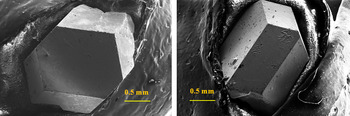
CH3NH3PbI3 single crystals were grown following a published procedure,[ Reference Dong, Fang, Shao, Mulligan, Qiu, Cao and Huang 13 ] where a temperature gradient was used to grow the crystals on a silicon wafer that was partly immersed in a 57% hydroiodic acid solution of lead iodide and CH3NH3I, where the part remaining outside the solution was cooled by an air flow. The resulting tetragonal (pseudo cubic)[ Reference Dang, Liu, Sun, Yuan, Liu, Lu, Liu, Xia and Tao 14 ] crystals usually expose the (100) and (211) faces (see Fig. 1).
Scanning electron microscopy images of (left)] (100) and (right) (112) faces of CH3NH3PbI3 crystals.

For the growth of CH3NH3PbBr3 we used anti-solvent (ethyl acetate) slow evaporation into a solution of N,N-dimethylformamide of lead bromide (PbBr2) and methylammonium bromide (CH3NH3Br). Single-crystal growth procedures of CH3NH3PbBr3 and of CH3NH3Br have been described previously.[ Reference Shi, Adinolfi, Comin, Yuan, Alarousu, Buin, Chen, Hoogland, Rothenberger, Katsiev, Losovyj, Zhang, Dowben, Mohammed, Sargent and Bakr 4 , Reference Tidhar, Edri, Weissman, Zohar, Hodes, Cahen, Rybtchinski and Kirmayer 15 ] The resulting cubic CH3NH3PbBr3 [ Reference Zhao, Xu, Dong, Wang, Ren, Bian and Chang 16 ] crystals typically expose the (100) face [see Fig. 2(a)].
Light-microscope images of (a) as-grown crystal of CH3NH3PbBr3 presenting the (100) face and (b) image after indentation measurements. The spacing between the indentations is ~20 times the penetration depth of 800 nm. (c) Typical nano-indentation load/displacement curve on CH3NH3PbBr3. For load/displacement curves of CH3NH3PbI3 and CsPbBr3, see supplementary information, Fig. S1.

The growth method for CsPbBr3 is similar to that used for CH3NH3PbBr3 (see above), where the solvent is dimethyl sulfoxide and the anti-solvent is water or ethanol (to be published). The crystal structure was verified by comparing the powder-x-ray diffraction to literature data.[ Reference Stoumpos, Malliakas, Peters, Liu, Sebastian, Im, Chasapis, Wibowo, Chung, Freeman, Wessels and Kanatzidis 17 ]
All the precursor preparation and crystal growth were done under ambient conditions with 45%–65% relative humidity. None of the precursors or solvents was specially treated before use. All the crystals were stored in an air-filled desiccator with ~25% relative humidity.
Nano-indentation
Nanohardness and the indentation modulus were measured using an Agilent XP Nanoindenter. A Berkovich diamond indenter tip was loaded into the surface at a strain rate of 0.05 s−1 to a depth of ~750 nm. The loading was done using the “Continuous Stiffness Measurement” (CSM™) mode[ Reference Li and Bhushan 18 ] which gave the modulus and hardness continuously as a function of loading. The data were analyzed using standard Oliver and Pharr analysis[ Reference Oliver and Pharr 12 ] and averaged over 300–700 nm depths to avoid any surface effects. Two CH3NH3PbBr3 and CsPbBr3, and three CH3NH3PbI3 samples were checked. 10–20 experimentally valid indentations were performed on each sample. The spacing between each indentation was at least 20 times the indentation depth of 0.8 µm [see Fig. 2(b)]. A typical load versus penetration depth curve is presented in Fig. 2(c). Further curves are presented in the supplementary information, Fig. S1.
Results and discussion
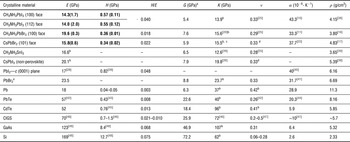
The Young's modulus and hardness, which are the quantities that can be obtained most directly from the nano-indentation technique, are listed in Table I, for CsPbBr3, CH3NH3PbBr3, and CH3NH3PbI3, together with other known physical properties. The results for CH3NH3PbBr3 and CH3NH3PbI3 are in quite good agreement with those of a very recent nano-indentation study (on CH3NH3PbX 3; X = Cl, Br, I) that was brought to our attention after submission of this paper.[ Reference Sun, Fang, Kieslich, White and Cheetham 19 ] Bulk modulus, K, values for CH3NH3PbBr3 [ Reference Swainson, Tucker, Wilson, Winkler and Milman 20 ] and CsPbBr3 [ Reference Hirotsu, Suzuki and Sawada 21 ] were previously experimentally derived, and can be related to E through the Poisson's ratio (see Table I). We deduced the linear thermal expansion coefficients, α, of all three APbX 3 perovskite compounds from literature reports.[ Reference Kawamura, Mashiyama and Hasebe 10 , Reference Swainson, Tucker, Wilson, Winkler and Milman 20 , Reference Rodová, Brožek, Knížek and Nitsch 22 ] Elastic moduli and other physical properties (i.e., density and thermal expansion coefficient) of functionally, compositionally or structurally related materials are also presented in Table I. Broader comparisons, the so-called Ashby two-dimensional maps of Young's modulus versus density or linear thermal expansion coefficient are presented in the supplementary information (Fig. S2 and S3).[ Reference Ashby 23 ] Where experimental information was missing we used results from theoretical calculations.[ Reference Egger and Kronik 24 – Reference Murtaza and Ahmad 26 ] For comparison and as guideline for future measurements additional mechanical characteristics, viz., bulk (K) and shear moduli (G), and Poisson's ratio (ν) were derived using fundamental relations that strictly apply only to homogeneous, isotropic, and linear elastic materials.[ Reference Ashby 23 ]
Mechanical constants of halide perovskites and related materials.

The values that are measured in this work are in bold in lines 1–4. The remainder of the mechanical constants were derived a,b or taken from experimental or theoretical[ Reference Feng 25 , Reference Murtaza and Ahmad 26 ] results from other works, references to which are given in the table. E, Young's modulus; H, (nano) hardness; G, shear modulus; K, bulk modulus; ν, Poisson's ratio; α, linear thermal expansion coefficient; if only the volume value was available, it was divided by 3; ρ, density.
a Estimated for a homogeneous, isotropic, and linear elastic material, according to[ Reference Ashby 23 ]: G = E/2(1 + ν).
b Estimated for a homogeneous, isotropic, and linear elastic material, according to[ Reference Ashby 23 ]: K = E/3(1 − 2ν).
c The speed of the sound-based bulk modulus is 26 GPa. This value was not used as it requires an unreasonably large Poisson's ratio (~0.4) to match the data.
d Estimated value.
e
Estimated from speed-of-sound average value of PbBr2 (2282 m/s),[
Reference Weber
29
] using the formula[
Reference Kinsler, Frey, Coppens and Sanders
49
]:
 $v_s {(p)} = \sqrt {E/\rho \cdot (1 - \nu )/(1 + \nu )(1 - 2\nu )} $
with an estimated Poisson's ratio of 0.33.
Extensive theoretical work on the mechanical properties of several Pb and Sn-based HOIPs,[ Reference Feng 25 ] which shows fair agreement with our experimental results, suggests that the type and strength of the Pb–X bond determine the elastic properties of the materials. Indeed, in agreement with the reported higher bond enthalpies for Pb–Br than for Pb–I,[ Reference Luo 27 ] we measure a higher Young's modulus for the Br-based HOIP than for the I-based one [E(CH3NH3PbI3) = 14.2 ± 1.9 GPa and E(CH3NH3PbBr3) = 19.6 ± 0.3 GPa]. Following this logic, the Young's modulus of 17 GPa[ Reference Veiga and Lepienski 28 ] previously measured along a Pb–I network in PbI2 —i.e., along the layers that make up the (CdI2-type) structure, which lie in the c (0001) plane— is comparable with that of APbI3 crystals measured here. Even though PbBr2 (average of 23.5 GPa[ Reference Weber 29 ]) has a STP structure that is very different from that of PbI2 (PbCl2-type; not layered), also here we find similar Young's moduli. This is consistent with the idea that the Pb–X framework dominates the mechanical properties of these materials (see Fig. S4).
Comparison of the mechanical properties of the hybrid organic–inorganic with the fully inorganic APbBr3 perovskite-structured material, reveals a slightly lower elastic modulus for CsPbBr3 than CH3NH3PbBr3 [the value for CsPbBr3, derived from speed-of-sound measurements (2775 m/s), was 26 GPa[ Reference Hirotsu, Suzuki and Sawada 21 ]]. For CH3NH3PbI3 and CsPbI3 (for which only a value based on theoretical calculations is available), an opposite relation is seen, but, as CsPbI3 does not have a perovskite(-like) structure at STP, such comparison may be invalid.
The bond length and stiffness trends of “classic” ionic (oxide) perovskite materials are such that the bulk modulus decreases as the ionic radius of the “A” cuboctahedral group increases.[ Reference Bhadram, Swain, Dhanya, Polentarutti, Sundaresan and Narayana 30 , Reference Verma and Kumar 31 ] For the oxide perovskites this increase of the A radius is usually accompanied by an increase in the unit-cell volume, which is opposite to the case for APbBr3 with 0.198 nm3 for CsPbBr3 and 0.207 nm3 for CH3NH3PbBr3. The difference in the volume is also reflected in different distances between the A cation and X anion (see Table II). A purely electrostatic model would have resulted in a higher elastic modulus for the shorter interatomic bonds, i.e., the CsPbBr3. As the results show the opposite, there must be additional forces that keep the hybrid structure bound.
Average bond lengths at room temperature versus the elastic constants of APbX 3 bulk materials (A = CH3NH3, Cs; X = I, Br). E and K are Young's and bulk moduli, respectively. The average bond distance refers to structures at room temperature with the indicated space groups.

a Theoretical value[ Reference Murtaza and Ahmad 26 ]—see Table I.
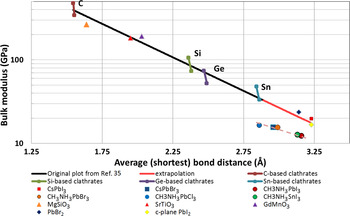
An interesting similarity to HaPs in terms of their crystal structure (cubic) and surprisingly low thermal conductivity[ Reference Pisoni, Jaćimović, Barišić, Spina, Gaál, Forró and Horváth 32 , Reference Nakamura, Yamada and Ohnuma 33 ], can be found in a structural family called clathrates. Inorganic clathrate compounds (e.g., K8Al8Si36 and Sr8Ga16Ge30) are characterized by an open framework structure with “guest” ions (e.g., K, Al and Sr, Ga) trapped in a well-crystallized “host” framework structure (e.g., Si and Ge). For perovskites, the “host” can be imagined to be as the Pb–X framework and the guest will be the A ion. In terms of the thermal conductivity—for both cases the main contribution to this effect was related to interactions between the collective “host” vibrations with the trapped “guest” atoms/ions.[ Reference Pisoni, Jaćimović, Barišić, Spina, Gaál, Forró and Horváth 32 , Reference Sui, He, Bobev, Zhao, Osterloh and Kauzlarich 34 ] As for the elastomechanical properties of clathrates, theoretical work showed that the bulk modulus is logarithmically related to the average interatomic distance of the “host” atoms (see Fig. 3 or[ Reference Karttunen, Härkönen, Linnolahti and Pakkanen 35 ]). By placing data of the ABX 3 (B = Sn or Pb) and PbX 2, which are presented in Table I, and other oxide structures found in the literature on a single plot (see Fig. 3), we find, for perovskite-structured APbX 3, a logarithmic relation between the B–X bond length and the modulus, but with lower elastic modulus than expected.
Bulk modulus versus average shortest bond distance. “Average (shortest) bond distance” means: for clathrates—“host”–“host” average bond distance (e.g., for Si-based clathrates this will be the –Si–Si bond); for any ABX 3 compound it is the average B–X distance; for PbX 2 structures is the average Pb–X distance. The actual numerical values used for the plot are summarized in Table S1. The black line is a linear fit adapted from[ Reference Karttunen, Härkönen, Linnolahti and Pakkanen 35 ]

In order to check the influence of these microscopic considerations on behavior of the bulk material, we looked at the relation between Young's modulus and the density or linear expansion coefficient, from the work of Ashby[ Reference Ashby 23 ] (see Figs. S2 and S3). On these maps the HaP materials are located between polymers, metals, and composite materials.
For a given E, the thermal expansion coefficients of the HaPs are higher than of most metals and composites, smaller than of most polymers and similar to those of rigid polymer foams (and to that of PbI2; see below). It is remarkable that what is formally an ionic material has such a large expansion coefficient, which may reflect the flexibility of the Pb–X bonds. If we compare both the elastic moduli and the linear expansion coefficients of CH3NH3PbX 3 and PbX 2 (c-plane in PbI2—see Fig. S4), it appears that the Pb–X bond plays a dominant role in the elasticity of these materials.
The finding that HaPs are positioned in the diagrams with relatively soft metals and that the Pb–X corner-sharing octahedral framework is quite (thermally) expandable might indicate possible ductility or flexibility, which could ease formation on heterogeneous surfaces with low energetic penalty and good adaptivity. Another implication of enhanced flexibility is that application of external energy (mechanical, electrostatic, and electromagnetic) to such materials might allow facile creation but also ready rearrangement (self-healing) of point defects, which can help atom/ion diffusion in the material. In this context, theoretical calculations gave for the energy barrier to iodide vacancy migration ~0.1 eV,[ Reference Azpiroz, Mosconi, Bisquert and Angelis 36 ] up to ~0.3 eV for iodide displacement in a vacancy-free surrounding environment (due to proton migration[ Reference Egger, Kronik and Rappe 37 ]). Confirmation of suggested processes[ Reference Yang, Gregori, Pellet, Grätzel and Maier 6 , Reference Eames, Frost, Barnes, O'Regan, Walsh and Islam 7 , Reference Azpiroz, Mosconi, Bisquert and Angelis 36 ] such as extensive ion migration and “self-healing” in these materials awaits further, direct experimental evidence.
If we look at possible benefits of these mechanical properties for manufacturing, these properties can be beneficial for spreading thin films of perovskites on surfaces with different morphologies, using methods such as “doctor-blading”. However, the ease of plastic deformation (i.e., low hardness), makes these materials less suitable for flexible substrates.
As to any correlation with other lead-based (Pb and PbTe), or photovoltaic materials (CdTe, CIGS, GaAs, and Si) —except for the similar elastic modulus for metallic lead, and some similarity to the hardness of the PbTe and CdTe—the overall mechanical properties do not really correlate.
Summary
The elastomechanical properties of the examined halide perovskites (CH3NH3PbI3, CH3NH3PbBr3, and CsPbBr3), with respect to their density or linear thermal expansion coefficient, are between those of soft metals, polymers, and composite materials. This combination of properties might be reflected in the (apparent low energies required for) dynamic processes speculated to exist in these materials (e.g., self-healing and ion-migration). Similar to what is the case for “classic” (oxide) perovskites, the elastomechanical properties seem to be dominated by the B–X bond, with the presence of the A group decreasing the elastic coefficients of these large-cage perovskite-structured materials. The lower elastic modulus of CH3NH3PbI3 than of CH3NH3PbBr3 may reflect differences in the Pb–X bond strengths. Comparison between CH3NH3PbBr3 and CsPbBr3 shows that the organic group actually makes the entire structure stiffer (higher elastic modulus); however, it might also be due [in part] to the difference in the crystallographic orientation between the tested crystals, because, as shown in Sun et al.,[ Reference Sun, Fang, Kieslich, White and Cheetham 19 ] the (100) is stiffer than (110) orientation in CH3NH3PbBr3. The similarity between the elastic modulus of PbI2 (c-plane) with that of CH3NH3PbI3 and that of PbBr2 (which has a structure that is quite different from PbI2, which cannot easily be related to a perovskite structure) with APbBr3, suggests that the Pb–X framework dominates the elastic modulus. We do not find an obvious relation between the mechanical and the optoelectronic, especially photovoltaic properties, of the materials.
The conclusions and conjectures presented in this work should mostly serve as guidelines for further investigations, such as growth and mechanics for analogous single crystals (e.g., chloride and formamidinium perovskites).
Supplementary materials
For supplementary material for this article, please visit http://dx.doi.org/10.1557/mrc.2015.69
Acknowledgments
D.C. thanks Leeor Kronik for drawing his attention to this experimental approach. We thank Milko van der Boom and Xiaomeng Sui for helpful discussions. This work was supported by the Israel Science Foundation, the Israel Ministry of Science, and the Israel National Nano-Initiative. D.C. holds the Sylvia and Rowland Schaefer Chair in Energy Research.