1. Introduction
Submarine gravity-induced processes are considered the most efficient mechanism to transfer sediments accumulated along a basin margin towards its depocentre. Gravity-induced deposits include mass transport deposits (MTDs) and turbidites (Dott, Reference Dott1963; Nardin et al. Reference Nardin, Hein, Gorsline, Edwards, Doyle and Pilkey1979; Moscardelli & Wood, Reference Moscardelli and Wood2008). MTDs significantly contribute to the origin of mass transport complexes (MTCs) and sedimentary mélanges or olistostromes (e.g. Hsü, Reference Hsü1968; Carter, Reference Carter1975; Cowan, Reference Cowan1985; Brandon, Reference Brandon1989; Mulder & Cochonat, Reference Mulder and Cochonat1996; Lucente & Pini, Reference Lucente and Pini2003; Sengör, Reference Sengör, Dilek and Newcomb2003; Moscardelli & Wood, Reference Moscardelli and Wood2008; Camerlenghi & Pini, Reference Camerlenghi and Pini2009; Shipp, Weimeir & Posamentier, Reference Shipp, Weimeir and Posamentier2011: p. 96; Alves, Reference Alves2015; Auchter, Romans & Hubbard, Reference Auchter, Romans and Hubbard2016; Jablonska et al. Reference Jablonska, Di Celma, Korneva, Tondi and Alsop2016). MTDs form a broad geological collection of chaotic sedimentary bodies such as slumps, slides, debris flows, debris avalanches and hyperconcentrated flows occurring along the slope system in different tectonic settings (e.g. Dott, Reference Dott1963; Nardin et al. Reference Nardin, Hein, Gorsline, Edwards, Doyle and Pilkey1979; Lucente & Pini Reference Lucente and Pini2003; Moscardelli & Wood, Reference Moscardelli and Wood2008; Festa et al. Reference Festa, Dilek, Pini, Codegone and Ogata2012 and references therein). The chaotic appearance in outcrop of these sedimentary bodies, which commonly display a block-in-matrix structure and high stratal disruption, makes them very similar to tectonically deformed lithostratigraphic units or tectonic mélanges (Festa et al. Reference Festa, Pini, Dilek and Codegone2010) and therefore difficult to identify. A further complication is added when original gravity-driven deposits have subsequently been overprinted by contractional tectonics. In this latter case, structures related to the early gravity-driven emplacement of these chaotic sedimentary bodies are frequently misidentified, potentially resulting in significant errors in the tectono-stratigraphic interpretations of sedimentary basins later incorporated within thrust and fold belts.
Based on marine surveys, MTDs are considered to play a fundamental role in the stratigraphic fill of many present-day basin margins around the world (Hampton, Lee & Locat, Reference Hampton, Lee and Locat1996; Canals et al. Reference Canals, Lastras, Urgeles, Casamor, Mienert, Cattaneo, De Batist, Haflidason, Imbo, Laberg, Locat, Long, Longva, Masson, Sultan, Trincardi and Bryn2004; Moscardelli & Wood, Reference Moscardelli and Wood2008; Bull, Cartwright & Huuse, Reference Bull, Cartwright and Huuse2009). Descriptions of outcropping MTDs, originally deposited within extensional and contractional tectonic settings and later incorporated within thrust-and-fold belts, are present in the literature (e.g. Williams, Reference Williams1983; Farrell, Reference Farrell1984; Martinsen, Reference Martinsen, Whateley and Pickering1989; Martinsen & Bakken, Reference Martinsen and Bakken1990; Burg et al. Reference Burg, Bernoulli, Smit, Dolati and Bahroudi2008; Posamentier & Martinsen, Reference Posamentier, Martinsen, Shipp, Weimeir and Posamentier2011, p. 96; Moscardelli & Wood, Reference Moscardelli and Wood2015; Sobiesiak et al. Reference Sobiesiak, Kneller, Alsop and Milana2016, Reference Sobiesiak, Alsop, Kneller and Milana2017). Generally, criteria used to recognize the original sedimentary nature of MTDs are based on studies regarding clast composition and disposition, fabric, fold morphology, etc. (e.g. Silver & Beutner, Reference Silver and Beutner1980; Bailey et al. Reference Bailey, Skehan, Dreier, Webster, Horton and Rast1989; McDonald, Moncrieff & Butterworth, Reference McDonald, Moncrieff and Butterworth1993; Steen & Andresen, Reference Steen and Andresen1997; Pini, Reference Pini1999, p. 335; Comeau et al. Reference Comeau, Kirkwood, Malo, Asselin and Bertrand2004; Armitage et al. Reference Armitage, Romans, Covault and Graham2009; Camerlenghi & Pini, Reference Camerlenghi and Pini2009; Dykastra et al. Reference Dykastra, Garyfalou, Kertznus, Kneller, Milana, Molinaro, Szuman, Thompson, Shipp, Weimer and Posamentier2011; Osozawa, Pavlis & Flowers, Reference Osozawa, Pavlis, Flowers, Wakabayashi and Dilek2011; Waldron & Gagnon, Reference Waldron and Gagnon2011; Cieszkowski et al. Reference Cieszkowski, Golonka, Ślączka and Waśkowska2012; Yamamoto, Tonogai & Anma, Reference Yamamoto, Tonogai and Anma2012; Zagorevski et al. Reference Zagorevski, Van Staal, McNicoll, Hartree and Rogers2012; Alves, Reference Alves2015; Golonka et al. Reference Golonka, Krobicki, Waśkowska, Cieszkowski and Ślaczka2015; Waldron et al. Reference Waldron, Jamieson, Pothier and White2015; Auchter, Romans & Hubbard, Reference Auchter, Romans and Hubbard2016). However, more detailed field-based studies are needed to better assess criteria for recognizing the sedimentary nature within chaotic lithosomes overprinted by later intense tectonic deformation.
Discriminating between sedimentary and tectonic mélanges forms a century-long debate since Greenly (Reference Greenly1919) originally introduced the term mélange. In this paper we will use as a case study the Triassic Monte Facito Formation, exposed in the southern Apennine thrust belt of Italy (Fig. 1), which is characterized by the occurrence of wide outcrops of chaotic rock bodies, generally interpreted as being derived from Triassic submarine slope failures (e.g. Scandone, Reference Scandone1967; Wood, Reference Wood1981; Martini et al. Reference Martini, De Wever, Zaninetti, Denelian and Kito1989; Panzanelli Fratoni, Reference Panzanelli Fratoni1991). However, intense deformation related to the incorporation of the Monte Facito Formation within the southern Apennine thrust belt was recognized by subsequent authors (Ciarapica & Passeri, Reference Ciarapica and Passeri2000; Passeri & Ciarapica, Reference Passeri and Ciarapica2010), who interpreted some of the chaotic units as being derived from tectonic processes connected to regional thrusting. These different interpretations arose because criteria for distinguishing rock bodies formed by slope failure or contractional tectonic processes are not clearly defined, with both processes being capable of generating similar final products such as breccias and rootless folds. However, the Monte Facito Formation is ideally suited to distinguishing structures formed during and after emplacement of chaotic lithosomes, due to the involvement of a wide range of sedimentary rock types in the gravity-driven processes, and to variations in the intensity of the later tectonic deformation. In particular, the presence of ‘low-strain’ domains that have scarcely been affected by tectonic deformation allows sedimentary structures to be described in detail, and thereby we can deduce the processes responsible for the emplacement of these units.
Geological sketch map of the southern Apennine thrust belt (thick red box indicates the study area covered by the map in Fig. 2) and regional cross-section (redrawn after Prosser et al. Reference Prosser, Schiattarella, Tramutoli, Doglioni, Harabaglia and Bigozzi1996) showing the main tectonic units of the accretionary wedge. Inset map shows location of study area in relation to the southern Apennine thrust belt.

For this reason, we first present a detailed sedimentological analysis aimed at describing the facies and facies associations that are recognized within these chaotic lithosomes. This is followed by a description of structures formed during later contractional tectonics associated with the southern Apennines thrust belt in the Miocene. This allows us to derive some criteria that can be used discriminate structures formed by sedimentary and tectonic processes. In this respect, chaotic lithosomes included in the Monte Facito Formation are helpful in discriminating the effects of a later contractional tectonic overprint on a coarse-grained rift-related succession.
2. Geological setting
2.a. Regional setting
The Lagonegro Basin succession in the southern Apennine thrust belt contains heterogeneous and poly-deformed deposits attributed to the Early to Middle Triassic Monte Facito Formation (MFF) (e.g. Scandone Reference Scandone1965, Reference Scandone1967; Donzelli & Crescenti, Reference Donzelli and Crescenti1970; Wood, Reference Wood1981; Martini et al. Reference Martini, De Wever, Zaninetti, Denelian and Kito1989; Ciarapica et al. Reference Ciarapica, Cirilli, Martini, Panzanelli Fratoni, Zaninetti and Salvini Bonnard1990a,b; Panzanelli Fratoni, Reference Panzanelli Fratoni1991; Ciarapica & Passeri, Reference Ciarapica and Passeri2000; Passeri & Ciarapica, Reference Passeri and Ciarapica2010) (Fig. 1). The MFF records the Late Permian – Triassic rifting stage, when the progressive separation between the European and African plates resulted in the opening of the northern branch of the Neotethys Ocean (D'Argenio, Pescatore & Scandone, Reference D'Argenio, Pescatore and Scandone1973; Channell, D'Argenio & Horvath, Reference Channell, D'Argenio and Horvath1979; Wood, Reference Wood1981; Bosellini, Reference Bosellini2002; Stampfli & Borel, Reference Stampfli and Borel2002; Schettino & Turco, Reference Schettino and Turco2011). The onset of extensional deformation led to the opening of the Lagonegro Basin at the northern edge of the Neotethys. Successive extensional phases, connected to the opening of the Jurassic Ligurian Tethys Ocean, shaped the African palaeomargin into a series of submarine lows and highs. Deposition of pelagic carbonates, siliceous and clastic sediments took place in the deeper domains, whereas structural highs were characterized by deposition of platform carbonates. From west to east these palaeogeographic domains were represented by the Liguride Basin (corresponding to the Ligurian Tethys oceanic domain), the Apennine Platform, the Lagonegro Basin and the Apulian Platform (e.g. Mostardini & Merlini, Reference Mostardini and Merlini1986; Casero et al. Reference Casero, Roure, Endignoux, Moretti, Muller, Sage and Vially1988; Prosser et al. Reference Prosser, Schiattarella, Tramutoli, Doglioni, Harabaglia and Bigozzi1996; Pescatore et al. Reference Pescatore, Renda, Schiattarella and Tramutoli1999; Menardi Noguera & Rea, Reference Menardi Noguera and Rea2000; Lentini et al. Reference Lentini, Carbone, Di Stefano and Guarnieri2002).
Platforms and basins have subsequently been deformed from late Oligocene to Pliocene times and incorporated as tectonic units with northeast vergence into the Apennine thrust belt (e.g. Malinverno & Ryan, Reference Malinverno and Ryan1986; Casero et al. Reference Casero, Roure, Endignoux, Moretti, Muller, Sage and Vially1988; Roure, Casero & Vially, Reference Roure, Casero and Vially1991; Monaco, Tortorici & Paltrinieri, Reference Monaco, Tortorici and Paltrinieri1998; Gueguen, Doglioni & Fernandez, Reference Gueguen, Doglioni and Fernandez1998; Pescatore et al. Reference Pescatore, Renda, Schiattarella and Tramutoli1999; Menardi Noguera & Rea, Reference Menardi Noguera and Rea2000; Butler et al. Reference Butler, Mazzoli, Corrado, De Donatis, Di Bucci, Gambini, Naso, Nicolai, Scrocca, Shiner, Zucconi and McClay2004; Shiner, Beccacini & Mazzoli, Reference Shiner, Beccacini and Mazzoli2004; Piedilato & Prosser, Reference Piedilato and Prosser2005; Patacca & Scandone, Reference Patacca, Scandone, Mazzotti, Patacca and Scandone2007; Palladino, Reference Palladino2011). During these contractional stages, the tectonic units derived from the Lagonegro Basin underwent intense deformation resulting in a series of thrusts and detachment surfaces originating in the less competent levels of the MFF. The MFF currently crops out in the central portion of the southern Apennine thrust belt. In particular, the study area is located in a structural high separating the High Agri Valley from the Melandro Valley (Fig. 2a, b). This area includes the type locality of the MFF where complex relationships between the different lithological units can be observed (Fig. 2c). Although the Lagonegro units generally occupied a relatively deep structural position within the thrust nappe stack, deformation generally took place under diagenetic conditions. Near the study area, depths of c. 2–3 km and temperatures not exceeding 100°C have been estimated by both mineralogical and microstructural data, combined with regional geological considerations (Di Leo et al. Reference Di Leo, Dinelli, Mongelli and Schiattarella2002; Novellino et al. Reference Novellino, Prosser, Spiess, Viti, Agosta, Tavarnelli and Bucci2015). In these conditions, localized ductile deformation was possible only within shale-rich lithologies, which are common in some stratigraphic intervals of the Lagonegro succession and particularly in the MFF.
(a) Geological map of the Sasso di Castalda area between Cappelluzzo and Petrara localities. Abbreviations: MAFZ – Melandro-Agri Fault Zone; TFFZ – Torrente Fiumarella Fault Zone. (b) Geological cross-section. Refer to (a) for location. (c) Stratigraphic framework showing the age, depositional environments and the stratigraphic subdivision of the Monte Facito Formation adopted in this paper. In the stratigraphic intervals, the key localities suitable for observation of stratigraphic interval transitions are indicated. Abbreviations: BL – biogenic limestone interval; MF/CS – Monte Facito/Calcari con Selce formations transition.

2.b. The Monte Facito Formation
The MFF forms the base of the Mesozoic Lagonegro Basin succession, which includes the pelagic limestones of the Late Cretaceous Calcari con Selce Formation, cherts and jaspers of the Jurassic Scisti Silicei Formation and clayey and marly lithologies of the Galestri Formation. It records the initial stages of the Africa–Europe continental separation, and the subsequent opening of the Lagonegro Basin during the Middle Triassic (Scandone, Reference Scandone1967, Reference Scandone1972). In particular, lithological and stratigraphic features of this formation are thought to result from the initial break-up and subsequent collapse of a pre-Mesozoic basement (Wood, Reference Wood1981). The MFF succession can be broadly subdivided into two informal units: (i) shallow-water Early to Middle Triassic lithofacies (Olenekian–Ladinian) comprising massive carbonate build-ups, shelf rythmites and wave-influenced shoreface sands; and (ii) deep-water Middle to Late Triassic lithofacies (Late Ladinian to Early Carnian) consisting of cherts and shales alternating with coarse-grained resedimented deposits (Donzelli & Crescenti, Reference Donzelli and Crescenti1970; Wood, Reference Wood1981; Miconnet, Reference Miconnet1988; Ciarapica et al. Reference Ciarapica, Cirilli, Martini, Panzanelli Fratoni, Zaninetti and Salvini Bonnard1990a,b; Panzanelli Fratoni, Reference Panzanelli Fratoni1991; Marsella, Kozur & D'Argenio, Reference Marsella, Kozur and D'Argenio1993; Ciarapica & Passeri, Reference Ciarapica and Passeri2000; Passeri & Ciarapica, Reference Passeri and Ciarapica2010). The shallow-water lithofacies is related to a pre-rifting stage, whereas the deep-water lithofacies marks the onset of pronounced basin subsidence following continental break-up.
MFF stratigraphy is briefly summarized in the following (older to younger) stratigraphic order (Fig. 2c). The pre-break-up succession consists of:
– calcarenite–shale interval (Olenekian). Thinly bedded calcarenite and shale related to deposition in a shoreface/offshore transition environment.
– biogenic limestone interval (Anisian–Ladinian). Algal limestone related to carbonate platforms or isolated build-ups.
– sandstone–shale interval (Anisian). Shale, wacke and quartz-rich arenite pertaining to both shallow- and deep-water environments.
The syn- to post-break-up succession consists of:
– radiolarite–shale interval (Ladinian). Shale and radiolarite containing thick beds of calcareous breccia bodies, calcarenite and olistoliths. The interval is attributed to a base-of-scarp / slope-basin environment.
– cherty limestone – shale Interval (Late Ladinian to Early Carnian). Cherty limestone alternating with thin levels of radiolarite and shale. The interval, which marks the transition toward the uppermost Calcari con Selce Formation, is attributed to a basinal environment.
The stratigraphic position and age of these long-established intervals has been mainly determined by means of biostratigraphy, based on numerous palaeontological studies performed on conodonts, radiolarians, brachiopods, foraminifers and algae (e.g. Taddei Ruggiero, Reference Taddei Ruggiero1968; De Capoa Bonardi, Reference De Capoa Bonardi1970; Pasini, Reference Pasini1982; Rettori et al. Reference Rettori, Ciarapica, Cirilli, Martini, Salvini Bonnard and Zaninetti1988; De Wever, Martini & Zaninetti, Reference De Wever, Martini and Zaninetti1990; Mietto & Panzanelli Fratoni, Reference Mietto and Panzanelli Fratoni1990; Panzanelli Fratoni, Reference Panzanelli Fratoni1991). However, although obvious transitions between different stratigraphic intervals have been locally documented in the field (e.g. Rigo et al. Reference Rigo, Preto, Roghi, Tateo and Mietto2007; Palladino, Reference Palladino2015), in most cases these intervals show inconsistent relationships. For example, the Early Triassic calcarenite–shale interval has often been recognized juxtaposed on top of Ladinian chert and shale belonging to the radiolarite–shale interval. This older on younger geometrical relationship led some authors to infer that the two intervals are separated by an important thrust plane of Miocene age (e.g. Mietto & Panzanelli Fratoni, Reference Mietto and Panzanelli Fratoni1990; Panzanelli Fratoni, Reference Panzanelli Fratoni1991; Ciarapica & Passeri, Reference Ciarapica and Passeri2000). Based on this hypothesis, chaotic lithosomes, including matrix-supported conglomerates (paraconglomerates) that are recognized along the contact, have been interpreted to be the result of shearing along this inferred Miocene thrust (Ciarapica & Passeri, Reference Ciarapica and Passeri2000; Passeri & Ciarapica, Reference Passeri and Ciarapica2010). However, recent studies, which demonstrate the absence of a regionally recognizable thrust contact within the MFF in the study area (Palladino, Reference Palladino2015), and previous studies (Scandone, Reference Scandone1967; Panzanelli Fratoni, Reference Panzanelli Fratoni1991), which considered chaotic lithosomes as sedimentary deposits, contradict this interpretation. We therefore suggest that the presence of chaotic lithosomes, related to slope failure during the Middle Triassic time, can explain the stratigraphic inconsistencies displayed by the MFF. Later Miocene thrusting is believed to be responsible for the subsequent tectonic overprint of the MFF and the overall deformed appearance currently observable in the field.
2.c. Structural framework
The structural configuration of the Monte Facito area (Fig. 2a, b) is mainly the result of Miocene to Pliocene southern Apennine contractional deformation, together with pre- and post-orogenic extensional and transcurrent tectonics (Monaco, Tortorici & Paltrinieri, Reference Monaco, Tortorici and Paltrinieri1998; Tavarnelli & Prosser, Reference Tavarnelli and Prosser2003). Pre-orogenic synsedimentary normal faults formed during the rifting stage, which led to the opening the Neotethys and the Ligurian Tethys oceans during the Mesozoic (D'Argenio & Alvarez, Reference D'Argenio and Alvarez1980; Mazzoli et al. Reference Mazzoli, Barkham, Cello, Gambini, Mattioni, Shiner and Tondi2001). From Eocene to Oligocene time onwards, the area experienced contractional tectonics related to subduction and closure of the Ligurian Tethys Ocean (Knott, Reference Knott1994). This phase led to the formation of a series of stacked tectonic units that mainly verge towards the NE and E (Torrente, Reference Torrente1990; Mazzoli, Reference Mazzoli1992; Mazzoli et al. Reference Mazzoli, Barkham, Cello, Gambini, Mattioni, Shiner and Tondi2001). The youngest post-orogenic structures are represented by high-angle Plio-Quaternary normal faults and left-lateral strike-slip faults (Catalano, Monaco & Tortorici, Reference Catalano, Monaco and Tortorici1993; Hippolyte, Angelier & Barrier, Reference Hippolyte, Angelier and Barrier1995).
A thrust-and-fold structural style mainly characterizes the study area (Fig. 2a, b). The most relevant tectonic structure is the regional Lagonegro Thrust, located at the base of the MFF (or, more rarely, at the base of the Calcari con Selce Formation) that separates two tectonic units both consisting of the Lagonegro Basin succession (Scandone, Reference Scandone1972) (Fig. 2). The Lagonegro Thrust plane largely crops out between the Piana Betina and Pietra Maura areas (Fig. 2a, b). The thrust contact is outlined by a decametre-thick deformation zone where structures such as asymmetric folds and S-C tectonites indicate a constant top-to-the-NE sense of shear, consistent with previous studies on the structural setting of the Lagonegro Basin deposits (Torrente, Reference Torrente1990; Mazzoli, Reference Mazzoli1992). A series of small tectonic windows and klippen located immediately north of Petrara and in the vicinity of Sasso di Castalda village enable an estimate of the areal extent of the Lagonegro Thrust. Discontinuous, NW-trending folds may be recognized between the La Cerchiara, Pietra Maura and Mount Maruggio areas (Fig. 2a). At La Cerchiara, folding involves alternating carbonate build-ups and shales of the MFF (Fig. 2b).
A series of steeply dipping faults of probable Quaternary age, displaying both extensional and strike-slip kinematics, repeatedly cross-cut Miocene contractional structures. In particular, two major tectonic structures are responsible for the exhumation of the deeper stratigraphic portions of the MFF in the Monte Facito locality (Fig. 2a, b). The main NW-trending Melandro–Agri Fault Zone displays a sub-vertical NE-dipping attitude and extensional kinematics. A second tectonic lineament, the NE-trending Torrente Fiumarella Fault Zone, consisting of right-lateral strike-slip fault segments, shows a steep attitude and dips approximately SE.
3. Sedimentary facies
The MFF includes numerous facies, representative of both shallow- and deep-water environments (Scandone, Reference Scandone1967; Wood, Reference Wood1981; Martini et al. Reference Martini, De Wever, Zaninetti, Denelian and Kito1989; Ciarapica et al. Reference Ciarapica, Cirilli, Panzanelli Fratoni, Passeri and Zaninetti1990b; Panzanelli Fratoni, Reference Panzanelli Fratoni1991; Marsella, Kozur & D'Argenio, Reference Marsella, Kozur and D'Argenio1993; Ciarapica & Passeri, Reference Ciarapica and Passeri2000; Passeri & Ciarapica, Reference Passeri and Ciarapica2010). In this paper we take into account only the deep-water facies of the MFF, which include the radiolarite–shale and cherty limestone – shale intervals. These intervals encompass fine- to coarse-grained deposits pertaining to proximal slope/base of fault scarp (F1), distal slope (F2) and basin (F3) facies associations (Table 1). Then chaotic lithosomes associated with the radiolarite–shale interval, representing the topic of this paper, will be described and incorporated in the recognized facies associations. Suitable sites for facies description, where detailed sedimentary logs have been constructed, include La Cerchiara, Acqua Moricine, Piano Bellagamba and Petrara (Figs 2, 3).
Facies classification and interpretation of the deposits forming the upper portion of the Monte Facito Formation.

Representative stratigraphic sections measured in different localities in the study area. The main characteristics shown by the radiolarite–shale and cherty limestone – shale intervals of the Monte Facito Formation as well as lithology, facies and facies associations are reported. See Figure 2 for stratigraphic sections location. Abbreviations: Ol – allochthonous megablocks; Msb – matrix-supported carbonate breccias; Cls – cherty limestones/shales couplets; Csb – clast-supported carbonate breccias; Pm – pebbly mudstones; Sh – siliceous marls and shales; Cs – calcarenite slabs; Mcb – monomict conglomerate/breccias; Sa – laminated silt/thin-bedded graded arenites; Ch – radiolarian cherts.

3.a. Proximal slope/base-of-fault scarp (F1) facies association
Proximal slope/base-of-fault scarp facies association forms the main portion of the radiolarite–shale interval succession. It crops out extensively at La Cerchiara, Pezza la Quagliara, Acqua Moricine and Piano Bellagamba (Figs 2, 3). The facies association consists of allochthonous megablocks (Ol) and clast-supported carbonate breccias (Csb) (Table 1).
3.a.1. Allochthonous megablocks (Ol)
Scattered and isolated metres- to decametre-sized calcareous and arenaceous blocks, embedded within a varicoloured radiolarian cherty/marly matrix, have been recognized throughout the study area (Fig. 4a). The calcareous blocks are derived from the fragmentation of the underlying biogenic limestone interval, while arenaceous blocks are made up of quartzarenites derived from the sandstone–shale interval. These latter blocks are particularly well exposed in the La Cerchiara area, where they still preserve the original stratification. Where the basal contact of individual megablocks is exposed, the underlying matrix shows plastic deformation, whereas the overlying matrix gently mantles the allochthonous blocks. Often, brecciated levels and slickenside striations outline the contact between blocks and matrix.
Sedimentary facies recognized in the upper portion of the Monte Facito Formation. F1 facies association: (a) carbonate olistoliths (Ol), provided by the bioclastic limestone interval, scattered in a radiolarite–shale matrix; (b) clast-supported carbonate breccias (Csb) recognized at Pezza La Quagliara. The clasts are sustained by a silty reddish matrix. F2 facies association: (c) laminated silt/thin-bedded graded arenites (Sa); (d) detail of the previous facies showing a normal graded and laminated arenite bed; (e) matrix-supported carbonate breccias (Msb). The matrix consists of green-coloured shales. F3 facies association: (f) siliceous marls and shales (Sh); (g) radiolarian cherts (Ch); (h) cherty limestones/shales couplets (Cls). 30 cm long hammer for scale.

3.a.2. Clast-supported carbonate breccias (Csb)
This facies consists of heterometric, well-lithified, unsorted and chaotic, ungraded breccias (Fig. 4b). The breccia elements, mostly angular in shape, are exclusively provided by the underlying biogenic limestone interval. These clasts range in size from a few centimetres to some tens of decimetres, while the matrix commonly consists of well-cemented yellow/red clays. Clast-supported carbonate breccias form discrete, wedge-shaped bodies, included in shale and radiolarian cherty successions. They commonly show sharp erosive bases. The thickness of breccia bodies ranges from few metres to some tens of metres.
3.a.3. Facies association interpretation
Based on previous descriptions, it is thought that the facies noted above have been deposited at the base or close to steeply inclined fault escarpments by falling, toppling and other gravity-flow processes. Calcareous and arenaceous megablocks can be considered as olistoliths (e.g. Alves & Lourenço, Reference Alves and Lourenço2010; Dunlap et al. Reference Dunlap, Wood, Weisenberger and Jabour2010; Jackson, Reference Jackson2011). Following Wood (Reference Wood1981), we suggest that carbonate megablocks were produced by break-up processes affecting carbonate platforms during the Middle Triassic, and deposition by mass transport mechanisms in a radiolaritic basin. Clast-supported breccias are interpreted as slope failure deposits. In particular, they are related to subaqueous talus, accumulated at the base of steep escarpments. They are considered to have been deposited by mass transport of sediments as well as rock falls and debris avalanches (e.g. Nemec & Steel, Reference Nemec, Steel, Koster and Steel1984; Eberli, Reference Eberli1987; Hine et al. Reference Hine, Locker, Tedesco, Mullins, Hallock, Belknap, Ingeominas, Neumann and Snyder1992; Spence & Tucker, Reference Spence and Tucker1997; Haas, Reference Haas1999; Drzewiecki & Simo, Reference Drzewiecki and Simȯ2002; Kim, Chough & Chun, Reference Kim, Chough and Chun2003).
3.b. Distal slope (F2) facies association
This facies association has been recognized at the base of the radiolarite–shale interval at La Cerchiara (Figs 2, 3). It consists of two distinct alternating facies: laminated silt/thin-bedded graded arenites (Sa) and matrix-supported carbonate breccias (Msb) (Table 1).
3.b.1. Laminated silt / thin-bedded graded arenites (Sa)
Laminated silt forms millimetre- to centimetre-thick layers characterized by plane-parallel laminations (Fig. 4c). Arenites consist of isolated, yellowish-greenish, centimetre-thick normally graded to laminated beds, showing marked erosional basal surfaces (Fig. 4d). Clast composition includes a mixture of quartz and whitish calcareous grains, while the matrix mainly consists of silt.
3.b.2. Matrix-supported carbonate breccias (Msb)
This facies consists of poorly sorted and crudely bedded monogenic breccias, made up of elements derived from the underlying biogenic limestone interval (Fig. 4e). The matrix comprises thinly laminated, red and green, silicified silty-clay. The breccia clasts predominantly consist of angular to sub-rounded limestone ranging in size from a few centimetres to some decimetres. Locally, replacement by chert affects the carbonate clasts that appear completely silicified or enveloped in a thick silicified crust. Matrix-supported carbonate breccia bodies are generally characterized by marked erosive basal surfaces and lens-shaped geometries.
3.b.3. Facies association interpretation
The described facies are attributed to a slope environment located in a more distal position with respect to the previously described facies association. In this distal slope setting, the deposition of large blocks or coarse-grained sediment was not possible whereas finer sediments were deposited. The erosive basal contacts and the normal gradation observed in the laminated silt/thin-bedded graded arenites suggest that this facies was deposited by turbidity currents. Matrix-supported breccias are interpreted as deposits formed by cohesive debris flows on a slope (Lowe, Reference Lowe1982; Eberli, Reference Eberli1987; Haas, Reference Haas1999; Drzewiecki & Simo, Reference Drzewiecki and Simȯ2002).
3.c. Basin (F3) facies association
A basin-related facies association has been recognized in the upper portion of the radiolarite–shale interval succession. It consists of three facies widely cropping out at Pezza La Quagliara, Acqua Moricine and La Petrara (Figs 2, 3). They are: siliceous marls and shales (Sh), radiolarian cherts (Ch) and cherty limestones/ shales couplets (Cls) (Table 1).
3.c.1. Siliceous marls and shales (Sh)
Variegated to dominantly red and yellow siliceous millimetre-laminated marl and shale commonly occur at different stratigraphic levels in the MFF. They frequently form packages several metres thick, alternating with other coarser lithologies (Fig. 4f). At La Cerchiara, and at the transition with the Calcari con Selce Formation in the Petrara locality, a thick package of orange shale, rich in pelagic bivalves (Halobia styriaca, Halobia cf. cassiana and Daonella lommeli), which represent a key interval in the MFF (Scandone, Reference Scandone1967; De Capoa Bonardi, Reference De Capoa Bonardi1970), has been recognized.
3.c.2. Radiolarian cherts (Ch)
Regularly bedded, mostly reddish and greenish ribbon cherts form successions tens of metres thick. Commonly the strata range in thickness from centimetres to decimetres (Fig. 4g). They are commonly embedded within thinly laminated mm-thick shales (facies Sh), together with other coarse-grained lithologies. The faunal content indicates a Late Ladinian age (Martini et al. Reference Martini, De Wever, Zaninetti, Denelian and Kito1989; De Wever, Martini & Zaninetti, Reference De Wever, Martini and Zaninetti1990).
3.c.3. Cherty limestones/shales couplets (Cls)
Cherty limestones/shales couplets are a characteristic facies recognized at the MFF/Calcari con Selce transition (Panzanelli Fratoni, Reference Panzanelli Fratoni1991; Ciarapica & Passeri, Reference Ciarapica and Passeri2000). This consists of thinly laminated, red to green shales and red radiolarites, with a few cherty limestones intercalations (Fig. 4h). These latter consist of nodular, well-bedded calcarenites, containing whitish cherty nodules. Normal grading and plane-parallel lamination in the limestone beds are the most commonly recognized sedimentary structure. Rare cm-thick calcirudite bodies are also present. Pink nodular limestones associated with cherty limestones, described as ‘Ammonitico Rosso-like limestones’, provide a Fassanian/Longobardian age, based on conodonts, ammonites, foraminifers and thin-shelled bivalves (Panzanelli Fratoni, Reference Panzanelli Fratoni1991). In the study area, calcareous layers are more frequent and thicken upwards. The deposition of chertylimestones/shales couplets is associated with slow sedimentation rates, occurring during rapid subsidence related to important episodes of extensional tectonics affecting the Lagonegro Basin during the Middle Triassic (Wood, Reference Wood1981).
3.c.4. Facies association interpretation
The described facies are related to sediment deposition in deep-water basin settings. Siliceous marls and shales facies were deposited by suspension fallout mechanisms. Radiolarian cherts were the product of both continued fallout of radiolarian tests and decantation from turbidites (Martini et al. Reference Martini, De Wever, Zaninetti, Denelian and Kito1989). Cherty limestones can probably be related to turbidite currents in accordance with the observations of Rigo et al. (Reference Rigo, Preto, Roghi, Tateo and Mietto2007) in a similar stratigraphic interval farther south of the study area. It is probable that the onset of carbonate sedimentation in the upper portion of the MFF is connected to the development of coeval carbonate platforms in areas adjacent to the Lagonegro Basin (Apennine and Apulian carbonate platforms).
4. The Monte Facito Formation chaotic lithosomes
Unravelling the sedimentary or tectonic nature of chaotic deposits by field analysis is challenging. Often, due to this difficulty, large olistoliths have been interpreted as tectonic thrust sheets (Cieszkowski et al. Reference Cieszkowski, Golonka, Ślączka and Waśkowska2012). In order to differentiate sedimentary chaotic units from tectonically deformed rock masses, different criteria have been developed and terms such as ‘olistostrome’ or ‘sedimentary mélange’ and ‘tectonosomes’ have been introduced in the geological literature (Pini, Reference Pini1999 and references therein). Basic diagnostic criteria are mainly focused on the structure, geometry, composition and age. The geological survey carried out in the study area (Fig. 2) allowed us to recognize different chaotic lithosomes (ChLs hereafter) contained in the radiolarite–shale interval of the MFF. Some of these rock bodies have already been recognized in the literature (Ciarapica & Passeri, Reference Ciarapica and Passeri2000 and references therein) and described in the previous section (i.e. Ol, Csb and Msb facies), while others, introduced for the first time in this paper, are grouped into three basic types, calcarenite slabs (Cs), pebbly mudstones (Pm) and monomict conglomerate/breccias (Mcb) (Table 1).
4.a. Calcarenite slabs (Cs)
The calcarenite slabs facies widely occurs in the Cappelluzzo, Pezza la Quagliara, Monte Facito and Piano Bellagamba localities (Figs 2, 3). Calcarenite slabs consist of tabular-shaped, well-bedded isolated blocks, embedded within a relatively undisturbed cherty/shaly matrix (Fig. 5a, b). They usually form metre- to decametre-scale blocks showing abrupt lateral terminations, discordant geometries with the surrounding matrix and a scattered distribution (Fig. 5c, d). The main internal features exhibited by calcarenite slabs are fold-and-thrust systems and breccia intervals, together with boudinaged horizons and extensional faults. Calcarenite slabs frequently exhibit evidence of soft-sediment deformation, liquefaction and fluidization and lack typical tectonic features such as cleavage, slickensides, calcite steps and veins, etc. In some intervals, beds are plastically folded, with a liquefied carbonate matrix surrounding bed fragments (Fig. 5e, f). Occasionally, extensional faulting is accompanied by liquefaction of sediments and by sedimentary dikes (sensu Montenat et al. Reference Montenat, Barrier, Ott D'Estevou and Hibsch2007) that have been recognized in the calcarenite package (Fig. 5g, h). These features indicate that sediments were only partially lithified during deformation. The bases of the slabs commonly coincide with a marked erosional surface, where increasing effects of brecciation are observed. These deposits are commonly associated with resedimented lithologies such as Ol and Mcb facies, and the matrix mainly consists of shales and radiolarites belonging to the facies Sh and Ch. The source of calcarenite slabs is represented by the calcarenite–shale interval of the MFF.
The Monte Facito Formation chaotic lithosomes: calcarenite slabs (Cs). (a) Calcarenite slabs alternating with radiolarian cherts at Pezza La Quagliara. Slab I consists of alternating calcarenites and red shales; slab II is mainly made by white-coloured calcarenites alternating with thinly bedded shales. (b) Folds commonly shown by calcarenite slabs facies. (c) Photograph and (d) interpretation of a calcarenite slab draped by siliceous marls and shales (Sh) at Pezza La Quagliara. (e) Photograph and (f) interpretation of a calcarenite slab recognized in the Cappelluzzo area showing a folded and fragmented bed. The original bedding has first been plastically deformed and then fragmented into centimetre-sized clasts. Note that spaces between the fragments have been filled with a carbonate matrix. (g) Photograph and (h) interpretation of faulting and fluidization of the sediments recognized in the calcarenite slabs facies indicating a partial lithification of the sediments at the time of their emplacement. Abbreviations: Ls – liquefied sediments; Sd – sedimentary dike.

4.a.1. Interpretation
The intense deformation displayed by the calcarenite slabs facies is usually accredited to tectonic processes affecting the Lagonegro Basin succession during Apennine orogenic phases (Ciarapica & Passeri, Reference Ciarapica and Passeri2000). Although tectonics is considered the main mechanism forming most of the deformational structures observed through the entire MFF succession, detailed study of the calcarenite slabs facies allows us to attribute significant parts of this deformation to pre-orogenic downslope submarine collapse. Among the evidence supporting this interpretation is the fact that calcarenite slabs are commonly more deformed than the surrounding cherty/shaly matrix. If deformation were related to tectonics, then it would mainly affect thin interbeds rather than cohesive slabs. Also, the evidence for soft-sediment deformation, liquefaction and fluidization processes indicates that sediments were only partially lithified at the time of their emplacement. Finally the coexistence of calcarenite slabs with other gravity-driven deposits indicates that slabs have been emplaced by sedimentary processes. We interpret calcarenite slabs as the products of sliding events that occurred during the Middle Triassic extensional tectonics.
The term slide indicates downslope-transported submarine deposits, formed of exotic, consolidated or semi-consolidated, well-bedded sediments, which are translated along a planar or spoon-shaped basal shear surface (e.g. Nardin et al. Reference Nardin, Hein, Gorsline, Edwards, Doyle and Pilkey1979; Gawthorpe & Clemmey, Reference Gawthorpe and Clemney1985; Martinsen, Reference Martinsen, Whateley and Pickering1989; Martinsen & Bakken, Reference Martinsen and Bakken1990; Steen & Andresen, Reference Steen and Andresen1997; Bryn et al. Reference Bryn, Berg, Forsberg, Solheim and Kvalstad2005; Ortner, Reference Ortner2007; Debacker, Dumon & Matthys, Reference Debacker, Dumon and Matthys2009; Posamentier & Martinsen, Reference Posamentier, Martinsen, Shipp, Weimeir and Posamentier2011, p. 96; Alsop & Marco, Reference Alsop and Marco2013). Idealized extensional and contractional structures have been described by a number of authors including Lewis (Reference Lewis1971), Farrell (Reference Farrell1984), Alvarez, Colacicchi & Montanari (Reference Alvarez, Colacicchi and Montanari1985) and Martinsen & Bakken (Reference Martinsen and Bakken1990) and have been discussed recently by Alsop & Marco (Reference Alsop and Marco2014) and Ortner & Kilian (Reference Ortner and Kilian2016). Following this model, it is possible to subdivide a slide mass into different portions that, from head to toe, result in areas affected by different classes of deformation (Fig. 6a): (i) upslope head region consisting of deposits affected by extensional deformation due to rotational slumping. This portion is commonly separated from the autochthonous substratum by an underlying detachment scar area; (ii) the middle part of the slide mass affected by translational transport, although internal slip between beds may occur; (iii) a downslope toe zone mainly dominated by contraction resulting in duplex or imbricate thrust geometries and folding.
(a) Model of sliding and slope failure adopted for calcarenite slabs (redrawn after Alvarez, Colacicchi & Montanari, Reference Alvarez, Colacicchi and Montanari1985). (b) Photograph and (c) interpretation of upslope head region: slide-related downslope-dipping extensional shear joints recognized at Piano Bellagamba. These structures systematically dip toward the S in good agreement with palaeocurrent directions provided by other gravity-driven deposits recognized in the area. (d) Middle zone: calcarenite slab recognized at Pezza La Quagliara showing a brecciated basal detachment surface. A secondary breccia level indicating internal shear deformation is also developed. (e) Photograph and (f) interpretation of downslope toe of the slide zone: recumbent folds recognized at Pezza la Quagliara. 30 cm long hammer for scale.

In the study area, the observation of a whole single slide, along the longitudinal direction, is often prevented by younger tectonic disturbance. However, an example of slide-related downslope-dipping extensional faults, from the Piano Bellagamba area (Fig. 2), is illustrated in Figure 6b, c. Here, closely spaced extensional shear planes dismember the calcarenite beds that acquire a boudinaged appearance. The resulting fabric consists of an argillaceous matrix containing sigmoidal-shaped, isolated, calcarenite clasts. Pinch-and-swell structures, recording layer-parallel extension, are also common.
Examples of structures related to the middle zone of the slide facies have been recognized in the Monte Facito, Piano Bellagamba and Pezza la Quagliara areas (Fig. 2). Figure 6d shows a calcarenite slab overlying green shales belonging to the facies Sh. At the base, the presence of a marked detachment surface coincides with a severely disrupted brecciated interval, from some centimetres to a few decimetres thick. Minor brecciated levels have also been recognized within the slab, and probably coincide with less consolidated intervals. In this case, the downslope transport is thought to have occurred through the activation of a series of layer-parallel shear surfaces, resulting in internal slip between beds, as observed both at the base and within the slab. The brecciation processes accompanying this example play an important role in the genesis of the monomict conglomerate/breccia facies (Mcb).
Within the downslope toe of the slide zone, the development of folds and thrusts is usually favoured where calcarenites alternate with closely spaced, millimetre- to centimetre-thick shale intervals (e.g. Alves & Lourenço, Reference Alves and Lourenço2010). This is particularly true in the frontal zone of slides, where shortening and thickening mechanisms largely occur. Figure 6e, f shows a series of mesoscale, recumbent folds, which are part of a calcarenite slab recognized at the Pezza La Quagliara (Fig. 2). Because of their close association with olistoliths and coarse-grained breccias, calcarenite slabs facies is ascribed to the proximal slope/base-of-fault scarp (F1) facies association (Table 1).
4.b. Pebbly mudstones (Pm)
Pebbly mudstones consist of matrix-supported, polygenic conglomerates corresponding to the paraconglomerates described by Ciarapica & Passeri (Reference Ciarapica and Passeri2000). Clasts may range in size from a few centimetres to decimetres and their shapes can vary from nearly spherical to irregular, flat or elongated and angular (Fig. 7a). Isolated bedded boulders are also present (Fig. 7b). Clasts are usually randomly distributed in the matrix, and only rarely have aligned layer-parallel clasts been observed. Rare crude inverse gradation can also be detected. Clast composition mainly consists of structureless or cross-laminated calcarenites, micaceous arenites, platform limestones and quartzarenites derived from the MFF shallow-water intervals. Permian Fusulina-rich carbonates, igneous and metamorphic rocks, from an unidentified extrabasinal source, have also been documented (Ciarapica et al. Reference Ciarapica, Cirilli, Martini, Panzanelli Fratoni, Zaninetti and Salvini Bonnard1990a; Panzanelli Fratoni, Reference Panzanelli Fratoni1991). Pebbly mudstone bodies usually show lens-shaped geometries with a marked erosional basal surface and a convex-up shaped top (Fig. 7c, d). They vary in thickness from a few decimetres to some metres and extend laterally over tens of metres. Where pebbly mudstones are well preserved, as in the case of La Cerchiara (Fig. 2), they form lens-shaped bodies that cyclically alternate with relatively undisturbed thinly laminated silts and fine graded arenites (Sa) or radiolarites (Fig. 7e, g). They also commonly alternate with mass transport deposits such as the facies Sa and Msb. The best exposures are in the La Cerchiara, Acqua Moricine and Bellagamba localities (Fig. 2).
The Monte Facito Formation chaotic lithosomes: pebbly mudstones (Pm). (a) Pebbly mudstone textural characters exposed at La Cerchiara. Isolated, angular to sub-rounded clasts, provided by the calcarenite–shale interval, enclosed in a predominant or varicoloured shaly matrix. Note the angularity of the clasts, the low degree of sorting and the random orientation of the clasts. Hammer, c. 30 cm long, for scale. (b) Large calcarenite block (outlined by the dashed line) showing a partially preserved stratification. (c) Lens-shaped pebbly mudstone bodies stratigraphically included within a well-stratified cherty succession at Acqua Moricine. (d) Close-up view of the contact between radiolarian cherts and pebbly mudstones. (e) Upright pebbly mudstone body recognized at La Cerchiara showing a marked erosional base. Note how the original shale lamination is perfectly preserved. Note also the inverse gradation characterizing the deposit. (f) Alternating shale packages and conglomerate bodies exposed at the La Cerchiara succession. (g) Detail of the previous picture showing thinly laminated shales draping with an onlap contact (white arrows) the pebbly mudstones. 30 cm long hammer for scale.

4.b.1. Interpretation
Pebbly mudstones have been interpreted as either Triassic sedimentary bodies or deformed rock bodies resulting from fragmentation and mixing of the older intervals of the MFF (calcarenite-shale, biogenic limestone and sandstone–shale intervals) during southern Apennine contractional tectonics (Scandone, Reference Scandone1967; Panzanelli Fratoni, Reference Panzanelli Fratoni1991; Ciarapica & Passeri, Reference Ciarapica and Passeri2000). However, some of the characteristics described above indicate a sedimentary origin. In particular, a depositional origin is outlined by: (i) the abundance of extrabasinal clasts of different ages and compositions, together with the occurrence of different-shaped clasts, (ii) the lack of structures indicating tectonic deformation, such as pressure shadows in the matrix, scaly fabrics or stretched and tectonically aligned clasts, and (iii) the occurrence of pebbly mudstone bodies alternating with levels consisting of undeformed matrix. In this latter case, if pebbly mudstones were the product of intense tectonic deformation, shearing would have been localized within the fine-grained matrix.
Thus, diagnostic characteristics, as well as the occurrence of clasts with different ages and compositions, scoured basal surfaces and the lens-shaped geometries, lead us to interpret the pebbly mudstone as being deposited by debris flow processes (Leitch & Cawood, Reference Leitch and Cawood1980; Lowe, Reference Lowe1982; Postma, Reference Postma1986; Nemec, Reference Nemec, Colella and Prior1990). Pebbly mudstones are commonly associated with fine-grained turbidites and matrix-supported breccias. They are therefore ascribed to the distal slope (F2) facies association (Table 1).
4.c. Monomict conglomerate/breccias (Mcb)
This facies consists of matrix to clast-supported conglomerate/breccia bodies displaying many similarities with the previously described pebbly mudstones (Pm). The main difference is that the clasts of monomict conglomerate/breccias are exclusively provided by the calcarenite–shale interval of the MFF. Another distinctive characteristic is that the long axes of the flat clasts are oriented parallel to the flow direction, locally forming imbricated layers. The carbonate clasts, commonly incorporated in a carbonate to siliciclastic matrix, range in size from a few centimetres to a few decimetres. They show angular to sub-rounded shapes, although tabular, centimetre-scale clasts are also common (Fig. 8a). Internal deformation structures, as well as folded or lozenge-shaped clasts enveloped in a pervasive scaly fabric, have frequently been observed in the field (Fig. 8b). Monomict conglomerate/breccia bodies are generally poorly bedded and laterally discontinuous, with markedly scoured bases. Bed thickness may vary from a few decimetres to some metres.
The Monte Facito Formation chaotic lithosomes: monomict conglomerate/breccias (Mcb). (a) Monomict breccia recognized at Pezza La Quagliara. Although these deposits show strong similarities to pebbly mudstones, they importantly differ in clast composition. (b) Internal deformation structures shown by monomict conglomerate/breccias. 30 cm long hammer for scale.

4.c.1. Interpretation
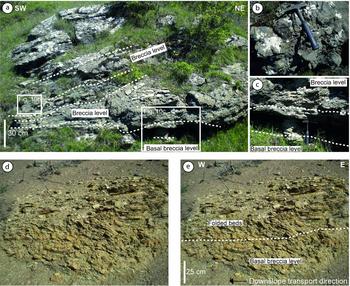
Monomict conglomerate/breccias are interpreted to be the result of the downslope displacement and transformation of a calcarenite slab into a debris flow deposit. Severe stratal disruption usually occurs when a well-bedded rock mass experiences mass transport down a slope. Examples of this process, which leads an initially coherent well-bedded sliding mass to convert to a debris flow deposit, have often been reported (e.g. Cook & Taylor, Reference Cook, Taylor, Cook and Enos1977; Cook, Reference Cook, Doyle and Pilkey1979, Allen, Reference Allen1982, p. 593; López Gamundí, Reference López-Gamundí1993; Hampton, Lee & Locat, Reference Hampton, Lee and Locat1996; Spence & Tucker, Reference Spence and Tucker1997, Bryn et al. Reference Bryn, Berg, Forsberg, Solheim and Kvalstad2005; Alonso et al. Reference Alonso, Gallastegui, García-Sansegundo, Farias, Rodríguez Fernández and Ramos2008; Callot et al. Reference Callot, Sempere, Odonne and Robert2008; Tripsanas et al. Reference Tripsanas, Piper, Jenner and Bryant2008; Alves & Lourenço, Reference Alves and Lourenço2010; Onderdonk & Midtkandal, Reference Onderdonk and Midtkandal2010; Odonne et al. Reference Odonne, Callot, Debroas, Sempere, Hoareau and Maillerd2011; Festa et al. Reference Festa, Dilek, Pini, Codegone and Ogata2012; Ogata et al. Reference Ogata, Mutti, Pini and Tinterri2012; Sobiesiak et al. Reference Sobiesiak, Kneller, Alsop and Milana2016, Reference Sobiesiak, Alsop, Kneller and Milana2017; Fallgatter et al. Reference Fallgatter, Kneller, Paim and Milana2017). According to the literature, this transformation is particularly efficient when blocks, made of thinly bedded, poorly lithified, limestone/shale alternations (such as the calcarenite–shale interval deposits) are involved. Figure 9 illustrates different stages of this process. During the first stage (Fig. 9, stage I), a well-bedded rock mass is disconnected from its original substratum and behaves like a ‘rigid block’ as it starts to slide down the slope under the influence of gravity. The downslope displacement commonly occurs along a basal, bed-parallel, translational surface (basal carpet of Ogata et al. Reference Ogata, Mutti, Pini and Tinterri2012). Generally, a brecciated interval, in the lower portion of the slab, progressively develops. Secondary shear planes can also develop in more unconsolidated levels (Fig. 10a–c). Furthermore, drag along the basal surface may cause the initiation of folding, while maintaining a bedded structure (Fig. 9, stage II). In some cases, the basal brecciated level and the uppermost folded level can coexist (Fig. 10d, e). Progressively, the mobilized mass loses its cohesion because of internal deformation as the water pressure increases. When the shear strength is exceeded, shales tend to form a fluidized matrix, whereas the semi-lithified strata are broken into a series of isolated clasts (Fig. 9, stage III). Outcrops illustrated in Figure 8 show the final product of this process. It is plausible that the transformation of the slide into debris flows begins at the base and along the margins of the mobilized mass, and then propagates progressively to the entire body as the block moves downslope (Hampton, Reference Hampton1972). It has been observed that the rounding of the clasts increases proportionally with the increase in thickness of shale interbeds. This is probably due to the fact that boudinage processes of competent layers are commonly favoured by the abundance of less competent lithologies represented by the shale interbeds (Fossen, Reference Fossen2016, p. 524). In this case, the final product of the slide transformation may be similar to the pebbly mudstones (Pm) because of the textural similarities. Alternatively, when a slab with a high calcarenite/shale ratio is involved, the strata undergo brittle behaviour giving rise to a breccia. Monomict conglomerate/breccias commonly alternate with fine-grained turbidites and matrix-supported breccias. For this reason we ascribe them to the–distal slope (F2) facies association (Table 1).
Idealized downslope model showing the evolution in the generation of monomict conglomerate/breccias (facies Mcb) starting from a calcarenite slab (facies Cs). Note that deformation facies transitionally grade from isolated and folded blocks to a completely broken formation in which no continuity of beds is preserved.

(a) Brecciated intervals alternating with well-stratified beds occurring in a calcarenite slab (Cs) recognized at Pezza La Quagliara. It is probable that during early stages of deformation some levels were plastically folded whereas others remained undeformed depending on the degree of cementation. (b) Close-up observation of the brecciated levels reveals the presence of fold noses indicating a stage characterized by an initial plastic deformation followed by fragmentation. (c) Details of the basal breccia levels. (d) Photograph and (e) interpreted photograph of a folded calcarenite slab, recognized at La Cerchiara, showing a bipartite structure consisting of a folded well-bedded upper portion and a brecciated lower portion. The downslope transport direction is toward W.

4.d. Stratigraphic organization of chaotic lithosomes
The stratigraphic distribution of ChLs through the radiolarite–shale interval can be observed by analysing the vertical trend of facies associations shown in the MFF stratigraphic column (Fig. 11). The radiolarite–shale interval succession can be subdivided into three separate portions. In the lower portion, exposed at La Cerchiara (Fig. 2), distal slope (F2) facies association consisting of Pm bodies alternates with metre-thick fine-grained sediments (Sa and Sh). Very rarely, other ChLs types and coarse-grained facies occur. The entire interval shows a thickness of c. 100 m. In the middle portion, observable between La Cerchiara and Acqua Moricine (Fig. 2), the proximal slope/base-of-fault scarp (F1) facies association is common. Here, Pm frequency is very low whereas metre- to hectometre-sized Cs and Mcb blocks, along with Ol and Csb facies, become the predominant lithofacies. The different lithosomes can be separated by thin packages of radiolarian chert and shale (Ch and Sh) or be in nearly direct contact. The considered interval is 900 m thick. In the upper portion, cropping out at Acqua Moricine, Piano Bellagamba and La Petrara localities (Fig. 2), distal slope (F2) and basin (F3) facies associations are predominant. ChLs show the same textural organization observed in the lowermost interval; the fine-grained sediments dominantly consist of radiolarian chert (Ch) whereas, in contrast to the lower portion, facies Sa and Sh are absent. The thickness is c. 80 m. The described succession shows two main general characteristics: (i) a marked bimodal clast size distribution with peaks corresponding to pebbles/cobbles (centimetres to decimetres) (Fig. 7) and blocks (decametres to hectometres) (Fig. 4a) and (ii) a coarsening-/fining-upward trend. Both characteristics may be interpreted as related to tectonic instability characterizing the MFF basin during the Ladinian and the consequent advance and retreat of the slope-to-basin depositional system. In particular, the bimodal distribution of the clasts testifies that high coarse-grained sediment discharge occurred in the vicinity of the source area that was likely represented by steep cliffs corresponding to active fault planes. The coarsening-/fining-upward trends suggest tectonically related vertical basin floor fluctuations. The initial coarsening-upward trend records a progressive lower-slope (F2) to upper-slope (F1) facies shifting associated with uplift of the area. The subsequent fining-upward trend, testified by a progressive upper slope (F1) – lower slope (F2) – basin (F3) facies evolution, marks the onset of a prolonged period of subsidence, which characterizes the entire Mesozoic to Cenozoic evolution of the Lagonegro Basin.
Conceptual stratigraphic column of the MFF succession cropping out in the study area. The lower portion, which lacks the sandstone–shale and calcarenite–shale intervals, reflects the succession between La Cerchiara and Acqua Moricine localities. The upper portion presents similar characteristics in all the studied sectors. See Figure 3 legend.

4.e. Origin and meaning of chaotic lithosomes
The described ChLs have been recognized in this paper as sedimentary bodies inside layered fine-grained marine strata. Gravity-driven deposits, alternating with undisturbed fine-grained sediments, showing distinctive characteristics such as a chaotic internal arrangement, internal large-sized blocks, erosional basal surface and irregular upper boundaries, imaged in seismic-reflection data or recognized in outcrop, are generally interpreted as mass transport complexes (MTCs), sedimentary mélanges or olistostromes (Pini, Reference Pini1999, p. 335; Festa et al. Reference Festa, Pini, Dilek and Codegone2010, Reference Festa, Dilek, Pini, Codegone and Ogata2012; Shipp, Weimeir & Posamentier, Reference Shipp, Weimeir and Posamentier2011, p. 96). In particular, sedimentary mélanges and olistostromes are considered fossil examples of MTCs (Pini et al. Reference Pini, Ogata, Camerlenghi, Festa, Lucente, Codegone, Yamada, Kawamura, Ikehara, Ogawa, Urgeles, Mosher, Chaytor and Strasser2012). Based on these considerations, and taking into account the data provided in the previous sections, it is possible to interpret the upper portion of the MFF, coinciding with the radiolarite–shale interval, as a mass transport complex. This interpretation is in agreement with earlier works (Wood, Reference Wood1981; Miconnet, Reference Miconnet1988; Martini et al. Reference Martini, De Wever, Zaninetti, Denelian and Kito1989; Marsella, Kozur & D'Argenio, Reference Marsella, Kozur and D'Argenio1993), which considered the MFF as an olistostrome consisting of Early Triassic clasts included in a Ladinian matrix, whereas it contrasts with more recent works (Ciarapica & Passeri, Reference Ciarapica and Passeri2000; Passeri & Ciarapica, Reference Passeri and Ciarapica2010), which regard the Triassic formation as a tectonic mélange or a broken formation. The recognized ChLs show close similarities to other MTCs described in the literature. For example, based on the bimodal clast distribution, it is possible to subdivide the recognized ChLs into two categories similar to types A and B olistostromes proposed by Pini (Reference Pini1999). In fact, the first group, coinciding with Pm, Msb and Mcb, consists of metre- to centimetre-sized fragments floating in a shaly matrix. The second group, comprising Cs, Ol and Csb, displays large blocks ranging from metres to tens of metres. According to Pini's classification, these categories are considered as two end members of olistostrome facies. The first group represents a distal facies occurring downslope, while the second group is the upslope proximal facies counterpart. The recognized characteristics are in general agreement with those defined in sedimentary mélanges or olistostromes (Hsü, Reference Hsü1968; Raymond, Reference Raymond1975; Silver & Beutner, Reference Silver and Beutner1980; Pini, Reference Pini1999, p. 335; Lucente & Pini, Reference Lucente and Pini2003; Camerlenghi & Pini, Reference Camerlenghi and Pini2009). Namely: (i) the complex consists of a mappable unit (at 1:25,000 or smaller scale) widespread in the Campania–Lucania sector of the southern Apennine thrust belt; (ii) it shows block-in-matrix fabric made up of mixed bedded or structureless rocks that were partially or totally consolidated during fragmentation and deposition. Most blocks are exotic and come from different intervals of the MFF (calcarenite–shale, biogenic limestone and sandstone–shale intervals). They display sharp contacts with the surrounding matrix, and either taper laterally or terminate abruptly; (iii) the blocks horizons are developed between layered sequences of normal basinal deposits represented by cherts and shales belonging to the radiolarite–shale interval deposits of the MFF.
4.f. Chaotic lithosomes depositional environment
The integrated sedimentological and structural analysis of the Triassic ChLs recognized in the MFF allows us to relate the radiolarite–shale interval and the overlying cherty limestone – shale interval to a tectonically controlled, strongly subsiding, deep-water basin, bordered by elevated, active, source areas. The facies characteristics and constant association of ChLs with rocks belonging to the Ol, Csb and Msb facies lead us to relate them to base-of-fault scarp/proximal slope – distal slope environments (F1, F2 facies associations). It is hypothesized that the margins of the basin were dominated by catastrophic gravity-flow events, represented by MTDs, and probably triggered by earthquakes related to extensional fault activity during the Ladinian. In fact, as argued by Wood (Reference Wood1981), extensional faults produced typical graben and half-graben structures, which gave rise to an articulated basin floor characterized by fault-rotated blocks. Along the basin margins, fault scarps acted as a line source at the base of which the desegregated detritus was redeposited. Transversal canyons could also have been active, allowing the transport of fragmented material from the innermost areas. A reasonably large proximal source area with high relief is required to explain the occurrence of oversized slide blocks recognized in the study area. It is also plausible that part of the sediments flowed parallel to the fault direction according to the two main measured palaeo-transport directions. A half-graben basin geometry may explain the contemporary coexistence in the basin of sediment coming from both deeper (calcarenite–shale interval) and shallower (biogenic limestone and sandstone–shale intervals) stratigraphic levels.
In this structural context, a large amount of sediment, mainly represented by debris flows, olistoliths and slides, was displaced downslope from the structural highs along the flanks of the basins. During tectonically quiescent periods, the sedimentation in the basin was strongly reduced and limited to the deposition of clays and radiolarites by suspension fallout mechanisms (basin (F3) facies association). The displaced sediments and semi-lithified rocks deformed in different manners during the downslope transport. Commonly, sandy/shale alternations (calcarenite–shale and sandstone–shale interval deposits) behaved in a semi-ductile manner because of the occurrence of the shale interbeds and the low degree of sand lithification. Carbonate deposits (biogenic limestone interval), although younger than sandy/shale alternations, behaved in a brittle manner because of the high degree of lithification achieved during early diagenetic processes. In the first case, the downslope transformation passed through a series of intermediate stages giving rise to a wide range of hybrid-structured rock bodies forming a continuum. For example, calcarenite slabs and the monomict conglomerate/breccias can be considered as the end members produced during the same downslope transformation process. Their recognition provides essential information about the proximal or distal setting occupied by the sliding rock mass on the slope. Calcarenite slabs showing a low degree of transformation in debris flow deposits suggest deposition in a proximal base-of-fault scarp setting. In addition, information is provided about diagenetic features (e.g. the degree of consolidation/lithification) of the rock bodies involved in the mass transport.
5. Evidence for tectonic overprint
In the previous sections, we provided evidence about the sedimentary origin of ChLs in the MFF, which are interpreted as the product of different gravity-driven processes down a depositional slope. Once deposited (Early to Middle Triassic), these lithosomes underwent contractional deformation (starting from the end of the Oligocene), which in several cases hampers their recognition as sedimentary bodies. The study of the structural/textural characteristics shown by Pm clasts, and the comparison between fold trends displayed by Cs and tectonic structures, provides clear evidence for a post-depositional tectonic overprint of ChLs. We now describe in detail the features associated with this later tectonic overprint.
5.a. Tectonic overprint features showed by pebbly mudstone (Pm) clasts
Tectonic deformation of Pm, connected with shearing along the Lagonegro thrust, is outlined by the development of a foliation oblique to bedding in the clayey matrix and by the different behaviour of clasts. These mainly consist of calcarenite, micaceous arenite, carbonate platform-derived limestone, calcite vein fragments and quartzarenite. Rare igneous and metamorphic clasts are also included. Calcarenite, which is the prevailing lithology, contains differing amounts of quartz grains and can range in composition from pure calcarenites to very quartz-rich calcarenites. Clasts behave in a different manner depending on the degree of cementation and the amount of finite strain. Pure calcarenites, well-cemented quartzarenites and platform-derived limestones behaved as rigid clasts because of early cementation. Consequently, clast rotation and asymmetric sigmoid-shaped pressure shadows in the adjacent matrix developed without any evidence of clast deformation (Fig. 12a, b). Conversely, less cemented clasts made up of quartz-rich calcarenites and micaceous arenites as well as calcite vein fragments were stretched, folded and boudinaged (Fig. 12c, d) during the development of the foliation in the clay-rich matrix. Therefore, Pm bodies display both undeformed and deformed clasts, given their polymictic composition (Fig. 12e).
Tectonic overprint features shown by pebbly mudstone (Pm) clasts. (a) Well-cemented platform-derived limestone clast (biogenic limestone interval) included in a deformed shaly matrix. (b) Well-cemented calcarenite fragment (calcarenite–shale interval) behaving as rigid clasts, showing rotation but no internal deformation, recognized at La Cerchiara. Clast contains a pre-incorporation beef-calcite vein. (c) Poor-cemented quartz-rich calcarenite clasts stretched and flattened when involved in contractional tectonics. (d) Deformed quartz-rich calcarenite clast showing a sense of shear consistent with the southern Apennine contractional deformation. (e) Pebbly mudstone bodies displaying both undeformed and deformed clasts, reflecting their polymictic composition. 30 cm long hammer for scale.

5.b. Comparing tectonic and depositional structures
Folding is a process that usually takes place as a consequence of either regional contractional tectonics or depositional slope failures (e.g. Ortner, Reference Ortner2007). The study of fold axis trends in contractional tectonic contexts may provide useful information about the regional stress field acting in a given area. Alternatively, slump folds are used to infer the palaeoslope dip-direction (see Woodcock, Reference Woodcock1976, Reference Woodcock1979; Strachan & Alsop, Reference Strachan and Alsop2006; Debacker, Dumon & Matthys, Reference Debacker, Dumon and Matthys2009; Alsop & Marco, Reference Alsop and Marco2012 for reviews). When fold axes related to these two different phenomena are nearly coaxial in the same area, recognizing the original gravity-driven structures might be very challenging (e.g. Elliott & Williams, Reference Elliott and Williams1988; Collinson & Thompson, Reference Collinson and Thompson1989, p. 207; Blewett, Reference Blewett1991; Paterson & Tobisch, Reference Paterson and Tobisch1993; Maltman, Reference Maltman and Maltman1994; Waldron & Gagnon Reference Waldron and Gagnon2011; Korneva et al. Reference Korneva, Tondi, Jablonska, Di Celma, Alsop and Agosta2016). In the MFF, recognition of the sedimentary origin of the ChLs is often prevented by the contractional tectonic overprint. Therefore, in order to better support their sedimentary origin, a comparison between the regional direction of tectonic shortening and the shortening direction deduced by the measurement of folds within calcarenite slabs has been performed (Fig. 13a, b). The hypothesis is that, even though folds generated by sedimentary or tectonic processes might display similar geometry, their orientation and the related shortening direction might be different. In fact, tectonically related structures should reflect the regional tectonic strain that is related to the building of the southern Apennines during the Early to Middle Miocene. Conversely, transport direction deduced from the gravity-induced structures should be roughly parallel to the Middle Triassic palaeoslope.
(a) Simplified geological map of the Sasso di Castalda area. Red arrows indicate the mean direction of tectonic transport. Measurement stations for the calcarenite slabs palaeocurrents are also indicated. (b) Stereoplots (equal-area, lower hemisphere) summarize the trends of calcarenite slabs fold axial planes, which provide a general top-to-the-S-or-SW sense of transport. These trends are not consistent with the main tectonic transport direction observed at regional scale.

5.b.1. Regional tectonic structures
The tectonic deformation recorded in the study sector of the southern Apennine thrust belt has long been recognized, and average NE–SW and E–W shortening directions have been established (Mazzoli, Reference Mazzoli1992; Cello & Mazzoli, Reference Cello and Mazzoli1999). However, in order to consider local tectonic stress variations, a series of structural data have been collected and analysed in the study area. Here, the tectonic transport direction is mainly provided by fold asymmetry, reverse fault/thrust planes, parasitic folds and S-C tectonites. Since a distinction between gravity-induced and tectonic-related folds is sometimes difficult to achieve in the field, we focused on the study of contractional faults and S-C tectonites found along the main shear zones. These data were collected from two representative sites located at Acqua Moricine and Pezza la Quagliara, respectively (Fig. 2). At Acqua Moricine, where the succession displays lithological heterogeneity (Fig. 14a), a series of reverse faults mark the main lithological boundaries. Consequently, well-defined fault planes and associated S-C tectonic fabrics develop. Reverse faults commonly display very sharp surfaces on which dip-slip slickensides and calcite steps are often recognized. Faults are characterized by intense and pervasive S-C fabrics affecting all the involved lithologies (Fig. 14b). W- and WSW-dipping thrusts indicate a general top-to-the-E-ENE sense of shear (Fig. 14c) consistent with S-C tectonic fabrics developed within the pebbly mudstones intervals. Indeed, the pebbly mudstones matrix is often laminated and striated, whereas the isolated clasts show a sigmoidal shape giving a general top-to-the-E-ENE sense of transport. Clast rotation and pressure shadows, whose orientation is consistent with the same shear sense, have also been recognized (Fig. 14d).
(a) Contractional tectonic structures recognized at Acqua Moricine. (b) Pebbly mudstone clasts deformed as a consequence of contractional stress along the main thrust plane. The sigmoidal shape of the clasts provides a general top-toward-NE sense of shear, consistent with the main contractional orientation of the southern Apennine thrust belt. (c) Stereoplots (equal-area, lower hemisphere) summarize the trends of the recognized thrust planes which provide a general top-to-the-E sense of shear. (d) Deformed pebbly mudstone clasts showing clasts rotation and pressure shadows. (e) Contractional tectonic structures recognized at Pezza La Quagliara. The succession consists of alternating radiolarian cherts and pebbly mudstones deformed by the regional contractional tectonics. (f) Detail of pebbly mudstones showing a rigid calcarenite clast with pressure shadows in the surrounding shales.

At Pezza la Quagliara, contractional deformation is mainly concentrated along bedding discontinuities and radiolarite/pebbly mudstone interfaces (Fig. 14e). Kinematic indicators, represented by S-C tectonites and asymmetric pressure shadows around rigid clasts, indicate an average top-to-the-ENE sense of shear (Fig. 14f). In summary, the described structures are consistent with the general tectonic transport direction measured for the southern Apennine thrust belt, which mainly consists of NE- to E-vergent thrusts (Mazzoli, Reference Mazzoli1992; Cello & Mazzoli, Reference Cello and Mazzoli1999).
5.b.2. Gravity-driven syndepositional structures
Gravity-driven structures are represented by asymmetric folds formed at the toe of the slides involving the calcarenite slabs (facies Cs). Well preserved examples, exposed between the La Cerchiara and Pezza La Quagliara areas, have been shown in the previous section (Figs 6, 10). Palaeoslope analyses indicate that gravity-driven structures are not chaotic despite their complex appearance in outcrop (Alsop et al. Reference Alsop, Marco, Levi and Weinberger2017). In particular, two main trends of fold axial plane orientations can be discerned (Fig. 13b): (i) W–E-trending fold axial planes have mostly been recognized between the La Cerchiara and Pezza La Quagliara areas. Fold asymmetry indicates a southward sense of vergence; (ii) NNW-SSE-trending fold axial planes have been recognized in the Pezza La Quagliara and Acqua Moricine areas. In the latter case, fold asymmetry provides a WSW sense of vergence. Therefore, the orientation and asymmetry of gravity-driven folds appears to be not consistent with the NE–SW and E–W orientation of tectonic shortening acting at a regional scale during the construction of the southern Apennine thrust belt.
The two sets of gravity-driven folds can be interpreted in two different ways. These may reflect the variable trend of the palaeofault scarp, or alternatively they reflect the reorientation of fold axes during downslope translation. In fact, at the toe of submarine landslides, fold axes are initially oriented perpendicular to the downslope direction, but with continued movement they may rotate and become almost parallel to the downslope direction (Debacker, Dumon & Matthys, Reference Debacker, Dumon and Matthys2009; Alsop & Marco, Reference Alsop and Marco2013). In addition, since arenaceous clasts are sourced from the sandstone–shale interval in the La Cerchiara area, a northward-oriented paleoslope direction is suggested. In conclusion, by comparing the directions of transport provided by both depositional and tectonic structures, two distinct trends are observed. In particular, southwest- and south-directed gravity-driven structures may provide information about the Triassic palaeoslope.
6. Discussion and conclusion
Chaotic lithosomes are recognized worldwide as the result of either sedimentary or tectonic processes occurring in different geodynamic settings along continental margins (Festa et al. Reference Festa, Dilek, Pini, Codegone and Ogata2012). They commonly form part of thick block-in-matrix units variously described in the literature as sedimentary and tectonic mélanges, olistostromes and megabreccias. ChLs, resulting from the superposition of tectonic, sedimentary and diapiric processes, represent an additional complexity which can produce polygenetic mélanges s.l. (Codegone et al. Reference Codegone, Festa, Dilek and Pini2012) or tectono-sedimentary mélanges (sensu Festa et al. Reference Festa, Pini, Dilek and Codegone2010). In these cases, recognizing mélanges produced by the complex interaction and superposition of different processes is challenging, as the final rock mass mainly shows the characteristics acquired during the final stages of mélange formation.
ChLs occurring in the MFF have previously been interpreted to be the result of either sedimentary or tectonic processes, and the two conflicting interpretations have led to contradictory models. In the sedimentary interpretation of the MFF suggested by the early authors (e.g. Wood, Reference Wood1981; Miconnet, Reference Miconnet1988; Martini et al. Reference Martini, De Wever, Zaninetti, Denelian and Kito1989; Panzanelli Fratoni, Reference Panzanelli Fratoni1991; Marsella, Kozur & D'Argenio, Reference Marsella, Kozur and D'Argenio1993), ChLs are considered as gravity-induced deposits. Alternatively, more recent authors (e.g. Ciarapica & Passeri, Reference Ciarapica and Passeri2000; Passeri & Ciarapica, Reference Passeri and Ciarapica2010) note the strong tectonic signature and suggest a tectonic origin. The data presented in this paper show that both sedimentary and tectonic processes acted to produce the studied ChLs. These rock bodies, identified in the MFF, mainly consist of Early Triassic folded calcareous beds (Cs), pebbly mudstones (Pm) and monomict conglomerate/breccias (Mcb). We propose that ChLs were initially emplaced as MTDs along a passive margin during the Middle Triassic (Fig.15a) and were then successively deformed by the southern Apennine orogenic contractional tectonic stages which started in the Oligocene (Fig.15b). This leads us to interpret the upper portion of the MFF as tectono-sedimentary mélanges, which reflects the history of opening and the successive closure of the Neo-Tethyan Ocean and the adjacent Lagonegro Basin. Some of the general criteria that have been used to support this hypothesis are: (i) ChLS bodies which have not been affected by contractional deformation are always included in a relatively undeformed, laminated, shaly matrix; (ii) deformational features such as fold and faults produced during sedimentary processes are not consistent with those derived from the regional contractional tectonics (Fig.15a, b); (iii) ChLs commonly show different textural and structural characters reflecting either sedimentary or tectonic processes (Fig.15c, d).
Simplified sketches showing the tectono-stratigraphic organization of the Monte Facito Formation during the Meso-Cenozoic extensional and contractional stages which led to the building of the southern Apennine thrust belt (not to scale). (a) In the Middle Triassic, the MFF deep-water deposits were deposited at the base of steep fault scarps. Coarse-grained sediments were fed by the underlying MFF shallow-water deposits. Half-grabens provided the necessary accommodation space. (b) During the Miocene contractional stages, the MFF acted as detachment level for the main thrusts developing in the Lagonegro Basin succession. (c) Pebbly mudstones deposited during the first extensional stage show a typical debris flow structure characterized by randomly oriented clasts floating within an isotropic matrix. (d) Where overprinted by tectonics during the second contractional stage, pebbly mudstones are deeply modified and show clast reorientation and a scaly fabric matrix.

Acknowledgements
We are very grateful to Dominic A. Armitage, Lorena G. Moscardelli and three anonymous referees for their critical reviews and suggestions that helped improve this paper.
Declaration of interest
None.