
The geisha is an elusive, often problematic, figure in the historiography of modern Japan. Her image—as a symbol of Japan, tradition, or “Oriental” femininity—has a robust presence in scholarly literature. Several recent studies examine how the figure of the geisha was constructed in movies, novels, paintings, and prints on both sides of the Pacific (Allison Reference Allison2001; Kawaguchi Reference Kawaguchi2010; Matsugu Reference Matsugu, Feldman and Gordon2006; Peabody Essex Museum 2004; Shibusawa Reference Shibusawa2006). But flesh-and-blood geisha—eighty thousand of them, according to a 1925 count (Garon Reference Garon1998, 94)—rarely appear as protagonists in historical scholarship on modern Japan. When they do materialize, it is usually in the context of the social problems they presented for bureaucrats and middle-class reformers: they are notorious criminals who shocked contemporaries’ sensibilities (Johnston Reference Johnston2005; Marran Reference Marran, Miller and Bardsley2005) or anonymous women who were assigned licenses and occasionally tested for venereal diseases (Burns Reference Burns1998; Fujime 1997; Garon Reference Garon1998).Footnote 1 In both the vast literature on their image and the smaller body of scholarship on their history, geisha are positioned as the antithesis of ordinary, matronly women.
But geisha were not always so easily categorized. During the Tokugawa period (1600–1868), they were a heterogeneous group of entertainers—not all of them women—whose business was closely associated with the brothels and teahouses of the demimonde. The first geisha were men who entertained at parties in Yoshiwara, the famous “pleasure quarter” in the shogunal capital of Edo. In the mid-eighteenth century, female dancers and musicians borrowed the appellation and began to offer their services at gatherings in various city neighborhoods. The women who called themselves “geisha” shared little other than at least a minimal level of artistic accomplishment. Most were indentured to geisha houses (okiya), but some town geisha (machi geisha) lived with their parents. They also engaged in prostitution to varying degrees. Because brothel keepers in Yoshiwara feared that geisha would poach their clients, geisha who worked in that quarter insisted that they did not sell sex. But those in the tacitly sanctioned entertainment district of Fukagawa, where the brothel keepers’ association was less powerful, were notorious for “rolling over” (Seigle Reference Seigle1993, 170–72).Footnote 2 As the craze for female banquet entertainers caught on across the archipelago in the nineteenth century, the difference between prostitutes and geisha (or geiko, as they were often called outside Edo) could be difficult to discern. An encyclopedia published in Echigo described Niigata geiko who sold “both their musical arts and their bodies” (Odajima 1936, 464).Footnote 3
For Meiji-era intellectuals, who were among the first to imagine a coherent group of geisha and invest them with symbolic significance, geisha's involvement in prostitution posed a problem. Prominent thinkers, such as Tsuda Mamichi, Mori Arinori, and Fukuzawa Yukichi, argued that Japan would have to adopt Anglo-American norms of sexual morality in order to join the ranks of “civilized” Western powers. They extolled the virtues of monogamy and deplored the social and cultural prominence of the sex trade. In 1875, the governor of Kobe Prefecture summed up their position when he issued an official notice that read, in part, “the decline of prostitution is the advance of enlightenment; the flourishing of prostitution is an obstacle to civilization” (Hitomi 2007, 44). Intellectuals of this group took a dim view of geisha, whom they associated with the backward customs of the recent past. Mori disparaged both geisha and prostitutes as low-class “bought women” who were unsuitable companions for the prominent men who took them as concubines (Braisted Reference Braisted1976, 105). Fukuzawa's assessment was even more extreme. In a series of essays penned in 1885, he suggested that geisha, like prostitutes, were such an embarrassment to the nation that they should be “ostracized from human society and barred from association with honorable people” (Fukuzawa Reference Kiyooka1988, 100).
Early feminists also regarded the popularity of geisha as a blight on Japan's reputation in the world and an obstacle to its pursuit of civilization. The educator Tsuda Umeko, who had spent her formative years studying in the United States, so resented the “women of doubtful reputation” who achieved prominence as statesmen's wives that she proposed to form an anti-geisha society. In her opinion, geisha impeded women's progress because they monopolized the attentions of high-status men and blocked “respectable” young ladies’ access to social authority (Rose Reference Rose1992, 47). Later, the feminist activist Ishimoto Shidzue deplored the existence of a class of women who specialized in catering to men's desires, sexual and otherwise, arguing that geisha threatened monogamous marriages, perpetuated women's oppression, and confirmed every despicable Western stereotype about submissive “Oriental” women. Although she expressed sympathy for geisha's plight, she concluded that they, like low-class prostitutes, were “enemies of civilization in Japan” (Ishimoto Reference Ishimoto1994, 293).
But in the early 1870s, women who were called or called themselves “enlightened” (kaimei or kaika) geisha engaged in a number of activities that were widely regarded as civilized. They read newspapers, attended school, donated money to educational institutions, and even sewed police uniforms. In one sense, the sudden appearance of enlightened geisha is not surprising. In the 1870s, the phrase “civilization and enlightenment” (bunmei kaika) was so ubiquitous that it was nearly meaningless. Intellectuals invoked the phrase to describe reactionary as well as progressive positions, and shopkeepers used it as a marketing slogan (Howell Reference Howell2005, 156; O'Brien Reference O'Brien2008). Since geisha were known for being trendy, their claim to be “enlightened” can be understood in this context, as a ploy to attract publicity by positioning themselves on the vanguard of a social transformation (O'Brien Reference O'Brien2008, 1333). But the “enlightened geisha” was not only a stylish pose; it was also part of a broader attempt by sex trade proprietors and employees to cast some of their traditional endeavors—including education and fundraising for civic projects—in new language. Their effort, which was led by teahouse masters in Kyoto's glamorous neighborhood of Gion, associated geisha with the values of enlightenment and separated them from the masses of “barbarous” urban poor, including low-class prostitutes and streetwalkers. Along the way, it articulated enduring ideas about the value and purpose of women's education. Geisha who claimed that they were pursuing knowledge to prepare for the future, like proprietors who insisted that schools could transform their employees into productive and moral mothers, anticipated the arguments of intellectuals and bureaucrats who hoped to create “good wives and wise mothers” (ryōsai kenbo) in the late Meiji period.
Considering geisha's and teahouse masters’ roles in constructing the ideal of the educated wife and mother yields insight into how elements of the Tokugawa past were used in the creation of Meiji modernity. It also raises the possibility of reassessing some of the social transformations ordinarily attributed to the efforts of the Meiji state. This may seem counterintuitive, since studies of the sex trade in this era often emphasize the overwhelming power of the state to harness female labor and inculcate new norms of sexual morality. Studies of the “good wife, wise mother” ideal, too, address the state as a central actor that disseminated its ideology through public schools and official publications (Molony Reference Molony, Bernstein, Gordon and Nakai2005; Nolte and Hastings Reference Nolte, Hastings and Bernstein1991; Uno Reference Uno, Molony and Uno2005).Footnote 4 But as Carol Gluck points out, in the early 1870s the central government could not fund many of its stated goals. Thus “an examination of the actual processes of modernizing change reveals a much more diverse cast of protagonists than appears in either the self-proclaimed or the conventionally identified accounts of Japanese history” (Gluck Reference Gluck2011, 683). In this case, the protagonists are people more often regarded as targets of reform than reformers. Threatened by the prospect of a stronger state that would declare them uncivilized and outlaw their business, they responded with a project that addressed some of the shortcomings in the state's power: they donated money to schools and embarked on their own privately funded mission to create ideal women for a new age.
The Sex Trade and the Crisis of Enlightenment
The late Tokugawa period was a time of unprecedented prosperity for the sex trade. As an emerging market economy enriched provincial commoners, their demand for sexual services skyrocketed, and new brothel districts sprung up in post stations, pilgrimage sites, and port towns across the archipelago. Theoretically, the Tokugawa shogunate limited prostitution to a few designated “pleasure quarters” (yūkaku) in its great cities. But in reality, samurai officials permitted the business to expand because they believed it was an engine of economic development and a necessary source of employment for the poor. Typically, brothel keepers and okiya proprietors faced scrutiny only if they used illegal methods of procurement, harbored criminals, or operated too conspicuously during reform eras. In many areas, local officials were so dependent on brothel keepers for tax revenue that they were unwilling to impose restrictions on their business (Stanley Reference Stanley2012).
But soon after the Meiji Restoration, critics of the prevailing labor pattern in the sex trade enjoined the government to reassess its policy. They objected to the industry's widespread use of indenture contracts, which obligated young girls to work for a set number of years in exchange for an advance payment to their parents, on the grounds that they deprived women of their liberty. This argument gained traction when a British lawyer raised a similar point during a court case about an unrelated issue: the fate of 230 Chinese “coolies” whom the Meiji government had liberated from a Peruvian vessel docked in Yokohama. The Japanese judge had ruled that the men were held in bondage, which was impermissible under Japanese law; the lawyer, who represented the ship's captain, cited the example of prostitution to argue that the law actually permitted such labor arrangements. This contention, issued in the midst of a closely watched legal proceeding, demanded a quick response from officials who were already in the process of reviewing their policy on prostitution. On the second day of the tenth month of 1872,Footnote 5 the Grand Council of State (Dajōkan) promulgated the “Edict for the Liberation of Geisha and Prostitutes” (Geishōgi kaihōrei), nullifying all existing contracts for work in the sex trade. A week later, the Justice Ministry proclaimed that the newly liberated women, like the “cows and horses” held in a similar state of bondage to their masters, were not responsible for their debts (Botsman Reference Botsman2011, 1337–42; Hayakawa 1998, 189–96).
This series of legal innovations inspired panic among brothel keepers and okiya masters because it destroyed the labor arrangement that allowed their business to function. In Tokyo, proprietors from Yoshiwara, Nezu, and other formerly sanctioned districts complained that “liberated” women were selling themselves on the streets, or their parents were sending them out to work, bypassing the former brothels and destroying their business. Several establishments closed (Hayakawa 1998, 199–200). But only months later, the Meiji government issued a new set of laws allowing prefectures to license prostitution, and most brothels reopened as sanctioned, tax-paying “room rental establishments” (kashizashikigyō). Many prostitutes returned to their former employers because they could not legally support themselves as independent operators (Burns Reference Burns1998, 18–19). Since establishments were able to rehire women on similar terms, the major effect of the 1872 laws was not to abolish prostitution but to reorganize the business under the auspices of the prefectures. Nevertheless, the shock of the liberation edict forced sex trade proprietors to realize that their livelihoods could be threatened at any moment by the stroke of a pen in a government office.
Another effect of the edict was to create a stable legal category of “geisha” (or geigi, in legal parlance), who were now understood to be female entertainers held to contracts. (The law ignored the dwindling ranks of male geisha.) However, the difference between geisha and prostitutes remained ambiguous. For the purposes of “liberation,” which aimed to reform labor practices rather than eradicate prostitution, there was no need to make a distinction: both types of women were procured via the same mechanisms and held to the same contractual terms.Footnote 6 Moreover, many municipal governments categorized geisha and prostitutes together because their employers resided in the same city neighborhoods and shared networks of procurers and enforcers. For example, early Kyoto prefectural decrees addressed the “three businesses” (sansha) of the sex trade: okiya, teahouses, and brothels (Kyōto-shi 1974, 374). The new regulatory regimes established in the wake of the edict offered an opportunity for prefectures to draw new distinctions, but these were inconsistent. Kyoto continued to confine both geisha and prostitutes to the same districts, but Tokyo administrators determined that geisha, who were “beautiful” and sold their art, should be distinguished from common prostitutes and allowed freedom of residence (Hayakawa 1998, 201).
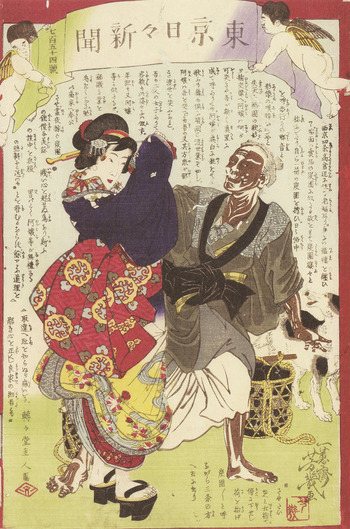
The cultivation of art and beauty privileged some geisha over prostitutes, but it did not assure them a place within the shifting boundaries of civilization. As David Howell (Reference Howell2005, 163–65) explains, in the early Meiji period, official notions of barbarity (yaban) expanded to encompass large numbers of the urban poor, who were perceived as lazy because they did not work at settled occupations. Geisha's sophistication differentiated them from manual laborers and streetwalkers, but if prostitution itself was uncivilized, then a high-class geisha—even one who sold sex indirectly and to an exclusive clientele—was as barbarous as the poorest, dirtiest peddler. An illustrated newspaper print published by the Tōkyō nichinichi shinbun in 1874 dramatized this point by depicting a tense encounter between a magnificently attired Kyoto geisha and a barefoot, soot-covered crone selling coal (Figure 1). The text explained that the geisha had stopped in the street to laugh at the old woman, who had responded: “What's so funny? I'm all black and selling coal, and you're all white and selling songs and dances. Seems like the same business to me. You're laughing at me, but I'm not laughing at your vulgar trade. . . . I've got two daughters . . . but I won't let them do something so disgusting. I'm going to put them in service at an honest (katai) merchant's house” (Chiba-shi bijutsukan 2008, 95).
A newspaper print published by the Tōkyō nichnichi shinbun depicts a tense encounter between a haughty Kyoto geisha and a soot-covered crone selling coal. Tokyo nichinichi shinbun no. 754 (July 27, 1874) (Chiba-shi bijutsukan 2008, 94).
The coal-seller's criticism of the “disgusting” geisha might have been a veiled reference to venereal disease, which was another concern of bureaucrats who denigrated the sex trade as uncivilized. Following precedent established in treaty ports, where foreigners had demanded that the prostitutes who served them be tested for syphilis, local officials had begun to implement mandatory medical examinations for licensed prostitutes. In some areas, geisha were also required to undergo testing, but typically they were either exempt or required to submit to inspection less often, a fine distinction that reflected officials’ uncertainty about the difference between geisha and prostitutes. Typically, these examinations took place in hospitals funded by taxes on sex trade businesses, which could include okiya and teahouses as well as brothels (Burns Reference Burns1998; Fujime 1997, 138–39).
Hospital funding was a new type of imposition on sex trade proprietors, but the idea that they should contribute to civic projects had a long history. Traditionally, levies on brothel keepers had provided for the purchase of horses at highway post stations, subsidized the operating budgets of small harbor towns, and even paid for the construction of theaters (Stanley Reference Stanley2012). In the years before the liberation edict, Kyoto brothels and teahouses (along with sumo stables and theaters) had contributed money to a vocational training center (jusansho) for the city's poor (Kyōto-shi 1974, 375). Building and supporting hospitals could be construed as a type of public service in this tradition, one that showcased the proprietors’ generosity, differentiated them from the masses of “barbarous” urban poor, and associated them with the values of civilization and enlightenment. In 1871, proprietors in Kyoto's Gion neighborhood, which was famous for its high-class teahouses and geisha, cooperated with local officials to fund the nation's first infirmary for syphilis patients (561).
But endeavors like these came at the price of associating the sex trade with filth and contagion, exposing proprietors to the criticism that their business undermined the health and prosperity of the nation (Burns Reference Burns1998, 19–21). For those who made a living in prostitution and related businesses, this was the central political dilemma of the 1870s. The turn to “civilization and enlightenment” offered new projects in need of funding, and these provided sex trade proprietors with opportunities to continue their strategy of protecting their status through donations to projects deemed priorities by local officials. But these priorities were now expressed in the same terms that denigrated their business. As work related to prostitution was defined as backward, sophisticated teahouse proprietors realized that they could not continue to let their money speak for them. They would have to learn to speak the language of “civilization and enlightenment” for themselves.
The Gion School for Geisha and Prostitutes
Teahouse masters’ attempt to couple civic engagement with enlightenment rhetoric was most visible in Kyoto, where the crisis precipitated by the emperor's departure for Tokyo created unique opportunities for prominent townspeople to shape the post-Restoration order. The city's population had declined sharply during the political violence of the 1860s, and it fell another 8 percent in the year following the permanent transfer of the capital in 1871 (Kyōto-shi 1974, 35–36). Kyoto's artisans, who produced specialty items such as dyed cloth, fans, and harnesses, were devastated as the Kyoto “brand” lost its cachet among provincial consumers who had once paid a premium for products associated with the throne. Kyoto Prefecture's chief counselor (daisanji), Makimura Masanao, planned to rehabilitate the city by promoting industry and showcasing new, “enlightened” civic projects, but he faced opposition from the city's remaining nobles, many of whom opposed any move toward Western-style reform. To counter their influence, he turned to wealthy townspeople for support (Kobayashi 1998, 92–96). Among them were the proprietors of high-class teahouses, where Makimura was a frequent guest. His close ties to famous establishments in Gion facilitated a number of collaborations on quasi-public initiatives.
The most successful ventures were in the realm of education. Makimura was determined to make Kyoto the leader in a countrywide effort to establish community schools (gokō), which were intended to admit children from a variety of status backgrounds and prepare them to build a prosperous, modern nation (Platt Reference Platt2004, 112). Sex trade proprietors were well-suited to contribute to this endeavor, since their establishments had long been sites of education for women. In the Tokugawa period, literacy had been essential to the most accomplished prostitutes and geisha, who were expected to display wit and erudition. Traveling book lenders visited high-class okiya and brothels, and several woodblock prints of the “pleasure quarters” depicted prostitutes reading books (Kornicki Reference Kornicki1980, 332). Low-class brothel prostitutes were not expected to read and write, but they were often required to entertain their guests by singing or playing instruments. Since girls procured from poor families were unlikely to have learned these skills at home, most brothels had to invest in instruction. Even foreigners, who ordinarily professed revulsion at the easy acceptance of prostitution among the Japanese populace, noted that brothels imparted useful skills to their employees. J. M. V. Silver, a British lieutenant in the Royal Marines who was posted on the archipelago in the mid-1860s, explained, “Generally speaking, when young girls find themselves a burden to their parents, they seek employment in the tea-houses, where they are well looked after and instructed in various accomplishments, for which they serve a certain apprenticeship, and at its expiration generally marry, as girls so educated are eagerly sought after” (Silver Reference Silver1867, 11).
Chief Councilor Makimura, later praised by proprietors as a man who “knew what was what in the pleasure quarter” (“Kyōto Pontochō” [1909] 1986, 172), was familiar with this tradition. When he needed funding to build schools, he turned to Sugiura Jirōemon, Gion's ward headman and the master of its famed Ichiriki teahouse. According to a later account, Makimura ensured the proprietor's support by suggesting that other wards could not look down on Gion if it took the lead in promoting education. Sugiura responded quickly, leveraging his position as headman to convince proprietors to contribute funding and space. Yasaka Elementary, named for nearby Yasaka Shrine, opened in the seventh month of 1869 with Sugiura as its principal. It was one of the city's (and the nation's) first public schools (“Yasaka shōgakkō” Reference Shigeki[1910] 1979, 196–97).
After this initial success, Gion proprietors continued to work with Makimura to promote new educational initiatives. Their most famous undertaking was the construction of a “school for womanly arts” (jokōba or nyokōba, as it was commonly pronounced in Kyoto) for the 413 geisha and forty-five prostitutes of their quarter. The ward submitted a plan for the school to the prefectural government in the tenth month of 1872, less than two weeks after the Council of State promulgated the liberation edict. The timing was not a coincidence. According to a history of a nearby entertainment district, Pontochō, proprietors were responding to an “official opinion” (goshui) urging them to prepare their employees to work in “legitimate trades” (seigyō) (“Kyōto Pontochō” [1909] 1986, 172–73). The Gion ward proposal, which was submitted for publication in the Kyōto shinbun in the eleventh month of 1872, borrowed the language of prostitution's critics, calling the sex trade an “evil custom of the past” (jūrai no heifū). But it redirected the reader's attention from proprietors’ business practices to the necessity of reforming geisha and prostitutes as individuals. The proprietors argued that a school of womanly arts would prepare them to engage in “legitimate trades” and thereby “support themselves and benefit the world” (shokuryoku ekisei) (“Fujo shokkō” 1872; Shinbun shūsei 1972, 1:516).
In the context of Kyoto city politics, this mission statement had a special resonance. Phrases similar to “self-supporting and benefitting the world” appeared in Makimura's declarations advocating for Kyoto's traditional industries and promoting the city's economic rehabilitation. By extolling the virtues of self-sufficiency, Makimura hoped to change the mindset of the city's artisans, who could no longer rely on the Kyoto “brand” or the imprimatur of the emperor to sell their wares. At the same time, he was responding to critics in the central government who alleged that his administration coddled commoners with charity rather than requiring them to earn their own living (Kamada Reference Tatsusaburō1979, 340–47). The Gion proprietors’ proposal matched Makimura's tone perfectly, and it also promised to further his agenda. By offering courses in sewing, silkworm cultivation, cotton spinning, the production of cotton thread and silk floss, kanoko dyeing, and knitting (meriyasu), the Gion school would replicate the prefecture's economic policy, which encouraged investment in textile industries. It would also serve as a showcase for the new, self-sufficient Kyoto, in which even geisha would contribute to the city's manufacturing output.
At the same time, the school's proposed curriculum reflected new, transnational ideals of feminine domesticity that were circulating among members of the city's elite. In the late nineteenth century, girls in places as diverse as Tehran, Istanbul, and the Nord region of France attended schools to study embroidery and painting. These schools had a dual purpose: they purported to prepare women for the aesthetic and practical responsibilities of homemaking, but they also imparted technical skills that allowed them to contribute their labor to regional and national manufacturing sectors (Alaimo Reference Alaimo1994; Najmabadi Reference Najmabadi2005; Walker Reference Walker1886, 223). In Kyoto, a school for womanly arts, the Shin'ei nyokōba, had opened a few months before the Gion proprietors submitted their proposal. It taught English, along with Western techniques of embroidery and knitting, Japanese handicrafts, and sericulture. Members of Kyoto's elite, convinced that women of all classes would need new skills to contribute to the national goal of creating a “rich country, strong army” (fukoku kyōhei), eagerly enrolled their daughters, and the school became extremely popular among well-bred young women (Kinugasa 1983, 349). The Gion plan built on the success of this model, adding a few flourishes appropriate to the business of geisha and prostitutes, including proposed courses in hairpin- and shamisen-making. By following Shin'ei's precedent, the proprietors suggested that women who worked in entertainment districts were worthy aspirants to the same ideal promoted for courtiers’ daughters: an aesthetically pleasing, potentially remunerative mode of domestic competence, achieved through careful education rather than hard experience.
In response to the anticipated objection that their ambitious agenda would be wasted on geisha and prostitutes, the Gion proprietors provided a new rationale for educating women. “One might say that these are only women from the floating trade,” they wrote, “but today's geisha and prostitutes are tomorrow's mothers, and they will be responsible for teaching their children to discern right from wrong” (“Fujo shokkō” 1872). By locating prostitutes’ and geisha's value in their imagined future as mothers, rather than their present activity as earners, the proprietors’ statement departed from Tokugawa-era vindications of work in the sex trade, which had portrayed prostitutes as filial daughters supporting their parents. It was also a move away from earlier justifications of education for women, which had focused on the necessity of preparing for marriage and household management rather than childrearing. Even the progressive Shin'ei school followed this model: its charter indicated that raising children was only one of many duties expected of the “good women” (ryōfu) it hoped to create. The others included obeying one's parents, serving one's husband, and managing the affairs of the household (“Nyokōba kaigyō no kokuji” [1872] 1972). The Gion proprietors, in contrast, narrowed their focus to the intimate relationship between mother and child, elaborating on the bleak future facing children whose frivolous mothers never taught them to work hard. By assigning to women the task of teaching children moral and productive behavior, the Gion proprietors picked up on an argument that was just beginning to gain currency among Tokyo intellectuals. For example, Mitsukuri Shūhei's 1875 contribution to Meiroku zasshi warned that children would become “ignorant and delinquent” unless their parents, and specifically their mothers, were trained to understand the importance of education. This, he argued, could best be accomplished by “actively establishing girls’ schools and devoting our energies to educating girls” (Braisted Reference Braisted1976, 108).
By focusing on geisha's and prostitutes’ fitness as mothers, rather than wives or household managers, the Gion proprietors presented a rationale for educating all women who had the capacity to bear children, rather than just the smaller number who would go on to be mistresses of households. Under the circumstances, however, this was less a bold statement of principle than a pragmatic attempt to appeal to the proposal's intended audience: the elite men who ran the prefectural government, patronized upper-class geisha, and read the Kyōto shinbun. Men of this stature often took geisha as concubines rather than marrying them outright, so some of the mothers of their children were not and would never be “good wives” serving the household.Footnote 7 The Gion headman Sugiura Jirōemon knew this from his own experience. His daughter, Oyū, was the finance minister Ōkubo Toshimichi's concubine and mother to four of his sons (Sasaki 1984, 250–56, 267). In this context, stressing education's potential to create good mothers rather than competent wives was a canny strategy; it would have appealed to men who considered geisha's fitness to raise children a matter of personal as well as national importance.
The Gion proprietors’ proposal was quickly accepted, and the Gion school (later known as the Yasaka nyokōba) opened to great fanfare in early 1873, supported by a combination of public and private funding. Residents of the ward formed a new corporation to purchase the land for the school, and the prefecture supplied additional operating costs, designating half the tax revenue collected from Gion's sex trade proprietors for that purpose (Matsuda 2010). The final version of the school's curriculum represented a compromise between the enlightenment ideals expressed in the initial petition and the type of vocational education actually required of geisha and prostitutes. A plan published in the Kyōto shinbun in 1874 revealed that the corporation had purchased land for an auxiliary campus on which it hoped to build a stage for dance practice (kaburenjo) (Kyōto shinbun May 1874).
But the Gion proprietors did not abandon their well-publicized commitment to enlightenment, and they followed the latest trends in education. In 1875, a member of the peerage criticized the Shin'ei school as “unenlightened” because its curriculum, which focused on sewing and handicrafts, was inadequate preparation for the task of raising children. Women, he argued, needed to be taught literature and composition in order to fully develop their moral faculties. In response, the Shin'ei school revised its curriculum to include more intellectual content (Kinugasa 1983, 350). In the same year, the Gion school, too, changed its focus. It opened an academy that required students to read works such as Fukuzawa Yūkichi's enlightenment classic Seiyō jijō (Conditions in the West) and the famous eighteenth-century didactic text for women Onna daigaku. It also provided instruction in basic arithmetic (“Nyokōba seito” [1875] 1972). An article in the Tokyo paper Yūbin hōchi reported that when students were not engaged in handicraft production, they would learn to name the wards in Kyoto, the prefectures in Japan, and the countries in the world (Shinbun shūsei 1972, 2:416).
The well-documented success of the Gion nyokōba spawned imitations in other entertainment districts. In 1873, schools of womanly arts opened in Kyoto's Shimabara, Kitano, Miyagawa-chō, Pontochō, Uchino Gobanchō, and Shichijō Shinchi neighborhoods, and plans were underway to construct several more (Sakamoto and Sakamoto 1983, 133). By the mid-1870s, similar schools for geisha and prostitutes were being built in cities such as Osaka, Okayama, Hakodate, Hiroshima, Beppu, and Kanazawa. Typically, the founders of these establishments were reform-minded local governors rather than enterprising teahouse masters. Nevertheless, they looked to the Kyoto proprietors for guidance. Officials from Osaka traveled to Kyoto to research the Yasaka nyokōba before drawing up their own plans, and their regulations for a school in the Nanba Shinchi brothel district promised to teach women to “support themselves and benefit the world” (135, 139). In Hakodate, too, the prefectural government echoed the Gion petition when it asked Tokyo to fund a school that would teach prostitutes and geisha sewing in order to prepare them for “legitimate trades” (Hakodate shishi hensanshitsu 1990, 2:4:1418–19).
Like the Gion proprietors, the founders of these schools promoted a model of “self-supporting” womanhood that did not entail autonomy from the household. Rather than pursuing economic independence, former prostitutes and geisha were meant to deploy their new skills in service to their families. The Nanba Shinchi school's regulations, for example, claimed that students would learn to be “good women and compassionate mothers” (ryōfu jibo) (Sakamoto and Sakamoto 1983, 139). This vision of ideal womanhood, which was not predicated on marriage, was slightly different from the “good wife, wise mother” that would later epitomize virtuous middle-class femininity. The invocation of “compassion” rather than “wisdom” suggested, perhaps, that women accustomed to the teahouse and the brothel needed to be taught kindness.Footnote 8 Nonetheless, by asserting the centrality of motherhood—and insisting that women required education to prepare for its responsibilities—the founders of the new schools anticipated later arguments about what constituted the ideal female subject and expressed a similar view of how such paragons could be produced.
Enlightened Geisha and the Press
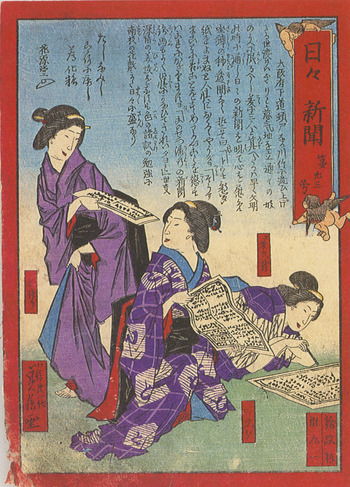
As schools for prostitutes and geisha opened in cities across Japan, “enlightened” geisha began to appear in newspapers. These stylish figures donated money to elementary schools, kept up with world events, and studied British and American-style domestic arts, such as embroidery and knitting. In 1875 the Osaka-based Nichinichi shinbun distributed an illustrated newspaper print (nishiki-e shinbun) depicting a group of three “enlightened geisha” (kaimei geisha) engrossed in reading the paper (Figure 2). According to the text, they were hoping to understand the “age of civilization” (bunmei no jidai). One of them remarked, “It seems that if you don't read the paper, you're behind the times!” (Kinoshita and Yoshimi 1999, 121; Tsuchiya 1995, 208–9).
Three “enlightened” geisha read the newspaper. Nichinichi shinbun vol. 23 (1875) (Kinoshita and Yoshimi 1999, 121).
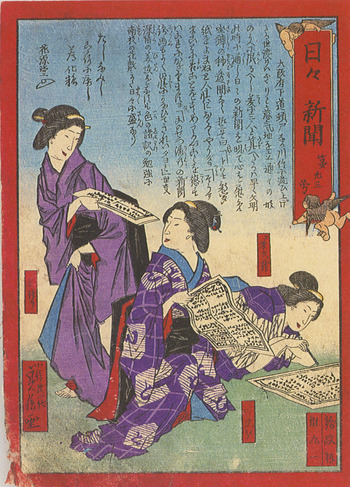
The Nichinichi shinbun's illustration was a form of celebrity endorsement that allowed the featured geisha from Osaka's Dotonbori district to advertise themselves while imbuing the newspaper with some of their glamour. It was also a playful allusion to an earlier form: woodblock prints depicting high-class prostitutes (yūjo) reading. On a conceptual level, this association would have resonated with readers because “civilization and enlightenment” was the ultimate example of au courant thinking in the 1870s, and geisha were known for being trendsetters. Similar newspaper stories depicting geisha involved in newly fashionable and enlightened activities—learning English to converse with foreign clients or washing down Western-style meals with imported beer—were a staple of newspaper reporting throughout the decade (Shinbun shūsei 1972, 1:433, 448).
But in most articles featuring enlightened geisha, the women in question were portrayed as participants in educational endeavors, either as students or donors. This trend may have been inspired by the popularity of the Yasaka nyokōba, which was covered extensively in Tokyo newspapers. In January 1875, a correspondent for the Tōkyō nichinichi shinbun reported on a tour of elementary schools and schools of womanly arts in Kyoto. He marveled at the sight of geisha and prostitutes competing to outdo each other at needlework, sewing everything from simple handkerchiefs to complete Western-style (yōfuku) uniforms for city watchmen. For women who reached this level of skill, he enthused, “there is no obstacle to leaving the business and getting married.” This was a curious shift in emphasis. Preparing women for marriage had not been the goal of Gion proprietors, who only promised to create women capable of entering “legitimate trades” and raising productive children. (Moreover, men who objected to marrying prostitutes and geisha were unlikely to be convinced by a perfectly embroidered handkerchief.) But the correspondent was optimistic about the Gion endeavor's potential to create good wives, even though he suspected that prostitutes and geisha in the capital would never submit to such a curriculum (Shinbun shūsei 1972, 2:260). A few months later, a letter to the editor of the Yomiuri shinbun, another Tokyo-based newspaper, warned that if Tokyo did not establish more schools for women, girls from good families in the capital would not be as accomplished as prostitutes from Kyoto (Yomiuri shinbun May 7, 1875).
Unlike their counterparts in other cities, Tokyo's officials made no attempt to encourage the construction of schools for geisha and prostitutes, and teahouse and okiya masters, perhaps comforted by the municipal government's recognition of the beauty and value of geisha's business, did not follow the Gion proprietors’ example. But individual brothel keepers made their own efforts, which were eagerly reported by the city's newspapers. In the eighth month of 1875, the Yomiuri related that a brothel in Yoshiwara had hired a teacher and founded a school where prostitutes, geisha, and servants could practice writing. This gesture raised the brothel's profile, and the article noted approvingly that the proprietors were conscientious types who were not typical of their profession (kagyōgachi ni mo niawazu kokorozashi no yoi mono) (Yomiuri shinbun August 30, 1875).Footnote 9 A similar notice appeared in 1877, this time about a proprietor in Honjō station along the Nakasendō who donated to a school and encouraged her employees to do the same. It noted that she was “not typical of her profession” (kagyōgachi ni niawazu) and that her employees “understood the times” (jisetsugara o wakimaete) (Yomiuri shinbun November 24, 1877). These articles owed their impact to an overdrawn contrast between the immoral brothel keeper and the upstanding schoolmaster, confirming many stereotypes about the backwardness of the sex trade even as it recognized these particular proprietors as exceptions to the rule.
Nonetheless, these and similar articles were valuable publicity for proprietors, who recognized newspapers’ emerging role in determining and disseminating norms of “enlightened” behavior to an expanding readership. In the early 1870s, circulations were still small—even the most popular newspapers counted their subscribers in the thousands—and readers were disproportionately officials and other educated men (Huffman Reference Huffman1997, 64–67). But newer papers, like the Yomiuri, were beginning to reach a broader population, and geisha were part of their target audience (Marran Reference Marran2007, 40–46). Notices in these venues attracted the attention of lawmakers and potential clients on one hand, and competitors within the industry on the other. Since “keeping up with the times” by opening a school was both a political and an advertising strategy, proprietors competed to publicize their educational initiatives. A day after an article in the Chōya shinbun praised brothel keepers in the neighborhood of Nezu for opening a school, the brothels of Senju contacted the Yomiuri and announced their desire to establish a similar institution (Chōya shinbun August 6, 1879; Yomiuri shinbun August 7, 1879).
Unlike their counterparts in Gion, who had designed their curriculum to appeal to local politicians and updated it to keep up with the latest trends in “enlightened” thinking, the Senju proprietors did not seem to have a clear idea of what their employees’ education should entail. They agreed that prostitutes should know how to read and write, but they had only vague notions about the proper curriculum, suggesting that students should learn from “whatever is convenient,” including the Analects and the Greater Learning. They also offered a different justification for why geisha and prostitutes should be educated. They displayed no interest in preparing women to move into “legitimate trades”; according to the article, the brothel keepers had decided that “as education becomes increasingly important as a hallmark of progress, geisha and prostitutes who are totally uneducated will not be able to deal with customers” (Yomiuri shinbun August 7, 1879). This conception of basic instruction as vocational training was not far removed from how Tokugawa-era proprietors would have explained their efforts to educate women decades earlier. But in the new era, they reframed this idea as progressive and touted it to reporters.
Geisha engaged in a similar type of reframing as they continued decades-old practices of civic involvement. During the late Tokugawa period, they had often donated lanterns to temples and shrines, and some even made gifts of cash to support the development of urban infrastructure. In Nagasaki, for example, town geisha funded the maintenance of bridges. There was an explicit quid pro quo element to these transactions: when women contributed their share, samurai officials ensured that new regulations about manners and morals did not destroy their business. On the other hand, “selfish” geisha who neglected their duty became targets of reforming magistrates (Morinaga 1962, 142–43). During the Meiji era, these small cash gifts might not have been sufficient to buy influence with officials appointed by the central government, but the popularization of newspapers meant that geisha could advertise their generosity to a much larger audience. Many targeted their donations to the enlightened cause of education. In 1875, the Yomiuri began listing the names of several Tokyo geisha who made contributions to their neighborhood schools (Yomiuri shinbun February 23, 1875).Footnote 10 One notice about a geisha named Kinpachi who donated ten yen to a middle school in Fukagawa read, “This also appeared in the Hōchi shinbun—one hears such wonderful things nowadays” (Yomiuri shinbun September 3, 1875). A few months later, the paper reported that a geisha who lived next door to a school had gotten into the habit of making donations during exam time—in the tenth month, she offered a gift of thirty teacups (Yomiuri shinbun November 18, 1875).Footnote 11 Prostitutes engaged in similar endeavors, although the papers tended not to address them as individuals or mention them by name. In 1879, dozens of prostitutes from the Senju district of Tokyo donated money to build a neighborhood elementary school, and the police commissioner awarded them a special commendation for their efforts (Yomiuri shinbun December 13, 1879).
It is possible that individual women intended their gifts as expressions of a frustrated desire to attend school themselves. Accounts in Tokyo newspapers indicate that some geisha eagerly pursued education on their own behalf. One apprentice geisha framed her efforts to learn to read and write as an attempt to keep up with the times: “In today's world,” she told the paper, “even if you are a geisha or a prostitute, if you are uneducated you will be ashamed in front of your customers, so you can't neglect reading and writing” (Yomiuri shinbun October 24, 1875). Two geisha from Nezu who studied the “womanly arts” at a neighborhood school expressed slightly different concerns: they said they had decided that their skills at playing the shamisen and entertaining men were not enough to secure their future (Yomiuri shinbun June 24, 1875). A geisha named Onoshi from Yoshiwara shared this view, explaining that she had realized if she could not read and write she would be embarrassed in front of her customers, and moreover, she would always be hampered by a lack of freedom (shōgai fujiyū de komaru). She called herself an “enlightened geisha” (Yomiuri shinbun November 10, 1875).
Unlike newspaper reports from Kyoto, which depicted prostitutes and geisha as an anonymous group benefitting from the efforts of progressive officials and proprietors, these accounts offered geisha the opportunity to be mentioned by name and associated with enlightened opinions. This further enhanced the status of Tokyo's geisha and contributed to the widening gap between these “beautiful,” cultured women and “common” prostitutes, who were never named or quoted in these contexts.Footnote 12 It is possible that speaking to newspapers about the importance of education was a deliberate strategy on the part of geisha who wished to publicize their erudition and thus differentiate themselves from an increasingly marginalized group. But it is more likely that their primary goal was to distinguish themselves from rival geisha, using their reputation for bookishness to attract curious customers. Others, such as the apprentice geisha who feared she would be embarrassed in front of customers, may have been parroting their employers.
Geisha's explanations of their motives for pursuing education are also open to multiple interpretations. Strikingly, none of the women quoted spoke of the importance of education as preparation for childrearing or household management. There were likely economic considerations behind this omission. There was nothing glamorous about keeping house or raising children, and clients might not have wanted to imagine their drinking companions as mothers. But this shift in emphasis may also have reflected geisha's own aspirations. Bound by indenture contracts that seldom allowed them to profit from their own labor, they may have seen education as a path to economic independence for themselves rather than their imagined children, their city, or the nation.
From “Enlightened Geisha” to “Good Wife, Wise Mother”
After peaking in 1875, articles about studious geisha, along with those about sex trade proprietors and employees establishing or donating money to schools, gradually disappeared from newspapers. In part, this was because the officials who might have supported such endeavors began to perceive that associating publicly with teahouse masters and geisha (never mind brothel keepers and prostitutes) was a political liability. Although newspaper coverage of Makimura Masanao's patronage of the Gion school was generally positive, at least one article suggested that he might be more interested in ogling geisha than educating them. The Yubin hōchi's account of the ceremony marking the opening of the Yasaka nyokōba's academy in 1875 noted that the officials in attendance, including Makimura, were drooling over the students (Shinbun shūsei 1972, 2:416). The previous year, the author of a letter to the editor of the Yomiuri had described seeing Makimura surrounded by fawning geisha at a party and suggested that he should donate his money to a school or give it to the poor rather than wasting it on women (Yomiuri shinbun April 18, 1875). In fact, the teahouses Makimura favored were funding schools and donating to the poor, but the author of this letter was more concerned with the spectacle of a high-ranking official making a fool of himself in public.
By the mid-1880s, political attacks on officials who consorted with geisha were more common. Supporters of the Freedom and People's Rights movement lambasted Prime Minister Itō Hirobumi and members of his so-called “dancing cabinet” for neglecting public affairs in favor of fashionable pursuits: dressing up in Western-style clothing, attending masked balls, and consorting with geisha. Newspapers competing for readers fanned the flames by eagerly reporting on government ministers’ peccadillos. These articles cast proponents of “enlightenment” who indulged in sensual pleasure and kept up with the latest fashions as disloyal to the nation (Karlin Reference Karlin2002, 47–48). In this political atmosphere, it was unwise for officials to ally themselves with sex trade proprietors.
An 1882 article in the Yomiuri shinbun illustrates how high-ranking officials went to great lengths to avoid publicly acknowledging sex trade proprietors’ contributions to their pet projects. The paper reported that the community association from Kobe's licensed district, Fukuhara, had donated 1,500 yen for the construction of a local elementary school. In recognition of their efforts, they had asked permission to mount a performance at the groundbreaking ceremony. The ward's representatives called this proposal “very interesting” and agreed to apply for a permit on Fukuhara's behalf. Shortly afterward, they received permission from the police department and the ward office. On the morning of the ceremony, geisha appeared at the site and attracted excited crowds. But when Hyōgo Prefecture's education commissioner heard about the proposed festivities, he asserted that it was “extremely inappropriate” (futsugō senban) to have geisha dance at a site where children would be educated. After learning that the police department had issued a permit for the performance, he paid the police chief an angry visit. But the chief replied that his department's responsibility was only to make sure the event was not obscene and did not block the road. Exasperated, the commissioner complained to the prefectural governor's office, which overrode the permit and canceled the performance (Yomiuri shinbun May 2, 1882). On the neighborhood level, officials still cooperated with brothel keepers because they were capable of amassing the capital to fund large projects. But it had become “inappropriate” to display this cooperation in public, particularly in the presence of prefectural officials.
Schools for geisha and prostitutes survived into the early twentieth century, but they began to change their focus. Proprietors in cities outside Kyoto had only a small stake in these schools, which were established by officials long after the panic generated by the liberation edict had subsided. They were not eager to send their employees to class if they could be profitably employed seeing customers instead (Sakamoto and Sakamoto 1983, 149). Moreover, the Gion proprietors had intended their educational endeavors as a mark of their neighborhood's prestige, but most of the new schools were in brothel districts that had no reputation for glamour or sophistication to defend. These neighborhoods also tended to be less cohesive than Gion, which was united under the leadership of the Sugiura family. When the economy soured in the late 1870s, proprietors who competed for business were reluctant to cooperate to support schools, and they began pulling their employees out of class so that they could concentrate on work. In response, prefectural and city governments began to institute fines for truant geisha and prostitutes (152, 160–61).
As officials began to enforce attendance, schools came to serve disciplinary functions. In Hirakata, a small city between Osaka and Kyoto, women apprehended for illegal prostitution more than three times were sent to either the syphilis hospital or the school of womanly arts (Kyōto Tachibana 1997, 62–64). In Fukuhara, the jokōba was merged with the syphilis hospital because the school had low attendance and authorities realized that it was easier to reach women when they were already confined for another reason (Sakamoto and Sakamoto 1983, 169). Meanwhile, jokōba students’ labor was redirected to more explicitly serve the interests of the state. In 1877, women in Osaka's Horie district received special commendation for producing bandages for imperial soldiers wounded during the Satsuma Rebellion (143).
In Kyoto, the Gion school, too, began to change its focus. Rather than sewing or raising silkworms, students used their class time practicing for the Miyako Odori, an annual dance recital that was first performed at the Kyoto Exposition in 1872. Like so many other initiatives in early 1870s Kyoto, this had been the brainchild of Makimura Masanao, who intended the spectacle as a strategy to promote tourism. It was an astonishing success, and soon the Yasaka nyokōba became most famous as a school of dance. Meanwhile, the neighborhood corporation initially formed to purchase the land for the school began to move into other real estate ventures, buying up property and leasing it to teahouses. By the late 1990s, this organization was using its clout to preserve the distinctive character and appearance of Gion by enforcing building codes and limiting “undesirable” businesses such as off-track betting parlors (Matsuda 2010).
As proprietors stopped sending their employees to school and examples of enlightened geisha vanished from the papers, intellectuals began to dominate public discourse on women's education. Female educators, who also tended to be proponents of monogamous marriage, aimed to create wives who could preside over well-ordered households and serve as their husbands’ social and intellectual companions. They viewed geisha, who were often the mistresses of married men, as threats to this vision of domestic partnership. Accordingly, one of their primary goals in educating women was to elevate the daughters of “good families” at the expense of those who worked in the sex trade (Rose Reference Rose1992, 47–48). Alice Mabel Bacon, an American who taught English to women at Gakushūin in the late 1880s, called geisha “formidable rivals” for women from “good families” and proposed, “If the wives of the leaders in Japan are to come from among such a class of women [as geisha], something must be done, and done quickly, for the sake of the future of Japan; either to raise the standards of the men in regard to women, or to change the old system of education for girls” (Bacon Reference Bacon1893, 289). She believed that a liberal education would allow women to entertain their husbands and thus fend off challenges from wittier, livelier geisha.Footnote 13 By the turn of the century, education had been reconceived as a wedge that divided women destined to work in the sex trade from those who would not. One abolitionist even suggested that prostitutes should be relocated to outcast villages so that they would not be educated in the same schools as the daughters of “good families” (Burns Reference Burns1998, 24).
By the early twentieth century, the idea of a brothel as a schoolhouse was inconceivable, and in an era when education was considered synonymous with schooling, few worried that the women who worked in entertainment districts were better educated than sheltered daughters. Prostitutes, in particular, were defined by their low levels of access to schools: a survey in the 1920s found that half of prostitutes had not completed elementary school, and over 15 percent had never been to school at all (Ramseyer Reference Ramseyer1996, 112). Meanwhile, even geisha, who typically attended elementary school before beginning their artistic training, were faced with indifferent employers and teachers. A Niigata geisha born in 1893 recalled that her public elementary school, located in an entertainment district, was nicknamed the “geisha school” because it enrolled so many girls indentured to okiya. They spent their class time bragging about their evening engagements, and their teachers would let them leave whenever they received word that clients requested their presence (Hirayama 1990, 64–68). Masuda Sayo, who worked as a geisha in Kami-suwa during the 1930s and ‘40s, explained that she never learned to read because she attended a school run by the geisha registry office where “no one cared much whether or not you learned your letters” (Masuda Reference Rowley2004, 23). Although proponents of monogamous marriage still envisioned a dangerously competitive relationship between wives and geisha, they now attributed geisha's attractiveness to their erotic capabilities rather than their superior learning. When articles in women's magazines urged housewives to cultivate worldliness and sophistication in order to entertain their husbands, they imagined the up-to-date café waitress (jokyū), rather than the artistically proficient geisha, as the wife's chief adversary (Tanaka Reference Tanaka2011, 132–33).
In any case, the content of public education for girls, which aimed to create moral wives and mothers, would have had little meaning to geisha and prostitutes, who had begun to receive the message that they were unqualified for domesticity. Higuchi Ichiyō's 1896 novella Child's Play (Takekurabe) depicted a girl destined for work as a high-class prostitute who had only a vague sense of the world beyond her neighborhood of brothels and teahouses. Higuchi (Reference Danly[1896] 1981, 271) describes her alienation: “For her, lessons in manners and morals and the wifely arts were topics to be left at school.” By the time Gion's Yasaka elementary school compiled its official history in 1910, it seemed obvious that the business of the sex trade and the aims of elementary education were incompatible. “This school district was located in an old pleasure quarter,” the history acknowledged, “so it was extremely difficult to promote education” (“Yasaka shōgakkō” Reference Shigeki[1910] 1979, 197).
***************
The short-lived phenomenon of the enlightened geisha could be considered one of the lost possibilities of the early Meiji period. In this historical interpretation, the rupture of the restoration threw off sparks of potential—for using new ideas and language, for enacting progressive reforms, for increasing participation in the public sphere—that were smothered during the conservative turn of the 1890s.Footnote 14 Geisha and their employers, who appropriated elite discourse and contributed to civic projects before being marginalized by intellectuals and government functionaries, certainly have a part to play in this narrative. But the phenomenon of the “enlightened geisha” was not a completely new possibility, nor was it ever entirely lost. Rather, it was one of many slim threads linking early efforts to recover the Tokugawa past and later, state-led attempts to limit the parameters of Meiji modernity. By casting themselves and their work as “civilized and enlightened,” geisha and sex trade proprietors were calling on new language, but they were describing longstanding practices: educating women, contributing to neighborhood projects, and even “keeping up with the times.” Their insistence that these endeavors were uniquely modern was both a marketing strategy and a defensive maneuver: it allowed them to salvage elements of the Tokugawa-era social order, in which sex trade proprietors and geisha had been acknowledged as contributing members of their communities, amid threatening political change.
These endeavors, which looked backward to the early modern past, left their own legacy for the self-consciously modern future. Even as the “enlightened geisha” faded into obscurity, parts of her survived as the “good wife, wise mother.” The Kyoto proprietors who established the first school for geisha and prostitutes argued that women of all social strata needed to be taught how to raise moral, productive children. They also insisted that women learn to be “self-supporting,” preferably through wage-earning work that would further national (and local) industrial development. Both contentions were novel at the time, but they became articles of faith for the late Meiji bureaucrats and educators who developed and articulated the “good wife, wise mother” ideal (Nolte and Hastings Reference Nolte, Hastings and Bernstein1991).
This flip side of Gion proprietors’ argument that all women required education in order to raise moral children was the idea that all women were educable, no matter where they came from or what kind of work they did. But in subsequent decades, the potentially democratic elements of this original vision were lost. The notion that geisha and prostitutes needed to be reformed survived, but the idea that they could be transformed through education—that they could enter “legitimate” occupations, raise productive children, or even achieve “freedom”—was increasingly in doubt. Women who worked in sex trade businesses found that their access to school was limited and their traditional forms of educational attainment were devalued. Meanwhile, they were disqualified from an increasingly restrictive ideal of feminine domesticity that was premised on being a “good wife.” It would be easy for a new generation to forget that geisha's and prostitutes’ donations had once funded their schools, just as it would be difficult for them to imagine that modern ideals of educated, civic-minded womanhood had once been embodied by geisha who raised silkworms, sewed uniforms, and learned to name the countries of the world.