




No CrossRef data available.
ACare: A communication training program for shared decision making along a life-limiting illness
Published online by Cambridge University Press: 12 May 2005
Abstract
Objective: This article describes an innovative 8-h training program that provides clinicians with the competencies necessary to conduct efficient, effective, and compassionate advance care planning discussions throughout the trajectory of life-limiting illnesses.
Method: The Advance Care Training Program (ACare) includes 6 h of group workshops and 2 h of one-on-one faculty–learner interaction. In this article, we describe the (1) objectives of ACare; (2) structure, training procedures, and educational rationale of ACare training; and (3) educational outcome studies in progress.
Results: ACare training in various forms has already been provided to over 100 medical professionals (medical students, medical residents, oncology and geriatric fellows, medical attendings, social workers, and nurses). Formative outcome data indicate considerable trainee satisfaction. Emerging summative outcome data indicate improved skills.
Significance of results: Widespread adoption of the program could increase the frequency and quality of advance care planning discussions between patients with life-limiting illnesses, their health care providers, and families.
Keywords
Information
- Type
- Research Article
- Information
- Copyright
- © 2004 Cambridge University Press
INTRODUCTION
Improving the effectiveness, through shared decision making, of advance care planning for the seriously ill has been an elusive goal for medical care near the end of life (Omnibus Budget Reconciliation Act, 1990; SUPPORT Principal Investigators, 1995; Field et al., 1997; Covinsky et al., 2000; Martin et al., 2000). Even well-conceived, intensive projects like the SUPPORT study (1995) have not been able to change the troubling deficits in medical care for the patient with life-limiting illness. This article describes an innovative, highly focused professional training program designed to increase the frequency and quality of advance care planning discussions between health care providers, patients with life-limiting illnesses, and their families.
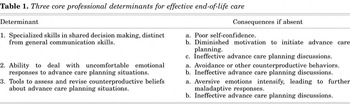
The authors have developed a conceptual model that provides the theoretical foundation for the new program (Weiner & Cole, 2004). In brief, we conceive that professional training efforts in advance care planning communication have not yet led to large changes in patient care, because they have not effectively overcome the clinician's individual and highly specific emotional, cognitive, and skill barriers to engaging in these discussions. The rationale and methods of a fully successful program must include educational strategies targeted at overcoming these individual clinician barriers (see Table 1).
Three core professional determinants for effective end-of-life care

Advance care planning involves far more than completion of advance directive forms. Experts agree that advance care planning refers to a process of recurrent clinician–patient–family interactions, which includes the following core elements: (1) the individualized delivery of medical information; (2) a shared decision-making paradigm that develops clear objectives for advance care planning discussion; (3) focus on multiple, evolving, and fluid medical treatment decisions, along the complete trajectory of a life-limiting illness; and (4) clarification and documentation of a patient's future treatment preferences in anticipation of his or her loss of capacity to express those preferences (Emanuel et al., 2000; Prendergast, 2001; Kolarik et al., 2002; Tulsky & Arnold, 2002).
Advance care planning incorporates spiritual and emotional issues as they help define medical treatment decisions, as they relieve suffering, and as they provide meaning and dignity (Breitbart, 2002; Chochinov et al., 2002; Kolarik et al., 2002). And advance care planning, as we conceive it, also involves the process of coordinating and implementing these medical decisions through the patient, physician, and family in advance of patient death.
The Advance Care Planning Training Program (ACare), grew out of a 12-year experience at Long Island Jewish Medical Center in intensive clinician–patient communication training for internal medicine residents, medical students, fellows in medical oncology and geriatric medicine, medical faculty, and nonphysician medical personnel (Gordon et al., 1996; Oh et al., 2001; Weiner et al., 2001). These training experiences have included broad patient-centered communication training as well as specific training focusing on advance care planning.
This article describes the objectives, training procedures, and educational rationale of ACare, which were elaborated with guidance from accepted educational theory and research (Cohen-Cole, 1980; Bird et al., 1983; Davis et al., 1999). In an effort to achieve adequate, measurable, and lasting benefits of training, ACare was modeled after other evidence-based communication programs that utilized 8 h of training time (Roter et al., 1995; Gerrity et al., 1999; Cole et al., 2000). These investigators believed that 8 h was the minimum necessary for participants to change ingrained clinical communication patterns.
ACare has been designed to be adaptable across medical disciplines and levels of experience. Encouraging pilot data have documented short and long term efficacy with oncology fellows (Weiner et al., 2002a, 2002b).
OBJECTIVES OF THE ACare TRAINING PROGRAM
Knowledge Objectives
At the conclusion of the training program, learners will be able to describe the following:
- The elements and appropriate clinical applications of advance directives, including a Health Care Proxy, a Living Will, and a Do Not Resuscitate/Do Not Intubate (DNR/DNI) Order;
- A structured approach to initiate and complete advance care planning discussions with patients and families.
Attitudinal objectives (including emotional, cognitive, and self-confidence outcomes)
At the conclusion of the training program, learners will report the following:
- Positive changes in their confidence and comfort in initiating and leading advance care planning discussions; and
- A willingness to engage in the evolving process of advance care planning across the entire trajectory of illness from diagnosis through death.
Skills Objectives
At the conclusion of the training program, learners will be able to perform the following:
- Identify specific end-of-life situations that cause them to experience aversive emotional responses and counterproductive beliefs.
- Create alternate ways to experience these end-of-life situations by recognizing and reinterpreting these associated counterproductive beliefs.
- Facilitate shared decision-making with patient and family about medical treatment choices by engaging in the 10 communication behaviors described in the text below.
THE ACare PROGRAM: STRUCTURE, TRAINING PROCEDURES, AND EDUCATIONAL RATIONALE
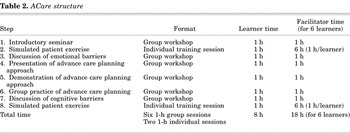
ACare training consists of 6 h of group sessions and two 1-h individual sessions. The group sessions can be taught separately in 1-h blocks or combined into longer blocks (e.g., three 2-h sessions). These sessions are summarized in Table 2 and elaborated below.
ACare structure

1. Introductory seminar: Concepts in advance care planning.
A. Teaching method: Group learning, teaching time 60 min.
B. Description: At the beginning of the h, the participants take a 15-item multiple-choice exam on advance directive knowledge (J.S. Weiner & S. Sarij, unpubl.). They then receive a 15-min lecture on basic concepts of advance directives. After the lecture, the group reviews the multiple-choice exam.
C. Educational rationale: Starting the workshop with a self-assessment examination demonstrates to learners their strengths and limitations in personal knowledge. This interactive session engages learners and helps ensure that all participants master basic concepts after the first h of the program.
2. Simulated patient exercise: Each trainee conducts a pretraining advance care planning discussion with a simulated patient.
A. Teaching method: Individual learning, teaching time 60 min.
B. Description: Learners conduct a videotaped advance care planning discussion with a trained actor or faculty member. Standardized vignettes are constructed so that the “simulated patient” (Maguire et al., 1986; Gordon et al., 1988) is in his/her 60s, with an incurable, but medically stable cancer, and the role play is scripted in an ambulatory setting (J.S. Weiner & R. Janicik, unpubl.). This forces the trainee to have the advance care planning discussion earlier than is generally done, but at a time that experts suggest it should be initiated. The scenarios have been constructed to elicit moderate and realistic emotional intensity from the simulated patient. The videotaped discussion is privately reviewed with the trainee immediately afterward. During this review, the educator facilitates learner-driven self-assessment and learner-centered goal setting for the training (Knowles, 1973, 1990).
C. Educational rationale: This simulated patient exercise provides the learner and the teacher with a snapshot of the participant's strengths and weaknesses. The moderate emotional intensity of the scenario also allows the trainees to experience some of their emotional and cognitive barriers. While providing an opportunity for feedback and individual learning, the educator encourages the learner to set more detailed goals for the next 6 h of training.
3. Introducing the concept of emotional barriers: Eliciting and sharing physicians' emotional barriers to advance care planning discussions.
A. Teaching method: Group learning, teaching time 60 min.
B. Description: The group of 4–6 learners participate in the following exercise:
“Think about the last time you spoke with a terminally ill patient about advance care planning. If you have only recently spoken to families because your patients were not able to communicate, then use one of those examples. What did the experience feel like? What do you think caused those feelings?”
The trainees go around the room and exchange stories, facilitated by the faculty. The class develops a list of personal emotional challenges during end-of-life discussions, and the faculty supplements this list as appropriate (Weiner & Cole, 2004).
Trainees without much clinical experience, such as medical students, may not have participated in advance care planning. In this case, we ask trainees what it might feel like for them to have such a discussion. We have observed that it is generally better to conduct training sessions for clinicians with similar levels of experience as this will facilitate the openness necessary to share emotionally laden challenges.
After exchanging advance care planning vignettes and personal emotional responses, the class then discusses the specific precipitants that led to each clinician's response (Weiner & Cole, 2004). For example, a physician's anxiety about having advance care planning discussions with a terminally ill patient might stem from his or her conception that such a discussion would take away hope.
C. Educational rationale: This exercise, along with the previous simulated patient role play, provides learners and the teacher with invaluable information about individual emotional barriers to engaging in advance care planning. The group format helps participants appreciate the universality of emotional distress and the variety of challenges clinicians face. The group also discusses how common and understandable it is for the clinician to avoid discussions that elicit such distress. Many clinicians find relief in this common emotional ground (Bailint, 1972).
4. Effective advance care planning: A 10-step model to facilitate shared decision making is presented in detail.
A. Teaching method: Group learning, 60 min.
B. Description: ACare training encourages the clinician to take an approach to advance care planning based on expert opinion (Lo et al., 1999; Larson & Tobin, 2000; Wenrich et al., 2001) and clinical experience.
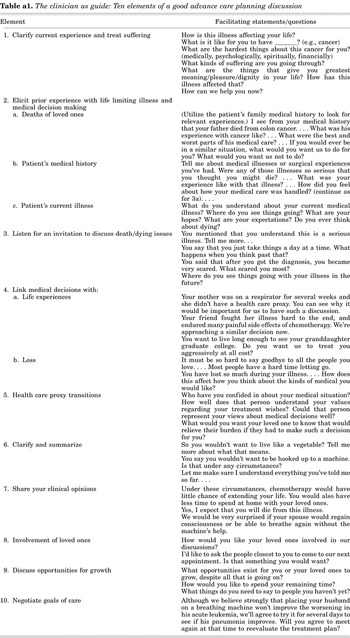
Table A1 lists 10 elements we believe are fundamental to advance care planning discussion, along with sample questions or statements. Note that “advance care planning” goes beyond advance directive determination. The clinician acts as a guide to help the patient participate in a shared medical decision-making process throughout the illness trajectory (Teno & Lynn, 1996; Charles et al., 1999; Elwyn et al., 2000; Kolarik et al., 2002). This is helpful not only to sort out complex treatment planning issues, but it also facilitates the patients' efforts to construct meaning around their illness experience. This may have, in itself, therapeutic effects (Breitbart, 2002; Chochinov et al., 2002).
C. Most of these elements, list in the table in the Appendix, are self-explanatory. However, six deserve more attention:
[bull ] Elicit and explore three forms of personal experience the patient may have had with death and dying issues:
1. With loved ones who have died.
2. With the patient's own prior medical illnesses, and
3. With the patient's own current medical illness.
Ineffective advance care planning discussions are overly technical and abstract. It is easier to make good decisions when they can be framed within prior personal experiences. For example, if a clinician can help a patient recall the last days, weeks, or months of a loved one's life, the patient can consider what aspects of that medical care they might or might not want for themselves.
[bull ] Help the patient actively link past experiences to the decisions he or she should ponder. Once such experiences are drawn out, it becomes a bit clearer for the patient to sort through decisions. The physician should help the patient by asking questions like, “You saw how your mother did on a breathing machine. What were the pros and cons of that experience for you? If you would ever be in a similar situation what would you want and not want for yourself?”
[bull ] Carefully listen for cues the patient gives that invite the clinician into a discussion about end-of-life issues. Clinicians are often reluctant to raise end-of-life issues, because they feel patients won't want to discuss it. This is usually an incorrect assumption. Data indicate patients commonly wait for physicians to raise the issue (Johnston et al., 1995). In practice, patients drop cues for physicians to discuss emotionally based topics, but these cues are frequently missed (Branch & Malik, 1993; Suchman et al., 1997). The ACare training helps clinicians pick up these cues by illustrating them during role play or a modeling videotaped interview that the class views.
[bull ] Help the patient and loved ones link the medical decisions they are making with losses they are suffering. Sometimes patients or family members refuse to accept imminent death. They might request ineffective treatments in the hope of a miracle. Sometimes they angrily demand constant attention from the medical staff or anxiously overinterpret small movements of a dying patient as a sign of recovery. These behaviors commonly cloak the grief of patients and family, which is rarely addressed in the acute care setting. Rather, the staff adapts by labeling people as “in denial,” “irrational,” or “difficult.” This establishes adversarial relationships that often escalate the demands of patient and family. Often the health care team unknowingly participates in “irrational denial,” by not acknowledging how painful it is for the patient and family to say goodbye. If this were more directly addressed, the maladaptive behaviors of patients, families, and staff might diminish.
[bull ] Provide accurate prognostic information and treatment recommendations, as requested by the patient or as needed by the patient to make adaptive decisions. In an attempt to protect patient hope and perhaps avoid emotionally upsetting bad news, clinicians may not share frank clinical information with patients. Providing this necessary information must be guided by the provider's assessment of the patient's desires and needs, not by the provider's personal distress (Buckman, 1992; Novack, 2000). By withholding crucial clinical opinion, the patient or family cannot exercise truely informed consent. Although it varies from patient to patient, studies have shown most patients would like to hear the truth (Buckman, 1996). Superimposing cultural preferences, however, must be taken into account (Crawley et al., 2002).
[bull ] Find opportunities for growth at the end of life. Clinicians sometimes narrowly frame patients into “treatable” and “terminal,” causing the misunderstanding that discussion about a noncurable condition may cause the patient or family to lose hope. Rather, the opposite has been amply described (Byock, 1997; Block, 2001). Patients and family members can hope for many other things besides a cure, including the hope for symptom reduction, to stay connected to and become closer with loved ones, to leave a legacy, and to emotionally grow (Nuland, 1994). With such a perspective, there is always the possibility for hope and growth near the end of life.
D. Educational rationale: A concrete, structured model for advance care planning discussion provides a framework for learners to develop skills. We believe having this structure also helps increase clinician comfort and confidence with this difficult task. This reduces their emotional distress.
5. Demonstration of advance care planning: A modeling videotape is shown of an actual advance care planning discussion with a terminally ill patient.
A. Teaching method: Group Learning, 60 min.
B. Description: A videotaped advance care planning discussion with actual patients and families is used as a demonstration tool for the 10 elements of good advance care planning. The video is stopped many times to elicit trainees' thoughts and emotions. Counterproductive beliefs (see below) are challenged and reframing tasks are assigned.
C. Rationale: Modeling videotapes are used as a springboard to elicit group discussion. As discussed by Bandura (1977, 1992), modeling provides a template to improve clinician self-confidence.
6. Skills-based practice: Group “rolling role plays” based on personally challenging scenarios constructed by trainees.
A. Teaching method: Group learning, 60 min.
B. Description: Instead of trainees doing individual role play, we repeatedly utilize “rolling role play.” This is where the whole group assumes the role of the clinician: Group members sequentially ask one question or make one statement to the simulated patient (a faculty member). As role plays proceed, the facilitator will get a sense of specific situational-based skills each trainee needs to work on. For example, a nurse may have difficulty saying the word dying, when trying to ask, “Have you ever thought of dying?” This can be practiced within the context of a role play, and then given as an assignment to practice with the next appropriate patient in the clinical setting. When the nurse returns to the next class, the facilitator can follow up to see whether he or she was able to perform this skill. It is important to encourage participants to have advance care planning discussions with actual patients between classes, so they can bring in real vignettes to discuss and practice.
C. Rationale: This group role play effectively diffuses emotional discomfort among several people. As participants watch each other struggle during the role play, they feel validated in their shared distress, which facilitates open dialogue. And because the entire group participates in each role play, everyone remains involved in time-effective learning. Although these exercises and associated discussions about trainees' personal reactions are carefully controlled not to deflect into psychotherapy, they nevertheless can enable clinicians to overcome substantial personal anxieties related to discussions near the end of life (Bandura, 1977, 1992; Weiner & Cole, 2004).
7. Reduction of cognitive barriers: Counterproductive beliefs of trainees regarding advance care planning are elicited and challenged. Links between counterproductive beliefs and emotional barriers are made.
A. Teaching method: Group learning, 60 min.
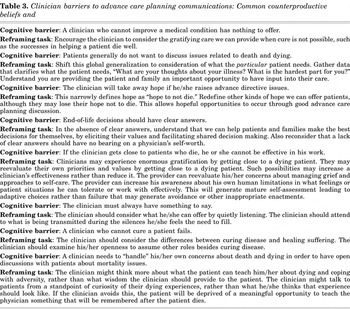
B. Description: The group format of the course allows trainees to examine and share their misconceptions about end-of-life care. We do not attempt to address unconscious conflict in the training. Rather we facilitate a group process to help trainees reevaluate their cognitive assumptions (Weiner & Cole, 2004). This approach is based on the cognitive-behavioral work of Beck et al. (1979) and Beck (1995). Table 3 illustrates common counterproductive beliefs clinicians have about end-of-life care and ways to reframe these misconceptions.
C. Rationale: Misconceptions can cloud clinical decision making. By clarifying and reframing counterproductive beliefs, we improve clinical effectiveness and reduce emotional distress. Clarification and reframing becomes part of the group process.
8. Each trainee conducts a final advance directive discussion with a simulated patient that serves to demonstrate and solidify improved skills.
A. Teaching method: Individual learning, teaching time 60 min.
B. Description: Each trainee has a second advance care planning discussion with a simulated patient that is videotaped and reviewed immediately after. During private review of the videotape with the clinician, faculty facilitates a learner-driven self-assessment and learner-driven goal setting for the future.
C. Rationale: The trainee sees objective evidence of improvement, which increases motivation to put these skills into practice. The trainee also sees objective evidence of skills that he or she can continue to improve.
Clinician barriers to advance care planning communications: Common counterproductive beliefs and

VALIDATION STUDIES IN PROGRESS AND FUTURE DIRECTIONS
Pilot data indicating formative and summative measures of efficacy have been reported for ACare training of medical oncology fellows (Weiner et al., 2002a, 2002b). Self-reported comfort and confidence increased in advance care planning communication skills. Additionally, objective measures of skills improved as assessed by a modified RIAS analysis (Roter et al., 2000) of videotaped advance care planning discussions with simulated patients (Weiner et al., 2002a, 2002b). Medicine interns trained with ACare also reported increased self-efficacy in several tasks related to advance care planning discussion (Weiner et al., 2001). Details of these studies will be formally reported elsewhere. In addition to these uncontrolled outcome studies, a randomized controlled study of ACare is currently in progress, assessing the knowledge, attitudes, and skills of medicine interns in advance care planning discussion.
DISCUSSION
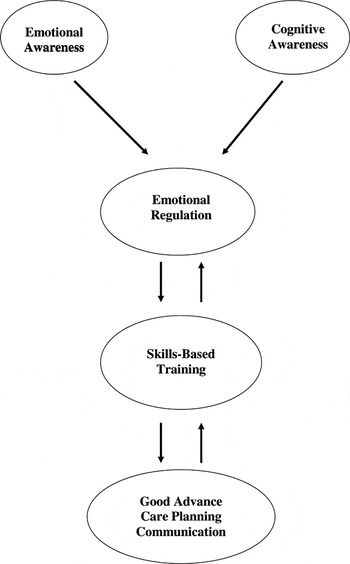
This article describes an innovative training program for clinicians in shared decision making across the trajectory of life-limiting illness. The effectiveness of the program is supported by current formative and emerging summative outcome data. The conceptual paradigm underlying ACare has been described in a separate publication (Weiner & Cole, 2004). ACare emphasizes the need for trainees to learn to recognize and manage their personal distress during advance care planning, reinterpret their individual cognitive barriers, and practice specialized communication skills in shared decision making. Along with focused exercises designed to overcome participants' emotional and cognitive barriers, ACare develops skills through highly structured role plays. Figure 1 displays the educational paradigm.

ACare: A conceptual paradigm.
It is clear that the time demands of this training are considerable and may even be prohibitive for some settings—8 h for the trainee and 14–18 h for the trainer, based on a group of four to six participants. We believe that this time investment, including the individual faculty–trainee interaction is important for effective outcomes. However, once the initial validity of the program has been established, further educational studies can be undertaken to determine which elements of the program may be trimmed.
Future research directions will address four key areas: (1) the development of valid measures for the content of an advance care planning discussion; (2) the development of reproducible, testable (i.e., manualized) approaches to advance care planning; (3) the determination of how improvements in a clinician's advance care planning capabilities translates into actual changes in clinical behavior; and (4) the determination of whether a clinician optimally trained in advance care planning skills improves the outcomes of terminally ill patients and their families.
There has been widespread recognition of the need to help professional providers address their emotional discomfort with terminally ill patients, yet without clear guideposts. We hope that adoption of this training by others, with concomitant validity studies, will increase the ability of a clinician to more comfortably and effectively discuss the crucial treatment decisions that terminally ill patients and their loved ones need to make. As important, we anticipate that these discussions will be more emotionally meaningful and dignified for the patient, family, and clinician.
ACKNOWLEDGMENTS
This work was supported in part by a Faculty Scholar Award from the Project on Death in America (J.S.W.). The authors thank Drs. Tomer Levin and Jesse Roth for helpful suggestions, as well as Sharon Alabaster and Marion Silver for assistance in the manuscript preparation.
APPENDIX
Table A1 lists the 10 elements of a good advance care planning discussion.
The clinician as guide: Ten elements of a good advance care planning discussion

References
REFERENCES
Bailint, M.
(1972).
The Doctor, His Patient, and the Illness.
New York:
International University Press.
Bandura, A.
(1977).
Self-efficacy: Toward a unifying theory of behavioral change.
Psychological Reviews,
84,
191–215.Google Scholar
Bandura, A.
(1992).
Psychological aspects of prognostic judgments. In
Prognosis of Neurological Disorders,
Evans, R.W.,
Baskin, D.S. &
Yatsu, F.M. (eds.), pp.
13–28.
New York:
Oxford University Press.
Beck, A.T.,
Rush, A.J.,
Shaw, & B.F.,
et al.
(1979).
Cognitive Therapy of Depression.
New York:
The Guilford Press.
Beck, J.S.
(1995).
Cognitive Therapy: Basics and Beyond.
New York:
The Guilford Press.
Bird, J.,
Cohen-Cole, S.A.,
Boker, & J.,
et al.
(1983).
Teaching psychiatry to non-psychiatrists: I. The application of
educational methodology.
General Hospital Psychiatry,
5,
247–253.Google Scholar
Block, S.D.
(2001).
Psychological considerations, growth, and transcendence at the
end-of-life: The art of the possible.
Journal of the American Medical Association,
285,
2898–2905.Google Scholar
Branch, W.T. &
Malik, T.K.
(1993).
Using “windows of opportunities” in brief interviews to
understand patients' concerns.
Journal of the American Medical Association,
269,
1667–1668.Google Scholar
Breitbart, W.
(2002).
Spirituality and meaning in supportive care: Spirituality- and
meaning-centered group psychotherapy interventions in advanced
cancer.
Supportive Care in Cancer,
10,
272–280.Google Scholar
Buckman, R.
(1992).
How to Break Bad News. A Guide for Health Care Professionals,
pp.
10–12, 190–198.
Baltimore:
Johns Hopkins University Press.
Buckman, R.
(1996).
Talking to patients about cancer: No excuse now for not doing
it.
British Medical Journal,
313,
699–700.Google Scholar
Byock, I.
(1997).
Dying Well. Peace and Possibilities at the End of Life.
New York:
Riverhead Books.
Charles, C.,
Amiram, G., &
Whelan, T.
(1999).
Decision-making in the physician-patient encounter: Revisiting the
shared treatment decision-making model.
Social Science and Medicine,
49,
651–661.Google Scholar
Chochinov, H.M.,
Hack, T.,
McClement, & S.,
et al.
(2002).
Dignity in the terminally ill: A developing empirical model.
Social Science and Medicine,
54,
433–443.Google Scholar
Cohen-Cole, S.A.
(1980).
Training outcomes in liaison psychiatry: Literature review and
methodological proposals.
General Hospital Psychiatry,
2,
282–288.Google Scholar
Cole, S.,
Raju, M.,
Barret, & J.,
et al.
(2000).
The MacArthur Foundation Depression Education Program for primary
care physicians: Background and rationale.
General Hospital Psychiatry,
22,
299–358.Google Scholar
Covinsky, K.E.,
Fuller, J.D.,
Yaffe, & K.,
et al.
(2000).
Communication and decision-making in seriously ill patients:
Findings of the SUPPORT Project.
Journal of the American Geriatrics Society,
48,
S187–S193.Google Scholar
Crawley, L.M.,
Marshall, P.A.,
Lo, & B.,
et al.
(2002).
Strategies for culturally effective end-of-life care.
Annals of Internal Medicine,
136,
673–679.Google Scholar
Davis, D.,
O'Brien, M.A.,
Freemantle, & N.,
et al.
(1999).
Impact of formal continuing medical education: Do conferences,
workshops, rounds, and other traditional continuing education activities
change physician behavior or health care outcomes?
Journal of the American Medical Association,
282,
867–874.Google Scholar
Elwyn, G.,
Edwards, A.,
Kinnersley, & P.,
et al.
(2000).
Shared decision making and the concept of equipoise: The
competencies of involving patients in healthcare choices.
British Journal of General Practice,
50,
892–899.Google Scholar
Emanuel, L.,
von Gunten, C.F., &
Ferris, F.D.
(2000).
Advance care planning.
Archives of Family Medicine,
9,
1181–1187.Google Scholar
Field, M.J.,
Cassel, & C.K. for the Committee on Care at the
End-of-life,
Institute of Medicine
(1997).
Approaching Death: Improving Care at the End-of-Life.
Washington, DC:
National Academy Press.
Gerrity, M.S.,
Cole, S.A.,
Dietrich, & A.J.,
et al.
(1999).
Improving the recognition and management of depression: Is there a
role for physician education?
Journal of Family Practice,
48,
949–957.Google Scholar
Gordon, J.,
Sanson-Fisher, R., &
Saunders, N.A.
(1988).
Identification of simulated patients by interns in a casualty
setting.
Medical Education,
22,
533–538.Google Scholar
Gordon, J.H.,
Walerstein, S.J., &
Pollack, S.
(1996).
The advanced clinical skills program in medical interviewing: A
block curriculum for residents in medicine.
International Journal of Psychiatry in Medicine,
26,
411–429.Google Scholar
Johnston, S.C.,
Pfeifer, M.P., &
McNutt, R.
(1995).
The discussion about advance directives: Patient and physician
opinions regarding when and how it should be conducted.
Archives of Internal Medicine,
155,
1025–1030.Google Scholar
Knowles, M.S.
(1973).
Self-Directed Learning: A Guide for Learners and Teachers.
New York:
Association Press.
Knowles, M.S.
(1990).
The Adult Learner: A Neglected Species,
4th ed.
Houston, TX:
Gulf.
Kolarik, R.C.,
Arnold, R.M.,
Fischer, & G.S.,
et al.
(2002).
Objectives for advance care planning.
Journal of Palliative Medicine,
5,
697–704.Google Scholar
Larson, D.G. &
Tobin, D.R.
(2000).
End-of-life discussions: Evolving practice and theory.
Journal of the American Medical Association,
284,
1573–1578.Google Scholar
Lo, B.,
Quill, T., &
Tulsky, J.
(1999).
Discussing palliative care with patients.
Annals of Internal Medicine,
130,
744–749.Google Scholar
Maguire, P.,
Fairburn, S., &
Fletcher, C.
(1986).
Consultation skills of young doctors, 1. Benefits of feedback
training in interviewing as students persist.
British Medical Journal,
292,
1573–1576.Google Scholar
Martin, D.K.,
Emanuel, L.L., &
Singer, P.A.
(2000).
Planning for the end-of-life.
Lancet,
356,
1672–1676.Google Scholar
Novack, D.H.
(2000).
Use of the self in medical care. In
The Medical Interview. The Three-Function Approach,
2nd ed.,
Cole, S.A. &
Bird, J. (eds.), pp.
239–247.
St. Louis:
Mosby.
Nuland, S.B.
(1994).
How We Die: Reflections on Life's Final Chapter.
New York:
Alfred A. Knopf.
Oh, J.,
Segal, R.,
Gordon, & J.,
et al.
(2001).
Retention and use of patient-centered interviewing skills after
intensive training.
Academic Medicine,
76,
647–650.Google Scholar
Omnibus Budget Reconciliation Act of 1990.
Title IV, Section 4206.
Congressional Record.
October 26, 1990;
136:
H12456–H12457.
Prendergast, T.J.
(2001).
Advance care planning: Pitfalls, progress, promise.
Critical Care Medicine,
29,
N34–N39.Google Scholar
Roter, D.L.,
Hall, J.A.,
Kern, & D.E.,
et al.
(1995).
Improving physicians' interviewing skills and reducing
patients' emotional distress: A randomized clinical trial.
Archives of Internal Medicine,
155,
1877–1884.Google Scholar
Roter, D.L.,
Lardon, S.,
Fischer, & G.S.,
et al.
(2000).
Experts practice what they preach: A descriptive study of best and
normative practices in end-of-life discussions.
Archives of Internal Medicine,
160,
3477–3485.Google Scholar
Suchman, A.L.,
Markakis, K.,
Beckman, & H.B.,
et al.
(1997).
A model of empathic communication in the medical interview.
Journal of the American Medical Association,
277,
678–682.Google Scholar
SUPPORT Principal Investigators for the SUPPORT
project.
(1995).
A controlled trial to improve care for seriously ill hospitalized
patients: The Study to Understand Prognoses and Preferences for Outcomes
and Risks of Treatments (SUPPORT).
Journal of the American Medical Association,
274,
1591–1598.Google Scholar
Teno, J.M. &
Lynn, J.
(1996).
Putting advance-care planning into action.
Journal of Clinical Ethics,
7,
205–213.Google Scholar
Tulsky, J.A. &
Arnold, R.M.
(2002).
Communication at the end of life. In
Principles and Practice of Palliative Care and Supportive
Oncology,
2nd ed.,
Berger, A.M.,
Portenoy, R.K. &
Weissman, D.E. (eds.), pp.
673–684.
Philadelphia:
Lippincott Williams & Wilkins.
Weiner, J.S. &
Cole, S.A.
(2004).
Three principles to improve clinician communication for advance care
planning: Overcoming emotional, cognitive, and skill barriers.
Journal of Palliative Medicine,
7,
817–829.Google Scholar
Weiner, J.S.,
Cole, S.A., &
Roter, D.
(2002a).
Overcoming physicians' emotional barriers to advance directive
communications: An innovative training program for oncology
fellows.
Research Presentation.
Academy of Psychosomatic Medicine Proceedings, 49th Annual
Meeting, Tucson, Arizona.
Weiner, J.S.,
Gordon, J.,
Walerstein, & S.,
et al.
(2001).
Program in the patient–doctor relationship at Long Island
Jewish Medical Center: Recipient of the Alan Stoudemire Award for
Innovation and Excellence in Consultation-Liaison Education.
Poster Presentation,
Academy for Psychosomatic Medicine 48th Meeting, 2001, San
Antonio, Texas.
Weiner, J.S.,
Roter, D., &
Cole, S.A.
(2002b).
Training medical oncology fellows in advance directive
communications: Focus on physician emotional barriers.
Poster Presentation,
The American Academy on Physician and Patient, Research and
Teaching Forum, Baltimore, Maryland.
Wenrich, M.D.,
Curtis, J.R.,
Shannon, & S.E.,
et al.
(2001).
Communicating with dying patients within the spectrum of medical
care from terminal diagnosis to death.
Archives of Internal Medicine,
161,
868–874.Google Scholar
Three core professional determinants for effective end-of-life care
ACare structure
Clinician barriers to advance care planning communications: Common counterproductive beliefs and
ACare: A conceptual paradigm.
The clinician as guide: Ten elements of a good advance care planning discussion
 You have
Access
- 24
- Cited by