Introduction
Hoarding disorder (HD) is characterized by difficulty in discarding possessions, urges to save possessions and acquire new ones, and distressing or debilitating levels of clutter in the home (American Psychiatric Association, 2013). Current estimates of the incidence of HD in the general population range from 5.3% (Samuels et al., Reference Samuels2008) to 5.8% (Timpano et al., Reference Timpano2011), depending on the diagnostic criteria used. The incidence of HD has been estimated to be nearly three times higher in older adults than in younger adults (Samuels et al., Reference Samuels2008), and non-clinical community samples suggest that older adults exhibit more severe hoarding symptoms than do their middle-aged counterparts (Reid et al., Reference Reid2011). Although there have been several previous studies examining the characteristics of older adults with HD (Ayers et al., Reference Ayers, Saxena, Golshan and Wetherell2010; Diefenbach et al., Reference Diefenbach, DiMauro, Frost, Stektee and Tolin2013) and one investigation of psychiatric correlates of hoarding symptom severity in non-clinical older adults (Reid et al., Reference Reid2011), there has been little investigation of which characteristics predict hoarding symptom severity in older adults with HD.
Kim and colleagues (2001) interviewed 36 elder care workers in about 62 cases involving older adults who were determined by the provider to have a compulsive hoarding problem. A majority of cases were White (90%), never married (55%), and females (73%) who lived alone (82%). Clutter was reported to have interfered with the personal hygiene moderately to severely in 60% of the cases observed and hoarding was reported to be causing a physical health threat for the patient in 81% of the cases. The elder care workers interviewed also cited pest infestations, fire hazards, and falling to be of significant risk to their clients with compulsive hoarding tendencies. Unfortunately, Kim et al. (2001) did not interview identified hoarding individuals and so hoarding status cannot be substantiated.
Ayers et al. (Reference Ayers, Saxena, Golshan and Wetherell2010) assessed 18 older adults with compulsive hoarding, looking primarily at psychiatric co-morbidities, family history of HD, and the progression of the disorder. A majority of participants were currently unmarried, Caucasian, and retired, and one-third reported having an immediate family member with hoarding symptoms. Half of the participants reported co-morbid psychiatric disorders and over two-thirds reported having received psychiatric care at some point in their lives. Interestingly, 49% of the participants reported having a head trauma resulting in loss of consciousness in their lifetime, although 71% of those individuals reported that the hoarding symptoms preceded the loss of consciousness. Finally, many of the participants reported medical co-morbidities, namely hypertension (61%), sleep apnea (22%), seizures (11%), and stroke (11%).
Reid et al. (Reference Reid2011) examined the possible psychiatric correlates of hoarding symptom severity of 269 non-clinical older adults (aged 56–93 years) from senior centers in central Florida. Hoarding symptom severity was significantly related to depression and anxiety symptoms as well as symptoms of obsessive-compulsive disorder. Further, females and men reported equal levels of hoarding symptom severity, with the exception of clutter cognitions, where females scored significantly higher.
Finally, Diefenbach and colleagues (Reference Diefenbach, DiMauro, Frost, Stektee and Tolin2013) examined the demographic and psychiatric characteristics of older adults with (n = 55) and without (n = 39) HD as well as any possible associations between hoarding symptom severity and age in a mixed age (n = 210) sample. Older adults with HD were found to be mostly unemployed, college graduates, not married, and White. They also looked at the frequency with which older adults with HD endorsed certain health risks associated with hoarding symptoms (such as falling, poor hygiene, etc.); however, as with the demographic characteristics, there was no examination of possible relationships between endorsement of items and hoarding symptom severity, with the exception of age (which was not significantly related).
The recent addition of HD to the Diagnostic and Statistical Manual of Mental Health Disorders, 5th edition (DSM-5; American Psychiatric Association, 2013) has highlighted the dearth of information about the demographic, sociologic, and medical predictors of HD severity, particularly in older adults. This is the first investigation of possible predictors (including family history, psychiatric and medical co-morbidities, and demographic characteristics) of hoarding symptom severity in older adults with HD. As an exploratory examination of the predictors of hoarding symptom severity in older adults with HD, the current study serves as the first step toward investigating possible moderators of treatment outcome in late life HD.
Methods
Participants
Participants were 71 older adults (mean age: 67 years, SD = 5.8, range: 60–86 years) who were enrolled for one of the two studies of HD at the VA San Diego Healthcare System between January 2010 and January 2014. This was a self-selected, self-referred sample recruited primarily from fliers posted in the San Diego County area and no monetary compensation was provided for participation. All participants were required to meet criteria for HD as defined by the proposals for the DSM-5 criteria of HD. The final determination of HD status was determined by a consensus diagnosis supervised by a licensed clinical psychologist. Participants were excluded if they scored below 23 on the Montreal Cognitive Assessment (MoCA; Nasreddine et al., Reference Nasreddine2005), or met criteria for bipolar disorder, schizophrenia, psychosis, suicidal ideation, or substance dependence on the Mini-International Neuropsychiatric Interview (M.I.N.I.; Sheehan et al., Reference Sheehan, Lecrubier and Sheehan1998). Study protocol was approved by the Institutional Review Board of the University of California, San Diego and by the VA San Diego Healthcare System and all participants provided written informed consent.
Measures
Psychiatric co-morbidities were assessed using the M.I.N.I., and psychiatric symptom severity was measured using two self-report measures: the Anxiety Sensitivity Index (ASI; Reiss et al., Reference Reiss, Peterson, Gursky and McNally1986), and the Hospital Anxiety and Depression Scale (HADS; Zigmond and Snaith, Reference Zigmond and Snaith1983). Both measures had adequate internal consistency in the current sample (ASI: α = 0.92; HADS anxiety: α = 0.78; HADS depression: α = 0.85).
Hoarding symptom severity was assessed using one clinician-administered measure, the UCLA Hoarding Severity Scale (UHSS; Saxena et al., Reference Saxena, Brody, Maidment and Baxter2007), and two self-report measures: the Clutter Image Rating Scale (CIR; Frost et al., Reference Frost, Steketee, Tolin and Renaud2008) and the Saving Inventory – Revised (SI-R; Frost et al., Reference Frost, Steketee and Grisham2004). The UHSS is a ten-item scale of the frequency of cognitions and impairment related to HD over the course of one week. Each item on the UHSS is rated from zero (not at all) to four (extreme) and summed for a total score. The CIR is a three-item measure in which participants are shown nine pictures of increasing levels of clutter for each of the three major rooms of a house (living room, kitchen, and bedroom). Participants are instructed to select which of the nine pictures best represents the level of clutter of that particular room in their own homes. Score for the three rooms are averaged, and higher scores indicate higher average levels of clutter. The CIR has been validated against clinician judgments of participants’ homes (Frost et al., Reference Frost, Steketee, Tolin and Renaud2008; Tolin et al., Reference Tolin, Frost and Steketee2010; Dimauro et al., Reference Dimauro, Tolin, Frost and Steketee2013). The SI-R has 23 items relating to the major cognitions associated with HD. Items on the SI-R are summed to create a total score and create three subscales: clutter, difficulty discarding, and acquisition. All items are rated from zero to four, with four indicating the highest level of HD symptom severity, and a total score of at least 40 indicating clinically severe HD (Frost et al., Reference Frost, Steketee and Grisham2004). All hoarding symptom severity measures demonstrated high internal consistency in the current sample (UHSS: α = 0.80; CIR: α = 0.86; SI-R total: α = 0.90; SI-R clutter: α = 0.91; SI-R difficulty discarding: α = 0.81; SI-R acquisition: α = 0.82).
Participants were also asked to complete a questionnaire that queried demographic characteristics, self-reported medical conditions, family history of hoarding symptoms, and effects of their hoarding, including the following: (1) How difficult is it for them to use particular rooms in their homes on a Likert-type scale of 0–8, where 0 is “not at all” and 8 is “extreme”; (2) whether they or others think that clutter has caused any problems for their health or safety; (3) whether other people or agencies have tried to intervene because of home clutter; and (4) how concerned are they about falling and how much they avoid certain activities because they think they might fall, with both questions on a Likert-type scale of 0–4, where 0 is “not at all” and 4 is “quite a bit.” These items were adapted from a similar questionnaire developed by G. Steketee (see Diefenbach et al., Reference Diefenbach, DiMauro, Frost, Stektee and Tolin2013).
Data analysis
All analyses were performed using Stata version 13.0. Descriptive statistics were examined for all variables, including frequencies for categorical variables. Zero-order correlations were examined between all hoarding severity measures (SI-R, UHSS, and CIR) and all other continuous variables. Group differences in hoarding severity measures were examined for categorical variables. Answer choices for categorical variables were grouped together as appropriate if there was a skewed distribution of participants for a particular variable (e.g. race was compared by “White” and “not White,” employment status by “retired” and “not retired,” and marital status by “married” and “not married”). When the frequency of participants living in different types of homes (single family, apartment, single room, or other) was examined, only one participant reported living in a “single room” home. This participant was included in the “apartment” category in further analyses.
To determine the possible effect of type of home on hoarding symptom severity, three regression analyses were conducted (one each for SI-R, UHSS, and CIR) using two dummy-coded variables with single-family home as the reference group. A series of t-tests were conducted to determine the possible effect of having a mother with hoarding tendencies, a father with hoarding tendencies, and of having reported that both parents have hoarding tendencies.
Results
Demographics
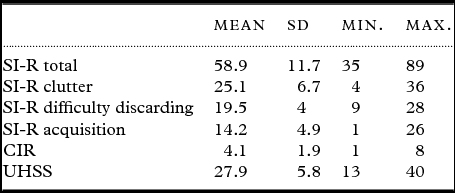
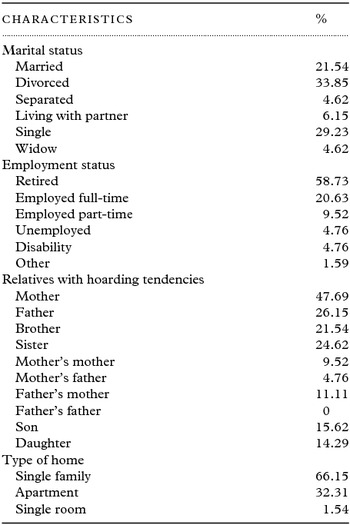
Participants in the current study were primarily White (85%; no significant other minority percentage) and females (69%). All of the participants, except for one, were high school graduates and the overall average years of education was 16 (SD = 2.16, range 10–20), which was unrelated to hoarding severity measured by the SI-R, UHSS, and CIR (in each case p > 0.05). Scores on hoarding severity measures were similar to established norms for adults with HD (see Table 1). Over half (58.73%) of the participants were retired (see Table 2) and the retired participants tended to be older (t 61 = −2.9, p < 0.01). There was no significant correlation between participants’ age and their hoarding severity, and participants who were retired did not have significantly different hoarding severity (SIR, CIR, and UHSS: in each case p > 0.05).
Hoarding severity in older adults (N = 71) with HD

Demographic characteristics of older adults (N = 71) with HD

Females reported significantly higher hoarding severity as measured by the SI-R (t 63 = 2.93, p = 0.01) and the UHSS (t 62 = 3.13, p < 0.01); however, the difference in hoarding severity observed on CIR was not significant (t 61 = 0.97, p = 0.17). Although White participants consistently reported lower hoarding severity than non-White participants, none of the differences observed were statistically significant (all p-values > 0.05).
The majority of participants were currently unmarried (see Table 2). Married participants had significantly lower hoarding symptom severity than participants not currently married as measured with the CIR (t 61 = 1.84, p < 0.05), but not with the SI-R (t 63 = 0.99, p = 0.16) or with the UHSS (t 62 = 1.14, p = 0.13). Over two-thirds of the participants lived in single-family homes (68.33%; see Table 2), but the type of home a participant lived in had no effect on their hoarding symptom severity as measured by the SI-R, UHSS, or CIR (in all the cases p < 0.05).
Family history and current living situation
The participants reported having an average of 1.7 (SD = 1.71) biological relatives who “save many things or have a lot of clutter in their living space.” Almost 50% (47.69%) reported having had a mother with hoarding tendencies, and over a quarter (26.15%) reported having had a father with hoarding tendencies (see Table 2). However, there was no correlation between the number of reported relatives with hoarding tendencies and the SI-R total, UHSS, or CIR (in all the cases p > 0.05) and there was no effect on hoarding severity of having reported a mother, a father, or both parents as having hoarding tendencies (all p-values > 0.05).
Nearly all the participants reported living alone (61.82%) or with one other person (27.27%), and no participants reported living with more than four other persons. The number of persons living with a participant was not associated with the SI-R or UHSS (in both the cases p > 0.05); however, the increased number of persons living with participants was strongly negatively correlated with the CIR (r = −0.31, p < 0.05). Further, the participants who reported living alone endorsed significantly higher levels of clutter in their homes than the participants living with one or more other person (CIR: t 51 = 2.92, p < 0.01; SI-R clutter: t 53 = 1.97, p < 0.05), although there was no reported increase in cognitive hoarding symptoms (SI-R total, SI-R acquisition, SI-R difficulty discarding, and UHSS: in all the cases p < 0.05).
Psychiatric and medical co-morbidities
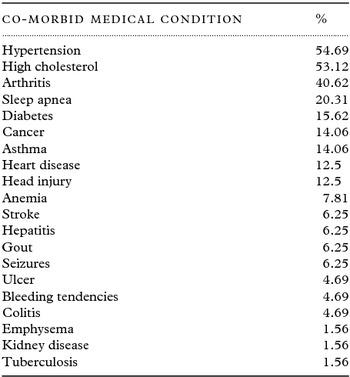
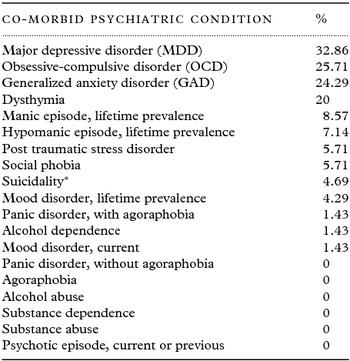
Eight-four percent of the participants endorsed one or more medical co-morbidities with an average of 2.9 (SD = 1.98) reported co-morbidities per participant (see Table 3). However, there was no correlation between reported number of medical illnesses and the SI-R, UHSS, or CIR, and no single reported medical co-morbidity significantly altered hoarding symptom severity in the above measures (all p-values < 0.05). Almost two-thirds (63%) of the participants had one or more psychiatric co-morbidities, most commonly major depressive disorder (MDD; 32.86%), obsessive-compulsive disorder (OCD; 25.71%), and generalized anxiety disorder (GAD; 24.29%) (see Table 4). The number of co-morbid psychiatric diagnoses was positively correlated with hoarding symptom severity in the SI-R (r = 0.35, p < 0.01) and the UHSS (r = 0.40, p < 0.001), but not in the CIR (r = 0.20, p = 0.11). Although 35% of the participants reported drinking alcohol, there was no significant difference in hoarding symptom severity in the SI-R, UHSS, or the CIR in patients who reported drinking alcohol and those who reported abstaining (in all the case p > 0.05).
Medical co-morbidities in older adults (N = 71) with HD

Psychiatric co-morbidities in older adults (N = 71) with HD

Note: *All participants who indicated some suicidal ideation were determined to be at low risk.
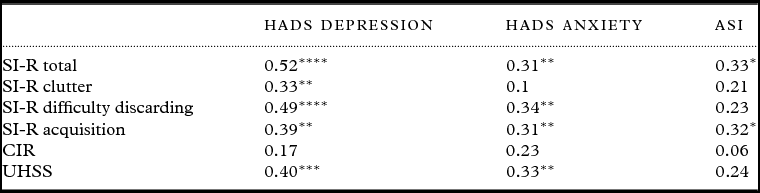
Participants’ scores on the HADS depression subscale (mean: 7.9, SD = 4.3) was near the cutoff score (8–10) for borderline depressive symptoms. Patients scored in the “borderline psychiatric symptoms” range (8–10) on the HADS anxiety subscale (mean: 9.7, SD = 4.0). Similarly, the mean score of ASI in the current sample (18.9; SD = 12.8) was lower than scores seen in samples of individuals with anxiety disorders (Reiss et al., Reference Reiss, Peterson, Gursky and McNally1986). The ASI and the HADS anxiety subscale were significantly related (r = 0.33, p < 0.05) and both demonstrated strong relationships with SI-R. However, the ASI and the HADS anxiety subscale depicted conflicting patterns regarding the CIR and the UHSS (see Table 5). The ASI was also significantly related to the HADS Depression subscale (r = 0.51, p < 0.0001).
Relationship between depression and anxiety symptoms and hoarding symptom severity in older adults (N = 71) with HD

Notes: ****p < 0.0001, ***p < 0.001, **p < 0.01, *p < 0.05.
HADS: Hospital Anxiety and Depression Scale; ASI: Anxiety Sensitivity Index.
Medical and psychiatric care
The majority of the participants (81.69%) reported having a current primary care provider and there was no difference in hoarding symptom severity (as measured by the SI-R, CIR, and UHSS) for participants who did and who did not have a primary care provider (all p-values > 0.05). Over half of the participants (57.75%) had a current mental health provider or had previously seen a mental health provider for treatment of depression (48.78%), anxiety (34.15%), hoarding symptoms (14.63%), OCD (27.50%), grief (7.32%), marital problems (9.76%), bipolar disorder (7.32%), ADD or ADHD (7.32%), or other (30.77%). Having received previous mental health care, for any reason, did not significantly impact hoarding symptom severity for the SI-R, CIR, or UHSS (all p-values > 0.05).
Impact of hoarding symptoms
When queried on how difficult it is to use particular rooms in their homes, participants reported a range of difficulty levels ranging from mild (bathroom: mean = 2.63, SD = 2.26; hallways: mean = 2.76, SD = 2.47) to moderate (kitchen: mean = 4.15, SD = 2.22; living room: mean = 4.25, SD = 2.63; bedroom: mean = 4.52, SD = 2.63) to borderline severe (dining room: mean = 5.22, SD = 2.45; garage: mean = 5.42, SD = 2.43). The level of difficulty for using each room was significantly correlated with the level of difficulty for using all other rooms (all p-values < 0.01), with the exception of the garage (all p-values > 0.05); thus, the level of difficulty in using the garage was excluded from subsequent analyses involving level of difficulty of using rooms in the home. The mean level of difficulty using rooms (excluding the garage) was in the moderate range (3.97, SD = 1.9), and these six rooms had higher internal consistency (α = 0.88). The mean difficulty level of using rooms (living room, dining room, bedroom, kitchen, bathroom, and hallway) was significantly correlated with the SI-R (r = 0.53, p < 0.0001), the SI-R Clutter subscale (r = 0.74, p < 0.0001), the CIR (r = 0.70, p < 0.0001), and the UHSS (r = 0.60, p < 0.0001), but was not significantly related to the SI-R Acquisition subscale (r = 0.11, p = 0.40) or the SI-R Difficulty Discarding subscale (r = 0.22, p = 0.08). The level of difficulty reported for the living room, kitchen, and bedroom was significantly related to the level of clutter indicated by the CIR for those rooms (living room: r = 0.75, p < 0.0001; kitchen: r = 0.60, p < 0.0001; bedroom: r = 0.62, p < 0.0001).
While the majority of the participants (75.76%) reported having encountered no intervention attempt, 14.93% of the participants reported having had their landlord attempt to intervene, and 16.67% reported an intervention attempt from at least one government agency (5.97% from adult protective services, 5.97% from a police department, 4.48% from animal protection, 4.55% from child protective services, and 4.48% from a fire department). However, no single reported intervention or having reported any interventions versus none had any effect on hoarding symptom severity as measured by the SI-R, CIR, or UHSS (all p-values > 0.05).
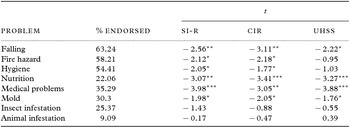
Participants endorsed an average of 2.31 (SD = 1.71) health or safety problems that they or other people think are caused by the clutter in their homes, with only one-fifth (19.4%) of the participants indicating that the clutter in their homes has not generated any concerns in the queried areas. The major problems endorsed include falling (63.24%), fire hazard (58.21%), and hygiene (54.41%) (see Table 5). The overall number of health and safety problems endorsed by the participants correlated positively with the severity of their hoarding symptoms (SI-R: r = 0.44, p < 0.001; CIR: r = 0.44, p < 0.001; UHSS: r = 0.36, p < 0.01). Participants who endorsed one or more health or safety problems scored significantly higher on the SI-R (t 65 = −2.5, p < 0.01) and on the CIR (t 63 = −2.1, p < 0.05), but not on the UHSS (t 64 = −1.1, p = 0.13). Only two problems (insect infestation and animal infestation) were not related to increased hoarding symptom severity on at least one hoarding measure when analyzed alone (see Table 6). In addition to problems directly caused by hoarding, the presence of guns, old paint, and asbestos as safety hazards in the homes of the participants was also examined. Nearly half of the participants (43.28%) reported having old paint in their homes, 11.76% had guns in their homes, and 5.97% reported having asbestos in their homes. However, none of these safety hazards affected the severity of hoarding symptoms in the SI-R, CIR, or UHSS (all p-values > 0.05).
Relationship between health or safety problems caused by clutter and hoarding severity in older adults (N = 71) with HD

Note: ****p < 0.0001, ***p < 0.001, **p < 0.01, p < 0.05.
Over two-thirds (69.35%) of the participants reported experiencing one or more falls in the past three years, with the average participant having fallen 2.24 (SD = 2.76) times; however the number of falls in the past three years was not significantly related to hoarding symptom severity as measured by the SI-R, CIR, or UHSS (all p-values < 0.05). When queried for how concerned they were about falling, 21.54% of the participants reported “not at all,” 35.38% said “a little bit,” 21.54% endorsed “somewhat,” and 21.54% said “quite a bit.” Concern about falling was significantly related to number of falls in the past three years (r = 0.53, p < 0.0001), but unrelated to hoarding symptom severity in the SI-R, CIR, and UHSS (all p-values > 0.05). Although concern about falling was related to avoidance of certain activities due to falling (r = 0.55, p < 0.0001) and the number of falls in the past three years (r = 0.50, p < 0.0001), 40.62% of the participants reported that they were “not at all” avoidant of activities because they thought they might fall. Only 4.69% of the participants reported that they were “quite a bit” avoidant of activities because of falling, with 35.94% saying they were “a little bit” avoidant and 18.75% reporting that they were “somewhat” avoidant. However, avoiding activities because of fear of falling was not significantly related to hoarding symptom severity for the SI-R, CIR, or UHSS (all p-values > 0.05).
Almost two-thirds of the participants (65.62%) reported that they never have friends and family visit their homes, 20.31% said that they only have family or friends visit their home—one to two times per month, and only 14.06% endorsed that they have friends of family visit at least weekly. Participants who reported they never had family or friends visit their homes reported significantly more severe hoarding symptoms than those participants who reported having family or friends visit their home at least—one to two times per month (SI-R: t62 = 2.12, p < 0.05; CIR: t60 = 2.44, p < 0.01; UHSS: t61 = 2.53, p < 0.01).
Discussion
Participants in the current study reported demographic characteristics, including race, gender, and education levels, similar to those observed in previous characterization studies (Ayers et al., Reference Ayers, Saxena, Golshan and Wetherell2010; Diefenbach et al., Reference Diefenbach, DiMauro, Frost, Stektee and Tolin2013), which further validates the generalizability of the results of the demographically related predictive factors with other older adults with HD. Although the limited range of years of education in the current sample (all participants were at least high school graduates) might have decreased the likelihood of finding significant results when comparing years of education with hoarding severity, the current findings are congruent with the correlates of hoarding symptoms in the general population (Samuels et al., Reference Samuels2008). There was no significant association between age and hoarding symptom severity, although this may in part be due to the restricted age range (60–85 years).
The observed gender disparity in hoarding severity in the current study is different from studies of mid-age adults with HD (Frost et al., Reference Frost, Steketee and Grisham2004), which found that the only acquisition subscale of the SI-R was higher in females, as well as characterization studies featuring non-clinical older adults (Reid et al., Reference Reid2011), which found that only the clutter subscale of the SI-R was higher in females. Interestingly, the observed gender difference in hoarding severity was only true for self-reported measures of hoarding severity (SI-R and UHSS) and not on a visual measure of clutter volume (CIR). The CIR has been proven to be a reliable tool for estimating clinician ratings of clutter levels (Frost et al., Reference Frost, Steketee, Tolin and Renaud2008; Tolin et al., Reference Tolin, Frost and Steketee2010; Dimauro et al., Reference Dimauro, Tolin, Frost and Steketee2013) as well as discriminating between individuals with and without compulsive hoarding (Grisham et al., Reference Grisham, Norberg, Williams, Certoma and Kadib2010; Gordon et al., Reference Gordon, Salkovskis and Oldfield2013; Nordsletten et al., Reference Nordsletten, Fernández de la Cruz, Billotti and Mataix-Cols2013), potentially making it a more objective measure of clutter volume than other self-reports. This suggests that although females are more likely to report higher hoarding severity when queried with subjective verbal self-reports, their actual levels of symptoms are comparable with their male counterparts.
Although previous studies have looked at the role of genetics in the prevalence of hoarding symptoms (Iervolino et al., Reference Iervolino2009), this is the first study to look at the correlation between hoarding symptom severity in individuals with HD and the number of biological relatives with hoarding symptoms. We found no relationship between number or kind of relatives with hoarding tendencies and hoarding symptom severity. This is surprising considering that previous studies have found that 50% of the variance in HD symptoms can be attributed to genetics (Iervolino et al., Reference Iervolino2009). However, this may be attributed to the fact that the identified hoarding relatives in our sample were not formally evaluated or diagnosed.
Consistent with HD prevalence reports from across the lifespan, we found that the majority of the participants were unmarried (Timpano et al., Reference Timpano2011) and that married participants were more likely to report lower hoarding severity (Samuels et al., Reference Samuels2008). Similar to prevalence reports of hoarding in community samples, there was no relationship between number of cohabitants and the cognition-related symptoms of HD, such as is measured by the UHSS and the SI-R (Samuels et al., Reference Samuels2008), although increased number of cohabitants led to decreased scores on the CIR, suggesting that as the number of people sharing a home increased, the clutter levels in that home actually decreased. Thus, being married and having more than one additional person in the home may serve as a buffer to clutter build up over time. Other individuals in the home are either serving as barriers to incoming clutter or actively taking steps to remove items from the home.
The psychiatric co-morbidities observed in the current sample were similar in type to previous samples of older adults with HD (Ayers et al., Reference Ayers, Saxena, Golshan and Wetherell2010; Diefenbach et al., Reference Diefenbach, DiMauro, Frost, Stektee and Tolin2013). Although the frequency with which most psychiatric co-morbidities were observed closely mapped on to a recent characterization study of older adults (Diefenbach et al., Reference Diefenbach, DiMauro, Frost, Stektee and Tolin2013), MDD in the current sample was observed in only one-third (32.86%) of the participants, compared with over half (51.4%) of the sample observed by Diefenbach et al. (Reference Diefenbach, DiMauro, Frost, Stektee and Tolin2013). Thus, when older adults present with MDD, clinicians should query HD symptoms as these are often found co-morbid. It remains to be seen whether depression symptoms affect treatment response, although preliminary results examining older adult treatment responders suggest that the more the psychiatric co-morbidities, the more difficult it is to treat HD (Ayers et al., Reference Ayers, Saxena, Espejo, Twamley, Granholm and Wetherell2014).
The mean score of the ASI in the current sample was roughly three points lower than the scores Diefenbach and colleagues (Reference Diefenbach, DiMauro, Frost, Stektee and Tolin2013) observed in older adults with HD (mean score = 21.81, SD = 11.85), but results from both studies suggest that older adults with HD have moderately low levels of anxiety sensitivity. Because previous studies found that anxiety sensitivity was significantly related to hoarding symptoms in non-clinical undergraduate samples (Timpano et al., Reference Timpano, Buckner, Richey, Murphy and Schmidt2009), the findings of the current study further demonstrate the inadequacy of non-clinical undergraduate populations to serve as a testing ground for hypotheses about HD mechanisms. This is especially true considering that in the current study only one of the hoarding severity measures used demonstrated even a moderate relationship with the ASI.
Anxiety and depression symptoms were strongly correlated with cognition-related symptoms of HD, or their beliefs about acquiring and discarding, but were not significantly related to the clutter component of hoarding, as measured by the CIR. However, this may be due to a limitation of the study design, which had no behavioral investigation of anxiety or depression to compare with the physical manifestation of hoarding (i.e. clutter as measured by the CIR). Unfortunately, previous investigations of the relationship between hoarding symptoms and anxiety and depression have relied solely on the cognitions-related symptoms (such as measured by SI-R or UHSS) and not on the clutter component, and so no comparisons can be made with previous literature. That being said, Reid and colleagues (Reference Reid2011) did find that the SI-R clutter subscale had a more modest relationship with anxiety as measured by the Penn State Worry Questionnaire than did the difficulty discarding or acquisition subscales (r = 0.24 for clutter; r = 0.45 for difficulty discarding; r = 0.28 for acquisition), although all relationships were observed to be equally significant, p < 0.001. This suggests that although higher levels of hoarding-related cognitions may be related to higher levels of anxiety, the clutter component of HD does not have a similar relationship. Further analysis is need to determine whether there is any unique variance shared between anxiety and the clutter component of HD that is not explained by the symptoms of hoarding-related cognitions. A better understanding of this relationship will lead to the potential for individualized treatments for older adults suffering from HD who may or may not also have co-morbid anxiety disorders.
The level of difficulty for using the living room, kitchen, and bedroom was significantly related to the ratings for the level of clutter in the corresponding rooms, suggesting that reported clutter levels could be used as an approximation for overall difficulty in using rooms in the home. Although this might sound intuitive (e.g. more clutter leads to less maneuverability), validating this relationship also validates conclusions that clinicians might make about impairment of daily living due to hoarding-related clutter based on participant's self-report of clutter levels using the CIR. Further, this information can be used to inform clinicians on the information to query during a patient in-take session; i.e. clinicians do not need to ask about both clutter levels and impairment due to clutter, thus saving time for both clinician and patient.
The current sample of older adults with HD endorsed health and safety problems in similar frequencies with those endorsed in the Diefenbach et al. (Reference Diefenbach, DiMauro, Frost, Stektee and Tolin2013) sample, most notably falling and fire hazards. Although there was a significant correlation between endorsement of health and safety problems and hoarding symptom severity, there was no significant relationship between hoarding severity and intervention attempts or hoarding and reported falls in the past three years. Further, workers entering the home should be cautious and inquire about potentially harmful items (e.g. guns, old paint, rat feces) that they may encounter.
One possible reason for the low frequency of reported intervention attempts by people or agencies is that the current sample was self-selected and is not indicative of the non-treatment seeking individuals who are more likely to be the target of such intervention attempts. The finding that the current sample of self-referred late life HD patients reported even some level of community service involvement suggests that even for treatment-seeking HD patients, HD still has an impact on the community at large and might create a burden for community health agencies.
While this study had multiple strengths (relatively large numbers, in-person assessment) it also has several limitations. Namely, there was no community or psychiatric control group. A control group would allow for a direct comparison of the predictors of HD symptom severity in HD and non-HD samples. The use of a non-clinical control sample would also enable for a comparison of the psychiatric and medical co-morbidities of HD and non-clinical samples.
The study is further limited by the recruitment strategy, which limited the study to a characterization of treatment-seeking individuals. Symptoms of hoarding may present differently in more severe cases of HD, and further investigation of the predictors of HD severity in treatment-resistant individuals is needed. An additional limitation of the recruitment strategy was the exclusion of participants with cognitive impairment, bipolar, schizophrenia, psychosis, suicidal ideation, and substance dependence as these co-morbidities may be present in many of the HD cases that present to community clinicians. There was also no assessment of personality disorders in the current investigation, preventing any analysis of the prevalence of Axis II co-morbidities in patients with HD.
A further limitation of the current study is the self-report nature of many of the variables, including the participants’ family history of hoarding symptoms and the consequences of hoarding (e.g. functional, health, and safety risks). Clinician-administered assessment of these factors would enable for a more objective account of these variables.
Finally, the restricted age range did not allow for a more accurate examination of any age-related changes in the presentation of hoarding symptoms. Future studies should include an investigation of how the predictive characteristics of hoarding symptom severity vary across the lifespan.
Another avenue of future research is the differential abilities of these characteristics to predict hoarding symptom severity in adults with HD as well as the potential of demographic, sociologic, and medical characteristics to predict treatment outcome in HD. It is possible that one combination of predictive factors might lead to better results from one type of intervention (e.g. more exposure-based), which a different set of predictive factors might be related to higher outcomes from a different type of intervention (e.g. more cognitive-based). By investigating the predictive factors of HD severity in older adults with HD, we have taken the first step to examine possible treatment predictors for late life HD.
Conflict of interest declaration
None.
Description of authors’ roles
C. Ayers designed the study, supervised the data collection, and assisted with writing the paper. M. Dozier analyzed the data and wrote the paper.
Acknowledgments
This research was supported by a Career Development Award (CSRD-068-10S) from the Clinical Science R & D Program of the Veterans Health Administration. The contents do not reflect the views of the Department of Veterans Affairs or the US Government.