INTRODUCTION
Over the last 2 decades red fox (Vulpes vulpes) populations in Europe have increased substantially as a result of successful rabies vaccination campaigns and possibly better food resources. Expanding populations and their encroachment upon urban areas presents an increasing public health hazard for the human population (Švrček et al. 2000). Among the helminths hosted by European foxes, the occurrence of the tapeworm Echinococcus multilocularis has been monitored most intensively over the last decade (e.g. Pétavy et al. Reference Pétavy, Deblock and Prost1990; Duscher et al. Reference Duscher, Pleydell, Prosl and Joachim2006; Hegglin et al. Reference Hegglin, Bontadina, Gloor, Romig, Deplazes and Kern2008; Kinčeková et al. Reference Kinčeková, Hrčková, Bober, Vrzgula, Szabadošová, Bohuš and Zachar2008; Miterpáková et al. Reference Miterpáková, Dubinský, Reiterová, Machková, Várady and Šnábel2003, Reference Miterpáková, Dubinský, Reiterová and Stanko2006, Reference Miterpáková, Hurníková, Antolová and Dubinský2009). Another common, but less-studied tapeworm group transmitted by these hosts is represented by the genus Mesocestoides Vailant, 1863 (Cestoda, Cyclophyllidea, Mesocestoididae), which are also parasites of dogs and other carnivores (Rausch, Reference Rausch, Khalil, Jones and Bray1994) and have been reported in at least 27 cases of human infection (Fuentes et al. Reference Fuentes, Galán-Puchades and Malone2003).
Mesocestoides spp. are unique among tapeworms in several aspects of their biology, including their life cycles, that are thought to involve 3 hosts (Etges, Reference Etges1991; Rausch, Reference Rausch, Khalil, Jones and Bray1994) and include a larval stage called a tetrathyridium. These presumed second-stage larvae show little host specificity and have been reported from the peritoneal cavity and parenchymal organs of a large diversity of mammals, birds and reptiles (Specht and Voge, Reference Specht and Voge1965; Loos-Frank, Reference Loos-Frank1980a; McAllister et al. Reference McAllister, Bruce Conn, Freed and Burdick1991; Millán et al. Reference Millán, Gortazar and Casanova2003; Literák et al. Reference Literák, Olson, Georgiev and Špakulová2004). Unlike foxes and humans, dogs, and to a lesser extent cats, are known to serve as both definitive and intermediate hosts (Crosbie et al. Reference Crosbie, Boyce, Platzer, Nadler and Kerner1998, Reference Crosbie, Nadler, Platzer, Kerner, Mariaux and Boyce2000; Thiess et al. Reference Thiess, Schuster, Nöckler and Mix2001; Caruso et al. Reference Caruso, James, Fisher, Paulson and Christopher2003; Toplu et al. Reference Toplu, Yildiz and Tunay2004; Foronda et al. Reference Foronda, Riviero, Morales, Kabdur, González, Ricalde, Feliu and Valladares2007; Wirtherle et al. Reference Wirtherle, Wiemann, Ottenjann, Linzmann, van der Grinten, Kohn, Gruber and Clausen2007; Eleni et al. Reference Eleni, Scaramozzino, Busi, Ingrosso, D'Amelio and De Liberato2007), and as the definitive hosts they could be involved in the transmission cycle.
Morphologically, the group is unique in exhibiting a median ventral position of the genital atrium and a bipartite vitelline gland and, unusually, possessing a paruterine organ, rarely found in other cyclophyllidean groups (see Georgiev and Kornyushin, Reference Georgiev, Kornyushin, Khalil, Jones and Bray1994). On this basis they have been traditionally classified in their own family, Mesocestoididae Fuhrmann, 1907, within the order Cyclophyllidea (Khalil et al. Reference Khalil, Jones and Bray1994). However, molecular analyses have demonstrated that Mesocestoides spp. represent 1 of 4 primary lineages that together with the orders Cyclophyllidea, Nippotaeniidea and Tetrabothriidea, comprise the most derived clade of cestodes (termed ‘higher acetabulates’ sensu lato Olson et al. Reference Olson, Littlewood, Bray and Mariaux2001, Reference Olson, Poddubnaya, Littlewood and Scholz2008) (Olson et al. Reference Olson, Littlewood, Bray and Mariaux2001, Reference Olson, Poddubnaya, Littlewood and Scholz2008; Olson and Tkach, Reference Olson and Tkach2005; Waeschenbach et al. Reference Waeschenbach, Webster, Bray and Littlewood2007). The interrelationships of these groups are poorly resolved (see Olson and Tkach, Reference Olson and Tkach2005) and it is thus unclear how close Mesocestoides is to the clade that represents the Cyclophyllidea. Nevertheless, independence of the Mesocestoides lineage clearly reflects the unique biology of the group and suggests that it should be recognized at an ordinal rank (i.e. Mesocestoidea) alongside other higher acetabulate groups.
Although ubiquitous and widespread across the Northern Hemisphere, Mesocestoides species are known to display an unusually high degree of phenotypic plasticity that has made routine species identification difficult without the aid of molecular tools, contributing to confusion regarding their species boundaries, geographical ranges and host associations (Voge, Reference Voge1955; Loos-Frank, Reference Loos-Frank1987; Padgett et al. Reference Padgett, Nadler, Munson, Sacks and Boyce2005), and according to Rausch (Reference Rausch, Khalil, Jones and Bray1994), few species can be indentified on the basis of morphology alone. In Europe, 2 species of Mesocestoides, M. litteratus (Batsch, 1786) and M. lineatus (Goeze, 1782), have been reported commonly (Pétavy et al. Reference Pétavy, Deblock and Prost1990; Kapel and Nansen, Reference Kapel and Nansen1996; Willingham et al. Reference Willingham, Ockens, Kapel and Monrad1996; Okulewicz et al. Reference Okulewicz, Hildebrand, Okulewicz and Perec2005; Dalimi et al. Reference Dalimi, Sattari and Motamedi2006; Literák et al. Reference Literák, Tenora, Letková, Goldová, Torres and Olson2006). According to Skrjabin (Reference Skrjabin and Skrjabin1978) and Jancev (1986), the two species may be differentiated morphologically by subtle differences in the cirrus sac, testes number and position of ovaries and vitellaria. However, such differences require careful microscopical examination of stained and mounted specimens and thus the species cannot be reliably differentiated in the field. Moreover, as in the present paper, most reports on European Mesocestoides are based on examination of previously frozen worms, which contributes to morphological variability and poor preservation of parasite specimens in general. However, this is a typically unavoidable consequence of the manner in which foxes are routinely surveyed and examined. We therefore believe that many previous reports of European Mesocestoides spp. are likely to have confounded the identities of these species.
Few molecular studies of the group have been conducted. Among European isolates, Nickisch-Rosenegk et al. (Reference Nickisch-Rosenegk, Lucius and Loos-Frank1999) reported a slight divergence in 12S rDNA among Mesocestoides spp. from red foxes in Southern Germany, and Literák et al. (Reference Literák, Tenora, Letková, Goldová, Torres and Olson2006) reported no divergence in 18S rDNA among isolates of M. litteratus from red foxes in Spain and the Czech and Slovak Republics. In North America, molecular-based studies of Mesocestoides spp. in dogs, coyotes, foxes and other animals (Crosbie et al. Reference Crosbie, Boyce, Platzer, Nadler and Kerner1998, Reference Crosbie, Nadler, Platzer, Kerner, Mariaux and Boyce2000; Padgett and Boyce, Reference Padgett and Boyce2004; Padgett et al. Reference Padgett, Nadler, Munson, Sacks and Boyce2005) revealed the existence of 3 highly distinct lineages that were neither host specific nor could they be distinguished on the basis of features of their scolex and strobila (see Padgett et al. Reference Padgett, Nadler, Munson, Sacks and Boyce2005). Moreover, only 1 of the lineages could be assigned to a known species (i.e. M. vogae Voge, Reference Voge1955=M. corti Etges, Reference Etges1991). Padgett et al.'s (Reference Padgett, Nadler, Munson, Sacks and Boyce2005) findings, together with morphological assessments of the group (Voge, Reference Voge1955; Rausch, Reference Rausch, Khalil, Jones and Bray1994), underscore the need to employ molecular data in the circumscription of these highly variable species (Olson and Tkach, Reference Olson and Tkach2005).
A broader sampling of European isolates, including molecular confirmation of M. litteratus and M. lineatus, has not been conducted previously. The Slovak Republic is a heavily mountainous and forested country in central Europe that is home to a large red fox population, and monitoring of these populations provided the opportunity to examine more than 3000 individuals collected over a 6-year period. Here we report on infections of Mesocestoides spp. in these populations and use a combination of 3 mitochondrial genes (12S rDNA, CO1 and ND1) and 13 morphometric characters to assess the validity of the commonly reported European species M. litteratus and M. lineatus.
MATERIALS AND METHODS
Necroscopy and examination of hosts
During the years 2001–2006, a total of 3157 red foxes (Vulpes vulpes) were examined from 6 administrative districts of the Slovak Republic: Bratislava (BA), Dolný Kubín (DK), Košice (KE), Nitra (NT), Prešov (PO) and Zvolen (ZV). All foxes were collected in Spring and Autumn and were shot by hunters according to government initiatives to manage population growth resulting from anti-rabies vaccination campaigns. Animals were transported to the State Veterinary and Food Institutes for rabies examination. After necropsy, only the small intestines of rabies-negative foxes were examined for tapeworms, and intestines were frozen at −80°C for 7 days according to Ministry of Health guidelines (i.e. to avoid possible infection with Echinococcus spp.) prior to the examination via sedimentation and intestinal scraping (WHO/OIE Manual, Reference Eckert, Gemmell, Meslin and Pawlowski2001). Small intestines were cut into 5 pieces, opened and placed into water, and large food items removed. This was followed by a 30-min sedimentation period and by multiple washings, after which adult Mesocestoides spp. were collected and preserved in 70% ethanol.
Morphological identification of specimens
Cestode specimens subjected to morphological and molecular analyses were sampled from 10–15 foxes collected from each of the 5 localities in 2006, and 2–5 whole worms were selected from each fox on the basis of their completeness and quality of preservation. A subsample of these worms were also used for molecular analyses, in which case small portions of tissue were preserved in 95% EtOH, while the remainder of the worms were stored in 70% EtOH. Specimens used for morphometric analysis were rehydrated in a graded ethanol series and post-fixed for 24 h in 4% paraformaldehyde in phosphate-buffered saline (PBS; pH 7·2). After washing for 1 h in PBS, specimens were stained overnight with Gill's haematoxylin (Sigma, US) diluted in tap water (pH=6·0), dehydrated in a graded ethanol series, cleared in clove oil and mounted in Canada balsam. Identifications were based on comparison of 13 anatomical characters following the protocol of Skrjabin (Reference Skrjabin and Skrjabin1978) and specimens were compared with museum voucher specimens held in the Parasitic Worms Collection at the Natural History Museum, in London (NHM-PWC). In total, 35 specimens identified as M. litteratus and 20 identified as M. lineatus were measured using an Olympus BX 51 microscope and digital analysis imaging system. Significant differences in morphometrics between species were determined using a non-parametrical Kolmogorov-Smirnov test (P-level indicated in Table 2) implemented in Statistica ver. 6.0 (Tulsa, USA). Specimens are deposited in the NHM-PWC under accession numbers BMNH 2011.2.2.1-18 and BMNH 2011.2.2.19-20, and include those used for both morphological and molecular analyses (i.e. hologenophores, sensu Pleijel et al. Reference Pleijel, Jondelius, Norlinder, Nygren, Oxelman, Schander, Sundberg and Thollesson2008).
DNA isolation and PCR amplification
Ethanol in the tissue samples was replaced with Tris-EDTA buffer via soaking and total genomic DNA was extracted using a Qiagen DNeasy tissue kit following manufacturer's protocol, except that worms were incubated in proteinase K overnight and the gDNA eluted via 2 vols of 100 μl. Three μl of template gDNA were added to 25 μl PCR reactions using Ready-To-Go PCR beads (Amersham Pharmacia Biotech). The mitochondrial 12S and nuclear ITS-2 rDNA genes were amplified to provide direct comparison with the work of Padgett et al. (Reference Padgett, Nadler, Munson, Sacks and Boyce2005). Partial 12S sequences (∼370 bps) were amplified and sequenced using the primers 60.for and 375.rev (Nickisch-Rosenegk et al. Reference Nickisch-Rosenegk, Lucius and Loos-Frank1999), and complete ITS-2 sequences were amplified using primers NC-6 and NC-2 and sequenced together using primers NC-6-F1 and NC-2-R1 (Littlewood et al. Reference Littlewood, Waeschenbach and Nikolov2008). In addition, partial sequences of the mitochondrial CO1 (∼400 bps) and ND1 (∼450 bps) genes were characterized using the primers Cyclo-cox1FA, Cyclo_16SRc and Cyclo_cox1Rb for CO1, and Cyclo_nad1F, Cyclo-trnNR and Cyclo_nad1Fb for ND1 (Littlewood et al. Reference Littlewood, Waeschenbach and Nikolov2008). Fragments were amplified using the following thermocycling conditions: 94°C/5 min denaturation hold; 40 cycles of 94°C/30 sec, 52°C/30 sec, 72°C/1 min; and 72°C/5 min extension hold. PCR products were visualized on a 1·5% agarose gel and either gel-excised using a Qiagen QIAquick Gel Extraction Kit or purified directly using a Qiagen PCR Purification Kit, and then cycle-sequenced from both strands using ABI BigDye™ chemistry, alcohol precipitated and run on an ABI automated Sanger-based sequencer.
Sequence alignment and phylogenetic analyses
Amplification was successful in samples of 38 of the isolates (BA=2, DK=8, KE=13, PO=6, ZV=7) representing the majority of specimens used for morphometric analysis, although not all samples yielded results for all genes. Thus 31, 25 and 26 Mesocestoides sequences were characterized for 12S, CO1 and ND1 partitions, respectively, plus 2 additional CO1 and ND1 sequences of the cyclophyllidean Taenia taeniaformis from red foxes in Košice and Zvolen included for outgroup comparison. Sequences were assembled and edited manually using Sequencher ver. 4.6 (GeneCodes Corporation). Regions corresponding to the PCR primers were removed prior to analysis. All sequence identities were verified using the Basic Local Alignment Search Tool (BLAST) (McGinnis and Madden, Reference McGinnis and Madden2004) (www.ncbi.nih.gov/BLAST/). All sequences are deposited in GenBank under accession numbers JF 268553-581 (12S), JF 268498-525 (CO1) and JF 268526-552 (ND1).
The composition and number of additional Mesocestoides and outgroup sequences included varied, based on the availability of relevant sequences for the different gene partitions. For the 12S alignment, the comparatively large number of North American isolates from Padgett et al. (Reference Padgett, Nadler, Munson, Sacks and Boyce2005) were included along with several other available sequences, whereas only additional Mesocestoides sequences were available for CO1 (AB033413 and EU665469), and 1 for ND1 (EU665480). All data partitions were rooted using cyclophyllidean taxa (see Fig. 3 for sequence Accession numbers). Sequences were aligned initially with ClustalX v 2.0 (Thompson et al. Reference Thompson, Gibson, Plewniak, Jeanmougin and Higgins1997) using default parameter settings (i.e. gap opening and gap extension fixed at 10 and 0·2 respectively. Alignments were further improved by eye using MacClade ver. 4.08 (Maddison and Maddison, Reference Maddison and Madison2000), with the protein-coding CO1 and ND1 sequences aligned according to codon positions, with the genetic code set to ‘flatworm mtDNA’ (Nakao et al. Reference Nakao, Sako, Yokoyama, Fukunaga and Ito2000). Alignments were truncated to remove leading and trailing gaps, as well as regions that contained alignment gaps in the majority of taxa.
Phylogenetic trees were constructed using maximum parsimony, maximum likelihood and Bayesian inference. Maximum parsimony was performed using PAUP* ver. 4.0b (Swofford, Reference Swofford2003). A heuristic search (1000 replicates), random-sequence addition and tree bisection and reconnection (TBR) options were used, with all characters unweighted and unordered and gaps treated as missing data. To determine branch support, 1000 bootstrap replicates were generated. Maximum likelihood analysis was performed using PhyML v2.4.4 (Guindon and Gascuel, Reference Guindon and Gascuel2003) with the best-fit model of nucleotide substitution selected using MrModelTest ver. 2 (Nylander, 2004): GTR+G for 12S rDNA, HKY+G for CO1 and GTR+I+G for ND1. Analyses of CO1 and ND1 protein translations employed the WAG amino acid substitution model (Whelan and Goldman, Reference Whelan and Goldman2001).
Bayesian analysis was performed with MrBayes v3.2 (Ronquist and Huelsenbeck, Reference Ronquist and Huelsenbeck2003) using the substitution models selected above and default prior probabilities set to be estimated (Dirichlet (1,1,1,1)). Chain length was set to 1 000 000 generations sampling every 100th generation. Two simultaneous independent runs were undertaken for each dataset starting from different random trees with the ‘burn-in’ set to 10% (100 000 generations). To ensure convergence, parameter estimates were examined using Tracer ver. 1.4 (part of the BEAST package; Drummond and Rambaut, Reference Drummond and Rambaut2007). Perl scripts were written to automate the majority of the phylogenetic analyses (available on request from AOC) and Geneious ver. 5.0 (Drummond et al. Reference Drummond, Ashton, Cheung, Heled, Kearse, Moir, Stones-Havas, Sturrock, Thierer and Wilson2010) was used for both analysis and visualization of the data.
RESULTS
Prevalence of Mesocestoides spp. in red foxes in Slovakia
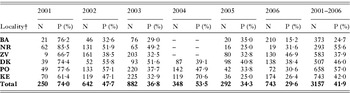
Of the 3157 foxes examined over a 6-year period, 1322 harboured infections with Mesocestoides spp. (41·9%), and prevalence fluctuated considerably among localities and years (Table 1). In the locality near Bratislava encompassing a largely urban area, the mean prevalence was 24·7%. For the 5 remaining administrative regions that were mostly forested, a higher density of foxes was associated with higher rates of infection, with the highest overall prevalence of 57% recorded from the Prešov district adjacent to the Tatra National Park in the High Tatras mountains. Among the years of study, the highest infection rate (74·0%) was seen in all 6 regions in 2001 and the lowest (29·6%) in 2006. Intensities of infection ranged from 10 to several hundred worms, but the inability to make positive identifications in the field meant that we could not record intensity data for individual Mesocestoides species.
Prevalence of Mesocestoides spp. in red foxes from six administrative districts of the Slovak Republic from 2001–2006

† BA, Bratislava; NR, Nitra; ZV, Zvolen; DK, Dolný Kubín; PO, Prešov; KE, Košice.
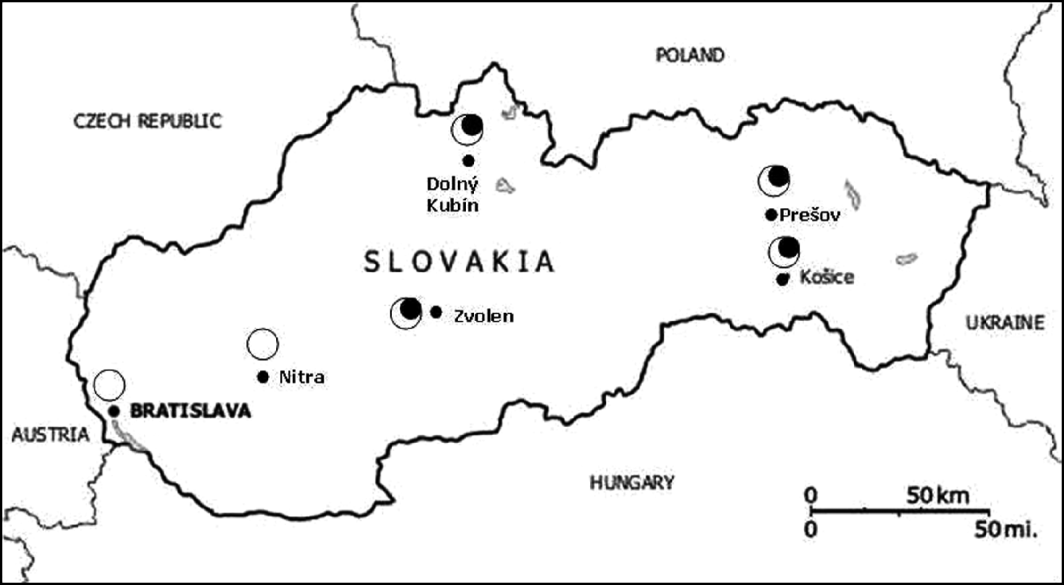
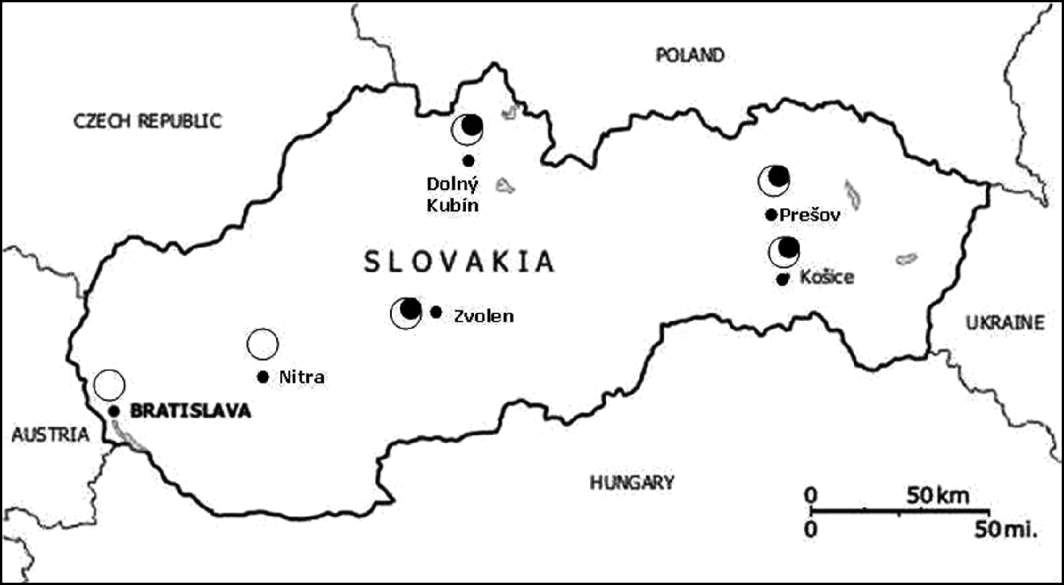
Two species of Mesocestoides were identified in the samples that were consistent with the descriptions of M. litteratus (Batsch, 1786) and M. lineatus (Goeze, 1782) and to voucher specimens of these species (BMNH 6.14.25.44 and BMNH 6.14.25.45, respectively, Ex. Vulpes vulpes from Iraq) deposited in the NHM-PWC. Of the two species, M. litteratus was far more prevalent and widespread than M. lineatus, which was present only in the regions of Košice, Prešov, Dolný Kubín and Zvolen (Fig. 1), where it had a prevalence of only 7%. With the exception of 1 fox from Dolný Kubín that harboured a mixed infection, all other foxes hosted infections with single species.
Collection locations of red foxes (Vulpes vulpes) in the Slovak Republic and distribution of Mesocestoides litteratus (open circles) and Mesocestoides lineatus (black circles) species according to the area of host origin.
Morphometric diagnosis of M. litteratus and M. lineatus
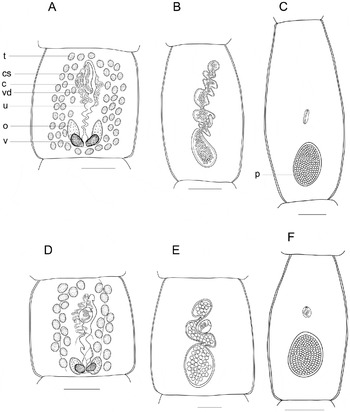
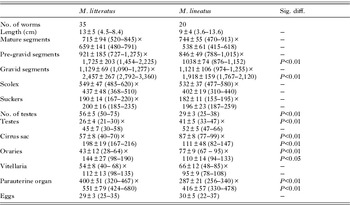
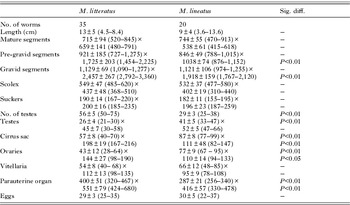
No significant difference was seen in the total length of gravid worms, which varied considerably in both species (4–18 cm; Table 2). Scolex morphology was similar in appearance and size, consisting of 4 simple suckers and lacking a rostellum. No significant difference was found either among scolex characters or for the width and length of mature proglottids. Specimens identified as M. litteratus (Fig. 2A–C) had an elongate cirrus sac, the cirrus was muscular, straight or formed 1 or 2 small curves. In contrast, specimens of M. lineatus (Fig. 2D–F) had a rounder cirrus sac with a thinner, longer cirrus forming a few coils. The cirrus sac was significantly longer in M. litteratus than M. lineatus (P<0·01). Localization and size of ovaries was different in both species. They were localized at some distance from the posterior margin of proglottids in M. litteratus and were elongate in shape. In the mature proglottids of M. lineatus, ovaries were round to oval and were localized adjacent to the posterior end of the proglottids. There were significant differences in the width (P<0·01) and length (P<0·05) of the ovaries between species. Vittelaria were bi-lobed and ventral, partially covered by the ovaries. A significant difference (P<0·01) was found in the number of testes, which were less numerous in M. lineatus (29±3) than in M. litteratus (56±5). Testes formed 2 lateral fields in mature proglottids, which merged in the middle, posterior and anterior to the female system in M. litteratus (Fig. 2A), but only in the anterior part in M. lineatus (Fig. 2D). Pre-gravid segments of M. lineatus (Fig. 2E) were significantly shorter (P<0·01) than segments of M. litteratus (Fig. 2B), and contained the cirrus sac, tube-like uterus and parauterine organ. In gravid proglottids of both species the uterus was either rudimentary or absent. Eggs were accumulated in the fully developed para-uterine organ, which was oval in M. litteratus (Fig. 2C), more round and smaller in M. lineatus (Fig. 2F) (P< 0·01) and the size of eggs was not significantly different between the species.
Diagnostic line drawings of the proglottide morphology of Mesocestoides litteratus (A–C) and M. lineatus (D–F). A, D: mature proglottid; B, E: pre-gravid; C, F: gravid. cs, cirrus sac; c, cirrus; o, ovaries; t, testes; u, uterus; v, vitellaria, vd, vas deferens. Scale bars: A, E, D=200 μm; B, C, F=500 μm.

Comparison of morphometric measurements of adult Mesocestoides litteratus and M. lineatus from red foxes in the Slovak Republic
Phylogenetic analyses
Characterization of ITS-2 showed the presence of more than 1 copy of the gene in the Slovakian samples, resulting in sequence trace files confounded by multiple signals. The presence of 2–3 intraspecific haplotypes per sample was identified by cloning several of the PCR amplicons using a TOPO-TA kit (Invitrogen), and for this reason, no further analysis of the ITS-2 data was conducted.
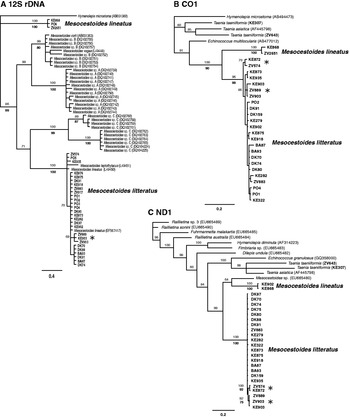
Analyses of the 12S, CO1 and ND1 data partitions strongly supported the existence of independent clades of M. litteratus and M. lineatus, consistent with their diagnosis on morphological features described above. Estimated divergence between Mesocestoides species was 13% in ND1, 9–15% in CO1, and 16–18% in 12S. By comparison, intraspecific divergence within M. lineatus and M. litteratus was less than 1·5%. Phylogenetic analyses (Fig. 3) showed that the European M. lineatus and M. litteratus isolates are not sister species, and that M. litteratus groups are within the clade of North American isolates (Fig. 3), as the sister group to ‘Clade C’ as defined by Padgett et al. (Reference Padgett, Nadler, Munson, Sacks and Boyce2005). Substructuring within the M. litteratus clade is poorly resolved by our data, albeit some consistencies among the data partitions (e.g. grouping of isolates KE903, ZV889 and ZV903) suggest a degree of non-random sorting of the mitochondrial genes. At the amino acid level, however, analyses of CO1 and ND1 show separation of the Mesocestoides spp., but provide no support for the subspecific structure of the M. litteratus isolates (trees not shown). Phylogenetic estimates were the same regardless of the method of analysis used.
Bayesian inference analyses of the molecular data partitions. Nodal support shows posterior probabilities (above) and bootstrap support ⩾50% (below). Asterisks indicate subclades of Mesocestoides litteratus discussed in the text.

DISCUSSION
Results from 6 years of monitoring of red foxes in Slovakia show that the prevalence of Mesocestoides infections can be as high as 85% in regions of dense forestation, and that there is a high (42%) overall prevalence in foxes throughout the country. Mountainous regions in the north (Dolný Kubín) and northeast (Prešov) showed the highest prevalences, and the lowest were found in more urban areas in the west, near Bratislava. Annual fluctuations in prevalence were likely due to the climatic factors that alter the population densities of foxes and intermediate host populations. Miterpáková et al. (Reference Miterpáková, Dubinský, Reiterová, Machková, Várady and Šnábel2003, Reference Miterpáková, Dubinský, Reiterová and Stanko2006) examined the tapeworm Echinococcus multilocularis in red foxes in Slovakia and found significant correlations between the prevalence, type of habitat and climatic conditions. Their work showed that the prevalence of E. multilocularis ranged from 25% to 33% and that co-infections with Mesocestoides spp. were common.
We report, for the first time, the occurrence of M. lineatus in the territory of Slovakia and show that it can be differentiated from M. litteratus using both morphological and molecular data. M. lineatus has previously been reported from foxes in countries situated to the north and northwest of Slovakia, i.e. Poland (Okulewicz et al. Reference Okulewicz, Hildebrand, Okulewicz and Perec2005), Denmark (Willingham et al. Reference Willingham, Ockens, Kapel and Monrad1996), Greenland (Kapel and Nansen, Reference Kapel and Nansen1996), France (Pétavy et al. Reference Pétavy, Deblock and Prost1990), and to the south of Slovakia, i.e. Hungary (Gubány and Eszterbauer, Reference Gubány and Eszterbauer1998). Although its prevalence in Slovakia was low (5–7%), distribution was widespread in the north and northeast of the country. In contrast, M. litteratus was the dominant species found in all 6 regions and accounted for most of the high prevalence seen in the country, just as it was in the countries situated to the south and west of Slovakia (Literák et al. Reference Literák, Tenora, Letková, Goldová, Torres and Olson2006).
There have long been, and there still remain, uncertainties surrounding the taxonomy of Mesocestoides species, and it is clear that diagnosing specific lineages in the genus cannot be based on characters of the scolex and other features that show high levels of variation. However, our results corroborate older taxonomic studies (e.g. Skrjabin, Reference Skrjabin and Skrjabin1978; Jančev, Reference Jančev1986) that show that M. lineatus and M. litteraus can be differentiated on the basis of proglottide morphology (i.e. shape of the cirrus sac, length of cirrus, number of testes and position of ovaries). Our measurements of the Slovakian isolates were also regularly within the range of those reported by Loos-Frank (Reference Loos-Frank1980b), Jancev (1986) and Gubány and Eszterbauer (Reference Gubány and Eszterbauer1998), based on specimens from Germany, Bulgaria and Hungary, respectively. Although Padgett et al. (Reference Padgett, Nadler, Munson, Sacks and Boyce2005) reported that the 3 main clades of North American isolates recovered by their 12S sequences could not be distinguished via morphometric analysis, their study compared only the sizes of the scolex, suckers and parauterine organ, all of which showed tremendous ranges. Morphological diagnosis of European Mesocestoides suggests that analyses of proglottide morphology may have yielded character differences among the 3 clades not found by Padgett et al. (Reference Padgett, Nadler, Munson, Sacks and Boyce2005).
Molecular data partitions strongly supported the existence of individual clades of M. litteratus and M. lineatus, and showed that the two species do not share a most recent common ancestor. Instead, M. litteratus was found to be closer to the North American isolates examined by Padgett et al. (Reference Padgett, Nadler, Munson, Sacks and Boyce2005) and formed a sister lineage to an as yet unidentified species of Mesocestoides infecting foxes and dogs on the west coast of the USA (i.e. clade ‘C’). M. lineatus was positioned outside this large group of European and North American isolates, and a better understanding of its phylogenetic affinities clearly requires broader sampling of species in the genus. Within the M. litteratus clade, genetic divergence was similar to that seen within the North American ‘species’ clades. Six haplotypes were present in the 12S rDNA, but only 2 of these subgroupings were also supported by the CO1 and ND1 data. These haplotypes were shared among isolates from Bratislava and Dolný Kubín in one instance, and from Košice and Zvolen in the other, but like the other subgroupings produced by the various data partitions, the individual haplotypes did not appear to reflect geographical separation, but rather showed that most haplotypes were widespread within Slovakia.
Some discussion over recent decades has evolved around the taxonomic status M. leptothylacus described from foxes from southwest Germany (Loos-Frank, Reference Loos-Frank1980b; Loos-Frank and Zehle, 1982). According to Loos-Frank (Reference Loos-Frank1980b) the species is most similar to M. erschovi, but Priemer et al. (1983) advocated conspecificity of M. leptothylacus and M. litteratus. In our analyses, it is clear that the sequence of M. leptothylacus is part of the M. litteratus clade and differs genetically by no more than 2% from the other Slovakian haplotypes. By comparison with interspecific divergences in Mesocestoides of 8–14%, we consider that the divergence in this isolate most likely represents geographical variability within European M. litteratus and thus does not support species status of M. leptothylactus. However, our analyses also show that a number of published sequences found within the M. litteratus clade have been previously misidentified (e.g. as M. lineatus: EF567417, L49450) and it is not clear if an isolate identified as M. leptothylacus by the authors Nikish-Rosengeek et al. (Reference Nickisch-Rosenegk, Lucius and Loos-Frank1999) was in fact consistent with the morphological diagnosis of that species.
The presence of independent copies of ITS-2 rDNA (i.e. paralogues) confounded our attempts to characterize these loci in the Slovakian isolates of Mesocestoides and compare them with those of the North American species, in which the existence of multiple paralogues was not reported (Padgett et al. Reference Padgett, Nadler, Munson, Sacks and Boyce2005). The presence of multiple, independent rDNA arrays in the tapeworm genome were recently demonstrated via chromosomal in situ hybridization by Králová-Hromadová et al. (Reference Králová-Hromadová, Štefka, Špakulová, Orosová, Bombarová, Hanzelová, Bazsalovicsová and Scholz2010) in the caryophyllidean Atractolytocestus. Their study is the first to provide physical evidence of multiple arrays in the genome, but reports of intraspecific variation in nuclear ITS sequences in other tapeworms groups show that it is frequently observed (Olson and Tkach, Reference Olson and Tkach2005), giving the ITS rDNA regions limited diagnostic and phylogenetic utility in these parasites.
Our work shows that the encroachment of red foxes into urban areas in central Europe brings with it a high rate of Mesocestoides infection. Concurrent infections with Echinococcus multilocularis and the fact that these tapeworms can be hosted by domestic animals means that the risk to human populations merits the continued control and monitoring of fox populations in the region. Comparable molecular characterizations of isolates taken from both clinical and field settings is essential for a better understanding of species boundaries and host associations in Mesocestoides and for assessing the impact of the parasites on human health.
ACKNOWLEDGEMENTS
We are grateful for the support of a SYNTHESYS visiting grant (www.synthesys.info), financed by the European Community Research Infrastructure Action under the FP6 ‘Structuring the European Research Area’ Programme. Additional support to G.H. was provided by the Scientific Grant Agency VEGA of the Ministry of Education and the Slovak Academy of Sciences (Project no. 2/0188/10). We would like to thank Zuzana Vasilková for technical help with the digital version of morphological drawings using Adobe Illustrator software.