In March 2014, the World Health Organization (WHO) notified of an outbreak of Ebola virus disease (EVD) in West Africa. 1 An international response to the epidemic was required because local health services were quickly overwhelmed. Owing to the highly infectious nature of EVD, health workers treating people with EVD are at high risk of becoming infected with the disease.Reference Wichmann, Schmiedel and Kluge 2 From January 2014 to March 31, 2015, a total of 815 health workers were infected by EVD according to a May 2015 WHO report on health worker infections. 3 When the first medical assistance team from China arrived in Liberia and established the China Ebola treatment unit (ETU), developing and implementing scrupulous infection control initiatives to protect health workers from infection with EVD was of paramount importance. Achieving “zero infection” of all workers in the ETU was top priority. This report details the main infection control initiatives employed to achieve this outcome. In summary, these initiatives included the following: optimization of ETU design and layout, application of main lessons learned from SARS, improvement of personal protective equipment (PPE) and the processes for wearing PPE, continuous infection control inspection and supervision, implementation of protective measures for invasive procedures, and task-focused pre-deployment training of health workers, designated role-focused pre-employment training of local staff, and effective communication with local staff. The following report groups these initiatives under 3 main headings: optimization of ETU design and layout, comprehensive infection control initiatives, and staff training and communication.
OPTIMIZATION OF ETU DESIGN AND LAYOUT
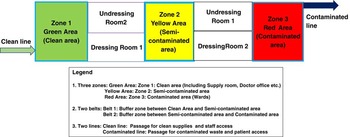
Optimizing the ETU design and layout was fundamental to the implementation of strict infection control procedures. The China ETU, located at the Samuel Kanyon Doe Sports Stadium in the Liberian capital of Monrovia, differed from the temporary tent structures used by the vast majority of ETUs. A permanent structure was built and upon its decommissioning, when Liberia was declared Ebola-free by the WHO, the facility was given to the Liberian government. To reduce the risk of infection, the structure was strictly designed in accordance with the “three zones, two belts, and two lines” layout (Figure 1). The 3 zones were an uncontaminated area, a semi-contaminated area, and a contaminated area. The 2 belts were 2 buffer areas between the uncontaminated area and the semi-contaminated area and between the semi-contaminated area and the contaminated area. These 2 belts increased the distance between the uncontaminated and contaminated areas, effectively reducing the risk of infection. A clean line and a contaminated line were the 2 lines that provided 1 line of passage for staff, clean supplies, and equipment and a different line of passage for anyone or anything contaminated. The “three zones, two belts, and two lines” design worked well logistically and ensured there was no cross-contamination. To maximize the effectiveness of this design, tasks and personnel were strictly organized. For example, ward rounds, patient treatment, and removal of contaminated waste all occurred at different pre-set times. There were clear and specific divisions of responsibilities between personnel to perform tasks so as to avoid any cross-contamination. Information-technology-based patient monitoring and information management were also an important part of the overall design. An advanced monitoring system, including the installation of cameras in all public areas and the ward, was established. This enabled the medical staff to observe the condition of patients through closed-circuit television and to communicate with them via an electronic calling system. Not only did this achieve 24-hour-a-day patient monitoring, it also reduced the amount of time medical staff needed to be in the infectious ward. With this close monitoring, it was necessary for medical staff to be very aware of the need to pay close attention to maintaining the privacy of patients. Visitors from other ETUs in Liberia appreciated the design of the China ETU and believed it to be worthy of promotion.
The “Three Zones, Two Belts, and Two Lines” Layout of the China Ebola Treatment Unit.

COMPREHENSIVE INFECTION CONTROL INITIATIVES
Comprehensive infection control initiatives were developed on the basis of China’s valuable experience in fighting SARS in 2002-2003 and the lessons learned from the experiences of health care workers who had previously treated people with EVD. These infection control strategies encompassed safe operating procedures (SOPs) for various processes, including the use of PPE, infection control and monitoring, and protection when performing invasive procedures.
Main Lessons Learned From SARS
The main lessons learned from SARS made a significant contribution to the development of infection control initiatives in the China ETU. These included (1) a strong awareness of the potential risks of EVD for health workers and the importance of self-protection and (2) improvement of protective initiatives for infection control, for example, wearing a disposable surgical uniform under the protective gown to advance self-protection, actions referred to as the “second protective line.” Furthermore, additional protective equipment was utilized to improve the protection of the head, feet, and body parts that were most frequently and closely in contact with patients. The protective equipment included the wearing of double caps, a protective visor covering the goggles, and boot covers. The final lesson was (3) the innovation of the ward design: expanding 1 changing room to 2 changing rooms to increase the buffer area while donning and removing the PPE.
Improvement of PPE and the Processes for Wearing PPE
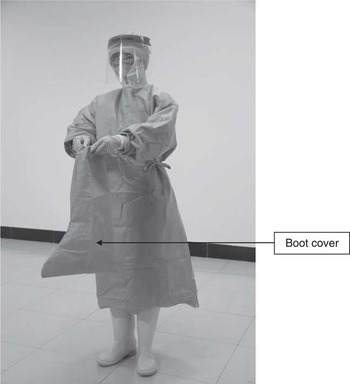
In August 2014 the Chinese Disease Prevention and Control Center promulgated new guidelines for the wearing of PPE with EVD. 4 To optimize the use of PPE, an even more stringent process including a 41-step PPE-wearing guide was developed for the donning and removal of PPE (Figure 2). 5 These steps were performed respectively in 2 different buffer areas within the ETU. In total, 11 items of PPE were used for self-protection of health workers. Two health workers were required to don and remove PPE at the same time, check the performance of PPE wearing, and mutually correct any errors before entering the ward and after leaving the ward. This buddy-style PPE donning and removal strategy provided maximum reduction in the potential for exposure to EVD. Furthermore, the design of the PPE was improved with a focus on increasing the PPE coverage of the face, feet, and body by making connecting cap and boot covers (Figure 3), which promoted the efficiency of the PPE protection. Most importantly, apart from the protective boots, all of the other PPE was disposable and was burnt immediately after use, which reduced the potential infection risks of health workers.
The 41-Step Personal Protective Equipment (PPE) Wearing Guide. 7-Steps hand washing source: World Health Organization. WHO guidelines on hand hygiene in health care. WHO website. http://www.who.int/gpsc/5may/tools/9789241597906/en/. Published 2009. Accessed August 10, 2016. 5

The Improved Personal Protective Equipment.

Continuous Infection Control Inspection and Supervision
To protect the safety of all staff, the China ETU established and followed SOP. The SOP required strict supervision and inspection of staff and processes. The hospital leaders were required to do at least 3 inspection rounds of the ETU each day. The head of the ward was especially responsible for safety supervision and inspection. Ten experts were responsible for checking the performance of PPE wearing by individual staff members. Medical staff had to be doubly checked when they performed any patient procedure. Site inspections and supervision were combined with video surveillance. Safety inspectors conducting video surveillance were required to not leave their post and to always look at the screen; furthermore, the camera must not be moved from focusing on what was being monitored. This allowed any errors in procedures to be quickly evaluated and corrected. The strong supervisory efforts, along with full-time safety inspection coverage, ensured that all protective measures to prevent infection were effectively implemented.
Protective Measures for Invasive Procedures
Currently, treatment of EVD is mainly symptomatic and supportive. Many of these treatments involve invasive procedures such as intravenous infusion, which is the basic means of maintaining fluids, electrolytes, and acid-base balance, significantly increasing the survival rate from EVD. 6 The most common invasive procedures are intravenous infusion, drawing blood, tracheal intubation, and abdominal puncture. Owing to the special nature of EVD, such procedures may present an increased risk of infection. Therefore, special protective protocols were implemented to strengthen the use of PPE when performing these procedures. For instance, these procedures had to be performed by at least 2 skilled staff members, one leading the procedure and the others assisting. They operated as a team with good cooperation and tacit understanding; again, there was always one person in the team who was responsible for watching out for any contamination. All personnel involved had to wear at least 3 levels of gloves. Chlorine disinfectant was immediately sprayed if any suspected contamination occurred.
STAFF TRAINING AND COMMUNICATION
Task-focused training of health workers, designated role-focused training of local staff, and effective communication with local staff were essential components of the overall strategy.
Task-Focused Pre-Deployment Training of Medical Assistance Team Members
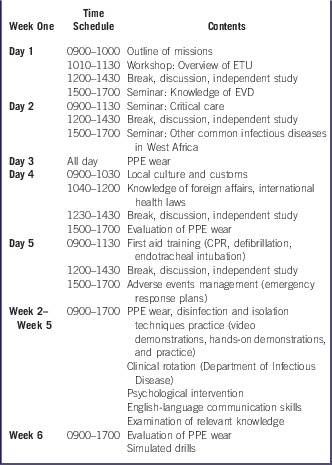
Task-focused pre-deployment training was one of the most important measures to protect staff from infection with EVD. All of the medical assistance team members attended a 40-day intensive training program (Table 1) before deployment so that they would be skilled and professional with the required protocols. The contents of pre-deployment training included: design and layout of the China ETU; rules and regulations of the China ETU; workflow of the China ETU; knowledge of EVD and other common infectious diseases in West Africa; disinfection and isolation techniques, especially emphasizing how to don and remove PPE; emergency response plans; psychological interventions; English-language communication skills; knowledge of foreign affairs; international health laws; and local culture and customs in Liberia. Apart from the common training contents, the emphasis of doctors’ training was on diagnosis and treatment, while nurses’ training was focused on the performance of relevant procedures. Trainers were experts in various disciplines such as infectious diseases specialists, intensive care specialists, psychological specialists, English-language specialists, and experts with previous experiences in treating and caring for people with highly infectious diseases or performing major disaster medical assistance. Training programs integrated different methods including seminars, video demonstrations, hands-on demonstrations and practice, simulated drills, and short-term clinical practice in the department of infectious diseases. Evaluation of the training outcome encompassed examinations of relevant knowledge and hands-on medical procedures with an emphasis on donning and removing of PPE and performing related procedures while fully equipped with PPE.
Pre-Deployment Training SyllabusFootnote a

a Abbreviations: CPR, cardiopulmonary resuscitation; ETU, Ebola treatment unit; EVD, Ebola virus disease; PPE, personal protective equipment.
Designated Role-Focused Pre-Employment Training of Local Staff
Designated role-focused pre-employment training of local staff was another significant strategy for protecting the staff working in the China ETU. A total of 80 local staff were employed by the China ETU and attended a 5-day pre-employment intensive training program before commencing work. The 80 local staff recruited to be part of the China ETU team included social workers, nurses, cleaners, and technicians. According to their designated roles in the ETU, the contents of the training program included common knowledge such as the design and operation of the China ETU, the rules and regulations of the China ETU, EVD-related knowledge, disinfection and isolation techniques, donning and removing PPE, adverse event processing flow, and the special techniques involved in their particular roles. For instance, psychological interventions for patients and their relatives were highlighted in social worker training; workflow was emphasized in nurse training. Training methods ranged from seminars, video demonstrations, hands-on demonstrations and practice to simulated exercises. The donning and removal technique of PPE was evaluated after the training.
Effective Communication With Local Staff
Because the ETU was built and operated in another country, it was important to recognize that differences existed between China and Liberia in how medical treatment was delivered. These differences were due to a variety of factors such as government policy, along with cultural and religious differences. It was essential to fully understand and respect the customs of patients and local staff. Relevant strategies included respect for their religious beliefs and practices, as well as providing appropriate food for them. China is not an English-speaking country, and while the official language of Liberia is English, the country is multilingual with over 30 languages spoken, plus local dialects. The ETU needed to employ local staff, and to ensure the safety of the whole team, it was essential to communicate with local staff effectively. In order to overcome the language barrier, the selection criteria for the medical team members included their English-language skills and communication capabilities. Pre-deployment English training advanced the English-language and communication skills of team members. Shift rosters intentionally mixed Chinese and local staff, which not only ensured that there were sufficient personnel for each shift, but also promoted communication and coordination among staff members with different cultural backgrounds. This buddy-style roster provided opportunity for Chinese and local staff to learn from each other and ensured mutual supervision and the best patient care. In addition, local staff were helpful while communicating with patients with strong local accents.
Acknowledgments
The authors express their sincere appreciation to the entire medical team for their contribution to the development of all the procedures.