The establishment of the euro followed fifty years of ever-deeper European integration and was initially seen as a success. In recent years, however, problems surrounding the euro have absorbed most of the EU's energies.Footnote 1 Many economists warned that the risk of moral hazard in the form of imperfectly observable slack fiscal discipline meant that a common currency could not, and would not, function without strong coordination and the centralization of national fiscal policies.Footnote 2 Yet in the early stages of economic co-operation, member countries were reluctant to give up fiscal sovereignty. The EU instead devised an elaborate system of budget surveillance and fiscal rules, notably in the 1992 Maastricht Treaty and 1997 Stability and Growth Pact (SGP).Footnote 3 As has become clear following the financial crisis, however, such rules and surveillance did not ensure sound public finances.
We analyze the political origins of (non-)compliance with this fiscal framework, in the form of creative accounting or fiscal gimmickry, that is, deviations from accepted and expected reporting practices. For example, consider the 2002 European statistical agency (Eurostat) challenge to the Portuguese government, which refused to provide information on some €7.4 billion of subsidies to seven public enterprises, including Metro Lisboa.Footnote 4 By classifying subsidies granted on a regular basis to cover accumulated losses as equity purchases, the government moved them ‘below the line’, outside the deficit, which was the key indicator governed by the SGP.
We show that:
-
(1) despite reporting rules and an elaborate monitoring mechanism (including Eurostat), political incentives resulting from the electoral cycle and the state of the economy systematically undermined compliance with SGP fiscal rules;
-
(2) under such rules, the scale of gimmickry depends on the degree of fiscal transparency in the domestic budget process;
-
(3) incentives for fiscal gimmickry grew with the adoption of these fiscal rules, and tampering with accounting related to subsidies was not the only way in which countries evaded the SGP and Eurostat supervision; and
-
(4) contrary to a good deal of contemporary discussion, non-compliance with the SGP was not ‘all about Greece’. Greece was indeed an extreme case, the least transparent of the countries we study. However, the patterns we identify appear whether or not we include Greece in the data.
In the Portuguese case described above, 2002 was an election year, which fits the pattern in low-transparency countries, where the extent of gimmickry reflects the need for political support in election years. Countries with higher fiscal transparency generally observed SGP requirements for fiscal reporting, but occasionally violated the deficit limits. When larger deficits loomed in an economic downturn, low-transparency countries also systematically circumvented the reporting rules using creative accounting. Our result – that despite common supranational rules and monitoring, domestic institutions (budget transparency), politics (elections) and economic cycles (recessions) explain much of the variation in outcomes – reinforces the argument that ‘the source of fiscal discipline is at the domestic level’.Footnote 5
More broadly, our findings have important implications for current and future attempts to reduce the risk of strategic behaviour with elements of moral hazard on the part of euro member countries. The conditioning role of transparency reveals limits on the effectiveness and credibility of centralized monitoring and enforcement regimes in treaty organizations.Footnote 6 Therefore, asymmetric information in an economic union is not only of academic interest, but has serious, real-world consequences for sustaining co-operation among national governments. Moreover, stricter fiscal rules without increased observability of actions and outcomes, let alone rules whose complexity decreases observability, will not improve the situation. Thus our findings raise doubts about the effectiveness of the 2012 Fiscal Compact.
First we define gimmicks and review the theory examining their relationship with rules, transparency, electoral timing and the business cycle. We extract data from detailed government accounts to show how gimmicks were achieved in practice, and where to look for them in the future. We then describe explanatory data, specification and estimates. Finally, we discuss policy implications, in particular related to the Fiscal Compact.
Theory And Measurement of Gimmicks
Originally, according to Webster's, ‘gimmick’ was a slang term for something that a con artist or magician had his assistant manipulate to make appearances different from reality. It retains that meaning in the fiscal context. Gimmicks are a variety of (more or less deliberate) attempts by governments to improve the appearance of their public finance statistics (like budget balance and debt) through actions that have no substantive effect on their real underlying fiscal position. The root of the problem is asymmetric information in fiscal/economic unions. When governments can misreport fiscal data, fiscal rules increase the potential for moral hazard, or ‘hidden actions’, like employing gimmicks that involve creative or unorthodox accounting treatments of operations to interpret rules in a favourable way, or, occasionally, cheating.Footnote 7 Appendix 1 reviews the existing literature and ways to measure gimmickry.
Why would governments choose to misrepresent the state of their public finances? Euro member countries generally face three audiences: domestic voters, bond markets and the EU itself. Conceptually, countries projecting deficits or debt levels that violate the SGP rules can – for a given level of budget transparency – do three things. Each involves a different trade-off. First, they can observe the fiscal rules and make real adjustments to tax and expenditure levels, which will placate bond markets and Eurostat, but will be costly if the resulting policies are unpopular with voters at the national level. Secondly, they can forego fiscal consolidation, break the rules outright, and post deficits and debts in excess of SGP thresholds. This also can come at a price. Greece's entry into the common currency was delayed due to too-high deficits and, after the introduction of the euro, the system had penalties that made it potentially costly for countries to violate the rules. Thirdly, countries can resort to gimmickry, leaving real outcomes (especially spending) unchanged.Footnote 8 Voters are unharmed in the short run, and gimmicks fool bond markets and supranational authorities to the extent they are undetected. Here the trade-off is intertemporal: if undetected, gimmickry keeps governments on good terms with everyone in the present, but may entail considerable costs, if deficits and debts later accumulate, in the form of high bond yields and even political unrest. Strategic choice could involve more than one of these avenues for action.
These trade-offs assume a given level of visibility or transparency, outside the scope of policy making, at least in the short term. If countries face costly constraints – either politically, from voters, or economically, from supranational fiscal rules or markets – why would countries not simply reduce transparency in order to facilitate fiscal gimmickry? They could, but making governance structures less transparent is visible, carries substantial reputational costs and, in our context, is penalized by bond markets.Footnote 9 When Romania (not in our sample) recently decriminalized legislative corruption there were fierce protests from the international community, including the EU.Footnote 10 Moreover, changing transparency happens infrequently: the longest time series of institutional budget transparency data reveals that across nine indicators, about one change per US state occurs every fifteen years, and changes rarely result in less transparency.Footnote 11 For four countries in our sample with repeat assessments between 2006 and 2010, the Open Budget Index (OBI) transparency measure reports no significant changes or reordering of the ranking.Footnote 12
Bond market pressure was absent before the financial crisis, as the essentially full convergence of eurozone government bond yields shows (see Appendix 3). Consequently, we focus on one strategy, which combines rule violation and gimmickry with the absence of market discipline and changes in transparency. But how can we make gimmickry observable and quantified, when the point of misrepresenting fiscal quantities is to avoid detection? We next show how gimmickry can be inferred from traces left in the national accounts, even after Eurostat scrutiny.
Measuring Gimmickry: Stock-Flow Adjustments
One measure of gimmickry that is reasonably well known to practitioners is the stock-flow adjustment (SFA).Footnote 13 The SFA is a statistical residual, an accounting item defined to reconcile the difference between a change in a government's debt (the total face value of the ‘debt-like’ or ‘fixed’ claims held against it) and budget deficit (the excess of spending over revenue). Thus in year t it is defined as SFAt = Dt − Dt −1 + Bt , where the first two terms are the annual change in gross debt (D) and B is the budget balance, in which a deficit is expressed as a negative number. Since on average, an increasing deficit would increase debt, a positive SFA indicates that the change in gross debt exceeds the magnitude of the budget deficit (or decreases by less than a surplus). For instance, if outstanding debt increases by 4 and the balance is reported as −2 (a deficit), then the above expression yields an SFA of 2. A surplus of 2 that resulted in no debt reduction gives the same result. A negative SFA implies that government debt increases by less than the size of the deficit.
Deficit figures can be manipulated in many ways. A familiar one, like the Portuguese example in the introduction, involves reclassifying a subsidy as an equity purchase, which is not counted as an expenditure in calculating the deficit. But if it is debt funded, the SFA increases, indicating misreporting. Indeed, despite the EU's well-known emphasis on deficit limits, many countries sustained positive SFAs after the euro was introduced. But some positive SFAs are legitimate, for example if they reflect a government's systematic net acquisition of financial assets or foreign-currency debt appreciation due to exchange rate movements. Negative SFAs, if a gimmick, could indicate that a country is attempting to stay below a debt limit while not broaching a deficit limit. After 1997, no country in our sample ran substantial negative SFAs on average, though several did so before then (see Appendix 4, Figure A3). This trend needs to be explained, since differences between deficit and debt changes may be unavoidable, but over time, if the finding was random, positive and negative would even out.
Hands on the Lever: SFA Components
To further examine such manipulations while avoiding some ambiguities of the SFA, we disaggregate it into its accounting components.Footnote 14 Our empirical results suggest that two components are important and plausible sources of gimmicks: the net acquisition of ‘shares and other equity’ and an item called ‘net incurrence of other liabilities’ that captures mainly ‘other accounts payable’ (OAP). Each is aggregated into the SFA along with other components listed in Appendix 4.
Again, ‘shares and other equity’ transactions become gimmicks when, for instance, payments to cover recurring losses by a state-owned company are treated as equity purchases instead of current transfers. Analyzing the component instead of the SFA strips out the possibility of confounding with the accumulation of other types of financial assets that also appear in the SFA. OAP covers a variety of goods and services that have been delivered but not yet paid for. With cash accounting, the accumulation of such arrears can make the deficit look better. With the EU's system of accrual accounting, this can be achieved through under-recording at the time of delivery, which has the effect of reducing the reported deficit without causing a corresponding reduction in debt (if the bills are actually paid). That shows up as an irregularity in the annual change of OAP: the SFA increases with a negative net change in OAP. For example, a 2004 audit by Eurostat uncovered such under-recording of military expenditures in Greece for several years. Full details and references can be found in Appendix 4, while exact data sources are presented in Appendix 5.
Explaining Gimmicks
Are there factors that systematically explain recourse to gimmicks? What are they? Are their effects conditional on the extent of transparency? Ultimately, was Greece a special case, or just an extreme example of systematic patterns that exist elsewhere?
Budget Transparency
Gimmicks reflect government decisions to misrepresent fiscal quantities. Such choices are constrained by but analytically distinguishable from budget transparency, a characteristic of the institutional framework for budgetary reporting, including accounting systems and standards. Budget transparency affects how easy it is for auditors, markets, and the public to see through gimmicks. More transparent institutions increase the probability of detection and so reduce the appeal of gimmicks.Footnote 15
How does one measure budget transparency? The Organisation for Economic Co-operation and Development defines it as ‘the full disclosure of all relevant fiscal information in a timely and systematic manner’.Footnote 16 This includes, for instance, an executive budget proposal with comprehensive expenditure and revenue figures and medium-term estimates, performance data, analysis of fiscal risks like deviations from key assumptions, in-year implementation updates and reliable annual accounts that are independently audited. We aggregate these items into an index that correlates from 0.66 to 0.80 with later indices from the International Budget Partnership and the International Monetary Fund.Footnote 17 Data, imputation and transparency scores appear in Appendix 2.
Other Explanatory Variables
The main explanatory variables are fiscal rules, electoral incentives and economic conditions. The fiscal rules in the SGP, a 3 per cent limit on government deficits and a 60 per cent cap on the government debt to GDP ratio, went into effect in 1998. We expect these rules to create larger gimmicks. A government's electoral incentives are captured by years left in its term of office, ending in zero in the election year: there should be more gimmickry when fewer years are left. We distinguish years of fast growth (boom) from below-trend growth (slump), as explained in Appendix 6: we expect more gimmicks during slumps.
Specification and Estimation Results
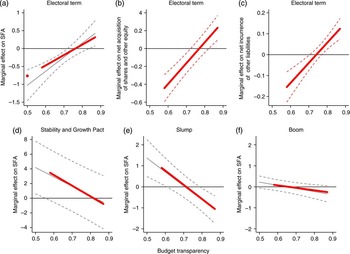
Our principal specification is for fourteen EU countries from 1990–2007.Footnote 18 We regress fiscal gimmickry on the explanatory variables described above, and their interactions with budget transparency. If the effects of rules, elections and economic conditions are conditional on fiscal transparency, higher transparency should offset the incentives to manipulate public finances.Footnote 19 Figure 1 reports the main results. It plots the marginal effects of each explanatory variable for the sample range of budget transparency and 10 per cent confidence intervals based on standard errors clustered by country. It distinguishes between estimates obtained using samples that include Greece (plotted in grey) and exclude it (red). The logic of our approach is that if the SFA contains gimmicks, we should be able to identify plausible components of this residual whose patterns match those found for the SFA and whose magnitudes exhaust the estimated SFA patterns. Full regression results, with other explanatory variables and codings, are described in detail in Appendices 7 and 8.
The determinants of stock-flow adjustments conditional on budget transparency
Note: Red lines display results obtained with samples that exclude Greece; grey lines show results with the full 14-country sample. Panels A, D, E and F report results from Columns 3 and 4 in Table A.3 in Appendix 7. The thin grey lines report the conditional coefficients (solid) and associated 10 per cent confidence intervals (dashed) based on results with the full sample in Column 3. The thicker red lines report the conditional coefficients based on the results in Column 4, where Greece is excluded from the sample. The red dot in Panel A shows the coefficient projected from the results with the reduced sample for a country with Greece's level of budget transparency. Panels B and C are based, respectively, on the results in Columns 5 and 6 of Table A.3 in Appendix 7. Since data for these subcomponents are not available for Greece, as well as other countries, Panels B and C report only a single result each.

Panel A clearly reveals an electoral cycle in gimmicks, which is conditional on transparency. Each additional year left in the electoral term is estimated to reduce the SFA by 1 per cent of GDP if a country has Greece's level of budget transparency. But increasing transparency reduces or eliminates the electoral cycle. Excluding Greece from the sample, the estimate for the lowest observed level of transparency (in Italy and Portugal) is about 0.5 per cent of GDP. Using Eurostat data for 2002 GDP at market prices, this is equivalent to 747 million euro for Portugal (0.53 per cent of 141 billion) and 6.9 billion euro for Italy (0.53 per cent of 1.3 trillion). By contrast, if in 2002 Portugal had had two additional years left in the electoral term, we estimate that the SFA would have been 1.5 billion euro (over 1 per cent of GDP) lower. This behaviour thus turns out to be a substantial regularity. And this practice still occurs: Eurostat argued with Ireland about misclassified transactions in 2011, another election year though outside our estimation period (see Appendix 3).
What produced this pattern? Abuse via accounting for subsidies as equity purchases and, to a lesser extent, the under-recording of deliveries stand out among all the SFA components we reviewed, as shown in Panels B and C. In our sample period, Eurostat did not report components data for Greece. Moreover, the sum of predictions from these two components is about equal to the prediction for the whole SFA. The joint marginal effect of these two components, at Portugal's level of fiscal transparency, amounts to 0.6 per cent of GDP, providing a 20 per cent cushion on the 3 per cent deficit-to-GDP limit. This is likely to be a lower bound, since our fiscal data already include a number of revisions undertaken by Eurostat after their initial release, the likelihood of which is apparently also related to elections.Footnote 20 As far as we can tell, these components are ‘where the action is’. As elections approach, gimmicks increase, but where institutions make discovery easier and more likely, the electoral benefits of gimmickry diminish and ultimately disappear.
Panel D shows that, again in low-transparency environments, the SGP increased the SFA.Footnote 21 Further analysis in Appendix 7 suggests that the misuse of equity injections to disguise subsidies (and thus deficits) via the SFA was significant after the introduction of the SGP. Once again, this effect is absent where fiscal transparency is greater. However, reading across the panel from left to right, the SGP had a significant effect only at levels of transparency similar to those of Greece (minimal), where it induced an increase in SFAs of four percentage points of GDP, equivalent to 6.6 billion euro in 2002 (4.19 per cent of 157 billion). Data omitting Greece produces a similar estimate. The results show that Greece was not a special case; rather, it was the extreme case of a general, and comprehensible, pattern.
Fiscal transparency also affects the response to business cycle movements.Footnote 22 Low-transparency countries (but not high-transparency ones) make more use of SFAs in slumps, as Panel E shows. In contrast, Panel F shows that booms have no significant effects. Finally, Appendix 8 presents estimates with different measurements and coding of rules, transparency and other variables, varied samples and including a lagged dependent variable. Those tests qualitatively support our main results: the presence of an electoral cycle in gimmicks, more pressure from hard times and recourse to gimmicks exacerbated by rules – all of which are conditional on limited transparency. The results confirm that gimmicks were used in this period to manipulate deficits relative to debt. No results suggest that we have omitted important variables.
Implications
With asymmetric information about fiscal policy behaviour, domestic pressures exacerbate moral hazard. In democracies, even advanced ones, politicians’ incentives to employ gimmicks get stronger as elections approach. Moreover, supranational fiscal rules that are intended to sustain co-operation instead exacerbate incentives for national governments to manipulate reported data rather than fix fiscal policy. These are systematic tendencies, rather than the actions of any single country. Budget process transparency can reduce the incentives to manipulate, even those that would otherwise intensify in times of economic stress. Warnings that have been raised in policy and research papers since the early 1990s about the risks of moral hazard in economic policy making for countries in economic unions remain a concern.
It seems an inescapable implication that attempts at fiscal policy co-ordination in economic unions will struggle – or even fail – in non-transparent environments. The 2012 Fiscal Compact adopted by most EU countries emphasizes complex ‘second-generation’ fiscal rules based on structural indicators,Footnote 23 which are notoriously subject to differing interpretations and different methods of calculation.Footnote 24 This approach is especially worrying, given the tremendous difficulties the EU encountered in monitoring and attempting to enforce a seemingly simple 3 per cent deficit limit, and it makes fiscal transparency even more essential. Moreover, the compact yet again places more emphasis on the deficit than the stock of debt: article 3(2) requires countries to incorporate the structural balance rule into national law, but not limits on debt. Our findings suggest that without major improvements in fiscal transparency, this approach may not bring about the budgetary discipline sought by the designers of the compact. Indeed, the structural balance rule could instead turn out to be counter-productive.