Implications
Herbs have been used as alternative dietary supplementation in animal production since the prohibition of using of antibiotic growth promoter due to serious problems with the occurrence of antibiotic-resistant bacteria in humans. The supplementation of Lythrum salicaria increased in the total white blood cells and impacted caecal fermentation, which was related to animal health and was speculated to have benefits. However, a decrease in the digestibility of CP and ether extract was observed without the existence of any adverse effects on performance and meat quality.
Introduction
The long-term supplementation of animal feeds with antibiotics at subtherapeutic doses (antibiotic growth promoter, AGP) has been performed since 1951. This was often done without veterinary prescription, with the aim of promoting growth performance, maintaining the animal’s health and reducing the mortality rate after the weaning period, which is a major problem for rabbit production (Phillips, Reference Phillips2007). In 2006, because of the risk of the development of drug-resistant bacteria, the European Union banned the use of AGPs. Meanwhile, a sharp deterioration in animal health and performance was observed, with a consequent decrease in profits (Phillips, Reference Phillips2007). Several different approaches have been tested to control or prevent diseases and improve productive performance.
Aromatic plants contain many biologically active compounds that exhibit medicinal properties (Christaki et al., Reference Christaki, Bonos, Giannenas and Florou-Paneri2012) that could improve production performance, as well as animal health and meat quality. Supplementation with alternative substances, such as probiotics, prebiotics, enzymes and organic acids, has been studied in rabbits, with interesting results emerging (Falcão-e-Cunha et al., Reference Falcão-e-Cunha, Castro-Solla, Maertens, Marounek, Pinheiro, Freire and Mourão2007; Rotolo et al., Reference Rotolo, Gai, Peiretti, Ortoffi, Zoccarato and Gasco2014). However, the number of phyto-studies remains limited (Botsoglou et al., Reference Botsoglou, Florou-Paneri, Christaki, Giannenas and Spais2004; Krieg et al., Reference Krieg, Vahjen, Awad, Sysel, Kroeger, Zocher, Hulan, Arndt and Zentek2009; Arafa et al., Reference Arafa, Salem and OAHA2010; Simonová et al., Reference Simonová, Chrastinová, Mojto, Lauková, Szabóová and Rafay2010; Ayala et al., Reference Ayala, Silvana, Zocarrato and Gómez2011; Szabóová et al., Reference Szabóová, Lauková, Chrastinová, Strompfová, Simonová, Plachá, Vasilková, Chrenková and Faix2012; Rotolo et al., Reference Rotolo, Gai, Nicola, Zoccarato, Brugiapaglia and Gasco2013). L. salicaria (LS) is a flowering plant, which is commonly known as purple loosestrife, belonging to the Lythraceae family. LS is considered an invasive and competitive plant in ecosystems. However, this herb has been used in traditional medicine because of its medicinal properties. In fact, several in vitro studies used the active compounds (e.g. tannins and flavonoids) that were extracted from LS, showing that LS also has antimicrobial, antifungal, anti-inflammatory and antioxidant properties (Becker et al., Reference Becker, Scher, Speakman and Zapp2005; Tunalier et al., Reference Tunalier, Kosar, Kupeli, Calis and Baser2007; Humadi and Istudor, Reference Humadi and Istudor2009). The aim of this study was, therefore, to evaluate the supplementation of feeds with LS on the performance, digestibility, health and meat quality of growing rabbits.
Material and methods
Animals, housing, diets and condensed tannin content (CTC) determination
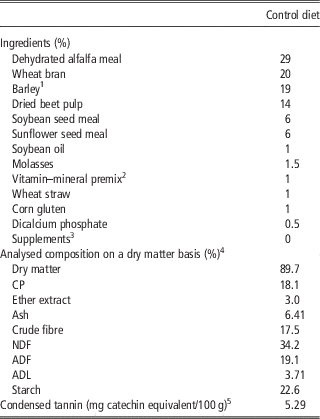
The experiment was performed at the experimental rabbitry facility at the Department of Agricultural, Forestry and Food Sciences in Carmagnola, Turin, Italy. In this study, 160 Hycole rabbits (934±118 g) were randomly housed in individual wire cages and reared from weaning (35 days) to slaughtering (89 days). A basal diet was formulated in order to cover the nutritional requirements of the growing rabbits (control). In addition, three experimental diets were set up with 0.2% (0.2%LS) or 0.4% (0.4%LS) dry ground LS leaves and 0.3% Cunirel® (CR, Biotrade snc®, Modena, Italy) in place of small fractions of barley meal in the basal diet (Table 1, Supplementary Table S1). CR is a commercial mixture of herbs that contains LS as a major component. The diets were assigned to the animals (40 animals/diet) using a completely randomised design. The feeds and clean water were provided ad libitum and, the facility was climate and light controlled during the whole trial in order to maintain a temperature of 22±2°C and a photoperiod of 16L : 8D. The diets were analysed in triplicate for dry matter (DM), CP by total nitrogen contents, ether extract (EE), crude fibre and ash by ignition to 550°C, according to the Association of Official Analytical Chemists (AOAC, 2000). The NDF, ADF and ADL were determined according to Van Soest et al.’s (Reference Van Soest, Robertson and Lewis1991) procedures. The level of starch was determined using Ewer’s polarimetric method (European Economic Community, 1972).
Ingredient composition and condensed tannin of the experimental diets

0.2%LS=0.2% of dry ground Lythrum salicaria (LS) supplementation in diets; 0.4%LS=0.4% of dry ground LS supplementation in diets; CR=0.3% of commercial supplementation in diets which is a mixture of medicinal plants with LS is the main composition (Cunirel®, Biotrade snc®, Modena, Italy).
1 The percentage on a dry matter basis of barley in 0.2%LS, 0.4%LS and CR were 18.8, 18.6 and 18.7, respectively.
2 Per kg of diet: vitamin A, 200 IU; α-tocopheryl acetate, 16 mg; niacin, 72 mg; vitamin B6, 16 mg; choline, 0.48 mg; dl-methionine, 600 mg; Ca, 500 mg; Pt1, 13 920 mg; K, 500 mg; Na, 1 g; Mg, 60 mg; Mn, 1.7 mg; Cu, 0.6 mg.
3 The percentage on a dry matter basis of supplementation in 0.2%LS, 0.4%LS and CR were 0.2, 0.4 and 0.3, respectively.
4 Analysed composition on a dry matter basis of 0.2%LS, 0.4%LS and CR, respectively; 89.9%, 90.5% and 90.8% (dry matter); 18.2%, 18.1% and 18.2% (CP); 3.0%, 3.0% and 3.0% (ether extract); 6.52%, 6.60% and 6.11% (ash); 17.5%, 17.2% and 17.7% (crude fibre); 34.7%, 34.6% and 34.3% (NDF); 19.1%, 18.9% and 19.5% (ADF); 3.58%, 3.80% and 3.73% (ADL); 22.2%, 22.0% and 22.8% (starch).
5 6.09, 6.16, 17.4, 27.3 and 94.9 mg catechin equivalent/100 g of fresh weight were observed in the 0.2%LS, 0.4%LS, CR, dry ground LS leaves and Cunirel®, respectively.
The CTC contents were determined in LS, CR, and the experimental diets, according to the method described by Lahouar et al. (Reference Lahouar, El Arem, Ghrairi, Chahdoura, Ben Salem, El Felah and Achour2014). A 50 μl aliquot of each extract or standard solution was mixed with 1.5 ml of 4% vanillin methanolic solution and then 750 μl of concentrated HCl was added. The well-mixed solution was incubated at ambient temperature (22°C) in the dark for 20 min. Absorbance against a blank was read at 500 nm. The concentration of CTC in the extract was quantified using a standard calibration curve at five concentration levels (0.05, 0.1, 0.25, 0.5 and 1 mg/ml), utilising a pure synthetic (+)-catechin standard (Sigma Aldrich, Milan, Italy). It was then expressed as mg of catechin equivalent/100 g fresh weight.
Performance and apparent digestibility
The rabbit’s live weight and feed intake were checked weekly. Mortality and morbidity were controlled daily by the same observer, from 35 to 84 days, according to Gidenne et al.’s (Reference Gidenne, Combes, Feugier, Jehl, Arveux, Boisot, Briens, Corrent, Fortune, Montessuy and Verdelhan2009) indications. The average daily weight gain, average daily feed intake, feed conversion ratio and health risk index (HRi) were calculated after the data collection. According to Rotolo et al.’s (Reference Rotolo, Gai, Peiretti, Ortoffi, Zoccarato and Gasco2014) procedure, faeces were collected when the rabbits were 45 days old for 4 days (n=10/treatment), and stored at −20°C for chemical analysis in duplicate for ash, EE and CP, according to AOAC (2000). The procedures and calculation of the apparent digestibility of the DM and nutrients were conducted according to the European standardised method (Perez et al., Reference Perez, Lebas, Gidenne, Maertens, Xiccato, Parigi-Bini, Dalle Zotte, Cossu, Carazzolo, Villamide, Carabaño, Fraga, Ramos, Cervera, Blas, Fernandez, Falcão-e-Cunha and Bengala Freire1995).
Slaughter procedures, carcass traits, blood parameters and digestive tract histology
A total of 10 rabbits/ treatment were stunned by concussion and slaughtered without fasting at 89 days of age. The carcasses were prepared following Dabbou et al.’s (Reference Dabbou, Gasco, Gai, Zoccarato, Rotolo, Dabbou, Brugiapaglia, Helal and Peiretti2014) indications, and the data were expressed as a percentage of slaughter weight. The carcasses, including the thoracic organs, liver and kidneys, were chilled at 4°C. After 24 h of chilling, the weight of the chilled carcass (CCW) and of the aforementioned organs was recorded as percentages of CCW (Dabbou et al., Reference Dabbou, Gasco, Gai, Zoccarato, Rotolo, Dabbou, Brugiapaglia, Helal and Peiretti2014). The cold carcasses were then kept for other analysis on meat quality.
Blood samples were collected from eight rabbits per group during the bleeding stage of the slaughter process. All of the blood haematology and serum biochemistry were performed using standard protocols (Vetlabor s.a.s., Volpiano, Italy). For gut histology, six rabbits from each group were selected in order to obtain small pieces of the caecal wall and mid-jejunum after the slaughtering procedure. The tissue samples were processed, embedded in paraffin, sectioned at 6-µm thicknesses by means of a rotary microtome (Leica RM2155; Leica Instruments GmbH, Nussloch, Germany) and stained by means of the haematoxylin and eosin method (Mikel, Reference Mikel1994). Villi height and crypt depth were measured under a microscope using an image analysis programme (Image Pro Plus; Media Cybernetics, Bethesda, MD, USA).
Caecal trials
The caecum from 10 animals/group was immediately separated and weighed. The pH was measured directly using a Crison MicropH 2001 pH metre (Crison Instruments, Barcelona, Spain). The caecal content was placed in sterile plastic tubes and kept at −20°C for further analysis, 1 g of the sample was mixed with 5 ml of distilled deionised water at 20°C, before being centrifuged (15 min at 3000×g) and filtered through a Schleicher and Schull membrane filter (BA-83; 0.2 μm Krackeler Scientific, Albany, NY, USA) for volatile fatty acid (VFA) determination, 1 μl of the extract was injected into a gas chromatograph (GC 1000 DPC; Dani Instruments S.P.A., Cologno Monzese, Italy) using a wide-bore capillary column (SGE BP21 25×0.53 mm internal diameter and 0.5 μm film thickness; P/N 054474, SGE International, Ringwood, Victoria, Australia). The testing protocol was performed according to Rotolo et al.’s (Reference Rotolo, Gai, Peiretti, Ortoffi, Zoccarato and Gasco2014) procedures. Ammonia was measured in the supernatant after the centrifugation (10 min at 3000×g) of a vortexed mixture (30 s) of 5 g of caecal sample and 25 ml of distilled deionised water at 20°C, using an ammonia gas-sensing combination electrode (Model 95-12; Orion, Boston, MA, USA) that was connected to an ion analyzer (Model 920A; Orion). The VFA and ammonia concentration were calculated on the DM of the caecal content.
Faecal bacterial community
Hard faeces were collected from 10 rabbits from each group at 35, 42, 49, 56, 70 and 89 days, while the caecal content was collected after slaughtering. Samples from the same group, the same collection site and the same day were pooled together in sterilised polyethylene bags using a sterilised spatula, and were stored at −20°C until examination, 10 g of samples were homogenised in 90 ml of Ringer’s solution (Oxoid, Milan, Italy) for 2 min in a stomacher (LAB Blender 400 and Sto-circul-bag stomacher bags; PBI, Milan, Italy) at room temperature. A deposit was allowed to set for 1 min, and 1 ml of the supernatant was used for the DNA extraction. The Powersoil DNA kit (MO-BIO; Carlsbad, CA, USA) was used according to the manufacturer’s instructions, 5 µl of RNAse (Promega, Milan, Italy) was added to the DNA and the mixture was incubated at 37°C for 30 min before being stored at −20°C. The DNA was quantified using a NanoDrop 1000 spectrophotometer (Thermo Scientific, Milan, Italy) and was standardised at 50 ng/μl.
338F and 518R primers (Muyzer et al., Reference Muyzer, De Waal and Uitterlinden1993; Invitrogen, Carlsbad, CA, USA) were used to amplify the variable V3 region of the 16S rRNA gene, and PCR products of about 250 base pairs were obtained. A GC clamp was added to the forward primers, according to Muyzer et al.’s (Reference Muyzer, De Waal and Uitterlinden1993) procedures. Amplifications were performed in a thermal cycler (Bio-Rad, Milan, Italy) using the previously described conditions (Muyzer et al., Reference Muyzer, De Waal and Uitterlinden1993), 2 µl aliquots of the PCR products were routinely checked on 2% agarose gels. The PCR products were analysed by means of denaturing gradient gel electrophoresis (DGGE) using a Bio-Rad Dcode apparatus. Samples were applied to 8% (wt/vol) polyacrylamide gels in a 1× TAE buffer. Parallel electrophoresis experiments were performed at 60°C using gels containing a 20% to 60% urea-formamide denaturing gradient (100% corresponded to 7 M urea and 40% (wt/vol) formamide). The gels were run for 4 h at 200 V, stained with SYBR® Gold Nucleic Acid Gel Stain (Invitrogen, Milan, Italy) for 30 min, and analysed under UV using the UVIpro Platinum 1.1 Gel Software (Eppendorf, Hamburg, Germany). A database of fingerprints was created using the Bionumerics software, version 5.1 (Applied Maths, Sint Marten Latem, Belgium). A dendrogram of similarity was retrieved using the dice coefficient and unweighted pair group method for the arithmetic average clustering algorithm (Vauterin and Vauterin, Reference Vauterin and Vauterin1992).
Meat quality (pH, colour, chemical composition and lipid oxidation)
After 24 h of chilling, 10 carcasses/group were halved, and then the two longissimus dorsi (LD) muscles were excised. The LD muscles on both the left and the right sides were divided into the forepart and hind part. The left forepart and the left hind part were used to measure pH and establish colour, respectively. The right forepart and the right hind part were freeze-dried and kept until needed for the analyses of the proximate composition and the thiobarbituric acid reactive substances (TBARS) assay, respectively.
The pH after 24 h of chilling (pH24), colour and chemical composition of the freeze-dried meat (moisture, CP, EE and ash) were determined according to Rotolo et al.’s (Reference Rotolo, Gai, Peiretti, Ortoffi, Zoccarato and Gasco2014) procedures. After 90 days at −20°C storage in vacuum packs, 2 g of freeze-dried meat (n=5/group) was homogenised with 20 ml of 10% trichloroacetic acid using a Polytron tissue homogeniser (Type PT 10–35; Kinematica GmbH, Luzern, Switzerland) to determine lipid oxidation. This was accomplished by using a modified TBARS method according to Witte et al.’s (Reference Witte, Krause and Bailey1970) protocol. Analyses were performed in duplicate and the results were expressed as µg malonyldialdehyde per kilogram of fresh meat, using a standard curve that covered a concentration range from 0.5 to 10 µM 1,1,3,3-tetramethoxypropane (Sigma-Aldrich, Steinheim, Germany). The absorbance was measured at 532 nm by means of a Helios spectrophotometer (Unicam Limited, Cambridge, UK).
Statistical analysis
All of the statistical analyses were performed using the SPSS software package (IBM SPSS, Reference SPSS2012). The differences in morbidity rate, mortality rate and HRi among groups were tested using the Fisher exact test. The performance, digestibility, carcass traits, blood parameters, meat quality, caecal trials and digestive histology were assessed with a one-way ANOVA (with the diet as the fixed factor) using Duncan’s New Multiple Range Test for post hoc analysis. The significance was established at P<0.05.
Results and discussion
Performance, digestibility and digestive tract histology
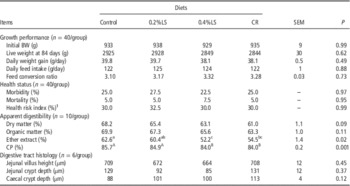
No statistically significant difference was observed between the treatment and control groups in terms of performance, morbidity, mortality, HRi and gut histology (Table 2). The CP digestibility declined significantly (P<0.05) in the rabbits fed the 0.4%LS and CR, compared with the control group and the group with a low dose supplementation. There was a statistically significant difference between the rabbits fed the control diet, 0.4%LS and CR (62.6% v. 52.2% and 54.5%, respectively; P<0.05; Table 2) in terms of EE digestibility.
Effect of phyto-additives (LS and CR) on performance, apparent digestibility and digestive tract histology in rabbits

0.2%LS=0.2% of dry ground Lythrum salicaria (LS) supplementation in diets; 0.4%LS=0.4% of dry ground LS supplementation in diets; CR=0.3% of commercial supplementation in diets which is a mixture of medicinal plants with LS is the main composition (Cunirel®, Biotrade snc®, Modena, Italy).
a,b,c or A,BValues within a row with different superscripts differ significantly at P<0.05 or P<0.01, respectively.
1 Health risk index is the summation between morbidity and mortality.
In general, the active components of the aromatic plants offered the potential of better flavour, which directly increased consumption (Christaki et al., Reference Christaki, Bonos, Giannenas and Florou-Paneri2012). Hence, an improvement in performance should have been observed in the rabbits fed phyto-additive diets. Some authors have reported these effects (Krieg et al., Reference Krieg, Vahjen, Awad, Sysel, Kroeger, Zocher, Hulan, Arndt and Zentek2009; Arafa et al., Reference Arafa, Salem and OAHA2010; Ayala et al., Reference Ayala, Silvana, Zocarrato and Gómez2011; Rotolo et al., Reference Rotolo, Gai, Nicola, Zoccarato, Brugiapaglia and Gasco2013). However, some studies came to a contrasting, or even completely opposite conclusion (Botsoglou et al., Reference Botsoglou, Florou-Paneri, Christaki, Giannenas and Spais2004; Soultos et al., Reference Soultos, Tzikas, Christaki, Papageorgiou and Steris2009; Dalle Zotte et al., Reference Dalle Zotte, Sartori, Bohatir, Rémignon and Ricci2013).
Generally, the chemical components of medicinal plants are considered cause some type of effect after usage (Christaki et al., Reference Christaki, Bonos, Giannenas and Florou-Paneri2012). Tannins have been suggested to be the main active compound in LS, but flavonoids have also been discovered to have an effect (Humadi and Istudor, Reference Humadi and Istudor2009). The supplementation of a natural extract of chestnut wood (containing tannins) increased the daily weight gain of rabbits and poultry (Schiavone et al., Reference Schiavone, Guo, Tassone, Gasco, Hernandez, Denti and Zoccarato2008; Liu et al., Reference Liu, Gai, Gasco, Brugiapaglia, Lussiana, Guo, Tong and Zoccarato2012), especially at younger age (Gai et al., Reference Gai, Gasco, Schiavone and Zoccarato2010). On the other hand, tannins are considered to be toxic and anti-nutritive substances, as Al-Mamary et al. (Reference Al-Mamary, Al-Habori, Al-Aghbari and Al-Obeidi2001) reported a significant reduction in the CP digestibility of rabbits fed a high level of sorghum tannins (3.5% catechin equivalent in the diet). In Al-Mamary et al.’s (Reference Al-Mamary, Al-Habori, Al-Aghbari and Al-Obeidi2001) study, there was a sharp decrease in intestinal enzyme activities (α-amylase, trypsin and lipase). This could help to explain the poor digestibility of EE and CP after tannin supplementation in the present study. However, this was not due to the abnormality of the jejunal or caecal histology. Moreover, excess tannin supplementation could be responsible for the negative outcomes in terms of daily weight gain (Al-Mamary et al., Reference Al-Mamary, Al-Habori, Al-Aghbari and Al-Obeidi2001), whereas the application of lower levels of tannins did not affect this study.
Blood parameters
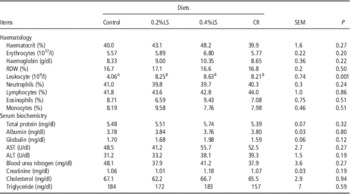
Regarding blood haemotology, the supplements used increased the quantity of white blood cells, compared with the control group (0.2%LS, 0.4%LS and CR v. control; 8.25, 8.63 and 8.21 v. 4.06×10⁹/l; P<0.05; respectively). The other measured parameters were not influenced by the treatments (Table 3). The blood parameters were most likely affected by the phyto-addition, since it was reported that echinacoside and cichoric acid, which are considered to be the active compounds that induce an increase in the total white blood cells, were found in Echinacea purpurea (Arafa et al., Reference Arafa, Salem and OAHA2010). At the moment, it is not possible to correlate this result with an improvement in animal health. A study on the action mechanism on the immune system of the active components in LS still needs to be performed.
Effect of phyto-additives (LS and CR) on blood parameters (blood haematology and serum biochemistry) in rabbits (n=8/group)

0.2%LS=0.2% of dry ground Lythrum salicaria (LS) supplementation in diets; 0.4%LS=0.4% of dry ground LS supplementation in diets; CR=0.3% of commercial supplementation in diets which is a mixture of medicinal plants with LS is the main composition (Cunirel®, Biotrade snc®, Modena, Italy); RDW = red blood cell distribution width; AST = aspartate aminotransferase; ALT = alanine aminotransferase.
A,BValues within a row with different superscripts differ significantly at P<0.01.
Caecal trials
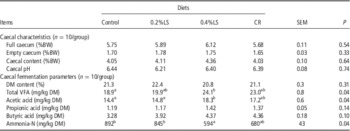
The caecal trials are reported in Table 4. The 0.4%LS supplementation increased the concentration of VFA, compared with the control group (24.1 v. 18.9 mg/kg DM; P<0.05), whereas the acetic acid values were greater compared with both the control group and to animals fed with 0.2%LS (18.3 v. 14.4 and 14.8 mg/kg DM; P<0.05). The ammonia level was lower in the 0.4%LS supplemented group, compared with both the control and the group treated with the addition of 0.2%LS (594 v. 892 and 845 mg/kg DM; P<0.05). Propionic and butyric acids were not influenced by the supplementation; however, the butyric acid level increased gradually with supplementation level of LS.
Effect of phyto-additives (LS and CR) on caecal traits in rabbits

0.2%LS=0.2% of dry ground Lythrum salicaria (LS) supplementation in diets; 0.4%LS=0.4% of dry ground LS supplementation in diets; CR=0.3% of commercial supplementation in diets which is a mixture of medicinal plants with LS is the main composition (Cunirel®, Biotrade snc®, Modena, Italy); DM=dry matter; VFA=volatile fatty acids.
a,bValues within a row with different superscripts differ significantly at P<0.05.
A high concentration of total caecal VFA in rabbits had a protective effect against enteropathogenic Escherichia coli infection (Peeters et al., Reference Peeters, Maertens, Orsenigo and Colin1995). Therefore, a higher level of VFA should contribute to health benefits that could prevent pathogen infection. Such benefits have been discovered after the dietary supplementation of LS in rabbits. However, more studies should be performed to confirm this theory. The nitrogenous residues are derived from the endogenous and undigested feed, which provides nitrogen sources for caecal fermentation, providing ammonia as an end product (García et al., Reference García, de Blas and Carabano2005). In the present study, there was less observed caecal ammonia in the group treated with the high level of LS. The lower ammonia concentration was likely due to a decrease of protein utilisation in caecum, as microbiota was unable to digest tannin-protein complexes (Maertens and Struklec, Reference Maertens and Struklec2006). It is possible that some group of microbe may use ammonia and produce acetic acid as products which increase the amount of acetic acid and total VFA. However, it is impossible to conclude this theory until a study on the microbial mechanism and fermentation was performed.
Faecal bacterial community
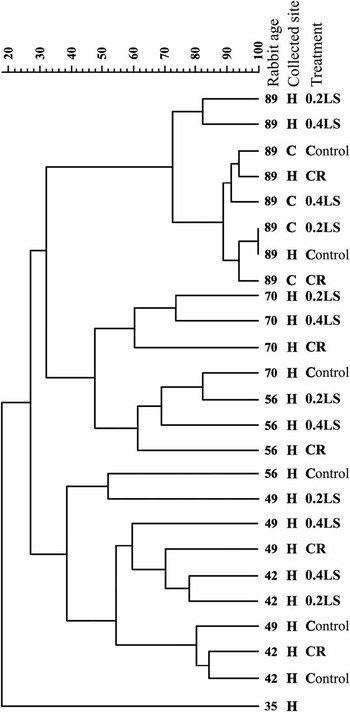
The overall picture of the gut bacterial community of rabbits was generated using the PCR-DGGE analysis of DNA extracted directly from the hard faeces and from the caecal content. The results are summarised in Figure 1. The dendrogram shows a great similarity of the bacterial community for rabbits fed supplemented diets when compared with the control group of rabbits at 56 and 70 days of age. Age increments influence the dynamics of the microbiota, as a close correlation exists between digestive microbiota and diet (Combes et al., Reference Combes, Fortun-Lamothe, Cauquil and Gidenne2013), which was also observed in the present study. The development of gut microbiota of the control group was slower than the treated groups. As bacterial community of the control group at 56 and 70 days was clustered in the treated groups with lower age than itself. The loss of diversity may correlate with the diet and antimicrobial functions of the medicinal plants. Hexahydroxydiphenoyl ester vescalagin in LS extracts, which is one of the hydrolysable tannins, was shown in vitro to be the main active component in antimicrobial activity (Becker et al., Reference Becker, Scher, Speakman and Zapp2005). Even though the active components that had antimicrobial properties present in LS, as well as the digestibility, were changed, the bacterial community was not affected by the supplementation in the present study.
Cluster analysis of the denaturing gradient gel electrophoresis profile of bacterial communities in the hard faeces (H) and the caecal content (C) of rabbits that were supplemented 0.2% of dry ground Lythrum salicaria (0.2LS), 0.4% of dry ground Lythrum salicaria (0.4LS) and 0.3% Cunirel® (CR), as well as the control group (Control), from the beginning of the experiment (35 days old) to the day of slaughter (89 days old).

Carcass traits, meat quality and lipid oxidation
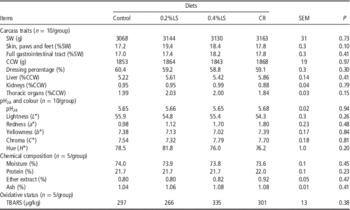
No statistically significant difference appeared between the groups for carcass traits, meat quality (pH24, colour and chemical composition) and lipid oxidation (Table 5). One of the common causes of liver enlargement is the ingestion of toxic substances, which was discovered in the rabbits fed high level of tannins (Al-Mamary et al., Reference Al-Mamary, Al-Habori, Al-Aghbari and Al-Obeidi2001). Fortunately, the low dose of tannins in our study did not induce hepatomegaly. Antioxidant substances can be used to prevent or slow down the problem of lipid oxidation. Phenolic compounds, which can be found in aromatic plants, have antioxidative properties, offering benefits in meat quality (Christaki et al., Reference Christaki, Bonos, Giannenas and Florou-Paneri2012). Previous research found that diets supplemented with 200 mg/kg of oregano essential oil, in addition to chestnut wood extracts that contained antioxidant compounds, delayed the lipid oxidation in rabbit meat (Botsoglou et al., Reference Botsoglou, Florou-Paneri, Christaki, Giannenas and Spais2004; Liu et al., Reference Liu, Gai, Gasco, Brugiapaglia, Lussiana, Guo, Tong and Zoccarato2012). Even though there were active components with antioxidant activities present in LS (Tunalier et al., Reference Tunalier, Kosar, Kupeli, Calis and Baser2007), lipid oxidation was not decreased in the present study. Conversely, Gai et al. (Reference Gai, Gasco, Liu, Lussiana, Brugiapaglia, Masoero and Zoccarato2009) as well as Liu et al. (Reference Liu, Zhou, Tong and Vaddella2009) reported a significant decrease of lipid oxidation in rabbit fed 0.5% of chestnut tannins, and indicated a dose-related effect. The pharmacokinetics of the antioxidative compounds in LS require further studies in order to clarify how these compounds distribute in the active sites.
Effect of phyto-additives (LS and CR) on carcass traits, meat quality and lipid oxidation (TBARS, µg malonyldialdehyde/kg of fresh meat) of the longissimus dorsi muscle in rabbits

0.2%LS=0.2% of dry ground Lythrum salicaria (LS) supplementation in diets; 0.4%LS=0.4% of dry ground LS supplementation in diets; CR=0.3% of commercial supplementation in diets which is a mixture of medicinal plants with LS is the main composition (Cunirel®, Biotrade snc®, Modena, Italy); TBARS = thiobarbituric acid reactive substances; SW = slaughter weight; CCW = chilled carcass weight; pH24 = pH of longissimus dorsi muscles were measured after 24 h of chilling.
Conclusion
The supplementation of LS in rabbits has led to a significant increase in the total white blood cells and higher concentrations of VFA and acetic acid, but also to lower levels of ammonia, CP and EE digestibility. No adverse effects on the other studied parameters were observed. Low level of LS supplementation (<0.4%) was suggested to gain health benefits and prevent adverse effects.
Acknowledgements
This research was supported by a University of Turin (ex 60%) grant (Es. fin. 2012-13 and 2013-14). The authors would like to humbly thank Mr Claudio Malavasi (Biotrade snc®) for providing LS leaves and Cunirel®, and Mr Dario Sola, Mr Paolo Montersino and Mr Mario Colombano for providing the rabbits’ care.
Supplementary Material
To view supplementary material for this article, please visit http://dx.doi.org/10.1017/S1751731115001822