Introduction
Plant defense mechanisms against herbivory or plant resistance are adaptations evolved by plants that improve their survival and reproduction by reducing the influence of herbivores. Previous exposure of a plant to herbivory increases the resistance of the plant to subsequent herbivore attacks; a process termed induced resistance (Karban and Baldwin, Reference Karban and Baldwin1997; Agrawal et al., Reference Agrawal, Tuzun and Bent1999; Kessler and Baldwin, Reference Kessler and Baldwin2002; Engelberth, Reference Engelberth, Witzany and Baluska2012). This defense mechanism is considered a manifestation of the phenotypic plasticity of plants when facing biotic stresses (Karban and Baldwin, Reference Karban and Baldwin1997). Induced defense against herbivores or pathogens has evolved in a number of plants, indicating a defensive trait (Karban and Baldwin, Reference Karban and Baldwin1997; Gatehouse, Reference Gatehouse2002; Heil and Kost, Reference Heil and Kost2006). Defense response (DR) genes in plants are activated after herbivores attack; redirecting normal cell maintenance genes to plant' defense systems (Smith, Reference Smith2005; Kant et al., Reference Kant, Jonckheere, Knegt, Lemos, Liu, Schimmel, Villarroel, Ataide, Dermauw, Glas, Egas, Janssen, Van Leeuwen, Schuurink, Sabelis and Alba2015). Damaged plants produce signaling compounds that activate synthesis of volatile and non-volatile allelochemicals (Dicke et al., Reference Dicke, Takabayashi and Posthumus1998; Kanchiswamy and Maffei, Reference Kanchiswamy and Maffei2015) such as phenolic compounds (Bergvinson et al., Reference Bergvinson, Arnason and Pietrzak1994; Kaur et al., Reference Kaur, Gupta and Taggar2014; Golan et al., Reference Golan, Sempruch, Górska-Drabik, Czerniewicz, Łagowska, Kot, Kmieć, Magierowicz and Leszczyński2017), hydrogen peroxidase (H2O2) (Apel and Hirt, Reference Apel and Hirt2004; Cheeseman, Reference Cheeseman2007; Sharma et al., Reference Sharma, Jha, Dubey and Pessarakli2012) and enzymes (Moloi and van der Westhuizen, Reference Moloi and van der Westhuizen2008; Kaur et al., Reference Kaur, Salh and Singh2017) involved in different types of plant defenses. These specialized plant defense compounds act as toxins to deter insects or hamper insects’ digestion.
In response to insect attacks, the chemical composition of a plant can be altered in highly specific ways, such that in future attacks, insects will experience altered conditions that may affect preference and performance (Tibebu, Reference Tibebu2018). Induced plants have various effects on the biology, physiology and behavior of related insects (Kant et al., Reference Kant, Jonckheere, Knegt, Lemos, Liu, Schimmel, Villarroel, Ataide, Dermauw, Glas, Egas, Janssen, Van Leeuwen, Schuurink, Sabelis and Alba2015). For example, induced defense can affect performance of an insect pest by decreasing its population and/or affecting quality of induced plants by changing quantities of various involved factors. Decrease in herbivore performance has been reported for more than 100 plant species (Karban and Baldwin, Reference Karban and Baldwin1997). The effect of earlier infestation on host-choice by insects has also been shown in a number of studies. Leaves injured by leaf miners in birch tree were avoided by four species of lepidopterans (Hartley and Lawton, Reference Hartley and Lawton1987). Female false potato beetle, Leptinotarsa juncta (Germar) preferred to oviposit on intact plants than those that had been infested by Epitrix fuscula (Crotch) (Wise and Weinburg, Reference Wise and Weinburg2002). Prior infestation by aphids prompts aphids to ‘spread the risk’ of competition by emigration of winged individuals and colonization of other host plants (Mehrparvar et al., Reference Mehrparvar, Mansouri and Weisser2014).
Each type of injury caused by insects can mediate a different induced defense response by plants. Leaves of maize and apple emit different mixtures of volatile compounds in response to damage caused by different herbivores; and even at different level of damage due to the same herbivore (Dicke et al., Reference Dicke, Takabayashi and Posthumus1998). Similarly, both soybean and tomato show different chemical response to feeding by different arthropods, while responses to mechanical damage are often dissimilar to feeding by arthropods (Stout et al., Reference Stout, Workman, Bostock and Duffey1998).
In this study we investigate the effects of induced plant defense following attacks of safflower aphid, Uroleucon carthami (Hille Ris Lambers, 1948), cotton bollworm, Helicoverpa armigera (Hübner, 1805), and mechanical wounding on performance of safflower aphid that subsequently infested several commercial safflower (Carthamus tinctorius) cultivars and wild safflower (C. oxyacantha). We have used H2O2 and total phenolic compounds as indicators for induced resistance in the plants. Among the reactive oxygen species (ROS) which are produced during oxidative stresses in plants, H2O2 constitutes one of the main components of induced defense response, due to its high stability and freely diffusible nature (War et al., Reference War, Paulraj, War and Ignacimuthu2011). Phenols include many defensive compounds such as flavonoids, phenolic acids, tannins and lignans involved in plant resistance against various stresses, both biotic and abiotic (Schaller, Reference Schaller2008). Furthermore, peroxidase in association with phenols produce phenoxy and other oxidative radicals that act as feeding deterrents and/or produce toxins that cause negative effects on insect growth and development (Zhang et al., Reference Zhang, Hau and Zhang2008; War et al., Reference War, Paulraj, War and Ignacimuthu2011). The study addresses the following questions:
(1) Does previous damage inflicted by herbivores or mechanically affect the performance of aphids that colonize safflower plants?
(2) Do different safflower cultivars respond differently to aphid attack in combination with earlier damage on the plants?
(3) Does aphid feeding in combination with earlier plant damage affect the levels of phenolics and H2O2, as markers of induced responses in safflower plants?
Materials and methods
Insects
The safflower aphid, U. carthami (Hem.: Aphididae) was obtained from a colony maintained by the Aphidology Research Group, at Graduate University of Advanced Technology, Kerman, Iran. Aphids were reared on safflower Goldasht cultivar plants. The plants that were used for aphid rearing were replaced every 10 days with new plants (in 6–10 leaves stage).
To establish a population of H. armigera (Lep.: Noctuidae), larvae from infested tomato fruits were collected from a tomato field around Mahan city, Kerman, Iran and reared on tomato plants (Falat cultivar) that were already planted in a greenhouse. The tomato plants and larvae were kept in a mesh (64 holes per cm2) covered cage (1 × 1 × 1 m). After emergence of adult moths, they were fed by a sugar solution (10 g table sugar dissolved in 100 ml water). After mating females oviposited on tomato leaves and the plants placed in new meshed cages. After the emergence of larva and their development to forth instar larval stage, they were used in the designed experiments. All insects and plants were reared in a greenhouse with temperature ranging from 24 °C during the day to 20 °C at night, with relative humidity of 50–60% and light period of 16:8 (L:D).
Plant culture
Seeds of four commercial safflower cultivars (C. tinctorius, Asteraceae) including, Faraman, Goldasht, Mahali-Isfahan and Sofeh were obtained from Isfahan Agriculture and Natural Resources Research Center. Seeds of wild safflower, C. oxyacantha, were collected around the university campus and identified by a specialist. Three to four seeds of each cultivar and the wild species were sown separately in three-liter pots filled with soil (40% clay, 40% sand and 20% organic compost). After early vegetative growth, only one plant was retained. Plants were watered regularly and no fertilizer was applied. The plants were used in the experiments when they had six leaves.
Experimental design
Using four commercial safflower cultivars and wild safflower species we investigated the effects of (i) safflower aphid, U. carthami, (ii) cotton bollworm, H. armigera and (iii) mechanical wounding by punching holes in leaves (common paper puncher) on subsequent safflower aphid infestation. All experiments were conducted in a greenhouse with temperature ranging from 24 °C during the day to 20 °C at night, with relative humidity of 50–60% and light period of 16:8 (L:D).
Experiment-I: Induced defense – due to safflower aphid
Plants were exposed to herbivory by the safflower aphid while control plants never experienced herbivory. At the start of the experiment, 50 plants (10 from each cultivar) were infested by three unwinged adult aphids of the same age which were allowed to feed and reproduce for 7 days, after which all aphids were removed from plants using a fine paintbrush. There were also the same number of plants as controls which never experienced herbivory. After 3 days (72 h) without herbivore infestation, five unwinged adult aphids were placed on each plant and were allowed to feed and reproduce for 14 days. At the end of this period, the total number of aphids (TNA) on each plant was counted and the percentage of produced adult winged individuals (as an indicator for unsuitability of the host plant) was calculated. Leaves of the plants (the fourth lower leaf) were harvested and frozen immediately in liquid nitrogen. The frozen leaves were then ground, and the resulting powder was stored at −80 °C so to determine the phenolic content and H2O2. This experiment was carried out in a randomized complete block designed with ten blocks (blocks were arranged at the same time on different benches of the greenhouse). In each block there were ten plants (two plants from each cultivar and wild species induced by prior feeding and control).
Experiment-II: Induced defense – due to cotton bollworm larvae
One fourth instar H. armigera larva was placed on leaves of each plant (50 plants: ten from each cultivar) for 30 min per day for 7 days, while control plants never experienced herbivory. The larvae were chosen randomly each time from the rearing cages and placed on the experimental plants. This experiment was conducted exactly the same way as experiment-I except for the herbivore used.
Experiment-III: Induced defense by mechanical wounding
This experiment was also conducted exactly the same as experiment-I except for the damage treatment, which consisted of mechanical wounds inflicted using a punch device to create four holes on the two middle leaves (two holes per leaf) of each plant (78.5 mm2) while control plants did not experience any injury. Leaves of the plants were harvested and frozen immediately in liquid nitrogen as described in experiment-I.
Total phenolic content (TPC) and hydrogen peroxide (H2O2) determination
TPC was determined using the Folin–Ciocalteu method (Singleton and Rossi, Reference Singleton and Rossi1965). A sample of 0.1 g fresh leaf material was used for TPC determination. Two hundred microliters of 10-fold diluted [methanol–acetic acid (85:15 v/v)] samples of the extract was added to 1 ml of 1:10 diluted Folin–Ciocalteu reagent in test tubes. The mixture was shaken and allowed to stand for 6 min and then 800 μl of 7% Na2CO3 solution was added. After incubation for 90 min at 23 °C, 220 μl of each solution was added to 96 micro-plate wells and absorbance read at 760 nm by a micro-plate reader, model Cary 50 spectrophotometer. All samples were prepared in triplicate and read four times. A mixture of 7% Na2CO3 solution, 1:10 diluted Folin–Ciocalteu reagent and the extracting solution instead of plant extract was used as a blank. Solutions of gallic acid (0–500 μg/ml) were used to prepare the standard curves (R 2 = 0.997). Results were expressed as milligram gallic acid equivalent (mg GAE)/gr fresh leaf material.
Hydrogen peroxide (H2O2) was determined using Junglee et al. (Reference Junglee, Urban, Sallanon and Lopez-Lauri2014) method. Frozen powder of leaves (150 mg) was directly homogenized with 1 ml of a solution containing 0.25 ml Trichloroacetic acid (TCA) (0.1% (w:v)), 0.5 ml KI (1 M) and 0.25 ml potassium phosphate buffer (10 mM, pH adapted to studied tissue) at 4 °C for 10 min (one-step buffer: extraction and colorimetric reaction combined). At the same time, for every sample, a control was prepared with H2O instead of KI for tissue coloration background. Care was taken to protect samples and solutions from light. The homogenate was centrifuged at 12,000 g for 15 min at 4 °C. Two hundred μl of supernatant from each tube were placed in UV-microplate wells and left to incubate at room temperature (20 °C–22 °C) for 20 min. Samples and blanks were analyzed in triplicate at 390 nm by a micro-plate reader, model Cary 50 spectrophotometer. A calibration curve obtained by H2O2 standard solutions prepared in 0.1% TCA and was used for quantification. Results were expressed as μmol/g fresh leaf material.
Statistical analysis
Generalized Linear Models (GZLM) using negative binomial distribution with log link function was used to analyze the count data for TNA and GZLM using gamma distribution with log link function was used to analyze percentage of produced winged individuals, TPC and H2O2. The block treatment was included as the intercept. The post-hoc analysis used Tukey test to compare means for plant cultivars at a probability level of <0.05. Data analyses were performed using IBM SPSS software version 22.
Results
Experiment-I: Induced defense by safflower aphid
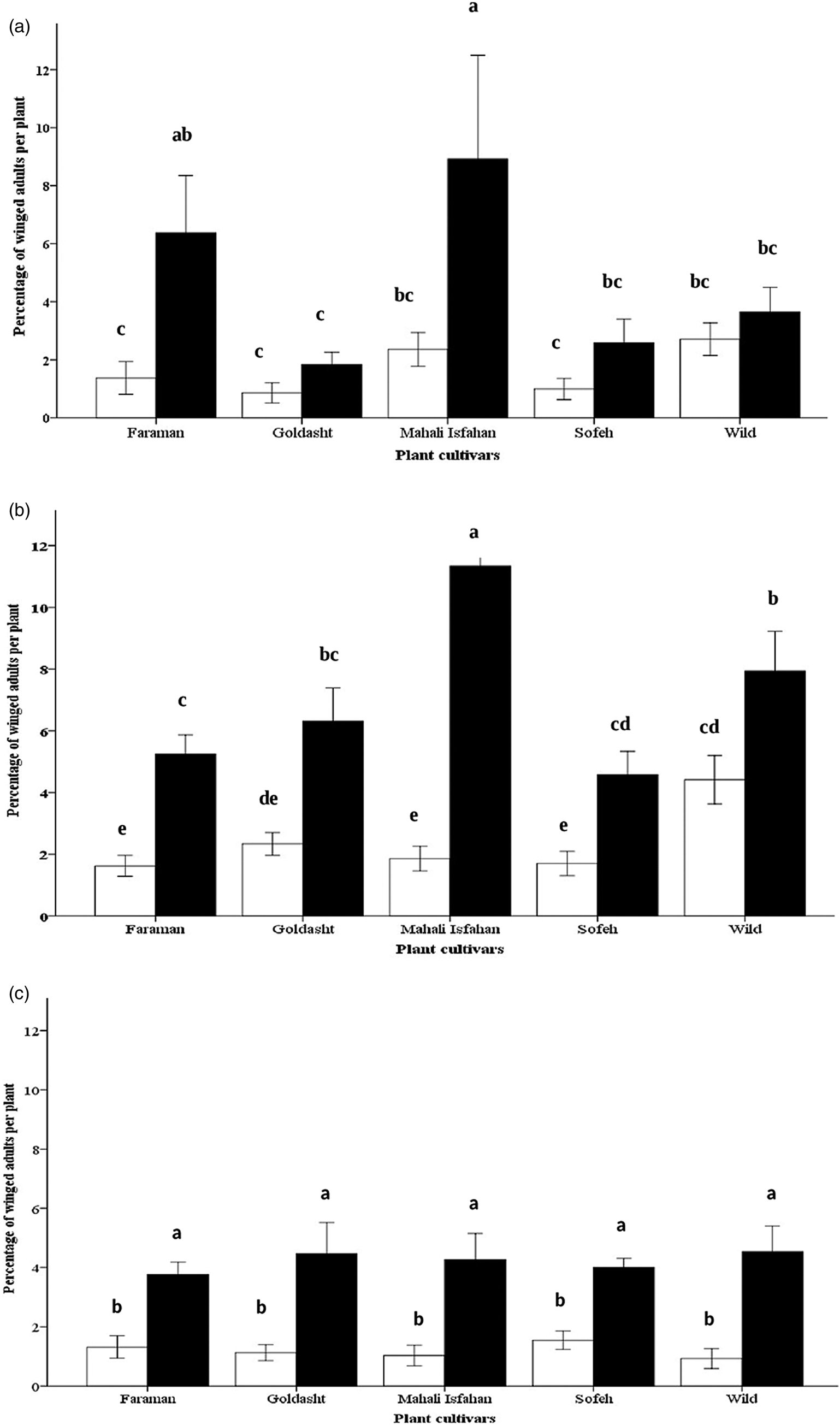
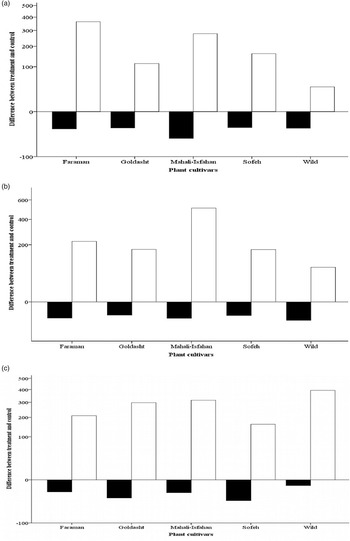
The TNA on safflower plants previously exposed to herbivory by conspecifics was significantly lower than controls (table 1) for all plant cultivars (fig. 1a). Percentage of produced winged aphids increased significantly for the induced plants (table 1, fig. 2a); with notable differences amongst the cultivars (table 1). Different cultivars showed different responses to the treatments (table 1); the Mahali-Isfahan showed the highest decrease in the TNA (40%) (fig. 3a) on induced plants. The highest increase in percentage of produced winged aphids (3.64 fold) was on Faraman cv. while the lowest increase was on wild safflower species, among induced plant cvs (fig. 3a).
Mean total number of aphids (TNA) per plant on four commercial safflower cultivars and wild safflower species. (a) Exp. I: the effects of prior exposure to safflower aphid, Uroleucon carthami, on subsequent safflower aphid infestation, (b) Exp. II: the effects of prior exposure to cotton bollworm, Helicoverpa armigera, on subsequent safflower aphid infestation and (c) Exp. III: the effects of mechanical wounding by punching (common paper puncher) leaves on subsequent safflower aphid infestation. Bars show mean ± SE. White columns: control plants, black columns: induced plants. Number of replicates was 10. Different letters above bars indicate significant difference at P < 0.05 from Tukey' post-hoc test.

Mean produced winged aphids on four commercial safflower cultivars and wild safflower species in (a) Exp. I: the effects of prior exposure to safflower aphid, Uroleucon carthami, on subsequent safflower aphid infestation, (b) Exp. II: the effects of prior exposure to cotton bollworm, Helicoverpa armigera, on subsequent safflower aphid infestation and (c) Exp. III: the effects of mechanical wounding by punching (common paper puncher) leaves on subsequent safflower aphid infestation. Bars show mean ± SE. White columns: control plants, black columns: induced plants. Number of replicates was 10. Different letters above bars indicate significant difference at P < 0.05 from Tukey' post-hoc test.

Percentage of difference of number of aphids (black columns) and produced winged aphids (white columns) between induced plants by (a) aphid and control plants, (b) H. armigera larval feeding and control plants and (c) mechanical wounding and control plants.

Summary of effects of induction and plant cultivars, and their interaction on the total number of aphids (TNA), percentage of produced winged individuals (PWA), H2O2 and total phenolic content (TPC)

Generalized Linear Models (GZLM) using negative binomial distribution with log link function was used to analyze TNA and GLZM using gamma distribution with log link function was used to analyze PWA, TPC and H2O2. Significant results are indicated in bold at probability level at 0.05.
Experiment-II: Induced defense by cotton bollworm larvae
Feeding of H. armigera larvae had a significant effect on the TNA in all cultivars (table 1, fig. 1b). Induction by caterpillars caused a decrease in the TNA; with wild safflower species showing the largest decrease (fig. 1b). Also, the percentage of winged aphid individuals on early-damaged plants was significantly higher than controls (table 1, fig. 2b); with Mahali-Isfahan cv. having the highest difference (5.1 fold) while the wild species had the lowest (fig. 3b).
Experiment-III: Induced defense by mechanical wounding
Mechanical wounding significantly reduced the TNA compared to the control plants (table 1, fig. 1c) and there was a significant increase in percentage of produced winged aphids on early-damaged plants (table 1, fig. 2c). Plant cultivars responded differently to previous herbivory in terms of the TNA (table 1). The highest and lowest decrease in the TNA, between induced and control plants, were observed for Sofeh cv. and wild species, respectively (fig. 3c). The highest increase in produced winged aphids caused by induction was observed in the wild species (3.93 fold), whereas the lowest increase was in the Sofeh cv. (fig. 3c).
Hydrogen peroxide (H2O2)
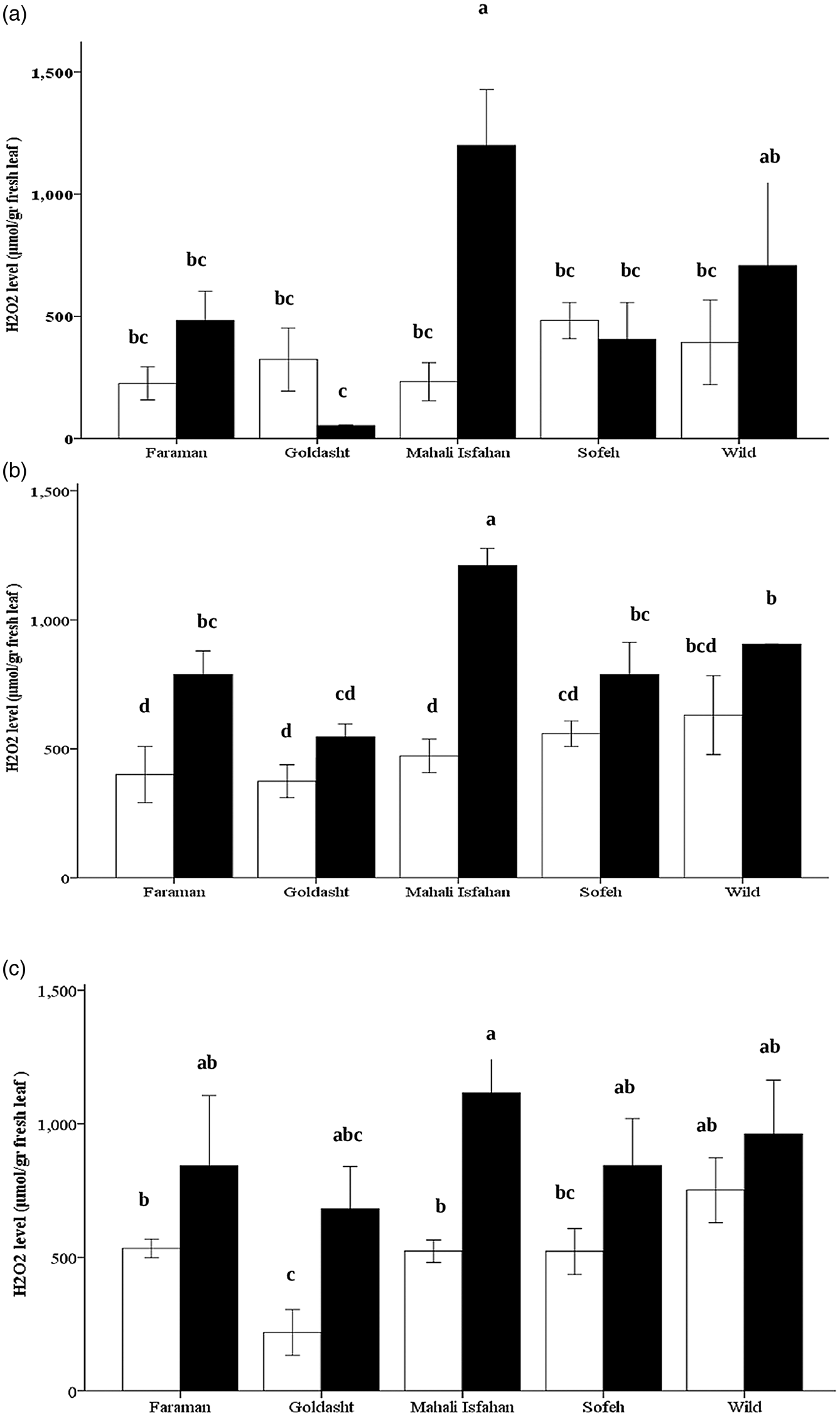
In comparison to controls, H2O2 levels increased significantly in plants that were previously exposed to caterpillars or mechanical wounding (table 1, fig. 4b, c); however, the change was not significant in plants previously exposed to aphids (table 1, fig. 4a). Response of cultivars, in view of H2O2 levels after induction, was statistically different for all three experiments (table 1). Mahali-Isfahan cv. showed the highest increase in H2O2 as compared to controls and other cultivars (fig. 4). In contrast, Sofeh cv. and wild species had weaker response to induction by larvae and wounding respectively (fig. 4b, c).
Mean of hydrogen peroxide (H2O2) level in four commercial safflower cultivars and wild safflower species in (a) Exp. I: the effects of prior exposure of plant to safflower aphid, Uroleucon carthami, and subsequent safflower aphid infestation, (b) Exp. II: the effects of prior exposure to cotton bollworm, Helicoverpa armigera, and subsequent safflower aphid infestation and (c) Exp. III: the effects of mechanical wounding by punching (common paper puncher) leaves and subsequent safflower aphid infestation. Bars show mean ± SE. White columns: control plants, black columns: induced plants. Number of replicates was 10. Different letters above bars indicate significant difference at P < 0.05 from Tukey' post-hoc test.

Total phenolic content (TPC)
In all the three experiments TPC increased significantly in previously damaged plants in comparison to controls (table 1, fig. 5). Cultivars responded differently to induction, in terms of TPC, in experiments I and III. However, no significant response was observed in experiment II (table 1, fig. 5); where for wild species the TPC decreased on those plants previously exposed to damage by caterpillars (fig. 5b). Overall, TPC increased by a factor of 2.72 in plants previously exposed to aphids; the increase was 1.75 and 1.53 in plants previously exposed to larvae and wounding respectively. When plants were previously exposed to aphids, the increase in TPC produced by Mahali-Isfahan cv. was 4.3 fold, and for the wild species 2.2 fold in comparison to controls (fig. 5a). Plants previously exposed to mechanical damage showed an increase in TPC; such that Goldasht cv. had the largest increase of TPC in comparison to controls and Sofeh cv. had the smallest increase.
Mean of total phenolic content (TPC) of fresh leaf in four commercial safflower cultivars and wild safflower species in (a) Exp. I: the effects of prior exposure of plant to safflower aphid, Uroleucon carthami, and subsequent safflower aphid infestation, (b) Exp. II: the effects of prior exposure of plant to cotton bollworm, Helicoverpa armigera, and subsequent safflower aphid infestation and (c) Exp. III: the effects of mechanical wounding by punching (common paper puncher) of leaves and subsequent safflower aphid infestation. Bars show mean ± SE. White columns: control plants, black columns: induced plants. Number of replicates was 10. Different letters above bars indicate significant difference at P < 0.05 from Tukey' post-hoc test. GAE, gallic acid equivalent.

Discussion
Our experiments consistently showed that in comparison to control plants, the number of aphids on previously damaged plants become significantly lower and the percentage of produced winged aphids increased significantly. Averaged over all on previously exposed plants, the TNA was decreased by 22.4, 20.2 and 15.6% in experiments I, II, and III, respectively.
In line with this study, there are other studies, on the assessment of preference and performance of insects, including different aphid species on induced plants (Karban and Baldwin, Reference Karban and Baldwin1997). Messina et al. (Reference Messina, Taylor and Karren2002) showed that plants already infested by Rhopalosiphum padi (L.) considerably reduced conspecific performance. Winged individuals of R. padi and Diuraphis noxia (Mordvilko) preferentially settle on uninduced plants than on plants already colonized by R. padi. Population growth of Aphis gossypii (Glover, 1877) colonizing cotton plants, that were previously infested by conspecifics, was reduced by 30% in comparison to controls (Wool and Hales, Reference Wool and Hales1996). Mehrparvar et al. (Reference Mehrparvar, Mansouri and Weisser2014) showed that colonization on plants, by dispersing aphid individuals, was influenced by prior occupancy as well as the presence of other aphids on the host plant. Ali and Agrawal (Reference Ali and Agrawal2014) evaluated plant defenses induced by monarch caterpillars, Danaus plexippus (L.) and oleander aphids, Aphis nerii Boer de Fonscolombe infesting two milkweeds, Asclepias syriaca and A. tuberosa. They showed that aphid growth was about 50% lower on caterpillar-damaged A. syriaca as compared to controls. Induced plant defense maybe mediated by either one or a combination of defensive mechanisms; even though defense mechanisms are not usually identified in such ecological studies.
In the present study, different responses to herbivory were observed among cultivars. Herbivore attack can prime the plant for a more effective defensive response in subsequent attacks by the same or another herbivore species; which ultimately reduces herbivore' performance (Schaller, Reference Schaller2008). Each cultivar differed in response to herbivory (fig. 3). This means that there are probably differences among the cultivars in the mechanisms that change the quality of phloem composition and other compounds (War et al., Reference War, Paulraj, War and Ignacimuthu2012; Will et al., Reference Will, Furch and Zimmermann2013). Further research is needed to identify the underlying mechanisms that trigger such dissimilar responses.
In experiment-I, the largest difference in the TNA and produced winged aphids, between induced and control plants, were observed for Mahali-Isfahan cv. and Faraman cv., respectively. This indicates that the response of these two cultivars previously exposed to herbivory by conspecifics was stronger than in other cultivars. This suggests that prior infestation by safflower aphid increased plant resistance and as a result, the population of aphids decreased much more on Mahali-Isfahan cv. in comparison to other cultivars, and production of winged aphids increased more than other cultivars on Faraman cv. Production of more winged aphid individuals (dispersal morph) on induced plants is an indication of unsuitable conditions for the aphids (Braendle et al., Reference Braendle, Davis, Brisson and Stern2006). Production of winged offspring in aphids is due to a number of environmental conditions, such as crowding (high densities), inter- and intra-specific interactions, biotic factors and host plant quality (Hille Ris Lambers, Reference Hille Ris Lambers1966; Mittler and Sutherland, Reference Mittler and Sutherland1969; Müller et al., Reference Müller, Williams and Hardie2001; Braendle et al., Reference Braendle, Davis, Brisson and Stern2006; Brisson, Reference Brisson2010).
In experiment-II, the percentage of produced winged individuals on caterpillar-exposed plants of Mahali-Isfahan cv. was more than four times that of the controls. This means that prior feeding by H. armigera larvae reduced plant quality, leading to the production of more winged aphids on the cultivar. This could be because the reaction of different cultivars to herbivory is dissimilar and so the amounts of salicylic acid and/or jasmonic acid is different in plants. Salicylic acid and jasmonic acid are two plant defense compounds that mainly produced in response to sap sucking and chewing herbivores respectively (Ali and Agrawal, Reference Ali and Agrawal2014).
In experiment-III, even though the difference in production of winged individuals on Mahali-Isfahan and Goldasht cvs. was high, in comparison to controls, the highest was wild safflower species (fig. 3c). This may be due to sensitivity of wild species to mechanical wounding.
Levels of TPC and H2O2 in all plants induced by larvae and wounding were higher than controls (except wild species in Experiment-II), whilst in plants induced by aphids H2O2 was not significantly different. H2O2 is known to play multiple roles in plant defense system (Kuźniak and Urbanek, Reference Kuźniak and Urbanek2000; Apel and Hirt, Reference Apel and Hirt2004; Mittler et al., Reference Mittler, Vanderauwera, Gollery and Van Breusegem2004). Aphids cause less tissue damage than chewing insects; they feed through stylets, accessing vascular tissues or plant cells directly (Maffei et al., Reference Maffei, Miyhofer and Boland2007; Will et al., Reference Will, Furch and Zimmermann2013; Züst and Agrawal, Reference Züst and Agrawal2016). During feeding, aphid' salivary stylets penetrate plant tissues to feed on phloem (Pollard, Reference Pollard1972), while chewing insects cause extensive damage to plant tissue; so this could be the reason why plants induced with aphids do not respond through H2O2 production. Hence, it can be concluded that plant-response to aphids and other phloem-feeding insects is different from those of chewing insects (Dicke et al., Reference Dicke, Takabayashi and Posthumus1998; Stout et al., Reference Stout, Workman, Bostock and Duffey1998; Walling, Reference Walling2001; War et al., Reference War, Paulraj, War and Ignacimuthu2012; Fürstenberg-Hägg et al., Reference Fürstenberg-Hägg, Zagrobelny and Bak2013; Züst and Agrawal, Reference Züst and Agrawal2016). Induction with aphids or other sap feeders causes an increase in plants TPC. In contrast, the amount of H2O2 increases if a chewing insect feeds on plant, or mechanical wounding takes place. Therefore, it could be concluded that insects’ feeding mode can affect the inducing defense mechanism and/or strengthen plant' response.
A rapid increase in H2O2 level is an early sign of herbivory damage (Bi and Felton, Reference Bi and Felton1995). Aphids also induce the generation of ROS, molecules for defense signaling pathways, which are involved in activation of plant-response to aphid feeding (Boyko et al., Reference Boyko, Smith, Thara, Bruno, Deng, Starkey and Klaahsen2006; Morkunas et al., Reference Morkunas, Mai and Gabrys2011). In line with the results obtained in this study, Moloi and van der Westhuizen (Reference Moloi and van der Westhuizen2008) showed that infestation by Diuraphis noxia induced accumulation of H2O2 to higher levels.
Several studies have demonstrated production of phenols in plants reacting to feeding by sap sucking insects (Leszczynski, Reference Leszczynski1985; Ciepiela, Reference Ciepiela1989; Bergvinson et al., Reference Bergvinson, Arnason and Pietrzak1994; Havlickova et al., Reference Havlickova, Cvikrova and Eder1996, Reference Havlickova, Cvikrová, Eder and Hrubcová1998; Lee et al., Reference Lee, Vogt, Hause and Lëbler1997; Golan et al., Reference Golan, Sempruch, Górska-Drabik, Czerniewicz, Łagowska, Kot, Kmieć, Magierowicz and Leszczyński2017; Kaur et al., Reference Kaur, Salh and Singh2017).
In the current study, it was found that prior exposure to a phloem feeder, folivore insect, and mechanical wounding modulate plant defenses and change some physiological parameters of plants. Consequently, performance and production of the dispersal morph of safflower aphid on induced plants were affected. The production of H2O2 and phenolic compounds are closely related to mode of feeding and nature of plant' injury. Aphid feeding causes the least amount injury to epidermal tissue, but stimulates a different defense metabolic pathways; the shikimic acid pathway where phenylpropanoids are formed, and the acetic acid pathway in which the main products are the simple phenols (Saltveit, Reference Saltveit and Yahia2017); which leads to production of phenolic compounds. Whereas a leaf injuring element stimulates other defense metabolic pathways which lead to production of H2O2 (Maffei et al., Reference Maffei, Miyhofer and Boland2007; Will et al., Reference Will, Furch and Zimmermann2013; Züst and Agrawal, Reference Züst and Agrawal2016). H2O2 is produced via superoxide and superoxide dismutase, by electron transport in chloroplasts and mitochondria, plasma membrane NADPH oxidases, peroxisomal oxidases, type III peroxidases and other apoplastic oxidases (Smirnoff and Arnaud, Reference Smirnoff and Arnaud2019).
In our study, among different safflower cultivars and wild species, Mahali-Isfahan cv. was the one that reacted the most to the induced defenses due to induction by aphids and larvae feeding; such that their effect on plant quality led to production of more winged individuals on the cultivar.
There is a need for in-depth studies on plant response to different herbivores in order to gain a better understanding of signal transduction, mechanisms of plant resistance to insects and co-evolution between plants and insects. We suggest these findings could contribute to a better utilization of inducer-dependent defenses in the integrated pest management of safflower fields, and to use this information for sustainable crop production. However, further studies are needed to understand the ecological role of induced defenses in plant-herbivore interactions and their natural enemies.
Acknowledgement
We would like to thank Dr Hossein Mozafari, Department of Ecology, Institute of Science and High Technology and Environmental Sciences, Graduate University of Advanced Technology, Kerman, Iran for his valuable help. The authors would like to thank Prof. Myron Zalucki, The University of Queensland, who kindly edited the English of the manuscript. This study was supported financially by Institute of Science and High Technology and Environmental Sciences, Graduate University of Advanced Technology, Kerman, Iran.
Conflict of interest
The authors declare that they have no conflict of interest.