1 Introduction
Until now, clicks have generally been regarded as having only a paralinguistic function in English conversation (see e.g. Gimson Reference Gimson1970, Ladefoged Reference Ladefoged1982, Laver Reference Laver1994). This means that they are thought to simply convey the emotional state or attitudinal stance of the speaker. Clicks are therefore not included in phonological descriptions of English, as they are not considered to form part of the inventory of meaningful English speech sounds. Phonological accounts of language are often concerned with examining contrasts and meanings of decontextualised speech productions or intuited language forms with scant attention being given to the phonetic details of talk produced in natural, interactionally-relevant contexts. This is unfortunate given that as long ago as 1935, the British linguist J. R. Firth highlighted the importance of contextually-bound analyses of talk when he argued that:
Neither linguists nor psychologists have begun the study of conversation, but it is here we shall find the key to a better understanding of what language really is and how it works. (Firth Reference Firth and Firth1935: 32)
Some linguists, particularly those working in the fields of discourse analysis (see e.g. Schourup Reference Schourup1985, Schiffrin Reference Schiffrin1987, Fox Tree & Schrock Reference Fox Tree and Schrock2002) and English intonation (see e.g. Crystal Reference Crystal1969, Crystal & Davy Reference Crystal and Davy1975, Cruttenden Reference Cruttenden1986, Pierrehumbert & Hirschberg Reference Pierrehumbert, Hirschberg, Cohen, Morgan and Pollack1990, Tench Reference Tench1996), have made naturally-occurring talk the focus of their investigation. However, these investigations can often (i) rely on the analyst's intuitions when establishing the functional categories of analysis; (ii) focus on pitch at the expense of other phonetic parameters; and (iii) attribute monosystemic statements whereby one overall function is sought to describe the meaning of the discourse marker/intonation contour under investigation (see Local, Kelly & Wells Reference Local and Kelly1986: 411–413 for further discussion of some of the limitations of ‘discourse intonation’ studies). As a result, little is still known about the phonetic and phonological details of everyday conversation and of non-lexical items such as clicks, ejectives and inbreaths (but see Eklund Reference Eklund2008 for a review of ingressive feedback particles across different languages). Considerably less is known about the phonetic exponents of interactional functions in naturally-occurring talk-in-interaction.
Some of the suggested states and stances that clicks are said to convey include disapproval (Ladefoged Reference Ladefoged1982: 124; Crystal Reference Crystal1987: 126), annoyance (Abercrombie Reference Abercrombie1967: 31; Ball Reference Ball1989: 10), irritation (Gimson Reference Gimson1970: 34), exasperation (Laver Reference Laver1994: 175), impatience (Laver Reference Laver1994: 175), regret (Clark & Yallop Reference Clark and Yallop1990: 18), sympathy (Gimson Reference Gimson1970: 34) and encouragement (Gimson Reference Gimson1970: 34; Abercrombie Reference Abercrombie1967: 31; Ladefoged Reference Ladefoged1982: 124; Laver Reference Laver1994: 177). The phonetic properties of these clicks are said to differ according to their paralinguistic function. For example, alveolar and/or dental clicks are thought to express irritation, sympathy, regret, disapproval, impatience and exasperation; lateral clicks are said to encourage animals, particularly horses; and bilabial clicks are thought to provide a kiss, such as ‘the gentle, pursed-lips types of kiss that one might drop on one's grandmother's cheek’ (Ladefoged Reference Ladefoged1982: 124) or a ‘kiss at a distance’ (Crystal Reference Crystal1987: 126).
Although various scholars have proposed many different paralinguistic functions of clicks, their works share one important feature: they are typically not based on naturally-occurring conversation; instead they rely on the analyst's intuitions about the functions of clicks. There are, however, two notable exceptions – the works by Benor (Reference Benor2004) and Ward (Reference Ward2006) – in which the functions of clicks are examined in actual conversation. In attempting to provide a sound–meaning mapping for non-lexical sounds in American English, Ward (ibid.) investigated clicks in American-English conversation. Ward (ibid.: 153) claimed that ‘[t]he meaning of tongue clicks can be subsumed under the term personal dissatisfaction’; Benor (Reference Benor2004: 189) argued that ‘hesitation clicks’ are often produced in conversation by Orthodox Jewish American-English people to index their ethnicity. However, although both these scholars make claims about the roles of clicks based on naturally-occurring English talk (and take seriously the functions that non-lexical items may undertake), they still regard clicks as having only a paralinguistic (or indexical, in the case of Benor) function. Moreover, their claims are based on intuited categories, rather than being established by observing the interactional conduct of the participants.
One consequence of the proposed functions of clicks being typically based on anecdotal observations or the analyst's own intuitions is that these functions can be difficult to identify when clicks in naturally-occurring conversation are examined. A case in point is provided in Fragment 1.Footnote 1 This fragment is taken from a radio phone-in programme which Lee has called to discuss and seek advice on the current difficulties he is experiencing in his relationship. Notice that Lee produces a bilabial click (L(ine)9) after his production of yep (L8) and before anyway (L9). In this location, this click cannot be seen to perform any of the proposed paralinguistic functions listed above, as there is no evidence in the surrounding talk that Lee is, for example, irritated, annoyed or exasperated. Instead, this click marks a structural location in the sequential organisation of talk where a move from one sequence of talk to another occurs.Footnote 2 This is evidenced by the embedded context, as the sequence which precedes the click (up to and including yep) concerns Lee's assessment of the previous caller's situation (as the previous caller had contacted the show to share his grief in not having had a chance to say goodbye to his wife before she died); whereas immediately subsequent to the click, there is an abrupt shift into a new sequence of talk concerning Lee's own relationship problems (and indeed his reason-for-call) – this shift is initiated with the disjunctive marker anyway (L9) and is accepted by the recipient/presenter (as evidenced by her mm mm, L11).

Fragment 2 provides another example of a click produced in naturally-occurring talk (L13).Footnote 3 Notice again that identifying which paralinguistic function this click may perform in this sequential location can be difficult, as there is no obvious emotive or attitudinal stance being displayed. Instead, comparisons can be drawn between the sequential location of this click and that discussed in Fragment 1, as the click in Fragment 2 also occurs at the boundary between the closing down of one sequence (concerning Lesley's mother's possible confusion with names, L1–12) and the onset of a new and disjunctive sequence (about Vanna's well-being, L13). Thus, rather than this click being engaged in the signalling of an emotive state or an attitudinal stance, it appears, instead, to function once again to demarcate the onset of a new and disjunctive sequence. Clicks which are located in this sequence juncture comprise the focus of this paper and are referred to herein as ‘New Sequence Indexing’ (NSI) clicks.
In addition to the difficulties encountered when trying to map the proposed paralinguistic functions of clicks onto the clicks produced in everyday talk-in-interaction, problems can also occur when attempting to distinguish between the various proposed paralinguistic functions, as many of them, such as irritation, annoyance and exasperation, are strikingly similar. This raises the question as to whether the suggested functions are actually different from each other or whether it is simply the terminology used or the analysts’ intuitions which differ. For example, are the clicks which are used to show ‘annoyance’ different from, and used in different places to, the clicks which are used to show ‘impatience’? Additionally, as noted by Crystal (Reference Crystal1969), how can the attribution of clicks to various emotional and attitudinal (i.e. paralinguistic) states of the speaker be constrained?
One way in which some of the difficulties with the paralinguistic accounts of clicks can be overcome is by adopting a rigorous methodology in which (i) the data are drawn from naturally-occurring talk-in-interaction and (ii) any claims made about the function of clicks are grounded in – and constrained by – the observable orientations of the participants. Conversation Analysis (CA) provides an appropriate methodology for such an endeavour, as it is a rigorously empirical, qualitative approach to the study of the ‘sequential organisation of interaction’ (Heritage Reference Heritage1989: 24). Since its inception in the 1960s, through the pioneering work of Harvey Sacks (and his colleagues Emmanuel Schegloff and Gail Jefferson, see e.g. Sacks Reference Sacks1992a, Reference Sacksb, which comprise Sacks’ lectures from the 1960s; Schegloff Reference Schegloff1968; Sacks, Schegloff & Jefferson Reference Jefferson1974), the methodology of CA has been adopted by many scholars interested in exploring the organisation of everyday interaction (for an overview of CA see e.g. Heritage & Atkinson Reference Heritage and Atkinson1984a, Hutchby & Wooffitt Reference Hutchby and Wooffitt1998, Drew Reference Drew, Fitch and Sanders2005). Since the 1980s (and the innovative work of John Local), linguists have begun to combine CA with phonetic analyses in order to investigate the phonetic exponents of interactive practices (see, e.g. French & Local Reference French and Local1983, Local & Kelly Reference Local and Kelly1986, Local et al. Reference Local, Kelly and Wells1986, Local Reference Local1996).
Following John Local's pioneering work in the 1980s, an increasing number of linguists have started examining the phonetics-interaction interface using the methodology of CA. These linguists have excavated and explicated the interactional implications of an array of linguistic-phonetic events (see e.g. Couper-Kuhlen Reference Couper-Kuhlen1993, Reference Couper-Kuhlen1996; Selting Reference Selting1996, Reference Selting2000; Wells & Macfarlane Reference Wells and Macfarlane1998; Curl, Local & Walker Reference Walker2004; Local Reference Local2004; Ogden Reference Ogden2004, Reference Ogden2006; Wright Reference Wright2005; Walker Reference Walker2007). Some key findings of this ‘interactional linguistic’ research include: the particle oh being produced with different phonetic patterns according to its specific interactional function (Local Reference Local1996); turn endings being signalled by the manipulation of a cluster of phonetic parameters such as tempo, syllabic length, loudness, duration and vowel quality (Local et al. Reference Local, Kelly and Wells1986, Walker Reference Walker2004); the holding or yielding of a turn depending on whether it is produced with creaky voice or a glottal stop (Ogden Reference Ogden2001) and and-uhm functioning to link back to a speaker's previously abandoned topic (Wright Reference Wright2001, Local Reference Local2004) (see also the collections of papers in Couper-Kuhlen & Selting Reference Couper-Kuhlen and Selting1996, Selting & Couper-Kuhlen Reference Couper-Kuhlen, Schiffrin, Tannen and Hamilton2001 and Couper-Kuhlen & Ford Reference Couper-Kuhlen and Ford2004). The research in this paper contributes to this expanding and exciting body of interactionally-driven linguistic-phonetic research by exploring mappings between clicks and the syntagmatic structure of English talk-in-interaction. To the best of my knowledge, this research presents the first systematic, empirical study of clicks in everyday English talk-in-interaction. It demonstrates, for the first time, an interrelationship between the distribution of clicks and the interactional organisation of the talk in which they are produced (see Wright Reference Wright2005 for a detailed account of the use of clicks in English conversation).
2 Data
The data used in this study consist of around 18 hours of naturally-occurring telephone interaction taken from six corpora: Holt, Heritage, Rahman, NB, SBL and Pline. The Holt, Heritage and Rahman corpora contain recordings of only British-English speakers whereas the NB and SBL corpora comprise recordings of only American-English speakers. The recordings for these corpora were made between the 1960s and 1980s and mostly contain dyadic conversations between male and female friends and family members with typical speech and language abilities, aged between (roughly) 12 and 80. The Pline corpus was recorded by the present author from a BBC Radio York (UK) phone-in programme in 2001. In this show, British-English speaking members of the public telephoned the programme to share their problems and seek advice from the female presenter and the male doctor; these conversations were therefore triadic. All the corpora were transcribed using the transcription conventions given in the Appendix, which were originally devised by Gail Jefferson in the 1960s (see Jefferson Reference Jefferson2002: 1377–1383 for the most recent version of these conventions). Five of the corpora – Holt, Heritage, Rahman, NB and SBL – had been previously transcribed (by Gail Jefferson); the Pline corpus had not and was therefore transcribed by the author in accordance with the conventions referred to above.
It is important to point out that the corpora used here comprise recordings of speakers with diverse social characteristics, and different national and regional accents/dialects. However, the methodology of CA does not appeal to these external factors as being relevant unless the interactants orient to them as being relevant and they can be seen to have a direct impact on how the talk sequentially unfolds (Schegloff Reference Schegloff, Boden and Zimmerman1991). However, in the data set examined, no sociolinguistic factors were found to impact on the use of the NSI clicks, as the patterns the clicks exhibit are seen across a range of speakers with various ages, accents and social backgrounds. In fact, it is ordinarily the case that the patterns observed in the phonetics-interaction interface hold across a range of speakers regardless of their social characteristics (see e.g. Local's work on oh (Reference Local1996) and and-uhm (Reference Local2004)). This suggests that the constraints which the interactional level of organisation may place on the phonetic details of talk may operate on a level higher than the sociolinguistic. More research is needed, however, in order to examine any relationships between social, phonetic and interactional factors in everyday talk-in-interaction.
3 Methodology
The methodology employed in this study combines the sequential analysis techniques of Conversation Analysis (Sacks et al. Reference Sacks, Schegloff and Jefferson1974) with impressionistic (Kelly & Local Reference Kelly and Local1989a, Reference Kelly and Localb) and instrumental phonetic investigations using PRAAT (Boersma & Weenink Reference Boersma and Weenink2010). Following Sacks’ pioneering work in the 1960s (see his lectures from the 1960s in Sacks Reference Sacks1992a, Reference Sacksb), conversation analysts have concerned themselves with identifying ‘how finely the details of actual, naturally-occurring conversation can be subjected to analysis which will yield the technology of conversation’ (Sacks Reference Sacks1992b: 339). In doing so, conversation analysts have assumed the following (taken from Heritage Reference Heritage1989: 22):
• Talk-in-interaction is structurally organized.
• No order of detail can be dismissed a priori as disorderly, accidental or interactionally irrelevant.
• Analysis should be based on naturally-occurring talk-in-interaction.
In order to get a handle on the orderly details of talk-in-interaction, through which and by which interactants sequentially manage their interactions, CA scholars implement detailed, contextually-driven, sequential analyses. One of the most fundamental aspects of CA is that any claims made about the organisation of talk must be grounded in the actual conduct of the participants. As argued by Wootton (Reference Wootton1989: 247),
in order to make claims as to the job performed by a turn it is incumbent on the analyst to demonstrate that the person occupying next turn reveals, through the design of his/her action, an analysis of the prior turn which is consistent with that being proposed by the analyst.
Thus, CA places strict constraints on the researcher, as only the observable orientations of the interactants are used, and allowed, ‘as a basis for theorising’ (Sacks Reference Sacks1984: 25). Research which has adopted CA's strict empirical approach has identified a plenitude of devices which interactants systematically employ and orient to in order to manage their social intercourse (see e.g. Schegloff & Sacks Reference Schegloff and Sacks1973; Sacks et al. Reference Sacks, Schegloff and Jefferson1974; Wootton Reference Wootton1989; Schegloff Reference Schegloff, Boden and Zimmerman1991; Sacks Reference Sacks1992a, Reference Sacksb; Drew & Holt Reference Drew and Holt1998; Jefferson Reference Jefferson2002). Conversation Analysis is a particularly useful methodology for phoneticians interested in examining natural conversation, as ‘it enables the analyst to establish structural “sameness” and to compare “like with like” both phonetically and interactionally’ (Local Reference Local2003: 116). Moreover, CA provides ‘a formal method [of analysis] which can free analysts from traditional reliance on their intuitions’ (Local Reference Local1996: 179), as any claims made have to be grounded in the data. Conversation Analysis has therefore successfully overcome the trap of which Firth warned, of developing nothing more than ‘a loose linguistic sociology without formal accuracy’ (Firth Reference Firth and Firth1935: 31, fn.1) whilst at the same time aligning with Firth's notion that ‘no study of meaning apart from a complete context can be taken seriously’ (Firth Reference Firth and Firth1935: 7). Thus, CA provides Firthian linguists with a toolbox with which the details of conversation can be rigorously and systematically explored.
The occurrence of clicks in new sequence boundaries was initially identified when closing initiations in British English telephone calls were being investigated (see Wright Reference Wright2005, Reference Wright2011). It was noticed that when interactants moved from some on-topic talk into the closing section of a call, they often produced a click at the boundary between the two sequences of talk. Other sequence transitions were therefore investigated, not only those in which a move to call closure was initiated. It was found that clicks were indeed regularly produced at the boundary between the closing down of one sequence and the onset of another regardless of what type of new sequence the click initiated, i.e. the clicks did not only preface call closing initiations but a whole range of new sequences. In total, 86 NSI clicks were found at the boundary between two disjunctive sequences of talk.
Both impressionistic and instrumental phonetic investigations of the NSI clicks and their environments were conducted alongside the sequential analysis techniques of CA. The speech freeware PRAAT (Boersma & Weenink Reference Boersma and Weenink2010) was used to listen repeatedly to the data set and to obtain evidence, where appropriate, to support particular impressionistic observations (such as, for example, a particular stretch of talk having a wider pitch span than another). An important feature of the phonetic investigation was the adoption of a parametric listening technique (Abercrombie Reference Abercrombie1965; Kelly & Local Reference Kelly and Local1989a, Reference Kelly and Localb). This technique involved listening to and recording various phonetic parameters separately from each other. This meant that, for example, parameters such as pitch and voice quality were listened to separately and their details recorded independently rather than the phonetics being conflated. Such a technique can therefore help the investigator ‘to untease the various strands of the auditory sensation into component factors’ (Kelly & Local Reference Kelly and Local1989a: 30) and to steer away from some of the prejudices that can arise from knowing one's own language, the latter being a factor in this research. The analytic listening conducted in this study revealed a number of parameters of importance for the participants; these include pitch, articulatory segmental features and voice quality. Moreover, these parameters were found to group together in different ways according to the sequential location in which they were produced, as will be discussed in Section 5 below. However, before examining the phonetic properties of NSI clicks and their environments, the sequential locations in which the clicks are produced will be explored in more detail.
4 Sequential analysis of NSI click environments
In total, 86 NSI clicks were found in the disjunctive initiation of a new sequence after a preceding sequence had been closed down. These NSI clicks were produced by twenty different speakers, thirteen women and seven men. The fact that twenty different speakers produced NSI clicks suggests that they are not an idiosyncratic feature of one person's speech. Rather they appear to be a phonetic resource which English speakers can draw on to organise their talk-in-interaction, as recurrent patterns were identified in their embedded phonetic and sequential contexts. Fragment 3 provides an example of an NSI click turn (L9–12) in its sequential environment. The fragment begins with the final part of Norman's telling about his use of a dialysis machine (L1–5); he closes down this telling by a series of sequence-closing assessments (L6–7) and a final closing token (hm:, L9). Lesley then proffers a click-initiated disjunctive shift in sequence (L9–12) (concerning an arrangement between Norman and Lesley's son, Gordon), in which okay functions as a prefatory discontinuity marker. Norman subsequently accepts Lesley's new sequence (L13), which indicates that in this location, a new sequence initiation was appropriately placed.
The sequences which occur before the NSI click turns are routinely closed down with the following sequence-closing devices: assessments (Goodwin & Goodwin Reference Goodwin, Goodwin, Duranti and Goodwin1992), figurative expressions (Drew & Holt Reference Drew and Holt1998), sequence-closing repetitions (Curl et al. Reference Curl, Local and Walker2004) and minimal final closing tokens, such as yep (Wright Reference Wright2005, Schegloff Reference Schegloff2007). The types of new sequence that NSI clicks initiate are varied and include call closings (Wright Reference Wright2011), requests and news tellings. After the NSI clicks, ‘prefatory discontinuity markers’ such as anyway and okay are often produced; these features serve to explicitly mark out the following sequence as being disjunctive with the prior (Drew & Holt Reference Drew and Holt1998). The recipients of the NSI click-initiated new sequences always accept the disjunctive change in sequence. This is evidenced by them providing a sequentially fitted response to the new sequence rather than talk which returns to a previous or new topic. Thus, the disjunctive NSI click turns appear to be appropriately placed, as the recipients consistently treat them as unproblematic in the interaction itself.
Fragments 4–6 provide additional excerpts from conversations in which an NSI click occurs between the closing down of one sequence and the disjunctive initiation of another: in Fragment 4, the click occurs between the closing down of the sequence concerning Lesley's problems with her phone (which is terminated with Lesley's yep, L7) and the following disjunctive sequence regarding the well-being of Dana (L7) – this new sequence is accepted by the recipient in her next turn (L9); in Fragment 5 the click is produced after the pre-click sequence has been closed down with Lesley's figurative expression (about her son's feelings concerning the feedback he's received at university, L5) and Dana's agreement (L7) and before the new sequence concerning a future arrangement (L10–11) – the new sequence is again accepted by the recipient in her subsequent turn (L14); in Fragment 6, an NSI click is produced by Gordon between his assessment of the lack of recent contact between him and Dana (L5) and his disjunctive shift to asking Dana about college (L5) – as in the other fragments, this shift in sequence is accepted in the recipient's subsequent turn (L8).
5 Phonetic analysis of NSI clicks and their environments
There are 86 clicks in the NSI click collection. Auditorily, they are all clear/unambiguous examples of clicks, and can therefore be presumed to have two points of closure (see Ladefoged & Maddieson Reference Ladefoged and Maddieson1996: 246–247 for an exposition of the production of clicks):
(a) an anterior closure with a variable place of articulation (see Table 1)
(b) a posterior closure located at the velum
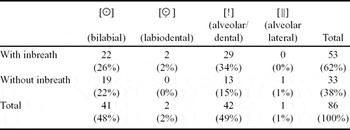
The NSI clicks are also consistently produced as singletons, without voicing or nasality and with a high amplitude. Although the NSI clicks are acoustically and auditorily salient, establishing the precise acoustic and articulatory details of each click can prove immensely difficult. In particular, identifying whether a click was produced with alveolarity or dentality was extremely hard. Therefore those clicks which sounded like they were produced at the alveolar ridge or further forward (i.e. at the teeth, but not as far forward as the lips) were grouped together as alveolar clicks (and transcribed using the symbol [ǃ]). Table 1 shows the different places of (anterior) articulation of NSI clicks (as far as they could be established) and whether they are released with the simultaneous initiation of an inbreath or not. The figures signify that the clicks are overwhelmingly produced with labiality (48%) or alveolarity/dentality (49%), and that they can often occur with the simultaneous taking of an inbreath (62%). When inbreaths are taken in this location, they always have a high amplitude and are typically fairly long, relative to other inbreaths. In this position, these inbreaths appear to function alongside other phonetic, lexical and sequential properties to demarcate the sequence boundaries (see Local & Walker Reference Local and Walker2005 for a similar account of inbreaths in abrupt-joins).
The different places of (anterior) articulation of NSI clicks and the occurrence of inbreaths.

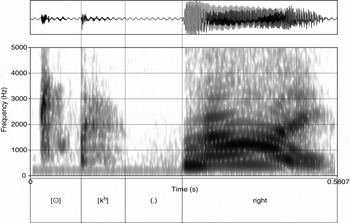
Figure 1 provides a waveform and a spectrogram of an NSI click (produced by Lesley in the NSI click turn in Fragment 5 above). Notice that before Lesley's production of right, there are two spikes of energy which coincide with the production of the click: the first of these spikes corresponds to the release of the anterior closure, which in this instance occurs with labiality as can be seen in the spectrogram by the energy being spread diffusely at all frequencies across the release of the closure (Stevens Reference Stevens1998); the second spike corresponds to the release of the posterior closure, which occurs with velarity and affrication, the latter of which can be seen by the high-energy noise following the release of the (velar) closure. Observe also the high amplitude of this click.
Waveform and spectrogram: NSI bilabial click (from Fragment 5, Holt.SO.88.(II).2.4/drop/).

It is important to point out that, in addition to the 86 NSI clicks, there were also 31 instances of non-velaric clicks being produced at sequence boundaries. In these cases, a short ingressive sound was produced by the lips or the tongue and alveolar ridge being parted with no closure at the velum being made (see Section 5.5 for a detailed account of the production of a non-velaric click; see also Ohala Reference Ohala1995 and Simpson Reference Simpson2007). Despite not being velarically initiated, and having a very low amplitude relative to the NSI clicks, these non-pulmonic sounds share many similarities with the NSI clicks; namely, they are produced with an ingressive airflow mechanism, with a complete occlusion in the vocal tract further forward than the velum, are voiceless without nasalisation and, importantly, they distribute at the same location in the interactional organisation of talk – that is, at sequence boundaries. Thus, it appears that in sequence junctures it is unimportant whether the click-like ingressive sound is produced with or without a closure at the velum. More research is needed, however, on these non-velaric click sounds in order to establish their acoustic and auditory correlates along with their interactional functions. These sounds have not been included in the analysis presented in this paper in order to avoid confusion.
The phonetic design of the talk which precedes and follows the NSI clicks corroborates claims in the literature regarding the phonetic characteristics of sequence closure and new sequence initiation, respectively, as will be discussed below. This therefore adds weight to the proposal that these NSI clicks are indeed situated in sequence boundaries. Three parameters were found to be particularly relevant to the phonetic design of the embedded contexts of the clicks: pitch, articulatory segmental features and voice quality. These parameters will be discussed below in Sections 5.1, 5.2 and 5.3, respectively. Section 5.4 will then examine the occurrence of the particle uhm in NSI click environments and Section 5.5 will discuss the proposal that NSI clicks are epiphenomena.
5.1 Pitch characteristics of NSI click environments
One of the most marked regularities in the phonetic design of the NSI click environments is found in the organisation of the pitch. The pitch of the closing down of the pre-click sequence is typically produced low in the speaker's pitch range and with a narrow pitch span relative to the following click-prefaced new sequence.Footnote 4 Conversely, the click-initiated new sequence is produced with a much higher pitch, located in the upper part of the speaker's pitch range and with a wider pitch span; its onset is also routinely produced with a marked upstep in pitch relative to the offset of the preceding sequence. Each of these pitch characteristics have previously been found to be typical in the closing down and initiation of new sequences (or major phrasal boundaries) in English (see e.g. Lehiste Reference Lehiste, Cohen and Nooteboom1975; Brown, Currie & Kenworthy Reference Brown, Currie and Kenworthy1980; Hirschberg & Pierrehumbert Reference Hirschberg and Pierrehumbert1986; Couper-Kuhlen Reference Couper-Kuhlen1998, Reference Couper-Kuhlen, Schiffrin, Tannen and Hamilton2001, Reference Couper-Kuhlen2003, Reference Couper-Kuhlen2004; Wichmann Reference Wichmann2000; Local & Walker Reference Local and Walker2005). This finding therefore reinforces the claim that the NSI clicks are produced between the offset of one sequence and the initiation of another.
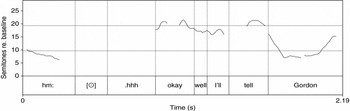
The pitch characteristics outlined above are evident in Figure 2, which provides a pitch trace of the final portion of the pre-click sequence (hm:) and the onset of the post-click disjunctive sequence (okay well I'll tell Gordon) of the NSI click turn produced by Lesley in Fragment 3 (L9). Observe in the pitch trace that the first unit (comprising hm:) is situated much lower in the speaker's pitch range relative to the following unit, being produced roughly ten semitones above the speaker's baseline. In comparison, the second unit, which has the main pitch accent on the verb tell, is located twenty-two semitones above the interactant's baseline and only seven semitones from her maximum pitch height. Notice also that the first unit has a much narrower pitch span than the second unit: the first unit spans only four semitones whereas the second unit spans fifteen semitones. There is also a marked upstep in pitch between the offset of the pre-click unit (i.e. hm:) and the onset of the following unit (i.e. the onset of okay); this upstep measures eleven semitones.
Pitch trace: design of pitch in pre- and post-NSI-click sequence (from Fragment 3, Holt.SO.88.1.8/tell/).

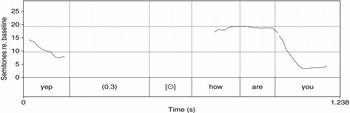
These pitch characteristics can also be clearly seen in the pitch trace in Figure 3, which shows the design of the pre- and post-click sequence of the NSI click turn produced by Lesley in Fragment 4 (L7) above. Observe that the final part of the closing down of the pre-click sequence (which is comprised of yep) is produced relatively low in the speaker's pitch range and with a fairly narrow pitch span of seven semitones. The following post-NSI-click new sequence (which is initiated with how are you) is produced higher in the speaker's range and with a much wider span of sixteen semitones. In addition, notice the marked upstep in pitch in the onset of the post-click new sequence (i.e. in the onset of how); this upstep measures eight semitones.
Pitch trace: design of pitch in pre- and post-NSI-click sequence (from Fragment 4, Holt.SO.88.2.10/pin/).

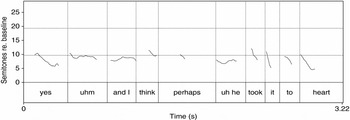
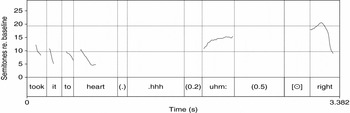
It is important to note that although the pre-click unit in both of the above NSI click turns comprises just one syllable (hm: in Figure 2 and yep in Figure 3), the pitch characteristics found in this location also occur on longer pre-click stretches of talk. A case in point is given in Figures 4 and 5 which comprise pitch traces of the click-initiated shift in sequence produced by Lesley in Fragment 5 above. Note that two pitch traces have been presented in order to fully illustrate the differences in the pitch placement of Lesley's talk in the pre-click sequence and the click-initiated new sequence (the latter of which is comprised of right). Recall that the sequence-closing figurative expression in this fragment initiates a move towards sequence closure (Drew & Holt Reference Drew and Holt1998), which is accepted by the recipient (in overlap with Lesley's subsequent inbreath), after which a click-initiated new sequence is proffered by Lesley. Observe in Figure 4 that Lesley's sequence-closing figurative expression (I think perhaps uh he took it to heart; L5 in Fragment 5) is located relatively low in her pitch range, typically being situated no more than ten semitones above her baseline, and is produced with a relatively narrow pitch span of six semitones. In comparison, the pitch trace in Figure 5 illustrates that after Lesley has terminated her figurative assessment (and produced the particle uhm; L10 in Fragment 5), she then produces a click-prefaced sequence shift with right, which is located much higher in her pitch range (it reaches a pitch peak of 21 semitones above her baseline) and has a wider pitch span of 11 semitones, relative to the preceding unit.
Pitch trace: low placement of pitch in sequence-closing figurative expression (from Fragment 5, Holt.SO.88.(II).2.4/drop/).

Pitch trace: relative differences between placement of pitch in pre- and post-NSI-click sequence (from Fragment 5, Holt.SO.88.(II).2.4/drop/).

The organisation of pitch in the NSI click environment presented in Figures 4 and 5 serves to illustrate that regardless of how many lexical items comprise the unit which closes down the pre-click sequence, this unit is routinely produced with a much narrower pitch span – and is located lower in the speaker's pitch range – relative to the following click-initiated unit. This suggests that the pitch placements and spans of the pre- and post-click turns are not determined by the number of lexical items in the turns but rather by the actions undertaken within them: the turns which embody the action of closing down the pre-click sequences are routinely produced with a low-pitch and a narrow-pitch span whereas the turns which initiate new and disjunctive click-initiated shifts in sequence are typically produced with a higher pitch and a much wider span. Again, this aligns with claims in the literature concerning the phonetic organisation of sequence/phrasal boundaries (see e.g. Lehiste Reference Lehiste, Cohen and Nooteboom1975; Brown et al. Reference Brown, Currie and Kenworthy1980; Hirschberg & Pierrehumbert Reference Hirschberg and Pierrehumbert1986; Couper-Kuhlen Reference Couper-Kuhlen1998, Reference Couper-Kuhlen, Schiffrin, Tannen and Hamilton2001, Reference Couper-Kuhlen2003, Reference Couper-Kuhlen2004; Wichmann Reference Wichmann2000; Local & Walker Reference Local and Walker2005).
5.2 Articulatory segmental features of NSI click environments
Another phonetic characteristic of the NSI click turns is that in those turns which comprise ‘multi-units’ (as in Fragments 2–4 above), the final syllable of the first unit (which functions to close down the preceding sequence) is routinely terminated with a portion of complete closure.Footnote 5 This closure is then maintained between the offset of the preceding sequence until its following release. Note, however, that although no talk occurs in this holding piece, it is not a period of non-activity because the glottis is being actively held closed by the speaker (see Local & Kelly Reference Local and Kelly1986, Kelly & Local Reference Kelly and Local1989b, Ogden Reference Ogden2001 for a discussion of glottal closure as a turn-holding device); the closure (from the final syllable of the first unit) is then released in the subsequent production of the click. As a result of this maintained closure, it is typical for the anterior release of the click to share the same place of articulation with the preceding sequence-final closure (if these two components are produced by the same speaker).
Below are phonetic transcriptions of the NSI click turns provided in Fragments 2–4 above. In each turn, the labial closure from the pre-click sequence is maintained (across any gap) and released in the onset of the following bilabial click (or in the case of Fragment 2, the non-velaric bilabial click, which is transcribed using the IPA bilabial percussive symbol, i.e. [

]; see Section 5.5 below for more discussion on the phonetic details of this stretch of talk). The holding of closures is shown on the transcriptions below by the tie bar into and out of the gap (note that the tie bar into the inbreath in Fragment 3 indicates that the click was produced with the simultaneous taking of an inbreath).
Interestingly, when the speaker does maintain an oral closure between the closing down of one sequence and the click-prefaced initiation of another, the recipients remain silent through any gaps in the talk, and the producer of the closure continues to produce the following click-initiated new sequence. This suggests that recipients orient to the closures as being indicative of speakers having more talk to produce, and supports previous claims in the literature that the maintenance of articulatory closures in conversation can serve as an interactional resource for turn and speaker management (Local & Kelly Reference Local and Kelly1986; Ogden Reference Ogden2001, Reference Ogden2004).
5.3 Voice quality of NSI click environments
Another common feature found across the NSI click collection is that the vocalically-initiated first lexical items in the click-initiated new sequences are always produced with ‘glottalisation’, i.e. a glottal stop, creaky voice or both. This initial portion of glottalisation can be seen in the phonetic transcriptions below of three of the fragments discussed above. Observe that in each fragment, the speaker initiates their post-click talk with a portion of glottalisation. The finding that speakers consistently produce glottalisation in the onset of vocalically-initiated first lexical items in the click-initiated new sequences supports the claim that glottalisation indexes phrasal boundaries, as the onset of the stretch following the NSI click comprises a new (major) unit of talk (Dilley, Shattuck-Hufnagel & Ostendorf Reference Dilley, Shattuck-Hufnagel and Ostendorf1996). However, this finding also furthers these previous claims, as the glottalisation not only initiates a new unit of talk but it also prefaces a new and disjunctive sequence. Thus, along with the pitch and articulatory segmental properties, these glottal features serve to index sequence organisation in everyday talk-in-interaction.
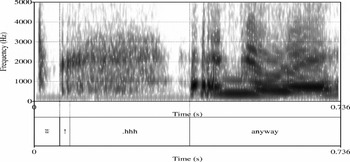
Figure 6 provides a spectrogram of the click-initiated new sequence produced by Lesley in Fragment 2 (L13), in which a portion of glottalisation in the onset of the new sequence can be clearly seen. Observe in this figure that Lesley initially produces a non-velaric bilabial click (which is her release of the held labial closure from the offset of yep), as can be seen by the initial high-energy spikes. This is then immediately followed by an alveolar click (see Section 5.5 below for more discussion on the phonetic details of this stretch). A relatively loud inbreath then follows (.hhh), after which the first lexical item of the new sequence is produced (i.e. anyway). Notice that the onset of this sequence-first lexeme is produced with creaky voice, as shown by the vertical striations which correspond to the irregularity of the vocal fold vibration. The talk then continues concerning the new sequence of talk.
Spectrogram of glottalisation in onset of first lexical item of click-initiated new sequence (from Fragment 2, Holt.SO.88.1.11/anyway/).

5.4 Particle uh (m) in NSI-click-initiated new sequences
There are several instances in the NSI click collection in which the particle uhm is produced at the boundary between the closing down of one sequence and the click-prefaced initiation of a new sequence. These particles are particularly prevalent in call openings, as in Fragments 7–10 below.
Observe in the above fragments that the particle uhm can be produced after the click-prefaced initiation of the new sequence (as in Fragments 7 and 8) or after the closing down of the preceding sequence but before the following click-initiated new sequence (as in Fragments 9 and 10). In each instance, however, this particle occurs at the boundary between the two sequences of talk. Moreover, when this particle is produced in this location, it is almost always uttered with particle-final lip closure, as in uhm rather than uh, although when it is situated before the NSI clicks it is always produced as uhm.Footnote 8 In other words, there are no instances in which the particle uhm is produced just as a long vowel (i.e. [əː]) without a final bilabial closure when it precedes an NSI click. This finding therefore supports the claim that the particle uhm is routinely situated at major phrasal boundaries, as it occurs at the boundary between two sequences of talk (Shriberg Reference Shriberg1994, Swerts Reference Swerts1998, Clark & Fox Tree Reference Clark and Tree2002). Conversely, the regular occurrence of uhm in the NSI click sequence boundaries adds weight to the argument that these clicks are indeed situated between two sequences of talk, as uhm has previously been found to occur at major phrasal boundaries.
In addition to the particle uhm frequently occurring with syllable/particle-final lip closure when produced at the boundary between the click-initiated new sequence and the preceding sequence, as in uhm not uh, it also occurs with a strikingly similar phonetic design: it is typically produced with initial glottalisation, an upstep in pitch and amplitude relative to the preceding talk, and a relatively flat pitch which is located in the middle of the speaker's pitch range. That the pitch of the particle uhm is routinely placed in the middle of the speaker's range refutes the argument that ‘filled pauses’ are produced with a low fundamental frequency (Shriberg Reference Shriberg2001). The glottalisation on the particle uhm, its pitch placement and its location in the sequence all serve to strengthen the disjunctiveness of the sequence boundaries in which the NSI clicks are produced and add weight to the argument that the NSI clicks are situated in sequence boundaries. These findings also demonstrate that the particle uhm can undertake certain varied and specific interactional functions according to its location in sequence (see e.g. Jefferson Reference Jefferson1974; Wright Reference Wright2001, Reference Wright2002; Local Reference Local2004 for other interactional accounts of uh(m)).
5.5 Are clicks epiphenomena?
It could be argued that the production of clicks in new sequences of talk is not interactionally determined but may instead be a natural feature of the movements of the vocal apparatus in specific sequential locations. Indeed, it is not uncommon to find epiphenomenal non-pulmonic sounds in certain phonological contexts in talk (see e.g. Ohala Reference Ohala1995, Simpson Reference Simpson2007). And in fact in this research on clicks, there are instances in which it appears that certain click-like sounds may be the unintended result of the movements of the articulators rather than being ‘intentionally’ produced. A case in point is found in the NSI click turn in Fragment 2, produced in phonetic transcription below (see also Figure 6 above for a waveform and spectrogram of this NSI click turn):
Observe in the phonetic transcription above that after the sequence-closing yep token, the speaker then (after a short pause) produces a non-velaric bilabial click (shown using the bilabial percussive symbol, i.e. [ʬ]. It is likely that this non-velaric click arises in the following way: first, the labial closure is held from the offset of the preceding yep token; whilst this labial closure is maintained, the speaker then also produces a closure with alveolarity in the vocal tract thereby anticipating the upcoming alveolar click; the result of the closure at the lips and the alveolar ridge is a sealed pocket of air between the two closures; the movement of the lips in preparation of the release of the labial closure then expands this trapped pocket of air, which results in the air pressure dropping; when the lips part, the air flows into the area between the lips and the alveolar constriction, causing the click-like sound (see Ohala Reference Ohala1995 and Simpson Reference Simpson2007 for a similar description of the production of non-velaric click sounds). Of particular importance to this research is the fact that immediately subsequent to the non-velaric bilabial click, the speaker releases the held alveolar closure (and velar closure), resulting in a following alveolar click (with velarity). Notably, this alveolar click does not share its place of articulation with the placement of the oral closure at the end of the pre-click unit, i.e. with the offset of yep. It cannot therefore be argued that the alveolar click is an artefact of the speaker moving out from the labial closure that was held from the offset of yep. That a click is produced in such instances after a preceding non-velaric click suggests that NSI (velaric) clicks are indeed not epiphenomena of speakers moving their vocal apparatus and adds weight to the claim that these clicks are interactionally motivated rather than a phonetic accident.
Particularly relevant to this paper is the fact that NSI clicks are often produced after the particle uhm (see Section 5.4 above), thereby suggesting that they may be the result of the lips opening again after they had been closed to produce the final portion of uhm. This argument, however, does not hold when one looks more closely across the data set, as there are instances such as in Fragment 11, in which a click is produced before the particle uhm.
Observe in Fragment 11 that Lesley closes down the opening sequence with her turn-initial hello (L5). In this location, this hello functions as a sequence-closing third as it is ‘designed not to project any further within-sequence talk beyond itself’ (Schegloff Reference Schegloff2007: 118). Subsequently, Lesley produces a click, followed by the particle uhm (L5) before introducing the reason-for-call (L5–6). Thus, in this instance, the click is produced before uhm not after, therefore the occurrence of the click cannot be attributed to any lip closure from the offset of the particle uhm. Moreover, the final portion of hello is produced with vocalicity and without any audible oral closure prior to the production of the click. This fragment of talk, therefore, adds weight to the argument that clicks are not an articulatory consequence of the movements of the speech organs but are instead a resource which speakers can draw on to manage the sequential and interactional design of their talk.
The occurrence of NSI clicks could be regarded as being a consequence of speaker's taking an inbreath. However, there are two key arguments against this suggestion: (i) if clicks were simply a by-product of speakers opening their vocal apparatus to take an inbreath, then one would expect to find them at every location in which speakers intake breath, which is simply not the case; (ii) there are instances in which an NSI click is produced and an inbreath is not taken, as in the NSI click provided in the waveform and spectrogram in Figure 1 above (taken from Fragment 5). Part of the difficulty with addressing the suggestion that these NSI clicks may be epiphenomena is that due to the nature of the data, we are unable to establish what movements (if any) speakers make in order to prepare for taking a turn at talk and what sounds (if any) may be the result of such movements/preparations. It would therefore be worth investigating this factor in future research using techniques such as electropalatography (EPG) and ultrasound (see e.g. Wrench & Scobbie Reference Wrench, Scobbie, Palethorpe and Tabain2003). Despite this lack of detailed information, however, the fact that these clicks are regularly produced by different speakers in interactionally and phonetically equivalent environments suggests that they are being employed for interactional purposes in everyday talk-in-interaction.
6 Summary and discussion
This paper has examined the phonetics-interaction interface of clicks in English conversation and has shown that they are regularly produced in new sequence boundaries. In this location, these NSI (New Sequence Indexing) clicks function alongside the phonetic parameters of pitch, articulatory segmental features and voice quality (and the sequential and lexical organisation of talk) to demarcate the onset of new and disjunctive sequences. The sequences which precede the NSI clicks were shown to be closed down by a variety of interactional practices such as sequence-closing assessments, figurative expressions and repetitions. In the post-click environments, the new sequences were found to often be overtly marked by the use of prefatory disjunctive markers such as anyway and right. The recipients of the NSI click turns were shown to orient to the click-initiated shifts in sequence as being appropriately placed, as they accepted the disjunctive shifts in sequence in their immediately subsequent turn.
As well as similarities in their sequential and interactional properties, the NSI click turns were also found to share a number of remarkably consistent phonetic characteristics. The NSI click turns and their embedded contexts were frequently observed as having the following phonetic designs:
• systematic differences in the placement of the various components of the NSI click turns in the speakers' pitch ranges – the closing down of the pre-click sequence is routinely produced lower in the speaker's pitch range relative to the click-initiated new sequence; there is a noticeable upstep in pitch in the onset of the click-prefaced sequence shift;
• orderly differences in the relative pitch spans of the units in the multi-unit NSI click turns – the units which attend to the preceding talk and function to close it down are consistently produced with a much narrower pitch span relative to the following click-initiated new unit/sequence;
• maintenance of articulatory closures between the offset of the preceding sequence and the onset of the click in the multi-unit NSI turns;
• glottalisation in the onset of the click-initiated new sequence when that sequence is prefaced with a vocalically-initiated lexical item;
• the routine occurrence of high-amplitude inbreaths (relative to other inbreaths) undertaken simultaneously with the release of the click.
These various constellations of phonetic parameters function together in complex ways to demarcate the sequences which flank the NSI clicks. They therefore provide further evidence to support the sequential, interactional and lexical evidence that the NSI clicks are indeed situated in new sequence boundaries.
7 Conclusion
Using a novel combination of interactional and phonetic analysis techniques, this study has demonstrated that the production of clicks in the initiation of new sequences is a resource which interactants can employ routinely and systematically in order to phonetically demarcate sequence boundaries in naturally-occurring talk-in-interaction. These findings therefore differ markedly from the claims in the literature that in English, clicks serve only a paralinguistic function, signalling various attitudinal and emotive states of the speaker. Instead, this paper has demonstrated that, regardless of any paralinguistic work that clicks may undertake, in certain sequential locations, they can function alongside various other components to index and manage the sequentially unfurling interactional structure of everyday English talk-in-interaction. This is not to say that clicks cannot perform displays of emotion or stance – rather that this is not the only function that they have in talk. It remains to be seen from future empirical investigations of conversation what the range of functions and phonetic exponents of clicks may be.
Although this paper has discussed only one non-paralinguistic use of clicks identified in everyday conversation, other investigations by the author have revealed additional interactional functions, e.g. clicks are used systematically in environments where a speaker is actively searching for a word (see Wright Reference Wright2005 for more details of these ‘word searching’ clicks). Much more research is needed on clicks, and on non-lexical components of conversation in general, as to date these features of talk have been little studied. Future research will therefore continue to investigate clicks in naturally-occurring English talk-in-interaction, seeking to identify the range of functions that they can undertake. Regarding NSI clicks, comparisons need to be made between sequence junctures where clicks do and do not occur, as it may be that there are phonetic and/or interactional differences between these environments. An examination is also needed of the use of gesture to demarcate new sequences; preliminary investigations by the present author have identified that hand claps are used in sequential locations comparable to the NSI clicks documented here. Detailed phonetic investigations of clicks are also required, as establishing the auditory and acoustic correlates of clicks produced in natural talk can prove to be immensely difficult.
On a final note, it is important to point out that had intuited or laboratory speech data been used for this investigation, the patterns found in the production of clicks would not have been discovered. This highlights the importance of examining naturally-occurring talk-in-interaction and the fruitfulness of CA as a methodology for exploring and identifying the systems and structures in conversation.
Acknowledgements
This research was carried out whilst I was in receipt of an AHRB Postgraduate Studentship at the University of York. I would like to thank Richard Ogden, John Local, Elizabeth Couper-Kuhlen, Adrian Simpson and three anonymous reviewers for their helpful and insightful comments at various stages of this research. Any errors remain entirely my own, of course.
Appendix. Transcription conventions
Following Atkinson & Heritage (Reference Atkinson and Heritage1984a), the following transcription conventions are used in the data fragments:
Phonetic transcriptions follow IPA (1999).