Introduction
Qualitative olfactory disorders describe a distorted olfactory perception when exposed to an odour (parosmia) or even without an olfactory trigger (phantosmia) (Frasnelli et al. Reference Frasnelli, Landis, Heilmann, Hauswald, Huttenbrink, Lacroix, Leopold and Hummel2004). The prevalence is estimated at between 0.8% and 2.1% for phantosmia (Landis et al. Reference Landis, Konnerth and Hummel2004) and between 0.8% and 4% for parosmia (Nordin et al. Reference Nordin, Bramerson, Millqvist and Bende2007). The typical nature of the distorted perception is unpleasant and patients with qualitative olfactory disorders exhibit higher depression scores than those with quantitative olfactory loss (Deems et al. Reference Deems, Doty, Settle, Moore-Gillon, Shaman, Mester, Kimmelman, Brightman and Snow1991). Based on these findings, our aim was to study whether depression might lead to qualitative smell dysfunction, and we therefore examined whether severity of depression was related to parosmia or phantosmia.
For quantitative smell disorders it has been shown that depression increases among patients with hyposmia or anosmia (Deems et al. Reference Deems, Doty, Settle, Moore-Gillon, Shaman, Mester, Kimmelman, Brightman and Snow1991; Pause et al. Reference Pause, Raack, Sojka, Goder, Aldenhoff and Ferstl2003; Croy et al. Reference Croy, Landis, Meusel, Seo, Krone and Hummel2011). In accordance with this, we found enhanced depression scores in persons who were born without a sense of smell (Croy et al. Reference Croy, Negoias, Novakova, Landis and Hummel2012). Patients with depressive disorder have been shown to exhibit reduced olfactory function. Olfactory thresholds are impaired in patients with major depression (Pause et al. Reference Pause, Miranda, Goder, Aldenhoff and Ferstl2001), chemosensory event-related potentials are altered in depressed patients (Pause et al. Reference Pause, Raack, Sojka, Goder, Aldenhoff and Ferstl2003) and the olfactory bulb volume is reduced in patients with major depressive disorder (Negoias et al. Reference Negoias, Croy, Gerber, Puschmann, Petrowski, Joraschky and Hummel2010). In healthy subjects, a significant negative correlation of −0.36 between subclinical depression symptoms and olfactory sensitivity thresholds has been found (Pollatos et al. Reference Pollatos, Albrecht, Kopietz, Linn, Schoepf, Kleemann, Schreder, Schandry and Wiesmann2007).
Although there seems to be a connection between depression and quantitative olfactory disorders, less is known about qualitative olfactory disorders. We performed two studies: in a pilot study (Study I), we analysed the coherence between parosmia/phantosmia and depression in the normal population; based on these results, we analysed parosmia/phantosmia in relation to depression severity among in-patients of psychosomatic rehabilitation hospital (Study II).
Method
Study I
A total of 151 people were recruited among visitors at a popular scientific event at the University of Dresden Medical School. They were aged between 18 and 74 years (mean age 33.4 ± 11.8 years); 106 were women, 47 men, and for one person the sex had not been documented.
Parosmia/phantosmia assessment
A parosmia/phantosmia diagnosis cannot be measured objectively but a trained physician can obtain a patient's history in a detailed and directed interview (Frasnelli et al. Reference Frasnelli, Landis, Heilmann, Hauswald, Huttenbrink, Lacroix, Leopold and Hummel2004). A short questionnaire to screen for parosmia and phantosmia has been devised by Landis et al. (Reference Landis, Frasnelli, Croy and Hummel2010). This questionnaire consists of four items and exhibits good validity for detecting parosmia and phantosmia in a clinical sample of patients with smell disorders (Landis et al. Reference Landis, Frasnelli, Croy and Hummel2010). Each of the four questions has to be answered on a four-point scale ranging from ‘this is always the case’ to ‘this is never the case’. A sum score is built ranging from 4 to 16 points, whereby lower scores refer to increased parosmic/phantosmic symptoms.
Each of our anonymous participants completed the questionnaire with the four parosmia questions (Landis et al. Reference Landis, Frasnelli, Croy and Hummel2010). We added one question about sensitivity towards odours (‘In general I perceive odours very weak’), which also had to be answered on a four-point scale. Additionally, the participants completed two visual analogue scales ranging from 1 to 100 units for their general health and for depression. The verbal anchors for general health were 0 ‘extremely good health’ and 100 ‘extremely bad health’ and for depression they were 0 ‘not at all depressed’ and 100 ‘extremely depressed’. The depression scale has been shown to be valid for detecting depressive symptoms (cf. Rampling et al. Reference Rampling, Mitchell, von Oertzen, Docker, Jackson, Cock and Agrawal2012).
Study II
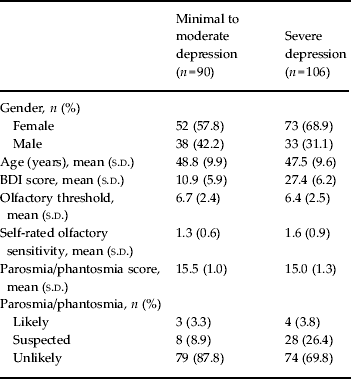
A total of 196 in-patients (125 women, 71 men, age range 21–63 years, mean age = 48.6 years, s.d. = 8.5 years) from a psychosomatic rehabilitation hospital were tested for olfactory sensitivity and for degree of depression before and after 4–6 weeks. Additionally, the patients completed the parosmia questionnaire (Landis et al. Reference Landis, Frasnelli, Croy and Hummel2010) at the beginning of the therapy: 171 (87.3%) of the patients had a diagnosis within the depressive spectrum (ICD-10 F3), 12 (6.1%) were diagnosed with mixed anxiety and depression (ICD-10 F41.2) and 13 (6.6%) with adjustment disorders (ICD-10 F43.2). Severity of depression was assessed with the Beck Depression Inventory (BDI; Beck et al. Reference Beck, Steer and Brown1996). The sample was split according to depression severity derived from the BDI-I. According to the BDI (Beck et al. Reference Beck, Steer and Brown1996) depression severity was classified as minimal to moderate depression (0–18 points, n = 90) and severe depression (19–63 points, n = 106).
Forty-six of the patients received no medication. Among the others, 81 received one type of medication, 52 received two and 17 received three different medications. The classes of medications prescribed were: selective serotonin reuptake inhibitors (SSRIs, 53 patients), selective noradrenaline reuptake inhibitors (SNRIs, 39 patients), tricyclic antidepressants (33), beta blocker (22), valdoxan (17), tetracyclic antidepressants (16), angiotensin-converting enzyme (ACE) inhibitors (10), antihistamines (9), l-thyroxine (8), atypical neuroleptics (6), painkillers (5), St John's wort (3), lithium (2), antiepileptics (2), antipsychotics (1), monoamino oxidase-A inhibitors (1), and others (8). The severely depressed patients received more atypical neuroleptics (6 v. 0) and antihistamines (8 v. 1) than the patients with minimal to moderate depression. Otherwise, there were no significant differences in medical prescriptions between both groups.
Olfactory sensitivity was tested with the threshold test of the standardized, reliable and validated ‘Sniffin’ Sticks' test (Hummel et al. Reference Hummel, Kobal, Gudziol and Mackay-Sim2007).
The investigations were performed according to the Declaration of Helsinki on Biomedical Research Involving Human Subjects. The protocol was approved by the University of Dresden Medical Faculty Ethics Review Board (protocol no. EK303092010). After a complete explanation of the study to the participants, oral and written informed consent was obtained.
Statistical analysis
The results were analysed using SPSS version 19 (SPSS Inc., USA). Sex differences in the parosmia score were analysed using the Mann–Whitney test. Coherence between parosmia score, age, depression rating and general health rating (Study I) was analysed using Spearman's coefficient of correlation. To control for potential influences of general health, a partial correlation between depression rating and parosmia, controlling for general health, was calculated.
In Study II, we divided the answers in the parosmia/phantosmia questionnaire into three categories for a more focused presentation. According to the results of the study by Landis et al. (Reference Landis, Frasnelli, Croy and Hummel2010), we divided the answers in the parosmia/phantosmia questionnaire into three categories: very likely parosmia/phantosmia (⩽12 points), suspected parosmia/phantosmia (13–14 points) and parosmia/phantosmia unlikely (15–16 points). Non-parametric testing of the influence of depression severity on the parosmia/phantosmia score was performed using the Mann–Whitney test. The level of significance was set at 0.05.
Results
Study I
The parosmia/phantosmia score for the whole sample ranged from 10 to 16 (mean score = 13.7, s.d. = 1.5). A significant correlation was found between the parosmia score and the depression rating (r = −0.33, p < 0.001) and the parosmia score and general health rating (r = −0.25, p < 0.001). After correcting for general health, the correlation between the parosmia score and depression rating remained significant (partial correlation: r = −0.30, p < 0.001).
There was no significant sex difference regarding the parosmia scores and there was no significant correlation between parosmia score and age (r = 0.10, n.s.). There was a significant negative correlation between the parosmia score and self-rated olfactory sensitivity (r = −0.33, p < 0.001), indicating that participants who reported some of the parosmia items also reported perceiving odours only weakly.
Study II
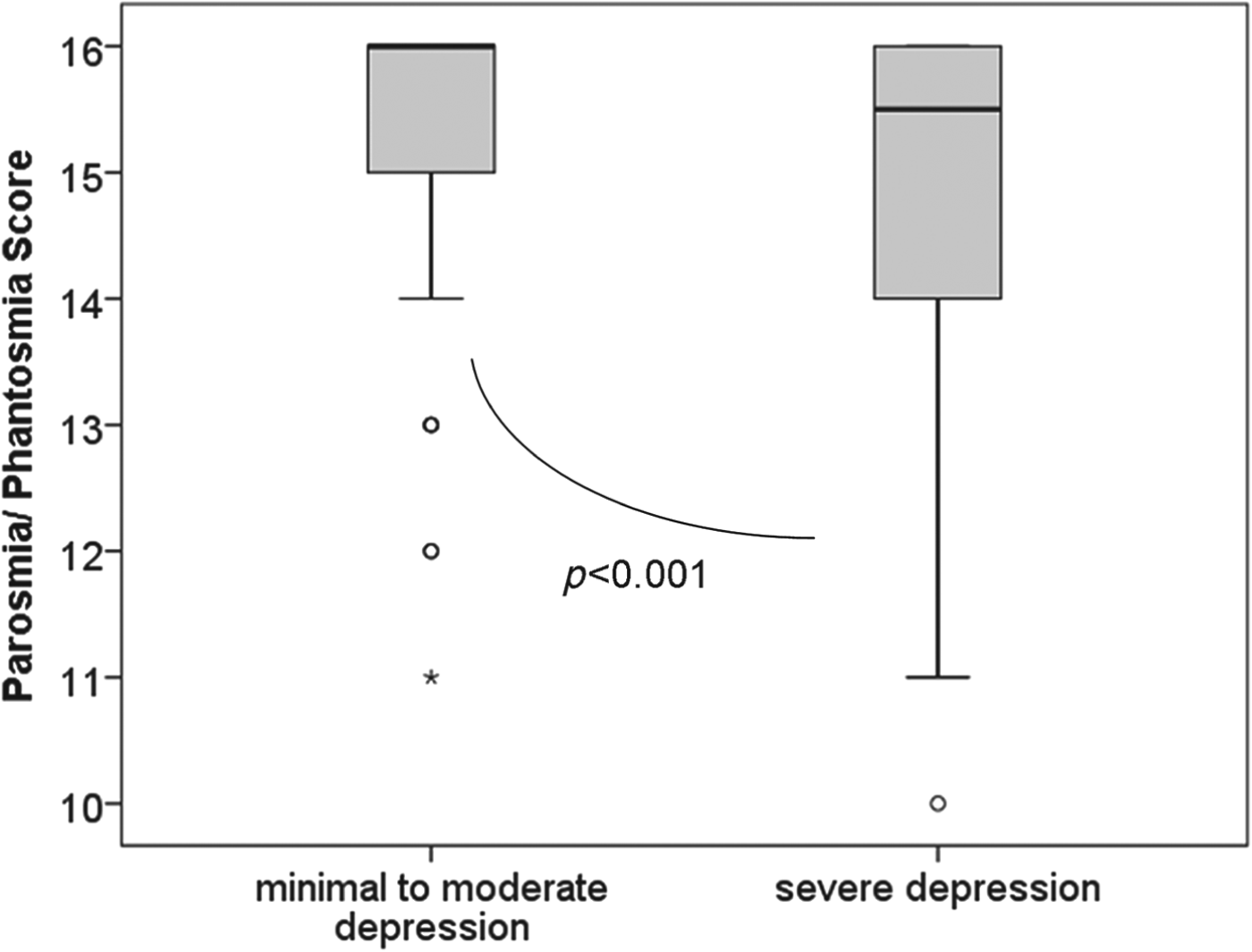
The parosmia/phantosmia score for the whole sample ranged from 10 to 16 (mean score = 15.2, s.d. = 1.2). A significant influence of depression severity on the parosmia/phantosmia score was revealed (Z = 3.5, p < 0.001; see Fig. 1 and Table 1). Patients with severe depression exhibited lower scores on the parosmia/phantosmia questionnaire than patients with minimal to moderate depression. Because of the reversed coding of the questionnaire, this means that the patients with enhanced depression severity exhibited enhanced parosmia/phantosmia symptoms. Accordingly, there was a significant correlation between the BDI and the parosmia questionnaire scores (r = −0.31, p < 0.001). At an individual level, parosmia/phantosmia was likely in 3.8% and suspected in 26.4% of the severely depressed patients. For the minimal to moderately depressed patients, parosmia/phantosmia was likely in 3.3% of the patients and suspected in 8.7%. There was no other significant influence of diagnosis on the parosmia/phantosmia score.
Parosmia/phantosmia score in patients with minimal to moderate (n = 90) and severe depression (n = 106). The median, range and interquartile range are shown in the box plot. A significantly higher rate of parosmia/phantosmia symptoms was reported by patients with severe depression compared to patients with minimal to moderate depression. Note that the coding of the questionnaire is reversed, with higher scores representing reduced symptoms of parosmia/phantosmia.

Characteristics of patients with minimal to moderate and severe depression
BDI, Beck Depression Inventory; s.d., standard deviation.
There were no significant sex differences regarding the parosmia/phantosmia scores and there was no significant correlation between parosmia/phantosmia score and age (r = 0.06, n.s.). However, there was a significant correlation between the parosmia/phantosmia score and the self-rated olfactory sensitivity (r = −0.23, p = 0.001), but no correlation between the self-rated olfactory sensitivity and the objective olfactory threshold measurement (r = −0.06, n.s.) or between the olfactory threshold and the parosmia/phantosmia score (r = 0.04, n.s.). The olfactory threshold was lower among the severely depressed patients than among those with minimal to moderate depression but this observation did not reach the required level of significance.
Discussion
In Study I we found a significant moderate correlation between depression and parosmia/phantosmia. This finding encouraged us to examine parosmia/phantosmia relative to depression severity. In Study II we found that the presence of parosmia/phantosmia is suspected or likely in about one-third of the patients with severe depression. These are significantly more cases than in the group of minimal to moderately depressed patients.
A limitation of the study is the absence of a control group of non-depressed patients. The pilot study does not allow a direct comparison with Study II because of the different testing conditions. The normal population was recruited from attendees at a science fair who completed a questionnaire at the event whereas, for Study II, the patients were examined and completed the questionnaire in a standardized setting in the presence of a medical doctor. We assume that the testing procedure significantly influenced the answering behaviour of the participants. Studies on volunteers' bias show that the mode of recruiting participants influences their response in questionnaires (Roensthal & Rosnow, Reference Roensthal and Rosnow1975).
However, we found a similar association between depression and parosmia/phantosmia in the two studies, which were conducted with different samples in different settings and using different tools for assessment of depression. This strengthens the hypothesis that not only quantitative but also qualitative smell disorders are related to depression.
The correlative design of our study allows no conclusions about causes. It can be assumed that people get depressed because they experience the unpleasant sensation of parosmia/phantosmia. However, asked about their individual hypothesis of psychosomatic disease, according to our clinical experience depressed patients rarely speak about unpleasant smells, and this is in agreement with the lack of literature on these symptoms. However, even among patients in a smell and taste clinic, parosmia/phantosmia is rarely reported spontaneously (Landis et al. Reference Landis, Frasnelli, Croy and Hummel2010).
Given the joint occurrence of depression and parosmia/phantosmia, we can also speculate about a possible common underlying cause. Abnormal functionality in the orbitofrontal cortex has been hypothesized to affect olfactory processing in depressive disorders (Pause et al. Reference Pause, Raack, Sojka, Goder, Aldenhoff and Ferstl2003). In a more recent study on 22 patients with parosmia/phantosmia, reduced grey-matter volume was reported in the right anterior insular, the anterior cingulate cortex, the hippocampus and the left orbitofrontal cortex (Bitter et al. Reference Bitter, Siegert, Gudziol, Burmeister, Mentzel, Hummel, Gaser and Guntinas-Lichius2011). These areas match in part areas that are reported to be structurally reduced in depression. A meta-analysis encompassing 543 patients with major depressive disorder revealed grey-matter reduction in the anterior cingulate cortex, the middle and inferior frontal gyrus, the right hippocampus and left thalamus (Du et al. Reference Du, Wu, Yue, Li, Liao, Kuang, Huang, Chan, Mechelli and Gong2012). Structural deviations in these brain areas related to emotional evaluation and memory could contribute to depression and also to parosmia/phantosmia.
Replicating the work of Landis et al. (Reference Landis, Frasnelli, Croy and Hummel2010), we found no significant coherence between olfactory threshold and parosmia/phantosmia, and there was again no significant influence of age and sex. This is in accordance with the notion that parosmia/phantosmia is an independent olfactory disorder, affecting men and women of all ages.
Conclusions
Because of the coherence of parosmia/phantosmia and depression, we suggest that medical doctors who diagnose depression should ask their patients explicitly about parosmia/phantosmia. Patients do not normally report this spontaneously, but the disorder has a strong negative impact on the quality of life (Frasnelli & Hummel, Reference Frasnelli and Hummel2005) and should not be overlooked. We also recommend that physicians confronted with parosmia/phantosmia ask their patients about accompanying depressive symptoms. Finally, treating parosmia with antidepressive SNRI medication may be worth trying as reported by Landis et al. (Reference Landis, Croy and Haehner2012) in a single case study.
Declaration of Interest
None.