Introduction
Criminal behavior (CB) is strongly familial (Dugdale, Reference Dugdale1887; Burt, Reference Burt1925; Glueck & Glueck, Reference Glueck and Glueck1950; Farrington et al. Reference Farrington, Gundry and West1975, Reference Farrington, Jolliffe, Loeber, Stouthamer-Loeber and Kalb2001). Therefore, an important research goal has been to understand the mechanisms of familial aggregation for delinquency and criminal offending. The major research method used to address this question in the last century has been twin studies which have consistently found evidence for important genetic contributions to CB (Lange, Reference Lange1929; Rosanoff et al. Reference Rosanoff, Handy and Plesset1934; Christiansen, Reference Christiansen and Hood1974; Dalgard & Kringlen, Reference Dalgard and Kringlen1976). In a meta-analysis, Rhee & Waldman estimated from extant twin studies that 45% and 12% of the liability to broadly defined criminality resulted from, respectively, genetic and shared environmental effects (Rhee & Waldman, Reference Rhee and Waldman2002). However, twin studies only examine within-generation (or ‘horizontal’) familial resemblance and it is equally or perhaps more importantly necessary to understand the sources of cross-generational (or ‘vertical’) familial transmission of CB.
Prior studies using both official record data and self-report data have consistently indicated that children of parents with a history of criminal offending have a higher probability of also engaging in antisocial behavior and criminal offending (Glueck & Glueck, Reference Glueck and Glueck1950; McCord, Reference McCord and Meier1977; Farrington, Reference Farrington, Maguire, Morgan and Reiner1997, Reference Farrington, Thornberry and Krohn2002; Farrington & Welsh, Reference Farrington and Welsh2007; Kim et al. Reference Kim, Capaldi, Pears, Kerr and Owen2009; Thornberry et al. Reference Thornberry, Freeman-Gallant and Lovegrove2009; Thornberry, Reference Thornberry2009; Besemer, Reference Besemer2012). Much of what is known about intergenerational transmission of criminal offending has emerged from a series of studies using criminal conviction records. Although only using conviction data as a measure for CB has limitations for the study of intergenerational transmission of criminal offending due to official bias (Besemer et al. Reference Besemer, Farrington and Bijleveld2013), it does provide the benefit of being able to link family members across generations. Using data from the Cambridge Study in Delinquent Development (CSDD) on fathers and sons, Farrington and colleagues (Farrington et al. Reference Farrington, Gundry and West1975, Reference Farrington, Coid, Harnett, Jolliffe, Soteriou, Turner and West2006, Reference Farrington, Coid and Murray2009; Bijleveld & Farrington, Reference Bijleveld and Farrington2009) reported that by their early 20s, 48% of the males with convicted fathers were also convicted whereas only 19% of convicted males had fathers without criminal convictions. Additionally, 54% of the males with convictions also had mothers with criminal convictions. Farrington also reports that having a convicted parent by age 10 was among the strongest predictors of criminal offending among the males up until age 32. Farrington and colleagues (Reference Farrington, Coid and Murray2009) also examined resemblance in criminal offending among three generations: the study males (G2), and their parents (G1) and offspring (G3). They found significant transmission of criminal convictions between all generations of males; from G1 males to G2 males and from G2 males to G3 males. However, intergenerational transmission among study males and females (parent or offspring) was weaker. There was less transmission evident between G1 females and G2 males, and G2 males and G3 females. As Besemer (Reference Besemer2012) notes, although studies of intergenerational transmission of criminal offending indicate that children of criminal offenders are more likely to offend themselves, whether the transmission relates to violent offending or offending more generally is not as clear. His recent study using data on fathers and sons from the CSDD suggests some specificity in the intergenerational transmission of violent criminal offending. Sons of fathers with violent convictions were more likely to have violent convictions, compared to sons of fathers convicted of non-violent convictions.
There are a number of genetic, familial and environmental sources that lead to the intergenerational continuity in criminal offending, such as socio-economic risk factors, maternal stress, maternal parenting styles, and exposure to parental criminal offending (Patterson, Reference Patterson1982; Bijleveld & Wijkman, Reference Bijleveld and Wijkman2009; Delisi et al. Reference Delisi, Beaver, Vaughn and Wright2009; Thornberry et al. Reference Thornberry, Freeman-Gallant and Lovegrove2009). Using self-report data, Thornberry and colleagues (2009) found that maternal antisocial behavior is related to child antisocial behavior as a result of maternal stress and ineffective parenting techniques. Parental antisocial behavior was also significantly related to child antisocial behavior but only for fathers that had frequent contact with their offspring. Bijleveld & Wijkman (Reference Bijleveld and Wijkman2009) used criminal conviction data for five generations and examined the extent to which intergenerational transmission was due to environmental or hereditary influences. They found that parental conviction before birth had no impact on risk for offspring conviction; however, parental conviction after birth significantly increased the risk of offspring conviction. They conclude that their results suggest that environmental exposure to a convicted parent may be more influential for cross-generational transmission than the hereditary effects of having a convicted parent.
All of these studies were in intact families and so were unable to determine the degree to which parent–offspring transmission of CB resulted from genetic v. from environmental processes. One major method traditionally available to discriminate genetic from environmental sources of parent–offspring resemblance has been the adoption study. While elegant, it has several potential limitations including non-random placement of adoptees and the atypicality of both the biological and adoptive parents (Cadoret, Reference Cadoret1986). Prior adoption studies of CB have shown mixed results (Crowe, Reference Crowe1972; Bohman, Reference Bohman1978; Gabrielli & Mednick, Reference Gabrielli and Mednick1984; Mednick et al. Reference Mednick, Gabrielli and Hutchings1984). In a recent national Swedish adoption study, we found that CB in adoptees, as indexed by official criminal convictions, was significantly predicted by CB in both adoptive and biological parents (Kendler et al. Reference Kendler, Larsson Lönn, Morris, Sundquist, Långström and Sundquist2013a ).
In addition to formal adoptions, two other relatively common family constellations can provide information to clarify the nature of parent–offspring transmission (Kendler et al. Reference Kendler, Ohlsson, Sundquist and Sundquist2014b ). Parents can beget offspring with whom they never subsequently cohabit and can raise children who are genetically unrelated to them. In this report, we utilize criminal conviction data from Sweden to examine intergenerational continuity in CB in (i) parent–offspring pairs from intact families, (ii) parent–offspring pairs where the parent never resided with or near the offspring, and (iii) stepparent–stepchild pairs. Next, we examine intergenerational continuity in CB for three major subtypes of CB as assessed via criminal convictions: violent (VCB), property (PCB) and white-collar (WCCB). Our primary goal is to gain insight into the relative contribution of genetic and environmental factors in the parent–offspring transmission of CB and its subtypes. Secondarily, we hope to clarify the degree to which the genetic and environmental factors involved in cross-generational transmission of CB are subtype specific or more general in nature.
Method
We used linked data from multiple Swedish nationwide registries and healthcare data, with linking achieved via the unique individual Swedish 10-digit personal ID number assigned at birth or immigration to all Swedish residents. This ID number was replaced by a serial number to preserve confidentiality.
The following sources were used to create our database: the Total Population Register, containing annual data on family, education and geographical status; the Multi-Generation Register, providing information on family relations; the Swedish Hospital Discharge Register, containing all hospitalizations for all Swedish inhabitants from 1964 to 2010; the Swedish Prescribed Drug Register, containing all prescriptions in Sweden picked up by patients from 2005 to 2010; the Outpatient Care Register, containing information from all outpatient clinics from 2001 to 2010; the Primary Health Care Register, containing outpatient primary-care data on diagnoses and time for diagnoses 2001–2007 for 1 million patients from Stockholm and middle Sweden; the Swedish Crime Register that included national complete data on all convictions from 1973 to 2011; the Population and Housing Censuses that provided information on household, education and geographical status in 1960, 1965, 1970, 1975, 1980, and 1985. Geographical areas were defined using Small Areas for Market Statistics (SAMS) units, which are small geographical units defined by Statistics Sweden, the Swedish government-owned statistics bureau. There are approximately 9200 SAMS throughout Sweden, their average population being around 1000.We secured ethical approval for this study from the Regional Ethical Review Board of Lund University (No. 2008/409).
Our measure of CB and three subtypes (VCB, PCB, WCB) is based on the following criminal conviction types during the entire follow up period: (i) VCB – (aggravated) assault, illegal threats, intimidation and illegal coercion, threats or violence against a police officer (aggravated) robbery, murder, manslaughter or filicide, kidnaping, arson, sexual crimes (excluding prostitution and the buying of sexual services but including child pornography); (ii) WCCB – fraud, forgery and dishonesty, and embezzlement; and (iii) PCB – theft, vandalism, vandalism causing danger to the public and trespassing. We discuss the drawbacks of using conviction data to measure CB in the limitations section of our paper.
As detailed elsewhere (Kendler et al. Reference Kendler, Maes, Sundquist, Ohlsson and Sundquist2013b ), drug abuse (excluding alcohol or tobacco) was identified in the Swedish medical registries using records of crimes related to drug abuse and from the Prescribed Drug Register which indicates excessive and medically inappropriate use of hypnotics and sedatives.
We also measure parental criminal convictions, highest achieved education among parents and community-level peer deviance. As outlined in detail elsewhere using drug abuse as the outcome (Kendler et al. Reference Kendler, Ohlsson, Sundquist and Sundquist2014a ), our peer deviance item measures the adulthood criminal convictions of peers that resided in the same area as the proband during adolescence. Specifically, we identified the proportion of peers (5 years younger or older) residing in the SAMS area of the proband at age 15 that had adulthood criminal convictions.
Sample
The database was created by entering all individuals in the Swedish population born in Sweden between 1960 and 1990 (N = 32 57 987). The database included the number of years from birth to age 15 that individuals resided in the same household and the same SAMS as their mother, father, possible stepmother and possible stepfather. From 1960 to 1985 (every 5th year), family type was defined using household ID and geographical status from the Population and Housing Census where the household ID includes all individuals living in the same dwelling. Every year from 1986 onwards, we defined our family types using the Family ID and geographical status from the Total Population Register, the Family ID defined by individuals that are related or married and who are registered at the same property. Furthermore, adults who are registered at the same property and have common children, but are not married, are registered in the same family. We created our different family types by investigating who the identified offspring (hereafter proband) shared the same household ID/Family ID with from birth to age 15. For the stepparent families, this means that from 1986 onwards, for a proband living with his/her mother, we only capture the stepfather if he is either married to the mother of the proband and/or having a common child together with the proband's mother. This means that the number of probands born after 1970 decrease [mean number of probands included in the stepfather analysis decrease from on average 4077 for years of birth 1960–1970 to 3529 for years of birth 1971–1985 and for the years (1986–1990) where we only have household information from the Family ID to 1872]. For the years we did not have information, we approximated the household and geographical status with the information from the year closest in time.
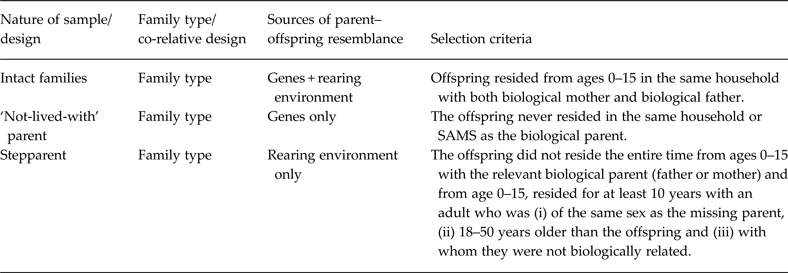
We identified three kinds of families using criteria outlined in Table 1: (i) intact families, (ii) ‘not-lived-with’ parent families, and (iii) stepparent families. The parent–child relationships in our not-lived-with and stepparent families were selected to resemble those seen in, respectively, biological parent–adoptee and adoptive parent–adoptee relationships in an adoption design. In only a small proportion of cases (1.5% of fathers and 4.7% of mothers) did the not-lived-with parent–offspring relationship arise through death of the parent in the year of the child's birth.
Description of the three key family types utilized in this report

SAMS, Small Areas for Market Statistics.
We identified separate groups of families where (i) the father or mother were a ‘not-lived-with’ parent and (ii) which contained stepfathers or stepmothers. In our stepfather and stepmother families, the offspring spent on average (s.d.) 1.35 (2.0) and 2.45 (2.6) years from ages 0–15 residing with their biological father and mother, respectively.
Analysis
We used Cox proportional hazards models to investigate the future risk for CB in offspring as a function of a CB status in the relevant parent, controlling for the CB status of all other relevant biological and stepparents. Robust standard errors were used to adjust the 95% confidence intervals (CIs) as we often had several sibling pairs from the same parent. We examined risk of CB, defined as criminal convictions, in offspring from age 15 until first conviction, death, emigration or end of follow-up year (2001). In all models we investigated the proportionality assumption. In order to combine the results from the different samples, we used the Mantel–Haenszel meta-analysis method (Mantel & Haenszel, Reference Mantel and Haenszel1959). We calculated the combined hazard ratios (HRs) and p values for the heterogeneity tests.
We then compared results from these family types using the same analytic methods with a subset of the sample previously analyzed in our Swedish nationwide adoption sample [born 1960–1990 rather than 1950–1991 in the original report (Kendler et al. Reference Kendler, Larsson Lönn, Morris, Sundquist, Långström and Sundquist2013a )]. All statistical analyses were performed using SAS v. 9.3 (SAS Institute, 2011). We utilized a ‘two-sided’ test, presenting 95% confidence intervals (CIs).
Results
Parent–offspring transmission in three family types
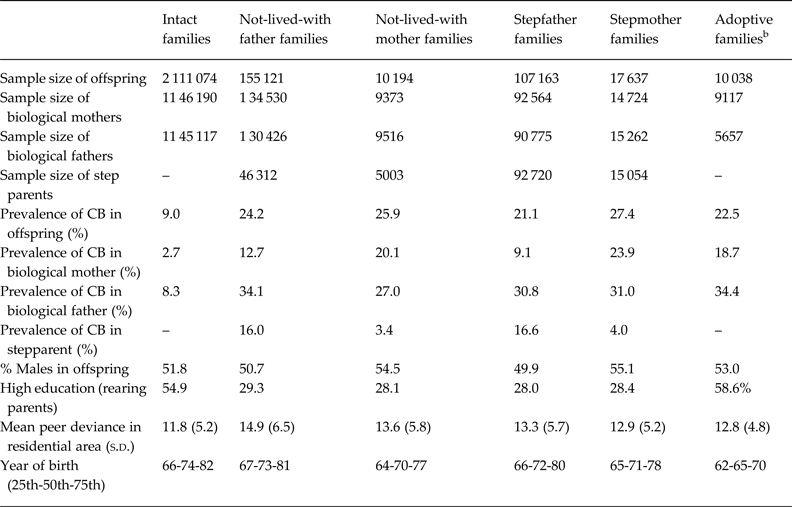
Table 2 depicts the sample size, rate of CB in various relatives, age, educational status, and community peer deviance for each of our five family samples. Sample size was largest for intact families, next for ‘not-lived-with father’ and ‘stepfather’ families, and smallest for ‘not-lived-with mother’ and ‘stepmother’ families. The intact families have noticeably lower rates of CB in parents and offspring and high levels of parental education. Community peer deviance was highest for fathers not-lived-with and stepfathers samples and broadly comparable in the other three samples.
Features of the five main family types examined as well as adoptive families a

CB, Criminal behavior.
a CB is here defined as registration in the Swedish Conviction Register.
b Number of adoptive fathers = 8512 and adoptive mothers = 8507. Prevalence of CB in the adoptive parents was 4.0% in adoptive fathers and 2.0% in adoptive mothers.
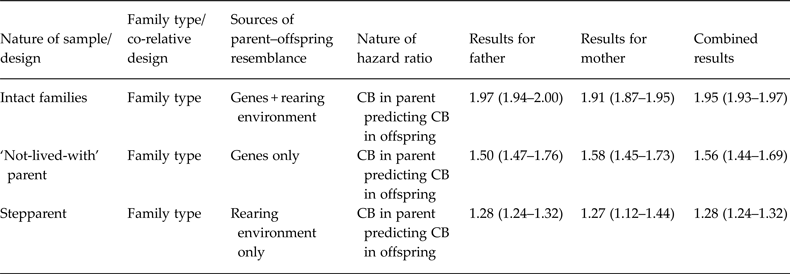
In the intact families – where the same parents contribute genetic risk and rearing – the association between CB in father–offspring and mother-offspring pairs was strong (HR 1.97, 95% CI 1.94–2.00 and HR 1.91, 95% CI 1.87–1.95, respectively) (Table 3). The parent–offspring associations for CB were more modest in the father not-lived-with and mother not-lived-with families where the parents contribute only genetic effects (HR 1.50, 95% CI 1.47–1.76 and HR 1.58, 95% CI 1.45–1.73, respectively). The parent–offspring associations for CB were weakest in the Stepfather and Stepmother families where the parents provide only rearing environment (HR 1.28, 95% CI 1.24–1.32 and HR 1.27, 95% CI 1.12–1.44, respectively). The HRs between mothers and fathers differed significantly in the intact families (p = 0.02) but not in the not-lived-with (p = 0.58) or stepfamilies (p = 0.91). The risk of criminal conviction in the child varies according to family structure, with the highest risk for children from parents in intact families who provide genes plus rearing (1.95), followed by not-lived-with parents who probably provide genes only (1.56) and stepparents who provide only rearing (1.28).
Results as hazard ratios (95% confidence intervals) for risk for CB (defined as registration in the Swedish Conviction Register) in three key family types (95% confidence intervals)

CB, Criminal behavior.
Comparison with the adoptive sample
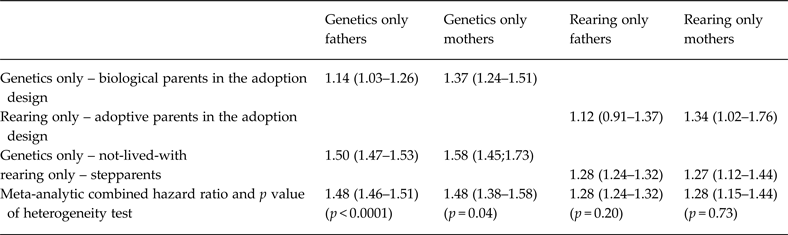
The parent–child relationships in our not-lived-with and stepfamilies were selected to resemble those seen in, respectively, biological parent–adoptee and adoptive parent–adoptee relationships in an adoption design. We re-analyzed, in a comparable manner, results from our prior Swedish national adoption study of CB (Kendler et al. Reference Kendler, Larsson Lönn, Morris, Sundquist, Långström and Sundquist2013a ) (Table 4) and examined the similarity of those estimates with those from the current study. No significant differences were seen in the transmission of CB from stepparents and from adoptive parents. However, the HRs were significantly higher for the risk of CB for both not-lived-with fathers and mothers compared to biological fathers and mothers in the adoption design.
Hazard ratios (and 95% confidence intervals) for criminal behavior in offspring as predicted by criminal behavior in parents from intact families, not-lived-with parents, stepparents and biological and adoptive parents from an adoption sample a

a Criminal behavior is here defined as registration in the Swedish Conviction Register.
Subtypes of CB
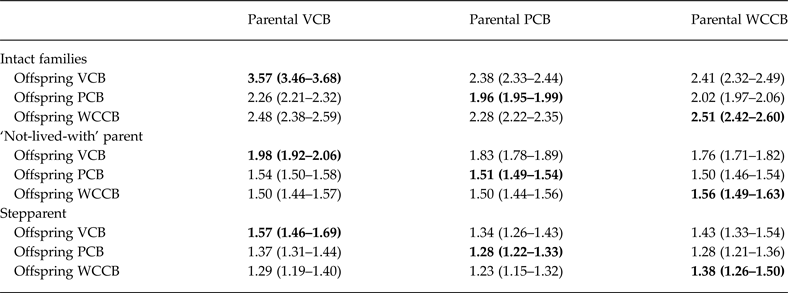
Our final analyses looked at the magnitude of parent–offspring transmission for the three types of CB (violent, property, white collar) for all three family types (Table 5). Several results were of interest. First, in all three types of families, all the HRs were highly significant both within and across subtypes. A substantial proportion of the genetic and environmental factors involved in the cross-generational transmission of CB appear to be non-specific with respect to the particular type of crime. Second, however, VCB displayed moderate specificity of transmission in all three family types. In intact, not-lived-with and stepfamilies, the HR was substantially higher from VCB in parent to VCB in offspring than for any other parent–offspring combination of criminal types (e.g. VCB in parent and PCB in offspring or WCCB in parent and VCB in offspring). Third, by contrast, no specificity was observed in any family type for the parent–offspring transmission of PCB. For example, in intact, not-lived-with and stepfamilies, offspring property crime conviction was more strongly predicted by parental violent crime conviction, rather than property crime. Finally, modest specificity was seen in the transmission of WCCB in intact families only. By contrast, in both not-lived-with and stepfamilies, WCCB in offspring was more strongly predicted by parental VCB than parental WCCB.
The hazard ratio (and 95% confidence intervals) for parent–offspring transmission for the violent (VCB), property (PCB) and white-collar (WCCB) criminal behavior in intact, not-lived-with and stepparents families, controlling for the same subtype of criminal behavior in the other parent(s). The results for within-subtype transmission are bolded for clarity a

a Criminal behavior is here defined as registration in the Swedish Conviction Register.
Discussion
We sought to determine the degree to which parent–offspring resemblance for CB results from genetic v. environmental effects. Using the complete genealogical and residential data available in Sweden, we expanded beyond the standard adoption study to examine more naturalistic and representative types of families which could potentially discriminate genetic and rearing-environmental effects. We are not aware of prior studies which have utilized similar methods.
Our study had three parts. First, we examined the cross-generational transmission of CB in intact families, not-lived-with families and stepfamilies. Combining results from mothers and fathers, the HRS for CB in offspring of these family types given CB in the parent was 1.95, 1.56 and 1.28, respectively. The strong degree of intergenerational continuity of criminal convictions among parents and children is in line with previous research (Farrington et al. Reference Farrington, Jolliffe, Loeber, Stouthamer-Loeber and Kalb2001, Reference Farrington, Coid and Murray2009; Bijleveld & Wijkman, Reference Bijleveld and Wijkman2009; Besemer, Reference Besemer2012). These findings indicate that both genetic and environmental factors contribute substantially to parent–offspring resemblance for CB with genetic effects appearing to be somewhat more potent than rearing effects.
Second, we re-analyzed our adoption sample to be comparable to results from our not-lived-with and stepfamilies. The results for stepfamilies closely resembled that found for adoptive parents but the resemblance between not-lived-with fathers and mothers and their offspring was significantly stronger than seen between biological fathers and mothers and adoptees. We explored two possible reasons for this discrepancy. First, the post-natal contact could have been greater between not-lived-with parents and their offspring than was the case for biological parents and adoptees. To explore this, we further restricted our definition of ‘not-lived-with’ and required that the parent never reside within the same municipality, a much larger geographic area than the SAMS units, as their offspring (there are 290 municipalities in Sweden v. ~9200 SAMS units). For not-lived-with fathers, the sample size decreased 40% but the HR for predicting CB in offspring from CB in father changed only from 1.50 to 1.49. For not-lived-with mothers, the sample decreased 30% and the HR actually increased from 1.58 to 1.71. Second, perhaps the greater HR in the not-lived-with v. biological parents was a result of greater variance – which would here mean higher prevalence of CB in the not-lived-with parents. However, as we see in Table 2, the prevalence of CB was nearly identical in not-lived-with fathers and biological fathers of adoptees (34.1% and 34.4%, respectively) and only slightly higher in not-lived-with mothers than biological mothers of adoptees (20.1% and 18.7%, respectively). We are left with no good explanation for the stronger transmission of risk for CB from not-lived-with parents to offspring, v. biological parents to adopted offspring. One possibility is that the disruption in the early years of development of the offspring of not-lived-with parents with a CB is more severe than the orderly adoption process which typically involves placement of infant adoptees in high-quality foster homes prior to adoption (Bohman, Reference Bohman1970).
Third, we examined the pattern of parent–offspring resemblance for type of conviction in the three family types. All the within and across subtype HRs were highly significant suggesting that for much of both the genetic and rearing-environmental factors responsible for the cross-generational transmission of CB is not specific to individual criminal subtypes. However, the results for VCB were striking with consistently higher within-subtype v. cross-subtype parent–offspring transmission. Interestingly, this was seen both in the not-lived-with and stepparent families suggesting some degree of both genetic and environmental specificity in the transmission of VCB. Prior studies have also noted greater familial and intergenerational transmission of aggression and violent offending as compared to other crime types as well as the possibility that both genetic and environmental factors contribute to such similarity (Farrington et al. Reference Farrington, Barnes and Lambert1996; Besemer, Reference Besemer2012). Genetic (Brennan & Raine, Reference Brennan and Raine1997) and social learning mechanisms (Bijleveld & Wijkman, Reference Bijleveld and Wijkman2009) may be stronger for aggressive and violent behavior than for other types of criminal offending (Besemer, Reference Besemer2012). In our adoption study of CB (Kendler et al. Reference Kendler, Larsson Lönn, Morris, Sundquist, Långström and Sundquist2013a ), we found modest evidence of specificity of transmission for violent v. non-violent crimes in biological parents but not in adoptive parents.
Could additional examination of our stepfamilies provide insight into the nature of the environmental transmission of criminal offending across generations? While CB might result from offspring ‘learning’ from observing parental figures (Bandura, Reference Bandura1986) or being actively taught ‘skills of the trade’ (Giordano, Reference Giordano2010), it could also arise from the more non-specific disruptions in the rearing environment and/or family socio-economic class to which parental criminal offending also contribute (Kolvin et al. Reference Kolvin, Miller, Fleeting and Kolvin1988). In our stepparent families, drug abuse (DA) in the stepfather that was not accompanied by criminal conviction did not increase risk of criminal conviction of offspring (HR 1.06, 95% CI 0.88–1.27). The increase in risk was quite modest when the stepmother had DA but not CB (HR 1.26, 95% CI 0.94–1.68). Given that DA is also associated with a range of disruptions in family functioning (Stein et al. Reference Stein, Newcomb and Bentler1993; Black et al. Reference Black, Nair, Kight, Wachtel, Roby and Schuler1994; Kendler et al. Reference Kendler, Myers and Prescott2000; Otowa et al. Reference Otowa, Gardner, Kendler and Hettema2013), these results suggest some specificity in the cross-generational transmission of CB. However, if the first criminal conviction in a stepparent occurred after the stepchild left home, the HR for CB was still substantially elevated in the offspring of both stepfathers (HR 1.38, 95% CI 1.30–1.46) and stepmothers (HR 1.51, 95% CI 1.25–1.83). These results point toward non-specificity but it is quite possible that the parent was engaging in some criminal activities that had not yet resulted in an arrest and conviction.
We have used this method previously in examining the sources of parent–offspring transmission of DA (Kendler et al. Reference Kendler, Ohlsson, Sundquist and Sundquist2014b ). It is of interest to compare findings. Parent–offspring transmission of DA was stronger than seen for CB as assessed by the HR – but with similar relative magnitudes across the three family types (averaged across mothers and fathers): intact families 3.52, not-lived-with families 2.73 and stepfamilies 1.79.
Limitations
These results should be interpreted in the context of six potential methodological limitations. First, our results only apply to the country of Sweden, a relatively egalitarian society. The degree to which these findings would extrapolate to other countries and societies is an empirical question. However, studies examining intergenerational continuity in criminal convictions in other countries, such as England and The Netherlands, have also found strong evidence for the intergenerational continuity of criminal offending (Bijleveld & Wijkman, Reference Bijleveld and Wijkman2009; Farrington et al. Reference Farrington, Coid and Murray2009; van de Rakt et al. Reference van de Rakt, Nieuwbeerta and Apel2009). Second, our measure of CB is criminal conviction, and there is substantial bias associated with using official record data as the only measure of CB. As elsewhere, in Sweden, a majority of crimes are not officially reported or do not result in a conviction. In the 2008 National Swedish Crime Victim Survey, the proportion of crimes reported to the police ranged from 14% for sexual offenses to 55% for serious assaults (Swedish National Council for Crime Prevention, 2008). Bias might arise if the probability that a committed crime is reported, or that a reported crime leads to a conviction, differs across social strata or between intact, not-lived-with and stepfamilies. There is also evidence indicating that children of parents with convictions are more likely to be targeted by law enforcement, thus some degree of intergenerational continuity of criminal conviction could result from criminal justice system bias (West & Farrington, Reference West and Farrington1977; Besemer et al. Reference Besemer, Farrington and Bijleveld2013).
Third, our various family constellations differed in measures (family socioeconomic status and levels of community deprivation) that are related to risk for CB, as well as potentially for criminal justice system biases. We therefore repeated all the key analyses here reported adding as control variables educational status of the rearing families and community peer deviance. As expected, the HRs declined for all the observed parent–offspring association with the reduction proportionally greatest among the stepfamilies: intact families (HR 1.84, 95% CI 1.81–1.86), not-lived-with families (HR 1.51, 95% CI 1.47–1.53) and stepfamilies (HR 1.20, 95% CI 1.16–1.24). These results suggest that a modest proportion of parent–offspring transmission of CB results from broad socioeconomic and community-level factors.
Fourth, we utilized 10 years as a minimum duration of cohabitation for stepparents and stepchildren because with longer periods the sample size declined markedly. As a result, we could not match perfectly for duration of rearing between intact and stepfamilies. To explore the impact of this, we focused on the larger group of stepfather families and found minor differences in the HR for CB in stepchildren who lived 5–9 v. 10–14 years with their stepfather (HR 1.20, 95% CI 1.17–1.24 v. HR 1.28, 95% CI 1.23–1.33, respectively). We also examined if the HR changed based on the developmental time span in which the child lived with stepparents. It may be possible that cohabitation between child and stepparent that occurs earlier in the child's development may be more influential than cohabitation that begins later in life. In families where the stepchild lived their first 15 years with the stepfather, the HR for CB (1.28, 95% CI 1.19–1.38) was not increased over that observed using our definition of at least 10 year of cohabitation (1.28, 95% CI 1.24–1.32). Given these results, it seems unlikely that we have substantially biased downward evidence for rearing effects on CB.
Fifth, we cannot rule out an impact of non-paternity on our findings. However, the impact is not likely to be large because the prediction of CB in offspring from CB in fathers is very similar to that seen from CB in mothers from both intact and not-lived-with families (Table 3). High rates of non-paternity in these families would predict a much stronger transmission of CB from biological mothers than biological fathers.
Finally, our design sought to examine the impact of genetic relationships and cohabitation history on parent–offspring transmission of CB. We could not control for many other important aspects of the parent–offspring relationship, such as the quality of family rearing, and the frequency and quality of interactions between parent and child. For example, we knew nothing about the frequency with which a biological parent might visit with or be a psychologically important figure for his or her ‘not-lived-with’ offspring. We had no information about the emotional depth of the stepparent stepchild relationships in our stepfamilies. These factors certainly could impact on the observed results. While we feel it is likely that our results accurately depict aggregate effects of both genetic and environmental factors on parent–offspring transmission of CB, elucidating the impact of more fine-grained aspects of parent–child relationships that result in the cross-generational transmission of criminal offending would require other types of data and research designs.
Acknowledgements
This project was supported by the Ellison Medical Foundation, the Swedish Research Council to Kristina Sundquist (K2012-70X-15428-08-3), the Swedish Research Council for Health, Working Life and Welfare (In Swedish: Forte; Reg. no. 2013-1836) to Kristina Sundquist, the Swedish Research Council to Jan Sundquist (2012-2378) as well as ALF funding from Region Skåne awarded to Jan Sundquist and Kristina Sundquist.