Introduction
Salivary gland extracorporeal shock wave lithotripsy has emerged as a reliable treatment for salivary gland duct stones. Initial salivary stone treatments were a logical extension of renal calculus lithotripsy and were conducted in vitro in 1986, followed by in vivo use with salivary gland specific equipment in 1989.Reference Marmary1, Reference Brouns, Hendrikx and Bierkens2 Intracorporeal lithotripsy using endoscopes was also explored using electrohydraulic, pneumoclastic, electromagnetic and laser power sources.Reference Grundlach, Scherer, Hopf, Leege, Muller and Hirst3–Reference Arzoz, Santiago, Esnal and Palomero6 Further in vivo reports have described the use of electrohydraulic extracorporeal lithotripsy.Reference Ottaviani, Capaccio, Campi and Ottaviani7–Reference Capaccio, Monforte, Moroni and Ottavani9
In 1987, Lusk and Tyler investigated noise intensities for a Dornier GmbH renal extracorporeal lithotriptor system.Reference Lusk and Tyler10 They found that peak sound pressure impulses of 112 dB were generated. Hearing protection was recommended for patients and operating room personnel.
The Minilith SL-1™ (K Storz, Tuttingen, Germany) extracorporeal lithotriptor can be compared to the renal lithotriptor in principle of function; however, the power levels and other shock wave parameters are reduced. The real possibility of significant and detrimental noise levels from the salivary extracorporeal lithotriptor exists. The Occupational Safety and Health Administration of the USA federal government has outlined safety guidelines for workers in noise-exposed environments.11 Even though the overall power levels are less than those of renal lithotriptors, the Minilith is directed at sialolith targets in the head, and so has the otential to harm surrounding anatomical structures. Shock wave acoustic trauma transmitted to the organ of Corti has the potential to result in hearing loss.
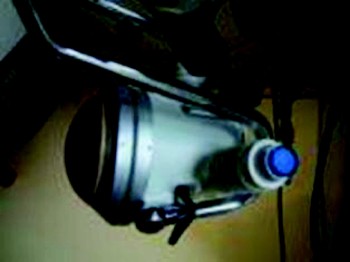
The Minilith has a fluid-filled bladder through which the shock wave pulse is transmitted (Figure 1). Powerful shock wave energy is transmitted to the stone through the soft tissues of the neck. An ultrasonic imaging beam is used to aim at the stone. The mandible, teeth and tooth fillings must be avoided in order to prevent pain or damage to these hard tissue structures, and also to prevent scatter of the shock wave. The shock wave pulse is focused as an hourglass-shaped channel of 2 mm diameter and 20 mm length. Maximum energy is delivered at the hourglass ‘waist’ area within the energy channel, and all other adjacent areas receive minimal energy. The shock wave produces a loud ‘hand clap’ sound audible to anyone near the machine. The intermittent nature of the treatment pulse is subjectively perceived by the physician and patient alike, as similar to a loud, repetitive hand clap. It is known that the noise of impact of an average hammer, pneumatic chip hammer and jackhammer measure respectively 87–95, 103–113 and 102–111 dB.12
The Minilith SL-1 (K Storz), showing the bladder which contacts the patient's skin and which houses the ultrasonic imaging and electromagnetic shock wave generator.

The Minilith has power levels that can be selected as megapascal (MPa) increments of shock pulse, from 10 to 35 MPa. These levels correspond to incremental dial settings on the machine, of one to six, respectively. Shock wave pulses can be delivered at one or two per second and are applied directly to the soft tissues overlaying the salivary ducts and parenchyma. Extracorporeal lithotriptor clinical treatment sessions usually last approximately 20 minutes.
No prior studies have reported the decibel levels of extracorporeal salivary lithotripsy by air or bone conduction. This study was undertaken in order to initiate an understanding of the hearing safety issues of such treatment, for patient and physician alike.
Materials and methods
This study used a Minilith SL-1 series OC.2.5 extracorporeal salivary lithotriptor (K Storz). The shock counter history registered 5 836 289 shocks. The sound level meter used was model number 33-2050 (Tandy Corporation, Fort Worth, Texas, USA). The meter was used in the ‘A’ weighting mode with a ‘fast’ response setting and had a measurement capacity of between 50 and 126 dB.
For tests one and two, the meter did not touch the lithotripsy machine; these were considered to be ‘air conduction’ type measurements. In tests one and two, measurements were taken respectively from directly in front and behind the shock wave generator. The measurements were along the axis of the centre of the shock delivery bladder (Figure 1). The measurement distances, for both the front and back of the unit, were 5, 10, 50, 100 and 200 cm. The power level was adjusted between Minilith settings one, three, five and six for each distance. For test three, the meter probe tip was placed directly on the centre front of the bladder with an ultrasound gel seal, in order to maximally transmit sound levels to the meter. These measurements were considered to be of the ‘bone conduction’ type. Power levels were again adjusted to Minilith settings one, three, five and six. The measurements were taken in the office treatment room in order to simulate actual use and exposure conditions.
Lastly, five consecutive patients were asked to undergo a trial of subjective noise level comparisons. These patients were asked to assess the loudness of sound, comparing an air-conduction exposure and use of the lithotriptor during their stone treatment session.
Results and analysis
For all series, selecting more powerful dial settings resulted in higher decibel levels.
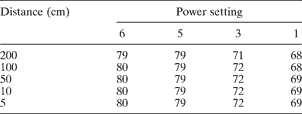
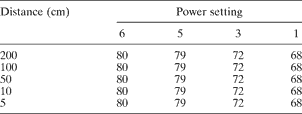
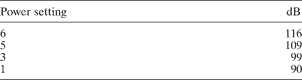
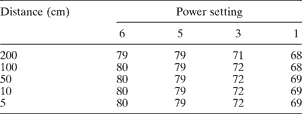
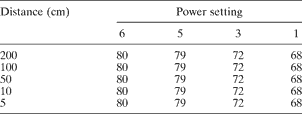
The decibel meter readings for the air conduction noise levels in tests one and two appeared not to appreciably attenuate between 5 and 200 cm from the machine, irrespective of the power setting (Tables I and II). The bone conduction noise levels showed considerably more decibel amplitude at equivalent power settings (Table III).
Test 1: decibels of ‘air conduction’ in front of lithotriptor
Test 2: decibels of ‘air conduction’ behind lithotriptor
Test 3: decibels of ‘bone conduction’, sound meter touching probe
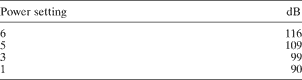
In test one, the decibel sound pressure levels generated by the power settings one, three, five and six ranged from 68 to 80 dB. In test two, the same power settings resulted in decibel sound pressure levels of 68 to 80 dB. In test three, the same power settings gave rise to decibel sound pressure levels of 90 to 116 dB.
Lastly, in the trial of subjective noise levels, the five patients consistently reported no particular difference between air and bone conduction noise generated by the lithotriptor.
Discussion
The US Occupational Safety and Health Administration has stated that when a ‘…hearing conservation program identifies employees exposed at or above 85 dB averaged over eight working hours, the exposure measurement must include all intermittent and impulsive noise within an 80 to 130 dB range’. The same ruling also states that hearing protection ‘shall be provided’ if noise levels reach or exceed these levels. At 99 dB, the recommendation for exposure is less than 20 minutes. At 105 dB, the permissible maximal exposure time is 4 minutes 45 seconds.11
The Minilith sialithotripsy unit exposes the physician operator to 68–80 dB during patient treatment, depending on the chosen therapeutic power level. Each patient treatment session lasts approximately 20 minutes. In order to reach the Occupational Safety and Health Administration exposure threshold of eight hours at 85 dB, 24 salivary stone patients would need to be treated for 20 minutes, each at maximal Minilith power levels, within one day. Thus, it would be highly unlikely that a typical Minilith physician operator would ever reach the Occupational Safety and Health Administration daily decibel exposure threshold solely from using the lithotriptor.
• Salivary gland extracorporeal shock wave lithotripsy has emerged as a reliable treatment for salivary gland duct stones
• This study aimed to determine the decibel sound pressure levels generated during extracorporeal lithotripsy for salivary stones, and whether these noise levels have the potential to cause acoustic trauma
• Sound level exposures ranged between 68 and 80 dB during treatment sessions, for both operator and patient
• No acoustic trauma is likely to occur during extracorporeal shock wave lithotripsy
For the patient, the possibility of higher decibel level exposure could occur if peak power settings were used during the treatment session, and if the soft tissues of the neck gave rise to complete bone conduction of energy to the ear. However, soft tissue impedances result in very poor transmission of sound energy. Bone conduction transmission of the lithotriptor shock wave energy from the targeted soft tissues of the neck to the ear would thus be insignificant. A difference of 36 dB between bone and air conduction measurements (depending on whether the machine was or was not in contact with the patient's tissues, respectively), as shown in Tables I and III, would be subjectively experienced by the patient as a significant difference in loudness. However, upon questioning, five individual patients subjectively rated tissue non-contact (air conduction) and tissue contact (bone conduction) sound levels as ‘about the same’. During treatment sessions, it appears that only imperceptible bone conduction energies are transmitted through the soft tissues of the neck to the ear. Thus, the air conduction ‘clap’ of the machine is the source of acoustic stimulus to the patient's ear. The maximal cumulative total of potentially traumatic acoustic stimuli to an average patient would be divided into 20 minute sessions over multiple weeks or months. Therefore, the level of exposure falls short of the threshold at which the Occupational Safety and Health Administration stipulates mandatory hearing protection to guard against hearing loss.
Summary
The short duration of treatment sessions and the comparatively low levels of sound generated by the lithotripsy shock wave would not give rise to auditory trauma to either the sialolithotriptor operator or the patient. No mandatory hearing protection would be required, according to the US Occupational Safety and Health Administration standards. However, optional hearing protection is always valuable in any situation of noise exposure, both to protect hearing and to prevent noxious sensory stimuli. Thus, hearing protection could be useful and may be encouraged during use of the Minilith extracorporeal lithotriptor.
Acknowledgements
The author wishes to thank Becky Colson, Administrative Secretary, for her assistance in preparing this manuscript.