


I. Introduction
The simplest type of fracture mechanisms occurs in "ideally brittle" solids. In these materials there is a critical stress at which a crack becomes unstable and propagates. Griffith (1920) showed by a simple energy argument that the crack propagation occurs when the rate of release of elastic strain energy is equal to (or greater than) the incremental increase in surface energy associated with the formation of new surface at the crack tip. With most real materials which show some ductility including metals, polymers, and ice, the fracture process involves not only the true surface energy of the solid but also creep and deformation processes at the crack tip. The energy involved in this process may easily swamp the surface energy term itself. Failure may not be primarily due to the propagation of a crack but to the flow and ductile separation of the specimen into two parts. The transition from ductile failure to failure by crack propagation is controlled by the time constant of stress relaxation at the crack tip. At high stresses and low temperatures or high strain-rates, the time constant is too long to prevent cracks reaching a critical size beyond which they are unstable, and propagate through the lattice. In the experiments to measure the "strength" of polycrystalline ice by Hawkes and Mellor (1972) and Wu and others (1976) in uniaxial compression and tension, a transition from ductile to brittle behaviour was observed at a strain-rate of about o-5 to 10-3 s-1 (the temperature was between -1 and - 10°C in Wu and others' experiment, and -7°C in Hawkes and Mellor's experiment).
Hawkes and Mellor also observed different strengths for tensile and compressive failure in the brittle region. This is to be expected because in a tensile test a single crack can lead to the eventual failure (unless failure is by void growth when many voids join up). By contrast in a compression test many cracks nucleate, change the local stress field, and link up in the final catastrophic failure. To obtain a better understanding of the fracture process it is clearly desirable to work with a system involving single crack propagation.
A number of workers have studied crack initiation in ice and have proposed various theories based on the pile-up of dislocations (e.g. Gold, 1967). On the other hand only two papers have discussed the propagation in ice of cracks of known geometry. Gold (1963) formed thermal cracks by bringing together two blocks of ice at different temperatures. He measured the depth to which cracks propagated, and the time after the blocks were brought together for the cracks to run. He then analysed the crack propagation process in terms of the diffusion of a thermal wave in the block, and the stresses produced by the temperature. H. W. Liu and L. W. Loop (personal communication of unpublished data) have used a compact tensile specimen (CTS). Here a single cracked block is pulled apart by fixtures through holes above and below the crack, a common technique for fracture studies. They also used a wedge-opening technique (see Fig. 1).
The test specimens used by Liu and Loop.

Most of the previous investigations of crack propagation in ice have involved relatively large specimens, e.g. three-point and four-point bending tests, compact tensile specimens, etc. The present paper describes some preliminary experiments in which a crack is formed and propagated under a conical or pyramidal indenter pressed into the ice. This has the advantage that many measurements can be carried out on a single specimen. A few experiments have also been carried out in three- and four-point bending.
2. Concept of fracture toughness
Griffith's energy argument for the critical stress σc to make a crack of length 2c propagate in an infinite solid when the stress is applied at right angles to the crack is

where Γ is the surface energy, and E the Young's modulus if the crack is in plane stress (in plane strain E is replaced by E/(I - v2)). If plastic deformation occurs at the crack tip, Equation (1) is a lower bound to the critical stress.
Comprehensive reviews of fracture toughness can be found in Lawn and Wilshaw (1975), Knott (1973), Kenny and Campbell (1967), Liebowitz (1969-72), and Turner (1975). Two useful parameters have been introduced: the stress intensity factor K which is the ratio of true stress at the crack tip to the average applied stress, and G which is the rate at which energy is released per unit length of crack advance. The particular stress intensity factor of interest to us is that for a crack being pulled apart by a stress normal to the crack plane (mode I), and this is designated K 1; its limiting value at which fracture occurs is K,1c. The stress could be applied so that the crack faces move over each other perpendicular to the crack front (mode 2) or parallel to the crack front (mode 3). G is generally referred to as the fracture toughness of a solid. In the perfectly brittle case G can be identified with 2Γ but if plastic work is performed at the crack tip G is the sum of the plastic work and the surface energy. The difference G -2Γ is then a measure of the plastic work involved in crack propagation. For a metal such as steel G is about to J m-2 while G is of order 40 000 J m-2. The quantities K and G are related by the expressions:
in plane stress

and in plane strain
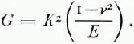
These parameters can be applied to situations where plastic flow occurs provided the plastic zone is small compared with the crack length and hence with the elastic hinterland within which the crack propagates. In the Irwin-Orowan model, the plastic zone at the crack tip is assumed to be cylindrical with a radius r p given by

where σy is the ideal plastic yield stress. With a material close to its melting temperature the yield stress σy will not be a constant but will depend on the strain-rate. For this reason in all fracture studies it is necessary to estimate the extent which significant plastic flow occurs (i.e. the size of r p compared with 2c).
In the present series of experiments, the strain-rates were estimated to range from 10-4 to 10 -2 s-1. Using earlier measurements of yield stress as a function of strain-rate at various temperatures, it was possible to estimate σy and hence the order of magnitude of r p. This proved to be about 0.04 mm which is much smaller than the length of the cracks studied. Consequently it is reasonably valid to use the elastic equations (Equation (2)) to define the stress field close to the crack tip. Clearly this assumption breaks down at very low strain-rates.
To obtain reproducible values of K IC, two further conditions must be met. First, the specimen width must be large enough so that the major part of the crack is in plane-strain conditions (this is usually met if the width is greater than about 50r p (Knott, 1973)). Secondly, the crack tip radius throughout the propagation must be so small that the perturbation of the stress field due to the crack can be represented by a singularity at the crack tip. In metals the value of K 1c has been found to fall to a limiting value as the crack tip radius is reduced, and it is usual, in a fracture test, to introduce a small sharp crack by fatigue. It is not possible to introduce a fatigue crack into the ice specimens with the present set up, but in the three- and four-point bending experiment a very sharp crack was formed by pushing a razor blade into a slot formed by melting. The tests were carried out in air and it is important to realize that environment can have a large influence on crack growth.
3. Experiments
3. 1. Specimen preparation
Specimens were grown in a water-filled tank inside a deep freeze (air temperature -10°C). The water used was once-distilled. The rate of growth could be varied by changing the setting on a water-temperature thermostat connected to a heater. Bubble-free specimens roughly 130 mm x 30 mm x 20 mm could be obtained after about a night and a day. The specimens were brought to the desired shape by melting them on an aluminium block at room temperature. They were stored at -10°C, in air, in the deep freeze. They were usually used within two days of manufacture; many were reshaped just before a test. Observations of the grain size (which varied from I mm to almost single crystals) were made with a universal stage on an optical microscope. Specimen dimensions were measured with vernier calipers to an accuracy of o.1 mm.
The fracture test rig set up for indentation experiments. The same loading arrangement was used in the three- and four-point bending tests.

3.2. Loading arrangement
The fracture toughness of ice is very low; a bar of cross-section 20 mm x 20 mm can be broken with one's fingers. Therefore it is possible to use a small, inexpensive rig completely contained within a small deep freeze to measure the fracture toughness. The arrangement is shown in Figure 2.
Oil from a hand pump was driven into the ram to force the indenter into the ice block. The ram heads can be interchanged to give various loading arrangements (three- and four-point bending, Vickers Diamond Pyramid, or other shaped indenters). The magnitude of the force is measured with a load cell beneath the ice block.
3.3. Three- and four-point bending test
Specimens, from the tank, were melted down to a bar shape, and then midway along one side a slot was melted with a thin copper plate to about half the thickness of the bar. At the end of the slot a very sharp crack was formed by pushing a razor blade into the ice. The ice block was put into the small deep-freeze unit containing the loading rig and allowed to equilibrate. The loading arrangement is shown in Figure 3.
The loading arrangement for the four-point bend tests. In the three-point bend test a single loading cylinder (giving line contact) is applied on the upper surface immediately above the crack.

Some three-point bending experiments (this is the B.S. I. standard) were carried out at -14 °C for a loading time of less than 10 s. Plans were also made to undertake some four-point bending tests since this situation provides a constant bending moment in the central section of the bar between the two upper loading cylinders: consequently, in contras t to the three-point test, the loading ram does not have to be located exactly above the crack.
3.4. Median crack formation beneath an indenter
When a diamond Vickers indenter (Tabor, 1970) is forced into the surface of an ice block to produce the usual hardness indentation, median cracks form with their planes perpendicular to the surface (see Fig. 4). These are apparently formed by the wedging action of the indenter. When the load is removed the sub-surface tension component about the deformed zone below the indentation nucleates and propagates another set of laterally extending cracks. The depth of the median crack is a measure of the fracture toughness, and can be deduced from the trace on the surface assuming that the crack is semicircular in shape. If ψ is the semi-angle of the Vickers pyramid, the fracture toughness is given (Swain and Lawn, 1976) by
The geometry of the crack formed beneath a Vickers indenter when Equation (4) applies. Frequently the crack ran to the intersection between two faces of the indenter, and was not always in a direction perpendicular to the edge of the indentation.

where c is the crack length, and P is the load. If K is constant then P should be proportional to  . Thus a plot of P versus
 may be used to deduce K
1C (see Fig. 5).
The experiments were carried out by attaching a diamond Vickers indenter or a conical indenter to the ram and forming median cracks for different loads. These ranged in length from 1 to 10 mm and could be measured with an accuracy of about 2%. They were generally formed within a single grain. Often three cracks were formed with trigonal symmetry, and changed their direction at a grain boundary. This suggests, as others have observed (Gold, 1961), that ice has specific cleavage planes. The measurements were made at two temperatures, -28°C and -20°C, and median cracks nearly always formed. Unfortunately in this preliminary study it was not possible to monitor the growth of the crack as the load was applied.
Median crack formation in ice. Plot of normal load P (in newtons) against (crack length) (in m
 ). The slope provides a measure of K
1C.
(a) Vickers pyramidal indenter with semi-angle ψ = 68°.
(b) Conical indenter with semi-angle ψ = 30°.

4. Results and discussion
In applying Equations (2) to convert the critical fracture toughness K 1c into G a value of Young's modulus E is needed. This is obtained assuming a value of 0.31 for Poisson's ratio v (Hobbs, 1974) and using the data given by Dantl (1968) for the dependence of shear modulus as a function of temperature. The resulting value is

where T is the temperature in degrees Celsius.
(i) The few three-point bending tests at -13°C gave a fairly consistent value of K
1c of 116 ± 13 kN m when the starter crack was at least one third of the specimen thickness. Using the above value of E this gives a value of the crack extension force G = 1.5 ± 0.2 J m-2. Some bending tests to failure were also carried out on specimens containing no starter cracks. Assuming that K
1c = 100 kN m-3 this makes it possible to calculate the size of surface flaws. The value came out to be about I μm, which seems reasonable.
(ii) The measurements with the Vickers and the conical indenters all gave reasonably good straight lines when the load P was plotted against c
 (where c is crack length) (Fig. 5). This is in good agreement with Equation (4). However the absolute values of the fracture toughness K
1c, are not satisfactory. They are obtained by dividing the slope of the P(
 ) relation by
 tan ψ. When this is done it is found that the K
1c values for the Vickers indenter (ψ = 68°) are one-third of the values obtained with the 6o° cone (ψ = 30°). Some workers using the indenter crack technique on glass have observed similar discrepancies. It has been suggested that with the relatively blunt pyramidal indenter the effective wedge angle is not that of the pyramid itself (ψ = 68°) but that of the plastic zone produced beneath the indenter. This would have an effective angle ψ of the order 45° and would reduce the calculated values of K
1c by a factor of 2.5 so bringing them into closer agreement with the results obtained with the sharp cone (ψ = 30°). If this assumption is accepted the final results obtained are as shown in Table I.
Fracture toughness K 1c and crack extension force G

From the experiments of Ketcham and Hobbs (1969) on contact-angle measurements and those of Jones (1973) on the motion of a water-ice interface in a temperature gradient, the surface energy of the ice-vapour surface can be calculated. The value is 0.12 mJ m-2. If the ice were "truly" brittle, the value of G would simply be double the ice-vapour surface energy, i.e. 0.24 J In-2. The values of Table I are considerably more than this even at -38°C indicating that there is an appreciable contribution to G from plastic work done at the tip of the crack. This is more marked at higher temperatures. However even at -16°C the plastic work term is only about 6o times the surface energy although this temperature corresponds to 0.93 of the melting temperature. A comparison with glass and steel at room temperature is therefore not particularly relevant. A comparison with a plastic such as P.M.M.A. is more meaningful (see Table II). At room temperature the surface-energy term is of order 0. 1 J m-2 whereas G is of order 300 J m-2.
These results are compared with those obtained by Liu and Loop and by Gold in Table II and Figure 6. As mentioned previously, Liu and Loop used compact tensile specimens and wedge-opening specimens (see Fig. I). Their results may depend on grain size as well as on strain-rate but their general range of values of G-of order 1-5 J m -2 resemble those quoted in Table 1. Gold's results obtained from thermal crack experiments are generally lower, 0.3 to 0.4 J m -2. However the main difference between the results of Liu and Loop and those quoted here lies in the dependence of G on temperature. They find that G increases as the temperature is reduced. By contrast the results of Table I indicate a marked reduction in G as the temperature is reduced. This would be expected if the colder ice is more "truly" brittle and involves less plastic work during crack propagation. This conclusion does however depend on the de tailed interpretation of indentation crack measurements.
Fracture toughness values of ice: summary

Crack extension force G as a function of temperature for various test methods involving large specimens.

5. Summary and conclusions
This paper provides a brief review of earlier work on the fracture toughness K and the c rack extension force G of ice, and includes a preliminary account of some new experiments in this field. The quantity G is essentially a measure of the energy required to propagate a crack in the solid. For a truly brittle solid the stresses generated around the tip of the crack are given by an explicit elastic solution and G is equal to twice the surface energy of the solid. If however plastic flow and creep occur at the crack tip, the singularity at the tip is modified. This is the situation with ice and the process becomes more and more complicated as creep deformation becomes more significant than change of shape by crack propagation. For ice this critical condition is reached for strain-rate less than about 10-4 S-1 . For a similar reason temperature may have a profound effect on the fracture energy.
Over the broad range 0 to -40°C, the value of G found from experiments using bulk specimens ranges from about 0.5 to 5 J m -2. In these experiments G appears to increase at lower temperatures. In experiments using crack propagation under hard indenters the value of G ranges from about 0.5 J m -2 at - 38°C to - to J m -2 at - 16°C. Here the values of G decrease at lower temperatures. Such a trend might be expected since creep and plastic deformation at the crack tip ought to be less at lower temperatures.
The use of a hard indenter to study fracture toughness of ice provides a very attractive technique. Many measurements can be made in a single small specimen so that the basic properties of the specimen are likely to be more uniform. Furthermore special specimen shapes are not required provided there is a single, reasonably flat surface accessible to the indenter. It might therefore be applicable to field studies. However the few measurements described in this paper show that the interpretation of the data demands critical examination ; in particular the influence of indenter geometry needs to be clarified. Other parameters such as loading rates and temperature must also be considered . It is hoped to look into these factors in the near future. In addition a direct study will be made of the propagation of the crack as it occurs during the indentation process itself.
Discussion
W. B. Kamb: Do you have a detailed mechanical model, in terms of the creep properties of ice, to explain the measured G values in terms of the contribution of plastic work near the crack tip?
D. J. Goodman: No. We do not have a model although our experiments are directed towards the understanding of microscopic mechanisms of fracture. We would expect fracture mechanisms identified in o ther materials to be observed in ice.
Kamb: In your experiments do you see any effects of the basal cleavage of ice?
Goodman: In the paper we mention that cracks under the indenter did form along specific crystallographic planes. The size of the medium crack was always smaller than the grain size.
A. Higashi: What was the strain-rate of your fracture experiments? Fracture toughness may be dependent upon the strain-rate. To build a model, evaluation of plastic surface work based on modes of generation of dislocations will be essential. As I reported yesterday, dislocation distribution is denser behind a crack tip than a t its front.
Goodman: The strain-rate depends on the distance from the crack tip. The loading time in most of the experiments was 10 s. In reply to your second remark, I thoroughly agree that it is essential to understand creep before tackling fracture. There is no doubt that creep plays an important part in controlling processes a t the crack tip. However our experiments do not show the same large temperature dependence as creep. Careful study of crack surfaces should help to understand what happens as the crack propagates. It will then be clear whether cracks cross grains or occur at grain boundaries.
J. W. Glen: In the wartime experiments to see if an iceberg could be used as an aircraft carrier, I believe they found that the results of firing a torpedo at an iceberg were very unpredictable- sometimes it shattered and sometimes little happened. This suggests a variability in fracture toughness that was not predictable-perhaps your experiments may throw light on this, or perhaps they themselves may show great scatter. Have you any comments?
Goodman: Fracture experiments always show a wide scatter , and ours are no exception. T his demonstrates the many parameters on which the fracture toughness depends. I suspect the torpedo sampled the extent of pre-existing flaws in the iceberg.



