Introduction
The Veterans Affairs, European Organization for Research and Treatment of Cancer and Radiation Therapy Oncology Group 91-11 trials established non-surgical organ preservation with chemo-radiotherapy (RT) as the standard of care for locally advanced laryngeal or hypopharyngeal cancers, with surgical salvage reserved for those with recurrent or residual disease.Reference Wolf, Fisher, Hong, Hillman and Spaulding1–Reference Forastiere, Goepfert, Maor, Pajak, Weber and Morrison3 Management of the clinico-radiologically node negative neck at salvage laryngectomy has been a matter of debate. Some advocate elective neck dissection, whereas others favour a wait and watch policy.Reference Wax and Touma4–Reference Pezier, Nixon, Scotton, oshi, Guerrero-Urbano and Oakley7 This is primarily because neck dissection in salvage settings is associated with increased post-operative morbidity.Reference Virtaniemi, Kumpulainen, Hirvikoski, Johansson and Kosma8–Reference Paydarfar and Birkmeyer11 On the other hand, a wait and watch approach can result in recurrences becoming unsalvageable. The risks must be balanced against potential benefits when a decision is made to address the neck in the salvage setting. The literature on this is sparse, and most studies have a small sample size and are heterogeneous. A recent systemic review addressing this issue failed to come up with concrete recommendations because of several limitations.Reference Gross, Vila, Simon, Rizvi, Zenga and Jackson12 The National Comprehensive Cancer Network and other commonly used guidelines are also ambiguous on this topic.13,14
We retrospectively analysed the occult metastasis rate and attempted to identify risk factors for occult metastasis in patients who were clinico-radiologically node negative following initial non-surgical organ preservation so that the decision for neck dissection could be made at the time of salvage laryngectomy.
Materials and methods
We retrospectively analysed patients who underwent salvage total laryngectomy following definitive RT or chemo-RT between September 2000 and October 2015 at a tertiary care centre. Of 1130 total laryngectomy procedures performed during the study period, 236 patients underwent salvage total laryngectomy. Of these 236 patients, 203 patients were clinico-radiologically node negative, and 33 patients had node positive disease.
Inclusion criteria were: (1) patients requiring salvage total laryngectomy for biopsy-proven recurrent or residual squamous cancer; (2) patients who were clinico-radiologically node negative at the time of surgery; and (3) patients treated with ipsilateral or bilateral neck dissection.
Patients who underwent salvage laryngectomy for dysfunctional larynx (n = 7), non-squamous pathology (n = 2) or who had a non-viable tumour on final histopathology (n = 5), and patients where the neck was not dissected (n = 18) were excluded from analysis. Our study cohort consisted of 171 patients.
Patient data were extracted from the hospital information system and electronic medical records system, which is updated at each follow-up visit ensuring effective and authentic data capture. The demographical, clinical, surgical, histological, post-operative and follow-up details were recorded.
Radiotherapy
As per the institutional policy, patients with T1 or T2 node negative glottic disease received narrow field radiation. Glottic tumours that were stage T3 or T4 or node positive and supraglottic or hypopharyngeal primaries received irradiation to primary as well as to bilateral nodal basins.
Imaging
All patients underwent routine radiological screening for the neck using contrast-enhanced computed tomography (CT) scans or positron-emission tomography (PET)-CT. The majority of the patients operated on before 2009 underwent CT scans. Patients operated on thereafter were imaged with either CT or PET-CT.
Surgery
All patients underwent wide field total laryngectomy for residual or recurrent disease. Primary closure of the neopharynx was performed if unstretched remnant mucosa was more than 2.5 cm. The decision to put pectoralis major myofascial flap over the suture line was taken by the treating surgeon. The technique of harvesting pectoralis major myofascial flap was described in our previous publication.Reference Sharma, Chaukar, Laskar, Kapre, Deshmukh and Pai15
If the remnant unstretched pharyngeal mucosa was found to be less than 2.5 cm, it was augmented with pectoralis major myocutaneous flap or free flap. All patients underwent unilateral or bilateral elective lateral neck dissection encompassing levels II–IV. Any patient with occult metastasis, which was confirmed by intra-operative frozen section, underwent level V dissection. Post-operative complication details were captured from the charts and electronic medical records.
Histopathology
Lymph nodes from each lymph node level were labelled and submitted in separate containers to the pathology department. All specimens were evaluated by specialist head and neck pathologists, employing a standardised grossing and reporting protocol. Briefly, all lymph nodes retrieved from each level were submitted separately and examined microscopically. Lymph nodes less than 1 cm were embedded in toto, and a single section was studied. Nodes ranging from 1 to 2.5 cm in size were bisected along the long axis, and both halves were submitted for examination. Nodes larger than 2.5 cm were sectioned serially, and a minimum of 2 sections were studied.
Follow up
Patients were followed up at three monthly intervals for first two years, six monthly intervals until five years and annually thereafter. Patients were assessed clinically during each follow-up visit. Imaging was ordered in cases of clinical suspicion of disease. Recurrence was confirmed clinico-radiologically, and a histological diagnosis was established. Second primary or recurrence during a follow-up visit was captured and labelled as local, regional, loco-regional or distant.
Statistical analysis
Statistical analysis was performed using SPSS® statistical software (version 24). Qualitative data was analysed using the chi-square test and Fisher's exact test for univariable analysis. Regression analysis using the binary logistic forward regression method was performed for multivariable analysis. Survival analysis was done using the Kaplan–Meier method. Comparisons in survival were analysed using log rank test. Two-sided p-values less than 0.05 were considered significant.
Results
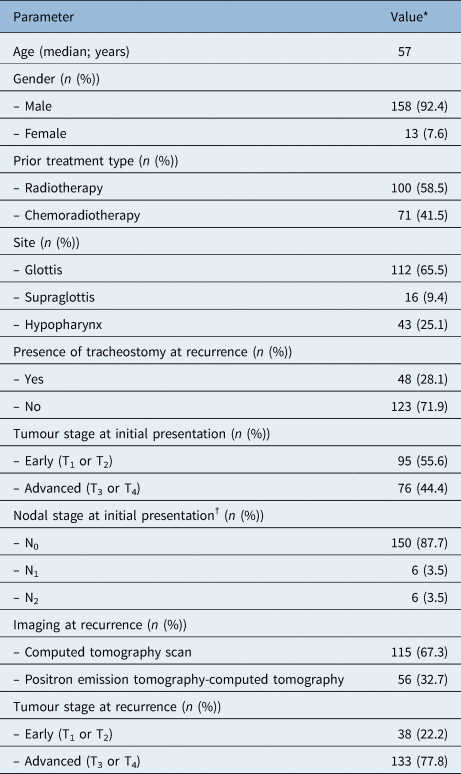
The study cohort comprised 171 patients. There were 158 men and 13 women with a median age of 57 years (range, 26–89 years). At the initial presentation, 112 patients (65.5 per cent) had glottic disease, 16 patients (9.4 per cent) had supraglottic disease and 43 patients (25.1 per cent) had hypopharyngeal disease.
About half of the patients (95 of 171; 55.6 per cent) were early stage (T1 or T2), 72 patients (42.1 per cent) were stage T3 and 4 patients were stage T4. A total of 150 patients were N0, 6 patients (3.5 per cent) were N1 and 6 patients (3.5 per cent) were N2. Information on nodal stage was missing in nine patients.
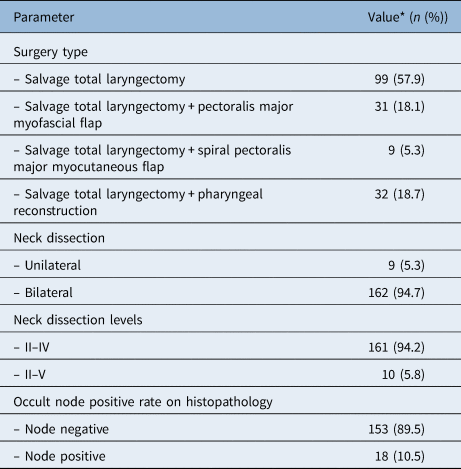
A total of 100 patients (58.5 per cent) received RT alone, and 71 patients (41.5 per cent) were treated with chemo-RT (Table 1). All patients who were included in this study were clinico-radiologically node negative at the time of salvage total laryngectomy. Primary pharyngeal closure was achieved in 130 patients. In 31 of these patients, the suture line was reinforced with onlay pectoralis major myofascial flap. Thirty-two patients (18.7 per cent) required pharyngeal augmentation using patch pectoralis major myocutaneous flap, free flap reconstruction or gastric pull up. In 9 patients (5.3 per cent), skin of the neck had to be excised and reconstructed with spiral pectoralis major myocutaneous flap. Surgical details are summarised in Table 2.
Clinical and demographic details

*n = 171; †data missing in nine patients
Surgical details

*n = 171
Neck dissection details
A total of 162 patients (94.7 per cent) underwent bilateral neck dissection, and 9 patients (5.3 per cent) underwent ipsilateral neck dissection. All patients underwent level II–IV lymph node clearance and level V was addressed in 10 patients (5.8 per cent) because of metastatic disease in the lateral neck as reported on frozen section.
Occult node positivity
A total of 18 patients (10.5 per cent) had occult nodal disease in the lateral neck on histopathology examination. Bilateral metastatic spread to the neck was present in only 1 patient (0.5 per cent). This patient had extensive local disease involving bilateral transglottic areas, both pyriform sinuses along with soft tissue extension to thyroid gland.
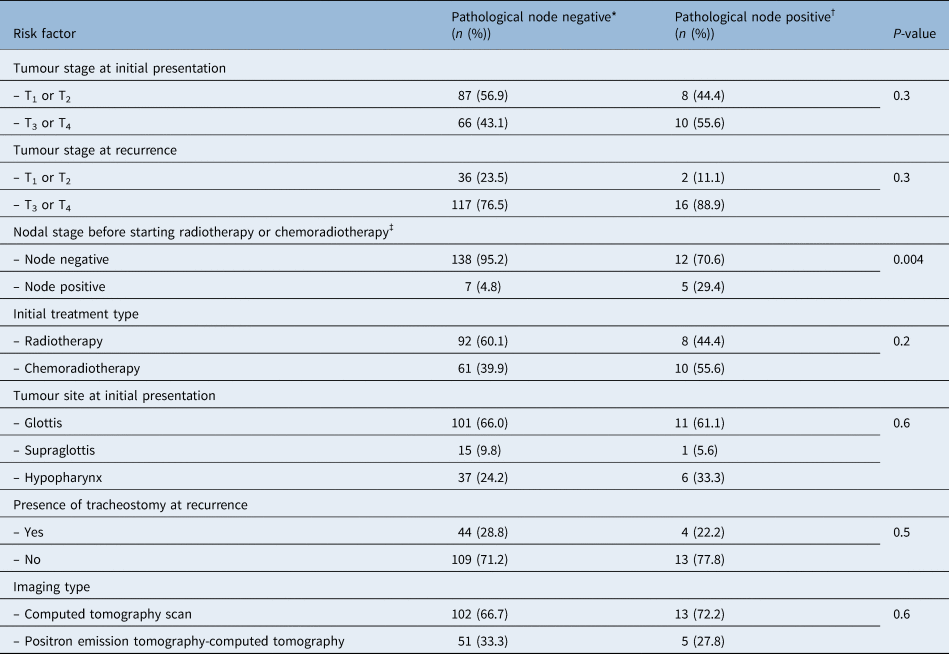
The incidence of nodal metastatic disease was highest for hypopharyngeal lesions (6 of 43; 13.9 per cent) followed by glottic lesions with transglottic spread (11 of 112; 9.8 per cent) and supraglottic lesions (1 of 16; 6.3 per cent); however, this difference was not statistically significant (p = 0.6). Early T-stage at recurrence (T1 or T2) had lower incidence of occult metastasis when compared with advanced T-stage at recurrence (T3 or T4), with 5.2 per cent versus 12 per cent, respectively, although this difference was not statistically significant (p = 0.3).
We had 12 patients who were node positive at initial treatment (RT or chemo-RT). On comparing the occult node positivity rate in these 12 patients with remaining patients who were N0 at the start of initial treatment, we found that the incidence of occult node positivity was significantly higher in these 12 patients (42 per cent versus 8 per cent, respectively; p = 0.004). This difference was significant on both univariable and multivariable analysis.
We analysed the following factors to predict occult node positivity: age, tumour stage before definitive treatment (RT or chemo-RT) and at recurrence, nodal status before initial treatment, tumour site, type of treatment received (RT versus chemo-radiation), time to recurrence, imaging type, and the presence of tracheostomy at salvage laryngectomy (Table 3). All these factors were analysed by cox regression analysis as covariates. Of these, node-positive disease prior to definitive treatment was the only significant factor for occult metastasis on univariable (p = 0.004) and multivariable analysis (p = 0.001).
Factors predicting occult nodal metastasis (univariable analysis)

*n = 153; †n = 18; ‡data missing in nine patients
Accuracy of imaging
A total of 115 patients (67.3 per cent) were imaged using contrast-enhanced CT, and 56 patients (32.7 per cent) underwent PET-CT. The negative predictive value of PET-CT and contrast-enhanced CT in detecting occult neck metastasis was 91 per cent and 88.7 per cent, respectively.
Post-operative complications
A total of 84 patients (49.1 per cent) had complications. The most common complication was pharyngocutaneous fistula which was present in 74 patients (43.3 per cent). The majority of the patients had minor fistula which healed with conservative management. Fourteen patients (8.2 per cent) required surgical intervention to close the fistula.
Recurrence and survival
Forty patients (23.3 per cent) developed recurrence, and 6 patients (3.5 per cent) had second primaries over a median follow up of 24 months. Twenty-one patients (12.3 per cent) developed isolated local recurrences. Three patients (1.7 per cent) developed isolated regional failure. Two patients (1.2 per cent) experienced simultaneous loco-regional relapse. Fourteen patients (8.1 per cent) had metastatic disease either alone or along with local or regional recurrences or both.
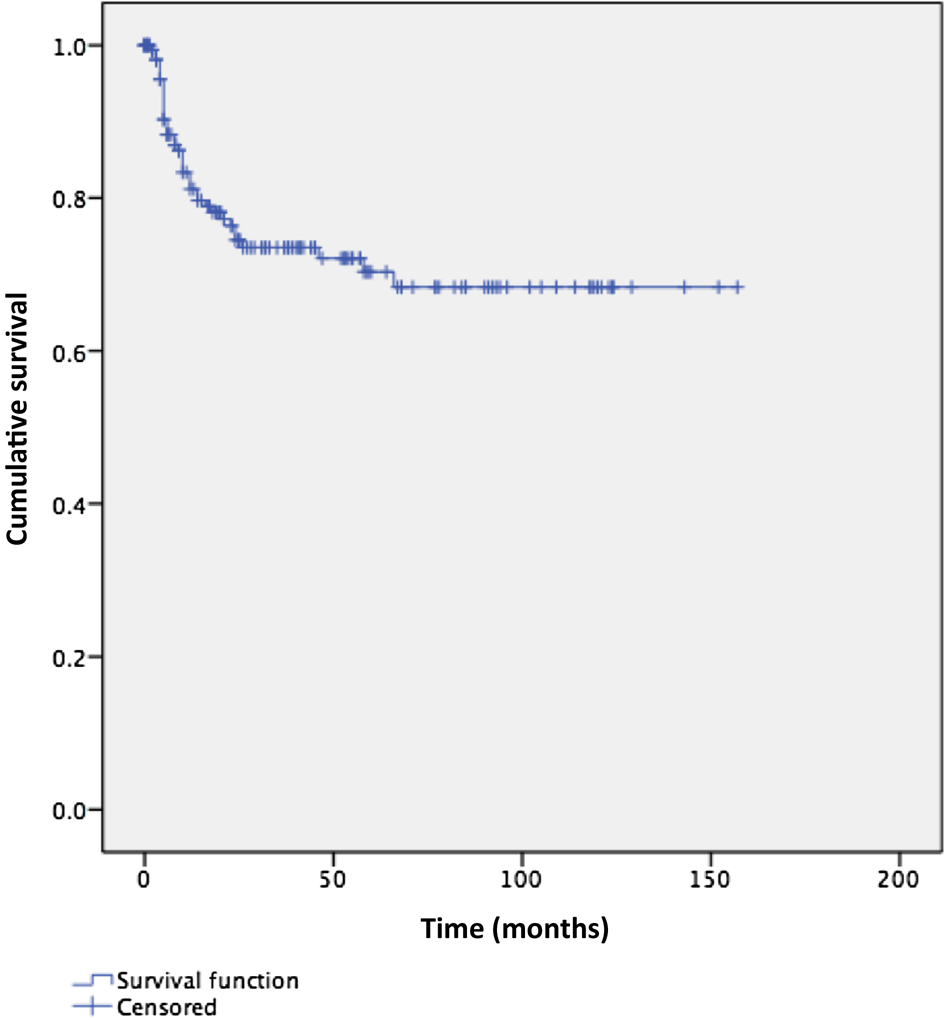
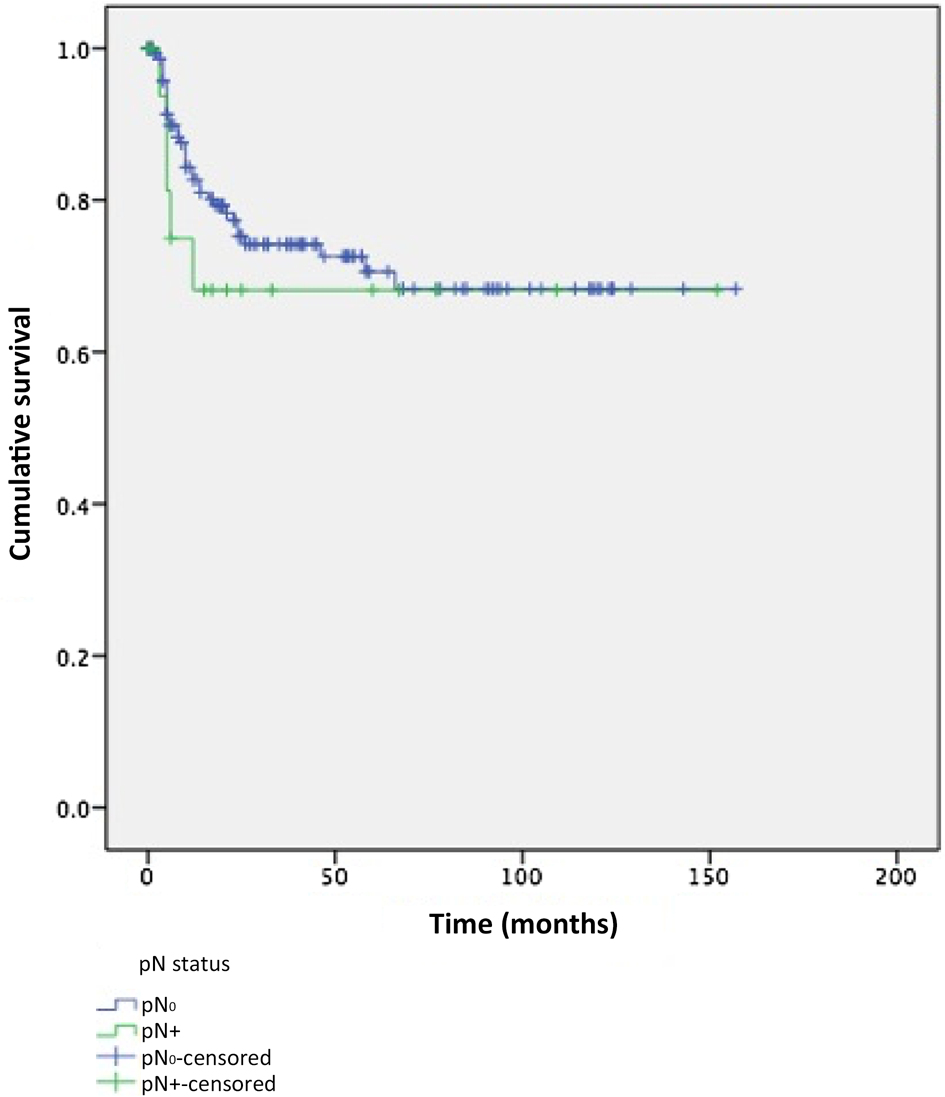
Seventy per cent of patients were recurrence free at the end of five years (Figure 1). We compared recurrence-free survival in patients who had occult neck positive disease on histopathology versus those who did not. There was no difference in the recurrence-free survival rate at 5 years between the 2 groups (70.6 per cent versus 68.2 per cent, respectively; log rank test p = 0.5; Figure 2).
Kaplan–Meier curve showing recurrence-free survival for the study cohort.

Kaplan–Meier curve for recurrence-free survival comparing neck dissection with pathological node positive versus pathological node negative patients. Five-year survival was 70.6 per cent and 68.2 per cent for pathological node positive and pathological node negative patients, respectively. Log rank test: p = 0.5. pN = pathological node; pN0 = pathological node negative; pN+ = pathological node positive

Discussion
The role of elective neck dissection at salvage laryngectomy for recurrent laryngeal cancer remains controversial. Salvage laryngectomy itself is a technically challenging procedure and is associated with increased post-operative complications, with the incidence varying between 5 per cent and 92 per cent in literature.Reference Sassler, Esclamado and Wolf16–Reference Sewnaik, Keereweer, Al-Mamgani, Baatenburg de Jong, Wieringa and Meeuwis18
Concurrent neck dissection has been shown to increase the risk of post-operative complications in salvage settings.Reference Virtaniemi, Kumpulainen, Hirvikoski, Johansson and Kosma8–Reference Natvig, Boysen and Tausjo10 A meta-analysis of factors affecting pharyngocutaneous fistula by Paydarfar and Birkmeyer demonstrated that neck dissection in salvage settings increases the risk of pharyngocutaneous fistula.Reference Paydarfar and Birkmeyer11 As per a Radiation Therapy Oncology Group analysis, neck dissection following RT increases the risk of both acute and late toxicity.Reference Machtay, Moughan, Trotti, Garden, Weber and Cooper19 This raises the concern about the safety of elective neck dissection in a salvage setting. Few studies have addressed this issue, and there have been conflicting results. The actual benefit of performing this procedure can only be shown after factoring in the rate of occult positivity, post-operative morbidity and regional failure.Reference Wax and Touma4
The incidence of occult metastasis following salvage laryngectomy varies from 3 per cent to 28 per cent.Reference Wax and Touma4–Reference Pezier, Nixon, Scotton, oshi, Guerrero-Urbano and Oakley7,Reference Farrag, Lin, Cummings, Koch, Flint and Califano20–Reference Yao, Roebuck, Holsinger and Myers23 In our study, it was 10.6 per cent. This wide variation in occult positivity rate results from variability in characteristics of the study population, such as patients recruited at different time periods, differences in treatment protocols, variations in the stage of the disease, initial node positivity, site of involvement, type of imaging method used and so on. Koss et al. reported the highest rate of occult positivity to the extent of 28.3 per cent.Reference Koss, Russell, Leem, Schiff and Smith21 In their study, N0 status was determined mainly by clinical examination, and imaging was used when available. Additionally, they reported the occult metastasis rate in lateral and paratracheal basins. These factors probably resulted in higher neck positivity.
In our study, all patients were clinico-radiologically node negative as assessed by either CT scan or PET-CT scan, and we analysed occult metastasis rate in lateral neck alone. We routinely dissect paratracheal lymph node basins as laryngeal cancers may have central node positivity. These stringent criteria could have resulted in a low occult metastasis rate in our study. Studies which have used imaging methods such as CT scan to determine N0 status have found a lower incidence of occult metastasis as was the case in our study.Reference Basheeth, O'Leary and Sheahan6,Reference Farrag, Lin, Cummings, Koch, Flint and Califano20 This is probably because of greater accuracy of CT scan in determining neck node status as compared with clinical examination alone. CT scans have a high negative predictive valve (94 per cent to 97 per cent) in detecting occult nodal metastasis in salvage settings.Reference Farrag, Lin, Cummings, Koch, Flint and Califano20,Reference Ojiri, Mendenhall, Stringer, Johnson and Mancuso24 Recently PET-CT has become the standard of care in planning neck dissection following chemo-RT in patients with advanced nodal disease.Reference Mehanna, Wong, McConkey, Rahman, Robinson and Hartley25 In our study, the negative predictive value of PET-CT was 91 per cent and for CT scan was 88 per cent. Based on our results, we hypothesise that PET-CT is a useful imaging tool to plan neck dissection in salvage laryngectomy settings.
On analysing the factors predicting occult metastasis, we found that patients who had positive lymph node status before initiating definitive treatment (RT or chemo-RT) had microscopic disease in 42 per cent of cases. If we eliminate this group (i.e. cases who were node positive before starting RT) and study the occult metastasis rate in patients who were node negative at the time of RT, then incidence of occult metastasis is further reduced to 8 per cent. This is an important observation that may be helpful in selecting cases for elective neck dissection at the time of salvage laryngectomy. The same observation has been reported by Amit et al.Reference Amit, Hilly, Leider-Trejo, Popovtzer, Gutfeld and Shvero5
There is less clarity regarding unilateral versus bilateral neck dissection during salvage laryngectomy. Yao et al. recommended bilateral neck dissection, based on two patients who had contralateral or bilateral pathological disease.Reference Yao, Roebuck, Holsinger and Myers23 It must be kept in mind that the type of imaging that was used for these patients was not specified. Wax and Touma recommended ipsilateral dissection for glottis cancers and bilateral neck dissection for supraglottic cancers in view of a 15 per cent bilateral neck metastasis rate.Reference Wax and Touma4 A recent meta-analysis by Lin et al. tried to find out whether unilateral neck dissection was as efficacious as bilateral neck dissection but did not reach any consensus due to lack of data in this regard.Reference Lin, Puram, Bulbul, Sethi, Rocco and Old26 Neck dissection, particularly bilateral neck dissection, is considered a risk factor for post-operative complications.Reference Basheeth, O'Leary and Sheahan6,Reference Paydarfar and Birkmeyer11,Reference Deganello, Meccariello, Bini, Paiar, Santoro and Mannelli27 The majority of patients (94.7 per cent) in our study had bilateral neck dissection, which could be a reason for the high incidence of pharyngocutaneous fistula (41.3 per cent). This is in accordance with literature where patients undergoing neck dissection had high post-operative complications when compared with patients who did not undergo neck dissection.Reference Basheeth, O'Leary and Sheahan6,Reference Deganello, Meccariello, Bini, Paiar, Santoro and Mannelli27,Reference Bohannon, Desmond, Clemons, Magnuson, Carroll and Rosenthal28 In our study, only one patient had bilateral neck disease. Others have also found either no or very low rates of contralateral node positivity.Reference Amit, Hilly, Leider-Trejo, Popovtzer, Gutfeld and Shvero5,Reference Basheeth, O'Leary and Sheahan6,Reference Farrag, Lin, Cummings, Koch, Flint and Califano20,Reference Bohannon, Desmond, Clemons, Magnuson, Carroll and Rosenthal28 In view of a bilateral metastatic rate of 0.5 per cent, we do not recommend bilateral neck dissection unless the tumour grossly involves both sides of the larynx.
Some authors have found advanced stage to be an important determinant for neck dissection and have recommended neck dissection in this group.Reference Wax and Touma4,Reference Yao, Roebuck, Holsinger and Myers23,Reference Hilly, Gil, Goldhaber, Amit, Biadsee and Popovtzer29 We did not find stage as a determinant for positive occult metastasis rate.
The proponents of elective neck dissection argue that the procedure eliminates occult metastasis and the resulting regional failure.Reference Wax and Touma4 Hilly et al. devised a decision analysis model to determine the need for elective neck dissection following salvage laryngectomy.Reference Hilly, Stern, Horowitz, Leshno and Feinmesser30 Based on their model, they recommended neck dissection only when the isolated regional recurrence rate exceeds 20 per cent. However, the isolated regional failure rate following salvage laryngectomy varies from 0–8 per cent and is much lower than the rate of observed occult metastasis.Reference Wax and Touma4,Reference Farrag, Lin, Cummings, Koch, Flint and Califano20,Reference Hilly, Gil, Goldhaber, Amit, Biadsee and Popovtzer29
Local recurrence remains the most common type of relapse following salvage laryngectomy. In a study by Deganello et al., the incidence of local recurrence was 31 per cent, and only 2.8 per cent of patients had regional relapse.Reference Deganello, Meccariello, Bini, Paiar, Santoro and Mannelli27 As per the existing literature, the regional failure rate in the dissected neck is either the same or worse than in the non-dissected neck. Elective neck dissection during salvage laryngectomy is not effective in reducing the rate of regional relapse.Reference Basheeth, O'Leary and Sheahan6,Reference Deganello, Meccariello, Bini, Paiar, Santoro and Mannelli27–Reference Hilly, Gil, Goldhaber, Amit, Biadsee and Popovtzer29
• Management of the node negative neck during salvage laryngectomy is debatable
• Neck dissection in salvage settings increases the risk of complications
• Incidence of occult metastasis following salvage laryngectomy is low
• Patients who are node negative at initial treatment and remain clinico-radiologically node negative at salvage laryngectomy can be observed
• Patients who are node positive before radiotherapy should be offered elective neck dissection even if they are node negative at the time of salvage laryngectomy
• Unilateral neck dissection is adequate unless the tumour grossly involves both sides
The majority of the studies have found no survival advantage with the addition of elective neck dissection in salvage laryngectomy.Reference Koss, Russell, Leem, Schiff and Smith21,Reference Yao, Roebuck, Holsinger and Myers23,Reference Bohannon, Desmond, Clemons, Magnuson, Carroll and Rosenthal28 Some have even reported poorer outcomes following elective neck dissection. In a large study by Li et al., the wait and watch group had better overall survival than the patients who received any kind of treatment to the neck, confirming the safety of the wait and watch approach.Reference Li, Hu and Jin31 We compared the outcomes between pathological node positive and pathological node negative patients. Presence of occult metastasis was not associated with inferior survival outcome in our study. Pezier et al. have reported similar findings.Reference Pezier, Nixon, Scotton, oshi, Guerrero-Urbano and Oakley7
The limitation of our study is that it is retrospective in nature. Since the policy of our institution is to do bilateral neck dissection, we did not have a comparative group where neck dissection was not performed. However, it overcomes many limitations mentioned in a recent systemic review.Reference Gross, Vila, Simon, Rizvi, Zenga and Jackson12 Our study is a single institution study with a large number of patients, with robust data collection. Unlike many studies, all patients underwent either CT or PET-CT before being labelled as node negative. We investigated the role of several factors in predicting occult metastasis, which was not possible in a recently published systemic review and meta-analysis due to inclusion of studies with small patient numbers with considerable heterogeneity.Reference Gross, Vila, Simon, Rizvi, Zenga and Jackson12
Conclusion
Patients who are clinico-radiologically node negative at the time of salvage laryngectomy have a low rate of occult metastasis. Risk of occult metastasis is high in patients who have node positive disease before starting RT. This group should be offered elective neck dissection. Unilateral neck dissection is adequate unless there is gross bilateral disease. With the use of excellent modern imaging modalities like PET-CT, it is possible to identify patients who are at low risk of harbouring occult neck node metastasis. Morbidity of neck dissection can be avoided in a select group of patients who are node negative before starting the RT or chemo-RT and remain node negative at the time of salvage laryngectomy. Our study is a useful addition to the existing literature to provide insight into the management of the neck during salvage laryngectomy.
Competing interests
None declared