1 Introduction
Natural Language Generation (NLG) systems across domains typically face an uncertainty with respect to the best utterance to generate in a given context. This is particularly true in interactive scenarios that involve constant verbal or non-verbal feedback from a human user. The reason is that utterances can have different effects depending on the physical circumstances, addressee and interaction history of the context in which they occur. This paper presents a hierarchical optimisation approach for situated NLG.
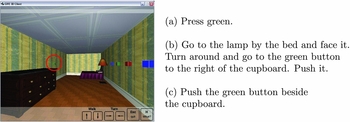
Situated NLG can be defined as generation in an enriched physical context, including features of a (real or virtual) environment, such as landmarks and users. The context in this setting is typically not static but undergoes dynamic changes triggered by linguistic or non-linguistic actions by the system or the user. Often, as in our case, situated NLG also deals with an additional element of interactivity in that the user can immediately react to the system's instructions through linguistic or non-linguistic actions. Figure 1 shows an example of the type of generation scenario we will address in this paper. It shows a spatial situation (from the perspective of the user) and a set of possible instructions which differ with respect to their level of granularity in identifying the (circled) referent button. A trade-off in situated NLG is often between generating efficient instructions and detailed instructions. Since the user is constantly moving through a virtual world, instructions need to contain just the right amount of information so that the user's cognitive load remains low and they do not get lost. In the figure, only instruction (c) seems to balance this trade-off appropriately. Instruction (a) is ambiguous and instruction (b) is complete, but long and difficult to memorise for a user on the move.
Generation example in the GIVE domain (Byron et al. Reference Byron, Koller, Striegnitz, Cassell, Dale, Moore and Oberlander2009), where some instructions are more felicitous than others. The intended referent button is circled.

While different techniques are conceivable to address this efficiency versus detail trade-off, we will present an optimisation framework that is based on hierarchical reinforcement learning (RL) and optimises its decision-making over time through a trial and error search. To this end, we design a hierarchy of learning agents, each of them representing a specific generation subtask. A hierarchical policy is then trained from interaction with a simulated environment which was trained from a corpus of human–human interactions. We argue that by using RL, an NLG agent is able to try a multitude of generation strategies under different circumstances and discover the optimal one automatically.
The hierarchical setup offers the additional benefit of a divide-and-conquer approach. This provides a modular and easy-to-maintain architecture, makes learning faster and our technique more scalable than flat RL setups due to the reduced policy search space. A possible disadvantage of using a modular architecture is that knowledge variables are specific to a particular generation subtask, such as referring expression (RE) generation or navigation. This automatically assumes an independence among subtasks which may not necessarily hold in practice. We therefore compare two different versions of a hierarchical reinforcement learner in this paper: one that shares task-based knowledge across generation subtasks, using a joint optimisation, and another that does not, using an isolated optimisation. Shared knowledge is predefined by the system designer. Our hypothesis is that by sharing knowledge the learning agent becomes more aware of the global effects of its actions rather than being confined to the local context of a particular subtask. By trying alternative sequences of decisions and observing the user's reactions, the system is then able to predict their effects on the utterance as a whole.
The paper is organised as follows. In Section 2, we review related work in three areas: (i) The application of RL to NLG, (ii) the sharing of knowledge across subtasks and (iii) the state of the art in situated NLG. Section 3 will then introduce the Generating Instructions in Virtual Environments (GIVE) task, the situated scenario we are addressing in this paper. Subsequently, Section 4 will give an overview of flat and hierarchical RL and discuss its application to situated NLG. We will present the learning agent's training setting in Section 5, followed by an evaluation in Section 6. The evaluation consists of two parts: (a) A simulation-based evaluation; and (b) a task-based evaluation comparing joint and isolated policy learning for hierarchical RL. It also makes a comparison with other state-of-the-art approaches to situated NLG. Finally, Section 7 will draw conclusions and discuss directions for future research.
2 Related work
In this section we will review previous research on applying RL to optimising sequences of NLG decisions and its relation to planning approaches. Further, we will discuss the sharing of knowledge across application subtasks and the state of the art in situated NLG. For each strand of work, we highlight commonalities and differences with our proposed approach.
2.1 Reinforcement learning for NLG in interactive systems
Reinforcement learning has become a popular method for optimising dialogue management decisions for flat (Singh et al. Reference Singh, Litman, Kearns and Walker2002) and hierarchical decision problems (Cuayáhuitl et al. Reference Cuayáhuitl, Renals, Lemon and Shimodaira2010). It has been appreciated especially for its ability of automatic optimisation, discovery of fine-grained behaviour from human data and adaptability under uncertain circumstances (Williams and Young Reference Williams and Young2007).
The NLG community has successfully adopted RL rather recently and with a specific focus on optimising generation for interactive systems (Lemon Reference Lemon2011). Rieser, Lemon and Liu (Reference Rieser, Lemon and Liu2010) apply RL to information presentation in a spoken dialogue system that gives restaurant recommendations to users. A particular focus is on whether database hits should be summarised for the user, contrasted given the user's preferences or whether a single recommendation should be given. An optimal action policy here depends on both the user's preferences and the number of database hits. Similarly, Janarthanam and Lemon (Reference Janarthanam and Lemon2010) use RL to optimise NLG in troubleshooting dialogues where users are assisted in setting up a broadband connection. A special focus of this work is the fact that the user learns new jargon during the interaction with the system so that the learnt policy needs to be sensitive to a dynamic user model.
Reinforcement learning has also been applied to other natural language processing tasks (Branavan et al. Reference Branavan, Chen, Zettlemoyer and Barzilay2009), which often use task completion as the primary component of their reward function and therefore require less or no simulation. In contrast, RL applications in dialogue or generation typically need to be trained in interaction with human users, which makes training more expensive. Even though simulated environments can be used, they often rely on linguistic or pragmatic features which may require annotation, depending on the domain. One possible solution to mitigate this problem has been to use Wizard-of-Oz data collections (Rieser and Lemon Reference Rieser and Lemon2008), which automatically log wizard actions and therefore can be used to bootstrap simulated environments from small data sets.
Research on RL for NLG is in several ways related to planning. In particular, it is often seen as a possible solution to Artificial Intelligence (AI) planning in which well-studied algorithms are used for finding action strategies for NLG tasks from a predefined set of knowledge and constraints. Please see Koller and Petrick (Reference Koller and Petrick2011) for a recent survey of planning approaches to NLG. In contrast to other approaches, RL is particularly suited for tasks in which we are unsure of the best strategy to achieve a goal and wish the system to find an optimal policy automatically from interactions with the environment and the user.
This paper follows the general direction of the RL research discussed above by representing situated NLG as a sequential decision-making problem that can be solved using trial and error search in an interactive context. In contrast to previous work, however, which has relied predominantly on flat RL, we formulate our NLG task as a hierarchical optimisation problem. This is often more scalable than flat RL settings and can be applied to larger search spaces, such as more complex generation scenarios than those that can be addressed using a flat RL setup.
2.2 Sharing knowledge across subtasks
A number of recent studies have presented evidence in favour of a joint treatment of subtasks by sharing knowledge among them. Angeli, Liang and Klein (Reference Angeli, Liang and Klein2010) present a robust domain-independent NLG system that employs a joint treatment of content selection and surface realisation (SR). In their approach, each generation decision is handled by a log-linear classifier that has access to all previous decisions and achieves better accuracy and human ratings than a system whose information is restricted to the local context. Lemon (Reference Lemon2011) presents a joint optimisation approach to NLG and dialogue management in the area of information presentation. He shows that using RL for the optimisation, a jointly optimised policy can learn when it is most advantageous to present information to the user or when to ask for more details to refine the query. In Cuayáhuitl and Dethlefs (Reference Cuayáhuitl and Dethlefs2011b), we present a hierarchical RL approach to spatially aware dialogue management by optimising it jointly with route planning in a wayfinding domain. We show that the spatially aware system – optimised jointly – generates the shortest possible route by adapting to individual users’ prior knowledge by guiding them past landmarks they are familiar with and avoiding junctions that cause confusion.
In addition to the studies discussed above, there have been suggestions for a joint treatment of syntax and semantics/discourse (Stone and Webber Reference Stone and Webber1998; Marciniak and Strube Reference Marciniak and Strube2004Reference Marciniak and Strube2005) of NLG and speech synthesis (Bulyko and Ostendorf Reference Bulyko and Ostendorf2002; Nakatsu and White Reference Nakatsu and White2006), speech and gestures (Stone et al. Reference Stone, DeCarlo, Oh, Rodriguez, Stere, Lees and Bregler2004) and content planning and realisation (Bontcheva and Wilks Reference Bontcheva and Wilks2001). All of them have demonstrated that a joint treatment of interrelated tasks can significantly outperform its isolated counterpart. All of the joint architectures discussed above (Angeli et al. Reference Angeli, Liang and Klein2010; Lemon Reference Lemon2011; Cuayáhuitl and Dethlefs Reference Cuayáhuitl and Dethlefs2011b) work essentially by making additional knowledge available to the components involved. Typically, this is knowledge that has traditionally been specific to one module of the system and is now shared between two or more modules in order to achieve a joint knowledge base on which to base decisions. These joint architectures have deliberately not attempted to share their full knowledge base, which would be computationally expensive. Instead, they have shared small parts of knowledge which were discovered from domain data or which the system designer expected to positively affect performance. In this way, they are computationally scalable and do not sacrifice the benefits of a modularised architecture.
A further approach to considering NLG decisions interdependently are systems like SPaRKy (Walker et al. Reference Walker, Stent, Mairesse and Prasad2007). Here sentence generation takes an overgeneration and ranking approach. In the first step, a randomised set of alternative sentence plans are generated. In the second step, these are ranked according to a boosting score that predicts user ratings of the outputs. Joint decision-making is possible in that an n-best list of alternatives is passed between modules, which can each be considered in the next module.
Here we will follow the direction of sharing knowledge across generation subtasks so as to provide a richer context for decision-making to our learning agent. In this way, the full utterance context can be considered rather than local context alone.
2.3 Situated NLG
Related work on situated NLG has explored a range of different methods. Denis (Reference Denis2010) presents a rule-based approach to GIVE which works by systematically eliminating distractor buttons until a unique reference to a target object is possible. To achieve this, he makes use of the fact that referring expressions are not only determined by context but also modify it. Benotti and Denis (Reference Benotti and Denis2011b) present an approach to GIVE based on corpus-based selection, which maps situations in the GIVE environment directly to human descriptions. This technique works with few or no annotations and therefore greatly reduces development costs. Also training from unannotated data, Chen, Kim and Mooney (Reference Chen, Kim and Mooney2010) present a system that learns to interpret and generate language based on pairs of action sequences and textual descriptions of RoboCup games. A particular challenge is that the action sequences are ambiguous in that not every action is described in the corresponding text. The authors’ best performing system in terms of surface realisation was optimised for precision by comparing generated system output against human-authored text. For content selection, the authors train their generator using a variant of the expectation-maximization (EM) algorithm to estimate the events that are worth including in a textual description.
Using supervised learning for situated generation, Stoia et al. (Reference Stoia, Shockley, Byron and Fosler-Lussier2006) use decision trees to learn content selection rules for noun phrases in a situated generation setting. Similarly, Dale and Viethen (Reference Dale and Viethen2009) and Viethen, Dale and Guhe (Reference Viethen, Dale and Guhe2011) use decision trees to learn content selection rules for referring expressions in spatial settings. Garoufi and Koller (Reference Garoufi and Koller2011a) use a planning approach to make a first set of content selection decisions and then apply a maximum entropy model to resolve the remaining nondeterminacy with respect to surface realisation. All of these approaches have demonstrated that supervised learning is attractive for learning behaviour from a labelled corpus, discovering interdependencies between choices and performing decision-making based on human behaviour. In contrast, based on the principle of assigning delayed rewards for a sequence of actions, RL is typically well suited for optimising sequential decision-making problems such as situated interaction. An example application is an NLG system that needs to generate an effective and coherent sequence of instructions. This principle is discussed in detail in Section 4.
3 Situated NLG in the GIVE environment
Generation in situated settings typically requires the NLG system to adapt to changing circumstances in its physical environment, such as new objects and spatial configurations. In addition, we assume interaction with a constantly moving user so that the system needs to monitor their progress and keep them on track.
3.1 Generating Instructions in Virtual Environments (GIVE)
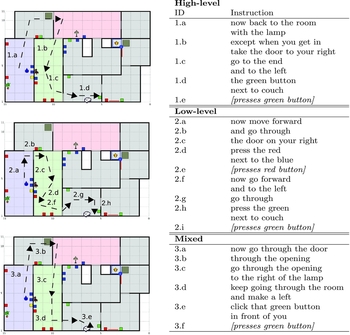
The GIVE task involves two participants, one instruction giver and another instruction follower, who engage in a ‘treasure hunt’ through a set of virtual worlds. The task can be won by finding and unlocking a safe and obtaining a trophy from it. It can be lost by stepping onto one of a number of red tiles and activating an alarm. To solve the task, the instruction giver has to guide the instruction follower in navigating through a world, and pressing a particular sequence of buttons. The sequence of buttons corresponds to a code that will, if pressed in the correct order, unlock the safe and release the trophy. There are also a number of distractor buttons present, though, which either have no effect or trigger an alarm. In the original GIVE task (Byron et al. Reference Byron, Koller, Striegnitz, Cassell, Dale, Moore and Oberlander2009; Koller et al. Reference Koller, Striegnitz, Byron, Cassell, Dale, Moore, Theune and Krahmer2010), the role of the instruction giver is taken by an NLG system of the kind that we will develop in the remainder of this paper. The NLG system's action set includes navigation instructions such as moving to the left/right, going straight or leaving the room. The system also generates referring expressions, which need to be accurate in order to distinguish intended referents from their distractors. To do this, the virtual worlds also contain a set of landmarks, such as plants or furniture, which can be used as points of reference. The instruction follower, or user, is restricted to a number of non-verbal actions. They can either move to the front, left, right or back, or press a button. They can, in addition, ask for help by pressing a help button or cancel the game by pressing escape. Note that even though the user's actions are confined to non-verbal behaviour, the task still resembles a dialogue setting in that the user is able to react to any instruction that the system produces. Figure 3 shows excerpts from three interactions between two humans during the GIVE task.
3.1.1 The GIVE-2 corpus
The GIVE-2 corpus (Gargett et al. Reference Gargett, Garoufi, Koller and Striegnitz2010) is a collection of (sixty-three English and forty-five German) human–human dialogues on the GIVE task that was collected in a Wizard-of-Oz study to shed light on the strategies that human instruction givers employ when giving navigation instructions and referring expressions to their interlocutors. Participants in this scenario played three games in three different virtual worlds. After the first game, they switched roles for the last two games.
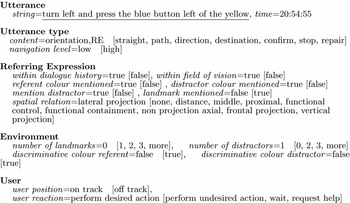
To facilitate the automatic analysis of the GIVE corpus dialogues and to provide our learning agent with information about the target domain, we annotated the English set of dialogues according to the annotation scheme shown with an example annotation in Figure 2. The annotationsFootnote 1 concern the following four areas: (1) the utterance itself and its type, (2) the semantic choices of a referring expression, where the set of spatial relations is taken from Bateman et al. (Reference Bateman, Hois, Ross and Tenbrink2010), (3) the spatial environment, i.e. the situational setting in which an instruction is produced and (4) the user's reaction to an instruction. The user reaction feature is key and will play an important role in training the learning agent in Section 5.2.
Sample annotation for a navigation instruction followed by a referring expression. Alternative annotation values are given in square brackets behind the actual values. This set of (possible) annotations defines our annotation scheme for the GIVE-2 corpus.

3.1.2 Instruction types in the human data
As an example of the task our NLG system faces, consider the instruction sequences of the GIVE corpus in Figure 3. All of these examples refer to the same situation, but instruction givers still employ a range of fundamentally different instruction giving strategies. Instructions differ in length, abstraction and semantic choices. We group them here into three types. Each type is characterised by a number of qualitative features discussed in the following.
Examples of instructions that can be categorised as high-level, low-level and mixed instructions (all describing the same situation) taken from the GIVE corpus. The arrows on the maps on the left show the route segment that is described in each instruction. The instruction follower's initial position is indicated by the person in the lower-left room.

The first instruction sequence guides the user by a high-level navigation strategy. It makes explicit reference to the dialogue history and to locations that the instruction follower has visited previously and is expected to remember (including how to get there). This strategy makes use of the structure of the environment by referring to doors, paths and rooms.
The second instruction sequence, in contrast, relies exclusively on guiding the instruction follower by low-level navigation. Every required action is explicitly verbalised and there is no reference to the environmental structure or dialogue history. High-level instructions represent contractions of low-level instructions.
The third instruction sequence, finally, lies in between the two extremes. While it takes advantage of the environmental structure and visual information, there are no references to the dialogue history. We call this mode of instruction giving mixed.
To design an NLG system that can solve the GIVE task, we will be concerned mainly with the generation of the following six instruction types:
• Destination Instructions aim to guide a user to their next subgoal in the virtual world, mainly by specifying the goal, rather than the way to the destination. An example is Head back to the room with the plant.
• Direction Instructions indicate changes of direction to the user, such as Turn left at the door.
• Orientation Instructions instruct the user to change their orientation. An example is Turn 180 degrees left.
• Path Instructions serve to guide the user along a certain path, as in Follow the corridor until you reach a door.
• Instructions to go straight aim to guide the user to go straight. An example is Keep going straight.
• Referring Expressions are instructions to press a particular button, for example, Push the red button to the left of the yellow.
The hierarchy of learning agents will make decisions at different levels of granularity to contribute to the generation of these six instruction types. While the agent's knowledge is partially informed by the annotations of the GIVE corpus, it is also informed by linguistic knowledge that was obtained through manual analysis of the domain. Note however that the route plan is provided by the GIVE client,Footnote 2 which informs the NLG system about the next (sub-)goal and about how to get there. It also provides information about the user's location, spatial objects and visibility. In the end, though, the learning agent has to decide how much detail to provide to the user and whether to realise route plans step by step or all at once.
4 A hierarchical optimisation approach for language generation
A central characteristic of RL-based approaches is that they typically specify abstract system goals, such as help the user set up the broadband connection without using words they do not understand and without unnecessary descriptions (Janarthanam and Lemon Reference Janarthanam and Lemon2010), or help the user find a restaurant they like without presenting every possible option to them, but still give them a good overview of the choices (Rieser et al. Reference Rieser, Lemon and Liu2010). The system is always just told what to achieve, but not how to achieve it. It is then the learning agent's objective to try different strategies and discover the best. For our situated NLG task, we could say that we wish the agent to guide the user to the nearest navigation (sub-)goal, e.g. the next button to press so that they get there as quickly as possible and obtain the trophy with as few problems and confusions as possible.
4.1 Reinforcement learning
The goal of an RL agent is to map situations to actions in a goal-directed manner so as to maximise a long-term, numeric reward signal. The computational model underlying RL agents is the Markov Decision Process, or MDP (Sutton and Barto Reference Sutton and Barto1998). A standard MDP can be defined formally as a four-tuple 〈S, A, T, R〉.
• S = {s 0, s 1, s 2, . . ., sN} is a set of states that summarise all information, present and past, that the agent needs in order to behave in its world of situations. It includes, for example, the status of the environment, such as present objects and buttons, the user's state of confusion or the next navigation action to execute. States must allow the agent to monitor its progress in the learning task at any time and observe the effects of its actions. Thus, whenever the agent takes an action a in state s at time step t, the updated state s t + 1 = s′ (at time step t + 1) should represent the action's effect on the environment. In this way, the agent is able to learn from its experience.
• A = {a 0, a 1, a 2, . . ., aM} is the set of actions available to the agent. It defines the agent's behavioural potential and forms the basis for decision-making and the principle of learning from trial and error. Example actions include generating instructions such as turn left, mentioning the colour of a referent or telling the user to stop.
• T is a probabilistic state transition function indicating the next state s′ from the current state s and the action a. It represents the way in which an action changes the current state of the world. T is represented by a conditional probability distribution P(s′|s, a) satisfying ∑s′ ∈ SP(s′|s, a) = 1, ∀(s, a). For example, if the user has to press a particular button, this will be represented with probability p for the state transition to the state with the right button pressed, and probability 1 − p for transitioning to a different state due to a wrong action (such as a wrong button pressed).
• R is a reward function R(s′|s, a) specifying a numeric reward that an agent receives for taking action a in state s. Rewards allow the agent to evaluate its decision-making process. The reward at time t + 1 is also denoted by r′. Rewards provide the primary feedback mechanism for the agent.
The dynamics of an MDP can be described as follows. At the beginning of an interaction between the agent and the environment, when the time step t = 0, the agent receives a representation of the current situation, called the state st ∈ S. It needs to perform an action at ∈ A. As a result, the agent will receive a reward r t + 1 ∈ R and observe the next state s t + 1 ∈ S, which is the updated environment state. This process can be seen as a finite sequence of states, actions and rewards {s 0, a 0, r 1, s 1, a 1, . . ., r t − 1, st}. Any mapping from states to actions is called a policy. Ultimately, the agent's goal is to learn an optimal policy denoted by π*, a mapping from every state s to an action a that will yield the highest expected return. An optimal policy can be found according to
 \begin{equation}
{\pi ^*} (s) = \arg \max _{a \in A} {Q^*} (s,a)
\end{equation}
4.2 Hierarchical reinforcement learning
Reinforcement learning systems with large state spaces are affected by a problem referred to as the curse of dimensionality, the fact that state spaces grow exponentially with the number of state variables they take into account. When the state space grows too large, the agent will not be able to find an optimal policy for a task, which affects its practical application in large systems (such as many real-world systems or the one we are designing for GIVE). The best one can do in such situations is to provide an approximate solution, such as a divide-and-conquer approach to optimisation. For this we divide the generation task into several subtasks, which have smaller state spaces and can therefore find a solution more easily. In other words, we learn a hierarchy of policies for generation subtasks, rather than learning one single policy for the whole task. An alternative way of dealing with the curse of dimensionality is to use function approximation techniques (Henderson, Lemon, and Georgila Reference Henderson, Lemon and Georgila2005; Jurcícek, Thompson and Young Reference Jurcícek, Thompson and Young2011; Pietquin et al. Reference Pietquin, Geist, Chandramohan and Frezza-Buet2011), which are not guaranteed to converge to optimal policies, though.
Any flat learning agent that is characterised by a single MDP can be decomposed into a set of subtasks Mij, where i and j are indexes that uniquely identify each subtask in a hierarchy of subtasks such that  $\mathcal {M}= \lbrace M^0_0, M^1_0, M^1_1, M^1_2, \dots , M^X_Y \rbrace$. These indexes do not specify the order of execution of subtasks, because the order of execution is subject to learning. Each subtask, or agent in the hierarchy, is defined as a Semi-Markov Decision Process (or SMDP) Mij = 〈Sij, Aij, Tij, Rij〉, in which Sij = {s 0, s 1, s 2, . . ., sN} is a set of states of subtask Mij. Aij = {a 0, a 1, a 2, . . ., aM} is a set of actions of subtask Mij that can be either primitive or composite. Primitive actions are single-step actions as in an MDP and receive single rewards. Composite actions are temporally extended actions that correspond to other subtasks in the hierarchy and are children of the current, their parent, subtask, such as referring expression generation. Composite actions receive cumulative rewards.
The execution of a composite action, or subtask, takes a variable number of time steps τ to complete, which is characteristic of an SMDP model (and distinguishes it from an MDP). The parent SMDP of a subtask passes control down to its child subtask and then remains in its current state st until control is transferred back to it, i.e. until its child subtask has terminated execution. It then makes a transition to the next state s′. Tij is a probabilistic state transition function of subtask Mij, and Rij is a reward function Rij(s′, τ|s, a) for subtask Mij that specifies the reward that the agent receives for taking action a ∈ Aij (lasting τ time steps) and making a transition from state st to state s t + τ ∈ Sij. Discounted cumulative rewards of composite actions are computed according to r t + 1 + γr t + 2 + γ2r t + 3 + . . . + γτ − 1r t + τ, where γ is called the discount rate, a parameter which is 0 ≤ γ ≤ 1 and indicates the relevance of future rewards in relation to immediate rewards. As γ approaches 1, both immediate and future rewards will be increasingly equally valuable. The equation for optimal hierarchical action selection is
 \begin{equation}
{\pi ^*}_{j}^i (s) = \arg \max _{a \in A} {Q^*}_{j}^i (s,a),
\end{equation}
 \begin{equation}
NewEstimate \leftarrow OldEstimate + StepSize \left[ Target - OldEstimate \right]\!.
\end{equation}
 \begin{equation}
Q^i_j (s, a) \leftarrow Q^i_j (s, a) + \alpha \big [ r + \gamma ^\tau \max _{a^{\prime }} Q^i_j (s^{\prime }, a^{\prime }) - Q^i_j (s, a) \big ]
\end{equation}
5 Training and learning setting
Section 4 has provided an abstract description of hierarchical RL, which we will now apply to situated NLG. We will first design the state and action space for our hierarchical reinforcement learner for the GIVE task. This will be a linguistically informed knowledge engineering task. We will then define a simulated environment and reward function and train the hierarchical learner in a set of training navigation worlds.
5.1 The hierarchy of learning agents interacting with the environment
This section will provide details of the knowledge engineering involved in applying hierarchical RL to GIVE. We first explain how the learning agent interacts with its environment during training (and execution) and then define a hierarchy of learning agents specifically for GIVE.
5.1.1 Interaction with the environment
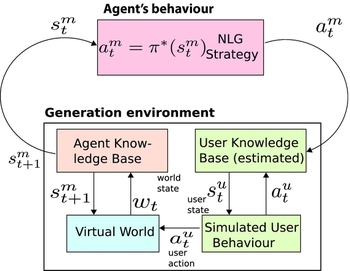
An illustration of the agent–environment interaction, as required during learning or execution of the learning agent, is shown in Figure 4. The agent's behaviour, represented by the upper box, is following a policy π*, which indicates the best action for a given state at time t, amt = π*(smt). Here m stands for machine. This action is passed to the generation environment, where its effects on the user and the virtual world are observed and represented in the updated state sm t + 1. Interaction with the generation environment is the main contributor to the agent's learning process. It contains three types of information: information concerning the knowledge base, the virtual world and the user. The agent's knowledge base contains all knowledge held by the agent about the virtual world, the user and the current generation state and history. From here, knowledge is also distributed to different learning agents and enters their state representation. The virtual world contains objects of the world, such as buttons and objects as well as the user's concrete position and angle in the world. During training, this knowledge is estimated from the simulated environment (see Section 5.2), during execution it is taken directly from the GIVE environment and planner.Footnote 3 Knowledge of the virtual world is passed to the agent's knowledge base as the world state wt so that it can be taken into account for action selection. In return, the current agent state smt is passed back to the virtual world so that it can be taken into account for updates to the world. The user's knowledge base contains all knowledge about the virtual world that the user has gained. For example, if the user has pressed a certain button or visited a particular room previously, we assume that the user is now familiar with these objects. Such user knowledge can only be estimated since we can never be certain about the user's knowledge. The simulated user behaviour is the agent's main way of learning about the user's current state, such as whether the user is confused or not, and to evaluate its own action policies. User behaviour is classified into four actions: perform desired action, perform undesired action, wait and request help. Since the user cannot communicate verbally in GIVE, this limited action repository provides a sufficient notion of the user's state. The user state sut is passed to the action simulator from the user's knowledge base so that actions can be estimated based on the user's knowledge. User actions aut produced by the simulator (or the actual user during a game) are communicated back to the knowledge base as updates.
Illustration of the interaction between the learning agent (upper box) and its learning environment (lower box). Within the learning environment, three types of information are considered: (1) the knowledge base of the agent, (2) the virtual world and (3) information about the user such as the user's knowledge base and behaviour.

5.1.2 The hierarchy of learning agents
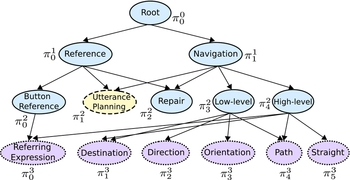
As a more concrete description of how knowledge and actions are passed between agents, Figure 5 shows the hierarchy of learning agents that we designed for the GIVE task. It comprises fourteen different agents whose policies can be roughly categorised as tasks of content selection (π00, π10, π11, π20, π22, π23 and π24), utterance planning (UP) (π21) and surface realisation (π30. . .5). Note that information is always passed between learning agents in the form of state updates that follow user or system actions.
Hierarchy of learning agents for content selection (solid lines), utterance planning (dashed lines) and surface realisation (dotted lines) of navigation and referring expression generation. The arrows indicate the flow of control as it is passed down from parents to child agents. The agents are indexed by their policies π00. . .π35 for SMDPs M 00. . .M 35.

Content selection is responsible for all semantic decisions made by the learning agent, such as whether to choose a high- or low-level navigation strategy, whether to mention a referent's colour or not etc. Utterance planning focuses on how to organise semantic content into a distinct set of messages. For example, should a set of instructions be aggregated or presented separately, what thematic structure should be used etc. Surface realisation finally chooses a realisation for the utterance from a set of candidates (Section 5.3) for our six instruction types. For a joint optimisation, these fourteen agents would share certain knowledge variables among them. This shared knowledge is predefined by the system designer and gives us the opportunity to optimise subtasks jointly rather than in isolation. It allows the learning agents to consider different types of decisions interdependently that affect the trade-off between detail and efficiency in situated interaction. At the same time, it preserves the benefits of a modular architecture.
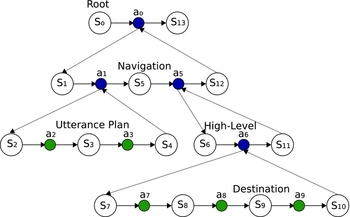
Generation always begins with the root agent M 00 (indexed by its policy π00) which has the option of taking primitive actions or invoke composite actions of reference or navigation. In the latter case, control is passed to a child subtask, agent M 10 for reference or agent M 11 for navigation, respectively. The flow of control is indicated by the arrows in Figure 5. During the process of generating an utterance, control is passed between agents, such as from parent to child when a subtask is called, and from child back to parent once a subtask has terminated. Whenever control is transferred back to the root agent, an episode has been completed and execution terminates. One episode (from state s 0 to state sT) corresponds to one utterance. Figure 6 illustrates the passing of control between agents during a generation episode. In this case a destination instruction is generated, which uses a high-level navigation strategy. In addition, an utterance plan is needed which specifies how the instruction fits in with other instructions.
This hierarchy of state–action sequences shows the high-level dynamics of states, actions and transitions for an example generation episode for a high-level navigation instruction. The empty circles represent generation states (s 0 = initial state, s 13 = final goal state), the dark (blue) circles represent composite actions, the light (green) circles represent primitive actions and the dotted arrows represent state transitions across learning agents. The low-level details of this example are given in Appendix B.

While Figure 6 only provides a high-level example, please see Appendix B for all details and individual actions and state transitions. The complete state–action space of the hierarchical learning agent has a size of ∑i, j|Sij × Aij| = ∑i, j[(∏k (i, j)|f k (i, j)|) × |Aij|] = 1, 480, 869.Footnote 4 Here (i, j) represents an agent in the hierarchy, f k (i, j) represents the feature set of agent (i, j) and k refers to features k in agent (i, j). In contrast, a flat agent using the same states and actions would have the (very large) state–action space of |S × A| = (∏k|fk|) × |A| = 3 × 1057, indicating the advantage of using a hierarchical decomposition for more scalable decision-making. The complete state–action space of the hierarchical agent (and the pre-specified shared knowledge variables for a joint optimisation) are given in Appendix A.
5.2 The simulated environment
Typically, an RL agent needs to be exposed to a large number of interactions during training to learn an optimal policy. Since it is impractical to use real users for these interactions, we use a simulated environment instead and estimate it from our annotations of the GIVE corpus. Our goal is to simulate different spatial surroundings in which the agent can try a multitude of action strategies in order to learn an optimal one by trial and error. The effect of each action will be simulated in the form of a user reaction from among Y = {perform desired action, perform undesired action, wait, request help}. Users in our training data were generally cooperative so that a good system action strategy always results in the user performing the desired action. All other user reactions indicate a non-optimal system action.
Our simulated environment is based on two Naive Bayes classifiers, one for simulating user reactions Y (the classes) to referring expressions and another for simulating user reactions to navigation instructions. We use two separate classifiers rather than one because different feature sets are relevant for each system action type. For simulating user reactions to referring expressions, we use the following features X:
• discriminating_colour_referentx 0 = {true, false}, indicates whether the referent's colour is uniquely identifying or not.
• discriminating_colour_distractorx 1 = {true, false}, indicates whether any of the distractor's colours are uniquely identifying or not.
• number_of_distractorsx 2 = {0, 1, 2, 3, more}, indicates the number of distractors present, if any.
• number_of_landmarksx 3 = {0, 1, 2, 3, more}, indicates the number of landmarks present, if any.
• is_visible_and_nearx 4 = {true, false}, indicates whether the referent button is near and visible to the user (the conditions to press a button).
• referent_colour_mentionedx 5 = {true, false}, indicates whether the system's instruction included the colour of the referent.
• within_dialogue_historyx 6 = {true, false}, indicates whether the button is already in the dialogue history, e.g. because it has been pressed before.
For simulating user reactions to navigation instructions, we use the following features Z:
• number_of_landmarksz 0 = {0, 1, 2, 3, more}, indicates the number of landmarks present, if any.
• is_visible_and_nearz 1 = {true, false}, indicates whether the button is visible and near (or whether we need to navigate further towards it).
• navigation_levelz 2 = {high-level, low-level}, indicates whether the system's instruction was a high- or low-level type instruction.
• navigation_contentz 3 = {destination, direction, orientation, path, straight}, indicates the type of navigation instruction generated.
• within_dialogue_historyz 4 = {true, false}, indicates whether the next target (a button, room or other object) is already in the dialogue history.
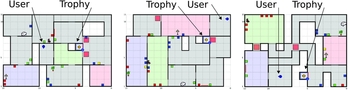
Using these feature sets, we predict user reactions from our annotations of the GIVE corpus by sampling from the distribution P(Y|X) for referring expressions, and by sampling from P(Y|Z) for navigation instructions. All features describing the environment, such as the number of buttons or landmarks present, were simulated from unigram language models estimated from the GIVE corpus. These features were simulated with the same distribution as they occur in the GIVE corpus, but deliberately so that the agent would encounter as many different settings as possible and not be restricted to the GIVE worldsFootnote 5 shown in Figure 7.
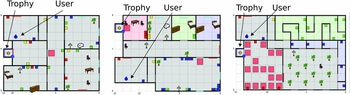
Illustration of the training worlds that are the basis of the simulated environment. All worlds require skills for navigation and disambiguation at a medium-level of difficulty.

To train our classifiers, we used the Weka toolkit (Witten and Frank Reference Witten and Frank2005),Footnote 6 and evaluated our classifiers in a ten-fold cross-validation. For referring expressions, our classifier achieved an accuracy of 78% and for navigation instructions an accuracy of 86%, yielding an average of 82%. As a baseline, a ZeroR (majority class) classifier yields an average accuracy of 69% by always voting for the most likely option.
5.3 A three-dimensional reward function
We use a reward function with three dimensions for optimisation: (1) first for achieving maximal user satisfaction, (2) second for rewarding human-like surface realisation decisions and (3) third for optimising the proportion of alignment and variation in system utterances. Each of these will be discussed in turn.
5.3.1 Dimension 1: user satisfaction
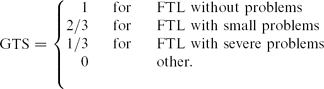
The first dimension aims to maximise user satisfaction. According to the PARADISE framework (Walker et al. Reference Walker, Litman, Kamm and Abella1997; Walker, Kamm, and Litman Reference Walker, Kamm and Litman2000), the performance of a (spoken) dialogue system can be modelled as a weighted function of task success and dialogue cost measures (e.g. number of turns, interaction time etc.). We argue that PARADISE is also useful to assess the performance of an interactive NLG system, since both objective measures (e.g. task success) and subjective measures (e.g. ease of understanding) seem equally relevant for NLG systems in situated contexts. To identify the strongest predictors of user satisfaction (US) in situated dialogue and NLG systems, we performed an analysis of subjective and objective dialogue metrics collected with an indoor wayfinding system, based on PARADISE (Dethlefs et al. Reference Dethlefs, Cuayáhuitl, Richter, Andonova and Bateman2010). We used a graded task success (GTS) metric (Tullis and Albert Reference Tullis and Albert2008), rather than a binary (success=1/failure=0) metric, so as to be more sensitive to problems that users experienced during navigation. This metric assigns different numerical values depending on the problems that users encountered. It is defined as follows, where FTL means ‘finding the target location’:
 \begin{equation*}
\mbox{GTS} = \left\lbrace \begin{array}{r@{\quad }c@{\quad }l}1 & \mbox{for} & \mbox{FTL without problems} \\
2/3 & \mbox{for} & \mbox{FTL with small problems} \\
1/3 & \mbox{for} & \mbox{FTL with severe problems} \\
0 & \mbox{} & \mbox{other.}\\
\nonumber \end{array}\right.
\end{equation*}
In order to identify the relative contribution that different factors have on the variance found in user satisfaction scores, we performed a standard multiple linear regression analysis on our data. Results revealed that the metrics ‘user turns’ and ‘graded task success’ were the only predictors of user satisfaction at p < 0.05. The binary task success metric was not significant (p < 0.39). Based on this, we ran a second analysis using only those variables that were significant predictors in the first regression analysis, i.e. graded task success and the number of user turns (which are negatively correlated). We obtained the following performance function:
 \begin{equation}
\mbox{Performance} = 0.38 \mathcal {N}(\text{GTS}) - 0.87 \mathcal {N}(UT)
\end{equation}
5.3.2 Dimension 2: naturalness
The second dimension focuses on surface realisation performed by agents M 30. . .5. We have decided to base surface realisation decisions based on probabilities of surface forms as they occur in the GIVE corpus and use these probabilities as rewards to inform the agent's learning process. While in this particular case we use the Bayesian Networks to represent probabilistic generation spaces per instruction type (for destination, direction, orientation, path, ‘straight’ and referring expression), nothing depends on the model chosen. Any surface realiser that is able to return a probability given a surface form would be suitable, including n-gram language models. Please see Dethlefs and Cuayáhuitl (Reference Dethlefs and Cuayáhuitl2011) for the details of how our Bayesian Networks were trained and Dethlefs and Cuayáhuitl (Reference Dethlefs and Cuayáhuitl2012) for a comparison with other graphical models.
For generating natural surface forms, the agent's rewards will be based on the probability of the word sequence it has generated. This means that having generated word sequence w 0. . .wn, it will receive the probabilistic reward Pr(w 0. . .wn). In Bayesian Networks, this reward can be obtained through probabilistic inference, according to
 \begin{equation}
\mbox{Surface\_String\_Probability} = Pr(w_1 \dots w_n | e)
\end{equation}
5.3.3 Dimension 3: balancing alignment and variation
The third dimension of the reward function aims to balance the proportion of alignment and variation in a natural and human-like fashion. It is used by the surface realisation agents M 30. . .M 35.
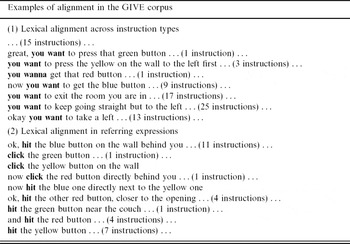
From the human GIVE data, it was observed that instruction givers tend to self-align with their own utterances and vary them in an about equal fashion. An example of this is provided in Table 1. The aligned phrases here are shown in bold face and the number of instructions intervening between aligned instructions are given in parentheses. In the first example, the instruction giver uses the phrase you want with high frequency and across instruction types. The phrase per se has a rather low frequency in the corpus on the whole (1.8% of all verbs). In the second example, the instruction giver produces referring expressions almost exclusively using the verbs click (33.3% in this dialogue and 33% in the entire corpus) and hit (66.6% in this dialogue, 6.6% in the corpus). We can see that human instruction givers do not only self-align with their own utterances but they also introduce a significant amount of variation, possibly to reduce the repetitiveness of their utterances.
Examples of (self-)alignment in the GIVE corpus. In the first example, the instruction giver uses the phrase you want with high frequency and across instructions. In the second example, the instruction giver uses exclusively the verbs click and hit in their referring expressions. The number of intervening instructions are shown in parentheses behind each instruction

We will not investigate the question here of why variation (or alignment) occurs in human discourse, but see Levelt (Reference Levelt1989), Belz and Reiter (Reference Belz and Reiter2006) and Foster and Oberlander (Reference Foster and Oberlander2006) for some hypotheses. Rather we will take the stance that if it occurs as ubiquitously as we have observed in our human data, then it should be a part of the agent's learning objectives. Therefore, we define a constituent alignment score (CAS) which indicates the proportion between alignment and variation for each constituent in the discourse. It is computed as CAS = lexical tokens in discourse/total number of tokens, which yields a number in the range of [0 . . .1]. Please see Dethlefs and Cuayáhuitl (Reference Dethlefs and Cuayáhuitl2010) for details of this computation and its background. We would like our agent to generate utterances so that the CAS for each utterance is as close to 0.5 as possible. To achieve this, we assign each generated utterance a probabilistic reward sampled from a Gaussian distribution. In probability theory this has a probability density function defined as 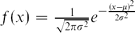 $f(x) = \frac{1}{\sqrt{2 \pi \sigma ^2}} e^{- \frac{(x-\mu )^2}{2 \sigma ^2}},$ where μ refers to the mean and σ2 refers to the variance. The right-hand side of this equation is also commonly denoted as
 $\mathcal {N}(x | \mu , \sigma ^2)$ so that the probability density function that we use for the sampling of rewards can be defined as
 \begin{equation}
P(CAS) \approx \mathcal {N}(CAS | \mu , \sigma ^2)
\end{equation}
5.3.4 Bringing all dimensions together
For the final experiments, we can bring all dimensions of the reward function together by summing rewards whenever more than one applies.Footnote 8 For example, at the end of an utterance (upon reaching the goal state), usually the reward for the Performance of the utterance will apply, the reward for the Surface_String_Probability and the reward for Alignment_Variation. Accordingly, the reward for the utterance can be computed as
 \begin{equation}
\mbox{Reward} = \mbox{Performance} + \mbox{Surface\_String\_Probability} + \mbox{$P(CAS)$}.
\end{equation}
6 Evaluation
In this section, we will evaluate our hierarchical learning framework in both simulation and a human evaluation study. We will focus particularly on a comparison of a joint generation policy, with shared knowledge, and an isolated generation policy. A brief comparison with state-of-the-art approaches for GIVE is also provided.
6.1 Simulation-based evaluation
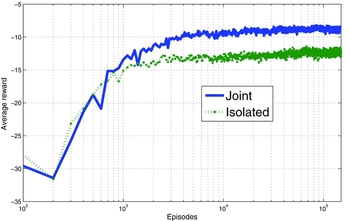
Using simulation, we have trained two policies, a joint policy and an isolated policy. A qualitative analysis after 150 thousand training episodes reveals the following learnt behaviour. Figure 8 compares the average rewards (averaged over ten runs) of (a) a jointly optimised policy, i.e. using shared knowledge, and (b) an isolated policy, using no shared knowledge. We can see that a joint optimisation achieves higher overall rewards over time. An absolute comparison of the average rewards (rescaled from 0 to 1) of the last 1, 000 training episodes of each policy shows that the joint behaviour improves the isolated behaviour by 34% (p < 0.0001).
A comparison of average rewards attained by the joint policy, using shared knowledge, and the isolated policy, using no shared knowledge, over time.

The joint policy has learnt to prefer high-level navigation over low-level navigation, but switch the navigation strategy when the user gets confused. It uniquely identifies a referent button by preferring the use of a discriminating colour, and otherwise (if neither the referent nor a distractor has a discriminating colour) use either a spatial relation, a distractor or a landmark (in this order of preference). If a distractor is used, the referent is located in relation to it, such as Press the yellow button beside the blue. In addition, it will use composite presentations for at most two instructions (and aggregate them) and incremental displays otherwise. It has learnt to use temporal markers for more than three instructions. Finally, the agent has learnt to balance the trade-offs of variation and alignment while still acting in accordance with the language model.
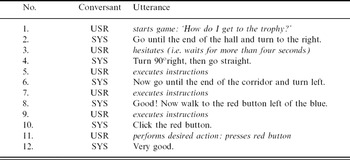
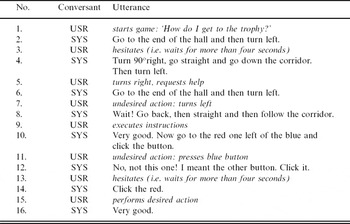
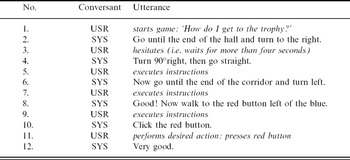
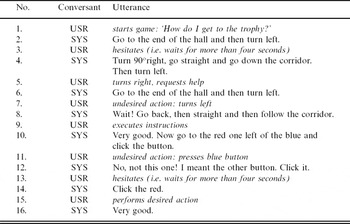
Tables 2 and 3 show example interactions (from simulation) with the joint and isolated policy, respectively. These dialogues illustrate the importance of graded task success: while both users are successful in the end, the user of the jointly optimised dialogue is likely to have a substantially higher user satisfaction than the user interacting with the isolated system. We can also see that utterances in the isolated case are on average longer and seem to balance efficient instruction-giving and the user's cognitive load less optimally than the joint policy.
Sample dialogue using the jointly optimised policy. The system starts using a high-level navigation strategy, and then switches to low-level as the user gets confused. Eventually it switches back to high-level
Sample dialogue using the isolated policy. The agent prefers efficient instruction-giving. It uses high-level navigation and aggregates utterances where possible. In terms of repair, only the immediately preceding utterance is repaired
6.2 Task-based evaluation
In this section we compare our jointly optimised policy with a policy optimised in isolation in a human evaluation study. We formulate the hypothesis that the sharing of knowledge across generation subtasks can lead to more successful interactions with fewer problems that are more positively perceived by human users.
6.2.1 Experimental methodology
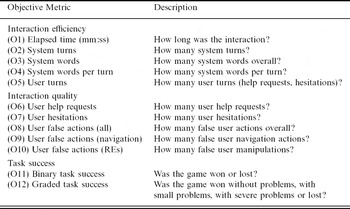
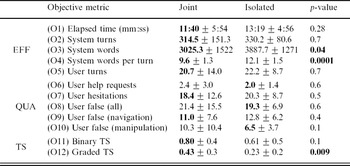
We use objective and subjective metrics based on the PARADISE framework (Walker et al. Reference Walker, Litman, Kamm and Abella1997) for evaluating dialogue systems to evaluate our systems for the GIVE task. Table 4 gives an overview of the objective metrics that we use to evaluate the two system versions, jointly optimised and optimised in isolation. Under the category interaction efficiency, we find metrics such as the time that an interaction took, the number of system turns and system words, and the number of user turns (we count as user turns help requests or hesitations that last longer than a pre-specified threshold of 4 seconds). Under the interaction quality category, we count the number of user help requests and user hesitations (the sum of which corresponds to the ‘user turns’ metric under interaction efficiency), the number of false user actions overall, the number of false user navigation actions and the number of false user manipulation actions (i.e. false button presses). The ‘false user actions overall’ metric corresponds to the sum of false navigation and manipulation actions. Finally, under the category task success, we distinguish average binary task success (won or lost) from average GTS which penalises task difficulty in different ways, as defined in Section 5.3.1.
Objective metrics that were logged during interactions
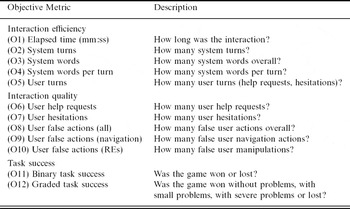
Binary task success is always 1 if a game was won (regardless of the number of problems) and 0 if it was lost. For graded task success, we assume that every user hesitation or help request indicates a problem, and assign the values of 2/3 (small problems) for more than five user turns, 1/3 (severe problems) for more than ten user turns and 0 for a lost game. The objective metrics were designed based on PARADISE, but tailored specifically to our scenario, so as to measure the success of instructions in a situated interaction scenario. Results of the objective metrics were induced automatically from log files.
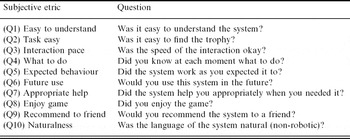
Table 5 shows the subjective metrics we use to evaluate the user satisfaction of our two systems. While questions Q1–Q6 are taken almost directly from PARADISE, questions Q7–Q10 were included to test some specifics of our situated NLG scenario. These metrics were obtained through questionnaires that participants were asked to fill after each game they played.
Subjective metrics and the questions that were asked to obtain them

6.2.2 Experimental setup
Setting and participants. We compare two systems for the GIVE task in a human evaluation study involving nineteen participants: 79% (fifteen out of nineteen) females and 21% (four out of nineteen) males, with an average age of 24.5 years.Footnote 9 The two systems to be compared generated instructions for the GIVE task in three different worlds, which were chosen to be different from the training worlds, in order to assess the generalisability of our learnt policies. We thus used the hierarchy of policies that was trained in the training worlds and evaluated them in the evaluation worlds (rather than training a separate hierarchy of policies specifically for the evaluation worlds). The learnt NLG policy was therefore environment-independent. Future work can in addition investigate how policies can be adapted during interactions via online learning.
In the evaluation, one system used a jointly optimised policy, and the other system used a policy that was optimised in isolation. Participants were asked to play three games. They were chosen so as to ensure that each participant played with at least one jointly optimised system and one system optimised in isolation. Apart from this condition, systems were chosen randomly from a uniform distribution.
Evaluation worlds. For the human evaluation, we used the virtual worlds from the official GIVE challenge 2.5Footnote 10 of 2011 (Striegnitz et al. Reference Striegnitz, Denis, Gargett, Garoufi, Koller and Theune2011). They are shown in Figure 9. While the main skills required in the training worlds (cf. Figure 7) were navigation and disambiguation of a medium level of complexity, the evaluation worlds require a range of different skills. While evaluation world 1 was designed to be similar to the training worlds, evaluation world 2 focuses on referring expressions. A large number of same-coloured buttons are located close to each other in different spatial arrangements so that disambiguation becomes a challenge. Evaluation world 3 requires sophisticated navigation skills in all rooms, especially in a maze-like corridor in which users can quickly lose orientation, or a room full of alarm tiles where any wrong step may cause the alarm to be triggered. Finally, it includes a room with many small rooms that require precise navigation.
Illustration of the evaluation worlds. World 1 is most similar to the training worlds in that it requires navigation and disambiguation skills at a medium level of difficulty. World 2 is focused on referring expression generation and World 3 on complex navigation.

6.2.3 Experimental results
Following the human evaluation study, we analysed the results in order to draw conclusions with respect to the effects that a joint or an isolated optimisation has on interactions and user satisfaction. Overall, the analysis is based on fifty-seven games.
Objective metrics. Table 6 compares average results (with their corresponding standard deviations) for joint and isolated settings and shows the p-values indicating the significance of the comparison between both settings. We can see that the jointly optimised system performs better than the system that was optimised in isolation according to almost all metrics. It produces shorter interactions using fewer words and turns and causes fewer user turns and hesitations and higher task success. The key findings can be summarised as follows:
• The isolated policy produces significantly more system words (O3) than the joint policy (p < 0.04). This difference could be interpreted as a suboptimal balance between efficiency and detail in instructions. When the joint policy is able to achieve an equal (or higher) task success using fewer words, the isolated policy most likely included redundant detail.
• The isolated policy produces significantly more system words per turn (O4) than the joint policy (p < 0.0001). This difference again points to a suboptimal balance of choosing or organising utterance contents. The cognitive load that is imposed on the user during an interaction is increased with the number of system words per turn that the user needs to keep in mind. (Unnecessarily) long utterances can therefore lead to user confusions and affect task success.
• The joint policy achieves higher task success than the isolated policy. While the difference in terms of binary task success (O11) only shows a statistical trend (p < 0.1), the difference in graded task success (O12) is significant at p < 0.0009. This means that users interacting with the joint policy encounter fewer problems and experience more smooth and successful interactions. This is also reflected in the large difference between binary and graded task success.
Results for the objective evaluation metrics per policy for joint and isolated settings. The objective metrics are organised into three groups: interaction efficiency (EFF) (the lower values, the better), interaction quality (QUA) (the lower values, the better) and task success (TS) (the higher values, the better). Numbers in the third and fourth columns refer to averages (per game) and are given together with their standard deviations. The final column shows p-values for the comparison obtained with a paired t-test. The best result per metric is indicated in bold face
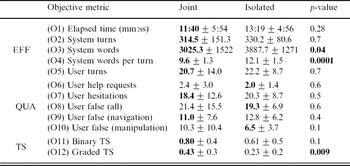
The comparison of the joint policy and the isolated policy seems to suggest that a joint optimisation leads to shorter, more efficient and more successful interactions. An exception to the overall trend is represented by metric O8, the number of false user actions overall, and metric O10, the number of false manipulation actions, i.e. wrong button presses. While users of the joint policy press on average 10.3 ( ± 10.4) wrong buttons, users of the isolated policy press only 6.5 ( ± 3.7) wrong buttons on average. The reason for this is most likely that few users in the joint setting pressed a very high number of wrong buttons, as is indicated by the high standard deviation of the O10 metric. The majority of users pressed very few (or no) wrong buttons, however.
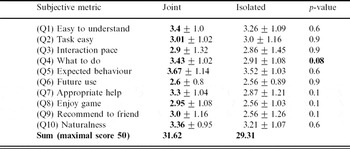
Subjective metrics. The subjective user ratings indicate user satisfaction with each system. Table 7 summarises the results, where the last column in the table provides the p-value for the comparison of the previous two columns. Overall, we can see a clear tendency of users preferring the joint policy over the isolated one. The user satisfaction ratings for all games can be summarised as follows:
• Users consistently rate the joint policy better than the isolated policy, even though unfortunately none of the differences is statistically significant.
• The metric ‘Expected behaviour’ (Q5) receives the highest ratings for both the joint policy (3.67 ± 1.14) and the isolated policy (3.52 ± 1.03). In turn, the metric ‘Future use’ (Q6) receives the lowest, 2.6 ( ± 0.8) for the joint policy and 2.56 ( ± 0.89) for the isolated policy. For the latter case, the metrics ‘Enjoy game’ (Q8) and ‘Recommend to friend’ (Q9) are rated similarly low. Especially, the metrics Q8 and Q9 can mean that users of the isolated policy enjoyed their games less than users of the joint policy. The metric ‘Future use’ in contrast could also have a different interpretation. Users may not have seen the usefulness of using the game in the future because they are not interested in video games: on a scale of 1 (i.e. ‘playing never’) to 5 (i.e. ‘playing very often’), our participants rated themselves as playing video games between ‘rarely’ and ‘never’ (1.78). An alternative interpretation is that users found the pace of the interaction too fast, as indicated by the ‘Interaction pace’ (Q3) metric, so that slowing the interaction pace down could lead to higher user satisfaction.
• The metric ‘What to do’ (Q4) showed the biggest difference in user ratings between the joint (3.43 ± 1.02) and the isolated (21 ± 1.08) systems. While it is not statistically significant, it shows the strongest trend among all individual subjective categories. Users seemed to find instructions generated by the joint system more easy to interpret and felt more safely guided through the task.
User satisfaction results per policy (scores range from 1 to 5, and are the better, the higher). Numbers refer to averages per game and are shown with standard deviations. The last column shows p-values for the comparison of systems. The best results per metric are indicated in bold face

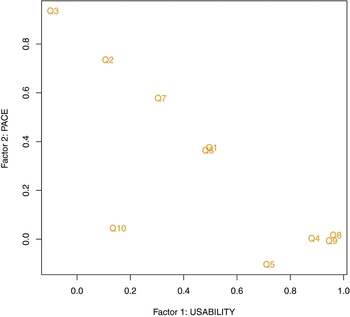
Despite an overall trend that users seem to prefer the joint policy over the isolated one, we were not able to report any significant differences. Related work on the evaluation of spoken dialogue systems suggests a factor analysis (Dzikovska et al. Reference Dzikovska, Moore, Steinauser and Campbell2001; Möller et al. Reference Möller, Smeele, Boland and Krebber2007; Wolters et al. Reference Wolters, Georgila, Moore, Logie and MacPherson2009). An explanatory factor analysis explains the variability found in a set of observed, correlated variables in terms of a set of unknown latent variables, or factors. These factors are often fewer than the initial set of variables and reveal those underlying subjective categories that users were concerned about in their ratings. The advantage of a factor analysis is often that it reveals those subjective experiences with a system that matter to users, rather than reflecting the system designer's expectations – as is often the case with predefined questionnaires. Please see Hone and Graham (Reference Hone and Graham2000) for details on a factor analysis applied to spoken language processing. A factor analysis applied to our subjective metrics of the GIVE evaluation showed the following. An illustration is provided in Figure 10.
Illustration of two factors, from an explanatory factor analysis, that explain 65% of variability found in subjective user ratings: ‘usability’ and ‘pace’.

Two factors were identified as accounting for 65% of the variability found in user ratings. For Factor 1, which we can call usability, subjective metrics (Q4) ‘What to do’, (Q8) ‘Enjoy game’ and (Q9) ‘Recommend to friend’ had high factor loadings of > 0.80. Factor loadings indicate correlations between questionnaire items. For Factor 2, which we can call pace, only subjective metric (Q3) ‘Interaction pace’ had a high factor loading of > 0.80. The difference between the joint policy and the isolated policy for factor pace was not significant at 0.9. While the difference for factor usability was not significant either, at p < 0.07, at least, we can observe a statistical trend for this factor. All in all, these results indicate that statistical significance may have been achieved here if more data were available.
6.3 Comparison with Systems from the GIVE Challenge
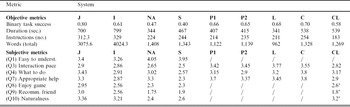
To allow for a comparison of our hierarchical RL framework with other state-of-the-art approaches to situated NLG, Table 8 contrasts our results with objective and subjective metrics collected for several systems in the GIVE-2 and GIVE-2.5 challenges. The former was run in 2010 and collected games from 1,825 participants. The latter was run in 2011 and collected 536 games. The official results were discussed in Koller et al. (Reference Koller, Striegnitz, Byron, Cassell, Dale, Moore, Theune and Krahmer2010) and Striegnitz et al. (Reference Striegnitz, Denis, Gargett, Garoufi, Koller and Theune2011), respectively. GIVE-2.5 was run with the same evaluation worlds as our evaluation. The worlds in GIVE-2 were comparable in that all three worlds posed different challenges for the systems. World 1 was designed to be most similar to the training worlds, while World 2 focused on referring expressions and World 3 on navigation. All evaluations were therefore carried out in comparable, if not identical, virtual worlds. All subjective scores in the table were rescaled from the − 100 to + 100 scale used in GIVE to our 1 to 5 scale.
Objective and subjective metrics for our systems (J = Joint and I = Isolated) compared with the best systems of the GIVE-2 challenge (NA and S) and the GIVE-2.5 challenge (P1, P2, L, C, CL). *Measures taken from Benotti and Denis (Reference Benotti and Denis2011b) rather than the GIVE challenge

We chose seven systems for our comparison, the two best systems of GIVE-2 (NA and S) and the five best systems from GIVE-2.5 (P1, P2, C, CL and L). Since the overall results of GIVE-2.5 were better than that of GIVE-2, we included more systems from the latter challenge in order to make a more challenging comparison.Footnote 11
There is unfortunately not always a perfect match between subjective metrics, but we wanted to include them nevertheless for a more comprehensive point of comparison. In particular, not all questions that we asked participants were the same that GIVE participants were asked. For category Q3, while we asked subjects Was the speed of the interaction okay?, GIVE asked participants to rate the statement The system's instructions were visible long enough for me to read them. For category Q4, we asked Did you know at each moment what to do?, while the GIVE questionnaire contained I was confused about which direction to go in. Finally, while we asked Did the system give you appropriate help when you needed it? for category Q7, GIVE used The system immediately offered help when I was in trouble. All objective and other subjective categories have a direct correspondence. Unfortunately, the number of questionnaire items differed in GIVE-2 and GIVE-2.5 so that some fields in the table cannot be compared. Since we are comparing data from separate evaluations, the results in Table 8 serve more as an indication rather than a direct comparison and statistical significance is not reported.
We can nevertheless make a number of observations from the data comparison:
• In terms of task success, we can see that our joint policy outperforms all other systems by at least 10%. This result also holds for other GIVE systems which were published separately from the challenge, such as Garoufi and Koller (Reference Garoufi and Koller2010) who achieve 69%, and Benotti and Denis (Reference Benotti and Denis2011b) who achieve 70%. This result reflects our reward function which placed a substantial weight on task success, rather than other metrics such as instruction or interaction length.
• The other objective metrics seem to suggest that both of our systems generate significantly more instructions and are more verbose than the other GIVE systems, which led to longer interaction times. This reflects the generation strategy learnt by our system, which was able to combine high- and low-level instructions and aggregate several instructions into one. This produced many instructions such as Go left and then towards the blue button. In contrast, many GIVE systems relied predominantly on shorter instructions such as turn left or press blue.
• In terms of the subjective metrics, we can see that our system is slightly outperformed in ‘Easy to understand’ and ‘XXXXXInteraction pace’ metrics. The latter was already indicated in our own evaluation, where participants wished that instructions were displayed slightly longer and the system would reduce its overall interaction speed. On the other hand, our system performs substantially better in the metric ‘What to do’ than most competitors and was ranked in the middle for the metric ‘Appropriate help’.
• We can further see that participants considered our system's instructions more natural than its competitors’, enjoyed playing more and would recommend the game to a friend more often. In terms of naturalness, this is again reflected in our reward function, where we placed an explicit weight on human-like surface forms. To an extent, the other metrics confirm our earlier results in that participants enjoy playing when they win the trophy and they do not enjoy playing when they lose. Participants may therefore have enjoyed playing with our system most because it achieved the highest task success score overall.
• Finally, we can see that while the isolated policy is outperformed in many categories, it is still able to compete with some systems, such as in the categories ‘Interaction pace’, ‘Enjoy game’, ‘Recommend to friend’, ‘Naturalness’ and ‘Binary task success’. This indicates that even a policy optimised in isolation represents a competitive baseline.
The highest overall scores in this comparison were achieved by two rule-based systems, C (Racca, Benotti and Duboue Reference Racca, Benotti and Duboue2011) and L (Denis Reference Denis2011). This suggests that a carefully designed ad hoc solution to a problem can still outperform many data-driven systems in NLG nowadays. Systems P1/P2 (Garoufi and Koller Reference Garoufi and Koller2011b) and CL (Benotti and Denis Reference Benotti and Denis2011a) represent more state-of-the-art approaches. System P1 was using a combination of planning and supervised learning to NLG that aimed to maximise the understandability of referring expressions (P2 acted as a planning-only baseline). This system received good scores for ‘Interaction pace’ and ‘Appropriate help’, possibly because its planning steps guided users in small steps avoiding confusions and maximising understandability. System CL used a corpus-based selection approach, choosing instructions from a pre-collected corpus of human utterances in the same domain. This system was rated well for ‘Naturalness’. The reason is probably that it relied on instructions that humans produced for the very same situation the system was facing. On the other hand, this method does not take context into account which can lead to inconsistencies and low scores in other subjective categories. In summary, the comparison with these systems shows that our hierarchical RL approach is able to achieve comparable performance to state-of-the-art systems: while our joint policy is outperformed in some subjective categories, it achieves higher task success and more enjoyable and natural interactions than the other systems. This corresponds to the optimisation metrics that our reward function was designed for.
7 Conclusions and future directions
Natural Language Generation systems for interactive contexts are faced with numerous trade-offs in generating an utterance that is optimally adaptive to the user and situation. Trade-offs include the level of detail chosen in a situation as well as the speed and efficiency with which instructions can be generated within a dynamic and constantly changing context. This paper has suggested to address these challenges using hierarchical RL. It extends previous research on NLG for interactive systems in several ways. First, it represents a novel hierarchical optimisation framework for situated NLG. This model is based on a divide-and-conquer approach and optimises a hierarchy of subtasks rather than one single complex task. In this way it is more scalable for large state–action spaces than previous approaches towards RL for NLG. Second, this hierarchical model has been trained with a comprehensive data-driven reward function addressing several aspects of our situated scenario. In contrast, related work has focused either on hand-crafting reward functions or has induced them for single aspects of the task only. Finally, we have compared two different learning settings for our domain, a joint setting in which a policy is learnt with predefined shared knowledge across subtasks, and an isolated setting without any shared knowledge. Results from simulation and a task-based human evaluation study showed the benefits of the joint architecture in optimising the trade-off between efficiency and detail in situated interaction. The joint setting led to more successful and efficient interactions that were better perceived by human users than their isolated counterpart.
Some future research directions are summarised in the following.
First, the idea of jointly optimising the behaviour of distinct, but related, subtasks is likely to enhance the performance of systems beyond NLG and dialogue. Candidate areas for such a joint treatment are language analysis and production, or multi-modal systems, where a joint treatment could help to reinforce communicated contents with non-linguistic behaviours.
Second, RL agents typically learn a behaviour policy off-line during a training phase in a simulated environment and then execute the learnt policy statistically during deployment. To allow agents to learn from real interactions, however, via online learning and adaptation, more efficient training algorithms are needed that allow action values to be computed quickly and reliably so that they could immediately have an impact on the agent's current behaviour. See Bohus et al. (Reference Bohus, Langner, Raux, Black, Eskenazi and Rudnicky2006), Cuayáhuitl and Dethlefs (Reference Dethlefs2011a) and Gašić et al. (Reference Gašić, Jurčíček, Thomson, Yu, Young and Waikoloa2011) for some first advances.
Third, RL agents are typically designed by a system developer who bases his or her design decisions on the knowledge of the task, the domain or the end user of the system. Drawbacks are that system development can be slow and labour-intensive, and different design decisions can have different effects on the performance of a system. An interesting direction for future research is therefore the investigation of methods for inducing the structure and features of the learning agent automatically from human or domain data. In this way, hierarchy construction could be automatised to accelerate development times and increase reuse of resources. Simultaneously, the benefits of a modular architecture and using a divide-and-conquer approach would be preserved for easy maintenance and scalability to large search spaces. Automatic feature induction is also interesting for deciding the features that should be shared between agents for a joint optimisation.
Fourth, RL agents for NLG currently make the simplifying assumption that their knowledge about the user and the environment is complete. This assumption is often unrealistic because most environments are not fully observable. While research on partially observable environments has been done on dialogue systems (Williams and Young Reference Williams and Young2007), generation under uncertainty has yet to be transferred to research on trainable NLG.
Fifth, our model relies on tabular state representations which can affect its scalability as the state–action space grows. While we have suggested a hierarchical setting to address this problem, function approximation techniques, such as linear approximation, neural networks or decision trees, are an alternative (or complementary) method to enhance scalability. Some approaches for dialogue include Henderson, Lemon and Georgila (Reference Henderson, Lemon and Georgila2008), Jurcícek et al. (Reference Jurcícek, Thompson and Young2011), Pietquin et al. (Reference Pietquin, Geist, Chandramohan and Frezza-Buet2011) and Cuayáhuitl, Kruijff-Korboyová and Dethlefs (Reference Cuayáhuitl, Kruijff-Korboyová and Dethlefs2012).
Finally, to evaluate our suggested methods on a larger scale, we would like to transfer hierarchical RL to new domains, such as text generation, and new applications, such as sentence compression, summarisation or machine translation.
Acknowledgments
This research was supported by the German Research Foundation DFG under a grant for the Transregional Research Centre SFB/TR8 Spatial Cognition, project I5-DiaSpace. It was also supported by the European Commission's FP7 programmes under grant agreement nos. 287615 (PARLANCE) and ICT-248116 (ALIZ-E). We would like to thank John Bateman, Jette Viethen, Alexander Koller, Konstantina Garoufi, Kristina Striegnitz, Oliver Lemon, Michael Strube and David Schlangen for comments and interesting discussions on the work presented. A special thanks to Kristina Striegnitz and Konstantina Garoufi for helping us make sense of the GIVE challenge data.
Appendix A: Hierarchical state and action space
This section provides a detailed description of the knowledge and actions available to each learning agent in the hierarchy in Figure 5. Each agent will be shown as a feature structure and explained in turn. In the state representation Sij, variables shown in cursive fonts are shared variables. This means that they were originally state variables of single agents which can now be accessed by other agents as well. This is to take them into account for their own decision-making. All non-cursive variables are individual state variables that cannot be accessed by other agents. This is the main difference between learning a jointly optimised policy and a policy optimised in isolation: while in the former, agents can access shared state variables, in the latter only individual, non-shared variables exist. The state space of the isolated agent can therefore be obtained by excluding all cursive state variables. In the action set Aij, bold-face actions denote composite actions, and the goal state Gij defines the termination conditions for the agent.
 \begin{equation*}
\nonumber \left[ \begin{array}{ll}S^0_0 & \left[ \begin{array}{l}\mbox{v1:GoalStatus} \leftarrow \mbox{\lbrace 0=continue,1=end\rbrace }\\
\mbox{{\it v2:GoalVisible}} \leftarrow \mbox{{\it \lbrace 0=true,1=false\rbrace }}\\
\mbox{v3:NextSysAct} \leftarrow \mbox{\lbrace 0=navigation,1=reference, 2=confirm, }\\
\mbox{} \hspace{79.66771pt} \mbox{3=stop\_navigation, 4=wrong\_button\rbrace }\\
\mbox{v4:PrevUsrReaction} \leftarrow \mbox{\lbrace 0=none, 1=perform desired action,}\\
\mbox{} \hspace{79.66771pt} \mbox{2=perform undesired action, }\\
\mbox{} \hspace{79.66771pt} \mbox{3=hesitate, 4=request help\rbrace }\\
\mbox{{\it v5:UserConfusions}} \leftarrow \mbox{{\it \lbrace 0=none,1=one, 2=two or more\rbrace }}\\
\end{array} \right]\\
A^0_0 & \left[ \begin{array}{l}\mbox{confirm, } \\
\mbox{{\bf reference} $M^1_0$, } \\
\mbox{{\bf navigation} $M^1_1$, } \\
\mbox{stop\_navigation, } \\
\mbox{wrong\_button} \\
\end{array} \right]\\
G^0_0 & \left[ \begin{array}{l}\mbox{v1=1} \\
\end{array} \right]\cr \end{array} \right]\cr
\end{equation*}
Agent M 00, first of all, is the root agent which initiates all generation episodes. It can either choose a primitive action such as to confirm a previous user action, Well done!, tell the user to stop navigating, Wait!, or not to press a button, Not this one!. Alternatively, it can choose a composite action and pass control down to a child subtask. Agent M 10 is responsible for references and agent M 11 is responsible for navigation instructions.
Specifically, agent M 10 deals with generating references to buttons or landmarks. It can make decisions based on the visibility of the next goal, the presence of landmarks and the reference context. It should also make sure that an utterance plan has been chosen before presentation to the user. If a button reference needs to be generated, it may, for example call child subtask M 20.
 \begin{equation*}
\nonumber \left[ \begin{array}{ll}S^1_0 & \left[ \begin{array}{l}\mbox{{\it v6:GoalVisible}} \leftarrow \mbox{{\it \lbrace 0=true,1=false\rbrace }}\\
\mbox{v7:PresenceOfLandmarks} \leftarrow \mbox{\lbrace 0=not\_present,1=present\rbrace }\\
\mbox{{\it v8:Presentation}} \leftarrow \mbox{{\it \lbrace 0=none,1=composite,2=incremental\rbrace }}\\
\mbox{v9:PrevUsrReaction} \leftarrow \mbox{\lbrace 0=none, 1=perform desired action,}\\
\mbox{} \hspace{108.12047pt} \mbox{2=perform undesired action, }\\
\mbox{} \hspace{108.12047pt} \mbox{3=hesitate, 4=request help\rbrace }\\
\mbox{v10:ReferenceContext} \leftarrow \mbox{\lbrace 0=button\_manipulation,1=navigation\rbrace }\\
\mbox{v11:Reference} \leftarrow \mbox{\lbrace 0=unfilled,1=filled\rbrace }\\
\mbox{v12:Repair} \leftarrow \mbox{\lbrace 0=unfilled,1=filled\rbrace }\\
\mbox{v13:UtterancePlan} \leftarrow \mbox{\lbrace 0=unfilled,1=filled\rbrace }\\
\end{array} \right]\\
A^1_0 & \left[ \begin{array}{l}\mbox{{\bf plan\_utterance} $M^2_1$, } \\
\mbox{{\bf generate\_button\_reference} $M^2_0$, } \\
\mbox{{\bf repair\_utterance} $M^2_2$, do\_not\_repair\_utterance, } \\
\mbox{generate\_landmark\_reference} \\
\end{array} \right]\\
G^1_0 & \left[ \begin{array}{l}\mbox{v11=1,v12=1,v13=1} \\
\end{array} \right]\cr \end{array} \right]\cr
\end{equation*}
Agent M 20 generates referring expressions to buttons. It decides whether to mention a referent's colour, a distractor, it's spatial position etc., based on information about the referent's physical properties. Eventually, it should call agent M 30 to make sure that a surface form for the referring expression is generated.
 \begin{equation*}
\nonumber \left[ \begin{array}{ll}S^2_0 & \left[ \begin{array}{l}\mbox{v24:ColourDistractor} \leftarrow \mbox{\lbrace 0=unfilled,1=filled\rbrace }\\
\mbox{v25:ColourReferent} \leftarrow \mbox{\lbrace 0=unfilled,1=filled\rbrace }\\
\mbox{v26:DiscriminatingColourDistractor} \leftarrow \mbox{\lbrace 0=false,1=true\rbrace }\\
\mbox{v27:DiscriminatingColourReferent} \leftarrow \mbox{\lbrace 0=false,1=true\rbrace }\\
\mbox{v28:Distractor} \leftarrow \mbox{\lbrace 0=unfilled,1=filled\rbrace }\\
\mbox{v29:HorizontalRow} \leftarrow \mbox{\lbrace 0=false,1=true\rbrace }\\
\mbox{v30:Horizontal} \leftarrow \mbox{\lbrace 0=unfilled,1=filled\rbrace }\\
\mbox{v31:NumberOfDistractors} \leftarrow \mbox{\lbrace 0=none,1=one, 2=two or more\rbrace }\\
\mbox{v32:PositionInConfiguration} \leftarrow \mbox{\lbrace 0=corner,1=edge,2=middle,}\\
\mbox{} \hspace{139.4185pt} \mbox{3=only\_button,4=other\rbrace }\\
\mbox{v33:Position} \leftarrow \mbox{\lbrace 0=unfilled,1=filled\rbrace }\\
\mbox{v34:Surface} \leftarrow \mbox{\lbrace 0=unfilled,1=filled\rbrace }\\
\mbox{v35:Type} \leftarrow \mbox{\lbrace 0=unfilled,1=filled\rbrace }\\
\mbox{v36:VerticalRow} \leftarrow \mbox{\lbrace 0=false,1=true\rbrace }\\
\mbox{v37:Vertical} \leftarrow \mbox{\lbrace 0=unfilled,1=filled\rbrace }\\
\end{array} \right]\\
A^2_0 & \left[ \begin{array}{l}\mbox{{\bf referring\_expression} $M^3_0$, } \\
\mbox{include\_distractor, do\_not\_include\_distractor, } \\
\mbox{include\_type, do\_not\_include\_type, } \\
\mbox{include\_referent\_colour, do\_not\_include\_referent\_colour, } \\
\mbox{include\_distractor\_colour, do\_not\_include\_distractor\_colour, } \\
\mbox{include\_horizontal\_position, do\_not\_include\_horizontal\_position, } \\
\mbox{include\_vertical\_position, do\_not\_include\_vertical\_position, } \\
\mbox{include\_position\_in\_configuration } \\
\end{array} \right]\\
G^2_0 & \left[ \begin{array}{l}\mbox{v24=1,v25=1,v28=1,v30=1,v33=1,v34=1,v35=1,v37=1} \\
\end{array} \right]\cr
\end{array} \right]\cr
\end{equation*}
Agent M 20 also shows that many actions are complementary to each other. This means that there is an action pair, such as include distractor and do not include distractor, one of which needs to be chosen at each instance in order to update the corresponding state variable, here Distractor, from unfilled to filled. This is a precondition for reaching the terminal state and ensures that all actions are considered by the agent. Since the reward function penalises the agent for each action it takes, it may otherwise happen that the agent neglects favourable actions in order to avoid a negative reward.
 \begin{equation*}
\nonumber \left[ \begin{array}{ll}S^1_1 & \left[ \begin{array}{l}\mbox{{\it v14:Aggregation}} \leftarrow \mbox{{\it \lbrace 0=none,1=conjunction,2=sequence\rbrace }}\\
\mbox{v15:AllRoomsKnown} \leftarrow \mbox{\lbrace 0=false,1=true\rbrace }\\
\mbox{{\it v16:GoalVisible}} \leftarrow \mbox{{\it \lbrace 0=true,1=false\rbrace }}\\
\mbox{v17:NavigationContent} \leftarrow \mbox{\lbrace 0=mixed,1=low,2=high\rbrace }\\
\mbox{v18:NavigationLevel} \leftarrow \mbox{\lbrace 0=unfilled,1=filled\rbrace }\\
\mbox{v19:PrevUsrReaction} \leftarrow \mbox{\lbrace 0=none, 1=perform desired action,}\\
\mbox{} \hspace{108.12047pt} \mbox{2=perform undesired action, }\\
\mbox{} \hspace{108.12047pt} \mbox{3=hesitate, 4=request help\rbrace }\\
\mbox{v20:Repair} \leftarrow \mbox{\lbrace 0=unfilled,1=filled\rbrace }\\
\mbox{{\it v21:RouteLength}} \leftarrow \mbox{{\it \lbrace 0=short,1=long\rbrace }}\\
\mbox{{\it v22:UserConfusions}} \leftarrow \mbox{{\it \lbrace 0=none,1=one, 2=two or more\rbrace }}\\
\mbox{v23:UtterancePlan} \leftarrow \mbox{\lbrace 0=unfilled,1=filled\rbrace }\\
\end{array} \right]\\
A^1_1 & \left[ \begin{array}{l}\mbox{{\bf plan\_utterance} $M^2_1$, } \\
\mbox{{\bf repair\_utterance} $M^2_2$, } \\
\mbox{do\_not\_repair\_utterance, } \\
\mbox{{\bf generate\_low\_level} $M^2_3$, } \\
\mbox{{\bf generate\_high\_level} $M^2_4$} \\
\end{array} \right]\\
G^1_1 & \left[ \begin{array}{l}\mbox{v18=1,v20=1,v23=1} \\
\end{array} \right]\cr \end{array} \right]\cr
\end{equation*}
In terms of navigation, agent M 11 is responsible for choosing a navigation level. It can choose low-level navigation by calling agent M 23 or high-level navigation by calling agent M 24. Mixed strategies can be generated by alternating these two choices. It can also decide to repair a previous navigation instruction (by calling agent M 22) in case the user was not able to comprehend it, and it should make sure that an utterance plan has been chosen before presentation to the user. Agent M 11 shares state variables on the aggregation and presentation strategy with the utterance planning agent M 21 so that a good balance between cognitive load and efficiency can be found.
 \begin{equation*}
\nonumber \left[ \begin{array}{ll}S^2_3 & \left[ \begin{array}{l}\mbox{v51:Destination} \leftarrow \mbox{\lbrace 0=unfilled,1=filled\rbrace }\\
\mbox{v52:DoorAction} \leftarrow \mbox{\lbrace 0=none,1=go\_through,2=go\_towards\rbrace }\\
\mbox{{\it v53:GoalVisible}} \leftarrow \mbox{{\it \lbrace 0=true,1=false\rbrace }}\\
\mbox{v54:Instruction} \leftarrow \mbox{\lbrace 0=unfilled,1=filled\rbrace }\\
\mbox{v55:LeavingRoom} \leftarrow \mbox{\lbrace 0=false,1=true\rbrace }\\
\mbox{v56:LowLevelContent} \leftarrow \mbox{\lbrace 0=direction,1=orientation,2=straight\rbrace }\\
\mbox{v57:Path} \leftarrow \mbox{\lbrace 0=unfilled,1=filled\rbrace }\\
\mbox{v58:VisibleAndNear} \leftarrow \mbox{\lbrace 0=none,1=objects,2=buttons\rbrace }\\
\end{array} \right]\\
A^2_3 & \left[ \begin{array}{l}\mbox{{\bf generate\_destination} $M^3_1$, } \\
\mbox{{\bf generate\_direction} $M^3_2$, } \\
\mbox{{\bf generate\_orientation} $M^3_3$, } \\
\mbox{{\bf generate\_path} $M^3_4$, } \\
\mbox{generate\_no\_path, } \\
\mbox{{\bf generate\_straight} $M^3_5$} \\
\end{array} \right]\\
G^2_3 & \left[ \begin{array}{l}\mbox{v51=1,v54=1,v57=1} \\
\end{array} \right]\cr \end{array} \right]\cr
\end{equation*}
The child agents of task M 11, low- and high-level navigation, both deal with content selection of their particular navigation type. Agent M 23 generates instructions of types direction, orientation or straight. It can optionally also include a destination or path instruction. Agent M 24 generates instructions of types destination and path, and optionally a referring expression, in case a button is a destination instruction. Both agents should ensure that the navigation instructions receive a surface realisation before being presented to a user by calling agents M 31. . .5.
 \begin{equation*}
\nonumber \left[ \begin{array}{ll}S^2_4 & \left[ \begin{array}{l}\mbox{v59:DestinationType} \leftarrow \mbox{\lbrace 0=other,1=landmark,2=button\rbrace }\\
\mbox{{\it v60:GoalVisible}} \leftarrow \mbox{{\it \lbrace 0=true,1=false\rbrace }}\\
\mbox{v61:Instruction} \leftarrow \mbox{\lbrace 0=unfilled,1=filled\rbrace }\\
\mbox{v62:LeavingRoom} \leftarrow \mbox{\lbrace 0=false,1=true\rbrace }\\
\mbox{v63:NextRoomEquals} \leftarrow \mbox{\lbrace 0=same,1=previous,2=corridor,3=other\rbrace }\\
\mbox{v64:Path} \leftarrow \mbox{\lbrace 0=unfilled,1=filled\rbrace }\\
\mbox{v65:Surface} \leftarrow \mbox{\lbrace 0=unfilled,1=filled\rbrace }\\
\end{array} \right]\\
A^2_4 & \left[ \begin{array}{l}\mbox{{\bf referring\_expression} $M^3_0$,} \\
\mbox{{\bf generate\_destination} $M^3_1$,} \\
\mbox{{\bf generate\_path} $M^3_4$,} \\
\mbox{generate\_no\_path} \\
\end{array} \right]\\
G^2_4 & \left[ \begin{array}{l}\mbox{v61=1,v64=1,v65=1} \\
\end{array} \right]\cr \end{array} \right]\cr
\end{equation*}
Whenever an utterance plan is needed, agent M 21 can be called. This agent decides whether to aggregate a set of messages or not, and if so, whether to conjoin them or order them sequentially. It further chooses an information structure (whether the theme should be marked or unmarked) and possible temporal markers (first, second, then, now etc.). Finally, it decides whether to present information in a composite manner, i.e. all in one, or incrementally, in a piece-meal fashion. The former usually supports efficiency whereas the latter reduces cognitive load. The agent has access to the navigation level chosen in its state representation so that this can further be considered for choosing an appropriate presentation strategy.
 \begin{equation*}
\nonumber \left[ \begin{array}{ll}S^2_1 & \left[ \begin{array}{l}\mbox{v38:Aggregation} \leftarrow \mbox{\lbrace 0=unfilled,1=filled\rbrace }\\
\mbox{v39:InfoStructure} \leftarrow \mbox{\lbrace 0=unfilled,1=filled\rbrace }\\
\mbox{{\it v40:NavigationLevel}} \leftarrow \mbox{{\it \lbrace 0=unfilled,1=low,2=high\rbrace }}\\
\mbox{v41:NumberOfInstructions} \leftarrow \mbox{\lbrace 0=none,1=one, 2=two,3=three or more\rbrace }\\
\mbox{v42:Presentation} \leftarrow \mbox{\lbrace 0=unfilled,1=filled\rbrace }\\
\mbox{v43:PrevUsrReaction} \leftarrow \mbox{\lbrace 0=none, 1=perform desired action,}\\
\mbox{} \hspace{108.12047pt} \mbox{2=perform undesired action, }\\
\mbox{} \hspace{108.12047pt} \mbox{3=hesitate, 4=request help\rbrace }\\
\mbox{{\it v44:RepairStatus}} \leftarrow \mbox{{\it \lbrace 0=none,1=repair\rbrace }}\\
\mbox{v45:TemporalMarkers} \leftarrow \mbox{\lbrace 0=unfilled,1=filled\rbrace }\\
\mbox{{\it v46:UserConfusions}} \leftarrow \mbox{{\it \lbrace 0=none,1=one, 2=two or more\rbrace }}\\
\end{array} \right]\\
A^2_1 & \left[ \begin{array}{l}\mbox{choose\_aggregation, choose\_no\_aggregation, } \\
\mbox{choose\_aggregation, choose\_no\_aggregation, } \\
\mbox{choose\_temporal\_markers, choose\_no\_temporal\_markers, } \\
\mbox{choose\_marked\_theme, choose\_unmarked\_theme, } \\
\mbox{choose\_composite\_presentation, choose\_incremental\_presentation } \\
\end{array} \right]\\
G^2_1 & \left[ \begin{array}{l}\mbox{v32=1,v33=1,v35=1,v37=1} \\
\end{array} \right]\cr \end{array} \right]\cr
\end{equation*}
Sometimes an utterance can be unsuccessful because the user was not able to comprehend or interpret it correctly. In such cases, agent M 22 may be called for a repair. It can either paraphrase a previously unsuccessful utterance, repeat it, or switch the current navigation strategy (from high to low level, e.g.).
 \begin{equation*}
\nonumber \left[ \begin{array}{ll}S^2_2 & \left[ \begin{array}{l}\mbox{{\it v47:GoalVisible}} \leftarrow \mbox{{\it \lbrace 0=true,1=false\rbrace }}\\
\mbox{v48:NavigationLevelContent} \leftarrow \mbox{\lbrace 0=low\_level,1=high\_level\rbrace }\\
\mbox{v49:Repair} \leftarrow \mbox{\lbrace 0=unfilled,1=filled\rbrace }\\
\mbox{{\it v50:UserConfusions}} \leftarrow \mbox{{\it \lbrace 0=none,1=one, 2=two or more\rbrace }}\\
[3pt] \end{array} \right]\\
A^2_2 & \left[ \begin{array}{l}\mbox{paraphrase\_utterance, } \\
\mbox{repeat\_utterance, } \\
\mbox{switch\_navigation\_level} \\
[8pt] \end{array} \right]\\
G^2_2 & \left[ \begin{array}{l}\mbox{v40=1} \\
\end{array} \right]\cr \end{array} \right]\cr
\end{equation*}
Agents M 30. . .5, finally, deal with generating different surface realisations for the semantics of referring expressions (agent M 30), destination instructions (agent M 31), direction instructions (agent M 32), orientation instructions (agent M 33), path instructions (agent M 34) and instructions to go straight (agent M 35).
 \begin{equation*}
\nonumber \left[ \begin{array}{ll}S^3_0 & \left[ \begin{array}{l}\mbox{{\it v66:Distractor}} \leftarrow \mbox{{\it \lbrace 0=true,1=false\rbrace }}\\
\mbox{{\it v67:Landmark}} \leftarrow \mbox{{\it \lbrace 0=true,1=false\rbrace }}\\
\mbox{{\it v68:Position}} \leftarrow \mbox{{\it \lbrace 0=true,1=false\rbrace }}\\
\mbox{v69:ReDeterminer} \leftarrow \mbox{\lbrace 0=unfilled,1=the,2=that,3=empty\rbrace }\\
\mbox{v70:ReSpatialRelation} \leftarrow \mbox{\lbrace 0=unfilled,1=adv,2=pp,3=rel\_clause\_pp\rbrace }\\
\mbox{v71:ReType} \leftarrow \mbox{\lbrace 0=unfilled,1=button, 2=one, 3=it, 4=empty\rbrace }\\
\mbox{v72:ReVerb} \leftarrow \mbox{\lbrace 0=unfilled,1=push,2=press,3=click,4=click\_on,}\\
\mbox{} \hspace{68.2866pt} \mbox{5=choose,6=get,7=hit, 8=empty\rbrace }\\
\mbox{{\it v73:UserConfusions}} \leftarrow \mbox{{\it \lbrace 0=none,1=one, 2=two or more\rbrace }}\\
\end{array} \right]\\
A^3_0 & \left[ \begin{array}{l}\mbox{det\_the, det\_that, det\_empty, } \\
\mbox{sr\_adv, sr\_pp, sr\_rel\_clause\_pp, } \\
\mbox{type\_button, type\_one, type\_empty, type\_it, } \\
\mbox{verb\_push, verb\_press, verb\_click, verb\_click\_on, } \\
\mbox{verb\_choose, verb\_get, verb\_hit, verb\_empty } \\
\end{array} \right]\\
G^3_0 & \left[ \begin{array}{l}\mbox{v69$\lnot $0,v70$\lnot $0,v71$\lnot $0,v72$\lnot $0} \\
\end{array} \right]\cr \end{array} \right]\cr
\nonumber \left[ \begin{array}{ll}S^3_1 & \left[ \begin{array}{l}\mbox{v74:DesDirection} \leftarrow \mbox{\lbrace 0=unfilled,1=direction, 2=straight, 3=empty\rbrace }\\
\mbox{v75:DesPrep} \leftarrow \mbox{\lbrace 0=unf.,1=to, 2=toward, 3=empty, 4=into, 5=in, 6=until\rbrace }\\
\mbox{v76:DesRelatum} \leftarrow \mbox{\lbrace 0=unfilled,1=room, 2=landmark, 3=empty\rbrace }\\
\mbox{v77:DesVerb} \leftarrow \mbox{\lbrace 0=unfilled,1=go, 2=keep\_going, 3=empty, 4=get, }\\
\mbox{} \hspace{71.13188pt} \mbox{ 5=return, 6=continue, 7=walk\rbrace }\\
\mbox{{\it v78:UserConfusions}} \leftarrow \mbox{\textit {\lbrace }{0=none,1=one, 2=two or more\rbrace }}\\
\end{array} \right]\\
A^3_1 & \left[ \begin{array}{l}\mbox{dir\_direction, dir\_straight, dir\_empty, prep\_to, prep\_towards, } \\
\mbox{ prep\_into, prep\_in, prep\_until, relatum\_room, relatum\_landmark, } \\
\mbox{ relatum\_empty, verb\_continue, verb\_go, verb\_walk, verb\_get, } \\
\mbox{verb\_return, verb\_empty, verb\_keep\_going, prep\_empty} \\
\end{array} \right]\vspace*{3.0pt}\\
G^3_1 & \left[ \begin{array}{l}\mbox{v74$\lnot $0, v75$\lnot $0,v76$\lnot $0,v77$\lnot $0} \\
\end{array} \right]\cr \end{array} \right]\cr
\nonumber \left[ \begin{array}{ll}S^3_2 & \left[ \begin{array}{l}\mbox{v79:DirDirection} \leftarrow \mbox{\lbrace 0=unfilled,1=direction, 2=empty\rbrace }\\
\mbox{v80:DirMeans} \leftarrow \mbox{\lbrace 0=unfilled,1=destination, 2=path, 3=location, }\\
\mbox{} \hspace{73.97716pt} \mbox{ 4=empty\rbrace }\\
\mbox{v81:DirPrep} \leftarrow \mbox{\lbrace 0=unfilled,1=to(the), 2=to(your), 3=empty\rbrace }\\
\mbox{v82:DirVerb} \leftarrow \mbox{\lbrace 0=unfilled,1=go, 2=turn,3=bear,4=hang,5=move,}\\
\mbox{} \hspace{65.44133pt} \mbox{ 6=empty\rbrace }\\
\mbox{{\it v83:UserConfusions}} \leftarrow \mbox{{\it \lbrace 0=none,1=one, 2=two or more\rbrace }}\\
[3pt] \end{array} \right]\\
A^3_2 & \left[ \begin{array}{l}\mbox{dir\_direction, dir\_empty, means\_destination, means\_path, } \\
\mbox{means\_location, means\_empty, prep\_to(the), prep\_to(your), verb\_empty,} \\
\mbox{prep\_empty, verb\_go, verb\_turn, verb\_bear, verb\_move, verb\_hang } \\
\end{array} \right]\vspace*{3.0pt}\\
G^3_2 & \left[ \begin{array}{l}\mbox{v79$\lnot $0,v80$\lnot $0,v81$\lnot $0,v82$\lnot $0} \\
\end{array} \right]\cr \end{array} \right]\cr
\nonumber \left[ \begin{array}{ll}S^3_3 & \left[ \begin{array}{l}\mbox{v84:Direction} \leftarrow \mbox{\lbrace 0=unfilled,1=around, 2=round, 3=degrees, 4=empty\rbrace }\\
\mbox{v85:OriMeans} \leftarrow \mbox{\lbrace 0=unfilled,1=path, 2=destination, 3=empty\rbrace }\\
\mbox{v86:OriVerb} \leftarrow \mbox{\lbrace 0=unfilled,1=turn, 2=you\_want\_to\_turn\rbrace }\\
\mbox{{\it v87:UserConfusions}} \leftarrow \mbox{{\it \lbrace 0=none,1=one, 2=two or more\rbrace }}\\
[3pt] \end{array} \right]\\
A^3_3 & \left[ \begin{array}{l}\mbox{dir\_around, dir\_round, dir\_degrees, dir\_empty, means\_path, } \\
\mbox{means\_destination, verb\_turn, verb\_you\_want\_to\_turn, means\_empty } \\
\end{array} \right]\vspace*{3.0pt}\\
G^3_3 & \left[ \begin{array}{l}\mbox{v84$\lnot $0,v85$\lnot $0,v86$\lnot $0} \\
\end{array} \right]\cr \end{array} \right]\cr
\nonumber \left[ \begin{array}{ll}S^3_4 & \left[ \begin{array}{l}\mbox{v88:PathMeans} \leftarrow \mbox{\lbrace 0=unfilled,1=straight,2=destination,3=direction,}\\
\mbox{} \hspace{76.82243pt} \mbox{ 4=empty\rbrace }\\
\mbox{v89:PathPrep} \leftarrow \mbox{\lbrace 0=unfilled,1=through,2=along,3=across,4=empty, }\\
\mbox{} \hspace{71.13188pt} \mbox{5=down, 6=past\rbrace }\\
\mbox{v90:PathRelatum} \leftarrow \mbox{\lbrace 0=unfilled,1=tunnel,2=space,3=room,4=landmark,}\\
\mbox{} \hspace{85.35826pt} \mbox{5=empty, 6=path\rbrace }\\
\mbox{v91:PathVerb} \leftarrow \mbox{\lbrace 0=unfilled,1=go,2=keep\_going,3=walk,4=pass, }\\
\mbox{} \hspace{71.13188pt} \mbox{5=empty, 6=continue\rbrace }\\
\mbox{{\it v92:UserConfusions}} \leftarrow \mbox{{\it \lbrace 0=none,1=one, 2=two or more\rbrace }}\\
\end{array} \right]\\
A^3_4 & \left[ \begin{array}{l}\mbox{means\_straight, means\_empty, means\_destination, means\_direction, } \\
\mbox{prep\_through, prep\_along, prep\_across, prep\_empty, prep\_down, } \\
\mbox{verb\_go, verb\_keep\_going, verb\_walk, verb\_pass, verb\_empty, } \\
\mbox{relatum\_space, relatum\_landmark, relatum\_tunnel, relatum\_room, } \\
\mbox{relatum\_empty, prep\_empty, relatum\_path, verb\_continue, prep\_past } \\
\end{array} \right]\\
G^3_4 & \left[ \begin{array}{l}\mbox{v88$\lnot $0,v89$\lnot $0,v90$\lnot $0,v91$\lnot $0} \\
\end{array} \right]\cr \end{array} \right]\cr
\nonumber \left[ \begin{array}{ll}S^3_5 & \left[ \begin{array}{l}\mbox{v92:StrDirection} \leftarrow \mbox{\lbrace 0=unfilled,1=straight, 2=forward, 3=straight\_ahead,}\\
\mbox{} \hspace{82.51299pt} \mbox{ 4=ahead, 5=empty\rbrace }\\
\mbox{v93:StrMeans} \leftarrow \mbox{\lbrace 0=unfilled,1=direction, 2=destination, 3=orientation,}\\
\mbox{} \hspace{73.97716pt} \mbox{4=empty\rbrace }\\
\mbox{v94:StrVerb} \leftarrow \mbox{\lbrace 0=unfilled,1=go, 2=empty, 3=keep\_going, }\\
\mbox{} \hspace{65.44133pt} \mbox{4=you\_want\_to\_go}\\
\mbox{{\it v95:UserConfusions}} \leftarrow \mbox{{\it \lbrace 0=none,1=one, 2=two or more\rbrace }}\\
\end{array} \right]\\
A^3_5 & \left[ \begin{array}{l}\mbox{dir\_straight, dir\_forward, dir\_straight\_ahead, dir\_ahead, dir\_empty, } \\
\mbox{means\_direction, means\_destination, means\_orientation, means\_empty,} \\
\mbox{verb\_go, verb\_empty, verb\_keep\_going, verb\_you\_want\_to\_go} \\
\end{array} \right]\\
G^3_5 & \left[ \begin{array}{l}\mbox{v92$\lnot $0,v93$\lnot $0,v94$\lnot $0} \\
\end{array} \right]\cr \end{array} \right]\cr
\end{equation*}
All surface realisation agents share knowledge of previous choices. During learning, each surface realisation agent will make its own surface realisation decisions and then evaluate their suitability under different circumstances given the rewards they yielded in different contexts (as described in Section 5.3.2).
Appendix B: An example generation episode
The feature structure below shows an example generation episode for the utterance Go to the sofa, where control is passed from the root agent down to the bottom of the hierarchy. At all levels, decisions are made towards the final form of the utterance. Information is passed between agents in the form of state updates in the agent's knowledge base.
Generation starts with the root agent M 00, whose state s 0 includes information on the current goal status and next system action required. Both kinds of information are stored in the agent's knowledge base but originate from the virtual world. The agent then executes a navigation instruction, which is a composite action, so that control is passed to the child agent M 11. This is a content selection (CS) subtask. The current state here contains information on that the next goal is visible and on the current navigation level, which can be low, high or mixed. This information is available from the generation history. The agent also knows that the current route leg is short, the user is not confused and has executed the previous instruction successfully. All this information enters the agent's knowledge base through the virtual world (even though information about the user always originates in the user's knowledge base, as shown in Figure 4). Finally, the agent has information on that the utterance planning agent has not yet been consulted, which is required, although before execution can terminate. It therefore chooses to call agent M 21 next to perform utterance planning. Control is passed to the new subagent, which again has to choose the best action given its current knowledge.
Note that agents M 11 and M 21 share several state variables, which are shown in cursive fonts. Agent M 11 has knowledge of the presentation type chosen, even though it has no control over the decision. It is an utterance planning decision and is therefore made in agent M 21. Similarly, agent M 21 knows the current navigation level, which is originally determined by agent M 11. Such shared state variables are the main mechanism through which a joint optimisation occurs. Since agents share knowledge with other agents, they are able to consider this knowledge in their own decision-making process. For example, had agent M 11 seen that the presentation strategy chosen by M 21 was complex, it could have chosen a simpler navigation strategy. Or conversely, agent M 21 is able to take the high navigation level chosen by M 11 into account for choosing a presentation strategy that eases the user's cognitive load. All other variables, which are not shown in cursive fonts, are specific to one agent and cannot be accessed by others.
 \begin{minipage}{\textwidth}
\begin{center}
{\tiny
\begin{equation}\nonumber
\hspace*{-0.3cm}
\label{eq:generationexample}
\left [ \begin{array}{ll}
M_{0}^0 \mbox{: {\bf {Root (CS)}}}\\
s_0=\mbox{GoalStatus=continue}\\
\mbox{NextSysAct=navigate}\\
a_0=\mbox{{\bf navigation}} M_{1}^1 \\
& \left [ \begin{array}{ll}
M_{1}^1 \mbox{: {\bf {Navigation (CS)}}}\\
s_{1}=\mbox{{\it GoalVisible=true}}\\
\mbox{{\it NavigationLevel=high}}\\
\mbox{NavInstruc.=unfilled}\\
\mbox{{\it Presentation=unfilled}}\\
\mbox{PrevUserReaction=desired}\\
\mbox{RouteLength=short}\\
\mbox{{\it UserConfusions=0}}\\
\mbox{UtterancePlan=unfilled}\\
a_{1}=\mbox{{\bf utterance plan}} M_{1}^2 \\
& \left [ \begin{array}{ll}
M_{1}^2 \mbox{: {\bf {Utterance Plan (UP)}}}\\
s_{2}=\mbox{{\it NavigationLevel=high}}\\
\mbox{Presentation=unfilled}\\
\mbox{TempMarkers=unfilled}\\
\mbox{{\it UserConfusions=0}}\\
a_{2}=\mbox{temporal marker}\\
s_{3}=\mbox{TempMarkers=filled}\\
a_{3}=\mbox{composite presentation}\\
s_{4}=\mbox{Presentation=filled {(T)}}\\
\end{array}\right ]\\
s_{5}=\mbox{UtterancePlan=filled}\\
\mbox{{\it Presentation=filled}}\\
a_{5}=\mbox{{\bf high-level}} M_{4}^2 \\
& \left [ \begin{array}{ll}
M_{4}^2 \mbox{: {\bf {High-level (CS)}}}\\
s_{6}=\mbox{Destin.=sofa}\\
\mbox{{\it GoalVisible=true}}\\
\mbox{Destin.=unfilled}\\
a_{6}=\mbox{{\bf destination}} M_{1}^3 \\
& \left [ \begin{array}{ll}
M_{1}^3 \mbox{: {\bf {Destination (SR)}}}\\
s_{7}=\mbox{Prep=unfilled}\\
\mbox{Relatum=unfill.}\\
\mbox{Verb=unfilled}\\
\mbox{{\it UserConfusions=0}}\\
a_{7}=\mbox{verb : go}\\
s_{8}=\mbox{Verb=go}\\
a_{8}=\mbox{prep : to}\\
s_{9}=\mbox{Prep=to}\\
a_{9}=\mbox{relatum : sofa}\\
s_{10}=\mbox{Relat.=sofa {(T)}}\\
\end{array}\right ]\\
s_{11}=\mbox{Destin..=filled {(T)}}\\
\end{array}\right ]\\
s_{12}=\mbox{NavInstruc.=filled {(T)}}\\
\end{array}\right ]\\
s_{13}= \mbox{GoalStatus=end {(T)}}\\
\end{array}\right ]
\end{equation} }
\end{center}
\scriptsize{Example generation episode for the utterance {\it Go to the sofa}. Control is passed from parent to child agents\goodbreak whenever a composite action is
invoked and is passed back upon termination. Agent names along with their\goodbreak subtasks are shown in red, as are terminal states. (T) denotes the terminal state for agent $M^i_j$.} \vspace{5mm}
\end{minipage}
Every time an agent takes an action, this is reflected in the updated state representation at the next time step.Footnote 12 Once utterance planning is complete with decisions on presentation style and temporal markers, control is passed back to the calling parent agent, M 11.
Subsequently, decisions are made to obtain a high-level navigation instruction (by calling agent M 24) and to obtain a surface form for a destination instruction (agent M 31, called by M 24). The latter is a surface realisation (SR) task, which bases decisions on lexical and grammatical information such as the verb, preposition and relatum to be realised. Once a surface form has been chosen, control is passed back to the calling agent and the destination slot is updated from unfilled to filled. At this point, control is passed back through several agents that have reached their terminal state and the generation process is completed. See Figure 6 for an illustration of the hierarchical state–action sequence of this example. For illustration, this example has relied on a subset of possible states and actions per agent.